






Abstract
Transportation, the experience of feeling “transported” into a fictional world, differs widely across individuals. We examined transportation in 3 studies. Study 1 investigated links between individual differences in various measures of audience response, whereas the latter 2 studies examined links between trait measures (independent variables) and audience response (dependent variables). Study 1 found that individual differences in self-reported transportation to a film explained variation in virtually all other dependent measures, such as identification with characters, emotion, and attribution of blame for the protagonist's struggles. Group bonding after watching the film was nonlinearly related to endorphin response (as measured by pain threshold), and transportation related to these variables as well (although more weakly). Study 2 found that individual differences in celebrity worship predicted transportation, as well as tendency to identify with the characters and approve of their behavior. Study 3 demonstrated that individual differences in trait measures of sensation seeking and empathy independently predicted viewers’ transportation in 2 very different film genres. Transportation measures for both films were highly correlated, suggesting that tendency to be transported may be less genre-specific than other dependent measures. Altogether, these results illustrate the usefulness of individual differences approaches in the psychological study of fiction.
Irrespective of its medium of presentation (casual storytelling, novels, drama, film), fiction remains one of the psychologically most challenging aspects of human behavior. We are willing to devote considerable quantities of time and money to engaging with fiction in all its many forms. This enthusiasm raises two major questions. One is why we are willing to invest so much effort in an activity that some would regard as trivial (Pinker's “art as cheesecake” argument; Pinker, 1997) and others consider psychologically uninteresting. Our very willingness to make such a sacrifice should alert us to the fact that there is something interesting going on. Others have, of course, made suggestions as to what the function of fictional storytelling might be. This has included the proposal that listening to or reading fiction helps us to learn essential social skills (Kidd & Castano, 2013; Mar & Oatley, 2008) or teaches us how to cope with common social dilemmas (Voland, 1988), or alternatively functions to bond individuals into a single community (Dunbar, 2005; Dunbar et al., 2016).
The second question is a more explicitly cognitive one: How is it that we are able to be simultaneously engaged with two completely separate worlds (physical reality on the one hand and a virtual fictional world on the other), seemingly able to switch effortlessly between the two without making egregious mistakes. The capacity to live simultaneously in two (or even more) worlds, fictional or otherwise, likely depends on complex cognitive mechanisms such as the capacity to switch attention from one focus to another and the ability to mentalize (the mechanism that underpins our ability to imagine that the world could be other than it actually is). Mentalizing, for example, has been subjected to intensive study (mainly in the form of theory of mind, and almost exclusively in young children), and there has been considerable interest in applying this to the study of literature (e.g., Chesters, 2014; Dunbar, 2005; Leverage, Mancing, Schweickert, & William, 2011; Vermeule, 2010; Zunshine, 2006). Yet, given how much time humans spend engaged with fictional worlds, either through telling stories and jokes or sitting in front of the flickering screen, there has been surprisingly little interest from psychologists in the psychological mechanisms involved.
The ability to engage with fictional worlds is prominently associated with the phenomenon variously referred to as “transportation,” “immersion,” “absorption,” “narrative engagement,” or “the literary illusion.” Transportation, as we will henceforth refer to it, describes the subjective experience of being drawn into a fictional world, in terms of both attention and emotion. Although this phenomenon has attracted considerable interest in some disciplines (e.g., communication sciences, virtual reality engineering, some aspects of literary studies: Busselle & Bilandzic, 2009; Gerrig, 1993; Green & Brock, 2000; Kuijpers, Hakemulder, Tan, & Doicaru, 2014; Ryan, 2001, 2015; van Laer, de Ruyter, Visconti, & Wetzels, 2014; Wolf, Bernhart, & Mahler, 2013), it has received surprisingly little attention from mainstream cognitive psychology—despite the fact that the ability to live in two “realities” (one real, one fictional) simultaneously must be cognitively very demanding. Indeed, neuroimaging evidence suggests that thinking about other people's mindstates (a form of virtual reality modeling) is cognitively much more demanding than thinking about physical facts associated with the same context (Lewis, Birch, Hall, & Dunbar, 2017). Perhaps because of a lack of engagement by the cognitive sciences, the precise psychological mechanisms involved in transportation are still largely unclear.
Transportation is clearly not a single, unitary state, but rather encompasses a variety of cognitive and affective mechanisms. As a result, the usefulness of such an overarching concept has been called into question (Bortolussi & Dixon, 2015). Nevertheless, terms such as “transportation” or “absorption” do capture intuitively a certain kind of prototypical experience of fiction, and—crucially for our purposes—there is a great deal of variation in how and when individuals report having undergone this experience. Indeed, once one starts to investigate audience responses to drama, it is quickly evident that even among adult humans there is enormous variation in both their ability to engage with fictional worlds and their preferences for particular kinds of fictional worlds (genres). This raises a secondary question about the extent to which individual differences play a role in transportation, and how this relates to different media and genres. Are we more or less equally prone to being transported by fictional worlds, or are some more susceptible than others? Does an individual's transportation into a work of fiction vary by genre, and if so, what causes this?
In most areas of psychology, the dominant method is to compare means across groups or manipulation conditions, downplaying variance. “Individual differences,” by contrast, is often thought of as a particular subdiscipline (specifically, personality psychology); however, it is also an approach that can be used across all areas, grounded in the underlying concept that humans are complex systems with traits that can vary meaningfully rather than merely presenting statistical noise. The individual differences approach has its limitations, to be sure; for instance, it typically cannot offer the inferences of causality that experimental manipulations often can. However, it serves not only to acknowledge that people differ, but also to investigate how the measured trait or state systematically relates to other measures of interest. The individual differences approach is especially useful when: (1) the phenomenon is, by nature, continuously variable rather than categorical; (2) a trait is difficult to isolate or manipulate experimentally; (3) the issue of interest is how or how much (not just whether) a certain trait contributes to a certain outcome; or (4) the main concern is with a broad view of how the system works, rather than testing each part piece by piece. Transportation, and responses to fiction more generally, fit Criterion 1 especially well, because individual variation is so marked. Because the mechanisms underlying transportation are still poorly understood, the latter three criteria additionally apply, making a strong case for an individual differences approach to studying transportation.
However, the existing body of literature on individual differences in transportation is small. Additionally, much of this prior work centers not on transportation itself, but on transportation's role in narrative persuasion (e.g., Dal Cin, Zanna, & Fong, 2004; Mazzocco, Green, Sasota, & Jones, 2010). Appel and Richter (2010) have argued that individual need for affect contributes to both transportability and the degree of narrative-based belief change achieved. A more limited amount of work has been undertaken on transportability as a predictor for genre-specific cultivation (Bilandzic & Busselle, 2008), and on the impact of story medium on transportation (Green et al., 2008): this concluded that individuals’ need for cognition predicted their transportability by different media (e.g., novel as opposed to film). Other studies have examined the relationship between the presence of individual personality traits and tendencies toward identification and fantasy (Cheetham, Hänggi, & Jancke, 2014), or between individual personality traits and the reading habits of sensation-seeking children (Jensen, Imboden, & Ivic, 2011). More recently, there has been an interest in how individual differences in transportability and presence predict identification with video game avatars (Christy & Fox, 2016).
In this article, we focus on the extent to which individuals differ in their response to dramatic film and some of the psychological processes involved in these differences. We do so by way of three studies designed to explore various aspects of individual differences in transportation and related experiences. Our first study found marked individual differences in the way people responded to a tragic film. Transportation was a central measure of this variation in audience experience, relating to almost all of the other outcome variables we measured, both behavioral and physiological. The subsequent studies explored the underpinnings of transportation by investigating how individual differences in trait measures might contribute to individual differences in transportation. Specifically, the second study explored how attitudes toward celebrity and the film's actors, as opposed to the content of the film itself, relate to transportation. The final study explored how empathy and sensation seeking predicted transportation across two different genres of film.
Although our focus is on filmed drama as a medium of presentation, we suspect our findings will apply more generally to the appreciation of fiction in all its forms. While there are obvious and important distinctions between oral storytelling, silent reading, staged drama, and film, from major differences such as the addition of visuals (in staged drama and film) to peripheral cues (such as incidental music, cinematic angles, and interpretative choices), some of the same broad issues, including meaningful individual differences, are likely to underpin all forms of storytelling (for a comparison of narratives in different media, see: Green et al., 2008; Mar, Tackett, & Moore, 2010). Although they do it in different ways, stories in their different forms all ultimately share the same social–cognitive functions: that is, informing, entertaining, persuading, and moving their audiences.
Study 1: Tragedies that Move (Some of) Us
Transportation has been implicated as instrumental in narrative persuasion (e.g., Green & Brock, 2000); however, less is known about how it relates to other aspects of narrative experience. Our first concern was to examine the extent to which individual differences in transportation could explain other subjective responses to dramatic film, such as identification with characters, attribution of blame for events, and emotional reaction. We further hypothesized that transportation might explain or reflect individual differences in measures related to group bonding in a shared viewing experience. For this, we asked participants to view a film that had a strong tragic theme.
Method
Stimulus
For this experiment, 169 participants (101 women; M = 24.8 years, SD = 10.2, range = 18–72) watched an emotionally rousing film, Stuart—A Life Backwards. This made-for-TV film is based on a book (Masters, 2006) that in turn is based on real-life events in which a writer (Alexander) chronicles the life history and eventual suicide of a disabled drug addict (Stuart) who had been bullied and abused as a child and spent much of his adult life in and out of prison or on the streets. It is a deeply tragic story.
Measures
To measure transportation, we administered an adapted version of the 7-item transportation scale for film by Tal-Or and Cohen (2010), itself adapted from Green and Brock (2000). Each item was scored on a 1–7 scale. We analyzed the results as a whole scale, and also separately by Tal-Or and Cohen's (2010) two subscales: the “experience” subscale (e.g., “I was mentally involved in the scenes I was watching”; similar to what was termed by Green and Brock (2000) a “cognitive” subscale), and the “attention” subscale (e.g., “while viewing, my mind wandered”). Because many measures and definitions of transportation separate emotional engagement from other aspects (cf. Kuijpers et al., 2014), we excluded the item “the film affected me emotionally” from the experience subscale and analyzed it separately. We report these three submeasures when their results diverge from the pattern of the overall scale.
To assess change in emotional state, we administered the short Positive and Negative Affect Scale (Watson, Clark, & Tellegen, 1988), both before and after the film. To measure identification with the two main characters, we administered the Tal-Or and Cohen (2010) Identification Scale, adapted for each character (e.g., “while watching, I could really ‘get inside’ [Alexander's/Stuart's] head.”) For attribution of blame, participants rated their agreement with 3 statements, each framing blame for Stuart's condition as either dispositional (internal to Stuart), external situational, or external personal, as according to the Internal, Personal, and Situational Attribution Questionnaire (Kinderman, & Bentall, 1996).
Results and Discussion
Transportation was highly interrelated with the other dependent variables. It correlated positively with change in both negative affect (r169 = .307, p < .001) and positive affect (r169 = .152, p = .048), such that higher transportation was linked to greater increase in affect overall. Transportation was also related to how viewers apportioned blame for Stuart's misfortunes: it negatively correlated with endorsement of dispositional attribution (i.e., higher transportation meant lower willingness to blame Stuart for his own unhappy life; r169 = −.155, p = .045), whereas it correlated positively with external personal attribution (i.e., higher transportation was linked to seeing others as the cause of Stuart's troubles; r169 = .210, p = .006). External situational attribution (blaming the situation) did not correlate with transportation (p = .548). Lastly, transportation also correlated with identification for each of the main characters (Stuart: r = .295, p < .001; Alexander: r169 = .375, p < .001). Although female participants reported significantly or marginally more transportation (t123.864 = 3.282, p < .001) and change in negative affect (t165 = 1.889, p = .061), and significantly less dispositional attribution than males (t165 = 2.498, p = .013), controlling for gender in partial correlations did not substantially change the above results. In summary, those who were highly transported were more likely to experience greater change in emotion, attribute Stuart's misfortunes to people other than Stuart, and identify with both main characters.
To test whether these significant correlations all represented meaningful, independent relationships with transportation, we entered all six variables (two each for affect, identification, and attribution) as predictors in a simultaneous-entry multiple regression analysis with transportation as the dependent variable. Changes in both positive and negative affect, as well as identification with both characters (but not the attribution variables), each explained unique variance in transportation (Table 1).
Regression of Identification, Affect, and Attribution on Transportation
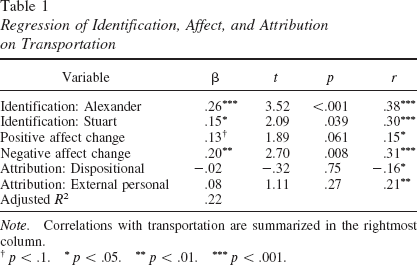
Note. Correlations with transportation are summarized in the rightmost column.
p < .1.
p < .05.
p < .01.
p < .001.
So far, we examined how individual differences in transportation related to audience members’ personal subjective experience of the film. However, personal subjective experience is not the only level on which humans respond to fiction; drama in particular is inherently a social phenomenon, and is usually experienced in groups. The reasons for this may reach beyond the purely logistical, pointing to possible adaptive advantages of group bonding through group responses to drama. At first glance, these two levels (group processes and individual levels of engagement) may seem entirely separate, even opposite; paradoxically, however, groups are formed of individuals, nor are groups necessarily homogeneous—not all individuals may engage in group bonding in the same way. We hypothesized that individuals would differ in their extent of drama-induced group bonding (in both self-report and physiological measures; a reanalysis of the results from Dunbar et al., 2016), and considered whether transportation could be the key to this variation. Because of this interest in group bonding, we used endorphin up-regulation as our physiological measure of how participants experienced the film. The endorphin system is part of the brain's pain management system, but plays a central role in social bonding both in nonhuman primates and in humans, normally though stroking and physical touch (Keverne, Martensz, & Tuite, 1989; Machin & Dunbar, 2011; Nummenmaa et al., 2016). In humans other behaviors (including laughter, singing and dancing: Dunbar et al., 2011; Pearce, Launay, & Dunbar, 2015; Tarr, Launay, Cohen, & Dunbar, 2015) also trigger the endorphin system, and similar effects have been reported in socially painful experiences such as rejection and emotionally arousing stories (Bershad, Seiden, & de Wit, 2016; DeWall & Baumeister, 2006; MacDonald, Kingsbury, & Shaw, 2005; Weaver & Zillmann, 1994; Zillmann, de Wied, King-Jablonski, & Jenzowsky, 1996). This is probably because psychological pain is experienced in the same brain regions as physical pain (Hsu et al., 2013; Kross, Berman, Mischel, Smih, & Wag, 2011).
We tested for an endorphin response by determining the change in pain tolerance from before to after watching the film (for further detail on methods, see Dunbar et al., 2016). A positive change in pain threshold (i.e., being able to withstand more pain) is a commonly used proxy for endorphin activation, because endorphins are difficult to measure directly as they do not cross the blood–brain barrier (Bloom, 1983; Dearman & Francis, 1983; Kalin, Shelton, & Lynn, 1995). We also measured the change that occurred in the self-rated sense of belonging to the group (in this case, the audience) using Aron, Aron, and Smollan's (1992) inclusion of other in self (IOS) scale adapted to refer to the rest of the audience.
The results demonstrated that having one's emotions roused by watching tragedy does result in endorphin activation, as well as a proportionate increase in the sense of belonging to the group with whom one watched the film (see Dunbar et al., 2016). Of particular interest, however, was the wide range of individual differences across both group and endorphin measures, and their relationships to each other and to transportation. The difference in sense of group belonging as rated before versus after the film was nonlinearly related to the difference in pain threshold, with an inflection point at a pain threshold difference of approximately 0 s (Figure 1). In other words, those who had a negative response to the film in terms of pain threshold showed no change in sense of group belonging, but those whose pain threshold increased (indicating endorphin activation) showed a proportional increase in their sense of belonging to the group.
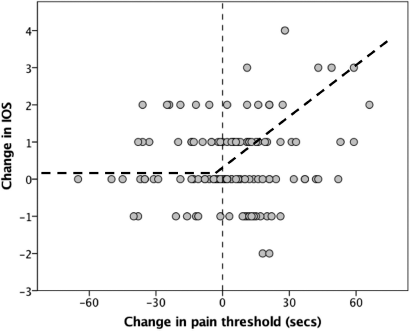
Change in IOS score (Inclusion of Self in Other; indexing sense of bondedness to the other audience members) plotted against change in pain threshold for the experimental film (as indexed by length of time the painful position is held, in seconds).
Transportation correlated positively with rated sense of group belonging after the film (r168 = .235, p = .002); more importantly, the experience subscale of transportation also correlated with change in group belonging (r168 = .155, p = .045). In addition, the experience subscale of transportation correlated marginally with change in pain threshold (r123 = .168, p = .063), such that viewers reporting higher transportation had a greater increase in pain threshold; this correlation was just as significant in a partial correlation when controlling for change in group belonging (r120 = .178, p = .050). Together, these findings suggest that transportation could contribute to (or result from) experiences of group bonding when viewing a dramatic film.
Our results place transportation at the center of audience experience; the strong relationships of transportation to a host of other dependent variables suggests it may play a key role in audience response overall. Viewers higher in transportation were more likely to identify with characters, experience heightened emotion, and attribute blame away from the protagonist; furthermore, they tended to feel more bonded with the group watching the film, and, marginally, display increased pain thresholds. Although we cannot identify causality between pairs of dependent variables, this exploratory study implicates individual differences in transportation as a potentially important element in not only subjective experience of audience members’ personal reactions to the drama's content (e.g., identification, enjoyment), but also in collective experience of group bonding and physiological response.
Study 2: No Fan is An Island
The strength of the individual differences in transportation prompted us to consider the role of other factors in this process. In the first study, we measured individual differences in dependent variables (outcomes). In a second study, we tested an independent trait variable (celebrity worship) to determine whether it could predict aspects of audience response, including transportation. This was motivated by the fact that reactions to theater are not simply based on plot; intuitively, we know that characters and the actors who perform them are vital to audience response. In modern film and commercial theater, casting is not done in a vacuum; the casting of ‘star’ or ‘celebrity’ actors in theatrical roles often brings new audiences into the theater for the first time (Engel, 2009, p. 326) and performance studies scholarship implies that these audiences may watch theater differently (Owens, 2008). But are audiences who love celebrities, in fact, different in their response to drama?
It is easy to envision how worshipping a particular celebrity actor might affect audience members’ responses to a performance with that specific actor: For instance, they might be expected to enjoy the performance more and rate the actor's skills more highly than other audience members. A more interesting question, however, is how propensity for celebrity worship in general relates to audience response to drama. Celebrity worship involves forming a strong emotional connection to a person one has never met (a “parasocial” relationship), a phenomenon reminiscent of the emotional engagement audience members enter into with remote characters on stage or screen (McCutcheon, Lange, & Houran, 2002). If celebrity worship reflects the propensity to form parasocial relationships, and this process contributes to engagement with drama, then casting celebrity actors may in fact represent a strategy for audience engagement that offers more than the surface value of a particular actor's popularity.
Method
To investigate these questions, we ran two experiments on celebrity worship and audience engagement. Experiment 2a included 252 online panel participants in the United Kingdom (138 women; mean age 31.36, SD = 7.915, range = 18–45). Experiment 2b included 106 respondents from the United States, United Kingdom, and Europe (95 women, mean age = 33.03, SD = 11.657, range = 19–66). Both groups watched a scene from Macbeth that had been especially filmed using two student actors as Macbeth and Lady Macbeth. Before watching the scene, all participants completed the Celebrity Worship Scale (adapted from McCutcheon et al., 2002), which includes items measuring both mild interest in a celebrity, for example, “I enjoy watching, reading, or listening to my favorite celebrity because it means a good time” and more intense parasocial connection, for example, “When my favorite celebrity fails or loses at something I feel like a failure myself.” 1 After watching the scene, participants in Experiment 2a answered questions about their interpretation of the scene—their identification with the characters, moral approval of the characters, and attribution of agency for the characters’ actions, and rated each actor's performance. Participants in Experiment 2b watched the scene then reported their transportation on 3 subscales (attention, transportation, and emotional engagement) of the Story World Absorption Scale (SWAS; Kuijpers et al., 2014).
Results and Discussion
Experiment 2a revealed correlations between celebrity worship and several other audience engagement measures. Respondents who had scored highly on the Celebrity Worship Scale identified much more strongly with both Macbeth (r252 = .440, p < .001) and Lady Macbeth (r252 = .412, p < .001), and approved of their behavior more (r252 = .379, p < .001 for Macbeth and r252 = .376, p < .001 for Lady Macbeth). Respondents who scored highly on the Celebrity Worship Scale also tended to rate the actors’ performances more highly (r252 = .311, p < .001 for Macbeth and r252 = .307, p < .001 for Lady Macbeth). In Experiment 2b, we found that celebrity worship was marginally correlated with the transportation subscale of the SWAS (r106 = .186, p = .057), but not with the attention or emotional engagement subscales (ps > .41).
To check the specificity of these effects, in both experiments we tested another antecedent measure for its correlations with outcome measures: familiarity with the play Macbeth (measured on a 5-point scale, Study 2a: M = 2.92, SD = 1.165; Study 2b: M = 2.44, SD = .996). Although not a trait measure per se, familiarity with the play might capture not only the expected effects of familiarity (e.g., increased exposure to the characters and therefore potentially increased identification with them, or perhaps increased polarization of moral approval), but may also reflect a hidden variable of predisposition to enjoy Shakespearean tragedy, or even drama in general.
When controlling for familiarity with the play, partial correlations between celebrity worship and outcome variables remained significant (Study 2a: p < .001; Study 2b: p < .05) and retained similar correlation coefficients to the original correlations. This suggests that the celebrity worship findings are a valid effect, reflecting a direct relationship between individual differences in an underlying trait measure and audience response to the actors and characters on screen. Furthermore, the results implicate the tendency to form parasocial relationships in the ability to feel transported into a dramatic narrative. The question remains, however, whether the link between celebrity worship and audience engagement (e.g., transportation, identification with characters) generalizes outside of the stimulus in our study. Moreover, it remains for future research to determine whether celebrity worship itself specifically drives this effect, or whether a third variable (such as attentional or social mechanisms) drives levels of both celebrity worship and transportation.
Study 3: How Different Genres Transport Us Differently
The results from the previous experiments raised two further questions. First, does transportation differ within an individual depending on the particular film or genre, or is likelihood to experience transportation itself a trait measure that fully explains attentional engagement with films in general? Second, are there underlying (cognitive, emotional or behavioral) trait measures that can predict a given audience member's transportation, both in a general way and for particular films or genres?
To answer the first of these questions, we designed an experiment in which participants watched clips from two films from drastically different genres, then reported their transportation to that film. To answer the second question, we measured empathy and sensation seeking, zeroing in on them as two orthogonal trait measures that might explain different parts of the tendency for a viewer to feel engaged and transported by drama. Because narratives typically involve agentive, human (or human-like) characters, it therefore stands to reason that tendency to empathize with others may allow audience members to become transported into these characters’ world. We hypothesized that empathy might especially predict transportation in narratives that heavily feature characters’ emotional experiences. Empathy has been implicated in fiction transportation, but mainly in terms of a link between transportation and specific feelings of empathy or identification with the characters in the story of interest (De Wied, Zillman, & Ordman, 1994; van Laer et al., 2014). Testing trait empathy allows us to examine a predictor variable that can be measured before the viewer is exposed to a particular piece of drama, and that furthermore reflects a reliable and stable individual trait (Reniers, Corcoran, Drake, Shryane, & Völlm, 2011). Sensation seeking (Zuckerman, Eysenck, & Eysenck, 1978) refers to a preference for disinhibited behavior and novel experiences, and as such we hypothesized that it may particularly explain transportation into genres that display instances of risk-taking and exciting events. It has been previously linked to enjoyment of certain genres of narrative (e.g., horror and violent: Hoffner & Levine, 2005; science fiction and fantasy: Jensen et al., 2011), but has not been previously implicated as a contributor to transportation.
Method
To measure the influence of these two factors, we chose our stimulus clips from genres that were highly different from each other but which might best engage each factor: an emotional family film (the opening sequence of Up) for empathy, and an action adventure (a chase scene from the James Bond film Casino Royale) for sensation seeking. For both films we used clips roughly 10 minutes long.
We recruited 99 participants (49 women, age range = 20–85) in the United States through an online panel provider (Qualtrics.com). We measured sensation seeking through the Brief Sensation Seeking Scale (Hoyle, Stephenson, Palmgreen, Lorch, & Donohew, 2002), and trait empathy using the Questionnaire of Cognitive and Affective Empathy (QCAE; Reniers et al., 2011). Participants then viewed both film clips (in a counterbalanced order) and after each one, rated their transportation for that film using a modified version of the Story World Absorption Scale, or SWAS (Kuijpers et al., 2014). The SWAS comprises 4 subscales, 3 of which we deemed relevant to the medium of film: attention (e.g., “When I finished the film I was surprised to see that time had gone by so fast”); transportation (e.g., “When I was watching the film it sometimes seemed as if I were in the world of the film too”); and emotional engagement (e.g., “I felt how the main character was feeling”/“I felt sympathy for the main character”). For most analyses (when not otherwise specified), we focused on the transportation subscale of the SWAS, as this subscale was the most relevant to our interest in the subjective experience of feeling transported into the world of the film.
Results and Discussion
We first investigated whether transportation varied within individuals for different films in different genres, by examining the correlation between reported transportation for Up and for Casino Royale. The resulting strong correlation (r99 = .631, p < .001) indicates that a given individual's transportation levels were similar even for films of very different genres, and thereby lends support to the notion of a trait measure of transportation (i.e., “transportability,” as investigated by previous studies: Bilandzic & Busselle, 2008; Dal Cin et al., 2004). In contrast, the SWAS subscale of emotional engagement for the two films yielded only a modest and marginal correlation: (r99 = .195, p = .054). Nonetheless, there was a significant amount of variance that was not explained by the transportation correlation (R2 = .40), indicating that there is still a noticeable amount of unexplained variation in transportation that may therefore be genre- or film-specific.
We next investigated, for each film, whether the two trait measures, empathy and sensation seeking, predicted any of the observed variance in transportation. They did: transportation showed modest-to-medium correlations with both empathy and sensation seeking for both films (Table 2). Because sensation seeking and empathy were themselves correlated, we asked whether they independently predicted variance in transportation by entering them as predictors into separate simultaneous-entry multiple regressions, for each film, with transportation as the dependent variable. In addition, because empathy scores differed by sex of respondent (t97 = 4.264, p < .001), we included sex as a predictor in both analyses. Multiple regressions for each film found that the overall model of these three predictors explained a modest amount of variance in transportation (Table 3). Sex was a marginally significant predictor of transportation in the multiple regression model for Casino Royale but not for Up: men were more transported by Casino Royale than women were, even when accounting for individual differences in empathy and sensation seeking. For both films, empathy and sensation seeking were significant independent predictors. It is interesting that empathy outperformed sensation seeking as a predictor in both films, and β levels of each predictor were similar across films, counter to our hypothesis that film content might differentially drive levels of each predictor (i.e., that empathy might especially predict transportation into films featuring interpersonal emotional scenes, e.g., Up and sensation seeking might especially predict transportation into films that feature risky behavior and physical suspense e.g., Casino Royale.)
Correlation Matrix Between Empathy, Sensation Seeking, and Transportation for Two FilmClips
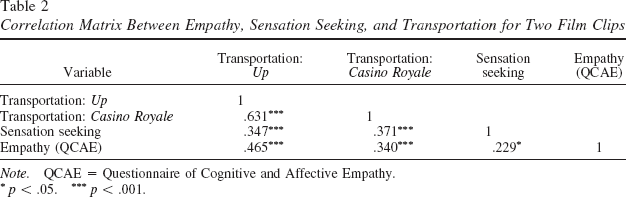
Note. QCAE = Questionnaire of Cognitive and Affective Empathy.
p < .05.
p < .001.
Regressions of Empathy, Sensation Seeking, and Sex on Transportation for Two Film Clips
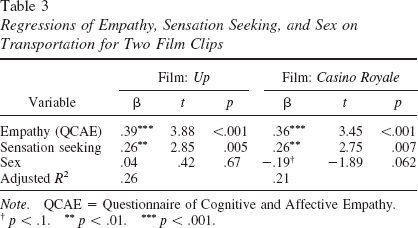
Note. QCAE = Questionnaire of Cognitive and Affective Empathy.
p < .1.
p < .01.
p < .001.
In summary, both empathy and sensation seeking were found to be good (and independent) predictors of transportation for both films. However, simply because each of those trait measures predicted transportation for both films does not mean the same mechanisms drove those correlations across both films. Considering how much the two films differed in their emotional content, a devil's advocate might suggest that different aspects of empathy could be separately driving the correlations with transportation for each of the two films (and the same for sensation seeking). If that is the case, each film's transportation measure should explain unique variance when entered into a multiple regression predicting empathy.
The high correlation between transportation for the two films, however, suggests that this is unlikely, and indeed, the supposition was not borne out. We conducted separate simultaneous-entry multiple regression analyses, both containing transportation for each film as predictors, and empathy or sensation seeking as the dependent variable. We found that transportation for both films predicted the same variance in each of the two trait measures. No unique variance was explained by Up for sensation seeking or Casino Royale for empathy (see Table 4). Therefore, it appears that, within each trait measure, the trait was related to transportation in the same way for both films.
Regressions of Transportation for Two Film Clips Onto Empathy and Sensation Seeking
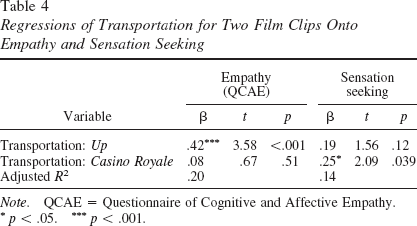
Note. QCAE = Questionnaire of Cognitive and Affective Empathy.
p < .05.
p < .001.
What can we say, then, about how trait measures can predict the differences in an individual's transportation for different films or genres? First, transportation was remarkably similar across film clips of two very different genres: in other words, transportation arguably hinged more upon the identity of the viewer than on the content of the drama. Admittedly, both clips were from extremely popular, high-budget feature films engineered to transport viewers, so it might not be surprising that transportation was similarly high across both films. However, for a correlation, mean values are irrelevant; regardless of overall levels of transportation, viewers high on transportation for one film were likely to be transported by the other, and those with low transportation were likely not to be transported by the other film. The fact that variation remained high even in stimuli engineered to be as transportive as possible across all viewers suggests that this variation would show up in most circumstances (although it remains to be seen whether individual differences in transportation can similarly resist floor effects with highly non-transportive, i.e., boring, stimuli). Second, we found that individual differences in trait empathy and sensation seeking together could explain considerable variance in transportation. Although the relative weights of predictors varied slightly by genre, the far more striking finding was how consistent this pattern was across two films, despite highly differing genres. Of course, it would be instructive to examine how these results would generalize to more genres, and more instances within genres.
Taken together, these two findings (that transportation varied little across two stimuli, and that it could be predicted by trait measures), suggest that transportation may be more stable (i.e., more dependent upon reliable individual differences, and less dependent on stimuli) than previously assumed. This conclusion is broadly in line with previous efforts to identify a possible trait measure of “transportability” (Bilandzic & Busselle, 2008; Dal Cin et al., 2004). Note, however, that our results apply specifically to a relatively narrow definition of transportation, one which other conceptualizations of the topic have labeled “narrative presence”; that is, the feeling of being in the world of the story (Busselle & Bilandzic, 2009). Our conclusions will not necessarily apply to broader conceptions of transportation, which are alternatively termed as “narrative engagement” (Busselle & Bilandzic, 2009) or “story world absorption” (Kuijpers et al., 2014). In fact, our own results clearly show that other aspects of narrative engagement can be much more stimulus-dependent than we found transportation to be: emotional engagement showed little similarity across stimuli. Emotional engagement with a narrative is often measured as part of a more holistic measure of transportation (e.g., Green & Brock, 2000); however, our results suggest we can gain a fuller picture of narrative engagement by measuring such subscales separately.
General Discussion
In three studies, we sought to explore individual differences in the phenomenon of transportation into film narratives. Study 1 found that self-reported transportation was strongly linked to other dependent variables, such that highly transported individuals were more likely to identify with the characters, exhibit an increase in emotion, and see others as the cause of the protagonist's troubles. Transportation also predicted endorphin response (as measured by pain threshold) and sense of group bonding, although these relationships were not as strong as the others, perhaps reflecting the fact that they are also triggered by emotional arousal (Dunbar et al., 2016). Study 2 found that individual differences in a trait measure (celebrity worship) predicted transportation as well as related concepts such as identification with characters. In Study 3, transportation (but not emotional engagement) was highly correlated across film clips of two very different genres. Empathy and sensation seeking were found to be predictors of variance in transportation across both clips, suggesting they may both contribute to a general tendency toward transportation.
Previous work has fruitfully used group means approaches, including manipulations, in order to examine the psychology of fiction, and specifically transportation (e.g., Cohen, Shavalian, & Rube, 2015; Green et al., 2008; Shimamura, Cohn-Sheehy, Pogue, & Shimamura, 2015). However, the study of transportation may be better suited to an individual differences approach, as it closely fits the criteria for when such an approach is particularly useful, as outlined in the introduction. Principally, as we found in our three studies, transportation varied vastly across individuals and ranged from the minimum to the maximum possible scale responses, suggesting that small differences in transportation across groups or experimental conditions could have been easily masked (Criterion 1: continuous variable). An individual differences approach is also useful when variables are difficult to manipulate in isolation (Criterion 2), and indeed this applied to our search for traits predicting transportation. For instance, empathy for particular characters might be manipulated through priming, but overall propensity for empathy (i.e., a trait measure) may not be easily open to manipulation without invasive or time-intensive intervention. Last, our question was exploratory, and meant to illuminate how these processes work and interact in situ (Criterion 4). Isolating and manipulating one of these trait factors of interest might have revealed more about that factor's role in transportation, but might have left out crucial insights as to how it interacts with the other factors in an ecologically valid situation.
There has been a tendency in psychology to equate individual differences with personality, perhaps not surprisingly given the striking differences in behavior and responsiveness that different personality types exhibit. One aspect of our message is that personality as such does not exhaust the scope of individual differences, at least in explanatory terms. There are aspects to individual differences, uncaptured by personality measures, that affect how easily we engage with fiction, and the fact that they are important in respect to fiction may have implications for other facets of everyday life. For instance, considerable research has looked into how transportation affects narratives’ ability to persuade and change beliefs about issues in the real world (Dal Cin et al., 2004; Green & Brock, 2000; Mazzocco et al., 2010).
Many questions for further investigation arise out of these results. One is why individuals should differ so much in their capacity to be transported into fictional worlds: what other psychological mechanisms, other than empathy and sensation seeking, underpin individual differences in this particular respect? The nebulousness of the concept of transportation makes this difficult to pin down, but there are several promising avenues. One obvious possibility might be attentional processes: Differences in preference for local versus global processing, vigilance properties such as alerting, or executive control of competing stimuli, might explain a large part of the ability or tendency to be transported by fiction. Another possibility is mentalizing, since individuals differ considerably in their ability to handle different mind states simultaneously (Kinderman, Dunbar, & Bentall, 1998; Stiller & Dunbar, 2007). Mentalizing allows us to separate ourselves from the immediacy of the physical world in which we are embedded (i.e., allows us to process two separate realities at the same time). Indeed, this capacity lies at the very center of what is termed “theory of mind” (the ability to appreciate that someone else believes something different to one's own belief—the simplest form of mentalizing). Another potentially relevant aspect of mentalizing is source skepticism, or the extent to which an individual trusts various information sources. Individuals with a higher tendency to automatically question the source reliability of information they hear, or stories they are told, might be less susceptible to transportation, if transportation relies on “suspension of disbelief.”
Research on readers’ responses to written stories has additionally identified sensory imagery ability (mostly visual imagery) as a potentially crucial component of transportation (Green & Brock, 2000; Kuijpers et al., 2014). Although the relevance of this factor likely diminishes for media, such as film, that have high verisimilitude, it may well contribute to transportation in media such as drama, which is arguably intermediate in its imagery demands. Last, even the traits we investigated could be picked apart to search for further specificity. Empathy might be broken down into factors such as self-other processing or emotional reactivity, both of which might have different effects on an individual's transportation and other aspects of fiction engagement. Likewise, sensation seeking has been split into subfactors of disinhibition, thrill seeking, boredom susceptibility, and experience seeking (Zuckerman et al., 1978). Clarifying the relationship of these to transportation ability and tendency will go far toward completing the picture of how individual differences affect audience response to fiction.
Footnotes
1
Both experiments also asked participants to read a biography of either the film's director, one of its actors, or a control biography. However, we ignored this manipulation in the current analysis, as none of the outcome variables differed significantly by reading condition, and the current analysis was not concerned with the question of group differences.