







Abstract
This article presents an iterative examination of a grounded theory of collaboration in conjunction with social psychology literature. The resulting PILAR (Prospects, Involved, Liked, Agency, Respect) model of collaboration encapsulates over 30 social and group psychology (SGP) theories, including social identity theory, social network analysis, and psychological safety. Selected works of the early 20th-century scholars Lewin, Moreno, Simmel, and Foucault resonate with the PILAR model. We considered that, in constructing a generalized model of collaboration made possible by the availability of modern SGP theory, PILAR may represent advancement toward accomplishing these early scholars’ original intent. To validate PILAR, we proposed an empirical investigation for its consistency with organizational psychology, positive psychology, and appreciative inquiry, and for testing whether learning PILAR may improve collaboration skills for individuals lacking empathy.
Theoreticians have long called for a general theory of the group (Grant & Ashford, 2008; Hackman & Katz, 2010; Weick, 1979). Kettner-Polley (2016) recently claimed that “… a clear and universal model of group development is something of a holy grail for small group researchers.” Rather than exclusively working from any one theoretical perspective, we have taken the approach of encapsulating empirical theory into a single model, as recommended by Bettenhausen (1991) and Thorngate (1976). Such unification may have proven elusive because each theory relevant to the group has remained within its respective disciplinary silo (Green, 2015) under the large umbrella of social and group psychology (SGP), and within more recent neuroscientific discoveries. We took the novel approach of assuming that the group is a coherent structure or system that must accommodate a significant proportion of already-validated theory, to uncover a unified, cross-disciplinary model of the group (Bettenhausen, 1991). It is, therefore, useful to first understand the foundations of small-group theory, that continues to inform contemporary ideas.
History of Collaboration Theory
The past century is marked with various thinkers taking a perspective on how groups might be generally described. Michel Foucault's approach was based on the understanding that practitioners might reconfigure their institutions and organizations, if given an understanding of how they had come to be (Brich, 2008). Foucault (1980) postulated three interacting principles of collaboration, the first being knowledge, skills, and abilities (KSAs); the second, willingness to cooperate; and third, delivery of results (Foucault, 1982, p. 787).
A forerunner of Foucault, the sociologist Georg Simmel took a view of collaboration as sociability, which manifested as personal, playful, and egalitarian, rather than professional, focused, and hierarchical (Simmel & Hughes, 1949). He marveled over human's natural propensity to socialize and create institutions, noting, however, that bureaucratic inertia eventually represses members’ creativity (Simmel, 1906). Whereas Simmel saw power distances between organization members as inevitable, coining subordination and subjugation relationships (Simmel & Hughes, 1949), Foucault believed they upheld flawed institutions.
A contemporary of Foucault, Jacob Moreno envisaged that both personal and professional spheres consist of identical social activity. Inspiring social network analysis (SNA), Moreno's sociometry was another universal conception of collaboration. Actors who were widely considered by their colleagues to either represent the group's norms or to challenge them, were respectively considered positive- and negative-sociometric stars (Buchanan, 1984). Moreno agreed with Simmel that hierarchy is essential to organizations, because his alliance state (egalitarian collaboration) was claimed to be desirable, but acknowledged to be difficult to achieve in practice (Bustos, 2014).
Foucault, Moreno and another early pioneer of social psychology, Kurt Lewin, all adapted theory from both within and outside of sociology, for example, Foucault drawing on Marx, or Moreno drawing on nuclear physics (as in the social atom of sociometry; Buchanan, 1984). Similarly, magnetic fields led Lewin to postulate that his social field theory (or topological psychology, as he also called it) diagrammatically represented factors or life spaces within a person's social life. Field theory assumes that the likelihood of any behavior is a function of the person and his or her environment.
While Moreno's work remains in use (Bustos, 2014), neither Lewin's field theory nor Foucault's historical analysis remain in active use (Burnes & Cooke, 2013). Nevertheless, both Lewin and Foucault's works contain aspects that we considered applicable to this article's search for a universal model of collaboration. For instance, Lewin's field factors might be regarded as collaborative opportunities available to the actor at a point in time, some of which are desirable, others less so. The actor's behavior is dictated by the sum of forces, of which Lewin conceived five types: (a) social norms, (b) the wishes of others, (c) the actor's wishes, and circumstances that (d) prompt, or (e) prevent, action (Stivers & Wheelan, 1986). Lewin's force definitions are too vague and generic for developing an instructive model of collaboration (Heslop, Bailey, Paul, Drew, & Smith, 2016). We later investigated how explicit, yet universal, forces may have increased the reliability of a member's ability to detect collaboration viability (Heslop, Stojanovski, Paul, Iverson, & Bailey, 2018). In doing so, in this article, we contended that each collaboration member employs five perceptions of collaboration, or pillars (i.e., Prospects, Involved, Liked, Agency, Respect), that collectively constitute the PILAR model of collaboration (Heslop, Paul, Drew, Bailey, & Stojanovski, 2018).
PILAR Model of Collaboration
We borrow from evolutionary psychology and sociobiology, to consider collaboration as the product of evolution. Earlier versions of the PILAR model were originally developed by the lead author via grounded-theory research (Strauss & Corbin, 1990), based on interview data collected from technology-transfer facilitators from five universities in the United Kingdom and one in Australia (Heslop, 2012). The present version of the PILAR is a result of the iterative examination of SGP theory and ensuing adjustment of the model, which halted when consistency between PILAR and significant SGP theory was achieved.
As previously noted, Foucault spoke of three types of social relationships that are similar to three perceptions that members’ monitor: the capacity of colleagues to contribute knowledge and experience (Respect) and their willingness to do so (Involved) to achieve desired end products (Prospects; Foucault, 1982, p. 787). Further, in agreement with Moreno, we see conformity (Liked) and change (Agency) as another two perceptions of collaboration. Before introducing the five pillars, assumed preconditions for the PILAR model to operate reliably are presented collectively as idealized collaboration.
PILAR Limited to Idealized Collaboration
There is a limitation to the capacity of PILAR to accurately reflect collaboration. PILAR is limited to idealized collaboration reminiscent of Moreno's alliance (Bustos, 2014) and Hieder's sociability (Simmel & Hughes, 1949). For PILAR to be applicable, the collaboration must consist of voluntarily participating members who possess a sincere desire to pursue the collective outcome. Initially, there must also be zero power distance between members, meaning in practice that members can only influence their colleagues through persuasion. Conversely, we contended that the PILAR model is less reliable where members; had been coerced to join, were initially hierarchically related to one another, or care little about (or are ignorant of) the group's stated goal. Although we acknowledged that exceptions to the PILAR model might occur, our investigations indicated that they would arise from collaborations substantively lacking in at least one of the idealized assumptions.
Nevertheless, as previously noted when referring to legitimate power, once collaboration commences, power among members will naturally fluctuate, for example, as members acquire and lose seniority, leadership, expertise, and popularity (Emery, Calvard, & Pierce, 2013). Such behavior is not only consistent with present forms of collaboration, including within workplace and education settings, but it also fits within the context of hunter–gatherer tribes (Boehm, 2009; Wilson, Ostrom, & Cox, 2013). In summary, we note continuous expression, from anthropology to modernity, of the characteristics of idealized collaboration, which are also assumed to exist in the following presentation of each of the five pillars.
The Prospects Pillar
A group member's perception of Prospects varies with the perceived likelihood of the collaboration achieving its goal, and of the member subsequently receiving his or her anticipated benefit, for instance, produce from a community garden. When the team member feels that his or her group is likely to fail, low Prospects can be experienced as uneasiness and foreboding. In anthropological terms, tribes historically collaborated to acquire shelter and sustenance, and failure to do so may have been deadly (Boehm, 2009). A tribe member realizing incipient risk if the tribe fails to achieve an important objective may afford his or her tribe critical opportunity for adaptation. Thus, we conceive that sensitivity to group Prospects has been individually adaptive, because a tribe that collectively fails affects the survival of each of its members.
The Involved Pillar
A positive and mutual perception of Involved encourages two members to cooperate in providing knowledge or physical assistance to complete a task. It can be experienced by the member as an openness to, and comfort working with, a specific colleague, which at high levels is experienced as enthusiasm to participate (Quinn & Dutton, 2005). Lack of the Involved perception can be experienced as unease as a result of embarrassment at needing help, an unappreciative recipient of advice, or the recipient becoming a competitor for expert status, which we conceive as some of the risks of cooperating (Klein, Lim, Saltz, & Mayer, 2004).
Assistance is offered by a provider and given to a recipient, with both parties having felt inclined to be Involved. However, only the recipient may decide whether assistance has been effective and thus maintain, or increase, their willingness to cooperate. When not offered assistance, or when the received assistance has no benefit, recipients will experience a lower perception of Involved. Only the impact on the member who receives assistance is examined in this article. The provider of assistance is considered by PILAR to benefit through meeting the basic psychological needs of mastery and challenge (Heslop, Stojanovski, Paul, Bailey, & Drew, 2018).
The Liked Pillar
A positive Liked perception is associated with belonging and security, whereas being disliked leads to feelings of social isolation and insecurity. In experiments, those asked to remember a time when they had been ostracized, were later more likely to dwell on past situations in which they had been accepted, such as a family gathering (Knowles, Lucas, Molden, Gardner, & Dean, 2010). Such is the unpleasantness of being poorly Liked, that in an 18th-century sailing tradition, suicide was the common response of a thief who had been shunned by his crewmates (i.e., “sent to Coventry;” Williams & Gerber, 2005).
The strength of humans’ and other social animals’ aversion to social exclusion reflects the ancestral lethality of surviving alone (Wittenbaum, Shulman, & Braz, 2010). Network centrality, a concept from SNA, is an accumulation of member's affective ties to his or her colleagues (Westaby, Pfaff, & Redding, 2014), the fostering of which requires interpersonal skills (Klein et al., 2004; Plötner, Over, Carpenter, & Tomasello, 2015). Liked is proposed to be the equivalent to the member's perception of personal popularity within a collaboration.
Popularity imbues status, which the member uses to adjust how the ingroup is defined (De Dreu et al., 2010; Hein, Engelmann, Vollberg, & Tobler, 2016). Centrally networked members are deemed prototypical ingroup members with higher status (Gómez, Kirkman, & Shapiro, 2000). Conversely, less central members are easier to designate as outgroup, and as a result, may suffer derogation and marginalization (Ellemers & Jetten, 2013). Because ingroup identity is influenced more strongly by popular members, their preferences may gradually change the group's initial goal (David & Turner, 1999; Haslam, Oakes, Reynolds, & Turner, 1999), which means in practice that popular members would receive greater benefit from a collaboration whose altered goal they more highly valued, whereas less popular members might receive a benefit they valued less. For example, the popular colleague changes plans so that a social lunch occurs at his or her favorite restaurant.
The Agency Pillar
We contend that a member requires Agency to suggest a change to the group's strategy or role allocations (Spânu et al., 2013), which is more likely to exist in a group possessing psychological safety (Edmondson, 1999). Suggesting change usually challenges group norms and therefore others’ expectations, which may incur censure, reproach, or penalty for the suggestion maker (Swann, Griffin, Predmore, & Gaines, 1987). Because of the ability to avoid punishment, Agency in today's collectivist societies is largely dictated by an individual's status, which may be socially derived or based on their seniority (legitimate power). However, in anthropological tribes and chimpanzee troupes, status is delivered by some combination of physical strength and political alliance (Kummer & Goodall, 1985; Reader & Laland, 2001). For modern and egalitarian collaboration, political alliances translate to a perception of being Liked. Therefore, to avoid Agency being restricted to those of high status, we contend that members need to deliberately invite suggestions from all, actively discourage punishment for doing so, and be willing to cede legitimate power should a suggestion be well-founded.
Lewin's field theory, when applied to collaboration, implies that a change to the group's environment may reduce the advisability of existing behaviors and strategies. As noted in the supporting rationale for Prospects, collective interests are served by a member who, having perceived a threat to the group, then raises the alarm (Greasley et al., 2008; Thomas & Velthouse, 1990). Based on the best available suggestion, a changed course of action can minimize waste of resources and loss of opportunities (Houghton & Yoho, 2005). Yet, there are political consequences in adopting a particular suggestion if the member making it is granted legitimate power, allowing a claim that they deserve a formal leadership role (French & Raven, 1959).
The Respect Pillar
A positive perception of Respect is defined as a member considering that a colleague possesses sufficient KSAs for his or her given tasks, and can be trusted to perform them diligently (Ibrahim & Ribbers, 2009). High Respect is faith and trust in colleagues’ dependability, compared with low Respect, which is associated with distrust and vigilance (Ko, 2010). Whereas hunter-gatherer societies knew one another intimately, when communities became larger as a result of farming, community members could be relative strangers. To coordinate these larger, diverse populations and to avoid misunderstandings, conformity was encouraged and differentiated behavior suppressed (Kessler & Cohrs, 2008). Today, poorer nations are largely collectivist, whereas wealthier nations have become so partly because they permit individual expression, with concomitant social and technological innovation (Gorodnichenko & Roland, 2012). In the former, seniority and status tend to confer Respect, whereas in the latter, Respect for individuals is somewhat independently evaluated (Gibson, 1999).
Constraining the Spectrum of Emergent States
The five pillars have been presented, and the precondition of idealized collaboration explained, in the context of both anthropological and modern collaboration. Another risk, or ramification, of collaboration that has been continuously manifested for hundreds of thousands of years, is not only that each pillar is independently adaptive, but also collectively adaptive, which is a notion reflected in sociobiological perspectives (Boehm, 2009; Wilson et al., 2013). As a result of competition between groups, such as for resource acquisition or technological innovation, there is greater likelihood of genes surviving within tribes that prosper (Bowles & Gintis, 2011). Hence, collaboration “fitness” is a mechanism that selects genes within individuals based on the success of their tribe, compared with the selfish gene perspective, which is limited to actions taken by the individual (Dawkins, 1989).
Considering that a tribe's productive output and collective decision making may substantively rely on collaboration, it may have been preferable for tribespeople to be adept at quickly identifying whether their collaborations were likely to fail or not (Heslop, Stojanovski, Paul, Iverson, et al., 2018). Yet, collaboration is a complex, emergent behavior, and a huge range of equally likely combinations of pillars is permitted, which would render detection of unviable collaboration more difficult (Read, Vanman, & Miller, 1997). In the simplest case, each pillar is limited to a low–high dichotomy, such that 32 unique combinations of the five pillars are permitted.
Consider the evolution of the human immune system, which has to quickly and reliably identify undesirable organisms. Fewer emergent states would allow faster, more reliable recognition by tribespeople of failing collaboration, which would be desirable for the tribe. For instance, a group of people who dislike working together would ideally make an early decision to limit their engagement, allowing for personal investment elsewhere.
Having fewer emergent states increases the speed of the actor's decision to leave, or remain within, the group. For example, perceived Respect and Liked are sufficiently indicative of collaboration viability, making further assessment of Agency, Prospects, and Involved unnecessary. Fewer emergent states also means that fewer identifiable patterns between relative pillar levels will occur. For example, if a new arrival to a collaboration perceives Liked as high and Respect as low, he or she might suspect that, because his or her contribution seems inordinately critical, failure approaches. Fewer emergent states may have allowed tribespeople to more quickly, and more reliably, prune the tribe of less-effective collaborations, thereby increasing productivity and retaining superior KSAs for future use. One method of reducing the spectrum of potential emergent states is for pillars to be interdependent (Gell-Mann & Lloyd, 1996) via forces.
Potential Forces between the Five Pillar Perceptions
We contend that each pillar perception affects the environment in which the accompanying four perceptions operate. Reminiscent of field theory, each perception generates either an avoidant or compelling influence on the member's willingness to remain in the group, based on lowering or increasing the relevant perception. However, the force between perceptions may itself be positive or negative. A positive force enjoins the affected perception to become more similar to the source, whereas a negative force pushes the affected perception to the opposite scale from the source. Thus, each force between each possible pair of pillars is indicated as either a positive (+) or negative (−
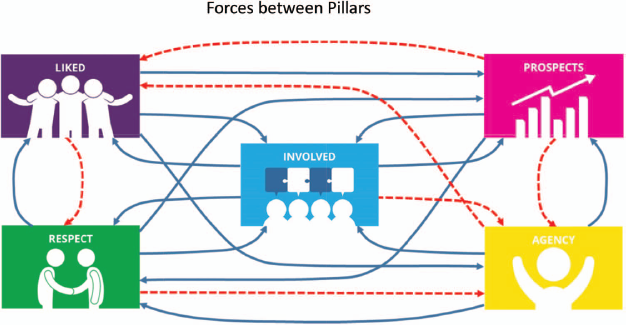
Twenty potential forces between five pillars, 14 positive (solid arrow) and six negative (dashed arrow). See the online article for the color version of this figure.
A positive force (e.g., Respect→ + Involved) offers potential for uniform increase, but also decrease, of both origin and destination perceptions (Wolff & Reed, 2000). A positive force is an unconscious reaction, or conscious behavior, considered helpful to a viable collaboration, but damaging to a failing one. Because PILAR seeks to be realistic and to identify what does, not what ought, to exist (Hume, 1739), it also permits negative forces (e.g., Prospect→−Agency). A negative force is also a reaction or behavior, but which changes the destination perception in opposition to the origin perception (Castaño, Watts, & Tekleab, 2013). The converse of positive forces, negative forces are behaviors and reactions that are detrimental when the collaboration is succeeding, but constructive when it is failing. Forces operate in reverse directions between the same two perceptions, meaning a pair of forces occurs between each two pillars (Turchin, 2016).
Whether a force exists between two pillars, and whether it is negative or positive, was identified based on an iterative review of the SGP literature. SGP theory is identified by hand searching selected, highly cited SGP texts recognized as authoritative (Fiske, Gilbert, & Lindzey, 2010; Forgas, Haselton, & von Hippel, 2007; Forsyth, 2010; Haslam, 2004; Levine & Moreland, 2006; Zanna, 2008).
For each SGP theory encountered, we used the iterative process to attempt to place it within one of five pillars, or one of 20 forces. That theory may have clashed with another theory already encapsulated, and if so, we considered whether the candidate SGP theory assumed nonidealized collaboration, and could therefore be disregarded. If that were not the case, the nature of forces was reconsidered, and thus-far accumulated SGP theory redistributed among them. If by leaving out certain SGP theory that also proved intractable, definitions for the pillars were themselves reconsidered, and forces redefined on that basis, with ensuing redistribution of SGP theory. An example of this decision making is evident in the Liked pillar, which as an aspect of social cohesion (Back, 1951), was originally based on mutual liking. However, the pillar was changed to a single-sided perception of Liked to allow inclusion of social identity theory (SIT), alongside SNA, because these were regarded as having superior evidence. The results of the iterative literature review process are displayed in Table 1.
SGP Theory Aligned With Forces Between Pillars
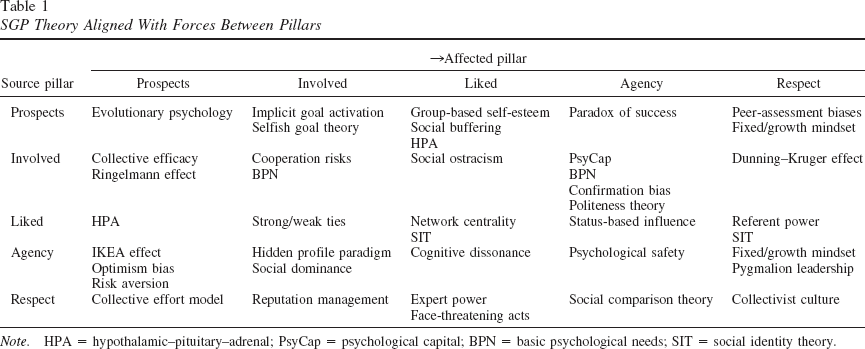
Note. HPA = hypothalamic-pituitary-adrenal; PsyCap = psychological capital; BPN = basic psychological needs; SIT = social identity theory.
Forces are presented in pairs acting in opposite directions between two pillars. For instance, Prospects versus Agency has two forces, the first being a negative impact of Prospects on Agency (Prospects→−Agency), and the second, a positive force of Agency on Prospects (Agency→ + Prospects).
Forces between Prospects and Agency
Prospects→−Agency
Audia, Locke, and Smith (2000) found evidence for the paradox of success, in which prior success reduces a group member's desire to change strategy. Conversely, imminent failure encourages the member to consider change in hope of improvement (Nicolini, 2012).
Agency→+Prospects
To conceive of an improvement to the group, the member imagines a better version of it. Yet, the more one cares about an outcome, the more reasoning is affected by optimism bias, so that the outcome appears more likely (Sharot, 2011). For example, the IKEA effect increases the subjective value of objects the actor has made (Norton, Mochon, & Ariely, 2012). Optimism bias also applies to an idea (Li, Shaw, & Olson, 2013), and because Agency requires a new version of the group to be constructed in the mind, the member feels aversion to losing that object (Hintze, Olson, Adami, & Hertwig, 2015), which makes the group's prospects seem overly bright.
Forces between Prospects and Involved
Prospects→+Involved
Because people like to be part of a winning team, through implicit goal activation (Bongers, Dijksterhuis, & Spears, 2010), they dedicate more of their personal resources when the group's Prospects are strong. When Prospects appear fraught, goals are held for conscious examination, and according to selfish goal theory (Huang & Bargh, 2014), involvement in a failing group may be scaled back, in preference for a different group elsewhere (Leitner, Hehman, Deegan, & Jones, 2014).
Involved→+Prospects
If the member chooses to engage with colleagues, confidence in the group's Prospects will, on average, increase as a result of increased mutual awareness of one another's strengths and weaknesses. For example, receiving assistance reveals subtle information about the provider's personality, motivations, and preferred techniques (Sørensen, 2004). Such interpersonal familiarity reduces uncertainty between colleagues (Jenkins & Mitchell, 2010), increasing confidence that the group has the collective efficacy to overcome obstacles. By contrast, the Ringelmann effect finds lower group success as group size increases, as a result of poor synchronization and coordination becoming more difficult (Levine & Moreland, 2006).
Forces between Prospects and Liked
Being part of a collaboration that may not achieve its objectives is potentially embarrassing, constituting a social threat (Crocker & Luhtanen, 1990; Jetten et al., 2015). For example, supporters of a losing sport team feel shame by association with their team's loss (Sullivan, 2014). On the other hand, victory is a source of satisfaction and collective pride, or group-based self-esteem (Martiny, Kessler, & Vignoles, 2011). We see that from the member's perspective, intergroup threat lowers anticipated group Prospects. Increased intergroup competition makes winning more difficult and depresses ingroup status relative to outgroups. Ingroup status is also lowered when prejudice is experienced, which, for example, Neuberg and Cottrell (2008) manipulated with a media article critical of ethnicity.
Prospects→−Liked
The typical response to intergroup threat is moving intragroup consensus to a more radicalized position; a “safety in numbers” response (Mashuri & Zaduqisti, 2015). For instance, when encountering prejudice, the targets unify in hostility toward their oppressors (Hornsey & Hogg, 2000). By polarizing ingroup opinion, intergroup threat creates the conditions for interpersonal connections to be strengthened. On the other hand, lack of intergroup threat encourages diverse intragroup opinions that create interpersonal distance (Haslam et al., 1999).
The neurobiological response to intergroup threat is mediated via the hypothalamic–pituitary–adrenal (HPA) axis (Bijleveld, Scheepers, & Ellemers, 2012). The hormone cortisol is elevated by both short-term exposure to intergroup threat, and longstanding discrimination, for instance racism (Busse, Yim, Campos, & Marshburn, 2017). Elevated cortisol is also associated with negative emotions, including depression and anxiety (Regehr, Glancy, & Pitts, 2013).
Social buffering, which is the receipt of support from close friends and loved ones, has been associated with lower cortisol (Gunnar & Hostinar, 2015). It is therefore proposed that a member with elevated cortisol instinctively seeks social buffering to ameliorate negative affect. In a moment of vulnerability, interpersonal differences become relatively less important, allowing connections to strengthen (Feeney & Collins, 2015). Hence, group members become unified in their defensiveness when Prospects are poor, allowing Liked (network centrality) to increase (Hostinar, Sullivan, & Gunnar, 2014). On the other hand, when Prospects are bright, reduced cortisol lessens the member's need for social buffering, fostering personal distinctiveness and reducing the urgency of interpersonal connection (Brewer, 1993).
Liked→+Prospects
As a result of his or her status and influence, a Liked member may extract an unequal share of the benefits of collaborating, whereas a disLiked member has less influence, and must therefore accept an unequal share. Neuroscience provides some evidence to support this, because activation of the HPA axis is linked to imbalance of effort and reward, consistent with subjective perceptions of unfairness (Qi et al., 2014; Siegrist, 1996). Through functional magnetic resonance imaging (fMRI), Montoya, Bos, Terburg, Rosenberger, and van Honk (2014) found that cortisol down-regulated the reward pathway, causing subjects to have lower subjective interest in rewards.
A leader emphasizing individual merit over popularity diminishes the force of Liked on Prospects. Bradler et al. (2016) found that, when group members realize that merit, rather than popularity, would affect their share of success, weaker performers became motivated. Ariely, Kamenica, and Prelec (2008) found that motivation was increased in students whose work was acknowledged by an experimenter, but not when work was ignored or destroyed. Hence, leadership is critical for reducing the demotivating effects of low popularity.
Forces between Prospects and Respect
Prospects→+Respect
If failure of the group is impending, colleagues more closely scrutinize one another's KSAs to identify “weak links” (Crocker & Luhtanen, 1990). Whereas peer assessment of the member is generally more accurate than self-assessment (Helzer & Dunning, 2012; Krueger, Ham, & Linford, 1996), there are biases that may distort a peer's judgment, for example, being unaware of historical impediments such as poverty, foreign birth, or mental illness that continue to handicap the member being assessed (Malle, Knobe, & Nelson, 2007), in addition to assuming that any mistake was intended, rather than based on ignorance (Malle, 2011). A third bias, known as a fixed mindset, invites an assumption that the member's past behavior is indicative of future behavior, and that the member is incapable of improvement (Doron, Stephan, Boiché, & Le Scanff, 2009), which also features in the Involved→−Agency force. When incipient failure increases scrutiny of the member, any of the above three biases may lower peer-assessment of her or his KSAs.
Respect→+Prospects
On perceiving that a member lacks KSAs, colleagues will respond with compensatory effort. Karau and Williams’ (1993) collective effort model includes social compensation and social loafing. Social compensation is compensating for a member's real or imagined shortcomings with greater effort (Kerr et al., 2007). The reverse effect is social loafing, where effort is reduced when colleagues are competent (Hart, Bridgett, & Karau, 2001). We postulate that both social compensation and social loafing result from the member's ongoing assessment of each colleague's KSAs, and its likely contribution, whether a help or a hindrance, to the group's success.
Forces between Involved and Respect
Involved→+Respect
Within a collaborative environment, failure to deliver promised assistance will damage the provider's reputation (Chan, 2011). Thus, we assume that if a provider agrees to render assistance, she or he possesses the KSAs to do so successfully. Yet, via the Dunning–Kruger effect, highly incompetent provider smay lack insight into their lack of KSAs (Schlösser, Dunning, Johnson, & Kruger, 2013), for example, a helpful bystander who is unfamiliar with a city, yet still tries to assist a tourist by providing incorrect directions. Nevertheless, we postulate that cooperation increases the receiver's Respect for the provider's KSAs.
Respect→+Involved
The exception to the above is a receiver who has insufficient KSAs to heed the advice or assistance offered, for example, people without scientific training who refuse to accept climate change (Lorenzoni & Pidgeon, 2006). Thus, a provider should also consider whether a receiver is capable of benefiting from assistance before agreeing to provide it, or his or her reputation may suffer to the same extent as having insufficient KSAs (Gupta & Somani, 2004). Not only does the provider desire a competent receiver, so too the receiver desires a competent provider, for successful task completion. It is also wise to assist a competent receiver because it invokes the Liked perception (“banking” reciprocity), which in the future, makes the receiver more likely to render assistance in return (Involved→+Liked→+Involved; Nowak, 2006). For example, supervisors preferentially select competent mentees who are likely to improve over time, which, in addition, strengthens the group's Prospects (Wicklund & Duval, 1971).
Forces between Involved and Liked
Involved→+Liked
Social inclusion is enjoyable, but exclusion, such as not being tossed a ball in a game, is distressing (Jones, Carter-Sowell, Kelly, & Williams, 2009; Zadro, Williams, & Richardson, 2004). Similarly, having a request for assistance refused can be perceived as being disLiked by the intended provider (Bowles & Gintis, 2011). The member denied assistance is then less likely to ask that particular provider for help in the future, nor provide assistance if asked (Feinberg, Willer, & Schultz, 2014). Conversely, receiving assistance increases the receiver's perception of being Liked by the provider, as a result of feelings of belonging and acceptance (Hein et al., 2016). Thus, cooperation translates into the receiver feeling more Liked by the provider, whereas denial of cooperation creates distance (Zebrowitz, White, & Wieneke, 2008).
Liked→+Involved
Unlike Involved, the outcome of which we only consider for the receiver (Involved→ pillar), the force from the Liked perception applies to both the potential receiver, and provider, becoming Involved. Granovetter (1983) found that a strong tie promotes cooperation more than an acquaintance or weak tie (Levin & Cross, 2004). Strong ties are positively correlated with knowledge transfer (Reagans & McEvily, 2003), whereas arduous relationships are negatively correlated with knowledge transfer (Szulanski, 1996). In an arduous relationship, cooperation is difficult to instigate and prone to breakdown.
As a result of possessing more strong than weak ties, the centrally networked member experiences more requests for assistance (Schulte, Cohen, & Klein, 2012), but also has more colleagues to call on for help (Krackhardt, 1990). Conversely, a less central, less popular member with predominantly weak ties and arduous relationships experiences fewer opportunities for cooperation (Brass, 2016).
Forces between Agency and Involved
Agency→+Involved
A member making a suggestion designates him- or herself to be a provider of assistance, on the presumption that colleagues require it (Van Dyne & LePine, 1998). Conversely, a member of low status tends to lack Agency (Liked→+Agency), demonstrated by experiments employing a hidden-profile paradigm, in which lower status members repeat facts already known to the group, rather than contribute novel information (Sohrab, Waller, & Kaplan, 2015). After hearing a suggestion to the group, colleagues’ may, in return, also display Agency by voicing queries to alleviate their fears, or express objections to assert their dominance (Costa, Passos, & Bakker, 2014). Because collective wisdom may improve the idea (Ghoshal, 2005), the member is advised to embrace constructive input (Carmeli, Brueller, & Dutton, 2009; Schulte et al., 2012), the incorporation of which has the additional benefit of providing colleagues a sense of ownership in the idea.
Involved→−Agency
A suggestion that opposes one's viewpoint may be perceived as a threat to autonomy, rather than a legitimately different perspective (Edmondson, 2004; Johnson & Johnson, 2014). As a result, assistance tends to limit the recipient's perceived Agency and may be seen as positive-face threatening (Brown & Levinson, 1987). Positive face is achieved when others approve of the image and personality the member wishes to present, and helplessness is rarely a preferred image. The reverse is also true because failing to receive assistance builds Agency to enact change, explaining why, for example, the differently abled prefer to live independently rather than in assisted care (Leathard, 1994).
Receiving assistance may lead to a reduction in the receiver's estimation of her or his own KSAs, for instance, discovering they have been “doing it wrong.” Negative affect is experienced through lowered psychological capital via self-efficacy, and basic psychological needs, via competence (Bamberger, 2009). For some, the pain of being wrong is worth avoiding if it means information sources would conflict with their worldviews (Nickerson, 1998). Intelligent people are more prone to confirmation bias because their identity places more importance on being correct, as well as being more capable of using fallacious argument tactics, such as “cherry-picking” (Stanovich & West, 2008).
Forces between Liked and Respect
Liked→−Respect
Having peers replicate one's mannerisms and opinions is a referent power (French & Raven, 1959). In modern parlance, an observer mimics ingroup members who hold referent power, thus replacing his or her personal identity with a social identity (Turner, Hogg, & Oakes, 1987). As a result, even in the face of conflicting evidence, such as failure at a task, popular members are more likely to preserve their reputation for competence (Balliet, Wu, & De Dreu, 2014). Conversely, less popular members tend to attract less Respect than their KSAs objectively merit (Linville & Jones, 1980), creating pressure to mimic Liked colleagues.
Respect→+Liked
As a result of their being perceived as having less expert power (French & Raven, 1959), less Respected peers may receive face-threatening acts, such as criticisms and inappropriate comments that generate resentment (Ames & Fiske, 2010). For instance, a character (Sheldon) in the TV program “Big Bang Theory” routinely disRespects his friends’ KSAs, who, as a result, express dislike for him. In contrast, peers will typically demonstrably appreciate being treated with Respect, allowing the provider of respect to feel Liked. Hence, one's relationships may be improved by identifying grounds on which to Respect peers.
Forces between Liked and Agency
Liked→+Agency
Suggestions are preferred from popular members to those of unpopular members. The Liked member derives status from popularity, which can be exercised as influence over the group (Kameda, Ohtsubo, & Takezawa, 1997; Neubert & Taggar, 2004). From colleagues’ perspective, their choice of relationship reflects mutual interests, rather than necessarily the popular member's judgement or character. Supporting the member's suggestion is based on a calculation of future benefit to the colleague, because a friend, rather than an enemy, is exerting influence (Boddy, Ladyshewsky, & Galvin, 2010; Chen, Lee-Chai, & Bargh, 2001). For this reason, successful politicians understand that relationships with powerful colleagues are more important than the objective quality of one's policies (Ligon, Hunter, & Mumford, 2008). Alternatively, those unpopular members, with weaker alliances, will find less support for their suggestion, regardless of its wisdom (Schulte et al., 2012). Knowing this, unLiked members will hesitate to voice their ideas, for instance, Over and Carpenter (2009) primed 28 children to feel ostracized, and mimicking behavior subsequently increased, which we interpret as lack of Agency.
Agency→−Liked
If a member makes a suggestion, political allies and enemies alike may feel uncomfortable by the potential change implied by the idea. Any change to the group's strategy or task allocation, at some level, conflicts with colleague's expectations. Even if in the interests of allies, initially hearing of a change may still create cognitive dissonance (Festinger, 1954). Colleagues’ ensuing reaction may temporarily reduce the member's perception of being Liked.
Forces between Agency and Respect
Agency→+Respect
A member with a growth mindset assumes she or he can master a challenge (Chiu, Hong, & Dweck, 1997) through deep learning (Dahl, Bals, & Turi, 2005). By contrast, a member possessing a fixed mindset treats challenges as unwelcome opportunities to fail, and to be negatively evaluated by peers (Doron et al., 2009). When a member suggests change, inherent is the implication that colleagues will also be able to rise to the challenge to enact the change, requiring the member to exhibit a growth mindset. For example, Pygmalion leadership is effective because a leader uses a growth mindset to kindle faith in their subordinates (Whiteley, Sy, & Johnson, 2012; Zingoni & Corey, 2017), which changes their personal identity (liked → Respect). The opposing approach assumes that others cannot adapt to change, for instance, a medical professional's hesitation to deliver a poor prognosis (Larson & Yao, 2005; Mack et al., 2007; Miyaji, 1993). Hence, members who do not suggest change may rationalize their behaviors by denigrating colleagues’ ability to adapt (Werhun & Penner, 2010).
Respect→−Agency
Festinger's (1954) social comparison theory provides two perspectives that members may take when comparing themselves to others (Wills, 1981). “Upward” is social comparison against those the member admires, such as celebrities, politicians, and morally upright friends (Monin, 2007). “Downward” is social comparison against those the member disdains, which, depending on their dispositions, might also include celebrities, politicians, and morally upright friends (Festinger, 1954). When upward comparison occurs, the member entrusts her or his Agency to external sources (Al Ramiah, Hewstone, & Schmid, 2011; Wheeler & Miyake, 1992), such as asking for, and adopting, the opinion of a colleague. Alternatively, downward comparison increases Agency, because the member feels more capable of voicing his or her own opinion (Hogg, van Knippenberg, & Rast, 2012), for example, advising a novice to perform a task differently (Macrae & Bodenhausen, 2000).
Discussion
In this research, we found that each of the 20 potential forces between pairs of pillars aligned with at least one SGP theory. In addition, seven of the forces aligned with two different SGP theories, and three of the forces aligned with three (or more) different SGP theories. The polarity of each force, either negative or positive, was established by the one, two, or three aligned SGP theories, leading to six negative and 14 positive forces. This finding is consistent with postulated interdependence between pillars that constrain the spectrum of emergent states, thereby allowing collaboration perceptions to be evolutionarily adaptive, as a result of increasing the reliability and speed of identification of failing collaboration.
The scope of early researchers’ thinking was wider, not only because they were forging new territory, but also because empiricism, intricate experimental design, and modern technology had not yet come to dominate group psychology research. As a result, early researchers could postulate based on first-hand experience, conversations with peers and borrowed ideas; yet lack of access to empirical theory also made quality control more difficult, and as discussed, their theories were sometimes problematic. There now exists a trove of empirically validated theory that was not available to earlier theorists, which we have discovered is ready for synthesis (Keyton, 2016).
Based on their willingness to adapt existing theory to develop theories both universal and applicable, we believe that Moreno, Lewin, and Foucault might have endorsed our approach and intent. In encapsulating over 30 SGP theories, we believe that the PILAR model is likely to be substantively accurate, and therefore potentially useful as a brief, instructive overview of SGP theory for those wishing to improve their collaboration techniques. Nevertheless, before it becomes taught material (Heslop et al., 2016), it would be preferable to empirically and conceptually test PILAR.
Recommendations for Future Research
Interdependence of pillars may have been advantageous to a tribe by reducing the spectrum of emergent states collaboration might assume. This may have made detection of collaboration viability both faster and more reliable for tribespeople, thereby reducing resources dedicated to failing collaboration, and improving the fitness of the tribe (Losco, 2011). Further research through mathematical modeling, for example, parallel constraint satisfaction (Read et al., 1997), might include investigations of which emergent states PILAR achieves.
Forces are intended to represent the likely response of a typical collaborator within an idealized collaboration. It is, however, acknowledged that, given the complexity of authentic collaboration, it is possible to conjecture circumstances in which any force might operate differently. Exogenous factors such as romantic attraction, historical reciprocity, kin relatedness, time pressure, communication effectiveness, competition with other groups, and personality variation of its members are just some well-studied factors that may moderate any of the PILAR forces between components (Kenrick, Li, & Butner, 2003). For example, a member's suggestion for change made as a result of time pressure (“let's get moving!”), may not cause the postulated increase in that member's Respect for colleagues (Agency→+Respect). Making PILAR predictive of a member's behavior in specific circumstances, rather than being merely typical and representative, would require a more nuanced understanding of moderation by exogenous factors on forces. Further work is recommended to investigate how particular exogenous variables might moderate the strength of a force, perhaps to the extent of nullification, or even reversing its polarity.
To further validate PILAR, we recommend research to further explore consistency with other literatures on collaboration. Design of the pillars was originally informed by grounded theory, then refined in this article by achieving consistency with SGP, with the assumption of idealized collaboration. Because organizations consist of numerous work units in which individuals collaborate, admittedly usually not conforming to idealized collaboration, we nevertheless found thematic consistency between constructs measured by organizational psychology and PILAR (Heslop, Paul, et al., 2018). Addressing the deficit of idealized collaboration within organizations, appreciative inquiry is a successful method of inducing collaboration within commercial and noncommercial organizations, and we explained its intervention process using the five pillars (Heslop, Paul, et al., 2018). As a result of the mental health benefits that collaboration can achieve, PILAR was subsequently assessed against positive psychology (Heslop, Stojanovski, Paul, Bailey, et al., 2018). However, we recommend empirical investigation within organizations to validate PILAR in the context of all three literatures, ideally controlling for the prevalence of idealized collaboration.
Another empirical avenue is the potential to improve collaboration awareness through teaching PILAR to individuals who otherwise adopt a zero-sum perspective on collaboration, which emphasizes win-lose, rather than win-win outcomes (Heslop et al., 2016). The intent would be for cognitive awareness of, and trust in, pillar perceptions to supplement any intrinsic deficiency of empathy, and thereby improve the learner's ability to negotiate collaborative environments (Dadds et al., 2012). A controlled approach might be comparing improved collaboration skills from learning PILAR, relative to equivalent models of the group, such as the SCARF model of collaboration (Status, Certainty, Autonomy, Relatedness and Fairness) and the Six Domains of Leadership (Ethical, Inspirational, Supportive, Personal, Relational, Contextual), based on neuroscience and leadership literature, respectively (Rock & Cox, 2012; Sitkin, Lind, & Siang, 2009).
A further potential area of research to validate PILAR is measuring collaboration viability using peer perception (Heslop, Stojanovski, Paul, Iverson, et al., 2018). Peer perception asks employees to assess their colleagues’ perceptions of the team, and is designed to overcome biases present in peer-assessment and self-perception instruments such as psychological safety (Edmondson, 1999). If such a PILAR-based instrument proves predictive of work-unit viability across cultures and organization types, it would support the universality of PILAR as a model of collaboration (Heslop, Stojanovski, Paul, & Bailey, 2017).
Conclusion
The PILAR model contains five pillars that were initially developed through grounded research (Heslop, 2012), then iteratively modified through considerations of social psychology. We identified over 30 SGP theories that aligned with the pillars, and hypothesized causal effect between each pair independently operating in both directions. Our intent of developing a general model of collaboration was found to resonate implicitly with earlier SGP scholars, and we found consistency between the pillars and some of Foucault and Moreno's thinking on generalized group behavior.
We postulated that for collaboration to provide a tribe an advantage, individual members had to reliably and quickly identify failing collaboration. Interdependence between pillars is one method of increasing the speed and accuracy of identifying failing collaboration by reducing the number of emergent states, relative to five independent pillars. Interdependence as forces are an extension of Lewin's field theory, with the distinction that universality, rather than person-to-person uniqueness, is assumed. PILAR presents as an alternative model to capture collaborative processes and offers an opportunity to teach collaborative skills and measure collaboration (Cronin, Weingart, & Todorova, 2011; McGrath, 1997).