






Introduction
Excessive superoxide production after cerebral ischemia is known to mediate neuronal injury. Angiotensin type 1 receptor (AT1R) activation is a source of superoxide, but whether blockade of AT1R leads to reduction of superoxide and subsequent neuronal injury after ischemia remains unclear.
Methods
Normotensive rats were treated with daily administration of the AT1R blocker candesartan (0.1–10 mg/kg) or vehicle from days 1 to 12. Global cerebral ischemia was induced for 5 minutes on day 7 and the animals were sacrificed on day 12 for evaluation of morphological injury to the vulnerable hippocampal CA1 neurons. Production of superoxide in these cells in the early stage after ischemia was also examined.
Results
Candesartan 0.5 and 1 mg/kg/day protected approximately 30% of the hippocampal CA1 neurons, whereas only 2% of neurons survived in vehicle-treated animals. There was significantly less superoxide production in these vulnerable neurons in candesartan-treated animals than in vehicle-treated animals (Fig 1). Scale bar = 20 μm.).
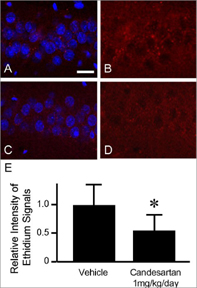
Photomicrographs taken under a confocal microscope of the hippocampal CA1 pyramidal cell layer (A–D) and quantitative study of ethidium signals (E). Numerous punctate superoxide signals were observed in the cytosol of hippocampal CA1 neurons in vehicle-treated animals (A, B), whereas less numerous and less intense signals were observed in the 1 mg/kg/day candesartan-treated animals (C, D). Ethidium signals are shown in panels B and D and nuclear counterstaining overlapped in panels A and C. Quantitative analysis confirmed the differences between these two groups (E, n = 4 each, *p < 0.05
Conclusions
AT1R may be involved in superoxide production and subsequent injury in the vulnerable neurons after global cerebral ischemia.