Introduction
Although glycine is an inhibitory neurotransmitter in the brain stem and the spinal cord, it acts as a coagonist in excitatory neurotransmission at the N-methyl-D-aspartate (NMDA) subtype of glutamate receptors. Activation of the NMDA receptors is known to mediate neuronal injury after cerebral ischemia, however, the role of glycine in ischemic injury has not been clarified. In this study we investigated the extracellular glycine concentrations in the functional knockout (FKO) mice of glycine cleavage enzyme following cerebral ischemia and the effect of extracellular glycine concentration on the ischemic neuronal injury.
Methods
FKO mice were generated by overexpressing a dominant-negative mutant glycine decarboxylase. The total glycine concentrations of the brain in FKO mice are 1.4 times higher than those of C57BL/6 wild-type (WT) mice. Cerebral ischemia was produced by the transient occlusion of middle cerebral artery (MCA) for 30 min, with the intraluminal suture method. CBF of the ipsilateral MCA cortex was measured by the laser doppler flowmetry. The mice with a CBF reduction to less than 10 % of the preischemic control level were only adopted in this study. The extracellular levels of amino acids (alanine, glutamate, glycine, taurine) in the dialysate were determined by high-performance liquid chromatography with electrochemical detector in both mice before and 2 h after transient MCA occlusion. The mice were sacrificed 24 h after reperfusion and coronal brain slices were incubated in 2% solution of 2,3,5-triphenylttetrazolium chloride for measurement of the cerebral infarct volume.
Results
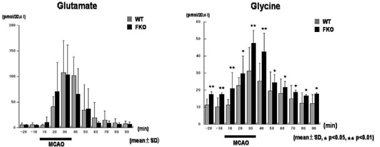
The extracellular glycine concentration of FKO mice significantly increased compared to Wt mice after the onset of MCA occlusion (FKO; preischemia 18. 4±3.4, postischemia 48.4±30.4, Wt; preischemia 12.9±2.0, postischemia 31.1±13.9 pmol/20 μl, mean±SD, n=5). The increase of extracellular glycine concentration was sustained in both groups following reperfusion and the sustained increase lasted longer in the FKO mice. On the other hand, extracelluar concentrations of other amino acids including glutamate increased during ischemia as reported previously, and there were no significant differences between them. The infarct volume in Tg mice was 52.6% larger than that of the Wt mice (Tg;95.03±15.6, Wt; 62.2±8.6 mm3, mean±SD)
Comments
FKO of glycine cleavage enzyme causes the increase of both intracellular and extracellular glycine concentrations of the brain. The extracellular glycine concentrations of the brain in FKO mice were more significant than those in Wt mice after cerebral ischemia. FKO mice with high extracellular glycine concentration showed the significantly large infarct volume. These results suggest that extracellular glycine affect the sensitivity of NMDA receptors to glutamate and that glycine may play a key role in excitatory neuronal damage through NMDA receptors after cerebral ischemia (See Figure 1).