






Introduction
It is well known that chronic arterial hypertension is not only a major risk factor for cerebral ischemia, but also a preeminent factor of exacerbation of the resulting infarct. The definitive mechanisms underlying arterial hypertension-induced increase in ischemic brain damage are not well understood. Our hypothesis is that in spontaneously hypertensive rats (SHR), beside the effects of arterial hypertension on the cerebral vasculature, the vulnerability to cerebral ischemia could be attributed to direct effects of hypertension on the neuroglia compartment and/or to genetic mechanisms unrelated to hypertension. Here we studied the potential implication of glutamatergic receptors (NMDA and AMPA), that are highly involved in neuronal death occurring during cerebral ischemia.
Materials and Methods
In the present studies, the effects of cerebral ischemia and those of intrastriatal injections of NMDA and AMPA on the lesion size were examined in young SHR (7 weeks), in which hypertension is not yet developed, adult SHR (14 weeks), and in age-matched normotensive rats (WKY). Under sevoflurane anesthesia, the rats underwent transient (90 min) intraluminal middle cerebral artery occlusion (MCAO), and cerebral blood flow (CBF) was monitored using laser Doppler flowmetry. The infarct volume was quantified 24 h later. Excitotoxic lesion were induced by intrastriatal administration of NMDA (75 nmoles) or AMPA (2.5 and 5 nmoles). The data are expressed as mean ± SD, statistics were performed by ANOVA.
Results
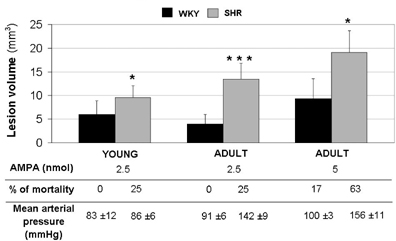
Despite the same degree of reduction in cortical CBF in all the four groups of animals studied, both young and adult SHR displayed exacerbated brain ischemic lesions (244. 6 ±31.6 (n=7) and 312,3 ±129.5 mm3 (n=7) respectively) compared to age-matched WKY rats (131.2±76.2 (n=8) and 92.0±56.5 mm3 (n=8)). No significant difference in NMDA-induced lesion between adult WKY and SHR was observed (21.0±8.9 (n=9) and 16.3±3.8 (n=7)). In contrast, AMPA administration resulted in a dramatic increase in the size of the lesion and the rate of mortality in both young and adult SHR compared to WKY rats (see figure 1).
Conclusions
These results show that, in spontaneously hypertensive rats, the exacerbation of both ischemic and AMPA-induced brain lesion is not totally dependent on the level of blood pressure. The fact that NMDA-induced brain lesion was similar in SHR and WKY, argues for a major role of AMPA receptors in the vulnerability of SHR to cerebral ischemia.