







Abstract
Previous studies have shown that imagining an event can alter autobiographical beliefs. The current study examined whether it can also create false memories. One group of participants imagined a relatively frequent event and received information about an event that never occurs. A second group imagined the nonoccurring event and received information about the frequent event. One week before and again 1 week immediately after the manipulation, participants rated the likelihood that they had experienced each of the two critical events and a series of noncritical events, using the Life Events Inventory. During the last phase, participants were also asked to describe any memories they had for the events. For both events, imagination increased the number of memories reported, as well as beliefs about experiencing the event. These results indicate that imagination can induce false autobiographical memories.
Imagination-inflation studies (reviewed in Garry & Polaschek, 2000) have shown that imagining an event increases the belief that it has happened. In most of these studies, participants are asked to rate the likelihood that they have experienced a set of events on the Life Events Inventory (LEI). They are then instructed to imagine a subset of these events. After a delay, participants are asked to complete the LEI a second time. Imagination inflation is an increase in ratings for imagined items.
Changes in LEI scores are often interpreted as changes in memory. However, the LEI asks people to rate their belief about the occurrence of each event, rather than their memory of it. Autobiographical beliefs are only partially dependent on memory (Mazzoni & Kirsch, in press). If people remember something happening, they are likely to believe that it happened. However, people also believe in the occurrence of events that they do not remember (e.g., being born in a particular place). Thus, an increase in beliefs that an event happened does not necessarily imply that a memory of that event has been created. The first aim of this study was to establish whether imagination alters autobiographical memories as well as beliefs. Previous studies (e.g., Hyman, Husband, & Billings, 1995; Hyman & Pentland, 1996) have shown that imagination combined with other suggestive procedures can induce new autobiographical memories, but no studies have investigated the effect of imagination alone.
One of the criticisms directed at prior research on imagination inflation concerns the veracity of the created autobiographical beliefs and memories: How can the investigator be certain that these events had not, in fact, occurred? In some studies, participants initially claimed that the critical events had not happened to them (e.g., Mazzoni, Loftus, Seitz, & Lynn, 1999; Mazzoni, Lombardo, Malvagia, & Loftus, 1999). However, a memory of an event that is initially inaccessible can become accessible after some prompting (see Read & Lindsay, 2000, for an example). Also, Pezdek and Eddy (2001) have claimed that this procedure can provide the illusion of change, when what may really be occurring is simple regression to the mean (see, however, Garry, Sharman, Wade, Hunt, & Smith, 2001, for a rebuttal).
In the current study, rather than selecting participants who reported low initial LEI scores, we used an event that never occurs in the country in which the participants lived. The nonoccurring event was “Having a nurse remove a skin sample from my little finger.” An extensive investigation of the records at the Department of Community Child Health, Grampian Region, indicated that there are no records of this medical procedure ever taking place in the United Kingdom. Beliefs and memories for this event, which never occurred, were compared with those for a relatively frequent event, “Having a milk tooth1 extracted by a dentist before the age of 6.”
When people imagine an event, they are necessarily exposed to the content of it. It is possible that merely reexposing people to an event increases their belief that it has occurred. Therefore, in the current study, each participant was asked to imagine one of these events and to read a short passage and answer a few questions about the other event. An effect in the imagination condition over and above the effect of simple exposure would indicate that imagination, rather than mere exposure, increases beliefs and helps create memories about an event.
Suggestive procedures produce false beliefs and memories in some people but not in others. Thus, it would be useful to identify those individuals who are susceptible to memory manipulations. Significant associations with individual differences in dissociation (e.g., Heaps & Nash, 1999; Hyman &Billings, 1998; Paddock et al., 1998) and imagery vividness (Hyman & Billings, 1998) have been reported, but other studies have failed to replicate these findings (Heaps & Nash, 1999; Mazzoni, Loftus, et al., 1999). To shed more light on this issue, we included measures of these two constructs in the present study.
To summarize, we assessed whether simply imagining an event (without any additional suggestive procedure) could produce memories of the event, as well as increase the belief that it had happened. We also assessed whether imagination could elicit memories for events that could not have happened to our participants, and compared these results with the effect of imagination on events that could have happened. Finally, we included a condition aimed at controlling for simple exposure to the event, thus allowing us to establish whether imagination per se was responsible for changes in belief and memory.
METHOD
Participants
Eighty-two British students (29 males) took part in the experiment for course credit. Their mean age was 21 years. Seventy-two of the participants completed all phases of the experiment.
Materials
Three versions of the LEI were prepared. In each, participants were asked to rate the likelihood that they had experienced each of 20 events before age 6. Each version contained a different set of events, but the two critical events and three control events were included in all three versions. One of the critical events was relatively frequent and common (“Having a milk tooth extracted by a dentist”); the other was an event that does not happen in the United Kingdom (“Having a nurse remove a skin sample from my little finger”). The three control events were “Found a £10 note in a car park,”“Got sick and had to go to casualty late at night,” and “Felt an earthquake.”2 For each event, participants were asked to indicate how certain (1 = definitely did not happen, 8 = definitely did happen) they were that the event had or had not happened to them before the age of 6 years.
Procedure
The experiment was held in three phases, separated by 1-week intervals, and participants were tested individually in Phases 2 and 3. In Phase 1, during a mass testing, participants filled out the first version of the LEI (pretest) as well as other filler questionnaires. The cover story was that the experimenter wanted to assess the reliability of several different measures.
In Phase 2, participants were randomly assigned to two groups. One group imagined the frequent (tooth) event and read a one-page passage and answered four questions about the nonoccurring (skin) event. The other group imagined the skin event and read a passage and answered questions about the tooth event. In each group, the order of activities (imagine or read) was counterbalanced. Participants were then asked to fill out the second version of the LEI (Posttest 1), Vividness of Visual Imagery Questionnaire (VVIQ; Marks, 1973), and Dissociative Experiences Scale (DES; Carlson & Putnam, 1993).
In Phase 3, participants were asked to fill out the third version of the LEI (Posttest 2, administered to assess the stability over time of altered belief ratings) and to report any memories they had of the two critical events and the three noncritical control events. The first author scored each participant's memories with a 0 (no memory of the event), 1 (very short statements like “I vaguely remember something” but no additional details), or 2 (a memory for the event was reported and at least two elements were mentioned; e.g., “There was a nurse and the place smelled horrible”). Belief and memory scores were averaged across the three control events for each participant separately. The order in which people were asked for belief ratings and memory reports was counterbalanced.
RESULTS AND DISCUSSION
Change in Autobiographical Beliefs
Analysis of belief ratings (Table 1)revealed a significant increase in autobiographical belief in the imagination condition, a significant decrease in belief in the control condition, and no significant changes in the exposure condition. Specifically, a 3 ×3 × 2 (Condition × Phase × Group) mixed-model analysis of variance (ANOVA) showed a significant main effect for phase,F(2, 140) = 4.35, p < .05, MSE= 1.86, qualified by a significant phase-by-condition interaction,F(4, 280) = 12.42, p < .001, MSE= 1.28. Post hoc t tests (α = .05)revealed a significant decrease in the control condition and a significant increase in the imagination condition between Phase 1 and Phase 3. These results replicate the imagination-inflation effect found in other studies (e.g., Garry, Manning, Loftus, & Sharman, 1996).
Mean belief ratings in the imagination, exposure, and control conditions
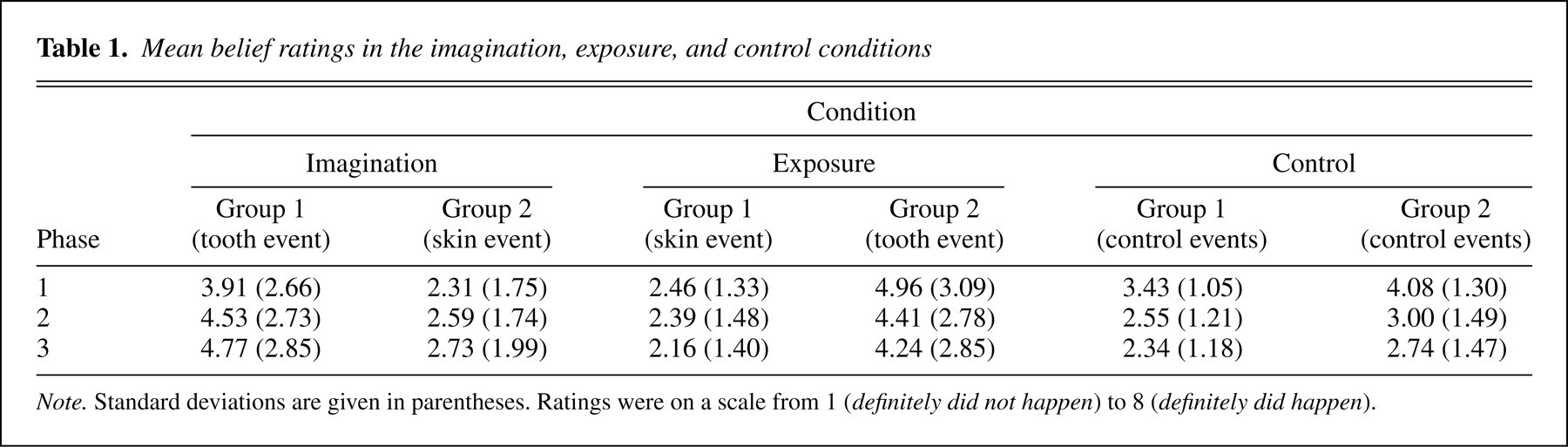
Note. Standard deviations are given in parentheses. Ratings were on a scale from 1 (definitely did not happen) to 8 (definitely did happen).
The condition-by-group interaction was also significant,F(2, 140) = 28.44, p < .001, MSE= 7.74. Post hoc t tests revealed that this was due to significantly higher belief ratings for the frequent event (tooth) than for the nonoccurring event (skin) or the control events, regardless of which event participants imagined and which they simply read about. The lack of a significant three-way interaction indicates that the increase in belief after imagination was not significantly different for the frequent event than for the nonoccurring event.
Memory
Analyses of memory scores (Fig. 1, upper panel) and the percentage of participants reporting memories (Fig. 1, bottom panel) revealed more memories in the imagination condition than in the exposure condition, and more memories of the tooth event than of the skin event. A 2 × 2 (Condition × Group) ANOVA on memory scores revealed a significant main effect for condition, F(1, 70) = 6.32, p < .02,MSE= 0.69, and a significant condition-by-group interaction, F(1, 70) = 17.80, p < .001,MSE= 0.69 (numerically equivalent to a main effect for event). The standardized mean difference (d) between memory scores in the imagination and exposure conditions was .61 for the skin removal and .31for the tooth extraction, indicating that the effect of imagination on memory was stronger for the nonoccurring event than for the frequent event.
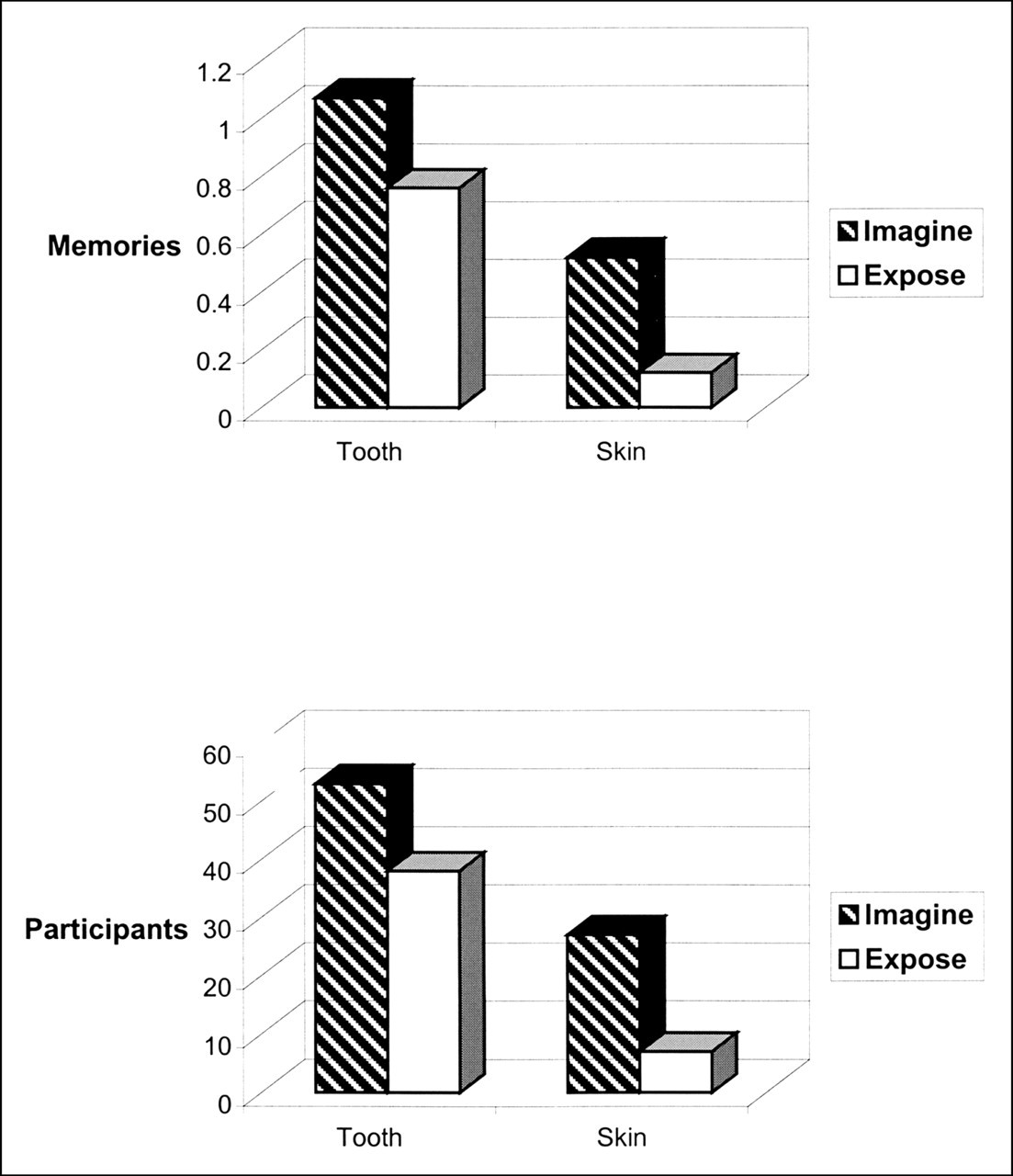
Memory for the tooth and skin events in the imagination and exposure conditions. The top panel shows mean memory scores. Higher scores indicate more memories. The bottom panel shows the percentage of participants reporting memories of each event.
After imaging, 40% of the participants reported a memory, whereas after being exposed, only 23% of the participants reported a memory. Memories of the skin removal were nearly 4 times more likely after imagination than after exposure to information. Memories of tooth extraction were 40% more likely after imagination than after exposure to information. Chi-square tests indicated that significantly more memories were reported after imagining the event than after exposure to information for both the tooth event, χ2(1, N= 72) = 4.54,p < .05, and the skin event, χ2(1, N= 72) = 14.17, p < .001.
Correlates of Beliefs and of Memories
Beliefs and memories were not significantly correlated with scores on either the VVIQ or the DES. A regression of Posttest 2 LEI ratings on pretest ratings, VVIQ scores, and DES scores revealed significant coefficients for pretest ratings in each condition (imagination: β = .68, p < .001; exposure: β= .55, p < .001; control: β= .56, p < .001) and for the VVIQ scores in the control condition only (β= −.28, p< .01). Thus, the significant decrease in beliefs about the occurrence of control events was associated with self-reported imagery vividness, whereas changes in autobiographical beliefs and memories as a function of imagination were not significantly associated with either imagery vividness or dissociation.
Conclusions
The results of this study show that people can develop both a belief in and a memory of an event that definitely did not happen to them by simply imagining its occurrence. Imagination alone, without any additional suggestive procedure, increased participants' convictions that an event had occurred in their childhood, and also produced false memories of the event. Additionally, the data indicate that the production of false beliefs and memories was not due to an increase in familiarity with the event, as some researchers have proposed (e.g., Wade, Garry, Read, & Lindsay, in press), but instead depended on processes that occur specifically during imagination. In our design, exposure (i.e., reading a brief text) controlled for familiarity, and the results showed that the effect of imagination was stronger than the effect of familiarity alone.
These results replicate and extend the results of prior studies on imagination inflation. They also lend strong support to the claim that the effect of imagination on memory is genuine and not merely an artifact (Garry et al., 2001).
Footnotes
Acknowledgements
We thank Irving Kirsch for his comments on an earlier draft of this manuscript.
1. The British term “milk tooth” corresponds to the American term “baby tooth.”
2. The British terms “car park” and “casualty” correspond to the American terms “parking lot” and “hospital.”