






Abstract
This is the most common question I have been asked since the announcement of my appointment to the World Bank. This paper provides a brief history of the development of the Bank, its role in social development, population health and health service delivery, and the reasons behind its recent interest in mental health.
The World Bank actually consists of two organisations, the International Bank for Reconstruction and Development (IBRD) and the International Development Association (IDA). Three additional agencies work very closely with the IBRD and IDA. These are the International Finance Corporation (IFC), the Multilateral Investment Guarantee Agency (MIGA) and the International Centre for the Settlement of Investment Disputes (ICSID). These five agencies together form the World Bank Group (Fig. 1).
Structure – World Bank Group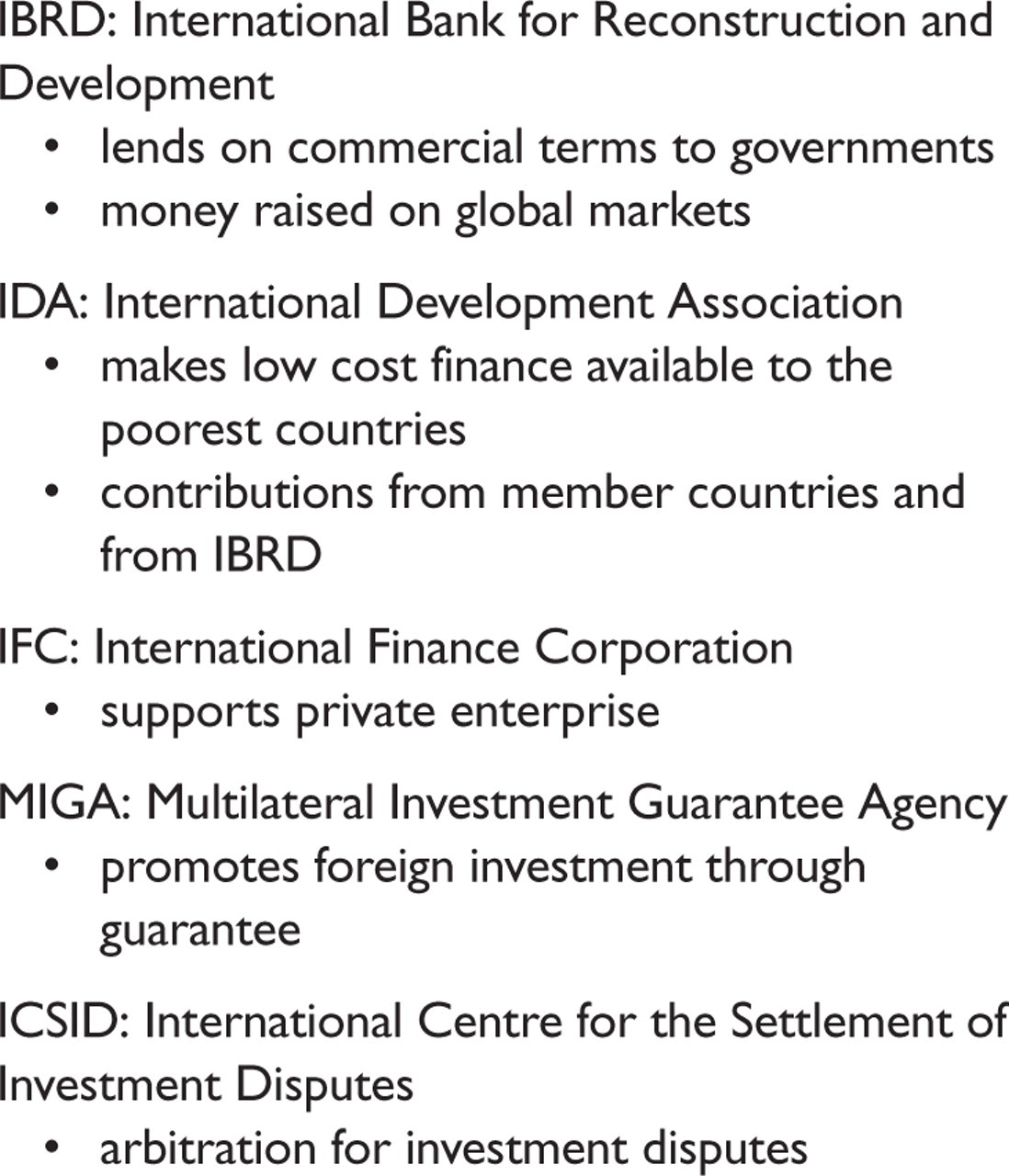
The IBRD was established in 1945. The rationale for its creation grew out of post World War Two economic thinking and the attitude of the allies towards Germany. It was believed that economic problems following World War One were, in part, a contributing factor towards creating the social, economic and political environments which led to World War Two [1]. The allies, meeting after World War Two in Bretton Woods in New Hampshire USA, designed a number of institutions with the aim of preventing a recurrence of these problems. They established the IBRD to fund long term social development and the International Monetary Fund (IMF) to promote economic reform and provide funds to rectify short term balance of payments deficits [2]. These were followed a few years later by the ill-fated International Trade Organisation (ITO) which was replaced by the General Agreement on Tariffs and Trade (GATT) and subsequently the World Trade Organisation (WTO). The aims of the WTO and its predecessors have been to promote free trade and investment. Others, including the Organisation for Economic Cooperation and Development (OEDC) and the United Nations Conference on Trade and Development (UNCTAD), later joined these institutions. These organisations have become known as the Bretton Woods system which as a whole aims to foster trade and economic benefits internationally and to promote the economic development of countries which were not industrialised at the end of World War Two.
The mandate of the World Bank is therefore to promote economic and social progress in developing countries with the aim of reducing poverty, improving the quality of life for the world's poorest and increasing prosperity. The IBRD and IDA make loans to governments for projects and programs that promote economic and social development and help raise economic productivity to enhance people's quality of life. Since 1944 the Bank has lent $US426 billion for 7500 projects in 163 countries. Along with these loans the Bank provides policy and service advice and technical assistance.
The governments of 180 member countries now own the IBRD. To join the IBRD, countries must first be a member of the IMF. Upon joining the IBRD, members subscribe to its capital stock. The number of shares each member is allocated reflects its quota in the IMF which in turn reflects the country's relative economic strength in the world economy. Members pay in a small portion of the value of their shares, the reminder is ‘callable capital’ and would only be paid should the IBRD be unable to meet its financial obligations – a situation that has never arisen [3].
The IBRD lends funds to developing countries for social development and only for projects that promise high rates of economic return to the country. The IBRD borrows most of the money it lends through medium and long term borrowing in the global capital markets. It also borrows funds at market-based rates from central banks and other government institutions [3].
The IDA was established in 1960 to provide assistance to poorer developing countries that cannot meet the IBRD repayment terms. To qualify for IDA loans (referred to as credits), the country would usually have an annual per capita Gross National Product of $785 or less (in 1996 US dollars). By this criterion, about 70 countries in the world are eligible. IDA credits are made only to governments. The repayment period is usually thirty-five to forty years with a ten year grace period. The credits carry no interest. All members of the IBRD are eligible to join IDA and 159 countries had done so by 1997 [3].
The IDA and IBRD share the same staff and IDA projects have to meet the same criteria as IBRD projects. Because the Bank (essentially the member countries) guarantee IBRD and IDA loans, the interest rates able to be secured are favourable compared with the interest developing countries would expect to pay on loans raised independently.
The three other agencies of the World Bank Group complement this work. The International Finance Corporation (IFC) works closely with private investors and invests in commercial enterprises in developing countries. The Multilateral Investment Guarantee Agency (MIGA) encourages direct foreign investment in developing countries by offering insurance against non-commercial risk. The International Centre for the Settlement of Investment Disputes (ICSID) provides facilities for settling disputes between foreign investors and their host countries.
The World Bank, with headquarters in Washington DC and approximately 90 offices around the world, employs about five and a half thousand staff. The Bank was restructured in 1997 and now has four networks:
Human Development
Environmentally and Socially Sustainable Development
Finance, Private Sector and Infrastructure
Poverty Reduction and Economic Management
The Human Development Network was the first network in the Bank's revised structure. It brought together staff working on health, nutrition, population, education, training and social protection. The Network promotes policies and funds programs which support economic growth and poverty alleviation through improving the health and educational status of individuals and the provision of social safety nets. The Network is organised into three sectors:
Health, nutrition and population (HNP).
Education
Social protection
The World Bank is the single largest source of external finance for HNP in developing countries. The mounting evidence that investments in health, nutrition and education contribute to individual productivity, and therefore to national economic growth, has influenced the Bank (Fig. 2), and HNP is now one of the fastest growing areas of Bank lending. The HNP sector has about 250 staff. The investments aim for allocative efficiency in lending (buying cheap health gains first), better health policy and research. Funding for health sector reform addresses health financing and management, health information, and enhancing quality, efficiency and equity in service delivery. These initiatives must be developed and implemented in a way that is sensitive to the macro and micro economic policies of the country [4].
Investing in health, nutrition and population (HNP)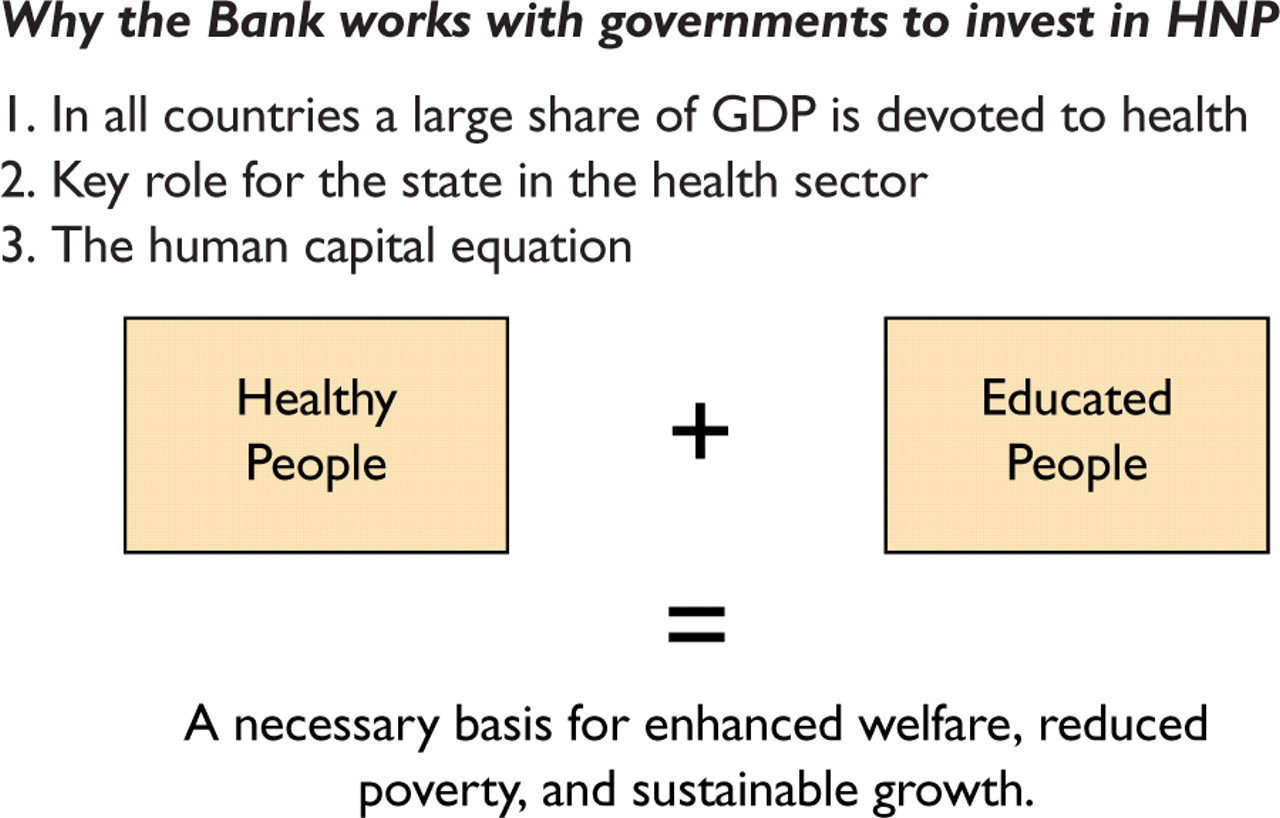
Currently the Bank lends over $US25 billion per year, of which some 10% is invested in health, population and nutrition, up from 6% in 1992–94. In 1995–96, $US1 billion was lent for HNP initiatives. In 1996–97, this had increased to $US2 billion and in 1997–98, $2.5 billion was lent for 260 projects in 93 countries. The largest recipient countries of HNP funds between 1988 and 1998 have been India, Mexico, Brazil, Argentina, China, Bangladesh, Indonesia, Russia, Venezuela, and Nigeria.
Traditionally HNP lending has been for areas such as infectious disease control and reproductive health. Seventyseven per cent of the Bank's HNP loans are in the area of primary health care. The publication of the World Bank's World Development Report in 1993: Investing in Health [5], focussed attention on the burden of disease able to be identified using a standardised comparison of both mortality and morbidity, the disability adjusted life year (DALY). Subsequent reports, especially the 1996 Global Burden of Disease report [6], have emphasised the significant burden associated with what the report refers to as neuropsychiatric disorders (epilepsy, substance abuse and mental disorders). Five of the ten leading causes of disability worldwide are mental illnesses, accounting for a quarter of total disability and 10% of total burden. The burden is estimated to rise to 15% by the year 2020 and the rise will be particularly sharp in developing countries.
The significance of this burden and how to address it has been debated by the international mental health community and is now being discussed in the international economic community [7]. Individuals from the World Health Organisation (WHO) and the World Federation for Mental Health (WFMH) [8] held discussions with officials from the World Bank during 1997 and 1998 to consider how the Bank might respond to this increasing problem. A decision was made to establish a new position at World Bank headquarters in Washington DC. Key players from the international mental health community involved in this development were Dr Rachel Jenkins, Director of the WHO Collaborating Centre at the Institute of Psychiatry, London; Professor Marten de Vries, Professor of Psychiatry, Maastricht University, The Netherlands and President of the World Federation for Mental Health; Dr John Gates, Mental Health Director at the Carter Center, Atlanta, USA; Professor Arthur Kleinman, School of Public Health, Harvard University, USA; and Professor Eugene Brody, Sheppard and Enoch Pratt Hospital, Baltimore, USA. Strong support was received from World Bank officials.
The duties and responsibilities of the position have been identified by the Bank as:
the provision of policy and technical advice on population mental health, mental health services and clinical interventions within the World Bank and to the Bank's client countries;
to prepare lending components of IBRD, IDA projects related to mental health;
to create a capacity within the Bank to help ensure projects funded in the mental health area are cost effective in the country in which they will be implemented and will also be responsive to the demography and culture of the country;
to develop and implement a training program on mental health for staff in the HNP Sector of the Bank and
to identify an international network of experts to assist the Bank in the area of mental health.
To meet these responsibilities access to a wide range of mental health policy, program, service delivery and clinical expertise will be needed. Support has been secured from key agencies such as the WHO, WFMH and the US Government's Centre for Mental Health Services. The World Psychiatric Association, US National Institute of Mental Health and the American Psychiatric Association have also offered assistance. Access to additional expertise is being sought from identified academic departments of psychiatry and public health and individuals around the world. It is critically important that the work undertaken is sensitive to the demographic, cultural, economic and political environments of the Bank's client countries [9]. Foreign aid can bring problems as well as solutions [10,11]. Governments and individuals in the Bank's client countries must be committed and be able to implement the projects and programs that are funded. Support for the Bank's work is essential from key individuals, professional and non-government organisations and government officials in developing countries. A number have already offered support.
My appointment is, I believe, an acknowledgment by the international mental health community and the World Bank of the work undertaken by psychiatrists, other mental health professionals, policy makers, administrators, consumers, carers and governments to improve mental health services in Australia. We still have a long way to go but, by international standards, our achievements over the last decade have been impressive. The political, economic and social situations as well as the health status and health services in many of the Bank's client countries are very different to Australia. Nevertheless, the lessons we have learned in developing and implementing mental health reform can, I believe, be adapted and applied to the benefit of those countries.