






Abstract
Our College has always emphasised that the practice of psychiatry is based on a biopsychosocial model. Most of us are aware that, for a variety of reasons, psychiatry, both in our region and internationally, has been emphasising the biological and social aspects.
More recently the psychological aspects, in particular the talking therapies, have had a renewed interest among psychiatrists. For example, there has been a resurgence of interest in Bowlby's work on attachment theory [1]. Recent research in mother–infant interactions by Daniel Stern [2], the neurobiology of the affective regulatory system by Allan Schore [3] and others has revised psychotherapeutic theory and practice. Indeed, there is now scientific evidence, in the form of pre- and post-psychotherapy PET scans, to show convincingly that therapy not only helps the patient in their interpersonal functioning but there is definite increased blood flow in the right front orbital region of the brain. There have been convincing research review articles by Norman Doidge [4] in Canada and Jeremy Holmes [5] in Britain on the cost effectiveness and efficacy of psychotherapy. From Australia, Meares and Stevenson's [6] work on borderline personality disordered patients (with one, five and ten year follow-up reports) has been cited frequently in international journals of psychoanalysis and psychotherapy to point out the clinical and economic benefits of psychotherapy. In this age of evidenced-based medicine, psychotherapy now has more scientific data to substantiate its claims than in the past. There is a significant increase in theoretical knowledge arising from early infant studies and technological brain investigations.
Psychiatry and, in particular, psychotherapy have often been chosen (with similarly small speciality groups) as targets by politicians during their regular waves of economic rationalisation. Psychiatrists as a group need to be much more assertive in putting forth the high quality psychotherapy we practise and the good outcomes we produce in our patients. It goes without saying that there are many health professional groups who have aggressively advertised themselves to compete for the private health dollar. It is time for our College to stand up for psychotherapy as practised by our Fellows, to document our rigorous training and to make known the efficacy and cost effectiveness of our work. As we know, the nonmedical psychotherapeutic groups have already gathered together to form their own large organisations, initially with the stated aim of helping the community to choose their therapist wisely but, no doubt, ultimately, to be a political force to lobby for the public health dollar. Psychotherapists, by tradition, have been a multidisciplinary group and as psychiatrists we have mutually benefited with our general practitioner and non-medical colleagues in the study and practice of psychotherapy. However, we should unashamedly stand out as the group with the most extensive training in terms of hours of seminars and supervision through our medical, psychiatric and psychotherapeutic careers and that we offer an in-depth and psychiatrically informed range of psychotherapies.
There have also been pressures from within our profession to form a Faculty of Psychotherapy. For some years psychiatric trainees have been asking for more seminars and supervision in the psychotherapies. Our registrars are quite content with the biological and social aspects of psychiatric teaching. However, in most training centres the number of seminars related to psychotherapy have been reduced and supervision has been increasingly unavailable. The formation of a Faculty would not only help upgrade the psychotherapeutic input in the first three years of psychiatric training but also offer those trainees who wish to subspecialise in the psychotherapies a twenty-four month intensive course in one of the psychotherapeutic modalities in the final two years of their training. The proposed Faculty will also offer bridging courses for existing Fellows who wish to update and upgrade their theoretical knowledge, to collect more supervisory hours to improve the quality of care for their patients, as well as to qualify to become seminar leaders and supervisors in the training programme run by the Faculty at various branches.
HISTORY
The Section of Psychotherapy was formed in October 1989. In the last nine years it has achieved its aims of promoting and encouraging the study of psychotherapy in all its aspects by providing a forum for the exchange of ideas and knowledge. Importantly, the Section of Psychotherapy promotes and encourages the highest theoretical, practical and ethical standards in the delivery of psychotherapy services. It facilitates research in the area and promotes and encourages training in psychotherapy of the highest standard for trainee psychiatrists, medical undergraduates and students of related mental health professions. Every year we have invited internationally recognised psychotherapists to speak at College congresses and to present papers and workshops for our members. Each branch has hosted scientific meetings and other continuing education activities in the psychotherapies. It was our Section that led the way in helping the College Maintenance of Professional Standards (MOPS) Program to get started in terms of peer review groups. As psychotherapists we had established peer groups reviewing and supervising our work for many years. Dr Josephine Beatson et al. wrote on psychotherapy group peer review in Victoria [7]. We shared our views with the MOPS Committee to formulate its structure for all psychiatrists.
There has been discussion concerning the formation of a Faculty from the very outset. Our members have been increasingly aware of the recent burgeoning literature in the newer theories and of the abundance of ground-breaking research in infant psychiatry and brain studies related to areas of emotion. The increased public awareness of child abuse and post traumatic stress disorders has also contributed to further research and useful theoretical constructs by practising psychotherapists in these challenging clinical areas. Through the years there has been increasing interest within the Section to provide quality subspeciality training in the psychotherapies by Fellows for trainees.
The sudden introduction of restrictions on the Medicare rebate beyond fifty sessions unilaterally imposed by the Australian government in 1996 brought things to a head. Negotiations between the Section, the College, the AMA and the Department of Health led to the compromise position of Item 319. This further galvanised our motivation towards formation of a Faculty with the hope that it would not only increase standards in psychotherapy right across the board from psychiatric trainees to practising psychiatrists but also result in the establishment of high quality psychotherapeutic care based on scientific research and backed by outcome studies. This would firmly accredit Fellows to receive rebates to help the most needy of our patients who are, in fact, the members of our society who are also most disadvantaged. As a College we have an ethical responsibility to the community to protect and deliver essential, high quality treatment to those who are most in need both in the public and private sector.
FORMATION OF A FACULTY SUBCOMMITTEE
In 1997 the Section established a Faculty Subcommittee, appointing Dr Eng-Kong Tan as Chair to look into the feasibility of forming a Faculty and to work towards this objective. It was felt that this was a major and long-term project which required a Committee of senior and experienced psychotherapists who have served in various College positions and psychotherapy organisations and who would have had sufficient experience to look into the many aspects of this significant development in our College. Our College constitution states that General Council may from time to time establish Faculties of the College responsible to General Council provided that any such Faculty shall in the opinion of General Council represent an internationally recognised body of knowledge in psychiatry and have College accredited training. Membership of Faculties shall be open to all properly qualified members of the College, such qualifications to be determined from time to time by General Council.
Dr Ron Spielman was entrusted with collecting data and drafting the document to support psychotherapy as an internationally recognised subspeciality within psychiatry. Dr Isla Lonie would lead in the formulation of guidelines for our training programmes. Following extensive discussions in face-to-face meetings and teleconferences among the Committee members of the Section in all the Branches, it was finally decided that there would be four chapters for psychotherapy training:
Individual Dynamic Psychotherapies
Cognitive Behaviour Therapy
Family and Couple Therapy
Group Therapies
Dr John Penman was entrusted with the formation of a curriculum committee to draft the general philosophy that would encompass all four chapters, and individual course requirements for each of the chapters. Dr Shirley Prager was appointed to form a Committee to look into issues of accreditation at all levels of experience and training for membership. As Chair of the Faculty Subcommittee, Dr Tan works in association with the Chair of the Fellowships Board, Professor Peter Ellis, to follow closely the general guidelines developed by the Board for the Training Programmes of all subspecialities within the College. There has been considerable experience gathered through the formation of the first two Faculties of the College, namely Faculty of Child and Adolescent Psychiatry and the recently formed Faculty of Psychiatry of Old Age. Dr Tan, in his role as General Councillor, would also make regular reports to keep College General Council informed, at six-monthly intervals, and present proposals for Council's deliberation and endorsement.
As one would expect, there was initially considerable anxiety stirred within the College. There were understandable concerns that forming such a Faculty might be divisive. There was also the basic idea that all psychiatrists are psychotherapists and there might not be a need to further subspecialise in this fundamental modality of therapy which should be present in all psychiatric consultations. Through many meetings within the Section and Branches, and deliberations at Council meetings, the initial anxieties about divisiveness subsided. Instead, there is now a growing awareness that the formation of such a Faculty could, in fact, unite all Fellows who have a substantial interest in the practice, teaching and research of psychotherapy. Psychotherapists are now getting together to help formulate training programmes for trainees who are the future psychotherapists of our College. For a long time now there has been a need to bring together senior, well trained and experienced psychotherapists within psychiatry to work together for the common benefit of our College. In years gone by, because of the lack of formal training provided by the College in the subspeciality of psychotherapy, Fellows have gone overseas and/or sought training from other organisations which provided psychotherapeutic courses of various orientations and depth to its multi-disciplinary members.
Following discussions led by the Chairman of the Section of Psychotherapy, Dr Isla Lonie, General Council, in October 1998, passed the motion that ‘the Section of Psychotherapy progress with the development of its proposed training program’. This has given further emphasis and incentive to the Faculty Subcommittee to advance as fast as it can to finalise aspects of the training programmes in the four chapters as mentioned.
SURVEY OF SECTION OF PSYCHOTHERAPY MEMBERS
A questionnaire was sent to all members of each Branch of the Section of Psychotherapy to assess levels of education, training, experience, and willingness to teach and supervise in the four chapters of Psychotherapy. Binationally, there was a total of 265 returned questionnaires, representing a 56% response (Table 1). From the data collected, it is abundantly clear that there are sufficient senior psychotherapists in New South Wales, Victoria, Queensland, South Australia and Western Australia who are adequately trained and willing to provide seminars and supervision for trainees and Fellows (Table 2). It is also clear that there are sufficient family and marital therapists, most likely trained Fellows belonging to the Faculty of Child & Adolescent Psychiatry in New South Wales and Victoria, who could gather together to train in the chapter of Family & Marital Therapy (Table 3). New South Wales has sufficient members trained in Cognitive Behaviour Therapy and Victoria has a relatively large number of trained group therapists. The two Branches could develop an exchange programme of seminar leaders and supervisors to provide training programmes in Cognitive Behaviour Therapy and Group Therapy. In terms of bridging courses, there are sufficiently senior, experienced and willing supervisors to help Fellows receive more supervision in individual dynamic psychotherapy in five Branches namely, NSW, Victoria, Queensland, SA and WA (Table 4). New South Wales and Victoria could also offer further supervision for Fellows in Cognitive Behaviour Therapy, Family & Marital Therapy and the Group Therapies.
Questionnaire responses: Summary
Senior and trained fellows offering seminars and supervision for trainees and fellows
Seminar leaders for training programmes
Supervisors for fellows
New Zealand, Tasmania and the ACT require special mention. Relative to the number of psychiatrists and total number of members of the Section, these Branches have small but significant numbers of Fellows who have completed two years' formal training in one of the modalities of psychotherapy. New Zealand has the logistic problem of their senior members being spread over two islands and four major cities. Tasmania and the ACT might be able to provide seminars and supervision for psychiatric registrars and Fellows but there may be insufficient numbers in any one particular year requesting a formal training programme or bridging courses. However, in the years to come, one New Zealand city could become the centre to provide seminars for interested psychiatric registrars to clock up equivalent number of hours. Supervision could still be acquired from senior members in each of the four major cities. Videotaped seminars and teleconferencing could be considered by these three Branches. Senior Fellows from New South Wales and Victoria could be invited to travel to these three Branches to act as seminar leaders. Also, these three branches (New Zealand, Tasmania and the ACT) might hold introductory lectures for interested psychiatric registrars to hold their interest over a period of years so as to accumulate a sufficient number of trainees to make a two year training programme viable, perhaps to commence once every three to five years.
CONCLUDING REMARKS
In a short period of just twenty-four months, the Section of Psychotherapy and its Faculty Subcommittee have worked extremely hard to think through, canvass views and do the groundwork to prepare for the formation of a Faculty of Psychotherapy. The Section understands that forming a Faculty takes time and each step should be taken cautiously. Paramount in its deliberations is the importance of reduction of anxieties as change, even in the direction of progress, can cause a degree of distress within any organisation. The Section strongly feels that it should be inclusive in its foundation membership, and the current proposed grandparent clause (Figure 1) invites all Fellows who are practising, teaching and researching in the psychotherapies to join within the first twelve months of the formation of the Faculty. The training programme should consist of a rigorous minimal standard to be maintained in every Branch consisting of 40 hours of clinical meetings, 80 hours of seminars and 120 hours of supervision per year for a two year period in any of the four chapters of psychotherapy. Each Branch should also be given autonomy in the logistics and details of its training programme, depending on availability of their local and interstate resources as well as the unique strengths within the membership of each Branch. At all stages of the formation of our Faculty the reality of wide-ranging political imperatives has to be kept in mind. There is a fine balance between the pursuit of excellence, the realities of available resources and the political pressures within and from outside of the College.
Levels of Education, Training and Accreditation in Psychiatric Psychotherapy.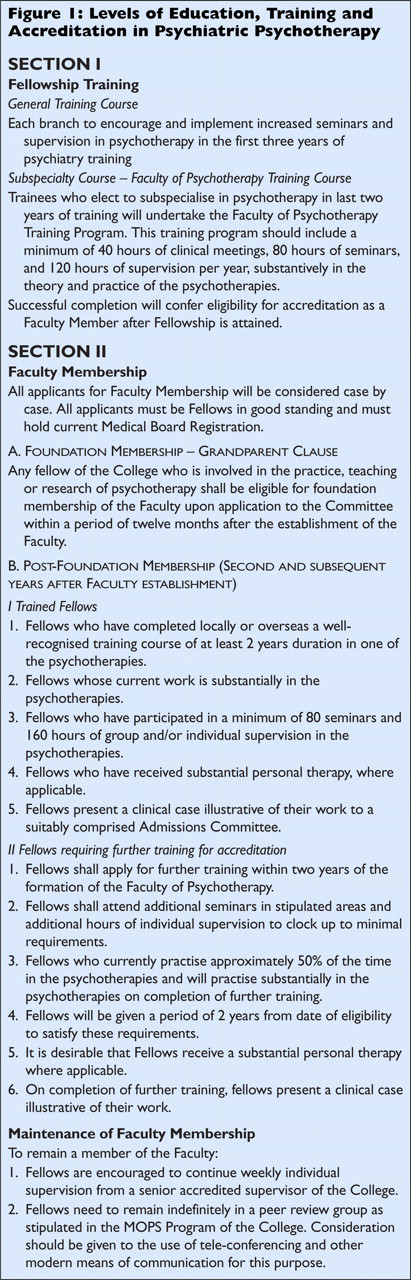
Fellows are invited to request any of the following six Draft Discussion Documents for further study, comment and feedback to the Chairpersons of each Branch Section of Psychotherapy or any of the office bearers of the Faculty Subcommittee:
Psychotherapy as a Subspeciality
Levels of Education & Training Accreditation
Guidelines for Training
Draft Course Curriculum
Draft By-Laws of Faculty of Psychotherapy
Draft administrative structure of the proposed Faculty of Psychotherapy
These documents are being widely discussed in all Branches of the Section of Psychotherapy and the views collected and relayed back to the Section Central Committee and Faculty Subcommittee for further deliberations. The final drafts shall be presented to General Council for deliberation and endorsement. Hopefully, the Faculty shall be formed in the not too distant future.
Acknowledgements
We would like to thank the following Faculty Committee Members and Chairpersons of each of the Branch Sections of Psychotherapy: Drs John Penman (WA), Shirley Prager & Paul Foulkes (Vic), Ron Spielman (NSW), Janet Rhind (Qld), Elizabeth Heath (SA), Rebecca Denford, (NZ), Douglas Carter (Tas), Don Lawrence and Paul Fitzgerald (ACT) and Prof. Pete Ellis (Chair, Fellowships Board) for their significant contributions working towards the formation of a Faculty of Psychotherapy and their continued efforts, till such time this is achieved. We also thank all Fellows who responded to the comprehensive Questionnaire and for your interest, concerns and recommendations towards the formation of our Faculty.