Abstract

Edited by Philip Mitchell and Dusan Hadzi-Pavlovic
The Melbourne psychiatrist John Cade published his seminal paper ‘Lithium salts in the treatment of psychotic excitement’ in the Medical Journal of Australia in 1949.[1] To commemorate the 50th anniversary of that report, the Conference “Fifty Years of Treatment for Bipolar Disorder: A Celebration of John Cade's Discovery” took place in Sydney on 4 and 5 December 1999, attended by 180 delegates from Australasia, the US, Canada and Hong Kong.[2] Overseas speakers included Frederick Goodwin, Husseini Manji and Mauricio Tohen.
As part of that conference, a dinner was held on 4 December, with after-dinner tributes to John Cade being given by a number of senior Australian psychiatrists whose careers had intersected with Cade's at some point. The following addresses were given that evening, with the session being chaired by John Ellard. Other speakers included Gavin Andrews, Ed Chiu and John Tiller.
JOHN ELLARD, PRIVATE PSYCHIATRIST, SYDNEY
I am honoured to be invited to take part in the celebration of John Cade, who did so much for psychiatry. I had assumed that I had been chosen to speak now because I was the only one old enough to have a firm first-hand recollection of what acute psychiatry was like in the 1940s. However, looking around me I suspect that I may not be the only survivor of those days. It is one thing to read John Cade's 1949 paper on lithium and marvel at its clarity and wisdom; it is another to have experienced what the wards containing psychotic patients were like until lithium and the antipsychotics appeared.
The interesting fact, reported in the literature but not given its due weight, is that in those days the psychotic illnesses presented—and I say presented—much more severely than they do now. I was in the Army at the same time as John Cade—although under happier circumstances. Our schizophrenic patients with a history of a month or less usually turned up totally disorganised, with gross thought disorder and often catatonic. In their age group mania was uncommon but memorable when it did present. A psychotic ward was a dangerous place: one did not enter it alone and while in it one kept one's back to the wall as much as possible. The more turbulent individuals had to be locked in a single room or restrained in a camisole for the safety of others. If you were smart you put them in a full camisole and put the bottom straps through the slats of a large heavy garden seat.
Speakers at the John Cade dinner December 1999 (from left to right): Neil McConaghy, Gavin Andrews, Bruce Peterson, John Cawte, Ed Chiu, John Ellard and David Grounds.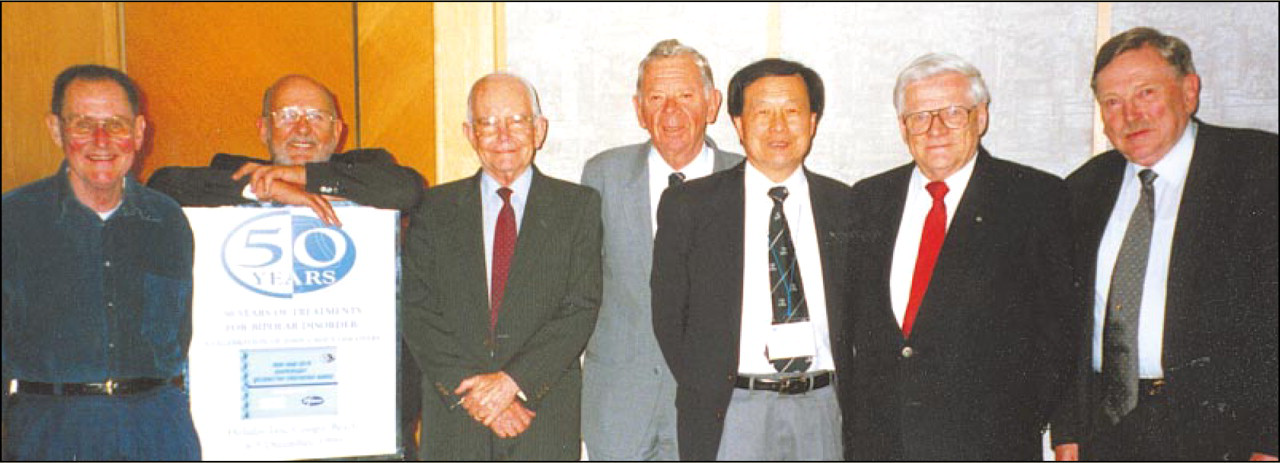
The available remedies for this tumult were barbiturates, paraldehyde by mouth or by injection, ECT and full coma insulin. Although John Cade published his paper in 1949, it was almost 20 years before lithium came into general use, partly because of the difficulty of monitoring the dose and partly because, being a cheap simple mineral, there was no money in it and the pharmaceutical companies did not support the research.
In those years chlorpromazine was first used in France, and reached these shores some time in the 1960s. I remember prescribing it for the first time and wondering what would happen. The next agents—promazine and mepazine—are now long forgotten.
Unless you were there, you cannot imagine how much we owe to John Cade and those other pioneers in the treatment of psychotic illness. Psychiatry is now—most of the time—a gentlemanly pursuit. Patients no longer arrive rubbing faeces in their hair and fighting the police; they are more likely to say that on becoming aware that they were hearing voices they looked it up on the internet, and thought that they should do something about it. And we can do something about it now because not only did John Cade benefit us enormously, but words cannot describe the benefit that he conferred upon so many of our patients.
Think of the walled fortresses once to be found in many large country towns and in the suburbs of the big cities. If you had bipolar disorder the probability was that you would go into one of them and perhaps stay there. They have gone and John Cade is one of the reasons why they have gone.
There is one more important thing to say. Pick up John Cade's article and look at it: it was written by John Cade and he did the work as well. There were not five co-authors with PhDs, nor was there a platoon of lay people carefully trained to ring people up, ask them 10 questions, tick the appropriate boxes, believe what was said and tip it all into a complex computer program which would produce an answer in the language of whatever DSM happened to be in circulation at the time.
Go to your favourite book on the history of medicine and note how many important advances have been made by someone with a bright idea, a critical mind and a small series of tests which would affront any decent computer program. John Cade's paper does not read like something that passes for research today.
In the military we had a saying—“No battle was ever won by a committee”: perhaps the same is true in medicine. That wonderful man Sir Peter Medawar once said ‘if you need statistics to prove your case then you're probably wrong’. Let me leave it there and turn to introduce the eminent personages who have come to pay tribute to John Cade.
NEIL McCONAGHY, VISITING PROFESSOR, UNIVERSITY OF NSW, SYDNEY
I first learned of John Cade's discovery of lithium when I was a medical officer at Ararat mental hospital in 1952. Following the procedure then current, new recruits to the Victorian mental health department were initially started at the most remote country hospitals. They then proceeded snail-like through the less remote to the goal of Melbourne and study for the Diploma of Psychological Medicine (DPM).
I arrived at Ararat to meet the only other member of the medical staff—the affable superintendent Nick Roberts. He had generously assumed responsibility for the over 1000 male inmates, leaving me the care of the mere 600 or so female patients, along with the newly admitted patients in the reception unit.
Relying on my memory, I think Nick casually mentioned John Cade's report in the Medical Journal of Australia on the value of lithium in the treatment of over-active patients. As there were a number of these in my care whose over-activity severely limited their relative freedom, I started some on it. Though one temporarily developed unilateral choreaform movements, I was not discouraged, as in general their clinical improvement was remarkable. I continued its use as I progressed through Sunbury hospital to finally arrive at the mecca of Royal Park itself, where John Cade was, of course, the superintendent.
There Sammy Gershon (now of psychopharmacologic fame) was the other medical officer. He and I shared a flat. Both of us enthusiastically continued to use lithium, but I gained the impression that Dr Cade did not, and seemed if anything to discourage its use by others. Lithium had been inappropriately used in the United States as a salt substitute, resulting in several deaths. Monitoring of its blood level was not in use. In view of the difference in the therapeutic and toxic range not being great, it is probable that Dr Cade was influenced by the risks in its use, suggesting his concern for patients over-rode any desire for personal aggrandisement.
However, our contact with him was remote, which I attributed to his formality, so that it was an issue that did not seem possible to discuss. In retrospect it is possible his remoteness was in part the result of both Sammy and I becoming regarded to some extent as what would now be called “cowboys”. Being the only two medical officers, we were on duty alternate nights. As Royal Park was the main psychiatric admission centre for Melbourne we argued that the consultants could take some of the night calls—not a good move.
Also Royal Park was the institution where I believe insulin coma treatment for schizophrenia was introduced into Australia, and certainly its use was regarded as one of the hospital's great achievements. My suggestion that it should be evaluated by a controlled trial was another poor move, as was Sammy Gershon's putting into practice his insight that sodium succinate was a revolutionary new therapy. Any patients with schizophrenia who could be persuaded—and he was very persuasive—received it by daily injection. This ecentricity on his part was matched on mine by a paper I read at a clinical meeting suggesting that people inherited different modes of abstract thinking, one of which could predispose them to schizophrenia. I felt that our departures, Sammy to the Department of Pharmacology at Melbourne University and mine to Mont Park hospital, were met with relief rather than regret.
However, if our behaviour had provoked hostility, Dr. Cade's generous over-looking of it was shown when he agreed to contribute a paper—“An eclectic psychiatrist looks at homosexuality”—to the Geigy Psychiatric Symposium on Liberation Movements and Psychiatry I organised in 1973. I must admit I expected he would express a strong view that homosexuality was a psychiatric disorder requiring treatment. In fact his views were remarkably liberal: stating that while he accepted Catholic teaching in the field of sexual morality he added that “as a doctor I regard it as highly irrelevant and always mischievous to make moral judgements on patients' problems and attitudes”.
On the question of whether homosexuality is psychiatrically abnormal, he considered that it certainly was no more so than nail biting, thumb sucking, doodling, or cigarette smoking. In his role as an administrator he remembered “one young man who was a pest when nursing in wards where there were numbers of young men who aroused him, but (who) became an absolute treasure when he was reposted to a male geriatric ward”. He believed there was a steadily increasing social acceptance of homosexuality and homosexuals, and ended by citing Kinsey “There is an abundance of evidence that most human sexual activities would become comprehensible to most individuals, if they could know the background of each other individual's behaviour”. This was not enough to appease the Gay Liberation activists present and when the eggs began to be thrown his suit received the major damage. Again his good nature was evidenced and he did not take up the offer of payment for its cleaning.
Though John Cade seemed to me a gentleman of the old school, he was clearly a liberal one.
BRUCE PETERSON, RETIRED PSYCHIATRIST, SYDNEY
I feel privileged to have this opportunity, along with others who knew him, to pay tribute to John Cade. My contacts with him were mainly at Federal Council meetings of the Australasian Association of Psychiatrists (AAP) and later of the Royal Australian and New Zealand College of Psychiatrists, especially in 1968–1971 when he was (respectively) President-Elect, President and Immediate Past President.
There was also the customary social gathering at the President's home on the evening after the Council meeting at which he and his wife, Jean, were a delight as they made us feel so welcome. I will always remember John as a good listener, empathic and considerate, whether in Council meetings or anywhere else. You felt that you could get your point across to him and be accepted and understood. I could understand remarks I had heard that his staff and patients at Royal Park loved and respected him.
Phil Mitchell has referred to him as “the classic clinician-researcher“‘[3] to this we could add “administrator”. He had a cool head and a warm heart, both desirable in these roles as well as in family life and friendship (and as a prisoner-of-war).
I end with a note on his name “John”. It is derived from the Hebrew “Johanan”, which means “Jehovah has favoured”. To me that seems entirely appropriate for John Cade. How often we find that the name suits the personality … and vice versa!
So tonight we honour John Cade.
JOHN CAWTE, EMERITUS PROFESSOR, UNIVERSITY OF NSW, SYDNEY
I graduated in 1949, in Adelaide, the same year as Cade's paper appeared in the M.J.A.
After being house surgeon at Royal Adelaide Hospital, I moved to Parkside Asylum sure that a revolution was pending in insanity and lunatics. After six months there I was placed in charge of Enfield, counterpart of Royal Park in Melbourne, where Cade was Senior Medical Officer.
Adelaide linked itself with Melbourne in the specialties. I began gathering my Diploma there. It took 10 years of crossing the border in “The Overlander”. I was Cade's guest at Royal Park on several visits, and also the guest of the seniors of the Victorian Department of Mental Hygiene: E.C. Dax, Alan Stoller and Charles Brothers, especially Charles in his seaside home at Frankston.
Most of my plans were made with “Jack” Cade. We corresponded. He had a fine old home. Later, my sons stayed with him in Melbourne, too.
I used to phone Jack Cade about visits to Melbourne. Here's one instance that I'll never forget. The Overlander was derailed at Belair. The railway estimated a six hour delay. I phoned him to say I had an exam, Medicine in Psychiatry, at Royal Melbourne Hospital the next day. Jack helped out. Prof. Lovell had left Royal Melbourne Hospital, but the other examiner, Alex Sinclair, was there. Half a bottle of Red Label was on the table: therapy for derailed candidates.
Sinclair started Lovell's questions: “Diagnosis of severe headache, fixed by shaking the head”. My response: “It's not colloid cyst of the 3rd ventricle. That's disproved”. Sinclair: “No, that's his answer, John”. Then he stood up. “Come on John. Let's go to the Melbourne Club”. There we spent the rest of the day.
If you read Jack's paper in 1949, you'll see he dwells on lithium poisoning, and the case of citrate vs carbonate, but he left it lamenting. I did the same, in response to side effects. I curbed mania with straitjackets, padded cells, paraldehyde, water-baths, Epsom salt enemas, and ECT.
DAVID GROUNDS, PRIVATE PSYCHIATRIST, MELBOURNE
Alan Stoller was Chairman of the Mental Health Authority in Victoria from 1969 to 1976 and received a CBE in 1977. Alan is 88, ceasing work only eighteen months ago. Over a leisurely lunch he told me that he first met John Cade when John was working at the Repatriation Hospital in Bundoora. It was either 1947 or 1948 when John showed Alan the back shed in which he kept his guinea pigs that he was using for his research. His interest was in the role of trace elements in manic depression.
I have never heard a bad word about John Cade. Alan's description is typical: “He was down to earth, a highly moral person, a devoted family man, and always humble. He was a warm person in a low key way, and had great regard for his fellow men and women. He showed a complete loyalty to those he worked with”.
Alan said that in addition to his interest in mood disorders, John Cade was also very interested in the mental health of immigrants, and worked with Jerzy Krupinski in this area. There was a ward for alcoholics at Royal Park in his time, and he took a special interest in this problem. Alan felt that if Cade was not the first to use large doses of thiamine for patients with DTs, he was certainly one of the earliest.
Being a Larundel (Hospital) man, I had a limited amount of contact with John Cade. I do recall thinking that the only downside of working at Larundel was not having the benefit of his teaching. He did give some lectures which I attended.
John Cade received honours from the President of the United States and the Pope, and an A.O. To me the significance of his rediscovery of the benefits of lithium in mania was brought home to me in 1978 in China when I went with a group of psychiatrists prior to the Singapore Congress. In Xian, which had just opened to tourists because of the discovery of the figures of the Entombed Warriors, we were not allowed to visit the local psychiatric hospital, for the psychiatrists said they would lose face if we saw the primitive conditions. However, they were hungry for news of developments in psychiatry, having been cut off during the Cultural Revolution. Following the usual ritual, we assembled to drink tea and were asked to introduce ourselves one by one stating where we came from. I was the first Melbournian to visit Xian, and after I stated that I was from that city there was an excited discussion at the top table. The interpreter said that one of the psychiatrists wanted to know if I knew of John Cade. When I responded with “He taught me” the interpreter said “Dr Wu wants to know if he can come and touch the shoulder of the man who was taught by John Cade”.
A toast to the memory of John Cade (by David Grounds)
A gentleman of Melbourne town
At whose feet were laid
Not riches, but a wide renown
A humble man, John Cade
In all endeavours he excelled
But lithium saw him made
His treatment spread throughout the world
A famous man, John Cade
Through dedication, faith and zeal
His goal was n'er waylaid
He sought for all a common weal
A Christian man, John Cade
Now let us all toast this great man
His like are born, not made
Emulate him if you can
John Cade, John Cade, John Cade.