






Abstract
Minutes of the 2002 Annual General Meeting of The Royal Australian and New Zealand College of Psychiatrists held at the Brisbane Convention and Exhibition Centre, Brisbane, Queensland on Tuesday 30 April 2002 commencing at 3.30 pm.
Dr Wayne Miles (President in the Chair), Dr Johanna Lammersma (Honorary Secretary), and 201 Fellows. Mr Craig Glenroy Patterson (Executive Director) and staff of the College were in attendance to assist with the meeting.
1 APOLOGIES
The following apologies were received:
Dr Gil Anaf (SA), Dr Graham Blom (NSW), Dr Lawrence Brain (USA), Dr Chris Cantor (Qld), Dr John Cone (Vic), Dr Clyde Cumming (NZ), Dr Eric Cunningham Dax (Vic), Dr Wayne de Beer (NZ), Dr Ronald Field (NSW), Dr Patrick Flynn (SA), Dr Norman Gold (Vic), Dr John Hoskin (NSW), Dr Basil James (Qld), Prof Robert Kosky (WA), Dr John Litt (SA), Dr David Lonie (NSW), Dr Isla Lonie (NSW), Dr Keith Mayne (NSW), A/Prof George Mendelson (Vic), Dr David Morgan (NSW), Dr Frances Orr (NSW), Dr Russell Pargiter (Tas), Dr Chris Perkins (NZ), Prof Beverley Raphael (NSW), Dr Donald Scott-Orr (NSW), Dr Jeff Self (WA), Dr Peter Smith (Vic).
2 OBITUARIES
The President announced the death of the following members since the last Annual General Meeting and Fellows stood in respectful silence:
Dr Colin Blashki (Vic), Dr John Sydney Blow (NSW), Dr Colin Degotardi (Qld), Dr Geo Gideon Gluckstern (NSW), Dr Paul Grainger-Smith (Vic), Prof Wallace Ironside (NSW), Dr Terence Hardiker (Vic), Dr Allen John Hughes (Qld), Prof Julian Katz (NSW), Dr Gwendolyn Nash (Vic), Dr Yean Mei Ong (WA), Dr Bronte Margaret Pulsford (SA).
3 MINUTES OF 2001 ANNUAL GENERAL MEETING
Copies of the minutes as printed in Australasian Psychiatry 2001; 9(3):280-4 (September 2001) for the 2001 Annual General Meeting of The Royal Australian and New Zealand College of Psychiatrists, held in Canberra on 23 May 2001, were circulated to the meeting.
4 REPORTS OF OFFICERS OF THE COLLEGE
4.1 Report of the President
The President, Dr Miles, referred the meeting to his written report in the 2001 Annual Report previously circulated by mail to all members and commented on the need for the College to publicly present a united voice of psychiatry and to develop relationships with key policy makers in Australia and New Zealand that would ensure that the view of the College was sought by policy formulators.
4.2 Report of the Honorary Secretary
Dr Lammersma highlighted that it had been a year of tremendous change in the College and noted the development of a College Special Interest Group in Rural Psychiatry which was an outcome of the rural meeting held in Uluru in July 2000. She then referred the meeting to her report as Honorary Secretary as printed in the 2001 Annual Report previously circulated by post to all members.
4.3 Report of the Chair, Fellowships Board
Professor Ellis advised the meeting of changes to the training program in light of the AMC accreditation process, which he described as an evolutionary process to meet the needs of Trainees to ensure they were adequately trained in the wide range of disorders that they would encounter in future practice. P Ellis then referred the meeting to the report of the Fellowships Board and its committees, as printed in the 2001 Annual Report previously circulated by post to all members.
4.4 Report of the Chair, Board of Practice Standards
The President conveyed the apology of the Chair of the Board of Practice Standards, Dr Mayne, and referred the meeting to the report from the Board of Practice Standards and its committees, as printed in the 2001 Annual Report previously circulated by post to all members.
5 ANNUAL ACCOUNTS
Dr Rodney referred the meeting to his report as Honorary Treasurer and to the Financial Report for the year ended 31 December 2001, together with the reports of the Directors and Auditors thereon and the Directors' Statement. He advised that the College was in a sound financial position with a significant surplus. Dr Rodney advised that seeding funding had been set aside to commence the AMC accreditation process due to occur in 2005.
Dr Rodney reported that the College share portfolio had not performed well in the previous year due to a downturn in the market and poor stockbroker services. He advised the meeting that the Executive Officers together with the Finance Committee would prepare a detailed policy to guide a tender process to review the management of the College share portfolio. Dr Rodney stated that the issue of transparency had not been addressed as well as possible in regard to the College finances and thanked Fellows for their persistence in bringing this to the attention of the Executive and acknowledged their input to the implementation of the new policy.
The Honorary Treasurer was commended by members of the audience for the new approach to managing the College finances.
6 GENERAL BUSINESS
The President explained that there were two resolutions to be considered by the meeting. Resolution 6.1 put forward by the Victorian Branch from Professor Sidney Bloch proposing direct election of the President was then put to the meeting:
That this Annual General Meeting requests the General Council 2002/2 approve the formulation of alterations to the College Articles of Association to allow election of the President by direct vote by all Fellows of the College, such alterations to the College Articles of Association to be put as a Special Resolution to the annual general meeting in 2003.
Dr Miles commented that the Executive Officers welcomed consideration of electoral reform in a calm, reasonable and evidence-based manner. He stated that the Executive Officers wanted to canvass a range of electoral reform options in a spirit of openness in order to present two options to Fellows before the 2003 AGM so Fellows could choose wisely and vote fairly.
S Bloch then supported his resolution by stating that his intention for electoral reform was to achieve democratisation in the College's goals and accountability to the membership. He stated that at this time direct election would be restricted to the Presidency only but advised that in future he would anticipate all positions would be filled by direct election.
S Bloch stated that the advantages of direct election would be threefold. It would give Fellows a voice in their organisation; it would fulfil the principle of representative democracy; and office bearers elected by this method would be directly accountable to the entire membership rather than a limited group such as General Council.
Discussion from the floor followed. J Buchanan spoke in favour of the resolution stating that the College does not meet modern standards of corporate governance and that the best way to achieve reform would be through the electoral process. He also suggested that rather than the multiple splits between groups in the College mentioned by the Executive Director he preferred to think that the College was made up of a multitude of sub-cultures and direct election was the only way to fairly represent all these groups. J Buchanan then noted that a culture change was already underway in the College and acknowledged the role of the Executive Director in achieving this. Finally J Buchanan congratulated S Bloch on his motion and thanked the Executive Officers for taking the process forward.
Some objections to the motion were then raised including the need to address the far more serious issues facing the specialty of psychiatry and also the need for a wider forum than the AGM to vote on such an important issue.
The motion was then overwhelmingly carried by a show of hands and IT WAS RESOLVED THAT this Annual General Meeting requests the General Council 2002/2 approve the formulation of alterations to the College Articles of Association to allow election of the President by direct vote by all Fellows of the College, such alterations to the College Articles of Association to be put as a Special Resolution to the annual general meeting in 2003.
The President then read Resolution 6.2 proposing the postponement of the compulsory introduction of the MOPS program put forward by the Section of Addiction Psychiatry and proposed by Professor Philip Morris.
Prof Morris then explained that his resolution was put forward to improve the MOPS program. He requested time to take stock and evaluate where the MOPS program was going. He outlined problems that Fellows had raised with him including that the current program is coercive; does not encourage self-directed learning; does not incorporate internet-based learning; and places too much emphasis on quality assurance and policing rather than continuing professional development. He suggested that the College investigate MOPS programs from other Colleges and produce a more flexible model. He also stated that involvement should be voluntary.
Dr Julian Freidin then replied on behalf of the Board of Practice Standards. He first declared his interest as a General Councillor, member of the College Executive Committee and the CME Committee. He then outlined the extensive consultation that had taken place on the MOPS program with feedback having been discussed by the Board as well as committees specifically formed to discuss the issues raised. He referred to the resolution passed by General Council (GC2000/2.R10) approving the introduction of compulsory MOPS by 1 January 2003.
Some discussion from the floor followed. The President put the motion to the meeting. The poll by a show of hands was inconclusive. A poll was demanded by five members as required by Article 45 of the Memorandum and Articles of Association.
The President advised the meeting that a ballot would be held and the result of the vote would be advised subsequent to the meeting. He then adjourned the meeting at 5.15 pm.
Following counting of ballot papers and proxy votes by the returning officer IT WAS RESOLVED THAT the compulsory introduction of the MOPS program be postponed until:
a wide consultation with College Fellows is undertaken by the College Council; and
a report of this consultation is widely disseminated to College members; and then
the Council votes to endorse a compulsory MOPS type program.
Recommended reading
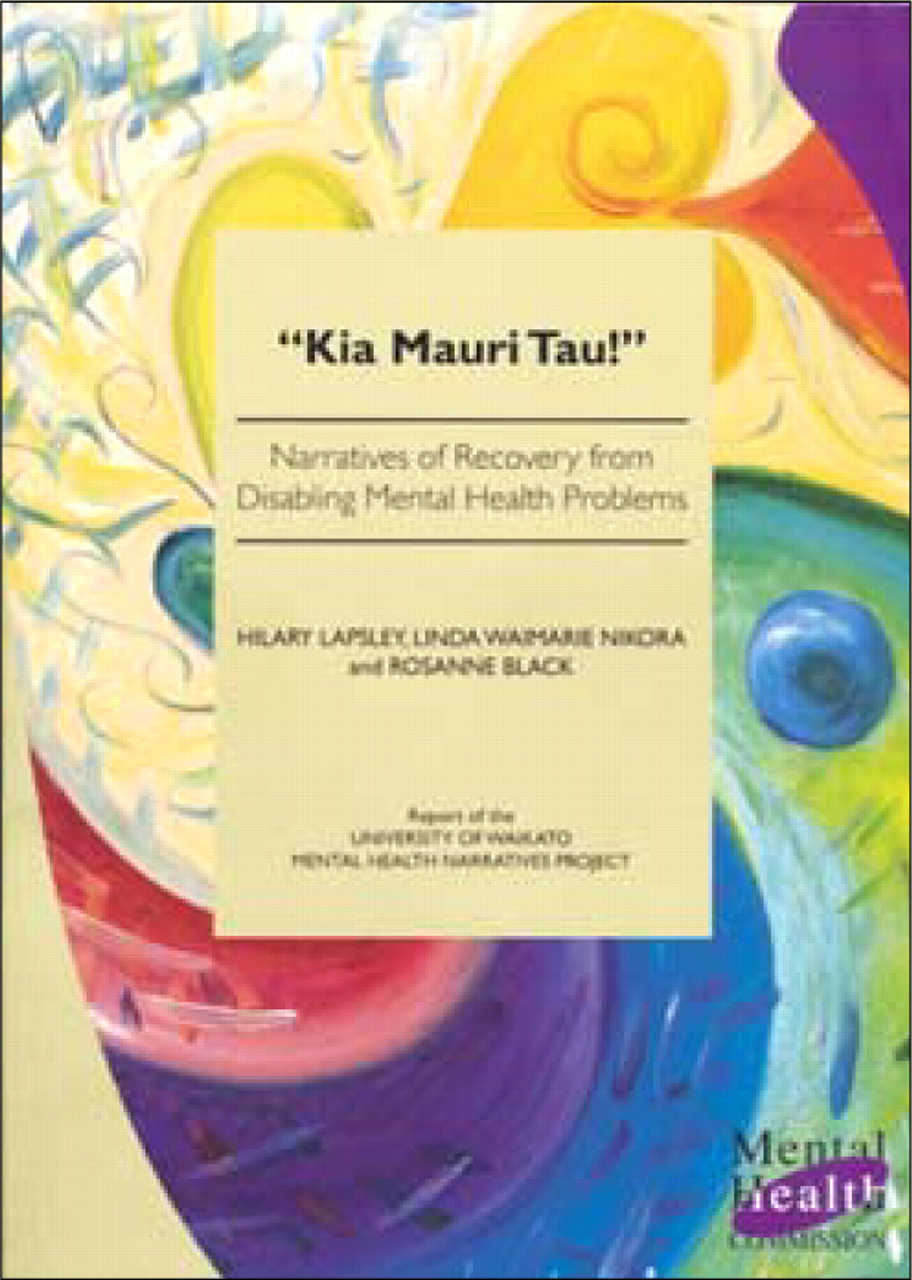
The Mental Health Commission in New Zealand has recently published “Kia Mauri Tau!”, Narratives of recovery from disabling mental health problems, which is the report of the University of Waikato Mental Health Narratives Project.
The authors, Hilary Lapsley, Linda Waimarie Nikora and Rosanne Black, interviewed 40 people who defined themselves as recovered about their lives before, during and after their experience of mental health problems.
In the words of Commissioner, Mary Hagan, “The Mental Health Commission has decided to publish Kia Mauri Tau! because we want the whole sector to benefit from this groundbreaking research. [This is] one of the best thematic accounts of mental health problems and recovery I have ever seen. It is a bicultural project based in New Zealand, when most recovery literature is written by white people from other countries. It honours the experience of the people who told their stories by taking them at their word. And its findings shed new light on the tempestuous and triumphant journeys of many thousands of New Zealanders. This is why everyone with an interest or involvement in mental health issues should read it.”
Copies of the document are available from the Mental Health Commission, PO Box 12479, Wellington, New Zealand. Email