






Abstract
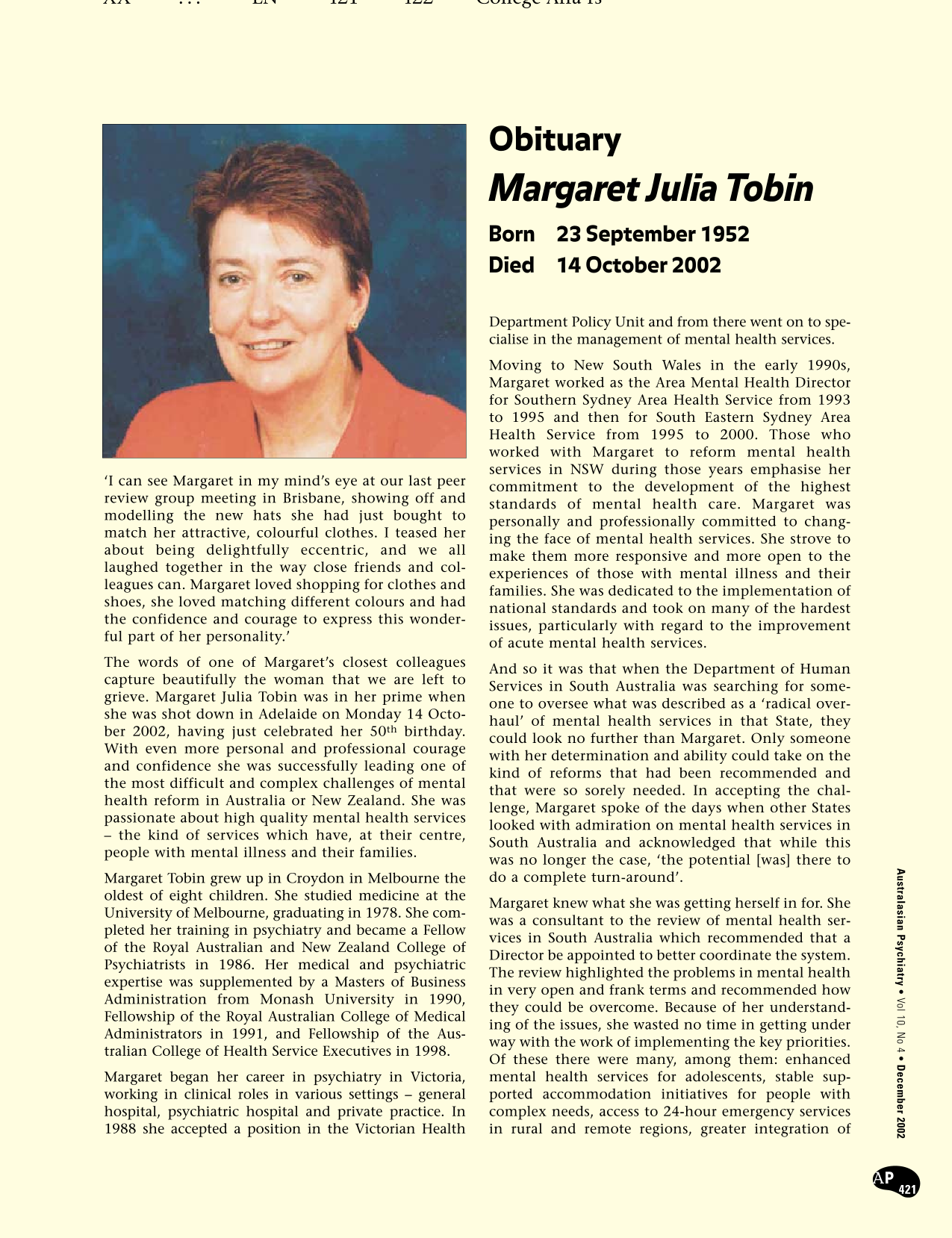
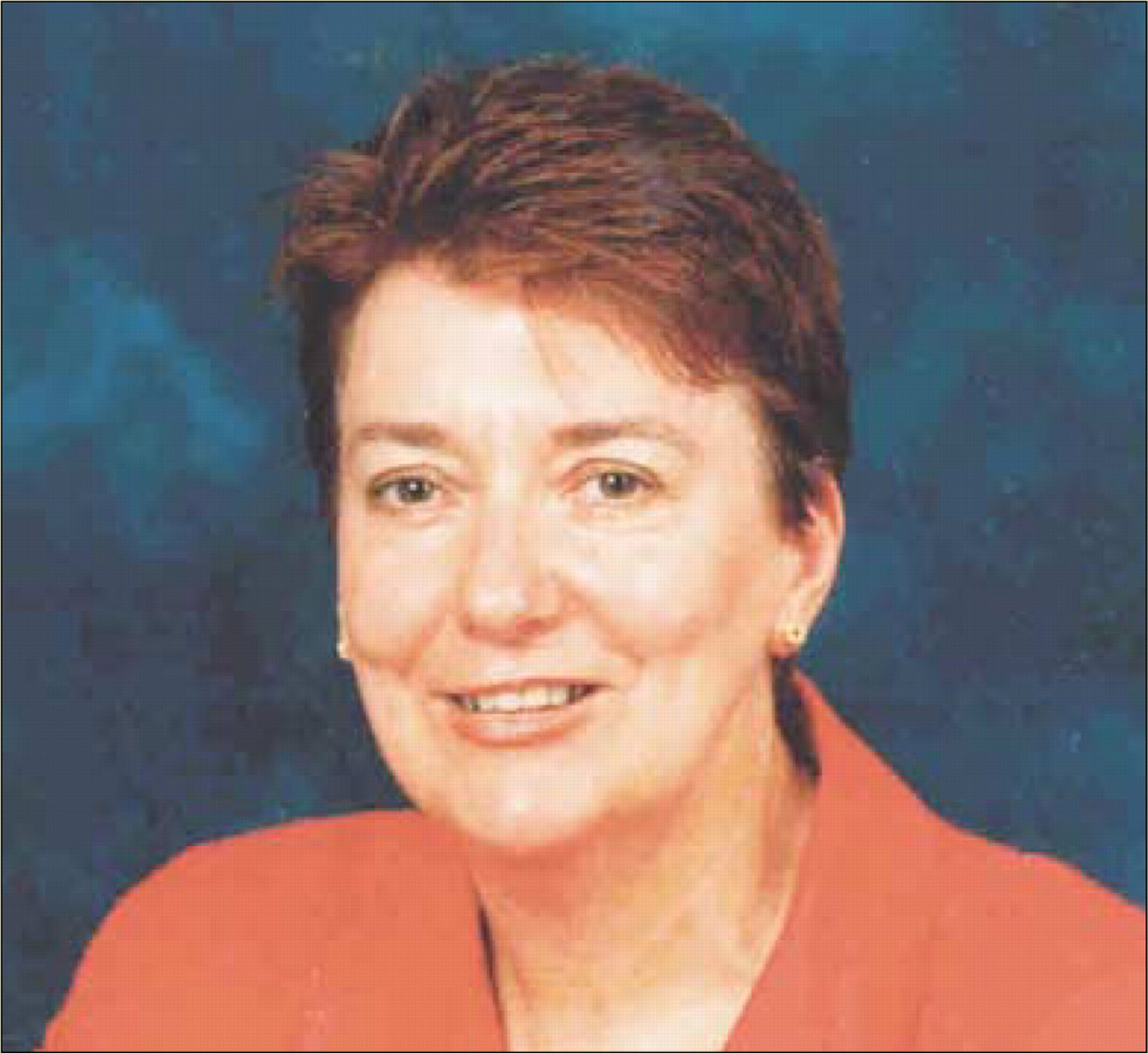
‘I can see Margaret in my mind's eye at our last peer review group meeting in Brisbane, showing off and modelling the new hats she had just bought to match her attractive, colourful clothes. I teased her about being delightfully eccentric, and we all laughed together in the way close friends and colleagues can. Margaret loved shopping for clothes and shoes, she loved matching different colours and had the confidence and courage to express this wonderful part of her personality.’
The words of one of Margaret's closest colleagues capture beautifully the woman that we are left to grieve. Margaret Julia Tobin was in her prime when she was shot down in Adelaide on Monday 14 October 2002, having just celebrated her 50th birthday. With even more personal and professional courage and confidence she was successfully leading one of the most difficult and complex challenges of mental health reform in Australia or New Zealand. She was passionate about high quality mental health services – the kind of services which have, at their centre, people with mental illness and their families.
Margaret Tobin grew up in Croydon in Melbourne the oldest of eight children. She studied medicine at the University of Melbourne, graduating in 1978. She completed her training in psychiatry and became a Fellow of the Royal Australian and New Zealand College of Psychiatrists in 1986. Her medical and psychiatric expertise was supplemented by a Masters of Business Administration from Monash University in 1990, Fellowship of the Royal Australian College of Medical Administrators in 1991, and Fellowship of the Australian College of Health Service Executives in 1998.
Margaret began her career in psychiatry in Victoria, working in clinical roles in various settings – general hospital, psychiatric hospital and private practice. In 1988 she accepted a position in the Victorian Health Department Policy Unit and from there went on to specialise in the management of mental health services.
Moving to New South Wales in the early 1990s, Margaret worked as the Area Mental Health Director for Southern Sydney Area Health Service from 1993 to 1995 and then for South Eastern Sydney Area Health Service from 1995 to 2000. Those who worked with Margaret to reform mental health services in NSW during those years emphasise her commitment to the development of the highest standards of mental health care. Margaret was personally and professionally committed to changing the face of mental health services. She strove to make them more responsive and more open to the experiences of those with mental illness and their families. She was dedicated to the implementation of national standards and took on many of the hardest issues, particularly with regard to the improvement of acute mental health services.
And so it was that when the Department of Human Services in South Australia was searching for someone to oversee what was described as a ‘radical overhaul’ of mental health services in that State, they could look no further than Margaret. Only someone with her determination and ability could take on the kind of reforms that had been recommended and that were so sorely needed. In accepting the challenge, Margaret spoke of the days when other States looked with admiration on mental health services in South Australia and acknowledged that while this was no longer the case, ‘the potential [was] there to do a complete turn-around’.
Margaret knew what she was getting herself in for. She was a consultant to the review of mental health services in South Australia which recommended that a Director be appointed to better coordinate the system. The review highlighted the problems in mental health in very open and frank terms and recommended how they could be overcome. Because of her understanding of the issues, she wasted no time in getting under way with the work of implementing the key priorities. Of these there were many, among them: enhanced mental health services for adolescents, stable supported accommodation initiatives for people with complex needs, access to 24-hour emergency services in rural and remote regions, greater integration of mental health services within a regional network, and provision of training and education support to attract and maintain an effective mental health workforce.
Margaret started work at the Department of Human Services on 31 July 2000. In the two short years that she had been in the role, her endeavours were just starting to bear fruit. She has achieved so much in such a short time. There was so much more to do. She was on a roll, she was going to continue to make a significant difference to the lives of people. Her death is such a loss and such a waste.
With what appeared to be boundless energy, Margaret brought her rare set of clinical and management skills to her involvement in a wide range of national and international issues – as a Fellow of our College, as a manager, as a public servant and as a citizen. She was widely published in national and international journals covering the subjects of quality improvement, organisational restructuring and change management in mental health services. Over the years, she had obtained several independent funding grants to develop new models of service in mental health and had a special interest in the application of academic and research method to practical service delivery.
One of her abiding interests was the development of leadership in the field of mental health. She was a great role model and example of a modern mental health leader. She always had time for teaching and mentoring of others. In remembering Margaret in recent days, even those who did not know her well have commented on her generosity – readily giving of her time and expertise to those who sought her counsel. She would always make time to listen, offer advice, provide support.
Margaret was one of few in mental health who wrote explicitly about leadership – interpersonally, intellectually and within human service systems. She included in her thinking the perspective of other disciplines. She engaged not just with like-minded or same-discipline peers, but with the whole of the system. She attempted to describe best practice. She was sometimes contentious, always outspoken.
For the College, she completed a project on leadership and management of health services which will change the culture of our organisation and set the framework for the development of our young leaders of the future. She contributed to College life in many other ways too – as chair of the College's Quality Improvement Committee and as a member of our Board of Practice Standards.
Margaret was someone who always made an impact. She was sometimes the one to do and say what was unpopular, too difficult – but there was never anyone asleep at her committee table. Some have described observing in her an impatience. We admired this quality and always left her company with the same sense that there were things to be done – yesterday! She had a determination and an interest that were instantly recognisable – an authenticity, that left a mark on all who came into contact with her.
Australia was not the only country to benefit from Margaret's expertise in the leadership of mental health. Between 1997 and 2000 she facilitated skill development workshops for senior managers in the New Zealand Health Services. She also gave invaluable advice and direction to an innovative project run by the Mental Health Commission in New Zealand on best practice health system management. Those who participated reported that the empowerment of mental health professionals, consumers and families that resulted from the initiative was very exciting.
In speaking publicly to mark World Mental Health Day 2002, Margaret referred to mental health as ‘everybody's business' and looked forward to a time when mental illness could be discussed with the same openness and understanding as we currently discuss many other forms of illness, such as diabetes. Only by eliminating the stigma associated with mental illness, Margaret argued, will people stop ‘seeing it as something to be worried, frightened or ashamed about’.
Above all Margaret was a pragmatist. She would not want her death to slow down or stifle the changes and innovations which are so necessary for people with mental illness to have better lives. In her work, Margaret was many things to many people, but she was also a wife, a daughter, a sister, an aunt. She was the dearly loved and loving wife of Don; the beloved daughter of Jean and the late Joseph; and loved sister, sister-in-law and aunt of Helena, Bernadette, Patrick, Peter, Mary, Catherine, Damian and Gerard (deceased) and their families. Our thoughts are with all of her family and friends, as they are trying to make sense of and come to terms with a most personal and intense loss.
There are no words to express the sadness, the utter waste of this tragedy. We will miss Margaret terribly for her support, her clear thinking about and analysis of complex social issues, her ability to articulate the way forward. But mostly we will miss her for her passion, her humour, her forthrightness, her sense of fun and of the absurd. We were all looking forward to another spirited encounter across a committee table on another day. That day will never come and we will never have another like her. Here's to Margaret.