






Abstract
Present
Dr Wayne Miles (President in the Chair), Dr Johanna Lammersma (Honorary Secretary), and 140 Fellows. Miss Gabrielle FitzGerald (Acting Executive Director) and staff of the College were in attendance to assist with the meeting.
1 APOLOGIES
The following apologies were received:
Dr Chris Branson, Dr Michael Duke, Dr Peter Eisen, Prof Peter Ellis (NZ), Dr Ronald Field, A/Prof Norman James, Dr Tony McCallum, Prof George Mendelson, Dr Tony McCallum, Dr Jonathan Phillips (NSW), Prof Beverley Raphael, Dr Wilfred Richards, Prof Graeme Smith, Prof John Tiller, Dr Janice Wilson.
2 OBITUARIES
The President announced the death of the following members since the last Annual General Meeting and Fellows stood in respectful silence:
Dr David Barlow (Vic), Dr John Sydney Blow (NSW), Dr Kenneth Henry Dyball (NSW), Prof Larry Evans (Qld), Dr Charles Steele Haughton (Vic), Dr Clifford George Judge (Vic), Dr David Morgan (NSW), Dr Roy Charles Muir (NZ), Dr Irene Phillips (Qld), Dr James (Bert) Prior (NSW), Dr Patrick Savage (NZ), Dr Catherine Thom (NSW), Dr Margaret Tobin (SA).
3 MINUTES OF 2002 ANNUAL GENERAL MEETING
Copies of the minutes as printed in Australasian Psychiatry 2002; 10(4): 418–20 (December 2002) for the 2002 Annual General Meeting of The Royal Australian and New Zealand College of Psychiatrists, held in Brisbane on 30 April 2002, were circulated to the meeting.
4 REPORTS OF OFFICERS OF THE COLLEGE
4.1 Report of the President
The President, Dr Miles, advised an item of new business on the suitability of the Governor-General as patron of the College. W Miles reported that General Council had discussed this matter and agreed that Dr Peter Hollingworth was no longer a suitable patron for the College. He asked that members respect the Executive Officers' decision not to become part of the current media circus and advised that the Executive Officers had communicated directly with Dr Hollingworth and the Prime Minister. W Miles asked that members treat this matter with confidentiality. He then referred the meeting to his written report in the 2002 Annual Report previously circulated by mail to all members.
4.2 REPORT OF THE HONORARY SECRETARY
Dr Lammersma referred the meeting to her written report as Honorary Secretary as printed in the 2002 Annual Report previously circulated by post to all members.
4.3 Report of the Chair, Fellowships Board
The President conveyed the apology of the Chair of the Fellowships Board, Prof Ellis, and referred the meeting to the report of the Fellowships Board and its committees, as printed in the 2001 Annual Report previously circulated by post to all members.
4.4 Report of the Chair, Board of Practice Standards
Dr Mayne referred the meeting to the report from the Board of Practice Standards and its committees, as printed in the 2002 Annual Report previously circulated by post to all members.
The President then paid tribute to Dr Mayne on the completion of his term as Chair of the Board of Practice Standards. He thanked Dr Mayne for his many years of work for the College as both a General Councillor and Board Chair. W Miles stated that during his term as Chair Dr Mayne had turned a small Board into a highly creditable and functional unit. The President proposed a vote of thanks to Dr Mayne which was endorsed with acclamation.
5 ANNUAL ACCOUNTS
Dr Rodney referred the meeting to his report as Honorary Treasurer and to the Financial Report for the year ended 31 December 2002, together with the reports of the Directors and Auditors thereon and the Directors' Statement. He advised that the College was in a robust financial state despite the vagaries of the equity market. Dr Rodney advised that the large surplus from previous years had protected the College during the last financial year and there would be no subscription increase. He advised that a surplus was expected for 2004.
The Treasurer was asked a question relating to the College's investment portfolio and whether it included investment in companies associated with Australasian Correctional Management. Dr Rodney advised that the College attempts to vet closely the companies in which we invest.
J Rodney moved that the financial report for 2002 be accepted, this was seconded by Dr Victor Stom and carried by the meeting.
6 BUSINESS ARISING
6.1 MOPS
The President invited Dr Nigel Prior as Chair of the MOPS Development Committee to report.
Dr Prior advised that following the motion passed at AGM 2002 that the compulsory introduction of the MOPS program be postponed until:
a wide consultation with College Fellows is undertaken by the College Council; and a report of this consultation is widely disseminated to College members; and then the Council votes to endorse a compulsory MOPS type program
The MOPS Development Committee had been charged with taking action on this resolution. Dr Prior advised that the Committee had conducted a survey of all Fellows. The survey achieved a 30% response rate and the majority view was that a flexible continuous professional development (CPD) model be adopted and that that there should be a name change from MOPS to CPD. The recommendation from the MOPS Committee and the Board of Practice Standards is that CPD not be made compulsory. Dr Prior advised that General Council (GC2003/1) had endorsed this view.
Prof Philip Morris stated that he had spoken to the motion last year and expressed his thanks to Dr Prior for the wonderful job he had done as Chair of the Committee. Prof Morris advised that he had been invited to be a member of the Committee and stated that the survey was an example of an effective consultation process. He stated that he was looking forward to working with Dr Prior and the Committee to implement the new program.
A question was raised from the floor on the comparison of the proposed College CPD program with other Colleges. Dr Prior advised that it was on a par with Australian and United States programs that recommend 50 hours per year of CPD and provide a broad range of activities. He advised that apart from the Royal Australian College of Obstetricians and Gynaecologists all CPD programs are voluntary. Dr Prior advised that the College already has an 85% participation rate in MOPS.
Dr Prior was asked a question about provisions for isolated practitioners. Dr Prior advised that this will be addressed in the detail of the program and there is the capacity for using technology such as internet-based activities and teleconferencing. He stated that the program will be made as flexible as possible. Dr Prior then thanked Dr Clive Allcock who will now take over as Chair of the MOPS Development Committee.
Dr Rodney stated that Prof Gordon Parker, as original Chair of the QI Committee, had been responsible for the instigation of the MOPS program and thanked and congratulated him on a process that had taken many years to come to fruition. This was endorsed with acclamation.
The President invited those present to show their appreciation for the work of the MOPS Committee and the meeting responded with acclamation.
6.2 Electoral Process
W Miles reported on action taken following the resolution at AGM 2002 that this Annual General Meeting requests the General Council 2002/2 approve the formulation of alterations to the College Articles of Association to allow election of the President by direct vote by all Fellows of the College, such alterations to the College Articles of Association to be put as a Special Resolution to the annual general meeting in 2003.
The President reported that General Council had considered that the best way forward with the resolution was to conduct a plebiscite of the Fellowship offering three options for the method of election of the President. He advised that the response rate of less than 30% had been considered not to give a clear direction to the Executive as to how to proceed and there had also been major procedural concerns about the way in which the plebiscite was conducted. W Miles advised that a special teleconference meeting of General Council had been held on 8 April 2003 and Council had agreed that they would not be fulfilling their governance role if action were taken based on such a small response rate. He advised that, in consultation with the proposer of the motion, a second, better-designed plebiscite would be conducted and the results brought to AGM 2004. W Miles stated that this would not impede the electoral cycle. He then presented the motions from the recent General Council meeting (GC2003/1).
A question was asked relating to the cost involved in a changed method of election. W Miles responded that there would be costs involved but this would not be possible to calculate until there was clarity on direction.
Prof Sid Bloch then addressed the meeting from the floor. Prof Bloch stated that the outcome from the AGM 2002 resolution had not been joyous and the issues it raised left him frustrated and dismayed. He requested that his comments be minuted to reflect how the College should not conduct itself in the future. Prof Bloch stated that he had been asked by the then CEO to explore methods of election used by the APA and the Royal College of Psychiatrists. He had carried out this task and provided the information to the CEO and had personally conveyed his findings to C Patterson who advised that he would consult with Australian and New Zealand Colleges. General Council, through the Executive Officers, in February 2003 decided to conduct the plebiscite which in Prof Bloch's opinion was a bit late. He also stated that the decision to poll Fellows on their least preferred option was done in an unfortunate way and caused confusion. S Bloch questioned the requirement for a 50% response rate outlined in the letter accompanying the plebiscite. He advised that he had consulted with solicitors and noted that a quorum for the AGM is only 20 people. S Bloch also stated that the plebiscite had not been anonymous although it was cheap and efficient. He then noted that a second letter signed by the President, Honorary Secretary and President-elect, had been sent to Fellows stating that unless a 50% response rate was received no further action would be taken on this matter and the current system would be retained. He advised that he had not been consulted on this and did not know if General Council had been consulted.
Prof Bloch reported that he had attended the counting of votes on 5 April 2003 and 725 ballot papers had been received. He stated that 6 out of 7 votes did not support the current system or having elected members of General Council elect the president. One in seven votes were opposed to all Fellows voting for election of the President.
Prof Bloch stated that in more recent developments a teleconference of General Council held one month ago decided to repeat the poll in a more professional fashion. He was then told by Victorian Branch Councillors that the 50% requirement would be waived with only the new options being put forward and not the status quo. He was advised that the poll would be secret and an external professional body would be employed to conduct the poll. Prof Bloch stated that one year had been wasted and the unfortunate example of the threat to abandon the exercise spoke for itself. Prof Bloch advised the meeting that he would leave them to determine their own views of the sequence of events.
Prof Bloch further stated that at the AGM today in reading the third paragraph of the President's report it stated ‘I am aware there is a section of the College which sees the election of College officers as the most important issue confronting us. I have to say that I do not share that view. I suspect it is to some extent, anyway, driven by the notion that the President has power, can determine what the College is and what if does.’ Prof Bloch noted that the President is entitled to express his view but suggested he is not entitled to indicate that a section of the College views the method of election of the President as our most confronting issue. He stated that democratising the College is an important step, not necessary but essential, and democratic election of the President will be a symbolic watershed for the College and will show that we have acknowledged our maturity when it is achieved. Prof Bloch then repeated what he had said last year about democratic election of the President: 1) Fellows would have a voice in their organisation 2) The hallowed principles of democracy would be fulfilled and 3) A President elected by all Fellows would be accountable to all Fellows and not just to General Council. Prof Bloch concluded by proposing that we learn from the experience of the last 12 months and realise that the College cannot afford to conduct its affairs in ways that are unprofessional and make members feel demoralised. He noted that the membership is generally optimistic and a terrific group that does great things. He noted that there are terrific challenges ahead and recommended that the College concentrate on those challenges rather than squander time on these sort of issues.
Some questions were directed to the President on procedural issues to do with voting at AGMs.
The President then paid tribute to the monumental work done by the staff of the College. He stated that it was unfortunate that Craig Patterson had accepted a position in Sydney but noted the benefit the College had gained from his input. W Miles advised that the new CEO, Ms Sharon Brownie, would commence in early June. The President gave particular thanks to Angela Hill and Gabrielle FitzGerald for their efforts during the transition period and noted that they had been towers of strength to all, especially to the Honorary Secretary. This was endorsed with acclamation.
7 OFFICERS OF THE COLLEGE 2003–05
The President announced that following elections conducted at the General Council meeting 10-11 May 2003, the College Officers for the coming two years are as follows:
President Prof Phil Boyce (NSW)
Honorary Secretary Dr Johanna Lammersma (SA)
President-elect Dr Julian Freidin (Vic)
Honorary Treasurer Dr Jim Rodney (Qld)
Immediate Past President Dr Wayne Miles (NZ)
Chair, Fellowships Board Prof Peter Ellis (NZ)
Chair-elect, Fellowships Board 2003-04 Prof John Condon (SA)
Chair, Board of Practice Standards Dr Nigel Prior (Qld)
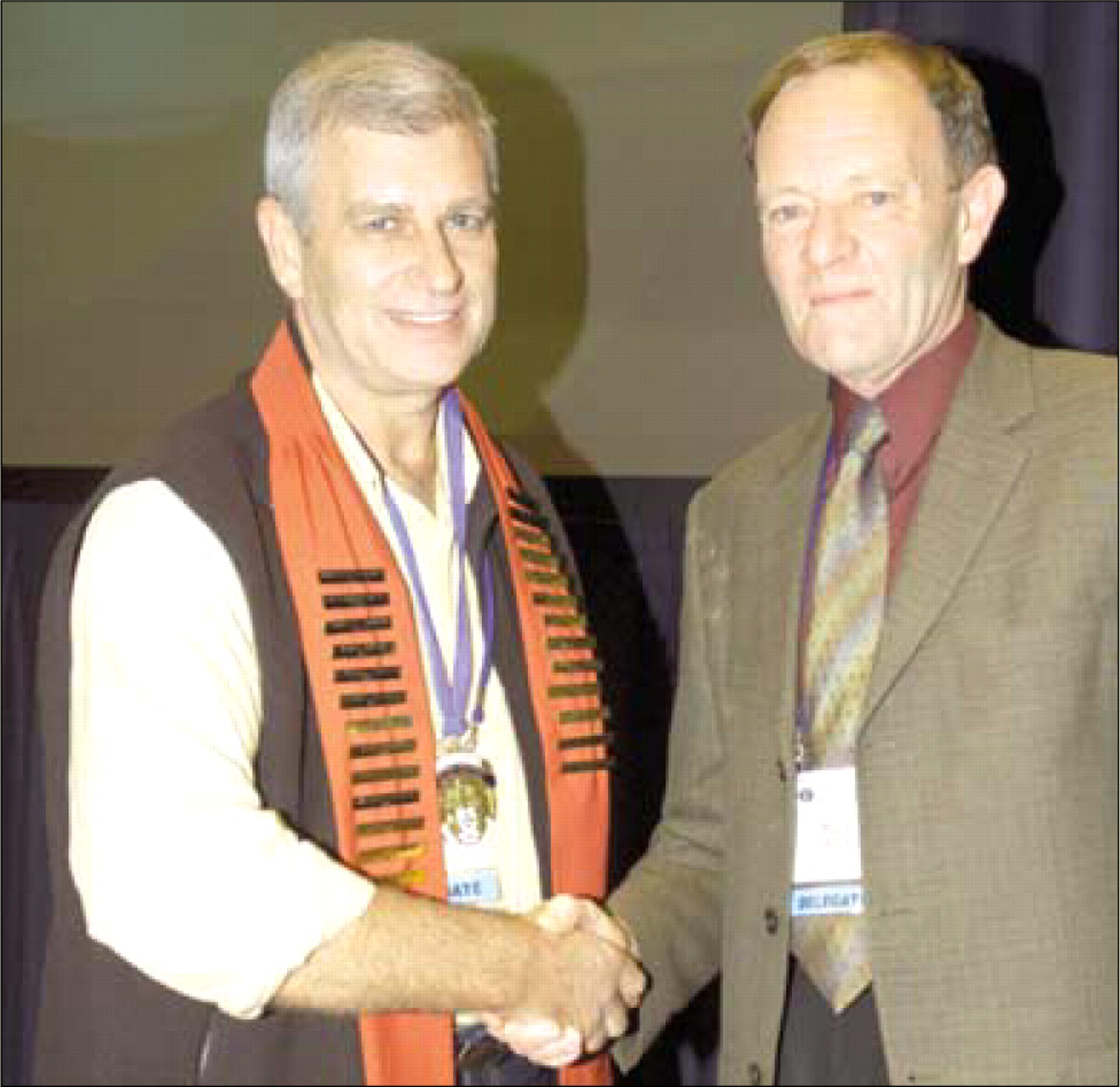
Dr Wayne Miles (R) handing over the Presidency of the College to Professor Philip Boyce (L).
Footnotes
Acknowledgements
The President informed members that this AGM marked the retirement from General Council of Dr Jonathan Phillips, Immediate Past President. The President paid tribute to the input given by Dr Phillips during his term on General Council and for the help he had given W Miles. The President stated that Dr Phillips has a wealth of knowledge about organisations and had moved the College forward during his term making his own job easier. He wished Dr Phillips well in his move from the private to the public sector and stated that we would continue to watch his input to the CPMC. The President presented a token of appreciation to Dr Carolyn Quadrio on behalf of Dr Phillips which was endorsed with acclamation.
The President invited Prof Boyce on to the stage stating that his role as President had commenced a few years ago and thanked him for his help. He noted that Prof Boyce has the ability to see the big issues and wished him well for his Presidency. Prof Boyce's inauguration was warmly applauded.
Prof Boyce assumed the chair and thanked W Miles for his leadership over the past two years. He stated that under W Miles' leadership the College has become more inclusive and more relevant. On a personal note he thanked W Miles for his friendship and mentorship. Prof Boyce then presented W Miles with the Past President's Plaque.
Prof Boyce thanked members for their attendance and declared the meeting closed at 4.35pm.