






Abstract
It had been so clear on day one. Archived photographs and images had tremendous value if they could be efficiently digitized and catalogued. Sports promoters and publishers had stores of archived information, most of it inaccessible to those who wanted it. Owners and fans represented only part of the untapped markets that the Internet and digital technology could serve. She had conceived a simple business model: digitize documents using the latest technology, tag them with easy–to–read labels, and link them to search engines for easy retrieval and widespread use. But over the ensuing months so many factors affected the look, feel, and substance of the company that Artemis Images would become.
So many things seemed outside her control that she wondered how she could have been so sure of herself back in February of 1999. Enthusiastically, Chris had approached a number of friends and acquaintances to help in the formation of a new “dot–com” company that seemed a sure bet. Frank Costanzo, a former colleague from Applied Graphics Technologies (AGT), shared Chris's enthusiasm, as did long–time friend George Dickert. George, in turn, contacted Greg Hughes, who was enrolled in a business planning course. Grateful for the opportunity to help launch a real company, Greg took the idea and honed it as part of a class assignment. The plan was a confirmation of Chris's confidence in the venture. But as she looked over the original plan, she knew there was a lot of work yet to do. Greg understood the business idea, but he didn't understand the work involved to actually run a business. George and Frank understood digital technology and project management, but, like Chris, had never launched, much less worked for, a start–up company. Chris knew that she had the technology and talent she needed and felt confident that the four friends could construct a business model that would put Artemis ahead of the current image providers. Greg's business plan looked like the perfect vehicle to appeal to investors for the funds they needed to proceed.
The Business Idea
In 1999, Chris had been working for three years as VP–Sales out of the Colorado office of AGT, a media management company that provided digital imaging management and archiving services for some of the largest publishers and advertisers in the world. AGT had sent Chris to Indianapolis to present a content management technology solution to the Indianapolis Motor Speedway Corporation (IMSC) as it prepared marketing materials for the 2001 Indy 500. IMSC is the host of the 80+–year old Indy 500, the largest single day sporting event in the world, NASCAR's Brickyard 400, the second largest single day sporting event in the world, and other events staged at the track. Chris's original assignment was a clear one: IMSC needed to protect its archive of photographs, many of which had begun to decay with age. The archive included five to seven million photographs and dynamically rich multimedia formats of video, audio and in–car camera footage.
Chris discovered that the photo archives at IMSC were deluged with requests (personally or via letters) from fans requesting images. She was amazed that a relatively unknown archive had generated nearly $500,000 in revenues in 1999 alone. Further discussions with IMSC researchers revealed that requests often took up to 2 weeks to research and resulted in a sale of only $60–$100. However, IMSC was not in a position, strategically or financially, to acquire a system to digitize and preserve these archives. Not willing to leave the opportunity on the table, Chris asked herself, “What is the value of these assets for e–commerce and retail opportunities?” Without a doubt, IMSC and some of her other clients (Conde Nast, BBC, National Motor Museum) would be prime customers for digitization and content management of their collections.
Chris knew that selling photos on the Internet could generate substantial revenue. She conceived of a business model where the system would be financed through revenue–sharing, rather than the standard model where the organization paid for the system up front. IMSC was interested in this arrangement but it was outside the normal business practices of AGT. AGT wanted to sell systems, not give them away. They couldn't see the value of managing other organizations’ content.
As Chris told the story, her visit to the archives at IMSC was her “Jerry Maguire” experience. In the movie, Jerry is sitting on the bed when everything suddenly becomes clear and now he must pursue his dream. Like Jerry, Chris believed so passionately that her idea would bear fruit that, when AGT turned down Chris's request for the third time, she quit her job to start Artemis Images on her own.
Building a Team
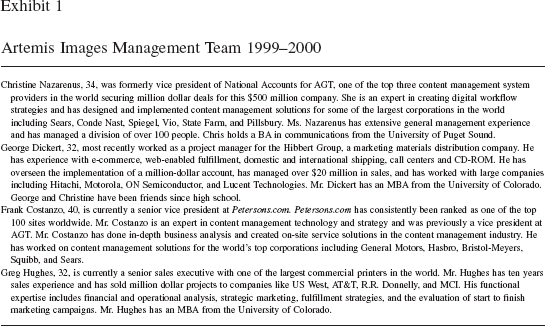
When AGT was not interested in Chris's idea of on–site digitization and sale of IMSC's photo archives, Chris was not willing to walk away from what she saw as a gold mine. She contacted her friends and colleagues from AGT. Swept up in the dot–com mania, Chris named her company “e–Catalyst.” e–Catalyst was incorporated as an Sc–orporation on May 3, 1999 by a team of four people: Christine Nazarenus, George Dickert, Frank Costanzo, and Greg Hughes. (See Exhibit 1 for profiles of these partners.) Expecting that they would each contribute equally, each partner was given a 25% interest in the company. Chris fully expected them to work as a team, so no formal titles were assigned, largely as a statement to investors that key additions to the team might be needed and welcomed. As another appeal to potential investors—and to broaden the team's expertise—Chris and George put together a roster of experts with content management, systems and technology experience as their first advisory board. Greg's professor and several local business professionals agreed to serve on the board of advisors, along with an Indy 500 winning driver–turned–entrepreneur, and Krista Elliott Riley, president of Elliott Riley, the marketing and public relations agency that represented Indy 500 and Le Mans Sports Car teams and drivers. Chris felt confident that her team had the expertise she needed to launch a truly world–class company.
Artemis Images Management Team 1999–2000
Chris and George quit their jobs and took the challenge of building a company seriously. They contacted one of the Rocky Mountain region's oldest and most respected law firms for legal advice. They worked with two lawyers, one who specialized in representing Internet companies as general counsel and one who specialized in intellectual property rights. With leads from her many contacts at AGT, Chris contacted venture capitalists to raise money for the hardware, software licensing, and personnel costs of launching the business.
The dot–com bust of 2000 did not make things easy. Not wanting to look like “yet another dot–com” in search of money to throw to the wind, Chris and her team changed their name to Artemis Images. Artemis, the Greek goddess of the hunt, had been the name of Chris's first horse as well as her first company, Artemis Graphics Greeting Cards, her first entrepreneurial dabble at the age of 16. Chris had always been enthralled with beautiful images.
Artemis Images's Niche
In her work at AGT, Chris had observed that many organizations had vast stores of intellectual property (photos, videos, sounds, and text), valuable assets often underutilized because they exist in analog form and may deteriorate over time. Chris's vision was to preserve and enable the past using digital technology and the transportability of the World Wide Web. Chris envisioned a company that would create a digitized collection of image, audio, and video content that she could sell to companies interested in turning their intellectual property into a source of revenue.
Publishers and sports promoters were among the many organizations with large collections of archived photos and videos. Companies like Boeing, General Motors, and IMSC are in the business of producing planes, cars, or sporting events, not selling memorabilia. However, airplane, car, and sports fans are a ready market for photos of their favorite vehicle or videos of their favorite sports event.
Proper storage and categorization of archived photos and videos is complex and expensive. In 2000, the two common solutions were to sell the assets outright or to set up an in–house division devoted to managing and marketing them. Most organizations were unwilling to sell their assets, as they represented their priceless brand and heritage. Purchasing software and hiring specialized personnel to digitize and properly archive their assets was a costly proposition that lay beyond the core competence of most companies. Chris's work with AGT convinced her that there were literally thousands of companies with millions of assets that would be interested in a company that would digitize and manage their photo and video archives.
Chris understood a company's resistance to selling its archives, and the high cost of obtaining and scanning select images for sale. However, she also understood the value to an organization of having its entire inventory digitized, thus creating a permanent history for the organization. She proposed a revenue sharing model whereby Artemis Images would digitize a client's archives but would not take ownership. Instead, her company would secure exclusive license to the archive, with 85% of all revenue retained by Artemis Images, and 15% paid to the archive owner. She expected that the presence of viewable archives on the Artemis Images website would lure buyers to the site for subsequent purchases.
The original business model was a “B2C” (business–to–consumer) model. Starting with the IMSC contract, Artemis Images would work with IMSC to promote the Indy 500 and draw the Indy race fans to the Artemis Images website. Photos of the current–year Indy 500 participants—and historical photos including past Indy participants, winners, entertainers, celebrities (e.g. Arnold Palmer on the Indy golf course)—would be added to IMSC's archived images and sold for $20–$150 apiece to loyal fans. A customer could review a variety of photo options on the Artemis website, then select and order a high–resolution image. The order would be secured through the web with a credit card, the image transferred to the fulfillment provider and a hard copy mailed to the eager recipient. The website was sure to generate revenue easier than IMSC's traditional sales model of the past.
Having established the model with IMSC content in the auto racing market, Chris and George built the business plan around obvious market possibilities that might appeal to a wider range of consumers and create a comprehensive resource for stock photography. Since the Artemis Images team had prior business dealings with two of the three largest publishers in the world, publishing was the obvious target for future contracts. Future markets would be chosen similarly, where the Artemis team had established relationships. These markets would be able to build on the archive already created and would bring both consumer–oriented content and saleable stock images. Greg made a list of examples of some industries and the content that they owned:
Sports: images of wrestling, soccer, basketball, bodybuilding, football, extreme sports
Entertainment: recording artists, the art from their CDs, movie stars, pictures of events, pictures from movie sets
Museums: paintings, images of sculpture, photos, events
Corporations: images of food, fishing, planes, trains, automobiles
Government: coins, stamps, galaxies, satellite imaging
As Chris and George worked with Greg to put together the business plan, they began to see other revenue–generating opportunities for their virtual–archive company. Customers going to IMSC or any other Artemis client's website would be linked to Artemis Images's website for purchase of photos or videos. Customer satisfaction with image sales would provide opportunities to sell merchandise targeted to specific markets and to syndicate content to other websites. For motorsports, obvious merchandise opportunities would include t–shirts, hats, and model cars. For landscapes it might be travel packages or hiking gear. Corporate customers might be interested in software, design services or office supplies. Unique content on Artemis Images's website could be used to draw traffic to other companies’ sites. Chris and her team planned to license the content on an annual basis to these sites, creating reach and revenues for Artemis Images.
Another potential market for Artemis Images lay in the unrealized value of the billions of images kept by consumers worldwide in their closets and drawers. These images were treasured family heirlooms which typically sat unprotected and under–utilized. Consumers could offer their photographs for sale, or simply pay for digitization services for their own use. If just 10% of the U.S. population were to allow Artemis Images to digitize their archive and half of these people ordered just one 8″× 10″ print, Artemis Images could create a list of 25 million consumers and generate revenues of approximately $250 million. Because images suffer no language barriers, the worldwide reach of the Internet and the popularity of photography suggested potential revenues in the billions.
Working together on the business plan, the Artemis team brainstormed ways they could attract customers to the Artemis Images site by providing unique content and customer experiences. A study by Forrester Research analyzed the key factors driving repeat site visits and found that high–quality content was cited by 75% of consumers as the number one reason they would return to a site. The Artemis team wanted to create a community of loyal customers through additional unique content created by the customers themselves. This would include the critical chats and bulletin boards that are the cornerstone of any community–building program. Artemis Images could continuously monitor this portion of the site to add new fan experiences to keep the experience “fresh.” Communities would be developed based on customer interests.
As the company gained clients and rights to sell their archived photos and videos, Artemis would move toward a “B2B” (business–to–business) model. Chris and George knew marketing managers at National Geographic, CMG World Wide, the BBC, Haymarket Publishing (includes the Formula 1 archive), Conde Nast and International Publishing Corporation. These large publishers controlled and solicited a wide range of subject matter (fashion, nature, travel, hobbies, etc.) yet often had little idea of what existed in their own archives, or had difficulty in getting access to it. Finding new images was usually an expensive and time–consuming proposition. Artemis Images could provide the solution. For example, Conde Nast (publisher of Vogue, Bon Appetit, Conde Nast Traveler, House & Garden, and Vanity Fair) might like a photo for its travel magazine from the National Geographic archives. They would be willing to pay top dollar for classic stock images, given the number of viewers who would see the image. Price–per–image was typically calculated on circulation volume, much like royalty fees on copyrighted materials. Similarly, advertising agencies use hundreds of images in customer mockups. For example, an agency may desire an image of a Pacific island. If Artemis Images held the rights to Conde Nast and National Geographic, there might be hundreds of Pacific island photos from which to choose. As with the B2C concept, a copy of the image would be transferred through the web with a credit card or on account, if adequate bandwidth were available (only low resolution images would be available to view initially), or via overnight mail in hard copy or on disk.
The transition from B2C to B2B seemed a logical progression, one that would amass a large inventory of saleable prints and, at the same time, draw in larger per–unit sales. The basic business model was the same. Artemis would archive photos and videos that could be sold to other companies for publication and promotion brochures. Chris and George expected that this model could be replicated for other vertical markets including sports, nature, entertainment, and education.
While the refocus on the B2B market seemed a surer long–term revenue stream for the company, both B2B and B2C were losing favor with the investing community. Chris and George refocused the business plan as an application service provider (“ASP”). With the ASP designation, Artemis Images could position itself as a software company, generating revenue from the licensing of its software processes. In 2000, ASPs were still in favor with investors.
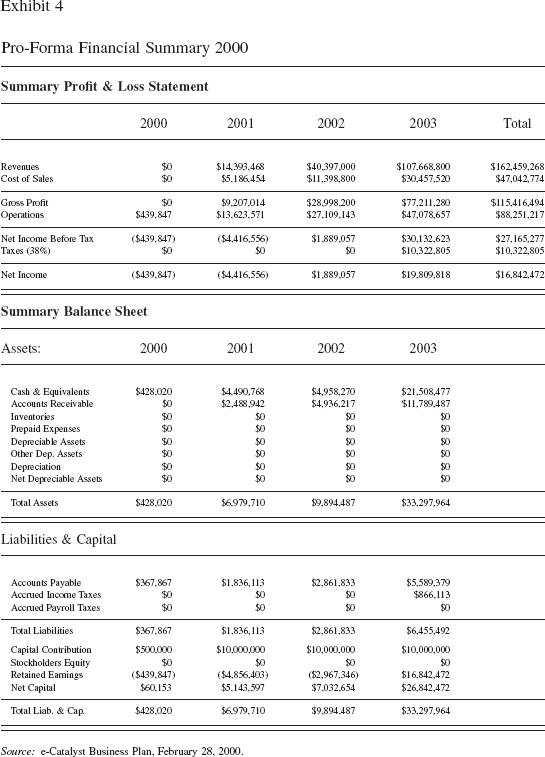
Artemis Images's revenue would come from three streams: (1) sales of images to businesses and consumers, (2) syndication of content, and (3) sales of merchandise. Projected sales were expected to exceed $100 million within the first four years, with breakeven occurring in year three. (See Exhibits 2, 3 and 4 for projected volume and revenues.)
Anticipated Sales Volume and Onsite Operations
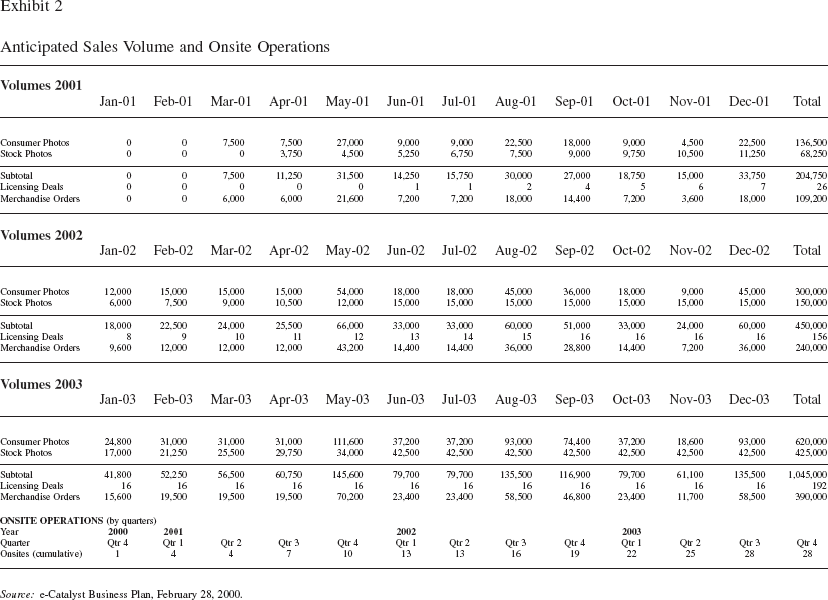
Source: e–Catalyst Business Plan, February 28, 2000.
Projected Monthly Revenue Stream
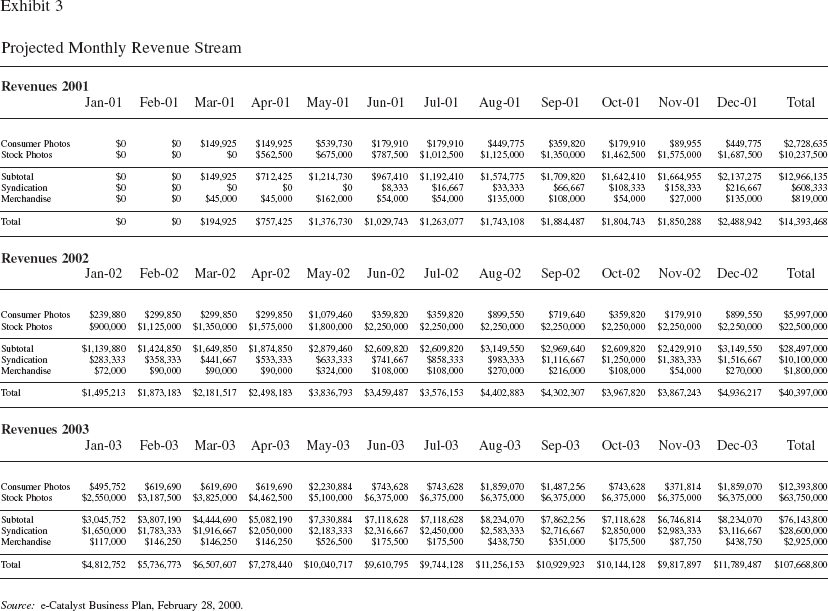
Source: e–Catalyst Business Plan, February 28, 2000.
Pro–Forma Financial Summary 2000
Source: e–Catalyst Business Plan, February 28, 2000.
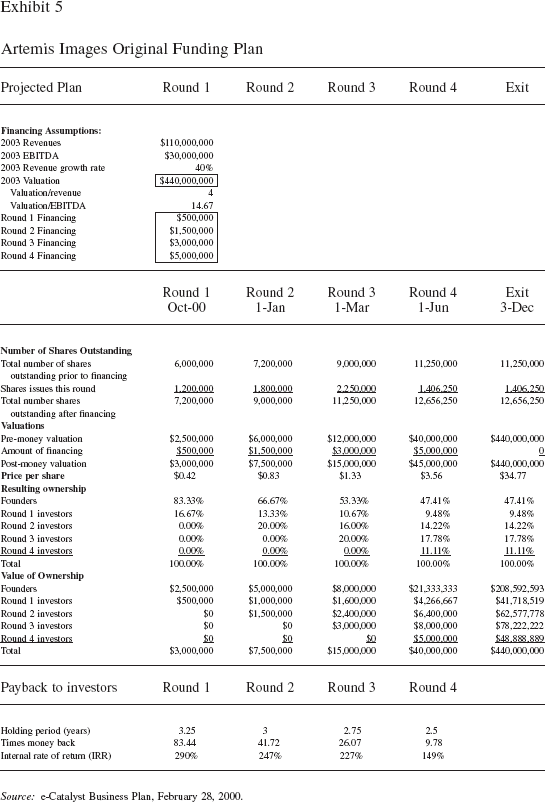
To implement this strategy, Artemis Images, Inc. needed an initial investment of $500,000 to begin operations, hire the team, and sign four additional content agreements. A second round of $1.5 million and a third round of $3 million–$8 million (depending on number of contracts) were planned, to scale the concept to 28 archives and over $100 million in assets by 2004. (See Exhibit 5 for Funding and Ownership plan.)
Artemis Images Original Funding Plan
Source: e–Catalyst Business Plan, February 28, 2000.
The Content Management Industry
According to GISTICS, the trade organization for digital asset management, the content management market (including the labor, software, hardware, and physical assets necessary to manage the billions of digital images) was projected to be a $2 trillion market worldwide in the year 2000 (1999 Market Report). Content could include images, video, text and sound. Artemis Images intended to pursue two subsets of the content management market. The first was the existing stock photo market, a business–to–business market where rights to images were sold for limited use in publications like magazines, books and websites. Deutsche Bank's Alex Brown estimated this to be a $1.5 billion market in 2000. Corbis, one of the two major competitors in the digital imaging industry, estimated it to be a $5 billion market by 2000.
Commercially produced images were also in demand by consumers. Industry insiders believed that this market was poised for explosive growth in 2000, as web–enabled technology facilitated display and transmission of images directly from their owners to individual consumers. The archives from the Indianapolis Motor Speedway were an example of this business–to–consumer model. Historically, consumers who bought from the archive had to visit the museum at IMSC or write a letter to the staff. Retrieval and fulfillment of images then required a manual search of a physical inventory, a process that could take as long as two weeks. Web–based digitization and search engines would reduce the search time and personnel needed for order fulfillment, and allow customers the convenience of selecting products and placing orders online. The Daily Mirror, a newspaper in London, had displayed its archived images on its own website and had generated over $30,000 in sales to consumers in its first month of availability. IMG, a sports marketing group, placed a value of $10 million on the IMSC contract.
Competition
There were a variety of stock and consumer photo sites ranging from those that served only the business–to–business stock photo market to amateur photographers posting their pictures. Most sites did not offer a “community,” the Internet vehicle for consumer comments and discussion, a powerful search engine, and ways to re–purpose the content (e–greeting cards, prints, photo mugs, calendars, etc.). In addition, the archives available in digital form were limited because other content providers worked from the virtual world to the physical world versus the Artemis Images model of working from the physical world to the virtual world. Competitors had problems with integrated digital workflows and knowing where the original asset resided due to the distributed nature of their archives. They scanned images on demand, which severely limited the content available to be searched on their websites.
Chris and Greg evaluated the major competitors for their business plan:
http://www.corbis.com: Owned by Bill Gates with an archive of over 65 million images, only 650,000 were available on the web to be accessed by consumers for web distribution (e–greeting cards, screen savers, etc.). Only 350,000 images were available to be purchased as prints. The site was well designed and the search features were good, but there was no community on the site. The niche Corbis pursued was outright ownership of archives and scanning on demand. Corbis had recently acquired the Louvre archive, for a reported purchase price of over $30 million.
http://www.getty–images.com: An archive of over 70 million images. In 1999, this site was only a source to link to their other wholly owned subsidiaries including art.com. There were no search capabilities, no community. This website functioned only as a brochure for the company. Like Corbis, Getty was focused on owning content and then scanning on demand.
http://www.art.com: A good site in design and navigation, this site was a wholly owned subsidiary of Getty and was positioned as the consumer window to a portion of the Getty archive. Similar to Corbis, customers were able to buy prints, send e–greeting cards, etc. Despite the breadth of the Getty archive, this site had a limited number of digitized images available.
http://www.mediaexchange.com: Strictly a stock photo site targeted toward news sources, the site was largely reliant on text. It was difficult to navigate and had an unattractive graphical user interface.
http://www.thepicturecollection.com: Strictly a stock site offering the Time photo archive, this site was well designed with good search capabilities. Searches yielded not only a thumbnail image but a display of the attached locator tags, or metadata.
http://www.ditto.com: The world's leading visual search engine, ditto.com enabled people to navigate the web through pictures. The premise was twofold: deliver highly relevant thumbnail images and link to relevant websites underlying these images. By 2000, they had developed the largest searchable index of visual content on the Internet.
Exhibit 6 shows a comparison of Artemis Images to the two major players in the stock photography market, Getty and Corbis. This table illustrates only revenues from stock photo sales and does not include potential revenue from consumer sales, merchandise, advertising, or other potential revenue sources.
Anticipated Sales Volume Comparisons
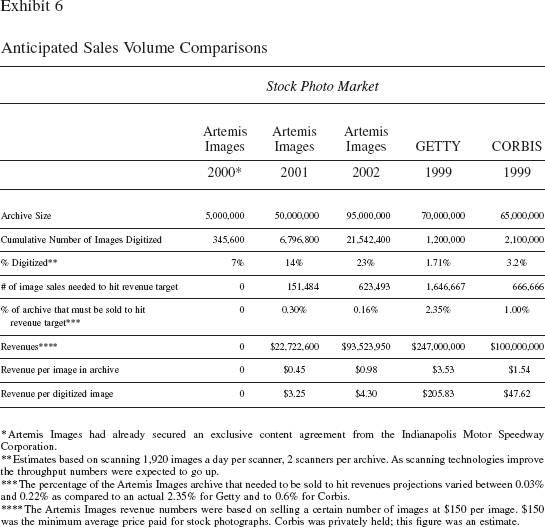
Artemis Images had already secured an exclusive content agreement from the Indianapolis Motor Speedway Corporation.
Estimates based on scanning 1,920 images a day per scanner, 2 scanners per archive. As scanning technologies improve the throughput numbers were expected to go up.
The percentage of the Artemis Images archive that needed to be sold to hit revenues projections varied between 0.03% and 0.22% as compared to an actual 2.35% for Getty and to 0.6% for Corbis.
The Artemis Images revenue numbers were based on selling a certain number of images at $150 per image. $150 was the minimum average price paid for stock photographs. Corbis was privately held; this figure was an estimate.
According to its marketing director, Corbis intended to digitize its entire archive, and was in the process of converting analog images into digital images, with 63 million images yet to be converted. While Getty and Corbis were established players in the content industry, they were just recently feeling the effects of e–commerce:
In 1999, Corbis generated 80% of its revenues from the web versus none in 1996
Getty's e–commerce sales were up 160% between 1998 and 1999
34% of Getty's 1999 revenues came from e–commerce vs. 17% in 1998
Strategy
Artemis Images intended to provide digitization and archive management by employing a professional staff who would work within each client–company's organization, rather than in an off–site facility of its own. Chris's model was to provide digitized archive services in exchange for (1) exclusive rights to market the content on the Internet, (2) merchandising rights, and (3) promotion of Artemis Images's URL, effectively co–branding Artemis Images with each client–partner. Chris envisioned a software process that would be owned or licensed by Artemis, and which could be used for digitizing different archive media, such as photos, videos, and text.
Chris and George expected Artemis Images to partner with existing sellers of stock photography and trade digitizing services for promotion through their sales channels. Artemis Images would pursue these relationships with traditional sales and marketing techniques. Sales people would call on the major players and targeted direct mail, trade magazine advertising and PR would be used to reach the huge audience of smaller players. In addition, content partners were expected to become customers, as they were all users of stock photography.
As Artemis Images gained clients, the company would have access to some of the finest and most desirable content in the world. Chris knew that the workflow expertise of the management team would put them in a good position to provide better quality more consistently than either Corbis or Getty. This same expertise would allow Artemis to have a much larger digital selection, with a website design that would be easily navigable for customers to find what they needed.
Using on–site equipment, the client's content would be digitized, annotated (by attaching digital information tags, or metadata) and uploaded to the corporate hub site. Metadata would allow the content to be located by the search engine and thus viewed by the consumer. For example, a photo of Eddie Cheever winning the Indy 500 would have tags like Indy 500, Eddie Cheever, win photo, 1998, etc. Therefore, a customer going to the website and searching for “Eddie Cheever” would find this specific photo, along with the hundreds of other photos associated with him. The Artemis corporate database was intended to serve as the repository for search and retrieval from the website.
The traditional content management strategy forced organizations to purchase technology and expertise. Artemis Images's model intended to alleviate this burden by exchanging technology and expertise for exclusive web distribution rights and a share of revenues. The operational strategy was to create an infrastructure based on installing and operating digital asset management systems at their customers’ facilities to create a global digital archive of images, video, sound, and text. This would serve to lock Artemis Images into long–term relationships with these organizations and ensure that Artemis Images would have both the historical and the most up–to–date content. Artemis Images would own and operate the content management technology, with all other operational needs outsourced including web development, web hosting, consumer data collection, and warehousing and fulfillment of merchandise (printing and mailing posters or prints). Artemis Images would scan thousands of images per day, driving down the cost per image to less than $2.00, versus the Corbis and Getty model of scan–on–demand, where the cost per image was approximately $40.00. The equipment needed for both the content management and photo production would be leased to minimize start–up costs and ensure greater flexibility in the system's configuration.
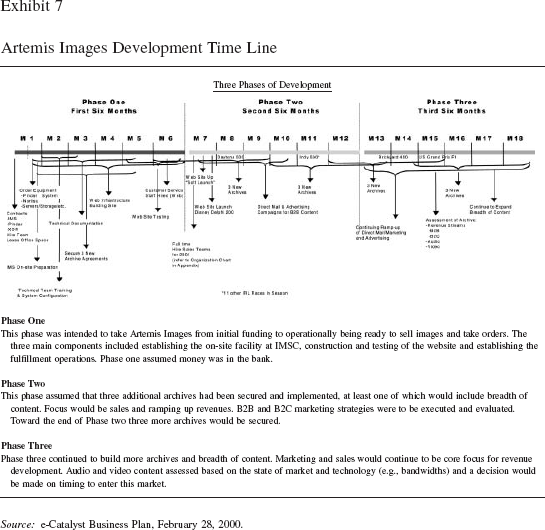
The original plan was to purchase and install software and hardware at their main office in Denver, Colorado, contract with a web development partner, and set up the first on–site facility at Indianapolis Motor Speedway Corporation. The Denver facility would serve as a development lab, to create a standard set of metadata to be used by all of their partners’ content. This consistency of annotation information was intended to allow for consistent search and retrieval of content. Artemis Images's goal was to build a world–class infrastructure to handle content management, consumer data collection, and e–commerce. This infrastructure would allow them to amass a large content and transaction volume by expanding to other market segments. Developing their own structure would ensure standardization of content and reduced implementation time. Outreach for news coverage and the development of community features would be negotiated concurrently. The time line in Exhibit 7 illustrates the Artemis Images development plan.
Artemis Images Development Time Line
Source: e–Catalyst Business Plan, February 28, 2000.
Financial Projections
Revenues were expected to come from four primary sources:
Consumer photos: IMSC's archive sold approximately 53,000 photos in 1999 to a market limited to consumers who visited the archive or wrote to its staff. Artemis Images based its projected sales on an average of 15,000 images sold per archive in 2001, increasing to 20,000 images per archive in 2003. Price: $19.99 (8″× 10″)
Stock Photos: Stock photos ranged in price from $150 to $100,000, depending on the uniqueness of the photo. Competitors Getty and Corbis, two of the leaders in this market, sold 2.35% and 0.6% of their archive respectively. Based on an average selling price of $150, Getty generated approximately $6.00 in revenue for each image in its archive; Corbis generated approximately $1.85. Artemis Images constructed financial projections based on sales of 0.30% of its archive in 2001 and 0.16% of its archive in 2002. Artemis Images's margin was based on a return of $0.20 per image in its archive for 2001, increasing to $0.60 per image in 2003.
Syndication: The team's dot–com experience led them to believe that websites with exclusive content were able to syndicate their content to other websites. They anticipated that Artemis Images would generate revenues of $100,000 per year from each contract for content supplied as marketing tools on websites. Existing companies with strong content had been able to negotiate five new agreements per week for potential annual revenues of $5 million.
Merchandise: According to America Online/ Roper Starch Worldwide, approximately 30% of Internet users regularly made purchases. Artemis Images used a more conservative assumption that only 1% of unique visitors would make a purchase. Estimates of the average purchase online varied widely, ranging from Wharton's estimate of $86.13 to eMarketers's estimate of $219. The Artemis Images team viewed $50 per purchase as a conservative figure.
Chris and George felt confident that Artemis Images would be able to reach the revenue projections for number of photos sold. IMSC's archive had sold approximately 53,000 photos in 1999, an increase of 33% over 1998. These sales had been generated solely by consumers who had visited the archive in person, estimated at 1 million people. In other words, 1 out of every 28 possible consumers actually purchased an image. Chris and George assumed that if even 1 out of 160 unique visitors to the website purchased a photo, the Artemis website would generate 42% more than IMSC's 1999 figures (see Exhibit 6 for projected sales volume). Chris and George believed that this projection was reasonable in light of the fact that IMSC did not market its archive and significant publicity and advertising would accompany Artemis Images's handling of the archive. As breadth of content and reach of the web increased, 2002 revenues should easily be double those of 2001.
Since the team previously had configured and sold content management systems, they were familiar with the costs associated with this process, including both equipment and personnel. They carefully conducted research to stay abreast of recent improvements in technology and intended to be on the lookout for cost reductions and process improvements.
The Launch: Problems from the Start
Chris dove into the Artemis Images project with a vengeance. Having secured a five–year contract for exclusive rights and access to the IMSC archive, she found a dependable technician who was eager to relocate to Indianapolis to start the scanning and digitizing process. A reputable, independent photo lab agreed to handle printing and order fulfillment. Chris's visit to the Indy 500 in May 2000 was a wonderful networking opportunity. She met executives from large companies and got leads for investors and clients. She secured an agreement with a web design company to build the Artemis Images site, careful to retain ownership of the design. She contacted over 100 potential venture capitalists and angel investors.
Personally, she was on a roll. Financially, she was rapidly going into debt. Frank and Greg, legal owners of the company, had long since contributed ideas, contacts, or legwork to the Artemis Images launch. While confident that his work on the business plan would appeal to investors, Greg viewed the start–up company as a risk to which he was unwilling to commit. Likewise, Frank decided to hold onto his job at Petersons.com , a unit of Thompson Learning, until the first round of investor funding had been secured. Frank continued to offer advice, but he had a wife and two pre–school children to support.
Each meeting with a potential funder resulted in a suggestion on how to make the business more attractive for investment. Sometimes they helped, sometimes they just added to Chris's and George's frustration. Beating the bushes for money over two years was exhausting, to say the least. The lack of funds impacted the look and feel of the business, and severely strained relationships among the founding partners. Heated discussions ensued as to the roles that each was expected to play, the re–allocation of equity ownership in the company, and the immediate cash needed to maintain the Indianapolis apartment and pay the scanning technician and web developers, not to mention out–of–pocket expenses needed to manage and market the business.
Chris and George appealed to their families for help. George's father contributed $5,000. Chris's mother tapped into her retirement, mostly to pay Chris's mortgage and to fund Chris's trips to potential clients and investors in London, New York, and Boston. By May 2001, Chris's mother's contribution had exceeded $200,000. A $50,000 loan from a supportive racing enthusiast provided the impetus for Artemis Images to re–organize as a C–corporation. All four original partners had stock in the new company, but Chris held the majority share (66%), George held 30%, and Frank and Greg's shares were each reduced to 2%. Financial projections were revised downward [see Exhibit 8].
Revised Pro–Forma Financial Summary 2001
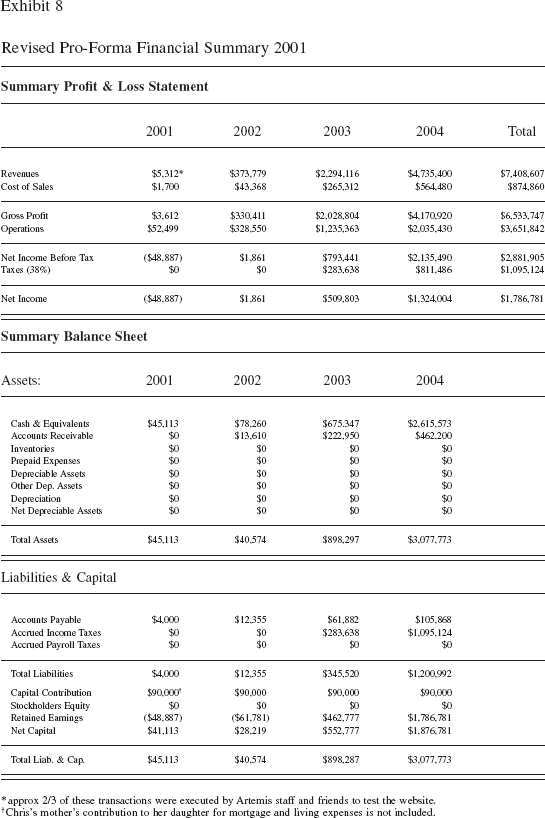
approx 2/3 of these transactions were executed by Artemis staff and friends to test the website.
Chris's mother's contribution to her daughter for mortgage and living expenses is not included.
The site was officially launched on May 18, 2001. It was beautiful. Chris held her breath as she put in her credit card late that evening when the site went live. The shopping cart failed and the order could not be processed. Chris knew she was in trouble.
The Crash
From the first, the website had problems. The web development contract stipulated that the website for the Indy 500 would go live by May 8, 2001, to coincide with the month–long series of events held at the Indianapolis Motor Speedway leading up to the Indy 500 on May 27. However, the web development took longer than anticipated, and the site was first operational on May 18. Having neglected to test the web interface properly, serious failures were encountered when the site was activated. The site went down for 24 hours, only to face similar problems throughout the following week, again shutting down on May 27. More technical difficulties delayed the re–activation of the site until May 31, after the Indy racing series had ended.
Throughout June, consumer traffic was far less than originally anticipated. The site was not easily navigable. The shopping cart didn't work. Yet the web–builder demanded more money. Fearful of a possible lawsuit, investors stayed away. The crash of the dot–coms added kindling to the woodpile. Chris and George started to re–think their original business model. They were held hostage, as they owned no tangible assets.
Website tracking data indicated that between May and July there had been at least $40,000 worth of attempted purchases. Chris read through hundreds of angry e–mails, and tried manually to process orders. Orders that were successfully executed resulted in spotty fulfillment. Many photos ordered were never shipped, were duplicated or were incorrectly billed. At the same time, she tried to negotiate with the software developers’ demand for payment and keep alive a $250,000 investment prospect.
On July 9, 2001, the web development company threatened an all–or–nothing settlement. They wanted payment in full for the balance of the contract even though the sites didn't work. Absent full payment, they would shut down the sites within the week. The investor offered to put up 80% of the balance owed on the full contract to acquire the code to fix it. The company refused. On Friday, the thirteenth of July, Chris had to tell IMSC that in less than 48 hours the sites would be shut down. The investor took his $250,000 elsewhere.
On Tuesday, July 17, Chris called an emergency meeting with George. George had had enough. The stress was affecting his health, his relationships, and his lifestyle. He believed that his family had already contributed more money than he had a right to ask. He was putting in long hours with no money to show for his efforts. His girlfriend had been putting pressure on George to quit for some time. Now he had run out of reasons to stay.
Chris was devastated. How could she face the people in Indianapolis? It was hard for her to come to grips with having let them down. Having put so much of herself into this venture, she wasn't sure she could let go. At the same time, she wasn't sure how to go on.
Chris reflected, “At one time, I defined success by my title, my salary, and my possessions. Working for AGT, I had it all. I started Artemis Images because I really cared about IMSC and making the Indy motorsports images available to its fans. Now, I realize that there is a profound satisfaction in building a company. I can see my future so clearly, but living day to day now is so hard. And I'm still enthralled with beautiful images.”