






Abstract

Medea/Mothers’ Clothes is a thirty minute long solo performance, developed as a part of a practice as research PhD entitled ‘(Dis)Identifying Female Archetypes in Live Art’ at Lancaster University. Medea/Mothers’ Clothes was supported by the Arts Council England and the Bluecoat Arts Centre in Liverpool, where it was first presented in the spring of 2004.1 In my performance, I bring Medea, as the archetypal anti-mother figure, into dialogue with a group of contemporary Liverpool mothers drawn from two toddler groups. The performance is an artistic and feminist response to social and cultural constrictions that I have experienced as a foreigner (a Croatian, resident in Britain) and as a mother of three British children. Medea/Mothers’ Clothes stages an intervention into cultural mythmaking about Medea by drawing on my daily experiences of ‘foreign motherhood’ and my place within a community of Liverpool mothers. The performance draws on the figure of Medea as a means of critiquing, trans-coding and rebelling against prescribed maternal ideals.
Medea/Mothers’ Clothes Live Art Event first took place on 30 April 2004 and 1 May 2004 at the Bluecoat Arts Centre in Liverpool. The performances were followed by an installation (from 1 to 6 May 2004) in the same space. Since its first performances at the Bluecoat, Medea/Mothers’ Clothes has been performed at emergency, green room, Manchester in October 2004, at Brunel University, London in November 2004, at Teatro Guiñol, Santa Clara, Cuba as a part of the ‘Magdalena Sin Fronteras’ festival and meeting in January 2005, at the Inter University Centre, Dubrovnik, Croatia in May 2005, at the Performance Art Carlisle Event at Source Café, Carlisle in February 2006, at the John Thaw Studio Theatre, Manchester University, Manchester in May 2006, at the interdisciplinary conference ‘Medea: Mutations and Permutations of a Myth’, Bristol University, Bristol in July 2006, as a part of On the Edge, an annual programme of contemporary small scale performance at the University of Hull in Scarborough in October 2006 and at the University of Winchester in February 2007. See www.medeamothersclothes.org for further information.
Being Foreign and Becoming a Mother
At the Tesco checkout, a checkout lady begins the conversation and as soon as I open my mouth … the accent … the possibility of invasion …. The justification that I am here because I married (all proper) a British person. Wow, a British person. So it is not like I came to suck dry the state's benefits. Oh, no I am not the asylum seeker. Better not say Croatia … nor Yugoslavia … That might give them the wrong idea. Now in public I talk to the children in Croatian. It is loud and strange. No one dares talk to me. I choose to endure the bemused looks. This is much better than justifying my position of a foreigner each time I am invited to open my mouth by an accidental passer-by who casually refers to the colour of my child's hair. Ginger.
Lena Šimić, Medea/Becoming British, 2007. Courtesy of artist.
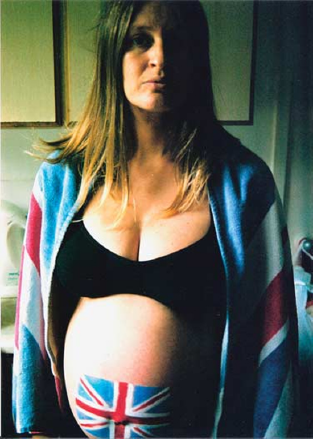
I am identified as a foreigner. I am a resident spouse of a British citizen. In my Croatian passport, there is an ILTR (Indefinite Leave To Remain) stamp. As a Croatian, I have no political rights in the United Kingdom. In everyday interactions, my nuanced, accented English language marks an ‘improper’ marginal relation to the country in which I inhabit. However, when I became a mother, I obtained a ‘proper’, recognizable social role within my Liverpool community. This ‘propriety’ came with a price: the weight of the social and cultural ideals of motherhood, as a perfect and compulsory identity stamp for women regardless of their class, nationality, race, age and sexual preference, with the power of reducing ‘us all’ to the common denominator of mother. The mother, reminiscent of the mother archetype, the all prevailing mater natura and mater spiritualis – totality of life (Jung, 1959: 92), re-invents itself in different social roles and cultural imaginings of maternity, ideal narratives increasingly supported by consumerism. That mother that smiles at us from Boots and Mothercare catalogues; who gazes at us from NHS (National Health Service) education leaflets about pregnancy, birth and parenthood.
Medea within the Community of Mothers
Lena Šimić, Medea/Mothers' Clothes, 2004. Courtesy of artist.
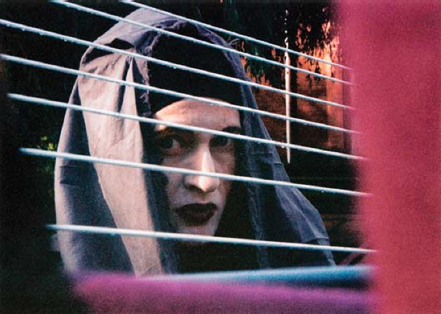
Protect the innocent! This is a bloody foreigner, that weird one who would die and kill for a higher cause. This is a mad terrorist. This is our danger. This is not spoken to. This. This is no longer just a personal arena; this is politics that we don't want to get involved in. This Medea's idea is just beyond the understanding of any contemporary thought, male or female, beyond humanity. Taken out of her context, Medea is the anti-mother, the archetype.
My community of Liverpool 17 is keen to accept all new mothers, including the foreigners, into the wonderful world of motherhood, as long as they all behave as ‘good mothers’ should. The same set of normative rules and ideals apply to me, a foreigner, and all other new mothers. I could claim Liverpool and specifically L17 as my new home, based on the fact that I do spend most of my time there and that I joined two toddler groups. Attending these toddler groups, I come across a variety of mothers: dedicated full-time mums who oppose the western ethic of work culture and ally themselves with more alternative lifestyles; ex-professionals (a general practitioner, a therapy councillor, a film editor, a further education lecturer, a lawyer) all of whom left the workforce for the ‘benefit’ of their children; working-class mothers who work part time as shop assistants or dinner ladies; full-time mums who were either entering or aiming to re-enter higher/further education. On the surface, it seems that the role of the mother was wholeheartedly embraced for the most of these women. However, looking more closely, I find the individual identities of women becoming subsumed under the weight of ideal motherhood. What is problematic about this wholehearted embrace of the mother is the placing of impossible aspirations of motherhood on real mothers themselves (Miller, 2005; Gatrell, 2008). The prescribed motherhood felt reductive and claustrophobic. It became increasingly difficult to assert difference, to critique, question or speak in a political voice. I needed to rebel – to claim an identity, a voice other than the maternal.
I took up Medea, both a barbarian and the anti-mother archetype, as my feminist tool in order to challenge some social presumptions about motherhood. Medea transgresses from mother to anti-mother through the ultimately rebellious act of murdering her children. In addition, she is swiftly judged on the assumption that she is first and foremost an immigrant barbarian, a figure who embodies ethnic and cultural difference. Referencing Sally Engle Merry's Urban Danger: Life in a Neighbourhood of Strangers, Sara Ahmed concludes, ‘The ultimate violent strangers are hence figured as immigrants: they are the outsiders in the nation space …’ (2000: 36). Medea, as anti-mother and barbarian, challenges the patriarchal nation space. I employed Medea as an alternative archetype, by bringing her into dialogue with the everyday experiences and (hidden) anxieties of contemporary Liverpool motherhood. However, I was careful not to explain Medea's actions in psychological terms, transform her into ‘a real woman’ or treat her as a tabloid headline. Medea is not a woman, but woman as sign – a construct of a canonical theatre tradition, the ultimate immoral figure invented in order to mark the ethical limits and boundaries of the state itself. Medea, the barbarian anti-mother, figures unspeakable danger, a disaster waiting to happen, a collapse of not only systems of gender and nation but also the absolute destruction of the natural order. She became my ultimate weapon.
Armed with Medea, I re-entered the toddler groups publicly, as an artist. ‘Coming out’ enabled a different relationship with the mothers to emerge (for a further discussion about the ‘coming out’ as a rhetorical practice of experiential accounts of motherhood with a potential for transformational social change see Tyler, 2009). Each mother, foreigner or not, carries within herself doubts about her skills as prescribed by the ideal mother construct. Each mother tries to cover up her insecurity by presenting herself in the most positive light within the communal toddler group environment. The secrets about the ‘real’ experience of motherhood soon start emerging through intimate confessions, chats and teas. A new darker side of motherhood slowly seeps out. We are all foreigners to the mother construct. In order to give distinctive voices to these secretive motherhood experiences, I decided to photograph each mother individually, gather a piece of clothing from each one of them, and finally, record their views on motherhood and present them in Medea/Mothers’ Clothes.
Performance Action on Stage
Lena Šimić, Medea/Mothers' Clothes, 2004. Courtesy of artist.
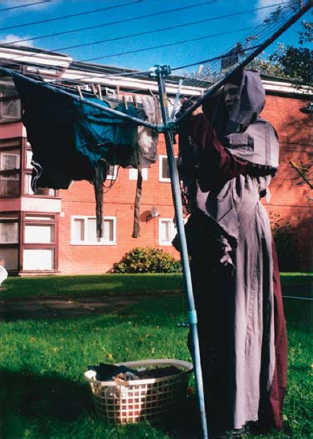
Medea/Mothers’ Clothes is a critical and yet, through the use of ritual-like repetitious actions of washing, a sensual response to my own experiences of motherhood. The performance aims to sensually create a new space among and between the participants; my first audience is the mothers from the toddler groups.
The set display consists of a washing line stretching from one side of the space to the other, with two garments hanging on it on two different sides: Medea's purple, somewhat theatrical, costume and a white sheet. There are lots of colourful clothes piled up on the floor as well as a bottle of baby shampoo. All of these clothes were given to me by the Liverpool mothers participating in the project. I enter the stage carrying my children′s baby bath, full of water. I wet the white sheet and hang it back onto the washing line. I operate the slide projector, focused onto the wet white sheet. We see changing slides of mothers’ faces on a wet dripping sheet – the portrait photos that I took during our toddler group session. I operate the DVD and video projector, focused onto the white screen in the background of the stage. We see images of myself in the Medea costume with my children while hanging out the clothes on my housing estate, cleaning the mirror in my bedroom and putting on mothers’ clothes. We hear two Medea monologues from Euripides’ play, sounds from the toddler group and Stabat Mater music.
One of the Medea monologues makes use of a foreign language, a central methodological tool in the creation of the performance. I make Medea's improper acquisition of foreign language visible. During the rehearsal period of Euripides’ monologues, I asked my Liverpudlian husband Gary Anderson to help me with learning my lines and prompt me if necessary. This exercise became an important component of my performance. I decided to use Gary's strong prompting voice as a way to give patriarchal authority over me as his wife, a foreigner and an actress. My ‘speech impediment’ in the performance is evident through the recorded sound footage of Gary prompting me with my lines and correcting my English. This dialogue became my comment on the supposedly inferior position of a barbarian Woman. Medea, our barbarian, with my ‘nuanced English’ is prompted lines by her author Euripides, contemporary society, and finally, my husband's Scouse accent (for an outline of different strategies in feminist theatre see Aston, 1995, 1999). I enter into a dialogue with this directorial voice, subverting its authority through interruption and laughter; I speak Euripides’ words ironically and scornfully and expose a political, agentic rebellious Medea which in turn enabled a challenge to myth's own figuration within the community as an alien other, as a ‘foreign mother’.
Situated in the middle of the stage with my children's baby bath, I perform the task of washing and hanging previously collected mothers’ clothes. A mother's work is never done. I am quietly humming nursery rhymes ‘A sailor went to sea, sea, sea’ and a Croatian children's song ‘Ja sam gusar s Porporele’ (‘I am a pirate from Porporela’). The elevation of the domestic activity from its everyday routine to its stage presence, gives me, a real woman, a space to challenge the patriarchal representations of myself as woman/mother/housewife/foreigner. This is my call for adventure, my escape. The smell of baby bath fills the performing space. The water splashes. The performer gets wet in it. After all the mothers’ clothes had been washed, I wet Medea's costume and put it on. I leave the stage. All is dripping wet.
Over time, the materials that constitute this performance, the audiovisual footage, the mothers’ slides and the objects have become documents laden with maternal memory. Representing a past time when I was faced with the joys and difficulties of motherhood within my adopted Liverpool community. Over the three years of performing the piece, I have watched my children grow and the mothers in the slides have passed out of my everyday life. However, the urgency to perform the piece and go back to it has stayed with me. While Medea/Mothers’ Clothes was created with a specific audience in mind (the Liverpool mothers), it strives to be re-performed, recreated, in new places, for it speaks to longer transnational secret histories of maternal experience.
Footnotes
Author Biography
Lena Šimić, performance artist, born in Dubrovnik, Croatia, living in Liverpool, UK. Lecturer in Drama and Theatre Studies at Liverpool Hope University. Completed practice as research PhD ‘(Dis)Identifying Female Archetypes in Live Art’ at Lancaster University in 2007. Lena is interested in generating an interventionist feminist arts practice, which is informed by its relation to everyday lived experience. Her most recent live art event, Sid Jonah Anderson by Lena Simic (MAP Live, Carlisle 2008), staged the daily routine of mothering. In collaboration with Gary Anderson, Lena is currently running The Institute for the Art and Practice of Dissent at Home, a project of events and residencies in the spare room of their council house.