






Abstract
Making links between different embodied cultural practices has become increasingly common within the feminist literature on multiculturalism and cultural difference as a means to counter racism and cultural essentialism. The cross-cultural comparison most commonly made in this context is that between ‘African’ practices of female genital cutting (FGC) and ‘western’ body modifications. In this article, I analyse some of the ways in which FGC and other body-altering procedures (such as cosmetic surgery, intersex operations and 19th century American clitoridectomies) are compared within this feminist literature. I identify two main strategies of linking such practices, which I have termed the ‘continuum’ and ‘analogue’ approaches. The continuum approach is employed to imagine FGC alongside other body-altering procedures within a single ‘continuum’, ‘spectrum’ or ‘range’ of cross-cultural body modifications. The analogue approach is used to set up FGC and other body-altering practices as analogous through highlighting cross-cultural similarities, but does not explicitly conceive of them as forming a single continuum. Two key critiques of the continuum and analogue approaches are presented. First, because these models privilege gender and sexuality, they tend to efface the operation of other axes of embodied differentiation, namely race, cultural difference and nation. As such, the continuum and analogue approaches often reproduce problematic relationships between race and gender while failing to address the implicit and problematic role which race, cultural difference and nation continue to play in such models. This erasure of these axes, I contend, is linked to the construction of a ‘western’ empathetic gaze, which is my second key critique. The desire on the part of theorists working in the West to establish cross-cultural ‘empathy’ through models that stress similarity and solidarity conceals the continuing operation of geo-political relations of power and privilege.
Keywords
Introduction
‘Bored with your Brazilian? Hundreds of North American and European women are choosing female genital mutilation’ – This rather sensationally headlined article from Jane magazine (Catchpole, 2004) was passed on to me by a friend. It suggests that ‘female genital mutilation’ is not merely an ‘African’ practice and discusses a range of genital modifications being undertaken by women in the United States and Britain as a form of ‘body art’ or as a means to increase or decrease sexual pleasure. This article represents only one mainstream example of African practices of female genital cutting (FGC) 1 being linked with western body-altering practices. 2
I use the label ‘female genital cutting’ (FGC) to refer to the broad group of procedures which are, or have been, practiced (with great variation) within some African, Asian and Arab countries (such as Sudan, Somalia, Yemen, Egypt, Mali, Kenya and Ethiopia) and their diasporic communities. Practices of FGC are diverse and encompass a range of different procedures. There are generally three types of operations: (1) pharonic or in-fibulation (usually thought to be the most drastic); (2) intermediate; and (3) sunna (usually thought to be the least extreme). For more detailed explanations of each of these procedures, see Gunning (1991), Abusharaf (2001) and Boyle (2002).
I feel it is necessary to use descriptive markers such as ‘African practices of FGC’ and ‘western body-altering procedures’ in order to indicate how particular practices have been differentiated and compared within feminist literatures. Such labels, however, are problematic because they homogenize a vast range of diverse practices, downplaying complexities, contradictions and hybridities, and force false dichotomies between ‘western’ and ‘non-western’ procedures. These dichotomies are untenable given that practices of FGC are not only rooted in African cultures, but also some Asian and Middle Eastern groups, and furthermore, such practices are performed within many western locations, while cosmetic surgery and intersex operations are now practiced all over the world. This discursive division also effaces the historical processes through which such practices have been constructed as ‘African’ and ‘western’ in the first place. Thus, while I think it is important to employ such labels here for practical reasons, I seek throughout the course of my analysis to illustrate the ways in which they continue to be problematic.
I had already identified a growing trend towards making such cross-cultural comparisons in the feminist academic literature. In The Whole Woman (1999), Germaine Greer suggests parallels between African ‘female genital mutilation’ and a wide range of ‘western’ procedures, including operations on intersex babies, male circumcision, body piercing, cutting, gender reassignment surgery, breast augmentation, episiotomy, hysterectomy and caesarean sections. Outside the specifically feminist literature, Gerry Mackie (1996, 2000) links FGC with Chinese foot-binding, while Sander Gilman (1999a) and David Gollaher (2000) suggest similarities between FGC and male circumcision. Legal scholars Sally Sheldon and Stephen Wilkinson (1998) compare FGC and cosmetic surgery procedures such as breast augmentation, suggesting that the legal frameworks relating to the two sets of practices in the UK should be made more consistent.
An analysis of the diverse collection of actors who seek to link FCG with other embodied practices, and the wide array of practices to which FGC gets compared, would be interesting for a number of reasons. How is FGC figured as such a porous and flexible practice that can be stretched to link with such a varied spectrum of other practices worldwide? Through what processes has FGC become fetishized as the practice of choice for so many comparisons? What are the motivations for making such comparisons on the part of different theorists? And crucially, how can we understand the potential material and discursive effects of such comparisons?
In what is to follow, I hope to address each of these questions. My particular focus, however, is examining how making links across different cultural practices is employed by feminist theorists as a means to counter racism and cultural essentialism. Within this context, ‘African’ practices of FGC have been compared to ‘western’ body modifications including cosmetic surgery procedures such as breast augmentation, labiaplasty and liposuction (Gunning, 1991; Greer, 1999; Meyers, 2000; Weil Davis, 2002; Njambi, 2004); ‘body art’ practices such as piercing, tattooing and cutting (Leonard, 2000; Salecl, 2000; Njambi, 2004); 19th century circumcision operations performed on women in the United States and Britain to ‘cure’ masturbation, nymphomania and hysteria (Women's Caucus of the African Studies Association (WCASA), 1983/2002; Gunning, 1991); contemporary reproductive procedures such as caesarean sections, episiotomies, hysterectomies and radical mastectomies (WCASA, 1983/2002; Greer, 1999); and, more recently, operations to ‘correct’ ambiguous genitalia in intersex babies in the United States (Meyers, 2000; Chase, 2002; Weil Davis, 2002). Feminist theorists living and working in the West author the majority of such texts (but are situated differently in terms of race, ethnicity, nation and sexuality).
These comparisons are diverse and their authors vary in their approaches and motivations. However, all establish similarities between FGC and western body modification practices to break down culturally essentialist binaries that construct non-western (in this case usually African) cultures as patriarchal and oppressed and western cultures as liberated and self-determining. In order to emphasize the cross-cultural affinities between such practices, some theorists have adopted what I refer to as the ‘continuum’ and ‘analogue’ approaches. The ‘continuum approach’ is employed by theorists who suggest that imagining FGC alongside other body-altering procedures within a single ‘continuum’, ‘spectrum’ or ‘range’ of cross-cultural body modification practices overcomes problematic binary representations. The ‘analogue approach’ is used by thinkers who highlight similarities between different embodied practices, but do not explicitly conceive of them as forming a single continuum. The continuum and analogue approaches are not mutually exclusive. The continuum approach involves identifying cultural practices that are similar and thus, analogues can (though need not necessarily) be part of larger continuums. Some theorists employ a combination of the two approaches or move back and forward between them. The continuum and analogue approaches therefore often do not represent fundamentally different theoretical frameworks. It is necessary to make a distinction between them, however, because in some cases their structural differences can become significant.
Both the continuum and analogue approaches offer appealing models for those seeking to disrupt essentialist constructions of FGC and ‘western’ body modifications. They can reveal the instability of neo-colonialist binaries that construct various groups as culturally, ethnically and morally ‘different’. They situate the potential for health risks associated with FGC in the context of similar risks linked to other body modifications and highlight the comparable motivations across cultures for undergoing such procedures. The continuum and analogue approaches can also encourage people to think critically about different cultural practices and challenge their ethnocentrism, while increasing cross-cultural and transnational dialogue.
In my view, however, neither the continuum nor the analogue approach provides a model capable of moving beyond the multiple problems associated with essentialist binaries. A continuum is, by definition, ‘a continuous sequence in which the elements next to each other are very similar, but the last and the first are very different’ (Oxford University Press, 2001: 185). Choices regarding where to position various practices on a continuum are shaped by culturally specific norms and as such the continuum model risks reifying culturally essentialist differences. An analogue, on the other hand, is defined as ‘a person or thing that is like or comparable to another’ (Oxford University Press, 2001: 27). The emphasis in this model is on ‘likeness’ and thus, when employed uncritically, the analogue approach risks collapsing into an economy of sameness that ultimately avoids dealing with antagonistic processes through which embodied practices and their imagined subjects are differentially constructed.
In this article, I analyse some of the ways in which FGC and other body modifications are linked within the feminist literature on cultural difference, with a focus on the potential effects of such representations. Two key critiques of the continuum and analogue approaches are presented. First, because these models privilege gender and sexuality, they tend to efface the operation of other axes of embodied differentiation, namely race, cultural difference and nation. As such, the continuum and analogue approaches often reproduce problematic relationships between race and gender while failing to address the implicit and problematic role which race, along with culture and nation, continues to play in such representations. This erasure of race, culture and nation, I contend, is linked to the construction of a western empathetic gaze, which is my second key critique. The desire on the part of theorists working in the West to establish cross-cultural ‘empathy’ through models that stress similarity and solidarity conceals the continuing operation of geo-political relations of power and privilege.
As a white, western, middle-class, scholar, I am conscious that my interventions into discourses relating to FGC might be seen as uninvited, if not imperialist, by women who are members of particular circumcising communities or who see themselves as linked to or invested in FCG in other ways that I am not. Indeed, some might argue that the very act of producing yet another analysis which takes practices of FGC as a focus functions automatically to re-fetishize FGC. It is important to acknowledge that I do not claim to have any privileged knowledge about how any of the embodied practices I discuss may be experienced by individuals in specific contexts nor do I endeavour to represent any of these practices ‘fully’ or with complete ‘accuracy’ (even if such a feat was possible). However, I do think it is important to analyse the ways in which such embodied practices come to be represented within the feminist literature and what kind of discourses are legitimated as a consequence. Throughout these processes, I endeavour to think reflexively about how my social location may affect and shape the ways in which I conduct and present my research.
Assessing Feminist Continuum and Analogue Approaches
In their introduction to Genital Cutting and Transnational Sisterhood, editors Stanlie James and Claire Robertson suggest that much feminist theorizing about FGC falls foul of what they refer to as ‘the colonial flaw’: ‘although many feminists by now are aware that clitoridectomy was practiced at different times and places in the United States, most confine it to the past’ Games and Robertson, 2002b). To overcome this problem, they advocate an analogue approach that traces the commonalities between FGC and other embodied practices normally categorized as ‘different’, such as US intersex operations. In this same collection, Cheryl Chase (2002) takes a similar stance, arguing that laws prohibiting African practices of ‘female genital mutilation’ in the United States should apply equally to intersex surgeries. A 2004 issue of the journal Feminist Theory focusing on feminist responses to practices of FGC offers similar advocacy of analogue approaches. Here, Kathy Davis suggests that western feminists should treat African practices of FGC as similar to cosmetic surgery or intersex operations in the sense that all such practices require analysis, rather than automatic condemnation. One of the central messages conveyed by texts like these is that FGC requires transnational feminist responses that emphasize the links and similarities between embodied practices across cultural contexts.
Theorists who explicitly employ continuum approaches to link FGC and ‘western’ body-altering procedures include Diane Teijens Meyers (2000) and Simone Weil Davis (2002). Among those who adopt an analogue model, Isabelle Gunning (1991) ‘world-travelling’ approach may be the most well known. Looking more closely at the texts of these three theorists provides further clues as to why and how feminist theorists seek to employ the continuum and analogue approaches in this context.
In ‘Feminism and Women's Autonomy: The Challenge of Female Genital Cutting’, Meyers (2000) refers to ‘the range of worldwide FGC practices – including “corrective” surgery for “ambiguous genitalia” in Western cultures as well as the various initiation rites observed in some African and Asian cultures’ (Meyers, 2000: 469). Through imagining such practices on a fluid continuum, she seeks to disrupt neo-colonialist binaries which pose FGC and intersex operations (among other procedures) as oppositional and distinct (Meyers, 2000: 473–474). Meyers is particularly concerned ‘to dispel some prevalent misconceptions about culture’ that portray non-western women who practice FGC as oppressed by culture and without autonomy, in contrast to western women as active agents freely negotiating their flexible cultural milieus (Meyers, 2000). As such, she aims to illustrate that FGC is a practice common to both non-western and western cultures. Intersex surgeries and practices of FGC are comparable, she suggests, because they are both potentially health-endangering procedures, which involve cutting female genital tissue. Both are also often impelled by ‘potent culturally specific feminine bodily norms’ (Meyers, 2000: 486) that do not tolerate ‘unnatural’ or ‘ambiguous’ genitalia.
In ‘Arrogant Perception, World-Travelling and Multicultural Feminism: The Case of Female Genital Surgeries’, Gunning (1991) seeks to address what she, borrowing from previous feminist critiques (e.g. Frye, 1983; Lugones, 1990), refers to as ‘arrogant perception’ (a self-centred and culturally essentialist way of viewing ‘the Other’). As a means to prevent arrogant perception, she draws on Maria Lugones (1990) concept of ‘world-travelling’ to develop a methodology for exploring cultural practices which appear unfamiliar within one's own cultural context (such as FGC). This approach has three prongs: (1) understanding one's own historical context; (2) seeing yourself as the other woman might see you; and (3) seeing the other woman, her world and sense of self through her eyes (Gunning, 1991: 202). Required as part of Gunning's adapted world-travelling method is ‘an in-depth look at one's own cultural context in search for analogues to culturally challenging practices in the “other's” culture’ (italics mine) (Gunning, 1991: 205). For her, 19th century female circumcisions performed on American and English women as a ‘cure’ for mental illness provide one suitable analogue with FGC:
The practice of reconstructing female genitalia through surgery is a universal one that crosses cultural boundaries. It is part of our own history.
(Gunning, 1991: 211, italics mine)
She suggests that the ‘the same kind of rationales’ have been given for both sets of procedures, such as beliefs in their health benefits, and women have demonstrated similar attitudes or responses towards the two sets of procedures, including, in some cases, ‘submissive or welcoming behaviour’. Gunning also makes links between FGC and other embodied practices, such as breast augmentation, anorexia and bulimia. Such comparisons are established to encourage westerners to acknowledge that ‘non-Westerners too can view Western practices as culturally challenging’ (Gunning, 1991: 212) and to increase ‘multicultural dialogue’ through a ‘shared search for areas of overlap, shared concern and values’ (Gunning, 1991: 191). Developing such multicultural dialogue is important to Gunning's overarching objective in this article, which is to advocate ‘the international human rights regime’ as a positive tool for developing and applying ‘universal human rights norms’ to practices of FGC (Gunning, 1991: 247–248).
In ‘Loose Lips Sink Ships’, Weil Davis (2002) advocates a continuum approach as an alternative to binary representations of FGC and western procedures of genital alteration. Concerned with culturally essentialist and racist representations of FGC in the media, US law and western academic critique, she claims:
It is a (prevalent) mistake to imagine a quantum distinction between Euro-American and African reshapings of women's bodies, far too often, they are measured on different yardsticks rather than on a continuum.
(Davis, 2002: 21)
In constructing links between FGC and American labiaplasty (as well as intersex surgeries), Weil Davis seeks to employ Gunning's world-travelling approach and its requirement to ‘look at one's own culture anew and identify […] practices that might prove “culturally challenging” or negative to some other’ (Gunning cited in Weil Davis, 2002: 27). From Weil Davis's perspective, labiaplasty would likely not only seem as ‘culturally challenging’ to many African women as FGC appears to most American women, but could also be understood as analogous to FGC in several ways. The key motivations impelling women to undergo both sets of practices are similar, including ‘beautification, transcendence of shame, a desire to conform’ (Davis, 2002: 24). Moreover, both sets of practices involve issues of agency, choice, consent and appropriation that should be analysed through a feminist lens. Weil Davis argues that a less binary approach to interpreting such embodied practices will lead to ‘a deeper understanding of core issues like the nature of consent, of bodily aesthetics and social control, and of cross-culturalist activist collaboration’ (Davis, 2002: 22).
Discussion
Meyers, Gunning and Weil Davis provide sophisticated analyses of how cultural essentialism and racism operate problematically in the representation of embodied practices. I share significant theoretical and political ground with these authors and have a great deal of sympathy for such strategies. This sympathy surges every time I confront yet another essentialist media portrayal of the free and liberated ‘West’ set against the oppressive and barbaric ‘East’, ‘Africa’ or ‘Muslim World’. At these moments, I am forced to consider the political effects of my work. Should I really be criticizing well-meaning feminist strategies that earnestly seek to break down culturally essentialist and racist binaries? Will my critique be (mis)-interpreted as a move intended to reinstate the very problematic dualisms feminists seek to upset? My intention, however, is not to criticize the project of interrogating racist and culturally essentialist binaries, which I see my work as advocating and pursing, but rather to critique the problematic aspects of specific theoretical approaches employed to upset such binaries.
On one hand, Meyers and Weil Davis's continuum approach may make them more susceptible than Gunning to reifying problematic differences between various embodied practices. For example, Meyers's image of a ‘range’ of FGC practices correlated with ‘a spectrum of health risks’ and ‘a spectrum of long-term consequences for women's sexuality, physical health and psychological well-being’ (Meyers, 2000: 473–474) suggests that some practices of genital alteration will be more serious, harmful or problematic than others. The point I want to make here is not that we should never make distinctions between particular practices (indeed, this article underscores the importance of differentiating practices), but rather that if we are delineating practices on the basis of how harmful, damaging or extreme they are, these judgements cannot be neutral. They will always be guided by culturally inflected values which need to be recognised and accounted for. The continuum argument should thus not be seen as a simple ‘way out’ of cultural essentialism or ethnocentrism. In light of the difficulties the problem of cultural bias would seem to raise for advocates of the continuum approach, it is significant that neither Meyers nor Weil Davis undertake any specific plotting of practices within a continuum structure. The fact that such continuums must remain completely vague in order to avoid re-essentializing various cultural practices raises crucial questions about the theoretical utility of the continuum approach in this context.
On the other hand, Gunning's analogue approach may make her more susceptible to the trap of ‘sameness’. While in linking intersex operations and FGC practices, Meyers explicitly states that FGC is not a ‘single procedure’. Gunning's language at times suggests that 19th century circumcisions and contemporary African practices of FGC are ‘the same’. In such moments, her analogy collapses into an equalization that effaces contextual and historical distinctions, yet, in other moments, Gunning appears to re-establish fundamental differences between the very practices she previously equated. For example, it is significant that after linking FGC to a number of ‘western’ practices including, cosmetic surgery, anorexia, bulimia, intersex surgeries and abortion (in addition to her central comparison with 19th century clitoridectomy), it is only FGC that she argues should be addressed (and indeed eradicated) through the international human rights regime. The unavoidable, if unintended, implication is that African practices of FGC are fundamentally different, and indeed worse, than the ‘western’ body-altering procedures. This would seem to represent a problematic slip into a continuum approach on Gunning's part.
Considering that Gunning claims to employ a ‘world-travelling’ approach which draws on and develops Maria Lugones's original framework, and that Weil Davis follows Gunning's methodology, it may be useful to think briefly about the extent to which these theorists are faithful to the spirit Lugones's approach. In her article, ‘Playfulness, “World”-Travelling, and Loving Perception’, Lugones (1990) describes world-travelling as ‘the experience of “outsiders” to the mainstream White/Anglo organization of life in the U.S.’ which involves the ‘the acquired flexibility in shifting from the mainstream construction of life to other constructions of life where she is more or less “at home'” (Lugones, 1990: 390). She suggests that while this flexibility is necessary for the outsider, it can also be employed by those who are at ease in the mainstream as a means to prevent arrogant perception. Travelling to the ‘other's world’ can enable the self to recognize the other's complex subjectivity and hence to identify with her: ‘to see oneself in other women who are quite different from oneself’ (Lugones, 1990: 393).
Gunning adds to Lugones's methodology a requirement on the part of the traveller to search for analogues, Yet, in my view, Lugones does not suggest that travelling to the other's world should require one to identify the ways in which the two worlds are inherently similar or that identification between self and other should depend on the recognition of likeness. In fact, her approach to world-travelling places an emphasis on the recognition of irreducible differences between women and their worlds: ‘Seeing myself in her through travelling in her “world” has meant seeing how different I am from her in her “world”’ (Lugones, 1990: 402). From this perspective, it may be that the analogue and continuum approaches are actually incompatible with Lugones's vision of world-travelling. Keeping these questions regarding the theoretical effectiveness of the continuum and analogue models in mind, the remainder of the article fleshes out two more specific critiques of these approaches.
Erasing Race, Erasing History
On the most basic level, African practices of FGC are linked with western body-altering procedures, such as 19th century clitoridectomies, cosmetic labiaplasty and operations on intersex babies, on the basis that all are practices that are performed exclusively (or predominantly) on female bodies. They are all procedures designed to alter (or, in the case of intersex surgery, construct) female genital tissue in ways that may be harmful or health endangering. Beyond this primary gender-based similarity, I have mapped five recurring sub-themes present in the ways in which particular sets of practices are linked.
The first theme relates to the cross-cultural notion of there being two separate and distinct sexes that correspond with two separate and distinct gender identities. For example, Gunning (1991: 210) links ‘the belief in the existence of only two clearly delineated sexes’ to the development of African and Asian practices of FGC, 19th century American clitoridectomies and contemporary US intersex surgeries. Along these same lines, Meyers (2002: 472) argues that both FGC and intersex surgery reflect the cultural belief that ‘babies can be born with “unnatural”, though not sexually or reproductively dysfunctional, genitalia’. She claims that both practices are linked to the notion that surgical ‘demasculinizing’ is required in order to enable the formation of proper female identity.
The second theme centres on aesthetic norms about the ideal female body. Weil Davis (2002) argues that one of the key motivating factors raised by both African women who support FGC and American women seeking labiaplasty is ‘beautification’. She claims that there are ‘aesthetic parallels’ between FGC and labiaplasty, which are illustrated through the common desire ‘for the clean slit’. Similarly, Stanlie James and Clare Robertson, (2002a, b) assert that both FGC and operations on intersex babies appeal to aesthetic ideals which depict ‘abnormal’ genitalia as disgusting.
The third theme relates to how such feminine bodily norms are established and enforced. Kathy Davis suggests that both FGC and intersex operations reflect ‘the ways femininity is constructed and policed through interventions in women's bodies’ (Davis, 2004: 309). In a similar vein, Weil Davis contends that in relation to both FGC and American labiaplasty, feminine body norms are often enforced through gendered feelings of ‘bodily shame’ produced and circulated within relations between females. She maintains that the two sets of practices are linked in their relationship to ideas about ‘gendered bodily performance’ which girls in both Africa and the US learn through their experiences as ‘members of both real and imagined female “communities'” (Davis, 2004: 26).
The fourth theme relates to female agency, autonomy and notions of consent. Many theorists link both FGC and various western procedures to the patriarchal control of women. For example, Gunning, (1991: 210) suggests that both FGC and 19th century clitoridectomies are related to ‘the basic motivating desire to control women into submission’. Most theorists, including Gunning, however, acknowledge that neither practices of FGC, nor the various western procedures to which they are compared, can be understood only through a model of patriarchy. Through emphasizing the significant variation within practices of genital cutting and women's responses to it, Meyers (2000: 471) seeks to ‘undercut simplistic dismissals of women's autonomy with respect to female genital cutting that rely on attention-grabbing horror stories and generalised theories of patriarchal domination’. Similarly, Weil Davis (2002: 22) acknowledges that FGC is often positioned as different from cosmetic surgery on the basis of consent, yet she argues that ‘we must also look at the social and cultural means whereby consent is manufactured, regardless of age, in the West as well as in African and other countries engaging in FGOs’.
The fifth theme focuses on the effects of the various procedures on women's sexuality. Meyers (2000: 427) suggests that both FGC and 19th century American clitoridectomies have been connected to the rationale that ‘female genital cutting reduces women's sexual appetite and enforces norms of chastity, and thereby protects family honour’. Similarly, Gunning (1991: 219) argues that, in relation to both of these sets of practices, many women saw themselves as facing a ‘social quagmire’: ‘women undergo the surgeries to secure marriage and satisfy their husbands, but the surgeries can lead to difficulties in sexual satisfaction for both men and women’, yet, other analyses have suggested that both FGC and cosmetic surgery procedures have been employed, in particular contexts, with the belief that they will increase women's sexual sensitivity and pleasure (Meyers, 2000; Braun, 2005).
Common to all these sub-themes is a linking of FGC and other body-altering practices on the basis of gender, and in some cases, its intersection with sexuality. Gender and sexuality are clearly crucial in these embodied practices, which makes feminist analysis particularly important in this context. Furthermore, many of these gendered comparisons reveal important links between particular forms of cultural practice that are not often Identified within the mainstream and are actively effaced by binary constructions that pose such practices as fundamentally distinct.
My concern, however, is that within all these comparisons, establishing similarities on the basis of gender proceeds (in part) through an erasure of embodied, social and historical differences relating to race, cultural difference and nation. For example, as Weil Davis makes clear of her use of a continuum,
In approaching the politics of female genital operations…. I would argue that it is imperative that both consent issues and vaginal modifications themselves be considered on a continuum that is not determined along hemispheric, national or racial lines.
(Weil Davis, 2002: 27)
It is clear that she intends here to emphasize that race and nation should not be used to differentiate ‘western’ and ‘non-western’ forms of genital alteration in neo-colonialist ways within the continuum model. However, by refusing to allow ‘hemispheric, national or racial’ considerations to enter the continuum approach at all, she, and the other theorists who employ continuum and analogue approaches, render their theoretical approaches much less capable of dealing with the ways in which axes of differentiation such as race, cultural difference and nation have been crucial to the construction of meaning in relation to particular embodied practices.
The feminist theorists I criticize are making particular political arguments and, as such, have not set out to offer a comprehensive analysis of any of the practices they look at (i.e. one that would theorize the significance of every axis of social differentiation within a particular cultural and historical context). Indeed, attempting to provide an analysis that ‘does everything’ is problematic and counterproductive. As Judith Butler (1993: 18–19) rightly points out, ‘any analysis which pretends to be able to encompass every vector of power runs the risk of a certain epistemological imperialism which consists in the presupposition that any given writer might fully stand for and explain the complexities of contemporary power’. My argument, however, is that if these feminist theorists claim to want to address racism and cultural essentialism inherent in representations of these embodied practices, advocating models which link such practices through dropping race, nation and cultural difference out of the picture is problematic.
We could, for example, construct a continuum which situates particular African practices of FGC alongside American cosmetic surgery procedures (such as labiaplasty) on the basis that both kinds of procedures relate to aesthetic ideals of femininity, pressures to approximate appropriate gendered bodily performance and desires to conform on the part of women and girls. These links might well be legitimate but what elements are hidden through this construction? How, within this model, would historical links between slavery and the development of practices of FGC in specific contexts get represented and theorized? Gerry Mackie (1996) has outlined a strong connection between the enslavement of Sudanic people by Egyptians in the 15th century and the adoption of FGC in Sudan and Egypt. Documentation from this period suggests that female slaves were more lucrative in the Islamic slave trade if they were infibulated in a way that made them unable to conceive (Mackie, 1996; Boyle, 2002). Here we see how a particular form of FGC in one region may have originated and spread through violent embodied encounters in which race and cultural difference intersected with gender and sexuality.
Furthermore, how would this continuum take into consideration histories of colonial domination and religious imperialism, which have been central to the construction of FGC as an oppositional practice? To take the example of Kenya, by the 1930s, after more than two centuries of western Christian missionary attempts to ban FGC, the practice had become closely linked to nationalist sentiments (predominantly through the rhetoric of male nationalist leaders). In response to such discourses, colonial administrators used images of FGC as primitive, barbaric and patriarchal to illustrate why such populations were in need of colonial control. This served predominately to shore up support for the practice among some native Kenyans and to intensify nationalist fervour (Njambi, 2004). Without downplaying the patriarchal nature of colonial and nationalist rhetoric concerning cultural practice and women's bodies, theorising FGC in these contexts calls for an intersectional approach that avoids privileging gender above and beyond (or through the erasure of) other axes.
We could ask similar questions in relation to practices of cosmetic surgery. How, within this model, would the relationship between the construction of cosmetic surgery as ‘white’ and ‘western’ and histories of western imperialism and colonial appropriation be represented? The oldest existing records indicate that cosmetic surgery originated in Hindu castes in India. 3 yet, after the ‘discovery’ (and exportation to the West) of such techniques by colonial powers, cosmetic surgery was appropriated and portrayed as an invention of modern western medicine (Gilman, 1999b; Sullivan, 2001). The explanation employed at the time by western commentators for why traditional Indian medicine had developed such sophisticated procedures (while western physicians had been left in the dark for several centuries) was that Indian culture included ‘barbaric’ customs of punishing thieves and adulterers which made such surgeries necessary, while European cultures did not (Gilman, 1999b). 4 Thus, it is through a relational model of colonial othering that cosmetic surgery comes to be appropriated and constructed as belonging to the ‘White’ West. We might also ask how this continuum would consider the relationship between the medicalization of cosmetic surgery procedures in Europe and North America in the 19th century and popular racial ideologies at the time, or the links between contemporary cosmetic ‘beauty’ procedures such as labiaplasty and breast augmentation and such histories of racist aesthetics (Gilman, 1999b). Rather than effacing such racialized constructions, it is crucial to recognize and trace the relational processes of their formation.
The oldest known written account of surgical reconstruction of the nose and ear lobes is contained in the Sushruta Samhita, written in approximately 600 Before the Common Era (BCE) and based on the Hindu hymn Rig Veda, which originated some 900 years before (Sullivan, 2001).
While a similar technique had been employed in Europe in the 16th century to rebuild syphilitic noses, it had subsequently gone into disuse and disappeared until it was ‘rediscovered’ by British colonial powers in India in the 18th century, and published in a 1794 edition of The Gentleman's Magazine (Gilman, 1999b).
It is not clear to me that the continuum and analogue approaches are capable of representing and theorizing the intersection of gender and sexuality with race, cultural difference and nation, as the examples above suggest is necessary. This weakness is particularly notable in the continuum model which, because of its linearity, links practices through a singular model of social differentiation (in this case, gender). Yet crucially, an intersectional analysis of such practices tells quite a different story about the relations between practices such as FGC and cosmetic surgery. On one hand, it reveals ways that the practices are disjunctive. For example, particular forms of FGC are linked to slavery as well as post-colonial nationalist struggle in ways that practices of cosmetic surgery are not. On the other hand, such an analysis also links practices in ways that cannot be reduced to gender/sexuality. Here, we might consider how the development of particular forms of both practices is related to western imperialism during the colonial period.
I should stress here that I am not arguing that the feminist thinkers I have mentioned fail to acknowledge the importance of race, nation and cultural difference in the context of their articles. Indeed, the racial hierarchies implicated in certain ways of analysing FGC and other body modifications represent the starting point for most of these authors. For example, Weil Davis (2002) discusses the ways in which ‘gender politics’ has often linked with ‘racial imperialism’ in relation to the historical objectification and manipulation of female genitalia. Similarly, Gunning (1991) acknowledges that insidious ideas about race, nation and class intersected with those about ‘gender’ in the development of 19th century American clitoridectomies. The point is that, after identifying the relevance of race as it interacts with gender and sexuality in the development and meaning of particular practices, they then go on to advocate models of representing and theorizing the links or similarities between particular embodied practices that do not seem capable of illustrating such articulations in any sustained way. Furthermore, while several theorists raise the relevance of issues of race, cultural difference and nation in regards to FGC at some point in their texts, most do not acknowledge that such issues are also relevant to cosmetic surgery. In presuming that FGC is ‘raced’ in a way that cosmetic surgery is not, this move may keep intact the problematic racialized binaries that these theorists claim to want to disrupt.
From Binary to Continuum or Analogue
How might we better understand what is happening in this act of erasing race, cultural difference and nation at the moment that a new representational/theoretical model is conceived? I use the ubiquitous (western) binary construction of FGC and cosmetic surgery to work through this process. Within this dualism the ‘victim of female genital mutilation’ is invariably raced and coded as ‘black’, while the ‘cosmetic surgery consumer’ is (almost) always de-raced and hence coded as ‘white’ (whiteness, within this construction is seen as not having to do with race, which is only seen to accord with blackness). These codings of race are then associated problematically with ideas about culture and agency, as depicted in the chart below.
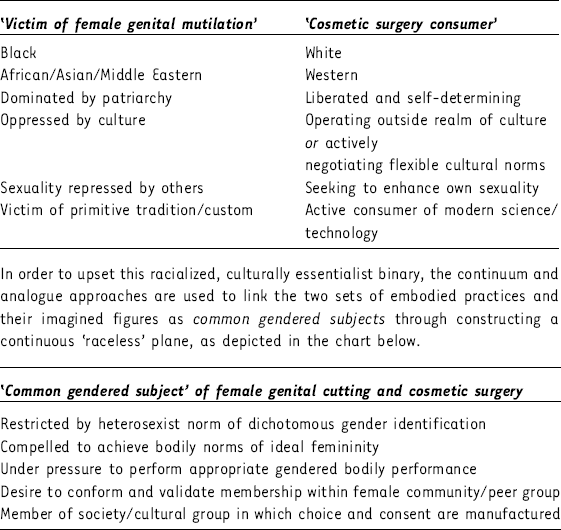
As we can see, in the movement from the top to the bottom chart, the continuum and analogue approaches collapse the original binary into a single field. The imagined characteristics of the common gendered subject on the bottom chart (relating to gender/sexuality) do not, on the whole, correspond with those listed in the binary chart above (relating to race, nation, culture). From this perspective, the continuum and analogue approaches have not specifically interrogated each point of assumed difference within the original binary, but rather have replaced the entire binary with a new construction emphasizing similarity. The new ‘common gendered subject’ has been constructed through flattening the previous divisions of race, culture and nation.
Yet, the ‘common gendered subject’ is only a façade, temporarily disguising the role that race, nation and cultural difference continue to play within the continuum and analogue approaches. Within the continuum model, there are implicit assumptions being made (if not explicitly expressed) about where particular practices would sit in relation to each other (e.g., Gunning's implication that only practices of FGC, and not the other ‘western’ body-altering procedures she discusses are in need of eradication). These assumptions are often highly racialized – those practices which are seen to be raced (various forms of African, Asian or Middle-Eastern-rooted FGC) are on the whole seen to be more extreme, harmful or damaging, and thus are imagined as sitting towards one pole of the continuum, whereas those practices which continue to be seen as un-raced (cosmetic surgery, reproductive surgery, intersex surgery) are assumed to be less extreme, harmful or damaging and are thus imagined as sitting towards the opposite pole. Within the continuum model race, cultural difference and nation thus continue to play the problematic role that they did within the original essentialist binary. Rather than upsetting the binary structure, the continuum has merely stretched it out, leaving its previous divisions more or less intact. While the analogue approach often risks collapsing into uncritical assertions of sameness, its simultaneous susceptibility to slipping into the continuum mode (as noted in Gunning's text earlier) reveals its continuing dependence on racialized scales of difference.
I want to argue therefore that in those approaches which have established similarities between FGC and other embodied practices exclusively on the basis of gender, we need to put race, cultural difference and nation back into the equation. We need to look at how these axes intersect and articulate with gender and sexuality, among other variables, in the historical constitution of practices and embodied figures posed as oppositional, while also examining the role and significance of such historical constructions in shaping contemporary experiences and representations of such practices. We also need to interrogate the implicit role that race, culture and nation continue to play in the ways in which we theorize the relationships between different cultural practices, even (or perhaps especially) when they appear to be absent. In the next section, I will consider how this erasure of race, cultural difference and nation within the continuum and analogue approaches may be related to the development of a ‘western’ empathetic gaze.
Empathy, Location and the ‘Right’ to Represent
In linking FGC with other body modification practices, several western feminist theorists argue that (other western) theorists should empathize with those in cultural groups different to their own through recognizing ‘common’ experiences of violence or oppression. Gunning (1991: 205) sees the development of such empathy as aided by ‘an in-depth look at one's own complex cultural context in search of analogues to culturally challenging practices in the “other's” culture’. In other words, being able to empathize with ‘the other’ in her cultural context requires that the western subject identify similar experiences in her own setting. Similarly, Meyers (2000: 486) suggests that developing transnational empathy requires that, through introspection, the western subject ‘discover[s] hidden similarities between others’ experience and one's own’. She writes:
Sensitized to the role that Western gender norms are playing in one's empathy for the American mother, one now appreciates how potent culturally specific feminine bodily norms are, and one can sympathetically reconstruct how a vastly different set of norms could figure in an African mother's feelings and decision about infibulation.
(Meyers, 2000: 486)
Although in contrast to Gunning, Meyer's language in this example does not suggest that the western subject should consider the two practices ‘the same’. Indeed, she stresses that the two sets of practices involve ‘vastly different’ sets of norms. 5
In addition to this example of transnational empathy, Meyers (2000) also discusses the importance of developing empathy within particular local communities that are divided by differences in regards to religion, socio-economic class, sexuality, etc. This particular invocation of empathy is not about encouraging privileged western subject to empathize with third world ‘Other’.
As a concept, empathy has been important to the development of feminist epistemologies and ethics (Hill Collins, 1990; Koehn, 1998). From my perspective as a western scholar working on cross-cultural and transnational issues, empathy seems crucial as a means to continuously remember that the embodied practices which I discuss do not exist merely as words on a page, but rather are linked to real women with real experiences and emotions, which include pain and suffering, but also joy and pleasure. The process of trying to understand the circumstances a woman might face and the feelings she might have in a cultural context which is very different than one's own seems crucial to conducting valid and ethical research. I remain concerned, however, about the effects of developing an ‘empathy’ which is imagined or produced through collapsing critical historical and contextual distinctions between different embodied practices and subjectivities. The potential for appropriation on the part of the privileged western subject in this context is especially worrying.
It is important to acknowledge that I am using the term ‘western’ here to denote a geo-political location of relative social and economic privilege within transnational circuits of academic knowledge production and dissemination. The individual feminist theorists whom I include in this category, however, are of course located (and hence privileged) differently on the basis of intersecting axes of social differentiation such as race, ethnicity, class, nation and sexuality. For example, while Meyers locates herself as a white, western feminist theorist, Gunning acknowledges that she speaks from the position of an African American, feminist scholar. Other feminist thinkers working within various western contexts may identify as ‘African’, ‘Black (African identified)’, or in a multitude of other ways that complicate any clear-cut binary of ‘privileged western theorist’ and ‘African other’. Such specificities relating to social location and identity will surely make a difference to (without directly determining) the ways in which particular cross-cultural constructions of empathy are formed and interpreted in a variety of complex ways which I want to acknowledge and yet do not have space to explore fully here. I am aware that in tracing the construction of a generalized ‘western empathetic gaze’, I sacrifice a more in-depth analysis of the complexities and contradictions of feminist social and geo-political positionalities and discursive strategies; however, I would argue that there are also important locational specificities and discursive patterns associated with ‘the West’ in an academic and political context within which western hegemony remains salient. Such patterns need to be examined and highlighted precisely so that they may be accounted for and addressed. Indeed, what is interesting, and problematic, about a number of ‘western’ constructions of cross-cultural empathy articulated from different social locations is the way in which they nevertheless function to reify dominant western dualisms and discursive hierarchies, though in different ways and to different degrees.
In a historical context in which African women's bodies have been routinely fetishized, pathologized and violated by westerners, interventions in discourses relating to FGC by feminists speaking from western locations have been perceived by many indigenous African women as ethnocentric and imperialist. In such circumstances, arguments have developed about who has the ‘right’ to represent the interests of women who practice (or are at risk of) FGC. Such arguments have been directly linked with ideas about embodied location. For instance, the Women's Caucus of the African Studies Association (WCASA) argue that ‘changes in the practice of clitoridectomy and infibulation in Africa must be initiated and carried out by members of those African cultures in which the custom exists’ (WCASA, 1983/2002: 2). By contrast, other theorists, such as Christine Walley (2002: 21), have claimed that restrictions made on the basis of experience or race and ethnicity in this context essentialize ‘both practitioners and non-practitioners by locating them in bounded groups assumed to share common beliefs – a reductionist view that ignores a far messier reality’. 6
It remains questionable how practical, or indeed possible, it is to delineate particular embodied locations, in definite and distinct ways. Does the WSASA's category ‘members of those African cultures in which the custom exists’ (1983/2002: 2) refer only to indigenous Africans living within circumcising communities or does it also include African Americans (such as Gunning) who identify with African diasporic culture and yet live and work in the United States and claim no direct attachment with circumcising communities?
Within a political framework in which representation is a fraught issue, the continuum and analogue approaches may be employed by ‘outsiders’, in part, as a strategy to establish their authority to speak. If, through the production of cross-cultural ‘empathy’, a western feminist theorist can show that FGC is actually inherently similar to practices within her ‘own’ culture and that such body modifications thus represent something shared across cultures, then perhaps she can more easily establish her legitimacy to represent ‘contested’ cultural practices such as FGC.
Gunning, for example, argues in relation to FGC that,
As feminists… we must develop a method of understanding culturally challenging practices, like female genital surgeries…. The focus needs to be on multicultural dialogue and shared search for areas of overlap, shared concerns and values.
(Gunning, 1991: 191)
Her claim that ‘The focus needs to be on multicultural dialogue‘ functions implicitly to reject claims that only those who are part of cultures in which FGC is practiced should have the right to initiate changes in relation to FGC.
Similarly, Kathy Davis encourages sympathetic cross-cultural comparisons between FGC and intersex surgeries. She writes:
Genital cuttings in all its manifestations, both in Africa and in the west, demands a reflexive and sympathetic politics of engagement. This is not the time for feminists in different parts of the world to ‘back off’ and focus on their own parochial concerns, rather it is time to take up the challenge posed by transnational feminism and find ways to build coalitions around issues that are of concern to us all (italics mine).
(Davis, 2004: 309)
Within this statement about challenging ethnocentrism, there is an explicit claim being made about Davis's (and other theorists’) authority and legitimacy to speak about and represent FGC. Presumably, in this context, it is the privileged western feminist, and not the indigenous African or ‘Third World’ feminist, who worries (or has been told) that she should ‘back off’ and focus on her ‘own parochial concerns’. Thus, while references to ‘transnational feminism’ and the building of ‘coalitions’ suggest a dialogic process in which feminists in different geo-political locations might work together, Davis's language paradoxically implies that the privilege of the western feminist subject in such alliances could remain intact.
Interestingly, there are also examples where continuum and analogue approaches are employed by western feminists as a rhetorical device within discourses which take ‘western’ practices as their focus, rather than as a means to enter debates relating to African practices of FGC. For example, Cheryl Chase links FGC with intersex surgery to raise awareness for the US intersex campaign, which seeks to call attention to the dangerous and damaging effects of ‘corrective’ surgery on intersex babies. Chase, who is Executive Director of the Intersex Society of North America, opens the article by criticizing ‘media and scholarly discourses on “female genital mutilation”’ which have not engaged with intersex surgeries, ‘instead serving up only representations of African women’ (Chase, 2002: 126). She then immediately frames her concern with this phenomenon as one relating to ethnocentrism:
These discourses continue a long tradition of making Africans into the ‘other’, suggesting that ethnocentrism is a key factor in the sometimes purposeful maintenance of ignorance about contemporary US genital surgeries.
(Chase, 2002: 126)
Chase's opening critique implies that FGC and intersex surgery are analogous, rather than fundamentally different, yet the article never actually makes any explicit case for why FGC and intersex surgery should be considered analogous. While Chase provides a sophisticated and compassionate critique of intersex surgery, the link she suggests (rather than establishes) between intersex surgery and African FGC is effectively no more than rhetorical. In this sense, it could be argued that while Chase, as an intersex person, speaks from a relatively marginal western position, her text nevertheless functions to shore up dominant geopolitical relations of power because she appropriates FGC as a tool to critique various aspects of ‘western’ culture. Through such a discursive move, critical attention is once again turned back on the western ‘self’ and the fetishized figure of the African ‘victim of female genital mutilation’ may be reified (rather than displaced as the surface of her text suggests).
In critiquing particular western feminist theorists in this article, I do not want to suggest that such thinkers are individually negligent or problematic. Rather I seek to place their texts within the larger context of global (First world/Third World, West/non-West) power relations in which particular modes of representation are constructed. In doing so, I acknowledge that I do not operate outside such a context, and hence, I may also recreate some of the problematic patterns which I identify and critique. It is my hope, however, that the disruption, rather than the reification, of such hierarchies may be enabled through employing a reflexive approach which traces and interrogates the ways in which particular dominant feminist modes of discursive representation are constructed and employed.
Returning to Gunning's use of empathy, she claims that in linking contemporary African practices of FGC with 19th century American clitoridectomies, her intention is not ‘to suggest that because Western women have confronted and “overcome” the specific problem, the practice of genital surgery is a “phase” cultures pass through; that whatever was done in Western societies just needs to be done in African societies’ (Gunning, 1991: 226). Yet, the language she uses to call for empathy from western women – ‘It is part of our own history‘ (italics mine) (Gunning, 1991:211) – suggests that western women are being asked to develop empathy on the basis of experiences they have apparently already worked though. As such, it functions to preserve particularly problematic notions of cultural difference related to assumptions of advancement and progress. In this case it may be that, as Sara Ahmed (2004: 30) asserts in another context, ‘empathy sustains the very difference that it may seek to overcome’.
Earlier, I suggested that Gunning's analogue approach might not be faithful to, or compatible with, Lugones's original world-travelling method. However, in addressing the relationship between empathy and privilege, we may also want to consider whether Lugones's methodology has its own potential weaknesses. Her notion that world-travelling enables one to ‘see oneself in other women who are quite different from oneself’ (Lugones, 1990: 393) may actually risk enabling a problematic projection of the self onto the other in ways that maintain the privilege self's status as the one who is always imagining, seeing, and contemplating her own subjectivity through others, and hence moulding others in her own image. As Adrianna (Cavarero, 2000: 91) argues, ‘To recognize oneself in the other is indeed quite different from recognizing the irremediable uniqueness of the other’.
In aiding the ‘western self’ to see hidden similarities between herself and the ‘non-western other’, this approach to transnational empathy may collapse into a sameness which, in flattening histories of embodied differentiation, simply reifies the essentialist differences identified as problematic in the first place. 7 Consequently, histories of othering and violence through which particular embodied identities and practices have been (re)constituted are again effaced. At this point, we can see how the problematic erasure of race, cultural difference and nation which I associated with the continuum and analogue approaches above, may be linked to the appropriative construction of the ‘western’ empathetic gaze. A central problem with this strategy of transnational or cross-cultural empathy is that it does not ultimately interrogate the privileged position(s) of the (western) self, and indeed often functions to shore up this privilege. Precisely as it claims to recognize embodied similarity in a way that transcends divisions of race, culture and nation, it actually preserves such hierarchies.
Karen Engle and Ranjana Khanna (1997) have similarly critiqued the ways in which empathy is used as a tool in transnational politics in Alice Walker's novel Warrior Marks (1993).
As I indicated earlier, my analysis raises further questions about how cultural context and social location may affect the operation, effects and reception of empathy as a discursive strategy. While my critiques have centred around the potential for reifying problematic discursive hierarchies associated with ‘western’ feminist perspectives, it would be interesting and vital both to consider how specificities and complexities within the category ‘western feminist theorists’ play out in this context as well as how the employment of such cross-cultural techniques by feminists working within other geo-political locations may raise different issues or concerns. For example, what difference would it have made to centralize the ways in which ‘African women’ both in Africa and the West, or Black (African-identified) women in the West, either as migrants of settlers, have discussed such issues? 8 These are all questions that I hope may be taken up in future analyses.
I thank one of the anonymous readers for indicating the importance of these types of questions.
In conclusion, feminists situated in divergent social and geo-political locations might more successfully seek to develop understanding, awareness and compassion across cultural and national boundaries through revealing, and mutually engaging with, the processes through which embodied cultural differences are relationally and hierarchically constructed. Instead of asking how the ‘victim of female genital mutilation’ and the ‘cosmetic surgery consumer’ are inherently similar, we might more fruitfully explore how these imagined figures are, in part, constructed and defined in and through one another, via the complex historical articulations of race, gender, sexuality, nation and culture.
Footnotes
Author Biography
Carolyn Pedwell received her Ph.D from the Gender Institute, London School of economics in 2007.