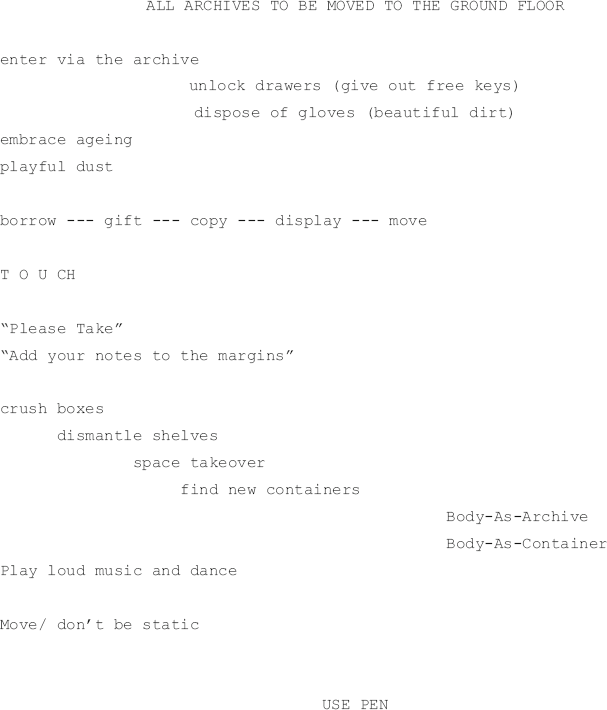
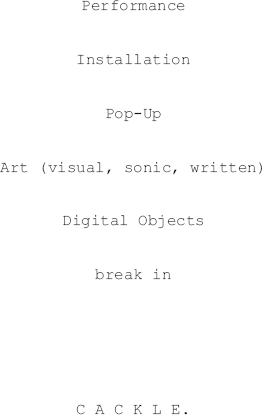
On 14 January 2016, a remarkable group of women and men-and self-proclaimed feminists-gathered at HOME Mcr to partake in talks, performances, discussions and networking responding to Archiving Women's Performance Practice. Exploring the (in)visibility of women's practice in history and contemporary contexts, the event unpacked how mechanisms and content of the archive can be unravelled and re-presented. We explored what archiving (and performance) means to different people, the importance and value of archives, and the many ways we can capture narratives and outcomes. Notions of performative feminist methodologies, and strategies for disrupting both the archive and modes of knowledge production, soon became this group's mantra.
Our thoughts in these discussions were not linear without gaps and breaks; they were not a substantial whole, but they were not lacking either. The fabric of our weaving conversation carried a rhythm and drive of excitement, a tension and buzz with a feminist-activist flavour. Our excitement (and buzz) emerged from a realisation that in that room (for one night at least) we had disrupted and reimagined the archive: process, structure, content and access. We had unlocked narratives; generated new herstories; played; reorganised; unravelled, and put back together again notions of the archive in theory and in practice.
The room wanted more.
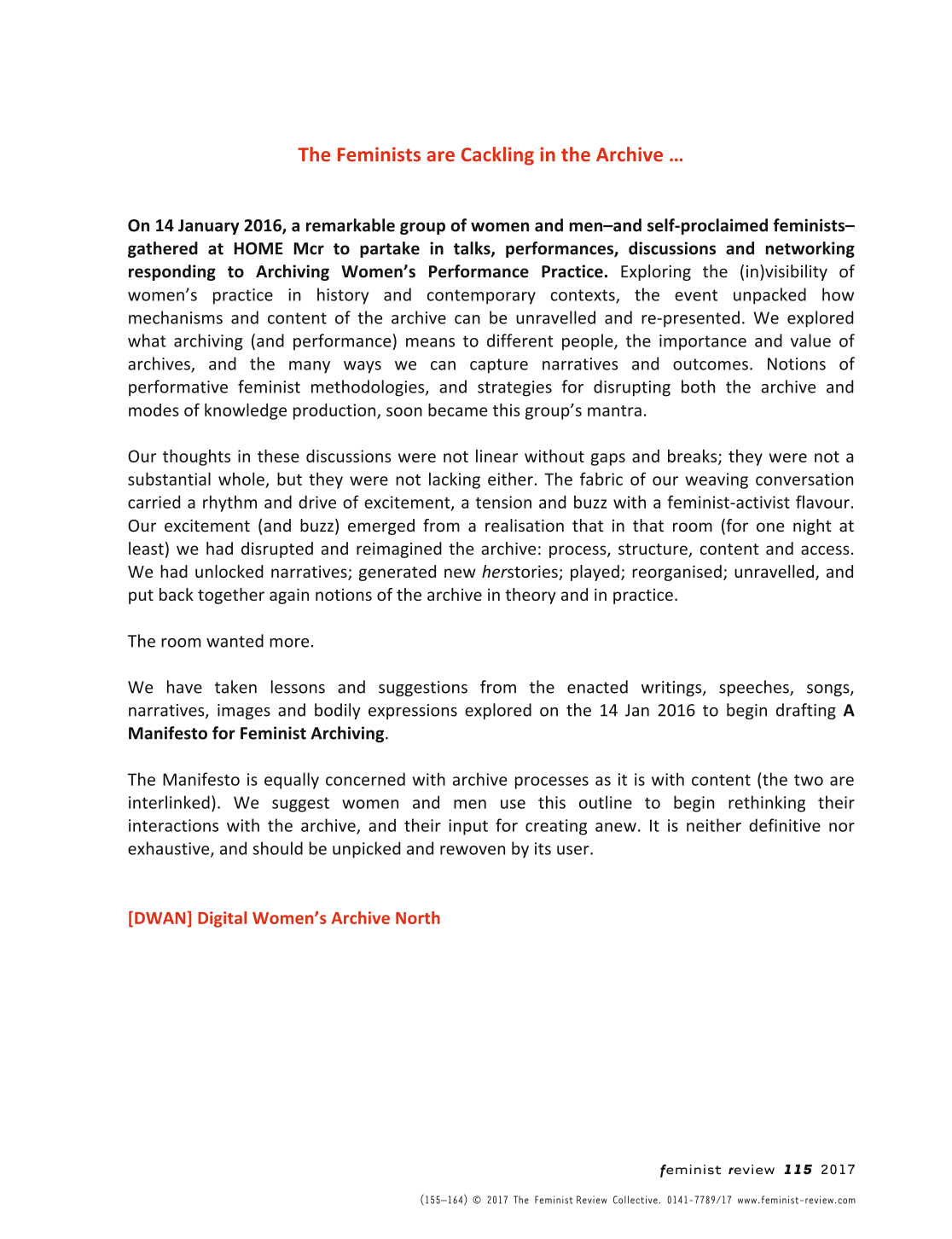
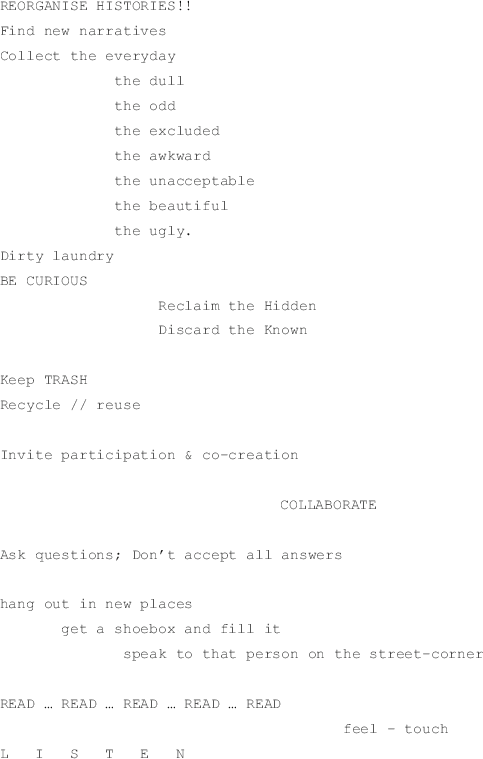
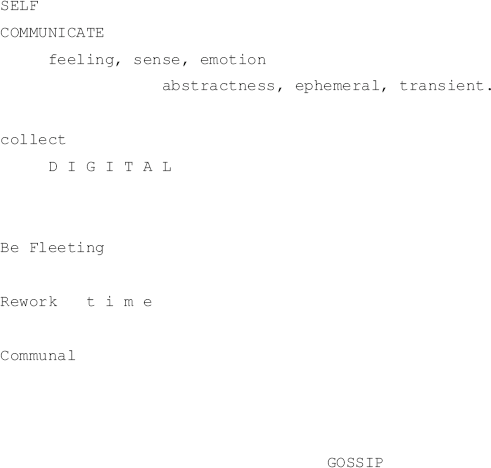
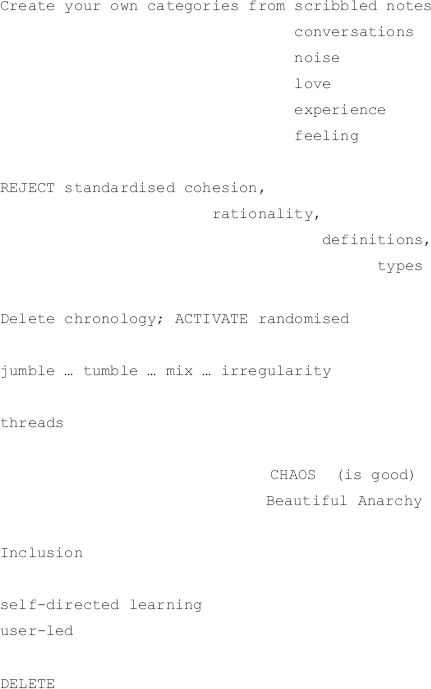
We have taken lessons and suggestions from the enacted writings, speeches, songs, narratives, images and bodily expressions explored on the 14 Jan 2016 to begin drafting A Manifesto for Feminist Archiving.
The Manifesto is equally concerned with archive processes as it is with content (the two are interlinked). We suggest women and men use this outline to begin rethinking their interactions with the archive, and their input for creating anew. It is neither definitive nor exhaustive, and should be unpicked and rewoven by its user.
[DWAN] Digital Women's Archive North
A Manifesto for Feminist Archiving (or disruption)
How can Feminism:
suggest alternative methods for reading the archive, through a reorganisation and re-selection of knowledge?
unravel (theoretically and creatively) the authority and structures of the regulated physical archive?
treat, or mistreat, the data and data categories offered by the mechanisms of the archive?
empower all users to take ownership of the body as presented in the archive?
create new models for searching and re-presenting data of the archive?
unite threads of tech and materiality in women's practice?
unlock the unknown narratives in archives?
encourage performative storytelling?
teach the archive to play?
Methods:
Intervention: a process of generating new practices and approaches for intervention with existing archival material. Intervention methods are specifically concerned with access and interpretation.
Living: approaches of specifically connecting archive material with contemporary political and activist contexts. The Living archive is one played out through the body and particularly concerned with individual engagement and voice.
Reimagined: a reuse and recycling of the archive material to create new archival forms. Reimagined is concerned with creating new processes and archival structures.
Archives traditionally follow a set of best practice guidelines in developing a data management plan, which would include material selection, mechanisms for facilitation and searching, type of media and storage, duration for holding, processes for access. It is during these different stages of traditional archival creation that feminist disruption can take place. We have identified five possible intervention points, which if responded to can result in form of Feminist Archiving.
1: SELECTION
An archive becomes such because individuals decide that certain pieces of knowledge and data should be collected and retained following initial generation and use. This is a political act: we select material to retain at the expense of other material or data. In selecting certain content we announce to future users that this material holds importance (to someone, for some purpose). Often the identity of the archivist or collector is secondary (or absent).
DISRUPTION:
2: TYPE
Each individual submission would (by traditional methods) have its own archive file, containing a summary, and related documentation which could include images, sound (if recorded), visual and material artefacts. Type of material archived is usually constrained to that which can be identified as an artefact or some kind of material substance. Emphasis on materiality doesn't allow for impression or experience.
DISRUPTION:
3: FACILITATION
An archive is made searchable by a series of predetermined categories decided by the archive creator. Archives love to categorise; they have to (do they?) in order to present material in a cohesive, searchable fashion. What is the point of an archive if you cannot locate the material you want? Of course, that is presuming you know what it is you wish to find. This presumption carries a set of rules: there are predefined topics of interest; when we enter the archive we only do so in a structured manner; knowledge in the archive is there to be given out, not created anew; there are mechanisms in place to direct your search; regulation and order must be maintained for future searchers. This process is presented as objective, but it is highly politicised and controlled.
DISRUPTION:
4: STORAGE & TIME
Archives require spaces in which to be stored (physical or digital). Many physical archives end up in a basement due to an assumption that archives are containing histories, and therefore should be separate from the contemporary activities taking place above. There is also the practicality of temperature and size. Digital preservationists are finding challenges with both space and formats with an ever changing and increasing content. Time is the archivist's enemy: a race to preserve and conserve before deterioration or loss.
DISRUPTION:
5: ACCESS
This is related to the above. Physical access is not always easy due to institutional restrictions (and policy around conservation), and a number of logistical barriers might be in place. Access to the archive is often a well-structured and formalised process undertaken with archivists. Archive access is almost always supervised, and often individuals will have to request ahead of time, via a system of booking, to engage with certain materials. Digitisation is deemed a way of increased access, but points 1-4 are still very much in play. Digitisation presents an exclusion from the actual material artefact; the user is viewing a facsimile, not originals. Both physical and digital archives also present intellectual access challenges - wider education around the purpose, content and possible uses of a specific archive may or may not be in place. Therefore, access to the archive is for those in positions of privilege, intellectually and physically.
DISRUPTION:
Feminist Archivists who participated on 14 January 2016
[DWAN] Digital Women's Archive North is an arts and heritage organisation delivering a programme of community-based projects and research relating to gender (culture, heritage, spaces, equality, social participation, wellbeing). [DWAN] Supports women and girls to identify, collect, disseminate and celebrate their cultural heritage through feminist creative and digital interventions. Women and girls are empowered and skilled to be active citizens participating in culture and heritage, and wider educational opportunities
Caro C is an artist, engineer and facilitator in sound based in Manchester UK. As one of the founders of Delia Derbyshire Day, Caro is now project manager of the growing organisation and has developed an education strand designing and delivering music technology courses in primary schools inspired by Delia's work. Delia Derbyshire Day taps into the rich archive (held at the John Rylands Library, Manchester) for avenues of inspiration, connecting with lineage and developing new work via new ways of working.
Mary Stark is an artist filmmaker based at Rogue Studios in Manchester. She explores film projection as a site of wonder and imagination and is enchanted by the sculptural materiality of the filmstrip. Since 2012 Mary has been exploring ‘voices’ created from fabric, lace and thread through the filmmaking technology of optical sound. Optical sound involves visual forms in the soundtrack area of the filmstrip transforming into noise through film projection. Mary's performances summon absent voices and obsolete industries, involving 16mm film projection, light and shadow, mechanical noise and music associated with textile production. Her commission piece for Delia Derbyshire Day 2016 is titled For Delia (35mm black and white camera-less film).
Abigail Ward is an award-winning curator, writer, DJ and project manager with over fifteen years’ experience in the music industry and cultural sector. She is the co-founder of Manchester District Music Archive. Her interests include Greater Manchester music history; community archives; music & disability; LGBT music culture; and digital storytelling. She has worked with Drake Music, The Lowry, Red Bull Music Academy, Cornerhouse/ Home_Mcr, Sabotage Times, Piccadilly Records and Louder Than Words Festival. Abigail won the Big Chip best not-for-profit website award in 2006 and 2014 for her work on Manchester District Music Archive. In 2008 she edited and co-designed ‘1 Top Class Manager - the notebooks of Joy Division's manager 1978–80’. Sarah Feinstein has worked in the cultural sector for over seventeen years, acquiring skills in collections management and arts administration. She is a Trustee for MDMA. Most recently, she worked as a collections assistant at the Women's Art Library (London) and a researcher at the Prisons Memory Archive (Belfast). She is currently a doctoral candidate at the Institute for Cultural Practices (UoM). Archives are closely linked with how we understand history and can be a site for resistance and celebration in challenging how history is defined - MDMA is a site for such exploration.
Nilan:Shannon:Wolstenholme have collaborated on various spoken word and audio works, including ‘The Little She Girls’, performed at the Creative Media Centre, Salford 2015. Nilan, vocalist in Rose & The Diamond Hands (German Shepherd Records) creates atmospheric, often downtempo and gothic tinged songs with rich, expressive female vocals, intense bass and primal beats. Shannon, performer and director of Let's Go has been experimenting with live performance and live art for over twenty years, always exploring women's activism, feminism and the female voice. Wolstenholme, a prolific composer of electronic music, singer songwriter and has been in many Manchester music bands including Bandit Queen and Beyond the Glass. The three women often come together to chat about life, politics, and how the world works, they make stuff together that explores their lives as working women in the arts and audio playing field. Their latest piece Idle Cackle, is creative spoken word and audio piece that explores how everyday women's voices can become more influential and more representative in society if captured, archived, and played to the world. Everyday conversational moments are often lost, not seen as important, or brushed aside as idle cackle. But these moments are rich, insightful and expose our day-to-day experiences of the complexities of our extra ordinary lives as women.
Najia Bagi is a musician, artist, producer and fundraiser. She has worked with various organisations including Manchester Art Gallery, The Hepworth Wakefield, Tate Liverpool and Royal Exchange Theatre. She is particularly interested in how young children develop through multi sensory stimulation, and how playing with sound can encourage communication between carer and child. Najia is artist in residence at Nightsafe, a homeless shelter for young people in Blackburn. She is also producing a permanent installation in the gardens of Alder Hey Childrens’ Hospital, Liverpool. As a freelance project manager, Najia has produced a wide variety of events and projects, most recently with community arts organisation, Let's Go. Najia's project with HOME Mcr in 2016, What Would Billie Do?, explores loss of self through Love, using performance, photography, intervention and music.
Kevin Burke is an artist, musician and composer based in Manchester. He is Co-Director of Instigate Arts CIC which aims to create positive, progressive, social change through arts production and participation with a specific focus on curating and developing exhibitions and events combining the arts, academia and activism. He has been writing, producing and teaching music for over twenty years and has for the past five years worked on exhibitions and events with a specific feminist and equality focus. In his film I hate silence when it is time to speak Kevin explores the nature and representation of female orientated audio/visual in the Internet archive: its presentation and direction, its accessibility to the general researcher and the voice or voices that come through within given pieces/practices.
Kate Lowes is Head of Programmes at Brighter Sound where she oversees all project delivery and is actively involved in fundraising and development initiatives for the Company. She joined Brighter Sound in 2007 but has worked in the arts sector for twelve years as a musician, a practitioner and in project management. She is currently undertaking a Professional Doctorate looking at the gender gap in the music industry. Kate's work is responding to low levels of female participation across their projects, and the historical barriers, inequalities and stereotypes that have impacted on women making music in the past but that still have resonance today.
Feminist Webs Archive (with Alison Ronan) began in 2006 as the result of a short conversation between two feminist youth workers worried about the potential fate of the paper trail of their work with girls and young women during the seventies and eighties. They put the word out and after an informal meeting of thirty-five youth workers from across the country the archive began to develop. We now have a small but representative collection of material from the late sixties onwards: magazines, newspaper cuttings, policy documents and books - all related to the second wave of feminism and its impact on work with girls and young women. We are rooted in feminism - but the collection also covers work on race, class and sexuality.
Anne Louise Kershaw is an artist, curator and writer based in Manchester. She is Co-Director of Instigate Arts. She has contributed towards numerous print and online publications writing about feminism, gender issues, art, culture and music and has written, designed and co-edited numerous educational publications. As well as being Chair of feminist literary charity For Book's Sake she is a feminist campaigner. Anne's piece Undercurrent/Subject to Change is a sonic exploration of the restrictive and easily accepted norms that underlie our society. It explores the landscape that exists between the comforting, familiar, everyday and the sinister, powerful and controlling, to consider what we can and will choose to do within that landscape. Do we settle on the undercurrent, or try to make change?
Dear Friend is a letter-writing project by Manchester-based historian Sylvia Kölling, supporting and celebrating the women who campaigned for a more equal world. Many stories we have of UK women activists are related to women's liberation: be it the right to vote and stand for office, have equal pay and employment opportunities, or fair cultural representation. Women fight and have fought for all kinds of causes, however: from campaigns against slavery, to the Greenham Common peace camp, to Friends and Families of Lesbians and Gays (FFLAG). This project celebrates those women who have made a difference in any area of (in)equality, but especially focussing on stories of solidarity and unity with other struggles. We challenge everyone to write a letter or postcard to a woman, living or dead, who has inspired them. Through writing these letters, we will build an exhibition and digital archive of support for these women, opening up and highlighting the role of women's activism in all areas of social change.
Broadside Balladress, Jennifer Reid is a Lancashire folk enthusiast and broadside archives researcher, having volunteered at Chetham's Library, the Working Class Movement Library and various other local institutions. Since completing an Advanced Diploma in Local History at Oxford University she is currently working with Jeremy Deller as well as singing broadsides from Manchester Central Library and Chetham's broadside collections. Jennifer has performed at Manchester City Art Gallery, Nottingham Castle Art Gallery, Chetham's Library for a Newsnight segment, Wythenshawe Hall, Band on the Wall, Manchester Metropolitan University, Manchester International Festival, on BBC Radio 2, 3 and 6, the BFI Southbank and the Venice Biennale. She has since performed again in Venice and New York for the Creative Time Summit, in Croatia for the Museum of Contemporary Art and regularly in Manchester and London.