






Abstract

Expo ‘92 was a Universal Exposition; a hymn to technology and conquest at the very end of the American century; an example of ‘the ‘West's’ escalating dominations of abstract individuation’ (Haraway,
Donna J. Haraway (
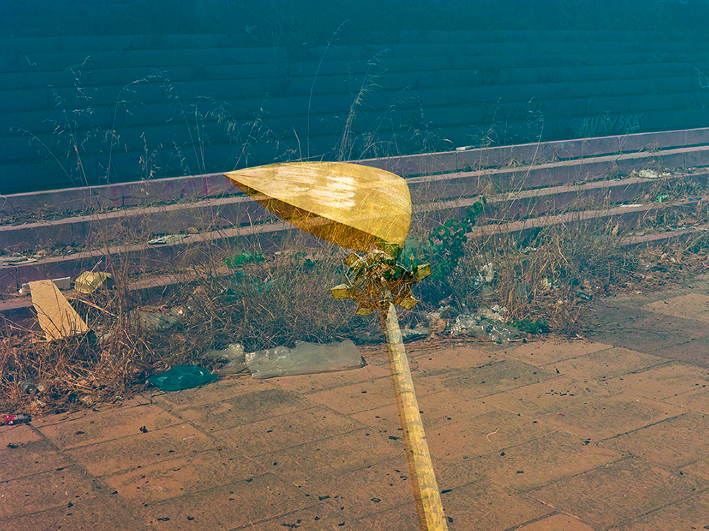
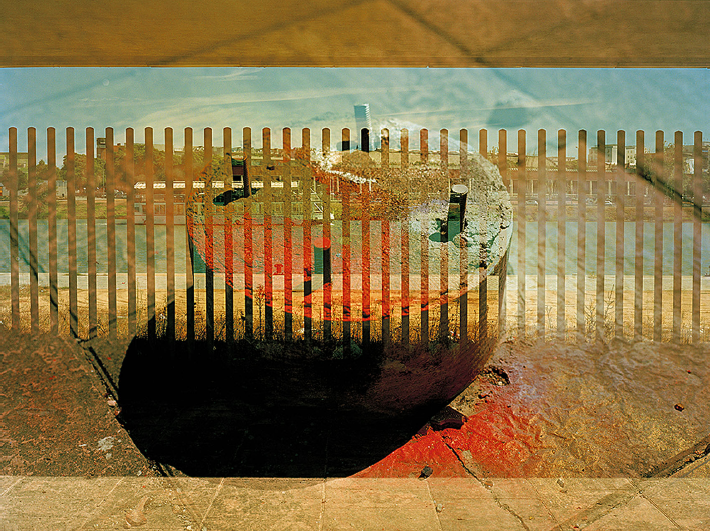
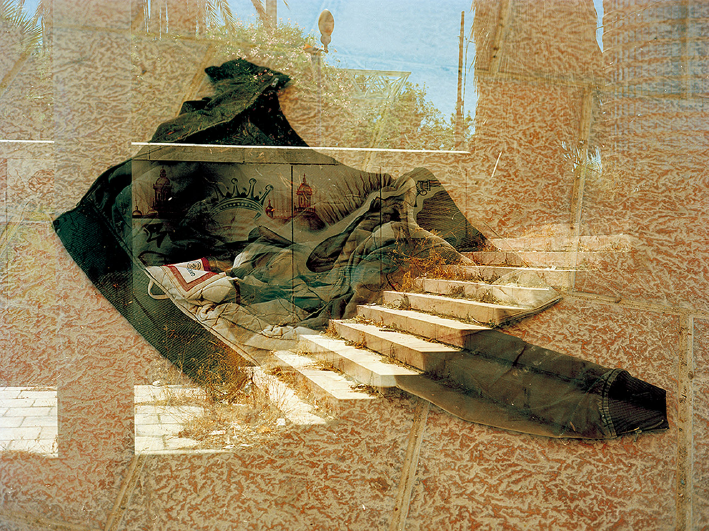
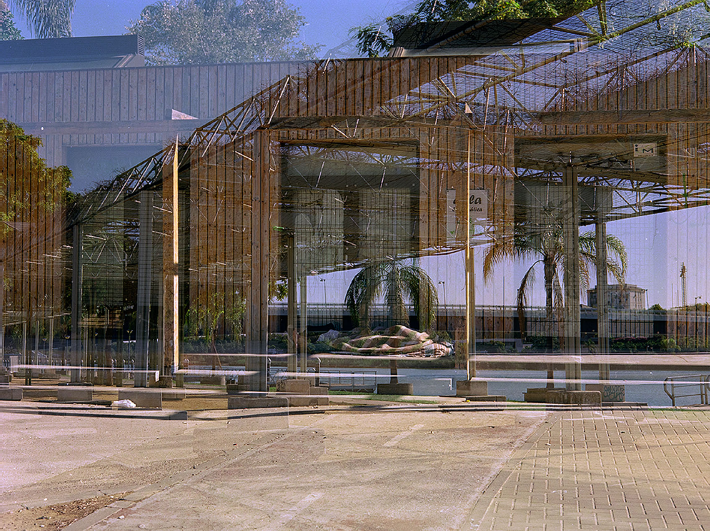
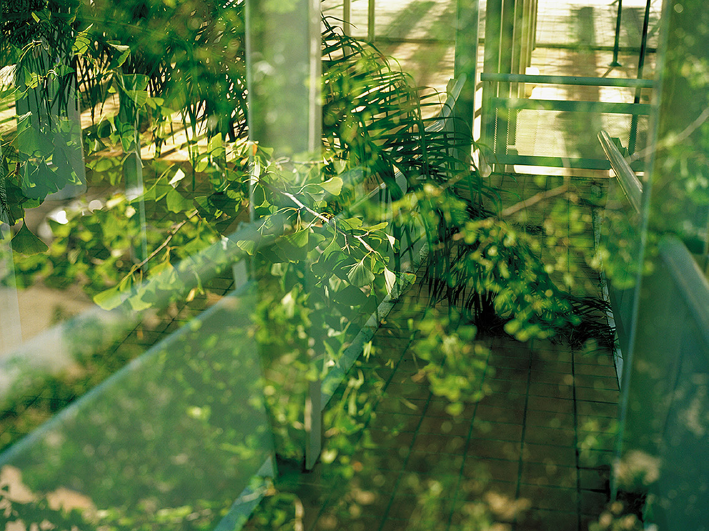
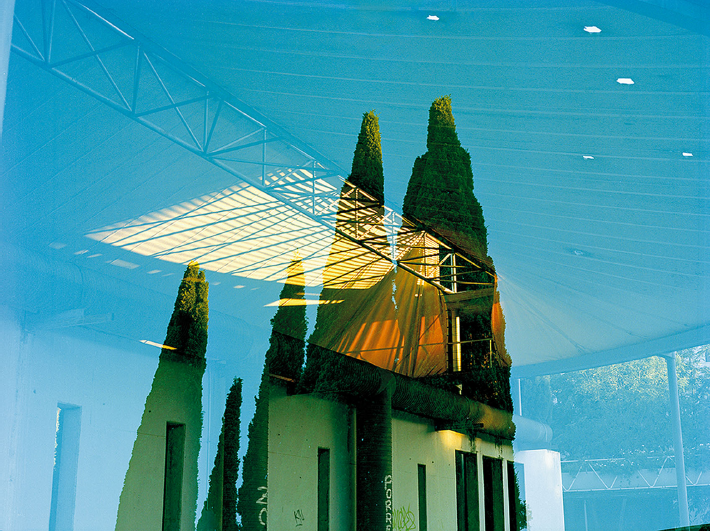
I used the technique of double exposure onto analogue film stock to introduce chance into the procedure of making images; I have no precise control over their formal qualities. The expo park is architecture designed to be photographed. I wanted it to be somehow more opaque, ambiguous and less concerned with a faithful representation of ‘that which was there’. I am interested in the ghosts of possibilities, the echoes of past futures.
Expo ‘92's totalising project was subject to limited postcolonial contestation at the time; the Mexican pavilion in the shape of an X presented a riposte to the contemporaneous Spanish insistence on spelling the country as ‘Mejico’. Universal ambitions for the future eventually became mired in local politics as corruption scandals overshadowed the transition of the project from pleasure ground into a more pragmatic, usable resource.
I don't claim that the metaphorical failure of this nominally global project opens up any space of hope for ‘progress’ beyond progress, but I think its stunted utopia gives a curious glimpse of a dream of a universalist capitalist ideal, which was probably quaint and anachronistic even in 1992. The ‘man in space’ no longer inhabits the space of discovery. In the intervening years, humans have developed drones and nanobots. Humans still make bold discoveries—landing on comets and Mars, for example; however, robots do the legwork of discovery. Our human-centred notion of progress has been radically altered.
In Issue 96 of Feminist Review I came across a quote from Deborah Parsons (2000, pp. 15–16 quoted in Wolff,
My methodology as an artist has a relationship to feminist ideas about gender and sexuality, particularly in articulating a way of producing lens-based work that avoids a masculine-coded ‘discourse of trespass, penetration, invasiveness and spatial appropriation’ (Prescott,
The process of making these images has happened over a fairly long period. I went to Sevilla just over a year ago. I set out to produce images at the site not knowing what I was trying to express precisely, nor what I would get out of the project. I meandered, making double exposures of the broken architecture and street furniture and the plants, the redundant Ariadne rocket. I exposed hundreds of frames and later whittled these down to the six you see here. I used some selection criteria in doing so—no people, no cars, no text—but much of the process happened instinctively, an affective response to certain forms. I can't really explain my choices, other than they produced certain complex feelings that I believe relate to the complexities of the site. 1
The histories of Expo ‘92 are histories of ongoing colonisation—the Pavilion of Latin America was used to present an exhibit on the Gold of America—whilst de-emphasising its impact on people. The site for the expo, Isla de la Cartuja, was chosen as the symbolic embarkation point for Columbus’ first voyage; most of the gold looted by conquistadors was channelled through Sevilla, which became for a time the richest city in the world, until its economic decline following the liberation of the colonies. The map of Expo ‘92 was written in English, not Spanish and the streets were originally named like American streets—4th Street, 1st Avenue, etc. In some ways I think of this Spanish dream/celebration of an ‘American future’ as a symbolic recolonisation of a weaker power by a stronger one, which mirrors the conquest of the Americas of 500 years earlier.
Working through this method requires me to acknowledge my embodiment in the making of the image, and I am aware of the challenges this presents. I am a white, straight, able-bodied middle-class British man armed with a camera. This project, which might be described as recording ‘decline’ in a ‘foreign’ country with a well-documented history of exoticising travelogues by (upper-class) English ‘adventurers’ can never be unproblematic.
Arguably I am projecting my own cultural fantasies in a similar way to twentieth-century British Hispanophiles—whose paternalistic admiration for a ‘charmingly primitive world’ unspoilt by modernity led to expressions of invective against the intrusions of plastic consumer goods (Richardson,
Haraway (
Footnotes
Acknowledgements
With thanks to Kyoung Kim.
Author Biography
Edward Oliver is a practising artist and lecturer in photography and film production at University for the Creative Arts (UCA).