






Abstract
My PhD research on the feminist analysis of music and musicianship through a lens of caste and gender led me to meet Shital Sathe, 1 one of the most important shahirs 2 in the anti-caste movement in contemporary Maharashtra. Being a target of state censorship, incarceration and surveillance over the last decade, Shital, along with her partner Sachin Mali, has been challenging Brahmanical hegemony embedded in the state, community and home through her music. Our growing friendship and sisterhood while travelling and performing together in ‘saffron India’ (from 2015 to 2016) marked an important space to further the conversation about non-Brahmanical aesthetics of music. Born and brought up in a Brahmin middle-class family in Pune, a place known for its staunch Brahmanical legacy, I have experienced first-hand for nearly two decades how the system of formal classical music education is hinged on hierarchies of legitimised cultural appropriation, patriarchal dominance and caste exclusion—the core of the twentieth century propaganda of Hindu nationalist politics. 3 This two-part piece presents Shital's journey as a Dalit woman shahir in Brahmanical neoliberal India. In an era where disturbingly anti-feminist Brahmanical aesthetics are forced upon us as consumers and makers of culture, I hope to offer through this piece an alternative aesthetic that transgresses the often depoliticised notion of music and musicianship (Figure 1).
The title of this article, ‘Our song impure, our voice polluted’ is a line from Shital Sathe's ‘Aik Maitara Rangadya’, my translation.
Popularly known as the balladeer who sang of King Shivaji in the seventeenth century; in contemporary Maharashtra, shahir is a revolutionary song-writer and singer in the anti-caste movement.
For more on this interpretation, see Bakhle (
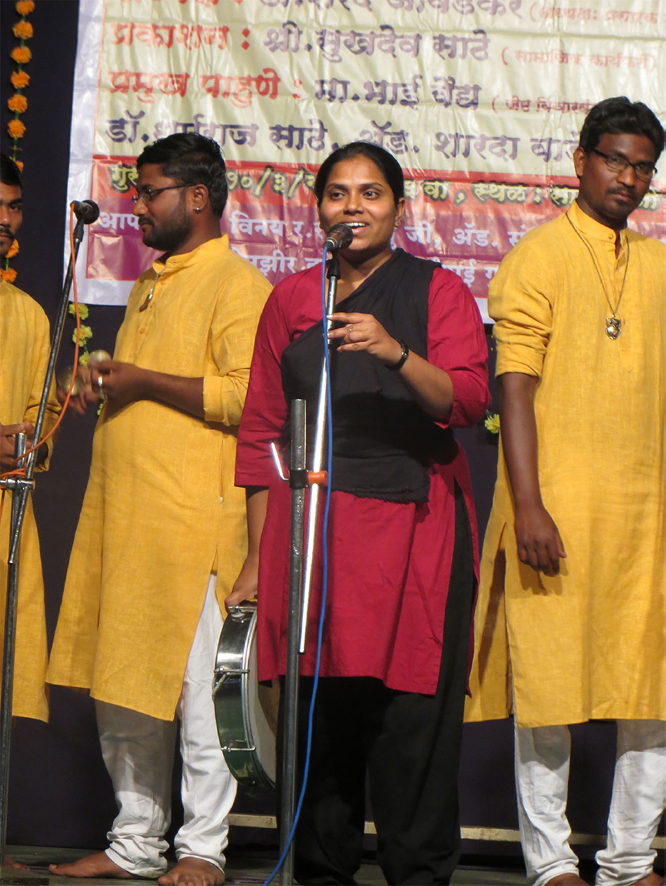
Shital Sathe in performance with her troupe, Rashtra Seva Dal, Pune, 2016
Vitaal 4
The Marathi word vitaal  , meaning ritual pollution, is ascribed to untouchability towards Dalit communities to assert separation for instance with food cultures, use of certain musical instruments and so on. Vitaal is also associated with menstruation, signifying an ‘impure’ female body.
Pollution on our plate
Pollution in the womb
The stem of a flower impure
Our song impure, our voice polluted
Halgi is a frame drum specifically associated with Dalit communities who have inherited music as an occupation or a religious/social function. Aaradhi songs are particularly performed by the Matang or Mang caste group.
Rojchi Chatni Bhakarach hay, jara yegla khayla ghaal maai
This bread and chutney has become routine, give me something different to eat mother!
Bagh mazi bhuk kartiya kaalwa, tuzya mani kasa pohchat naai
My hunger is creating commotion, how is it not reaching your heart?
Talking to you about this makes me realise how much tyranny there was around food. I understand now what nutritious food means!
With KKM, we initially performed a lot of songs of Sambhaji Bhagat, Vilas Ghogre, Vamandada Kardak and so on. Along with our performances in vastis for safai kamgars (the cleaners’ union), we also performed in colleges for students. We increasingly realised that we needed to study and nurture our political thought. Just singing was not going to be enough. We started reading a lot of Ambedkar, Marx, Phule, Annabhau Sathe. Sachin also got his songs and poems when he joined KKM. I composed some of them. As I became more politicised, I wrote songs like ‘Vitaal’, ‘Saau’, ‘Bhagat Singh’ and so on.
Here I translate lok-kala (people's art) as ‘popular’ and not ‘folk’, drawing on Sharmila Rege's (
A violent controversy around Shivaji's life (specifically his caste and ideology) emerged in Maharashtra after the publication of James Laine's Shivaji: Hindu King in Islamic India (2003). The pro-Hindutva historians have created an image of Shivaji as the upper-caste (kshatriya) King, the protector of the Brahmins and the cows (Go-Brahman Pratipalak). Jotiba Phule and his descendants in the anti-caste movement have put forth a non-Brahmanical history of west India (Maharashtra), where Shivaji is described as the jewel of the Kunbi peasant community (kulwadi kulbhushan), the king of the labourers, peasants and oppressed castes. The debate over Shivaji's identity still continues with growing assertions from both sides.
Tukaram was a seventeenth-century poet-singer from western India associated with the Varkari tradition. His work was groundbreaking in that he sang and composed abhang and keertan advocating against the caste system and Brahmanism while critiquing Hindu religion. Tukaram's abhangs are remembered as part of the aural tradition in Maharashtra. The verse cited by Shital is remembered as part of this cultural memory. It is part of abhang number 3396 in the collection of Tukaram's abhangs as noted by historian A.H. Salunkhe (
Amha ghari dhan, shabdanchich ratne, shabdanchich shastre yatnya karu
Words are the wealth in our house, words, our jewels, words, our weapons
Shabdachi amuchya jeevache jeevan, shabdachi vaatu jan-dhan loka
Words are what give our lives meaning, we can only distribute the wealth of words among people
What do we have? We have only words. Our revolt is founded on words.
Vidrohi shahiri jalsa (an assembly of rebellious music) is a genre and performance style developed by anti-caste cultural activists.
Marathi word for the necklace women wear as a marital symbol.
See B.R. Ambedkar's ‘Slaves and untouchables’ (
The Khairlanji massacre of 2006 was one of the most brutal cases of sexual violence and lynching of a Dalit family by the Kunbis, a local dominant caste group, in the village of Khairlanji in Maharashtra over ongoing land disputes. Surekha Bhotmange, her daughter Priyanka Bhotmange and two sons were sexually assaulted, paraded naked and hacked to death in front of the entire village.
For more information, see Shital Sathe's 23 May 2016 interview with Marathi journalist Nikhil Wagle (‘Greatbhet with Sheetal Sathe’, video, https://www.youtube.com/watch7v-RFB2IFjSFeU [last accessed 22 May 2018]) and Bhanuj Kappal's (
Shital and Sachin sought guidance from a number of intellectuals and activists while they went underground. One of them was comrade Sharad Patil, a significant historian and founder of the Satyashodhak Communist Party. Shital and Sachin's ideological path completely changed after their meeting with Sharad Patil. They decided to tell the state fearlessly that they were not Naxalites and face the judiciary once and for all. They dissociated from KKM with their newly found ideological path. After both were arrested in 2013, Shital, who was six months pregnant, was granted ball just before she gave birth to their son, Abhang. Sachin stayed in custody for almost four more years and was denied bail twice by the high court.
‘Our Song Yearns foR liberation’ 14
A line from Sachin Mali's ‘Shahir gela Turungaat’ (‘The shahir is in prison’), composed by Shital Sathe, my translation.
In 2014, the Bharatiya Janata Party (BJP) rose to power in India and what followed was a trail of systematic coercions and lynchings of Dalits, Muslims, progressive activists, journalists and intellectuals. Maharashtra witnessed murders of two progressive leaders, Dr Narendra Dabholkar and Comrade Govind Pansare in 2013 and 2015 respectively. In Dharwad, Karnataka, progressive writer M.M Kalburgi was assassinated at his residence. The investigation revealed clear links with Hindutva organisations like Sanatan Sanstha to both murders. Most have absconded and no concrete action has been taken against those arrested. This has similarly been the case in the murder of journalist Gauri Lankesh, who was gunned down in front of her residence in Karnataka in 2017. Progressive voices openly opposing Hindutva have been systematically under attack. A number of grassroots movements arose in fury against the state machinery. Shital and Sachin, who revered Pansare and Dabholkar as their teachers, wrote songs about them.
Your face is covered in blood, the power is in the hands of the wolves
Tell me, descendants of Hitler, how many people will you kill?
Tell me, descendants of Manu, how many people will you kill? 15
A verse from ‘Sanga Hitlerchya varasdaranno’ (‘Tell me, descendants of Hitler’), written and composed by Shital Sathe, my translation.
In 2014, one of Shital's public talks at St. Xavier's College, Mumbai, was cancelled after the organising body received repeated threats from ABVP (Akhil Bharatiya Vidyarthi Parishad/All India Student Council), the student wing of the Rashtriya Swayamsevak Sangh (RSS). The ABVP also attempted to attack Shital on stage during her performance in Solapur in 2016 and threatened the organisers of another event in Bhiwandi later that year. The police, on the one hand, offered protection in these instances, while at other times intimidated event organisers by visiting performance locations, interrogating them, asking for Shital's whereabouts and so on.
In January 2016, the gruesome institutional murder of the Dalit student Rohith Vemula in Hyderabad Central University (HCU) sparked protests all over the country, especially university campuses. In February 2016, while we performed at HCU, the agents of the Intelligence Bureau followed us in disguise throughout the day. We sang in unison the song Shital wrote and composed for Rohith.
You cannot be educated
You must only toil
Manusmriti banned us from education!
If we heard the Vedas, chanted the verses
You poured molten lead in our ears
Generations of control and power
A forced rule on knowledge!
An honest child of Babasaheb
Went to the university to do research
The casteists felt envious
They insulted, threw him out
And displayed their rowdiness
Rohith is gone, a Dalit is dead
Democracy is dead! 16
Select verses from ‘Rohith Gela, Dalit Mela’, written and composed by Shital Sathe, my translation.
Taking cues from Pratima Pardeshi's (
The trial of Shital, Sachin and members of KKM is yet to proceed in the courts. Sachin was finally granted ball in January 2017. Shital and Sachin both have restrictions on their movement within and outside Maharashtra and are unable to leave the country. While they await justice, they are not only performing with their troupe Navayaan, but also working on their new initiative, Kalasangini, which draws on the Buddhist tradition of Dhammasangini: a space for democratic debate and conversation to develop a new philosophy. Kalasanginis are held in Maharashtra among a community of artists to foster, learn and develop diverse art forms that aim to create a cultural movement with the anti-caste philosophy at its heart (Figure 2).
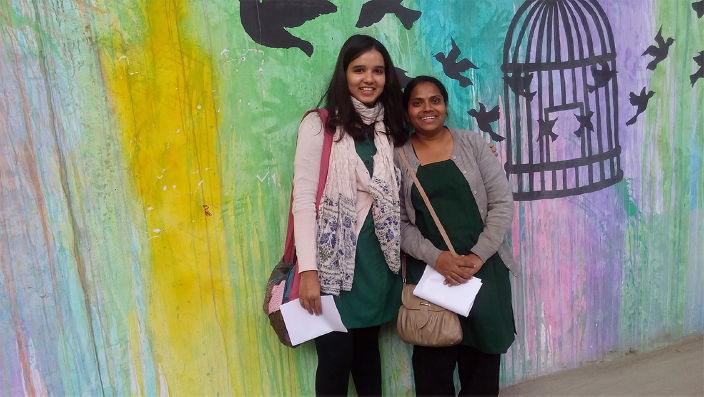
Rasika Ajotikar and Shital Sathe after a performance at Ambedkar University, Delhi, 2016
Relevant Video Links
Some of Shital Sathe's performances are accessible online at:
‘Dear Democracy’, video, http://www.youtube.com/watch?v=y10a7jFEX9g [last accessed 28 February 2018].
‘Mumbai Collective’, video, https://www.youtube.com/watch?v=gfLC2tD3TDI [last accessed 28 February 2018].
‘Sheetal Sathe & Troupe at UoH in solidarity for #JusticeForRohith - 1’, video, https://www.youtube.com/watch?v=y1uYFgnYYG8 [last accessed 28 February 2018].
‘Sheetal Sathe & Troupe at UoH in solidarity for #JusticeForRohith - 2’, video, https://www.youtube.com/watch?v=4dibUB8hldE [last accessed 28 February 2018].
Footnotes
Acknowledgements
My heartfelt thanks to Shital Sathe for her continued support and friendship, as well as for her time to go through the transcription of this interview. My sincere thanks also to Sachin Mali for his support, critical insights and, most importantly, for his poems. Finally, a special thanks to Navtej Purewal for her warmth and encouragement and without whom this piece would not have come together.
Author Biography
Rasika Ajotikar is currently a PhD student in the Department of Music at SOAS, University of London.