






Abstract
Ti–Nb β alloys are a promising alternative as an implant material due to their good properties and low Young's modulus, compared to other Ti-alloys currently employed as biomaterials. In this study, three materials of the Ti–Nb and Ti–Nb–Fe systems were produced by powder metallurgy techniques starting from TiH2 (TH) powder. Several sintering cycles were employed to evaluate the H2 elimination and the effect of sintering temperature on densification and fraction of β-Ti phase. Also, the influence of alloying element size using two kinds of Fe powder was evaluated. The highest loss of H2 was achieved by decreasing heating rate at the temperature range of hydride decomposition. SEM images and XRD results show mainly a β-Ti phase for TH–40Nb and TH–5Fe–25Nb samples. The TH–12Nb sample shows (α + β) microstructure. Fe addition with smaller particle size seems to improve the diffusion of Nb into Ti which promotes a higher β-phase fraction and sample homogeneity.
Introduction
Ti and its alloys have been widely employed as biomaterials in orthopaedic and dental implants due to their good mechanical properties, low density and excellent corrosion resistance in contact with human tissues and fluids. Ti and Ti–6Al–4V are the most commonly used implant materials, which have elastic moduli (100–110 GPa) that are much bigger than that of the cortical bone (10–30 GPa) [1–3]. Lately Ti–6Al–7Nb has been proposed as a real alternative to Ti–6Al–4V alloy due to biocompatibility reasons, since they, exhibit good mechanical properties as well as a biphasic (α + β) structure [4,5]
Research on development of novel Ti-based alloys designed for biomedical applications is focused on obtaining a material that combines mechanical properties and low elastic modulus, using biocompatible and non-toxic alloying elements. β-Ti alloys are promising materials that could solve the problem of stress-shielding since they exhibit lower Young's modulus with respect to (α + β) alloys. Various studies have reported on the development of biocompatible β-phase alloys with different stabilisers, such as Nb, Mo, Zr and Ta, with Nb being the most biocompatible β-stabilising element [1]. Young modulus of up to 90 GPa was reported for Ti–12Nb–5Fe alloy, 52 GPa for Ti–38Nb and 65 GPa for Ti–25Nb–3Fe; while for Ti–6Al–4V Young's modulus reaches values of 110 GPa, approximately [2,7]. For addition of 40 wt-% Nb a microstructure composed mainly of β-Ti phase has been reported [8,9].
High Nb content is needed to stabilise the β–Ti phase, often resulting in non-homogeneous microstructures due to incomplete diffusion of Nb into the Ti matrix [10]. Hence, it is necessary to add other alloying elements that promote the β phase stabilisation with lower Nb contents. Addition of small amounts of Fe can promote β phase stabilisation allowing decrease of the Nb content required. Besides, Fe addition improves the sinterability of Ti alloys since it accelerates mobility of Ti atoms by rapid Fe diffusion. Fe increases the Ti auto-diffusion coefficient, which could enhance the Nb diffusion process [7,11].
The use of titanium hydride (TiH2) powders instead of Ti elemental has been frequently employed in powder metallurgy to produce titanium products with satisfactory performance. TiH2 enhances the sintering providing higher densification and better homogeneity of sintered samples at the same consolidation conditions [12]. TiH2 improves the powder compaction characteristics reaching a higher green density. Besides, high number of crystal lattice defects are created during the TiH2 → Ti + H2 decomposition stage, which accelerate the sintering due to the increase of vacancies, enhancing the mass transfer through interparticle boundaries. TiH2 powders offer better control of impurities, owing to the fact that they provide a reducing atmosphere for Ti when the dehydrogenation process occurs, avoiding the interactions with the O2 atoms at low temperature [13,14].
In this work, alloys of the Ti–Nb and Ti–Nb–Fe systems were studied. Three compositions Ti–12 wt-% Nb, Ti–40 wt-% Nb and Ti–5 wt-% Fe–25 wt-% Nb were prepared following a conventional powder metallurgy route. In order to promote complete TiH2 transformation, to improve Nb diffusion and to increase the β-Ti phase fraction, the effect of sintering conditions as well as, the influence of Fe alloying element particle size was evaluated employing four sintering cycles.
Experimental procedure
Samples were prepared from TiH2, Nb and Fe elementary powders as raw material. Two kinds of Fe elemental powders were employed in order to evaluate the effect of alloying element particle size. The supplier, chemical composition and characteristics of powders are shown in Table 1. Particle size distribution was measured for the starting powders using a Mastersizer 2000, Malvern Instrument laser diffraction particle size analyser. Carbon and oxygen impurities/content was measured using Leco CS-200 and Leco TC-500, respectively. Powder density was measured by helium pycnometry using AccuPyc 1330 gas pycnometer (Micromeritics). The morphologies of starting powders are shown in Figure 1. Three different compositions containing Ti–12Nb, Ti–40Nb and Ti–5Fe–25Nb (all compositions are given in weight per cent) were prepared from the raw powders and the mixtures were homogenised by dry blending for 1 h in a Turbula® multidirectional mixer. The amount of TiH2 used for the mixtures was calculated in order to obtain the mentioned final compositions after the dehydrogenation process. Table 2 shows the nomenclature used for the samples from now onwards and the nominal composition for each powder mixture. Green compacts with a diameter of 16 mm and about 3–4 mm in thickness were obtained by uniaxial die at pressure of 700 MPa and using zinc stearate as a wall-die lubricant. The green powder compacts were sintered under high vacuum conditions (10−5 mbar). Four sintering cycles were applied, as shown in Figure 2:
heating at 5°C min−1 up to 1200°C, maintaining for 2 h and cooling down at 5°C min−1; heating up to 700°C, maintaining it for 1 h, raising the temperature to 1200°C with a heating rate of 5°C min−1 and maintaining it for 2 h before cooling down; heating up to 450°C with a heating rate of 5°C min−1; then, from 450 to 650°C employing a heating rate of 2°C min−1 and from 650 to 1200°C, heating at 5°C min−1, maintaining for 2 h; heating up to 450°C with a heating rate of 5°C min−1; then, from 450 to 650°C employing a heating rate of 2°C min−1 and from 650 to 1250°C at 5°C min−1 with holding time of 4 h. Starting powders morphologies: (a) TiH2; (b) Nb; (c) Fe-34 and (d) Fe-4. Comparison of sintering cycles tested. Characteristic of raw powders used. *Density measured by helium pycnometry. Nomenclature and nominal compositions prepared (wt-%). aTi weight per cent considering complete TiH2 transformation after dehydrogenation.


The dehydrogenation process was studied by thermogravimetry (TG) and differential thermal analysis (DTA) carried out on a Setaram Setsys ‘Evolution 16/18’. In order to evaluate the alloying element effect on the dehydrogenation process, the thermal decomposition of the TiH2 powder and the blended powders was compared for all compositions. The thermal analysis was carried out heating the samples up to 1250°C with a heating rate of 10°C min−1, under flowing argon keeping a rate of 80 ml min−1, to minimise atmospheric contamination effects.
The bulk-sintered density was calculated by the geometrical method. Theoretical density was calculated by the rule of mixtures for each composition, and assuming complete TiH2 dehydrogenation, thus, the theoretical density of Ti was considered (4.51 g cm−3).
Powder morphology and microstructural analysis were carried out using a Phillips XL-30 Scanning Electron Microscopy (SEM).
The phase structures for sintered samples were identified by X-ray diffraction (XRD), using X'pert Phillips with Cu Kα radiation 1.54 Å, and an accelerating voltage of 40 kV and a current of 40 mA.
Mechanical properties of the sintered samples were evaluated by Vickers hardness and Young modulus measurements. Young modulus was estimated by indentation method, considering unloading behaviour of the sample. Test conditions were: load applied of 100 N and dwelling time of 20 s in a universal durometer Zwick Roell ZHU 2.5. In both cases, measurements were carried out randomly over the longitudinal side of the sample. Three specimens for each composition were measured with a minimum of 10 indentations for each one.
Dehydrogenation of TiH2 powder and blended powders
TGA and DTA curves for TH–12Nb, TH–40Nb and TH–5Fe–25Nb powder mixtures are presented in Figure 3(a–c) respectively. For comparison purposes, the DTA and TG curve of TiH2 has been plotted alongside the powder mixtures in all cases. Table 3 summarises the temperatures where the maximum peak values are observed in each case, corresponding to the maximum reaction rates. In addition, the relative weight loss is presented related to the total amount of hydrogen in the initial TiH2 powder. It can be seen that TGA curves rapidly decrease between 435 and 865°C due to the dehydrogenation process. The mass loss per cent is in accordance to TiH2 fraction present in each sample; so, TiH2 sample exhibits the highest mass loss of 3.8%, while the most highly alloyed composition, TH–40Nb, has the lowest mass loss 2.5%. Nevertheless, the mass loss does not reach the amount theoretically expected in any case, achieving weight loss of only 84.2% for TH–5Fe–25Nb (A) composition and up to 94.5% for TH–40Nb.
Comparison of TG and DTA curves between TiH2 powder and mixtures of powders. Peak transformation temperatures for powders evaluated/thermal behaviour during decomposition process.

DTA curves show two reactions, represented by two intense endothermic peaks that correspond to the typical decomposition stages of TiH2. According to literature, TiH2 decomposition is strongly dependent on samples features, like purity of powder, particle size, surface contamination, which can act as barrier for release of hydrogen. The conditions of thermal analysis employed to study the decomposition process, as such, heating rate, atmosphere, sample mass, could shift the temperature at which the different dehydrogenation/transformation stages occur [13,15–17]. Generally, TiH2 decomposition occurs in a temperature range from 400 to 800°C. H Liu et al. [18] and Mingwang et al. [15] agree that the dehydrogenation process under vacuum conditions occurs by means of Reactions 1–4 [18],

The lattice defects generated by decomposition reactions of TiH2 are responsible for the activation of diffusion process, which leads to pore healing and accelerates the chemical homogenisation of final microstructure. Reaction 1 takes place between 400 and 500°C, in this step, H atoms are released and the hydride stoichiometry is altered but the crystal structure is not. The δ phase maintains the initial FCC structure of TiH2. In Reaction 2, δ-Ti hydride with phase structure FCC is gradually transformed to β–Ti phase that is H-rich (βH) with a BCC phase structure. Subsequently, H content decreases for βH according to Reaction 3. Reactions 2 and 3 may occur simultaneously between 500 and 700°C. Finally, βH is transformed to αH phase, which can subsequently transform to α-Ti phase (Reaction 4). This is usually associated to a small shoulder observed in the temperature range from 700 to 800°C, approximately. Furthermore, it has been reported in the literature that TiH2 decomposition occurs by means of the δ-Ti hydride transformation to αH (δ → αH) on the particle surface. Then an intermediate layer of βH-Ti phase is produced, which posteriorly is transformed to αH, and if the H elimination is complete, the whole transformation to alpha phase occurs [13,16]. However, the oxygen present may eventually affect the partial reaction of dehydrogenation and, the possible formation of a slight layer of oxide on the particle surface, could hinder complete H2 elimination [18]. The quality of final microstructure depends on achieving all these reactions.
It is possible that for the compositions studied Reaction 4 does not happen, due to the high percentage of β-stabiliser employed, which decreases the temperature of α → β transformation. In addition, the possible formation of a layer oxide at the outer surface of the TiH2 particles is a barrier for the complete hydrogen elimination and for the complete transformation to α.
In the DTA curves presented in Figure 3 it can be observed that alloying elements appear to decrease the temperature of step I of the dehydrogenation process with respect to the unalloyed TiH2 powder. Temperature reduction of first stage of dehydrogenation process may be due to the possible hydrogen released during the blending of TiH2 with Nb and Fe, which can react with Nb particles promoting the formation of NbH. It has been reported that NbH is formed during the mechanical alloying of TiH2-Nb powder mixtures, reducing the temperature of beginning dehydrogenation [8]. The structural transition of NbH to Nb starts at about 380°C and it is completed at 490°C [19]. Samples with 40 wt-% Nb addition show the greater reduction of temperature of the first stage of the dehydrogenation process with respect to TiH2 and its peak is wider in comparison with the other compositions evaluated. XRD was performed to verify the NbH presence. Figure 4 shows XRD pattern for powder TH–40Nb after blending, where small peaks corresponding to NbH phase can be identified; this supports the hypothesis that NbH formation might be responsible for the shift of the DTA peaks to lower temperatures. If this is the case, it is possible to have an overlapping of peaks corresponding to NbH and TiH2 decomposition reactions. On the other hand, the reduction of the temperature of the first decomposition stage, also, could be associated with the interaction of TiH2 with the β-stabiliser alloying element. Nevertheless, an extensive study is being done, in order to understand the influence of the Nb and Fe addition on the decomposition stage.
Diffraction pattern of the mixture of powders TH–40Nb, after blended.
For composition TH–5Fe–25Nb, for the sample with smaller Fe particles, TH–5Fe–25Nb (B), the first endothermic peak is shifted to lower temperature (450°C) respect to TH–5Fe–25Nb (A), which contains coarser Fe particles (470°C). The effect of Fe and its particle size on the TiH2 decomposition is not clear at this stage and further investigation is necessary to understand the mechanisms associated to this process.
Regarding the second dehydrogenation stage, it can be seen that alloying elements do not change notably the temperature, and in all cases, this stage occurs at around 590°C. It appears alloying elements only affect the first stage of the dehydrogenation process, mainly due to the presence of NbH, and once the NbH decomposition has been completed, only reactions associated with TiH2 decomposition occur, so that, stage II takes place at the same temperature for all samples.
Current results are focused on showing the differences between sintering cycles employed in order to achieve an optimised consolidation process. Bulk density is summarised in Table 4, and relative density is plotted in Figure 5.
(a) Relative density for samples sintered and (b) hydrogen loss during decomposition stages. Bulk density achieved on each sintering cycle (g cm−3).

Figure 5(a) shows the relative density obtained for each sample and corresponding sintering cycle. From these results, the sintering cycle that provides highest density is the fourth. Maximum values are 98.7, 95.5, 94.1 and 99.0% for TH–12Nb, TH–40Nb, TH–5Fe–25Nb (A) and TH–5Fe–25Nb (B), respectively. The sintering cycle 2 is the worst, as it provides the lowest values of density, especially for TH–40Nb.
The composition TH–12Nb achieves the highest densification for all cycles. However, this composition does not allow obtaining the highest β phase quantity, as Nb amount is not high enough.
The particle size of Fe powder determines the final densification achieved. It can be seen that, for the same sintering cycle, samples with smaller Fe particle size (TH–5Fe–25Nb (B)) reach a relative density 6% greater than samples with higher Fe particle size (TH–5Fe–25Nb (A)). This can be explained due to fact that the diffusion of Fe into the Ti matrix occurs by an interstitial mechanism. Smaller Fe particles size results in higher specific surface area favouring interdiffusion with respect to larger Fe particle size [11,20].
On the other hand, the total weight loss of samples is associated with the hydrogen released during decomposition of TiH2. Figure 5(b) shows the hydrogen loss for each sintering cycle. As confirmed by the thermal analysis, with all cycles, it was possible to achieve a high degree of hydrogen release and decomposition, and the highest amount was achieved for TH–12Nb with a hydrogen loss of 99%.
The heating rate influences significantly the dehydrogenation process and the final densification. It has been reported that slower heating rate achieves higher dehydrogenation process efficiency [21]. Heating rate was reduced for sintering cycles 3 and 4 during the temperature region where the main dehydrogenation reactions take place (450–650°C), which allows to obtain an efficient hydrogen elimination and higher densification.
The microstructures for samples sintered using all cycles are shown in Figures 6–9. The composition TH–12Nb (Figure 6) shows a typical (α + β) lamellar microstructure with alpha phase growing from the grain boundaries. Pores in this composition are mostly isolated and spherical; they are situated mainly on grain boundaries. Porosity is in accordance with the results shown in Figure 5: samples sintered with Cycle 1 (Figure 6(a)) exhibit more pores with respect to the other sintering cycles carried out.
SEM images for sintered samples of TH–12Nb composition: (a) Cycle 1, (b) Cycle 2, (c) Cycle 3 and (d) Cycle 4 SEM images for sintered samples of TH–40Nb composition: (a) Cycle 1, (b) Cycle 2, (c) Cycle 3 and (d) Cycle 4. SEM images for sintered samples of TH–5Fe–25Nb (A) composition: (a) Cycle 1, (b) Cycle 2, (c) Cycle 3 and (d) Cycle 4. SEM images for sintered samples of TH–5Fe–25Nb (B) composition: (a) Cycle 3 and (b) Cycle 4.


The composition TH–40Nb (Figure 7) has a predominantly β-Ti microstructure. The bright spots correspond to Nb-rich areas that remain undissolved. Higher sintering temperature and longer dwell time may be required to achieve greater chemical homogenisation/diffusion for 40 wt-% Nb addition. In this sense, it can be observed that samples sintered with Cycle 4 (Figure 7(d)), apparently, show a more homogeneous microstructure. The pores for TH–40Nb are mainly elongated, and there exist some spherical pores situated at the grain boundaries. Samples sintered at 1200°C with holding time of 2 h (Cycles 1, 2 and 3) do not show appreciable differences with respect to size and amount of pores; while samples of Cycle 4 show, apparently lower porosity and more rounded/spherical pores.
Finally, TH–5Fe–25Nb, both A and B, (Figure 8 and Figure 9, respectively) show a mainly β-Ti microstructure. Addition of Fe favours the formation of a more homogeneous microstructure, as the bright Nb-rich spots that could be seen in the TH–40Nb sample are not present. Microstructures indicate that TH–5Fe–25Nb (B) (Figure 9) presents, clearly, smaller and fewer pores with respect to TH–5Fe–25Nb (A) (Figure 8), where pores around 50 µm wide can be observed. It is possible that atoms mobility during the sintering process can result in the appearance of vacancies, their coalescence resulting in the large pores formation [20]. This effect is more noticeable for samples with coarser alloying powders. The diffusion surface is lower for bigger Fe powder, which delays the diffusion process during sintering in comparison with smaller Fe powders, and hence affects the size and amount of the final porosity. This could explain the bigger pores observed for the composition TH–5Fe–25Nb (A), which are maintained in all sintering cycles.
For TH–40Nb and TH–5Fe–25Nb (A and B) samples and for all sintering cycles, precipitates were found on the grain boundaries, as minority phase (indicated in red square Figure 7(d), Figure 8(d) and Figure 9(b)). EDX analysis (Ti 66.2 at.-%, Nb 1.8 at.-%, C 32.0 at.-%) confirmed that they probably correspond to titanium carbides (TiC). It is believed that the initial carbon content in Nb (0.1 wt-%) powder is enough to promote the TiC formation due to the high reactivity/affinity of Ti.
Considering the results obtained, the sintering Cycles 1, 2 and 3 were discarded. The next results presented correspond to samples sintered using Cycle 4 conditions.
Figure 10 shows the XRD patterns of samples sintered with cycle 4. The phases identified by XRD are in accordance with the phases observed by SEM (Figures 6–9). It can be seen that TH–12Nb is composed of (α + β)-Ti, according to file numbers PDF2 005-0682 for α-Ti and PDF2 089-4913 for β-Ti. Also, it can be seen that the samples TH–40Nb and TH–5Fe–25Nb were composed mainly of β-Ti. However, small peaks corresponding to Nb, were also identified in the diffraction pattern of TH–40Nb, due to the presence of Nb that did not diffuse into Ti matrix. With respect to TH–5Fe–25Nb (A) and TH–5Fe–25Nb (B) samples, it can be seen that are composed mainly of β-Ti phase.
XRD diffraction pattern for samples sintered with Cycle 4.
Elastic modulus is the main mechanical property for the design of biomaterial. For biomedical applications, low elastic modulus alloys should be employed, in order to avoid the stress-shielding phenomenon, which is associated with bone resorption around the implant. Young's modulus and Vickers hardness values for all samples sintered using Cycle 4 are shown in Figure 11(a–b). The oxygen content was measured for sintered samples (Table 5), due to the great influence it has on the hardness. Higher oxygen content are associated with an increase in hardness.
Mechanical properties for samples sintered under Cycle 4: (a) Vickers hardness and (b) Young's modulus. Content of oxygen and nitrogen for sintered samples under cycle 4 (wt-%).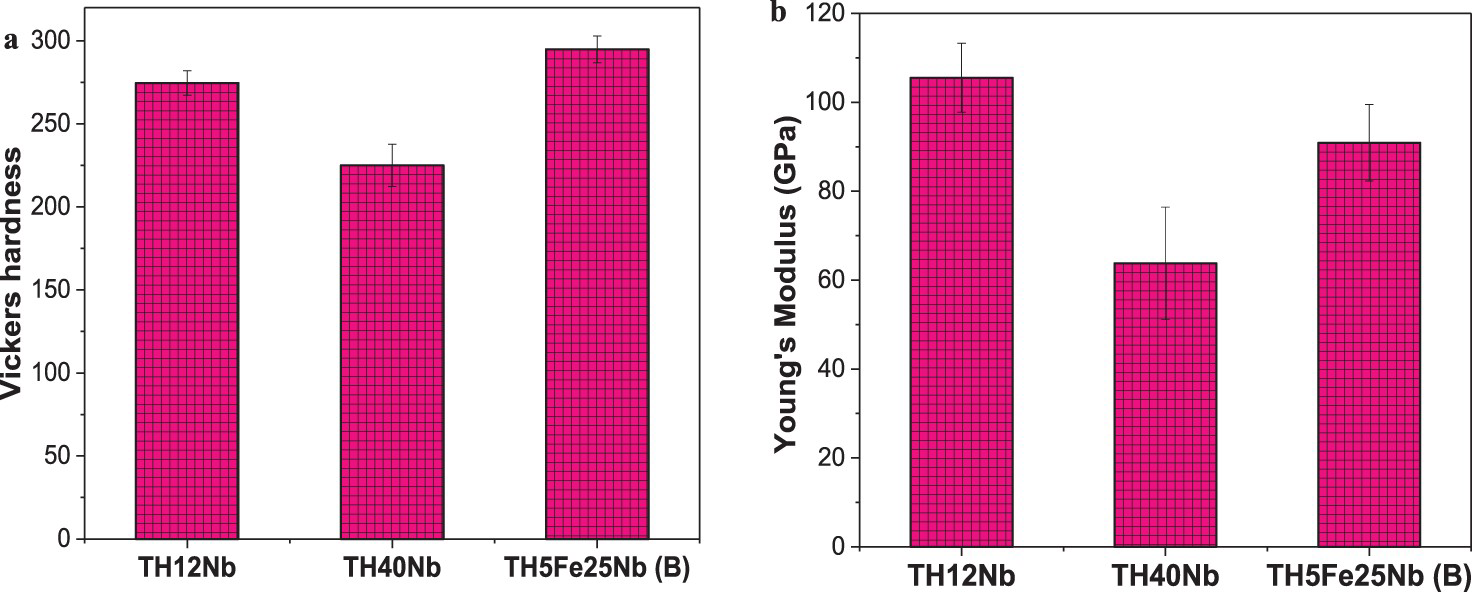

Despite, the clear differences of microstructure observed by SEM images for samples TH–12Nb (α + β) and TH–5Fe–25Nb (mainly β), sample TH–12Nb has values of elastic modulus of 106 ± 8 GPa, which is higher than that obtained for TH–5Fe–25Nb samples, whose elastic modulus is 91 ± 9 GPa. Biphasic (α + β)-Ti alloys, typically, exhibit higher Young's modulus than β-Ti alloys. The α-phase has a HCP structure, which is more brittle, but stronger that the β phase that has a BCC structure. Nevertheless, the Young's modulus decrease is not appreciable for these compositions.
Regarding the Vickers hardness, TH–5Fe–25Nb composition presents greater hardness values with respect to TH–12Nb composition, reaching values of 295 ± 8 and 262 ± 3 HV, respectively. This may be associated with the different oxygen content; 0.5% O was measured for sample TH–5Fe–25Nb while TH–12Nb had 0.4% O. Greater oxygen content of TH–5Fe–25Nb can lead to hardening respect to TH–12Nb. Porosity; also, can influence the hardness, but in this case, the alloys present similar porosity, between 1 and 2%. In addition, TiC precipitates observed in TH–5Fe–25Nb can increase the hardness values.
Elastic modulus and hardness for TH–40Nb are lower in comparison to other alloys produced in this study, achieving values of 64 ± 13 GPa and 225 ± 13 HV respectively. This can be attributed to the final beta phase, due to the high Nb content, and, on the other hand, to the total porosity of these samples, which is 4%, approximately. The elastic modulus deviation could be associated to the Nb-rich heterogeneous zone found in the SEM images, since the indentation measured could have been carried out in areas with different concentration of Nb, resulting in variations/fluctuations of Young's modulus values. Regarding Vickers hardness, it is possible that the TH–40Nb sample is more influenced by the porosity (4%) than by TiC precipitates presence, since this composition exhibits lower hardness values than TH–5Fe–25Nb, which also presented presence of these precipitates.
Mechanical properties of Ti alloys are strongly influenced by processing route, thermal treatments and other material features, such as the content of interstitial elements or total porosity. This makes the comparison of some properties with reported data difficult. Different Young's modulus values have been reported for alloys with similar composition, obtained by different processing routes. Ti-40Nb alloys processed by conventional powder metallurgy route got an elastic modulus of 17 GPa with 55% of porosity [10]; while Young's modulus for Ti–40Nb alloy produced by melting was to 62 GPa [2]. Moreover, alloys of the Ti–Nb–Fe system like Ti–25Nb–3Fe had elastic modulus of 65 GPa obtained by casting [7], Ti–12Nb–5Fe processed by cold crucible levitation melting reached 90 GPa [2]. The three composition processed in this work, presents similar/ comparable values with the reported in the literature.
In conclusion:
the specimens sintered employing a sintering cycle with a reduced heating rate in the temperature range where the dehydrogenation process occurs (Cycles 3 and 4) show so far the best results with respect to total porosity while ensuring the highest hydride decomposition. The efficient decomposition of TiH2 is influenced by the heating rate in the temperature range where decomposition reactions take place; sample Ti–12Nb shows a (α + β) lamellar microstructure for all cycles, whereas Ti–40Nb and Ti–5Fe–25Nb show a predominantly β-phase structure; sample Ti–40Nb presents incomplete diffusion of Nb, and Nb-rich regions can be seen in the beta phase; iron improves the Nb diffusion and final homogeneous microstructure is obtained, but the final porosity consists of larger closed pores for coarser particles. Smaller Fe particle size enhances the sinterability and decreases the amount and size of pores; Young's modulus values for Ti–40Nb and Ti–5Fe–25Nb are lower compared to Ti–12Nb and other typical α + β alloys.
Footnotes
Disclosure statement
No potential conflict of interest was reported by the authors.
Notes on contributors
