






Abstract
Iranian Feminists outside Iran are divided on women's positions in Iran under the Islamic state. Some have argued that the process of Islamization has marginalized women. Others have argued that the dynamic nature of Shari'a interpretation and the debate among religious scholars in Iran have shaped the indigenous forms of feminist consciousness, feminisms and women's involvement in the process of change. This paper, based on field research, is challenging both views. It will be argued that the contradictions of the Islamic state and institutions led to the process of feminist consciousness. In the period 1990–2000, Muslim and secular feminists in Iran have found their own ways of coming together, making demands and pressurizing the State and institutions to reform laws and regulations in favour of women's rights. But women are divided by the nature of their diversity. As their alliance has challenged the limitation of the Islamic state, the breakdown of their alliance (2000–2001), could have a great impact not only on gender relations, but also on the process of democratization and secularization.
Keywords
The aim of this article is to provide an analysis of the complex relationship between gender, institutions, feminisms and democracy in Iran. In the period 1990–2001, different groups of women with their diverse views, interacted with the state and other institutions (religion, law, media, parliament, politics, sport) and influenced the way in which these institutions act. Despite the lack of coherent feminist organizations, many women have discussed, debated and exchanged ideas through the media. This way many women have come together and, despite strict social rules, conventions and structural limitations on social interaction, have been able to challenge gender construction and behavioural conformity dictated by the state and other institutions. In part one of this article I will argue that in this period, laws and regulations were to some extent reformed in favour of women. This can be seen therefore, as a movement which has begun the hard struggle to win gender-based demands (Waylen, 1996a, 1996b; see also Molyneux, 1985).
However, during and after the parliamentary election in early to mid-2000, the conflicts arising from political and cultural differences among women, as individuals and groups, led to a breakdown of this alliance. This is significant because, as I will argue in the second part of this article, the perception of common fate in Iran is shaped by patriarchal 1 norms as well as women's level of religiosity, secularism and access or lack of access to political power which are socially constructed and could change over time. Equally important, the breakdown of their alliance (2000–1), could have a great impact not only on gender relations, but also on the process of democratization and secularization. This is particularly important at the present juncture where Iran is at a delicate crossroads toward democratization, secularization and the establishment of civil society. The path forward is by no means certain and many supporters of democracy in Iran in 2000–1 have been subject to imprisonment, including three of my interviewees for this article: two distinguished lawyers (Shirin Ebadi and Mehrangiz Kar) and the first woman publisher in Iran, Shahla Lahiji.
My intention therefore is to challenge two Iranian feminist positions outside Iran. First, the view that the dynamic nature of Shari'a (Islamic law) interpretation has shaped the feminist consciousness in Iran (Mir-Hosseini, 1996: 142–68, 1999: 6–7). On the contrary, in my view, the contradictions of the Islamic state and institutions led to the process of conscientization – women learned to perceive some of the social, political and economic contradictions in existence and took actions against oppressive institutional arrangements. Second, the view that ignores the importance of the alliance between Muslim feminists and secular feminists in Iran (Moghissi, 1999a, 1999b). In my view this alliance is important because it was created as a result of the pressure from below by many working-class and middle-class religious women who in the 1980s unconditionally supported the Islamic state, but who in the 1990s reacted in their varied ways to the contradictions arising from the patriarchal nature of the regime.
This analysis is based on interviews with sixteen women conducted in March 1999 and August 2000 in Tehran, Iran. I chose these women because they represent a large number of women in the parliament, the legal profession, the media, higher education, non-governmental organizations and sport. These women hold very different political views ranging from different forms of secularism to religious adherence. The secular women do not have access to political power while the religious women do in different forms and degrees, through the Islamic state apparatuses. They are in a disadvantaged position in comparison with their male counterparts but they have been able to build institutional bases for themselves. Furthermore, in the period 1990–2001 these women, and many of the women they represent, have played important roles in changing the position of women within these institutions. This analysis is also based on evidence from laws, regulations and statistics in relation to women's participation in the public sphere of culture, politics, society and the economy. I have also relied on my ethnographic observations as well as theoretical work on gender (e.g. Elson and Pearson, 1984; Oakley, 1972; Rubin, 1975; Mackintosh, 1984; see also Kandiyoti, 1996: 6–7), institutions (Chaudhry, 1979; Bardhan, 1989; Ackerly, 1997; see also Jackson, 1997: 162–3), feminisms 2 and democracy (Waylen, 1996a, 1996b; see also Potter, 1992, 2000).
Women and the Institutional Terrain – 1970s and 1980s
In order to evaluate the role of women in relation to institutional changes in the period 1990–2001, I have compared women's status within selected institutions (education, employment, parliament, media and NGOs) in three historical periods: the 1970s which was marked by Westernization and modernization under the secular Pahlavi state; the 1980s, the period of Islamization of the state and society under the Islamic republic; and the period 1990–2001, the period of institutional change, a growing gender consciousness and democracy movement.
It is important to recognize that in the 1970s, despite the reform of family law, the persistence of patriarchal norms in many cases did not allow the majority of working-class women and middle-class religious women to benefit from the reforms. They were alienated by the process of modernization of state and institutions. This period ended with the 1979 revolution.
In the process of Islamization of state and institutions, the secular women's movement, along with other movements were defeated by the autocratic state. The disassociation of Muslim feminists 3 from secular feminists and their strong association with the Islamic state and institutions led to the rise of state-sponsored religious women's institutions. Muslim feminism became popular and the majority of women related to it. This is because as an institution similar to other Islamic institutions, Muslim feminism seemed to be representing the stable patterns, norms and behaviour which were recognized and valued by society.
Two important factors had a great impact on gender consciousness. First, the policy and practice of hejab and sex segregation opened up opportunities for many religious women to have access to education and employment. Second, during the Iran–Iraq war, large numbers of women were politicized. This is because of their active participation in street demonstrations and also in the mosques, to produce food communally and provide medical aid for the soldiers. For example, according to the Shari'a law when a husband/father dies, the custody rights and the financial rights of the children go to their male kin and not to their mother. The war widows, although they supported the Islamic state, demanded the right to keep and raise their children and to be entitled to their husband's wage, salary or any living expenses payable out of government budget without interference of male kin (Paidar, 1997: 237–42; Poya, 1999: 130–8).
Women's status within a number of institutions in the 1970s, 1980s, 1990s
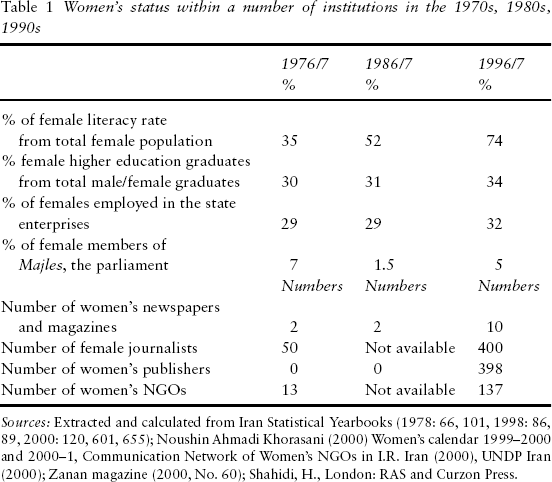
Sources: Extracted and calculated from Iran Statistical Yearbooks (1978: 66, 101, 1998: 86, 89, 2000: 120, 601, 655); Noushin Ahmadi Khorasani (2000) Women's calendar 1999–2000 and 2000–1, Communication Network of Women's NGOs in I.R. Iran (2000), UNDP Iran (2000); Zanan magazine (2000, No. 60); Shahidi, H., London: RAS and Curzon Press.
Thus the material effects of the process of Islamization and of the war on the lived realities of women and men within the family and other social institutions is the key to the rise of feminist consciousness in Iran. Shahla Lahiji, the first woman publisher in Iran, published books about the life of working-class women who lost everything in the war and felt that they were betrayed by the Islamic state to which they had given their full support. She organized a group of women who were working together on women's issues and published materials on women's issues. She finally gained recognition and Roshangaran publishing house was established in 1985. She explained:
During the war years, as a publisher I needed a supply of paper and there was shortage of paper. Paper like all other commodities was rationed. But I worked consistently to create an opportunity for women's voices to be heard. My publishing house became a women's studies institution and many women became active around it.
By the late 1980s, women's issues became important social and political issues throughout the society. In this period Muslim feminists gradually changed their position in relation to their men-folk and to the state that they had given their support to in the previous period. As Mahboubeh Abbasgholizadeh (the chief editor of Farzaneh feminist magazine, the director of Jame-Iranian women's publishing house and the director of Mehr White Home NGO) explained ‘issues such as divorce, custody of children and other family laws and regulations affected all women, especially poorer women in urban areas’. This common fate and the pressure from below led to joint action between the secular feminists and Muslim feminists. Noushin Ahmadi Khorasani (chief editor of Jense-Dovom feminist magazine and the director of Nashre-e Towsee women's publishing house) explained:
There has been huge amount of pressure from ordinary women for reform throughout the society. Therefore many professional women, whether secular or religious, as lawyers, as members of the Majles, the parliament, as media workers and so on had to leave aside their differences and respond to pressure from below.
Thus, as I will discuss in the next section, by the early 1990s, the balance of loyalty changed and led to a variety of types of collective actions by secular feminists and Muslim feminists who took the initiative to contest the institutionalized privileges of men over women. Despite their diverse views on gender, feminism, secularism and democracy, they identified with each other and collectively pursued their gender interests. Faezeh Hashemi (head of the Co-ordinating Council of Women in Islamic Countries, the Director of Merhr White Home NGO, Managing Director of Communication Network of Women's NGOs in Iran, member of parliament (1996–2000) and the director of Rouznameh Zan (August 1998 to March 1999) explained:
during the election of local councils in 1999, as the owner and the chief editor of Rouznameh Zan, I publicized the political platform of all women from left wing to right wing. Because, these women were standing for the local election, competing with men in a male dominated society and therefore my duty was to introduce them to the public.
1990–2001 – Institutional Changes
In this section of the article I will examine in some details the changes which took place during the last decade in politics, law, media, and higher education.
Politics and the Parliament
Throughout the 1990s women's active participation within different institutions highlighted and challenged the existing unequal gender relations and forced the Islamic state to respond. The Majles, in particular, became an important institution for women to struggle and change the laws or reform the laws in favour of women. Women's active participation in politics – in the 1990's presidential election, parliamentary elections, local elections and the parliamentary election in 2000 and the presidential election in 2001 – played an important role in preparing the ground for changing the gender balance.
According to the Shari'a and Article 115 of the Constitution, a woman could not become president. Despite this, in the 1997 presidential election, nine women stood as a form of protest, forcing the state to admit to its own limitations. Azam Taleghani (head of Women's Society and Iranian Islamic Women's Institute NGO, the Director of Payame Hajar newspaper and journal, member of parliament 1971–81) challenged many of the ulama, Islamic religious scholars, over their objection to women standing for presidency. She explained: ‘Five out of six ulama believed that women cannot be president. I argued with them, my aim was to prove to them that they have a particular reading of Islamic laws on women which can be changed’. President Khatami and a number of clergy were sympathetic to their demands. Despite this, all female applicants were rejected by the Shoraye Negahban, dominated by the conservative clergy. In this election, the majority of women and youth (especially young women) voted for Khatami, who won a landslide victory against the conservative candidate Nateghe Nouri. Gender consciousness determined the outcome of the election. They voted for Khatami because they believed that under his presidency women's issues could be fought for more easily than under the conservative Nouri (Poya, 1999: 145).
In the 1998 election of Majles Khebregan (the Assembly of Experts), Faezeh Hashemi's newspaper Rouznameh Zan waged a campaign to include women in the assembly, and encouraged women to stand for election. As a result of this campaign, ten women stood for election, competing with 368 men, but they were rejected, because, according to the Islamic constitution, women cannot be included in such an assembly (Poya, 1999: 142).
The local council elections in early 1999 also saw women actively participating in politics as both voters and candidates. Women activists in the media and politics encouraged women's participation and officially asked local authorities to identify potential female candidates, to encourage women to stand and to facilitate their campaigns. Many women candidates concentrated on the issues of democratic rights and the creation of civil society. Once again women's political participation resulted in the defeat of the conservatives and a landslide victory for the reformers. More importantly, 1,120 women were elected as local council members. Even in small cities and rural areas women were elected. This means that a large number of women are participating in decision making at both city and local levels on economic, political, social and cultural issues (Poya, 1999: 146).
The campaigns around the election of the sixth Majles in February–May 2000 concentrated on democratic issues. Both as voters and as candidates a larger percentage of the population participated in this election compared with the 1996 parliamentary election. The main focus was the reform of laws regulating economic, social and political life. The reformers called for a free press, a judicial system that respected citizen rights, and a limiting of the political role of the clergy. These issues became a political battle between the conservatives and the reformists, resulting in victory for the reformists who won a landslide victory. Once again the support of women and youth guaranteed victory for the reformers. This was significant because the presidential election of 1997 and the parliamentary election of 2000 put an end to the conservative domination of the two important institutions of the state – the legislature and the executive.
The election result reflected the growing strength of the democracy movement in Iran. Eighty per cent of the population voted, in both rural and urban areas. Before and during the election, different political groups extensively debated the issues in the media. In the modern history of Iran, such a scale of political debate was unknown. But there was also evidence of undemocratic actions. For example, 401 candidates – forty-eight of them from Tehran and the majority of them reformists – were disqualified by the conservative dominated institution of Hayate Nezarat (election watch-dog). Among them were Azam Taleghani, Jaleh Shadi Talab and Marzieh Mortazi and many other women activists.
Jaleh Shadi Talab, a female sociology lecturer at Tehran University explained the undemocratic nature of the conservative institutions:
they have disqualified me because in a number of interviews with Zanan magazine and with the media outside of the country I have criticized the economic policies of the conservatives and I have also been critical of Khatami's government. But this is my individual and civil right to express my views and as a teacher it is my responsibility to develop critical thinking and develop this skill in my students. 4
Azam Taleghani, who was disqualified in previous elections, was accused of supporting anti-revolutionary organizations and not being committed to the principles of the Islamic republic and Valeyate Faghih (the guardianship of Islamic jurisprudence). She rejected these claims and argued that ‘these actions reflect the weakness of the conservatives who have lost their ground and are desperately turning to violence against the reformers’. 5
Furthermore, in the period between the first round of the election (February 2000) and the second round of the election (May 2000) the conservatives, who still control the judiciary, closed down more than twenty reformist newspapers, which have been campaigning for the growing democracy movement, and arrested a number of journalists, students and intellectuals. Among them were three of my interviewees, Shirin Ebadi, Mehrangiz Kar and Shahla Lahiji for criticizing the slow process of democratization. Despite these undemocratic actions by the conservative-dominated institutions, student demonstrations in Iran, and hundreds of thousands of letters and petitions from campaigners all over the world, condemned the conservatives’ actions and strengthened the position of reformers.
In the first round of the election nine women were elected to the Majles and in the second round two more women were added to this list. The fall in the number of female members of the Majles from fourteen (in 1996) to eleven (in 2000) was disappointing, and especially the fact that Faezeh Hashemi, who became second to Senior Ayattollah in the 1996 parliamentary election, lost her seat in Tehran. She argued that:
I lost because of party politics. My position as a woman who had been involved in women's issues was completely ignored because my position as a member of Majles was seen as a political issue. Women's issues and political issues are interrelated, but political issues in the form of formal politics have damaged women's issues. We live in a patriarchal society, many male members of the Majles, believe that in a situation where there is unemployment, priority should be given to men. Our judges who are all men, interpret the laws and regulations in favour of men. For me these are all patriarchal cultural issues and we, as women, have to change them in our own favour.
There are other reasons which explain the fall in the number of female Majles deputies. A number of female candidates, including Faezeh Hashemi stood on the conservative platform and did not address women's issues explicitly. The popular female candidates, who were elected, either stood for the reformist platform and/or spoke of women's issues. Vahideh Taleghani, a supporter of the reformers, who has been campaigning for equal pay for women and men and the abolition of forced marriages, argued: ‘Until now, women's rights were denied in Iran and it is our role and our obligation to restore these rights’. Similarly Elaheh Koulaei argued: ‘Cultural problems are the main reasons for the discrimination which is carried out in the name of Islam’. 6
Maria Sarsalari's BBC Persian Service radio interview with Mehrangiz Kar (lawyer), Azadeh Kian (writer on women's issues), and Zahra Hajmohamadi (academic) pointed out that some of the female members of the previous Majles did not work in the interest of women, while those who have been elected in the Sixth Majles are more committed to reform and gender issues. In this sense the decline in the number of women in this parliament should not be seen as a disappointment. 7
The 2001 Presidential elections once again demonstrated the critical support of women and students for the reformist President. Many are critical, however, of Khatami's over-cautious approach to the conservatives including his position on gender. There was an outburst of anger among women when he refused to include any women to his new cabinet.
In the period 1999–2001 the number of women who have occupied high positions within formal politics has increased: three women are advisers to the president; sixteen women are advisers to different ministries; there are 106 women in the position of directorship. However, women are on the whole under-represented in formal politics. But it is important to recognize that they have a base. The support of the majority of women for the few élite women must be seen as a political act outside conventional politics. 8 More importantly, as will be discussed in the next section, this base and support has made some reforms possible, within the institution of law.
The Law
In the 1990s, many voices started to object to the traditional reading 9 of the Shari'a. Many Islamists who were in positions of power changed their views as they realized that their own daughters and sisters were suffering from the implementation of traditional laws and regulations. But the conservatives continued their traditional interpretation of fegh, Islamic jurisprudence, and attacked those who wanted change. The reformers began to discuss feghe poya, the dynamic Islamic jurisprudence, as an effective instrument to reform the Islamic laws. Shirin Ebadi explained:
The trend feghe poya is very popular among men, women and some clergy. This school of thought believes that Islam can be adapted to the modern world. It was the popularity of this trend which allowed us to change laws and regulations in favour of women.
The law allowing women to be research judges or investigative judges is an important reversal of the 1980's position when the Islamization of state and institutions took away from women the right to be judges. In 2000, despite the pressure of the conservative clergy and the arrest of Shirin Ebadi and Mehranguiz Kar (lawyers), the Sixth Majles reformed the education law of 1985 which prevented unmarried female students from studying abroad on the grounds that this could lead to moral degeneration among young and unmarried women. Many working-class women have been pressing for this reform since 1990. For example, the daily Keyhan newspaper published a letter in 1990 from a group of these women which read:
This law discriminates against religious working class women who rely for their studies on government financial help. Those women who have money can go abroad despite the law and continue their education. It is also gender discrimination, because why should moral degeneration apply to women and not to men. 10
The age of consent is another issue within the law that working-class women and also religious middle-class women have been pressing to change. This is because they are under more pressure to get married at young ages than the secular middle-class women. Shahla Lahiji (publisher) explained: ‘Many young girls have written to me about how the family does not allow them to continue their education and wants them to get married, because they believe that an educated girl may lose her chance of getting married’. Female lawyers have been pressing to reform this law and have succeeded. Shirin Ebadi explained:
according to the old law, a girl who has not reached the age of consent could have been forced to marry a man with the consent of her father or grandfather. According to the reformed law girls under 14 and boys under 17 must obtain permission from the civil court in order to get married. I feel that I have played a role, alongside other colleagues to reform these laws.
Thus, these women, holding very different political views ranging from different forms of secularism and religiosity used the popularity of feghe poya as an instrument to push for further reforms. Women lawyers were also able to reform family law. For example, Mehrangiz Kar has analysed the Iranian shia laws and has made valuable suggestions to reform these laws. Her aim is to pave the way for these laws to be compatible with the Convention on Elimination of All Forms of Discrimination against Women which was approved by the United Nations in 1979. On the basis of these reforms Iran can join the Convention and the Iranian law can become compatible with the principles of the international human rights (Kar, 1999).
The modification in the 1990s of institutions of mahr (bride price) and nafaghe (maintenance) were particularly beneficial for poorer women. According to the new regulations if a man wishes to divorce his wife, he has to pay her mahr index linked. The Central Bank of Iran specialists will determine and calculate the updated rate of mahr. Also, according to the reformed divorce law, if a man decides to divorce his wife unjustly he has to pay nafaghe and ojratolmesl to her – the equivalent of her contribution to the family throughout the years that they lived together. The aim is to limit men's easy access to divorce and if a man wishes to divorce, he has to pay a significant sum as compensation to his wife. 11 For example if a woman's mahr was 100,000 rials ten years ago and now has increased to 40 million rials, as a result of being index linked, she could use this amount together with her nafaghe and ojratolmesl to pay for a deposit to rent a place for herself and her children. Also mahr is payable not just at the time of divorce but also after the husband's death and because women's share of inheritance is very little, the index-linked mahr could compensate for this.
As Mehrangiz Kar argued, these reforms are particularly pressed for and supported by poorer women:
I write simply in order to have an impact on ordinary women. Many poorer women who either themselves have read my articles or their daughters have read the articles for them come to see me for consultation. My aim is also to draw the attention of the state and, therefore, institutions to the importance of the legal reforms because ordinary people demand reforms.
Despite the lack of organizational links between the poorer women and élite women, there is an informal link between them which has been created as the result of pressure from below for reform. Shahla Lahiji who has published a number of books on women and law explained:
When we have our book exhibitions in small cities, we feel that many ordinary women and men do receive our messages by reading our books and articles. When a man writes to me and complains that if he gives the right to divorce to his wife, his wife will become rebellious against him and the family, I feel that our messages are received.
Another example is the role of women's non-governmental organizations. In 2000, there were 137 indigenous women's NGOs. In different ways they are engaged in poverty alleviation and income-generating activities, in particular among female-headed households. Their impact is very limited but they have played a role in connecting professional women and poorer women. Moreover, the provision of small loans by these NGOs has been empowering for some women to the extent that it alleviates poverty and encourages women to stand up for their rights. Mansoureh Khalily, the Director of Mehr Foundation explained:
we provide small loans for women to be able to work according to their skills and abilities: baking bread; sewing maghnae [Islamic head scarf for school girls]; hair dressing and so on. For example, Khorshid Khanom from a village in the region of Damavand, in the north of Tehran, escaped from her violent husband and came to our organization for help. I asked her to explain her skills. She said that she is not good at sewing, knitting and hair dressing, but she could bake bread. We provided her with a tanor, bread making oven, she now provides the bread for the whole village and has not allowed her violent husband to return home.
The link between women's NGOs, women's media, women lawyers and female members of the Majles, demonstrates the connection between the élite women and poorer women and the linkages among élite women themselves despite their diverse views on secularism and religion. These links have played a significant role in making demands on the state and institutions for reform of the laws in favour of women. Noushin Ahmadi Khorasani (editor and publisher) explained: ‘we are linked together indirectly through theoretical work, practical work, women's NGOs and the media. We work systematically, therefore, we operate like a chain’.
However, the women who have pioneered the institutional changes are divided on the nature and the scope of the reformed laws. Some welcome the idea of fegh poya as an instrument for change. Ebadi (lawyer) explained:
These reforms are compromises because we are not in a position to argue that men should not have the right to divorce. Society will not accept this. The society should be ready for change, as we experienced under the Shah's secular state, change of law alone does not change women's situation.
For many secular women, as long as religion and politics are integrated, real equality in law for women and men cannot be achieved. This is because essentially the religious vision of the rights of men and women is based on an unequal relationship. Kar (lawyer) explained:
The Muslim reformers who believe that Islam is a dynamic religion and are in favour of modification of the Islamic law, don't really believe in equality between men and women. They believe that women and men have been born to play different roles in life and therefore they must be subject to different laws and regulations within family and society.
Feghhe poya as a trend is becoming a new movement. It is not an organized movement, but it is very popular, especially among the religious middle class and also poorer social classes. This is because they are directly affected and feel the social, economic and political pressure more than others. Marzieh Mortazi – an elected member of local council in Tehran in 1999 and a candidate for the parliamentary election of 2000 who was disqualified by the conservatives – considered herself as part of the new movement in favour of feghhe poya: ‘I believe religion is important for our society but we have to have a new look at religion and a new reading of the religious laws and regulations’.
This is an important development in the modern history of Iran. Under the secular Pahlavi state, authoritarianism never allowed political debates, the reforms were from above and did not affect the lives of the majority of the population. In the 1980s the Islamist conservatives were dominant and suppression of women was at the heart of the state's policy. In the 1990–2001 period, the dominant demands are the modification of the Islamic law. This view argues for the reinterpretation of the Islamic law according to historical changes and therefore, advocates a co-ordination between religion and civil society.
This may not heal the wounds of the 1980s and may only reduce the pain. But it is a significant change, based on debate and grassroots involvement. More importantly, it has led to the emergence of a third tendency (a citizens’ rights movement), which has no illusion about different Islamic trends and different readings of the Shari'a. It is a secular tendency which believes in the separation of religion from politics as the only way for real reform. This vision stresses the importance of civil society and citizens’ rights, male or female, Muslim or non-Muslim. Therefore, there is a struggle between these three tendencies – conservative, reformist and citizens’ rights.
The popularity of the reformist and the citizens’ rights tendencies can also be measured by the role of the media and the interaction between different social classes. Roshanak Darioush (writer) explained:
Even poor people, in rural areas are aware in indirect ways. They may not read newspapers but they know what is going on in politics through their sons and daughters who are studying at the universities in urban centres and their numbers have increased sharply. Therefore one realizes that the circulation of newspapers and magazines is much higher than what is advertised because of people's interaction and their interest in the political situation.
Furthermore, a strong gender consciousness is developing throughout the society and it is pressing for reforms from below, through the instrument of feghhe poya. In the early 1980s the secular women's movement was defeated, especially its objection to hejabe eslami. They were a minority, and contrary to their belief, segregation and hejabe eslami did not marginalize women's activities in the socio-economic and socio-political spheres. It opened up opportunities for many religious women to enter education and employment. In the late 1990s, many young religious and working-class women have realized the limitations of the Islamic system. Thus, they have become conscientized and demand reforms. Roshanak Darioush explained:
The modernism of the 1970s was alienating to our culture. Our reformed laws were from above and demanded by élite women. That is why only a minority of women objected to the Islamisation of the state and society. But today's reforms have a popular base and they cannot be taken away because it is demanded by the majority of women. To open up cinema and theatre in working class areas has had an enormous impact on working class women. To create literacy, numeracy, sports classes, foreign language classes and computer classes in the mosques alongside Qur'an reading classes where women attend has changed the culture of the mosques. These women have changed and demand change.
In the late 1990s and 2001 both religious and secular women agree with each other that men should not be allowed to marry four wives and an unlimited number of temporary wives, as is suggested by the Shari'a. In the 1970s, under the secular state of the Pahlavi, when secular women raised the same issue, many religious women's response was that this is a religious issue and is not the concern of the non-believers. In 2001 many religious women argue that this law does not apply to today's Iranian society. These changes evidently show that women of different classes and with different levels of religiosity and political persuasions have become more unified and are fighting together for reforms. Shirin Ebadi (lawyer) argued that:
in the year 1980, my understanding and definition of equality was very different to that of Faezeh Hashemi and Shahla Sherkat. In the year 2000 we have changed and have come closer together, because we have had the same ideal to achieve.
Media
In the period 1990–2000, a degree of freedom of expression within the media allowed women's issues to be discussed on a wider scale. Newspapers and magazines in particular, which are widely distributed and read, played the role of political parties. They represent different political views, ranging from conservatives who are resisting the reforms; the reformists tendency and the secularists. They compete with each other in debating socio-economic and socio-political issues.
Women's newspapers and magazines have boldly pioneered the challenge to traditional Islamic laws and regulations in relation to marriage, divorce, custody of children and inheritance law. Faezeh Hashemi (chief editor of Rouzname Zan 1998–9) explained:
These issues were traditionally discussed and debated by the clergy. We have broken this tradition and have dared to challenge them by arguing about whose interpretation are they? If they are against women's interests in the family and society they have to be changed. In my newspaper, we first ask ordinary women how they feel about these laws and regulations, we then take women's demands to the specialists and to the clergy. Secondly, we analyse them and report them back to our readers in our newspaper. This way we discuss many real problems raised by ordinary people at the level of society and we argue that Islamic laws are dynamic and changeable. This way we make ordinary people aware of these problems and we demand from the specialists and the clergy to resolve these issues as social problems.
Faezeh Hashemi's newspaper Rouznameh Zan (August 1998–March 1999) did not always concentrate on women's issues alone and discussed other wider issues alongside women's issues in order to attract male readers. She explained: ‘If men are our problem we should get them to read these issues’. This newspaper also took an important step towards relating women's issues to a growing democracy movement, on the basis of day-to-day political struggle for the establishment of civil society in Iran.
We pioneered the defence of freedom of speech and other democratic issues around the closure of newspapers and magazines by the conservative clergy who were powerful in the judiciary and took the owners and editors to court for publishing materials against the security of the country. This allowed other newspapers and magazines to have the courage to join us in this important democratic issue.
But her main aim was to promote women's issues:
I believe that our media is dominated by men and has to be changed. My aim was to report and analyse women's issues, news and activities through a daily newspaper for women and by women. We live in a patriarchal society, in Iran and elsewhere in the world, and this has to be changed. This change will only come about through long-term planning and educational and cultural activities which may take a generation or two because it is such a deeply rooted ideology.
This newspaper, with a circulation of 40,000 a day, was closed down in April 1999 for challenging the ghessas law – publishing a cartoon showing a gunman attempting to kill a man and a woman and the male victim appealing to him by saying that ‘don't kill me, kill her as she is cheaper’.
Hashemi also created Komisione Banovan (Women's Committees) in many cities. These committees played two important roles in consciousness raising: ‘Firstly, it forces city governors who are all males to take women's issues seriously. Secondly, women become involved in political, social and cultural issues which we hope will have an impact on gender consciousness’.
Zanan magazine (Women's magazine) is another influential part of women's media which started publication in November 1992. This magazine has played an important role in changing laws and regulations by publishing articles by Mehrangiz Kar and Shirin Ebadi (lawyers) on women's rights issues within family law and the wider society. In a series of articles it challenged the established view that women cannot be judges. These analyses and debates raised questions for women and invited the authorities to react. Shahla Sherkat (the chief editor of the magazine) explained:
The most important negative impact of Islamization on women after the 1979 revolution, was the reversal of the family law. This reform was so important that we have gone back to it and are using many parts of it now under the Islamic state. Women's demand for change is a movement which will not stop and will carry on, that is why I feel that the future is bright.
Zanan magazine is an important part of the media in today's Iran and has had a great impact within the context of improving women's rights issues. This is measured by the number of letters and telephone calls that the magazine receives every day from women from all over the country discussing their problems and reflecting on what has been published in the magazine. These communications also show that women read the articles and reflect upon them by supporting the reforms. This way they feel that they have been actively participating in the reforms which are encompassing Iranian society as a whole. The magazine also receives letters from conservative men who are opposing the reforms, accusing them of destabilizing family relationships. Shahla Sherkat explained:
Our aim is not to destabilise families and family relationship. Our aim is to bring about equality between women and men. If men are oppressive in a variety of ways, that does not mean that women must be silent against different forms of oppression. I also believe that in the last ten years, men have also changed. They have become more aware and conscious about women's oppression and gender relations. Under pressure from women they now understand that an unequal relationship will not last long. Also they witness that their own mother, sister and daughter suffer.
Women's newspapers, magazines and journals actively discuss women's issues, ranging from debates over feminism and patriarchy, to women's position within the family, employment, law and education. Also the increasing number of women media workers has made an important contribution to gender issues and gender consciousness. These institutions have also created employment for many women. Some published books, magazines and journals only on women's issues. Some concentrated on children's issues and other areas but mainly in relation to women's issues.
According to the publishing law only women who have higher education degrees can be publishers. Despite this pre-condition the number of women publishers is increasing. Furthermore, the large number of educated female publishers is changing the traditional character of these institutions which were dominated by men who did not have higher education. As a result for the first time in Iran, Anjomane Senfieh Rouznamenegaran Zan (Women Journalists Trade Association) was established in 1998 and with its large membership is contributing to democratic issues. Shahla Lahiji (publisher) explained:
Through this union we have tried to have annual conferences and exhibitions. We have also tried to play an important role for the freedom of speech and against any form of censorship. This issue may not necessarily be a women's issue. But in Iran women's writings have been more under scrutiny and censorship than men's writings, because of a moral double standard which applies to women and not necessarily to men. For example within literature, the role of love and lover is acceptable for men and not for women, and therefore, women's literature is constantly under scrutiny and censorship.
The work of Mahboubeh Abbasgholizadeh, as the chief editor of the Farzaneh magazine and as the Director of Jame-Iranian publishing house and Ahmadi Khorasani as the chief editor of Jens-e Dovom and the Director of Nashr-e Towse'e publishing house have also been significant in raising and debating theoretical issues and making a link between the work of feminists outside of Iran and in Iran by publishing their articles and books.
During the last decade, the institutional reforms in relation to women's issues and the question of democracy and the establishment of civil society have had a great impact on the media and politics in Iran. The female film makers have drawn on these issues to tell women's stories and therefore their films are more political than male film makers, as they put forward a different image of women, as workers, mothers, lovers, politicians and so on. 12
Rakhsah Bani Etemad, a distinguished film maker, has played an important role in changing the perception of Iranian women on the screen. In her films, in the 1990s, women play major roles. They are not passive, ineffectual, or marginal characters restricted to the kitchen or constantly seeking attention from their husbands. They are active participants in social, economic and political issues. They encounter with each other and with men; in doing so they try to change the socially and culturally constructed gender boundaries. She explained:
I try to show that a woman is neither a Madonna nor a whore. She understands male oppression and the boundaries between males and females. Despite many obstacles women have the ability to be optimistic, hopeful for the future and change their circumstances and the society as a whole.
Her films are a chain of events about women's issues across classes and cultures. She spends a considerable amount of time researching on women's issues, especially the lives of female prostitutes and those who are involved in drugs and petty crime: ‘For two years I have visited them in prisons, in their homes and their communities, they know me and they trust me, because I tell their true stories and am not making a legend out of their characters’.
These films are shown in all corners of Iran and are very popular with ordinary people because they touch their lives. She assesses the impact of her films on Iranian society by the number of letters she receives from women and men, from all corners of the country. Many women write to her about how they relate to the issues raised in her films. She also receives letters from some men who have expressed their anxiety about how her films have encouraged women to be independent and are undermining men's authority over women. She also receives letters from outside Iran from women who relate to issues which may be specific to Iranian society and a Muslim society: ‘I feel very proud of all these developments because this shows how the media could bring women close together to improve their status in a society and also globally’.
A major theme of her films, in different ways, is love. In the Iranian cinema sex segregation imposes a great deal of restriction on how to portray love between a man and a woman. But, women directors and film makers have learned how to show emotions between men and women in different ways, even though their hands are tied technically. Ironically, this restriction has created more space for women to be at the centre of love stories. For example, in Banoye Ordibehesht, (The May Lady), the man is not seen but is only heard by expressing his poetical and philosophical love and the woman is the powerful character at the centre of the story.
1990–2001 Feminisms and Democracy
In this part of the article I will assess the diverse views of the élite women on feminism, secularism and democracy. My aim is to raise questions about the implication of this diversity for the future of the women's movement and the democracy movement in Iran.
Feminisms
Gender consciousness and demand for reform and the support for élite women to pioneer institutional change has opened up the debate about feminism. The work of Hashemi and Taleghani inspired many religious women to struggle for change. Shahla Sherkat, the chief editor of Zanan magazine invited Merhangiz Kar and Shirin Ebadi (secular lawyers) to write about women's issues. This co-operation provided opportunities for ordinary women to understand the law and their rights. The work of Gholizadeh (the chief editor of Farzaneh magazine) and Ahmadi Khorasani (the chief editor of Jens-e Dovom magazine) at theoretical level and the work of Hashemi (the chief editor of Rouznameh Zan) and Shahla Sherkat (the chief editor of Zanan magazine) at a more popular level opened up opportunities in the media to discuss different forms of feminism and informed women of the diversity of women's rights issues and the need for the co-operation between different forms of feminisms. Shahla Sherkat explained:
Zanan magazine has pioneered the debate between secular and Muslim feminists over the issue of women's rights. Women's rights issues in Iran are so complicated that we must start from somewhere that we could agree with each other and work through until we arrive at areas of disagreement. Not to forget that beside secular women we also have religious minorities and national minorities where the issue of feminism could mean different things for different women.
This broke the taboo of feminism and feminist issues. A form of hegemony which existed under the banner of religion broke down. Different tendencies stood apart on issues of disagreement. But they debated on issues that they agreed upon. These issues challenged the state and led to reforms. For many conservatives the reforms of Shari'a and female empowerment threatened their privileges as males and their political power over state and institutions. They attacked feminisms and the feminists by defining the concept of feminism as zansalari (female domination), bebandobari (unrestrained behaviour) and hamjens basi (lesbianism). These definitions were culturally threatening to women, especially lesbianism which according to Shari'a is forbidden and punishable. The conservatives used these concepts and terminologies to attack the élite women who pioneered the reforms and institutional change. As a result a large number of women who are in favour of women's liberation in their varied ways, are reluctant to call themselves feminists. Nevertheless, the conservatives attack on women's rights issues opened up the debate on the issue of what is feminism in Iran and the debate around the women's rights movement. Shahla Sherkat explained:
The aim was an open discussion about what is feminism and different forms of feminisms and to let women decide for themselves whether they may agree with liberal feminism, radical feminism, socialist feminism or any other form of feminism. This way we broke the taboo against feminism. I believe feminism is a valuable belief which women in many parts of the world have experienced and has had a positive impact on the lives of many women and men. We may disagree with some forms of feminism, nevertheless the discussion around this issue was necessary.
As I discussed at the beginning of this article, the views expressed by my interviewees demonstrate that they define the concept of feminism according to their political views and their level of secularism or religiosity. Thus, feminism means different things to different women in the Iranian context. For example, Faezeh Hashemi believes that:
feminism is about defending women's rights and fighting for equal rights for women and men. In this context I do believe that I have been involved in defending women's rights. There are issues which affect all of us. Even in the parliament, we may disagree on political issues but most women members are agreeing on most issues in relation to family law, women's education and employment. This is very encouraging, especially that I see this on a global level, where there is a global women's movement which is unstoppable, like a stream.
For Azam Taleghani (head of Women's Society and Iranian Islamic Women's Institute) feminism is equal to humanitarianism and the women's movement is responsible to end gender discrimination and to create equality of opportunity for men and women:
Women have a common fate. It is historically and specifically true that marginalized groups including women have revolted against their oppression. The Qur'an approves of our movement. The problem is not Islam, the problem is men. I believe the heterosexual family relationship is necessary for the continuation of a healthy society but I also believe that there should be equal relationship between men and women within this family relationship, especially that the role of mother in the family is very important. I believe we women can change our society, we have the power but we have to understand how to exercise that power, taking into consideration the cultural issues.
Marzieh Mortazi (elected member of local council) does not call herself a feminist but she is in favour of women's equal rights with men:
I believe that the foundation of Islam is not anti-woman. The male interpretation of Islamic laws and regulations and the traditional reading of these laws and regulations are anti-women. I separate the foundation of religion (Islam) from the Shari'a. Therefore, I oppose the traditional reading of the Islamic laws and regulations which emphasize the role of motherhood and wifehood. In reality this means that a woman is the private property of her male kin. Even the role of motherhood and wifehood is not respectable, because if a woman cannot bear a child she is not considered a woman, she can be divorced. Or if a man wishes to divorce his wife for any reason, her children will be taken away from her. If a woman is attractive they want her to be a sacrificing mother and wife. If a woman is a sacrificing mother and wife they want her to be attractive. These expectations ruin any potential creativity in women. Nevertheless, I am not pessimistic, our society will change but through a long and hard process.
For Bani Etemad (film maker):
If one day in Iran, we have a proper understanding of the term feminism and different forms of feminisms and women's organizations, I may relate to one or more forms of feminisms. But at the moment I cannot do that. What is important for me is that women of different parts of Iran, write to me and relate to my films which portray the lives of women of different cultures and different social classes.
My interviewees also found the term Muslim feminism problematic. Shahla Sherkat explained:
I prefer to use the term feminism bomi, indigenous feminism, because it relates women's rights issues to the social and cultural specifics of Iran. For example, at present, we may not be able to raise the issue of abortion in our society. But we could raise the issue of women's rights to have control over their sexuality and fertility. This is a very important issue in a society where the traditional interpretation of the Islamic law gives a man the right to have sexual relationship with his wife and make decision on when and how many children he may want to have and the wife has to obey his wishes. Therefore, the demand for a woman to have control over her sexuality and fertility challenges the patriarchal rights of men within the Shari'a law.
For Kar (lawyer) Muslim feminism is a contradiction in term:
These women are searching in the Qur'an and the Hadith to find issues which may be in women's interests without tackling the issue of religion and Islam. In my view this cannot be called feminism because religion does not believe in equality between women and men. These women believe in modification of the law to give different rights to men and women according to their natural roles. I would rather call them a tendency which consists of Muslim women who are unhappy with their social positions and are opposing the traditional Islamic laws. It is a positive tendency but not a form of feminism.
Shirin Ebadi (lawyer) on the other hand is concerned with human rights issues, as a secular lawyer she is involved in women's issues as human rights issues, which has grassroots support. She believes that ‘the real issue is gender consciousness which is widespread among women and men. Gender consciousness is widely discussed in urban areas and among the educated sections of society. But, it is also raised in rural areas’.
The co-operation between Shahla Sherkat, (as a Muslim feminist) and Mehrangiz Kar, (as a secular feminist) was an important development in the 1990s. It highlighted the importance of on the one hand the celebration of diversity and, on the other hand the search to find commonality, around which they could make further reforms possible. Kar explained:
I support those who may call themselves Muslim feminists. But, in principle I disagree with them. I write for Zanan magazine because this is an opportunity for me to express my views and I admire them for facilitating this opportunity for me. Similarly as a lawyer, I do not agree with the Constitution but within my work I struggle to change the Islamic law and hopefully the Constitution. I believe that with the existing Constitution it is impossible to talk about the equal rights of women and men and the rights of citizens. But until we achieve the separation of politics from religion, we need to overcome obstacles and in this way I welcome co-operation with Muslim feminists and I hope that in the long term Muslim feminists will come closer to us.
The feminist movement and the women's movement in Iran is heterogeneous. There exists a plurality of identities and a clear recognition of diversity amongst women. They celebrate this diversity in some cases and in other cases there exist real conflicts between them. Nevertheless, many young women see the need to find commonality across differences through alliances and coalitions. This is expressed in the relation between feminism and democracy in Iran.
Feminisms and Democracy
The relationship between gender, institutions and feminisms in Iran has had a great impact on the issue of democracy. The demand by women for democratic rights in general and removing gender bias from the male-dominated structures of institutions is a process-making democracy meaningful to the majority of citizens. Shahla Lahiji (publisher) explained:
the activities of women within different institutions can help towards the establishment of democracy and civil society. This is because we recognize the diversity of women's interests and rights and we understand that if one trend monopolizes the power, women's rights will suffer.
These women do not see democracy as simply an institutional arrangement. They focus on the wider distribution of power in society and gender equality. Marzieh Mortazi (elected member of local council) explained:
As a woman I have a lot in common with working-class men but I am also aware that many working-class men look at me as zaifeh [the weak half]. Therefore, male perception of democracy will not resolve anything for women. I also believe, women winning votes and entering the political arena alone does not necessarily solve women's problems in our society. This is because our male-dominated society does not accept women's role in the political arena and this makes life very difficult for many women who are politically active.
These women, supported by the majority of women, have questioned the traditional view of norms, values and other aspects of social rules which are the manifestation of social institutions. Furthermore, through their cooperation, they succeeded in changing some of them in favour of women's rights. For the conservative elements of the state such as the judiciary, the development of autonomous organizations, including the women's movement demanding female empowerment is a threat to their privileges. After losing their power within the Majles, in early 2000, they challenged the process of democratization and used their power in the judiciary to impose coercion, including the closure of reformist newspapers and magazines and the arrest of pro-reform intellectuals and journalists.
Following the Majles election at a conference in Berlin in March 2000, Kar (lawyer) and Lahiji (publisher) criticized the slow process of reforms and argued that the continuation of censorship and religious domination over the civil law are a serious threat to the process of democratization as well as to women's rights. 13 On their return to Iran they were arrested, alongside other participants at this conference. Ebadi was their lawyer; as a result of her efforts, they were released on bail after two months. But, immediately after their release, Ebadi herself was arrested and similarly was released on bail after some weeks. These events had an impact on the alliance between the Muslim feminists and secular feminists. Kar, Lahiji and Ebadi feel that they were imprisoned for speaking in favour of women's rights and democracy, therefore, their arrest was a human rights issue, which should have been supported by the Muslim feminists. However, they feel that they have been betrayed by their womenfolk. Shahla Lahiji explained:
Despite tension and disagreement between us, we worked together for many years on women's issues, but when we were arrested, they did not support us. If they were arrested I would have protested and raised my voice against their imprisonment, even if I disagree with them on what they stand for. This was an interesting experience that showed the limits of our co-operation.
This also demonstrates that the diversity between the secular feminists and Muslim feminists has material and ideological roots. According to their vested interests they could unite with each other or break their unity which could play an important role in the process of democratization in Iran. Many secular feminists see the struggle for more reforms to empower women as very important and in this they welcome their unity with Muslim feminists. But they also question the whole notion of Muslim feminism and are raising very important questions: to what extent can they rely on the support of Muslim feminists? Mehrangiz Kar (lawyer) believed that ‘we are left under heavy bails, unjustified charges and completely marginalized, because nobody even talks about us’. Shirin Ebadi (lawyer) was not too pessimistic as ‘when I was released, Azam Taleghani [head of Women's Society and Iranian Islamic Women's Institute] organized a meeting in her headquarter and invited me to speak. For me this was her way of supporting us’. Mahboubeh Abbasgholizadeh (editor and publisher) and Faezed Hashemi (head of Co-ordinating Council of Women in Islamic Countries) said that ‘we did what we could to support them’ and Shahla Sherkat (chief editor of Zanan magazine) argued that ‘despite my disagreement with them, the pages of my magazine are still open to Kar, Lahiji and Ebadi’.
The publication of the book Zanan Berlin (Women of Berlin, 2000) was an important step towards renewing the co-operation between secular feminists and Muslim feminists and a significant contribution towards feminism and democracy at the present juncture in Iran. It was initiated by Noushin Ahmadi Khorasani. She explained:
I introduced the author [Lily Farhadpour] to the publisher [Mahboubeh Abbasgholizadeh]. I felt that there is a need for a new approach to the co-operation between different forms of feminisms. We need to deal with the fear of the other. Many secular feminists and Muslim feminists of the older generation have a fear of losing their identity or betraying their own class and culture if they co-operate with each other. But the younger generation are more open to face the challenge and have less fear of the other.
The events of the post-parliamentary election period in early to mid-2000, including the Berlin Conference and the arrest of intellectuals and activists, shed light on the challenges that feminists in Iran are facing: their diverse views; their vested interests; their access or lack of access to state and institutions, including political power and most importantly their responsibility towards the growing democracy movement.
The co-operation between Noushin Ahmadi Khorasani, Mahboubeh Abbasgholizadeh and Lily Farhadpour which resulted in the publication of Zanan Berlin raises the question of whether it is possible to close the gap which has been created between Muslim feminists and secular feminists. The publisher, Mahboubeh Abbasgholizadeh, believed that:
by publishing this book we wanted to show that through a realistic and objective analysis it is possible and it is necessary to fill the gap between different forms of feminisms in Iran. The author has powerfully demonstrated the importance of democratic issues. Within the democracy movement, this book stands out clearly, because it looks at politics with a feminist and a human face. The book is written for ordinary people who don't read dry and hard politics. It looks at political issues, women's issues and democratic issues in a humanitarian way which ordinary women and men can relate to.
The author, Lily Farhadpour, hopes that this book contributes toward Iranian women's struggle for democracy:
It is a humanitarian analysis of what happened to women (as mothers, as wives, as sisters, as writers, as political activists) when they were under attack for struggling for democracy, whether they were just taken to court and questioned, whether they went to jail or when their menfolk went to jail. Within the context of modern Persian literature, I have used feminist language to describe the real stories of these women, their anxieties, their different expectations and their shared hope for a better future.
For example, by using women's own words she shows women's survival strategies – how a woman may behave differently (in comparison with a man) in a prison cell. This is the story of Shahla Lahiji and Mehrangiz Kar who spent hours cleaning their prison cells in order to make it habitable, or when they tried to make themselves feel better by saving bits of their lunch and dinner to make their favourite food for the next day. They had to survive, as they have a long and hard struggle ahead. Many women who, in a variety of ways, are involved in the democracy movement feel that they have come a long way and have built many bridges in order to reach their ideals. But because there is still a long and hard way to go, they have to be hopeful. This was expressed by Mohtaram Eshkevari, whose husband, Yousef Eshkevari, a reformist clergy, was arrested for participating at the Berlin Conference:
I have a recurring dream. As I fly in the sky, I fall in Tehran's gold sellers bazaar, who are all women. Everywhere is shining like gold and the women who are around me say, you are a good family, you make a good bridge. Their message is that I have to hold on to this bridge.
Conclusion
In the period 1990–2001, the élite women in Iran – Muslim feminists and secular feminists – have found their own ways of coming together, making demands and pressurizing the state and institutions to reforms laws and regulations in favour of women's rights. Their commitment to gender issues and the pressure from poorer women and younger generations have been the basis of their co-operation.
The limitations of the Islamic state and its institutions have politicized women, especially the religious women and the working-class women who supported the Islamization of society. This gives the élite women a great deal of strength to campaign around specific issues to reduce inequality and to increase women's participation in political, economic, social and cultural arenas. Moreover, the support of the majority of women in Iran, for the élite women and their informal association with them, through different institutions – parliament, law, media, education, NGOs – has played an important role in eroding the legitimacy of authoritarian rule and promoting democratic issues. This informal association of women, as a form of women's movement, is deeply involved in the process of democratization.
But the events of 2000 have shown that women are divided by the nature of their diversity – based on different levels of religiosity, secularism, social status, political views and their vested interests. Secular feminism is getting its strength back and is challenging Muslim feminism and the limitation of the Islamic state and institutions on gender issues – the limitation of the reforms and the feminist reading of the Shari'a. There are also other issues besides women's issues in relation to democratic rights – the rights of workers, students, youth, nationalities, ethnicities, other religious groups and secular intellectuals. Nevertheless, in the period of 1990–2001, women in Iran have shown a great deal of courage, imagination and commitment to struggle for their gender interests. Furthermore, they have been ahead of other social forces in struggling for civil and democratic rights. This experience has taught many women, especially the younger generation, that they are divided over the definition of their gender, class, culture or political interests. But they have also learnt that they cannot win unless they are united over their gender-specific interests and they cannot win their civil and democratic rights unless they are part of a broader struggle for democratization.
Footnotes
Dr. Elaheh Rostami Povey is a visiting fellow at the Department of Development, Policy and Practice at the Open University. She is also a lecturer at SOAS and Birbeck College, University of London. She is the author of Women, Work and Islamism, Ideology and Resistance in Iran. This has been published in Pakistan and also translated into Farsi and published in Iran.
Elaheh Rostami Povey would like to thank Dr Parvin Paidar, Dr Deniz Kandiyoti and John Rose for their valuable comments and suggestions.
1
I use the term patriarchy as a problematic concept to mean male domination which is contested by women in their varied ways. See Poya (1999: 148–55) and Kandiyoti (1991, 1998).
2
See Mies (1986: 6–43). In the Iranian context see Mir-Hosseini (1996: 142–68, 1999: 6–7); Paidar (1996: 51–68, 1997: 18–24); Tohidi (1996); Poya (1999: 4–8). In the context of other Muslim societies see Al-Hibri (1982); Mernissi (1991, 1993, 1995); Ahmed (1992); Hassan (1996: 53–65, 1988: 26–9); Al-Ali (1997).
3
As is discussed in the second part of this article, in Iran there are women activists who may identify themselves as Muslim feminists or secular feminists and those who for different reasons may be critical of these terms. This is because their feminist identity is shaped by their access to or lack of access to political power and also in terms of their political views on how a secular state or an Islamic state may govern Iranian society. But they agree with my general definition of feminism.
4
Payame Emrouz newspaper no. 37, March 2000.
5
Zanan women's magazine no. 59, December 1999/2000.

7
Sarsalari BBC World/Persian Service, February 2000.
8
For a discussion of formal and informal political actions of women see Waylen (1996a) and on this issue in relation to Iran see Torab (forthcoming).
9
For the purpose of this discussion, I use the terms tradition and modern within the context of the debate in Iran between the reformers and the conservatives in the period 1990s–2001. Tradition is referred to feghh Islamic jurisprudence. With this definition, the conservatives are those who have a traditional interpretation of feghh and reformers are those who believe in feghh poya, the dynamism of feghh or nogarane dini, religious modernists who believe that Shari'a Islamic law can be adapted to the modern world. Within this context there is an alliance between the Islamist reformers and secularists who believe in the creation of civil society, as both groups despite their political differences see the defeat of the conservatives as the first step towards their different objectives in relation to institutional change.
10
Kayhan Daily Newspaper, 22 November 1990 and Poya (1999: 107).
11
In the 1970s, the divorce law was reformed and reduced men's access to easy divorce regulations, after the 1979 revolution the law of 1133 reversed this reform, advocating that, according to Shari'a, a man can divorce his wife at any time.
12
Iran produces about sixty-five films per year which is greater than Germany, the UK and Portugal and is much greater than in the Middle East (Syria and Egypt).
13
Farhadpour, L., Zanan Berlin (Jamee Iranian 1379/2000 Tehran).