







Abstract
This study examined the cognitive predictors and constraints of children’s strategic offers in the Ultimatum Game. The Ultimatum Game is a one-shot negotiation on the division of a given sum of rewards between two people, where the receiver has the right to punish the proposer by rejecting unfair offers, which results in nil reward for either party. Ninety-four Hong Kong children ranged between three and six years of age (48 girls, M = 4.94, SD = 0.90) participated in an Ultimatum Game, and tasks measuring theory of mind, cognitive flexibility, inhibitory control and verbal ability. Children’s theory of mind, measured with false belief understanding tasks, was positively associated with their Ultimatum Game offers. Regression analysis further demonstrated that cognitive flexibility moderated the association between false belief understanding and children’s offers in the Ultimatum Game. Being able to take the opponent’s perspective prompted children to offer more in the Ultimatum Game, but only when their cognitive flexibility was low.
Economic games such as the Ultimatum Game (UG; Camerer, 2003) present an opportunity to study strategic social behaviour in social exchanges where both parties aim to maximize their own gain. The basic form of the UG is a one-shot negotiation on the division of a given sum of rewards between two people in an anonymous pair. The proposer makes an offer, which the responder has the right to either accept or reject. If accepted, the reward is split accordingly; if rejected, the reward is forfeited, and each player receives nothing. To satisfy one’s own needs without jeopardizing the deal by being overly selfish or antisocial, the best strategy is to propose reasonable solutions that are acceptable to both parties. The UG provides an opportunity to study the psychological mechanisms of human specificity of fairness (Debove et al., 2016). Adults, on average, share 20% of their total endowment in the UG (Oosterbeek et al., 2004). Even though children stated that they should share half of their endowment in the UG starting from as young as three years of age, they failed to do so in reality until adolescence (Smith et al., 2013).
Multiple factors have been proposed to account for the developmental changes and individual differences in children’s strategic resource allocation, including theory of mind (ToM), behavioural and cognitive control, social norm, social distance, and moral judgement and emotion (for a review, see Blake, 2018). ToM is the ability to infer the mental state of others (Wellman, 2014). Projecting the recipients’ possible reactions, the proposers in the UG should offer a reasonable proportion to safeguard their own gain, neither too small to enlist rejection nor too large to inflate unnecessary cost (Leman et al., 2009). Thus, taking the recipient’s perspective is vital in the proposer’s decision-making (Fehr et al., 2008).
However, the empirical evidence on the association between children’s ToM development and their offers in strategic games was inconsistent (Blake, 2018). Sally and Hill (2006) found that second-order false belief understanding (FBU), a ToM developmental indicator during middle childhood, was positively associated with the UG offers of six-to-ten-year-old children, and that autistic children shared significantly less in the initial round of the UG. Takagishi et al. (2010) found that five- and six-year-olds who passed the false belief tasks proposed more in a one-shot anonymous UG than those who had not passed. Another study (Takagishi et al., 2014) found that only cognitive perspective-taking, and not emotional perspective-taking, was associated with three-to-five-year-old preschoolers’ higher UG offers and higher rejection rate among recipients. On the contrary, other studies reported that ToM was not associated with the amount children share in strategic games. For example, Burkart and Rueth (2013) found that a higher level of explicit ToM understanding in children between two and five years of age did not increase other-regarding sharing in either a costly or a cost-free version of a prosocial game. Lucas et al. (2008) reported a null correlation between four-year-old children’s ToM task performance and their UG offer. They concluded having a more advanced ToM did not enable children to be more prosocial in their sharing.
ToM facilitates strategic thinking but not pure altruism (Rochat et al., 2009). Contemplating the opponent’s minimal acceptance level, children with advanced ToM might be able to take advantage of the situation to maximize their own reward. The inconsistency in the empirical findings on the association between ToM and UG offers indicates the existence of moderating factors. While ToM enables children to envision their opponents’ expectations of, and possible reactions to, their offers, their decisions are inevitably constrained by their cognitive resources. Studies have shown that inhibitory control is associated with sharing behaviour in both children and adults (e.g., Steinbeis et al., 2012). For example, a longitudinal study (Paulus et al., 2015) found that parents’ reports on attentional shifting and inhibitory control at 30 months predicted children’s sharing behaviours at 60 months. While inhibitory control of selfish motives is relevant in any sharing, of particular interest here is cognitive flexibility, the ability to consider alternative options and overcome habitual responses (Diamond, 2013). Cognitive flexibility enables children to readily switch back and forth between maximizing their gain and satisfying their opponent with a minimal offer possible. Developmental constraints in cognitive flexibility have been demonstrated to affect young children’s strategic resource allocation. For example, Burkart and Rueth (2013) found that two-to-five-year-old children failed to pay attention to their partner’s payoff; instead, they were exclusively focusing on their own reward, hence showing less prosocial behaviour in a cost-free game.
Surprisingly, there are very few studies examining the effect of cognitive flexibility on children’s strategic social behaviour in the UG. On the one hand, ToM allows children to take their opponents’ view into consideration when they make an UG offer. Children with higher levels of ToM should offer more to their opponents. On the other hand, cognitive flexibility enables children to readily switch back and forth between how to maximize their own gain and how to satisfy their opponent with a minimal offer possible. It is possible that children with higher levels of cognitive flexibility would be more strategic and offer just enough to avoid rejection and safeguard their own interest. It is therefore hypothesized that ToM positively predicts children’s offers in the UG. More importantly, cognitive flexibility moderates the association between children’s ToM and their UG offers. When children’s cognitive flexibility is high, the positive effect of ToM on the UG offer would disappear. The current study adopts a cross-sectional design to test this hypothesis while controlling for children’s age and inhibitory control.
Method
Participants
Children as young as three years of age could understand and participate in the UG (Takagishi et al., 2014). The current participants were 94 typically developing Hong Kong children between three and six years (48 girls, M = 4.94, SD = 0.90) recruited from local kindergartens and preschools with diverse socioeconomic backgrounds. All participants were ethnic Chinese and fluent in Cantonese. None of the participants had diagnoses of developmental delays or neurological or medical complications. Children had no prior experience playing the UG. Socioeconomic status (SES) was indexed by the sum of each parent’s education level (ranging from 1, no education, to 6, postgraduate degrees) and monthly household income (ranging from 1, no income, to 9, HKD120,000 or above).
Procedures
All procedures were approved by the local university research ethics committee. Research invitations and information sheets were distributed through local kindergartens and preschools. Interested families provided their contact information and written informed consent in a sealed envelope. Individual families were invited to a developmental psychology laboratory for a 60-minute session with breaks. Children participated in a one-shot anonymous UG in the role of the proposer and completed a battery of tasks on ToM, cognitive flexibility, inhibitory control and verbal ability in a counterbalanced sequence. Children and parents were debriefed at the end of the session. Each family was compensated with HK$50 worth of supermarket coupons, and each child received a small gift for participating.
Measures
The Ultimatum Game (UG)
Economic games such as the UG show moderate to high reliabilities and stabilities over time and correlate well with self-reported competitiveness and concern for fairness (Baumert et al., 2014). A meta-analysis (Larney et al., 2019) revealed that the size of the stake does not affect the proportion of the UG offers. Four stickers were used in the current study in the UG to avoid burdening young children’s numerical skills (Chen et al., 2013). Individual participants acted as the proposer, while an anonymous child with a gender-neutral name was the recipient. The participant was given four identical stickers and told, ‘Today, you are going to play a game with a kid from another school, Ming. Now you have four stickers. They are all yours. You can distribute them as you wish. You may give one, two, three or four stickers to Ming, or you may keep them all. If Ming accepts the offer, the stickers will be divided as you proposed; however, if Ming rejects the offer, neither you nor Ming will receive any stickers. I will take all the stickers away’. The participant was asked a comprehension control question of what would happen if Ming rejected the distribution before any offer was made. The rules of the game were explained again in case of wrong answers. The game proceeded only when the participant answered the control question correctly. After the participant decided on the offer, the experimenter made a pretend phone call to ‘Ming’, who in fact was a confederate experimenter in another room. The confederate always rejected proposals that were less than an equal split (i.e., two stickers). When Ming did agree with the distribution, the participant was allowed to keep his or her share of the stickers. Otherwise, the experimenter took away all the stickers. Almost all children paid close attention to the phone call, and most often showed disappointment when their offer was rejected, indicating that the manipulation of the hypothetical opponent worked.
Theory of mind (ToM)
ToM was measured with two age-appropriate false belief understanding (FBU) tasks. These FBU tasks have good test-retest reliability and internal consistency (Hughes et al., 2000) and are valid ToM measures for three-to-seven-year-old children (Mahy et al., 2017).
Change of location false belief task (Wimmer & Perner, 1983)
The task was administrated using a figurine and a contact lense case with two lids of different colours. The participant was introduced to a protagonist who placed a coin under one of the lids before going out to play. In the protagonist’s absence, the experimenter proposed playing a trick on the protagonist and switched the location of the coin with the participant. Memory-checking questions were asked to ensure the participant understood the story. The story continued with the protagonist returning to the scene. The participant was asked where the protagonist would look for the coin, in the original location or in the new location.
Unexpected content false belief task (Gopnik & Astington, 1988)
The participant was shown a Band-Aid box with clear labelling and an image of a Band-Aid, and asked what was in the box. All participants answered ‘Band-Aids’ with or without the prompt. The experimenter then opened the box and revealed it actually contained a toy pig. Afterwards the toy pig was put back into the box, and the box was sealed again. The participant was asked what was really inside the box, and what the participant originally thought was inside the box before it was opened. Then the experimenter introduced a new character represented with a figurine and asked what the new character who had not seen the real content would think was inside, Band-Aids or a toy pig.
Children received one point for each correctly answered false belief question, giving a total possible score of three points across the two false belief tasks.
Dimensional change card sort (DCCS; Frye et al., 1995)
The DCCS demonstrates good construct validity in measuring cognitive flexibility (Deák & Wiseheart, 2015). The participant was presented with two boxes clearly labelled with either a red triangle or a blue circle, and four types of cards: red triangle, blue circle, blue triangle and red circle. The participants were told that there were two games to play, the colour game and the shape game. They were instructed to sort the cards according to either colour or shape and put them into different boxes with corresponding labels depending on which game was being played. Each participant was presented with five trials of the colour game and five trials of the shape game in counterbalanced order for practice. Feedback was given after each practice trial. The test phase included five trials of the colour game and five trials of the shape game in counterbalanced order, and then four trials of the switch game in which the sorting rule was switched after each trial. No feedback was given in the test phase. The maximum score for this task was 14 points.
Day/night stroop task (Gerstadt et al., 1994)
Inhibitory control was measured in the current study as a covariate. The Day/Night Stroop task measures three-to-seven-year-old children’s inhibitory control with good internal reliability and test-retest reliability, and correlates with IQ scores with modest effect size (Montgomery & Koeltzow, 2010). Participants were presented with four pairs of black-and-white pictures representing opposite meanings (sun vs. moon, large triangle vs. small triangle, upward arrow vs. downward arrow and boy vs. girl) and instructed to say the opposite as fast as possible. The task started with four practice trials followed by feedback. The test phase included 16 trials, with each picture presented twice in a pseudo-random order. No feedback was given. The maximum final score for this task was 16.
Results
Descriptive statistics and bivariate correlations
Descriptive statistics and bivariate correlations.
Note: N = 94
SES = Socioeconomic status; DCCS = Dimensional Change Card Sort; FBU = False belief understanding; UG = Number of stickers offered in the Ultimatum Game
*p < .05; **p < .01; ***p < .001
Regression analyses
Hierarchical multiple regression analyses predicting children’s offers in the Ultimatum Game (UG).
Note: N = 94
FBU = False belief understanding; DCCS = Dimensional Change Card Sort
† p < .1; *p < .05; **p < .01; ***p < .001
A loop plot (Figure 1) illustrated the moderation effect. The horizontal axis represents the values of DCCS within two standard deviations of the mean. The vertical axis represents the effect of FBU on the UG offer. The solid line shows the point estimate of the association between FBU and the UG offer, while the dashed lines indicate the upper and lower 95% confidence intervals. The area left of the red dotted line indicates a significant association between FBU and the UG offer, where 95% confidence intervals surpass zero on the horizontal axis. The area right of the red dotted line indicates that the association between FBU and the UG offer was no longer significant. As children’s cognitive flexibility increased, the effect of FBU on the UG offers decreased. When the standardized DCCS score reached −.80, FBU no longer predicted children’s UG offers. For instance, at one standard deviation below the mean, the point estimate was .358, with 95% confidence intervals surpassing zero [.068, .649], indicating a significant effect; however, at one standard deviation above the mean, the point estimate was −.175, with 95% confidence intervals including zero [−.650, .301], indicating a non-significant effect. Moderating role of DCCS on the association between FBU and the UG offering.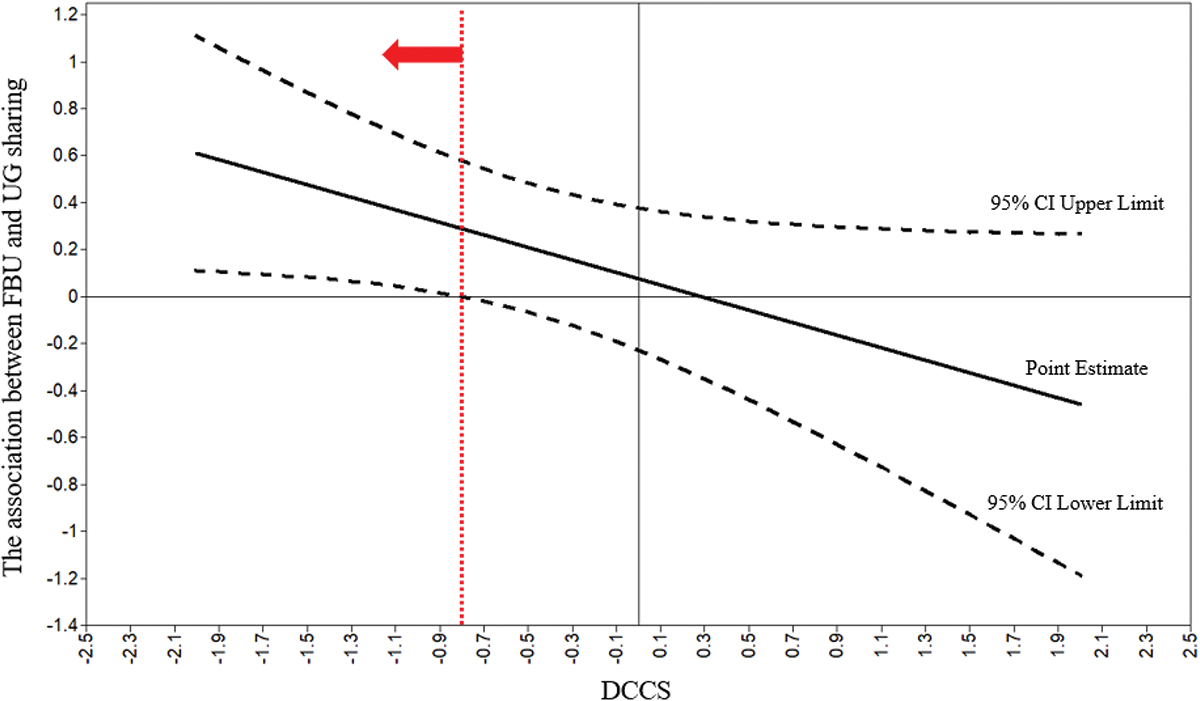
Discussion
The study demonstrated that cognitive flexibility moderated the positive association between ToM and children’s UG offers. Children’s FBU was significantly correlated with their offer in the UG. Hong Kong children from three to six years old were mostly fair, even hyper-fair, in the UG, giving away close to or even more than half of their stickers. Regression analysis demonstrated that cognitive flexibility moderated the association between FBU and children’s offers in the UG, controlling for child age and inhibitory control. With the increase of cognitive flexibility, the positive effect of FBU on the UG offers decreased. When the standardized DCCS score reached −.80, FBU no longer predicted children’s UG offers. Being able to take the opponent’s perspective prompted children to share more in the UG, but only when their cognitive flexibility was low.
The perceived fairness of the offer is essential in the success of the UG (Leman et al., 2009). Consistent with some previous reports (e.g., Sally & Hill, 2006; Takagishi et al., 2010, 2014), the current study showed that ToM was indeed positively associated with children’s offers in the UG. ToM allows the proposer to foresee their opponents’ reactions and offer a large enough portion of the resource in order to secure their own share, which could also mean that they might be paying a higher price than necessary. Cognitive flexibility as a moderator enabled children to readily switch between their own interests and others’ acceptance levels and consider alternative options. The proposers thus could cap their offers at a minimum acceptance level to safeguard and maximize their own gain. As a result, the positive effect of ToM on the UG offer disappeared when children’s cognitive flexibility reached a certain level.
Previous studies showed that ToM predicts children’s prosocial behaviours such as sharing, helping and comforting (Imuta et al., 2016; Pérez et al., 2022). The current study further underlined the role of ToM in children’s strategic social behaviour. Just as a well-functioning ToM does not guarantee popularity or compassion, being able to accurately read another’s mind is at times associated with knowing how to take advantage of the situation (Repacholi et al., 2003). As Rochat et al. (2009) insightfully summarized, ‘theories of mind actually open possibilities for either increased fairness or increased self-interest, depending on whether the child’s general outlook on the task is to promote equality or to maximize self-gain’ (Rochat et al., 2009, p. 436). Indeed, ToM was found to positively affect the proposer’s earnings in the UG for both children (Lucas et al., 2008) and adults (Artinger et al., 2014). The current result suggested that equipped with cognitive flexibility, children with advanced ToM ability were not purely altruistic; instead, they tended to be tactical and offer just enough to avoid offending their opponents. In the UG task, children needed to recruit a wide range of social understanding skills and cognitive capacities to contemplate the dynamic relationship between the proposer and the receiver and make calculated decisions to meet the competing demands simultaneously.
Practically, the current findings provide guidance for future intervention efforts in fostering children’s strategic prosocial behaviours through cognitive flexibility and perspective taking. Theoretically, the finding contributed to our understanding of the developmental changes and individual differences in young children’s strategic social behaviour. Although there are studies demonstrating that children become more prosocial in their sharing with age (e.g., Fehr et al., 2008), other studies showed that young children (Allgaier et al., 2020), especially those from collectivist societies (Rochat et al., 2009), tend to be hyper-fair in their resource allocation. The current result suggested that the mechanisms driving children’s other-regarding preference in their resource allocation are rather sophisticated and complex. Singular factors alone such as age, social norm, mental state understanding or cognitive resources are insufficient in providing a complete picture. A comprehensive explanation requires consideration of a range of developmental factors and social-cultural influences (Blake, 2018).
Limitations and future direction
This study has its caveats. First, four stickers were used in the UG following previous studies (Chen et al., 2013) to accommodate young children’s numerical capacity, based on a recent meta-analysis (Larney et al., 2019) showing that the size of the stake does not affect the UG offers. However, the small number limited the range of possible proportions children could offer, especially when factoring in Hong Kong children’s fair and even hyper-fair sharing norm. Future studies should consider using 10 or even more rewards in the UG with children. Second, the result should be interpreted with caution considering the marginally significant moderating effect, likely due to the small sample size. However, the effect size in the current study for the moderator was −.204, indicating a small but meaningful effect, as Gignac and Szodorai (2016) indicated that .19 is a median effect size in psychological research and .30 represents a large effect size. Replications with larger sample sizes are warranted. Last, social norms of sharing differ from culture to culture (Blake, 2018). Replications in diverse samples are needed to expand the generalizability of the current finding.
La flexibilidad cognitiva modera la relación entre la teoría de la mente y las ofertas de los niños en el Juego del Ultimátum
Los juegos de índole económica, como el juego del ultimátum (JU; Camerer, 2003), brindan la oportunidad de estudiar el comportamiento social estratégico en aquellos intercambios sociales en los que ambas partes tratan de maximizar su propio beneficio. La forma básica del JU es una negociación de propuesta única sobre el reparto de una determinada suma o recurso entre dos personas en una pareja anónima. El proponente presenta una oferta y el receptor de la oferta tiene el derecho de aceptarla o rechazarla. Si la acepta, el recurso se divide de acuerdo con la oferta; si se rechaza, se pierde la totalidad de la suma o recompensa y ambos jugadores se quedan sin nada. Para satisfacer las necesidades propias sin poner en peligro el acuerdo con un exceso de egoísmo o un comportamiento antisocial, la mejor estrategia es proponer una solución razonable que sea aceptable por ambas partes. Así pues, el JU brinda la oportunidad de estudiar los mecanismos psicológicos de un aspecto particularmente humano como es el sentido de justicia (Debove et al., 2016). Por término medio, los adultos comparten un 20% de su legado o recursos totales en el juego (Oosterbeek et al., 2004). Pese a que los niños, desde los tres años, declaran que compartirían la mitad de sus recursos en el juego, en realidad no lo hacen hasta alcanzar la adolescencia (Smith et al., 2013).
Se han propuesto muchos factores para explicar los cambios evolutivos y las dife-rencias individuales en la asignación estratégica de recursos por parte de los niños, entre los que se encuentra la teoría de la mente (TM), el control conductual y cognitivo, las normas sociales, la distancia social, el juicio moral y las emociones (para una revisión del tema, véase Blake, 2018). La TM hace referencia a la capacidad de inferir el estado mental de otras personas (Wellman, 2014). Proyectando las posibles reacciones de los receptores de la oferta, los proponentes u ofertantes en el JU deberían ofrecer una proporción razonable con el objeto de resguardar sus propios beneficios, ni tan pequeña como para provocar el rechazo, ni tan grande como para incurrir en una pérdida innecesaria (Leman et al., 2009). Por tanto, saber asumir la perspectiva del receptor es crucial en la toma de decisiones del proponente (Fehr et al., 2008).
No obstante, la evidencia empírica sobre la relación entre el desarrollo de la TM infantil y sus ofertas en juegos estratégicos es inconcluyente (Blake, 2018). Sally y Hill (2006) observaron que la comprensión de las creencias falsas de segundo orden, un indicador evolutivo de la TM durante la infancia intermedia, se correlacionaba positivamente con las ofertas de niños de entre seis y 10 años en el JU, y que los niños con autismo compartían una cantidad significativamente menor en las rondas iniciales del juego. Takagishi et al. (2010) hallaron que los niños de cinco y seis años que habían superado las tareas de comprensión de las creencias falsas (CCF) proponían ofertas más elevadas en un JU anónimo que los niños que no las habían superado. Otro estudio (Takagishi et al., 2014) reveló que la adopción de perspectiva cognitiva, pero no emocional, se correlacionaba con ofertas más elevadas por parte de preescolares de entre tres y cinco años y con una tasa más elevada de rechazos entre los receptores de las ofertas. Por el contrario, otros estudios revelaron que la TM no estaba relacionada con las ofertas presentadas por los niños en los juegos estratégicos. Por ejemplo, Burkart y Rueth (2013) observaron que un nivel más elevado de comprensión explícita de TM en niños entre dos y cinco años no incrementó la predisposición a compartir con los demás, ni en una versión de pago, ni en una gratuita de un juego prosocial. Lucas et al. (2008) señalaron una correlación nula entre el rendimiento de niños de cuatro años en tareas de TM y sus ofertas en el JU. Los autores concluyeron que una capacidad más desarrollada de TM no se tradujo necesariamente en un comportamiento más prosocial de los niños a la hora de repartir beneficios.
La TM facilita el pensamiento estratégico, pero no el puro altruismo (Rochat et al., 2009). Al considerar el nivel mínimo requerido por sus oponentes, los niños con una TM avanzada podrían ser capaces de sacar provecho de la situación para maximizar su propio beneficio. Las inconsistencias de los resultados empíricos en la relación entre TM y las ofertas en el JU apuntan a la existencia de factores moderadores. Si bien la TM permite a los niños calibrar las expectativas y posibles reacciones de sus oponentes a sus ofertas, sus decisiones están inevitablemente constreñidas por sus recursos cognitivos. Diversos estudios revelan que el control inhibitorio está relacionado con las conductas relacionadas con la predisposición a compartir, tanto en niños como en adultos (e.g., Steinbeis et al., 2012). Por ejemplo, un estudio longitudinal (Paulus et al., 2015) reveló que las observaciones de los padres sobre los cambios de atención y el control inhibitorio de sus hijos de 30 meses predecían sus comportamientos relacionados con las conductas de compartir a los 60 meses. Pese a que el control inhibitorio de motivaciones egoístas es relevante en cualquier conducta a la hora de compartir, en este caso la flexibilidad cognitiva es de especial interés, puesto que facilita la capacidad de considerar opciones alternativas y superar las respuestas habituales (Diamond, 2013). La flexibilidad cognitiva permite a los niños alternar con facilidad entre perspectivas de maximizar sus beneficios y satisfacer las expectativas de sus oponentes con una oferta lo más pequeña posible. Se ha comprobado que las restricciones evolutivas en la flexibilidad cognitiva afectan a la asignación estratégica de recursos de los niños de corta edad. Por ejemplo, Burkart y Rueth (2013) observaron que los niños de dos a cinco años no prestaban atención a la recompensa de sus oponentes sino que se centraban exclusivamente en su propia recompensa, exhibiendo, pues, un comportamiento menos prosocial en un juego sin penalización para el niño que hace la oferta.
Sorprendentemente, existen muy pocos estudios que analicen los efectos de la flexibilidad cognitiva en el comportamiento social estratégico de los niños en el JU. Por un lado, la TM permite a los niños tener en cuenta el punto de vista de sus oponentes al proponer una oferta adecuada. Los niños con una TM más desarrollada deberían ofrecer más a sus oponentes. Por otro lado, la flexibilidad cognitiva permite a los niños alternar con facilidad entre la forma de maximizar su propio beneficio y la forma de satisfacer al oponente con la oferta más baja posible. Es posible que los niños con mayor flexibilidad cognitiva sean más estratégicos y ofrezcan lo justo para evitar el rechazo y salvaguardar su propio interés. Por tanto, hipotetizamos que la TM predice positivamente las ofertas de los niños en el JU. Y más importante aún, la flexibilidad cognitiva modera la relación entre la TM de los niños y sus ofertas en el JU. Si la flexibilidad cognitiva del niño es alta, el efecto positivo de la TM en la oferta desaparecería. En el presente estudio se adopta un diseño transversal para comprobar esta hipótesis al tiempo que se controlan la edad y el control inhibitorio de los niños.
Método
Participantes
A la corta edad de tres años, los niños ya son capaces de comprender y participar en el JU (Takagishi et al., 2014). La muestra de nuestro estudio estaba formada por 94 niños hongkonneses de entre tres y seis años con un desarrollo típico (48 niñas, M = 4.94, DT = 0.90), reclutados en guarderías y centros locales de preescolar y de diversos niveles socioeconómicos. Todos los participantes eran de etnia China y hablaban el cantonés con fluidez. Ninguno de ellos había sido diagnosticado con retraso evolutivo o complicaciones neurológicas o médicas. Los niños no tenían experiencia previa con el juego del ultimátum. Su respectivo nivel socioeconómico (NSE) se calculó agregando el nivel educativo de los padres (de 1 = sin educación formal a 6 = estudios de posgrado) y los ingresos mensuales de la familia (de 1 = sin ingresos a 9 = 120,000 dólares hongkoneses o superior).
Procedimiento
Todos los procedimientos fueron aprobados por el Comité de ética de la investigación de la universidad local. Las invitaciones a participar en el estudio, acompañada de documentos informativos, fueron distribuidos por las guarderías y los centros locales de preescolar. Las familias interesadas facilitaron sus datos de contacto y un consentimiento informado en un sobre cerrado. Entonces se invitó a las familias interesadas a participar individualmente en una sesión de 60 minutos en el laboratorio de psicología del desarrollo, con los descansos necesarios. Los niños participaron en un juego anónimo del ultimátum, de una sola propuesta, en el rol de proponente, así como en una serie de tareas sobre TM, flexibilidad cognitiva, control inhibitorio y habilidad verbal en una secuencia compensada. Tanto los niños como sus padres recibieron información sobre el estudio al final de la sesión. Cada familia participante recibió cupones para un supermercado por valor de 50 dólares de Hong Kong, además de un pequeño regalo para cada niño.
Medidas
El juego del ultimátum (JU)
Los juegos económicos como el JU muestran una fiabilidad y una estabilidad en el tiempo entre moderada y alta y se correlacionan bien con las autopercepciones de competitividad y de preocupación por la justicia (Baumert et al., 2014). Un metanálisis (Larney et al., 2019) reveló que el tamaño de la suma en juego no afecta a la proporción propuesta en las ofertas del JU. En el presente estudio se usaron cuatro pegatinas durante el JU para evitar sobrecargar la capacidad numérica de los niños (Chen et al., 2013). Los participantes actuaron individualmente como proponentes, mientras que otro niño anónimo con un nombre neutro, que no daba a conocer su sexo, actuaba como receptor de la oferta. El participante recibió cuatro pegatinas idénticas y se le explicó lo siguiente: ‘Hoy vas a jugar un juego con un niño o una niña de otra escuela, Ming. Ahora tienes cuatro pegatinas. Las cuatro son tuyas. Puedes distribuirlas como quieras. Puedes darle una, dos, tres o las cuatro a Ming, o puedes quedártelas todas. Si Ming acepta tu oferta, las pegatinas se dividirán como tú hayas decidido, pero si la rechaza, ni tú ni Ming recibiréis ninguna etiqueta. Me las llevaré yo todas’. A modo de control, el participante tenía que responder a una pregunta de comprensión sobre lo que pasaría si Ming rechazaba la distribución antes de que se le propusiese una oferta. En el caso de dar una respuesta incorrecta, se le explicaban de nuevo las normas. Solo cuando el participante respondía correctamente a la pregunta de control, se iniciaba al JU. Una vez el participante hubo decidido qué oferta quería presentar, el experimentador realizó una llamada ficticia a ‘Ming’, quien en realidad era un experimentador colaborador que se encontraba en una sala cercana. El experimentador colaborador rechazó todas las ofertas que no fuesen una división igualitaria (es decir, dos pegatinas). En aquellos casos en que Ming aceptó la oferta, el participante pudo conservar su parte de las pegatinas. De otro modo, el experimentador retiró las cuatro pegatinas. Casi todos los niños prestaron gran atención a la llamada telefónica, y casi todos mostraron su decepción si su oferta era rechazada, lo que indica que la manipulación del hipotético oponente funcionó.
Teoría de la Mente (TM)
La TM se midió utilizando dos tareas de comprensión de las creencias falsas (CCF) adaptadas a la edad de los participantes. Estas tareas han demostrado un buen nivel de fiabilidad de prueba/reprueba y de consistencia interna (Hughes et al., 2000) y son medidas válidas de la TM para niños de entre tres y siete años (Mahy et al., 2017).
Comprensión de las creencias falsas (CCF): cambio de ubicación (Wimmer & Perner, 1983)
Esta tarea se realizó utilizando una figurita y un estuche de lentes de contacto con dos tapas de colores distintos. Al participante se le mostró un protagonista que colocó una moneda debajo de una de las tapas del estuche antes de salir a jugar. En ausencia del protagonista, el experimentador le propuso engañarle y cambiar de sitio la moneda entre los dos. Se le formularon algunas preguntas memorísticas para comprobar que entendía la historia. Esta historia continuó con el regreso del protagonista a la escena. Entonces se le preguntó al participante dónde debía buscar la moneda el protagonista, si en el lugar inicial o en la nueva ubicación.
Comprensión de creencias falsas: contenido inesperado (Gopnik & Astington, 1988)
Se mostró al participante una caja de tiritas con un etiquetado muy claro y una imagen de una tirita, y se le preguntó qué había en la caja. Todos los participantes respondieron ‘tiritas’ con o sin alguna ayuda. A continuación, el experimentador abrió la caja y reveló que, en realidad, contenía un cerdito de juguete. Después, volvió a colocar el juguete en la caja y la volvió a cerrar. Tras cerrar la caja, el experimentador preguntó al participante qué había en realidad en la caja, y qué pensaba inicialmente que había antes de abrir la caja. Entonces el experimentador presentó un nuevo personaje representado mediante una figurita y preguntó al participante qué creía que este personaje, que no había visto el contenido real de la caja, pensaría que había dentro de la caja, tiritas o un cerdito de juguete.
Los niños recibieron un punto por cada respuesta correcta sobre las creencias falsas, con un total posible de tres puntos en las dos tareas sobre creencias falsas.
Tarea de clasificación de cambios dimensionales o DCCS (Dimensional change card sort; Frye et al., 1995)
Esta tarea muestra un buen nivel de validez de constructo en las medidas de la flexibilidad cognitiva (Deák & Wiseheart, 2015). Al participante se le mostraron dos cajas claramente etiquetadas, bien con un triángulo rojo o con un círculo azul, y cuatro tipos de tarjetas: triángulo rojo, círculo azul, triángulo azul y círculo rojo. A los participantes se les explicó que iban a jugar dos juegos distintos, el juego del color y el juego de las figuras. Tenían que clasificar las tarjetas según el color o según la figura y ponerlas en cajas distintas con sus correspondientes pegatinas, en función del juego que jugasen. Cada participante disponía de cinco rondas en el juego del color y cinco en el juego de las figuras, compensando el orden de presentación. Tras cada prueba se ofreció una explicación al participante. Esta fase de pruebas incluyó cinco rondas del juego del color y cinco del juego de las figuras, también compensando el orden de presentación, tras los que se prosiguió con cuatro rondas del juego de cambio de ubicación en las que también se alteró el criterio de clasificación tras cada prueba. En esta fase no se ofrecieron explicaciones tras las pruebas. La puntuación máxima para esta tarea fue de 14 puntos.
Tarea de Stroop día/noche (Gerstadt et al., 1994)
En este estudio se midió el control inhibitorio como covariable. La tarea día/noche mide el control inhibitorio de los niños de tres a siete años con un buen nivel de fiabilidad interna y de fiabilidad de prueba/reprueba, y además se correlaciona con las valoraciones del CI con un tamaño de efecto modesto (Montgomery & Koeltzow, 2010). Se presentó a los participantes tarjetas de entre cuatro parejas de dibujos en blanco y negro con significados opuestos (sol/luna, triángulo grande/pequeño, flecha hacia arriba/hacia abajo, niño/niña) y se les pidió que dijesen su opuesto lo más rápido posible. La tarea comenzó con cuatro rondas de práctica, seguidas de un comentario. La fase de pruebas incluyó 16 rondas, en las que se presentó cada imagen dos veces en orden pseudo aleatorio. No se ofreció ningún tipo de feedback. La puntuación máxima final para esta tarea fue de 16.
Resultados
Estadísticas descriptivas y correlaciones bivariadas
Estadísticas descriptivas y correlaciones bivariadas.
Nota: N = 94
NSE = Nivel socioeconómico; DCCS = Dimensional Change Card Sort; CCF = Comprensión de las creencias falsas; JU = Número de pegatinas ofertadas en el Juego del Ultimátum
*p < .05; **p < .01; ***p < .001
Análisis de regresión
Análisis de regresión jerárquica múltiple de predictores de las ofertas en el JU (JU).
Nota: N = 94
CCF = Comprensión de las creencias falsas; DCCS = Dimensional Change Card Sort
† p < .1; *p < .05; **p < .01; ***p < .001
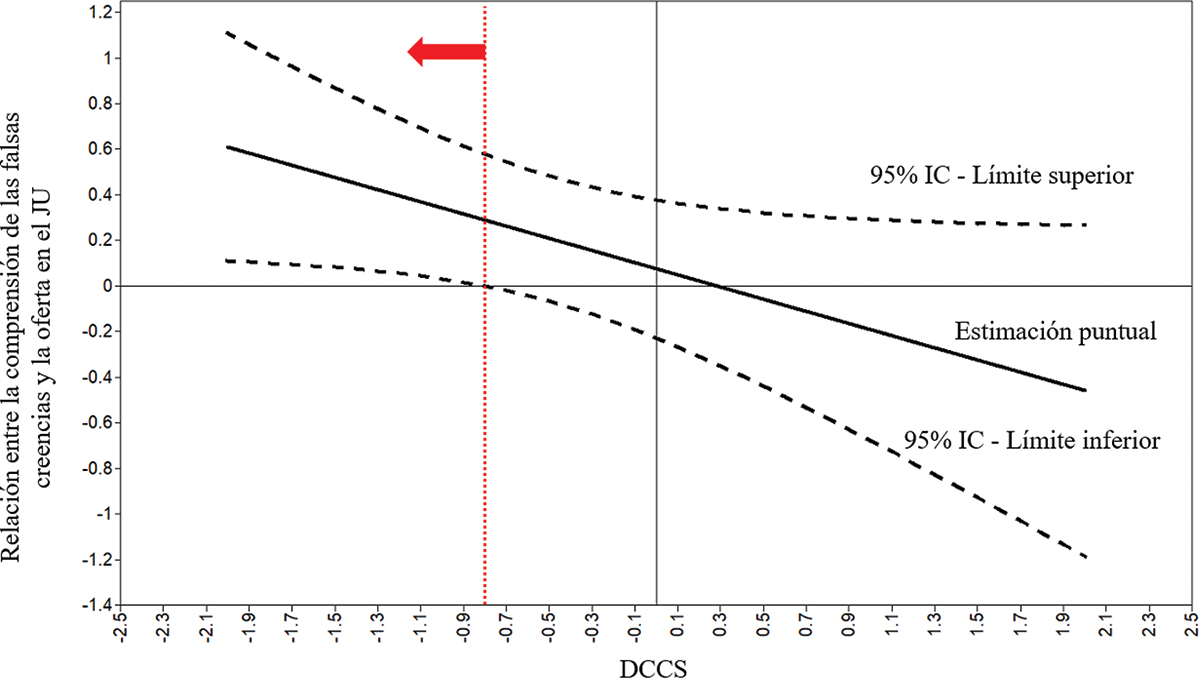
Papel moderador de la tarea DCCS en la relación entre la comprensión de las falsas creencias y la oferta en el JU.
Discusión
Este estudio demostró que la flexibilidad cognitiva moderó la asociación positiva entre la TM y las ofertas de los niños en el JU. La comprensión infantil de las creencias falsas se correlacionó significativamente con sus respectivas ofertas en el JU. Los niños hongkoneses de tres a seis años hicieron ofertas mayoritariamente justas en el JU, incluso hiper justas, ofreciendo alrededor de la mitad o incluso más de la mitad de sus pegatinas. Los análisis de regresión revelaron que la flexibilidad cognitiva moderaba la relación entre la comprensión de las creencias falsas y la oferta de los niños en el JU, controlando la edad y el control inhibitorio de los participantes. Con el incremento de la flexibilidad cognitiva, el efecto positivo de la comprensión de creencias falsas sobre las ofertas en el JU disminuyó. Cuando la puntuación estandarizada de la tarea DCCS alcanzó −.80, la comprensión de las creencias falsas dejó de predecir la oferta de los niños en el JU. La capacidad de adoptar la perspectiva del oponente llevó a los niños a compartir más en el JU, pero sólo cuando su nivel de flexibilidad cognitiva era bajo.
La percepción de justicia de la oferta es esencial para el éxito del JU (Leman et al., 2009). En coherencia con algunos estudios anteriores (e.g., Sally & Hill, 2006; Takagishi et al., 2010, 2014), el presente estudio demuestra que, ciertamente, la TM mantiene una relación positiva con las ofertas de los niños en el JU. La TM permite a los jugadores prever las reacciones de sus oponentes y ofrecer una parte suficiente del recurso para garantizar su propia parte, lo que también podría significar ofrecer más de lo necesario. La flexibilidad cognitiva como moderador permitió a los niños alternar con facilidad entre sus propios intereses y los niveles de aceptación de sus oponentes, y considerar opciones alternativas. Los ofertantes pudieron así limitar sus ofertas al nivel mínimo de aceptación para garantizar y maximizar el beneficio propio. En consecuencia, el efecto positivo de la TM sobre la oferta en el JU desapareció en cuanto la flexibilidad cognitiva de los niños alcanzó cierto nivel.
Estudios previos muestran que la TM predice ciertos comportamientos prosociales de los niños: compartir, ayudar y consolar (Imuta et al., 2016; Pérez et al., 2022). Este estudio subrayó aún más el papel de la TM en el comportamiento social estratégico de los niños. Del mismo modo que el buen funcionamiento de la TM no garantiza la popularidad ni la compasión, la capacidad de leer con precisión la mente de otra persona en ocasiones está relacionado con la capacidad de sacar provecho de una situación (Repacholi et al., 2003). Como Rochat et al. (2009) resumieron muy acertadamente, ‘las teorías de la mente verdaderamente abren la posibilidad de mayor justicia o de mayor interés propio, en función de si la percepción general del niño sobre la tarea es fomentar la igualdad o maximizar sus beneficios’ (Rochat et al., 2009, p. 436). En efecto, se comprobó que la TM influía positivamente en las ganancias propuestas por el ofertante en el JU tanto en los niños (Lucas et al., 2008) como en los adultos (Artinger et al., 2014). Nuestros resultados sugieren que si disponen de la necesaria flexibilidad cognitiva, los niños con alta capacidad de TM no eran meramente altruistas. Por el contrario, tendían a ser más tácticos y a ofrecer lo suficiente para evitar ofender a sus oponentes. En la tarea de JU, los niños tenían que adquirir una amplia gama de habilidades de comprensión y de capacidades cognitivas para contemplar la relación dinámica entre el ofertante y el receptor de la oferta y tomar decisiones calculadas para satisfacer simultáneamente las distintas demandas contrapuestas.
En la práctica, nuestros resultados ofrecen orientación a futuros esfuerzos de intervención para fomentar los comportamientos prosociales estratégicos de los niños a través de la flexibilidad cognitiva y de la toma de perspectiva. Teóricamente, este resultado contribuye a nuestro conocimiento de los cambios evolutivos y de las dife-rencias individuales en los comportamientos sociales estratégicos infantiles. Aunque existen estudios que demuestran que, con la edad, los niños se comportan de forma más prosocial a la hora de compartir (e.g., Fehr et al., 2008), otros estudios muestran que los niños más jóvenes (Allgaier et al., 2020), y especialmente los niños de sociedades colectivistas (Rochat et al., 2009), tienden a ser hiper justos en su distribución de los recursos. Nuestros resultados sugieren que los mecanismos que dictan la preferencia de los niños para tener en cuenta al otro en su distribución de los recursos son bastante sofisticados y complejos. Factores singulares como la edad, las normas sociales, la comprensión del estado mental o los recursos cognitivos son insuficientes para esbozar un panorama completo. Una explicación exhaustiva requiere tener en cuenta una amplia gama de factores evolutivos y de influencias socioculturales (Blake, 2018).
Limitaciones y direcciones futuras
Entre las limitaciones de este estudio cabe señalar, en primer lugar, en el JU se utilizaron cuatro pegatinas siguiendo el ejemplo de otros estudios previos (Chen et al., 2013) para adaptarnos a la capacidad numérica de los niños de corta edad, basándonos en un metaanálisis reciente (Larney et al., 2019) que reveló que el tamaño del recurso o recompensa a repartir no influye en las ofertas del JU. Sin embargo, el reducido número de pegatinas limitó el rango de posibles distribuciones que podían aplicar los niños en sus ofertas, especialmente teniendo en cuenta las normas infantiles hongkonesas de un reparto justo e incluso hiper justo. Futuros estudios deberían considerar el uso de 10 o más elementos en el recurso o recompensa del JU con niños. En segundo lugar, los resultados deben ser interpretados con precaución, teniendo en cuenta el efecto de moderación marginalmente significativo, posiblemente debido al pequeño tamaño de la muestra. No obstante, el tamaño del efecto en el presente estudio para el factor moderador era de −.204, lo que indica un efecto pequeño pero significativo, dado que Gignac y Szodorai (2016) indicaron que .19 supone un tamaño de efecto intermedio en la investigación psicológica y .30 representa un efecto de gran tamaño. Así pues, están justificadas las réplicas de este estudio con muestras de mayor tamaño. Por último, las normas sociales de distribución difieren de una cultura a otra (Blake, 2018). Es necesario reproducir este estudio con muestras diversas para ampliar la posibilidad de generalizar sus resultados.
Footnotes
This study was funded by Hong Kong Research Grants Council’s (RGC) General Research Fund 845211, awarded to the first author. / Este estudio ha recibido financiación del fondo General Research Fund del Hong Kong Research Grants Council mediante la beca 845211 otorgada al primer autor.
No potential conflict of interest was reported by the authors. / Los autores no han referido ningún potencial conflicto de interés en relación con este artículo.
