







Abstract
This study focuses on the performance of children managing double-entries in a weekly calendar. One hundred and four kindergarten and primary school children were interviewed and asked to solve weekly calendar construction and interpretation tasks using cards. The results show a difference between school year levels in the adequate management of a double-entry table when children construct and interpret a calendar; the interpretation process is less complex than the construction process. The results demonstrated that a deep understanding of a calendar requires using cognitive processes of varying degrees of difficulty and complexity. Therefore, there is a need to emphasize educational tasks which not only involve reading the calendar but which also explain its structure (double-entry) through construction tasks.
Using a calendar is a common educational practice during early school years, but it is not usually accompanied by specific instruction explaining the semiotic structure of the matrix or double-entry table. Understanding this structure involves using various cognitive skills, some of which are also involved in the learning of mathematics (Ethridge & King, 2005; Liedtke, 2008), a field that also uses these kind of tables.
This article presents part of the results of a doctoral research study on the development of cognitive processes in the construction and interpretation of a calendar and its relationship with knowledge of time. Here, we focus exclusively on the performance of children when they interpret and construct double-entries in a weekly calendar. The objective pursued is to compare the performance of students from different school years (kindergarten and the first four years of primary school) when interpreting and constructing a double-entry structure in a weekly calendar.
Method
Participants
One hundred and four students from a public school in Barcelona, from a medium-high socio-economic background, participated in the study. The distribution by school year level was: 36 kindergarten students (mean age: four years and eight months; 16 girls and 20 boys), 38 students from years one and two (mean age: seven years and five months; 19 girls and 19 boys) and 30 students from years three and four (mean age: nine years and one month; 16 boys and 14 girls).
Task and procedure
The task involved individually constructing and interpreting a weekly calendar using three types of cards, as presented below: (1) the names of the days of the week written in Catalan, each day was on a different coloured background; (2) colour drawings of three different times of the day — morning, afternoon and evening; and (3) black and white drawings of an activity undertaken by children during the week (see Figure 1). Each type of card was placed on the table in a pile and by using the written phrase ‘How would you arrange days, times and activities to show what you did yesterday, what you are doing today and what you are going to do tomorrow?’, children were asked to arrange the cards and indicate the reasons for their choices (construction process); the justifications will not be analysed in this article. Subsequently, two situations related to the interpretation process were presented to them where the interviewer displayed the calendar structure as a double-entry table (days on the horizontal axis and times of the day on the vertical axis). For the first situation (location) children were asked to place an activity suggested by the interviewer in a specified day and time; and for the second (read), the interviewer placed an activity while naming it, (‘If I put this card here, when does this child play?’) and the child had to interpret on what day and at which time of day that occurred. Each interview lasted approximately 30 minutes, was videotaped and digitally transcribed for later analysis.
Examples of placement of activities (Joi and Mat — kindergarten) and construction of a calendar (Remi — primary school).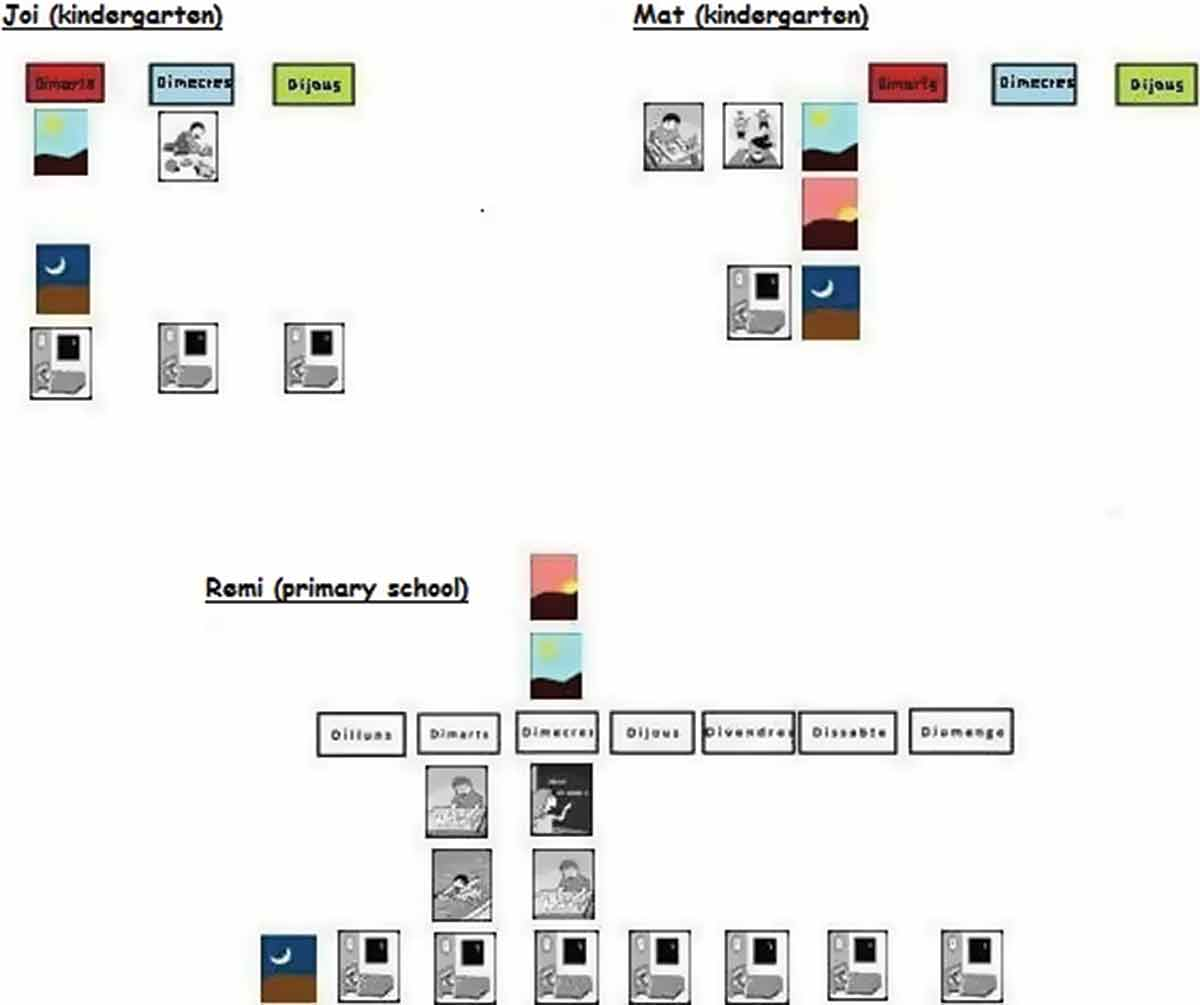
Results
If we analyse the construction task, the data show that the percentage of kindergarten students who were able to construct the calendar with a double-entry structure is very low, improving — albeit still remaining relatively low — with the first two years and the next two years of primary school (2.8, 26.3 and 40% respectively). The difference is significant if results for kindergarten children are compared with those for year one and year two children (X2(1) = 8.093, p < .01), but not if results for years one and two and year three and year four children are compared with each other (X2(1) = 1.434; p = .231).
If we consider the interpretation process, all primary school children were able to correctly place an activity on the correct day and time (location). However the percentage of correct responses by children in kindergarten was lower (63.4%). In the reading task, the percentage of correct responses was 77.3% for children in kindergarten, 97.3% for children in years one and two and 95.8% for year three and year four children (X2(2) = 7.960; p < .05).
These data indicate that the interpretation of a double-entry structure in the context of a calendar was less complex than its construction. To confirm this difference we compared the results of the construction task and the two interpretation tasks for the entire sample. The analysis indicated significant differences in both cases: McNemar X2 = 49.64; p < .01 when comparing construction and placement and McNemar X2 = 52.155; p < .01 when comparing the construction task with the reading task.
To illustrate the difficulties in both processes, some examples are shown below (see Figure 1). Joi (kindergarten) groups similar types of activities together and mixes them with places of times of day; Mat (kindergarten) only considers one dimension (times of day) despite having the structure constructed for him by the interviewer when the activities are placed; and Remi (primary school) has difficulty placing the two dimensions according to a double-entry structure when constructing the calendar. These difficulties to adequately consider the two dimensions arise despite support given by the interviewer, such as questions about their movements or even suggesting where the card might be better placed.
Conclusions
The results show an evolution in the skills needed to manage double-entry in a weekly calendar; children in kindergarten showed more difficulties than the first four years of primary school children in carrying out construction and interpretation tasks. However, while almost all primary school children were able to successfully interpret the calendar without difficulty, they did show difficulties in carrying out construction tasks. Furthermore, we found that the interpretation process was simpler than the construction process for all school year levels. This result seems theoretically interesting since it implies that managing a calendar requires two cognitive processes of varying difficulty and complexity: construction, where the double-entry structure seems to be a clear obstacle, as highlighted in other studies (Brizuela & Lara-Roth, 2002; Marti, Garcia-Mila, Konstantinidou, & Gabucio, 2011); and interpretation, a process which in the case of the calendar only posed difficulties for the younger children (those in kindergarten). It should be noted that the interpretation studied in this paper relates to the reading and placement of data, and not to more complex skills such as relating data with other data or inferring new data (interpolated or extrapolated) (Gabucio, Martí, Enfedaque, Gilabert, & Konstantidinou, 2010), where errors that students commit are much more frequent and persistent.
Organizing school activities into a calendar is a frequent educational practice from kindergarten onwards, but results indicate the need to emphasize not only tasks involving reading a calendar but also a profound and explicit understanding of its structure (double-entry) through construction tasks.
Construcción e interpretación de la organización tabular de un calendario en niños de infantil y primaria
El uso del calendario es una práctica educativa común en los primeros años de escuela, aunque por lo general no se la acompaña de una instrucción específica orientada a hacer explícita su estructura semiótica de matriz o tabla de doble entrada. La comprensión de esta estructura implica diversas habilidades cognitivas, algunas de las cuales también intervienen en el aprendizaje de las matemáticas (Ethridge & King, 2005; Liedtke, 2008), ámbito en el que también se utilizan tablas de este tipo.
En este artículo se presentan parte de los resultados de una investigación doctoral sobre el desarrollo de los procesos cognitivos en la construcción e interpretación de un calendario y su relación con el conocimiento del tiempo. Aquí, nos centraremos exclusivamente en la ejecución de los niños cuando interpretan y construyen la doble entrada de un calendario semanal. El objetivo que se persigue es comparar el desempeño de alumnos de diferentes niveles escolares (infantil y los dos primeros ciclos de primaria) al interpretar y construir la estructura de doble entrada de un calendario semanal.
Método
Participantes
Ciento cuatro alumnos de una escuela pública de Barcelona, con una población de nivel socio-económico medio-alto, participaron en el estudio. La distribución según el nivel escolar fue la siguiente: 36 alumnos de infantil (media de edad: cuatro años y ocho meses; 16 niñas y 20 niños), 38 alumnos del primer ciclo de primaria (media de edad: siete años y cinco meses; 19 niñas y 19 niños), y 30 alumnos del segundo ciclo de primaria (media de edad: nueve años y un mes; 16 niñas y 14 niños).
Tarea y procedimiento
La tarea a resolver consiste en construir e interpretar individualmente un calendario semanal utilizando tres tipos de tarjetas, según presenten: (1) los nombres de los días de la semana escritos en catalán, cada día sobre un fondo de un color diferente; (2) dibujos en color de tres diferentes momentos del día —mañana, tarde y noche; y (3) dibujos en blanco y negro de algunas actividades que realizan los niños durante la semana (ver Figura 1). Se colocó un montoncito sobre la mesa para cada tipo de tarjeta y mediante la consigna ‘¿Cómo pondrías los días, los momentos y las actividades para saber qué has hecho ayer, qué haces hoy y qué harás mañana?’, se pidió a los niños que las organizaran e indicaran el porqué de sus elecciones (proceso de construcción), aunque en el presente reporte no se analizan tales justificaciones. Posteriormente se plantearon dos situaciones relacionadas con el proceso de interpretación, en las cuales la entrevistadora proponía la estructura del calendario en forma de doble entrada (días en horizontal y momentos del día en vertical). En la primera situación (localización) los niños debían colocar una actividad sugerida por la entrevistadora en un día y un momento especificados; y en la segunda (lectura), la entrevistadora situaba una actividad nombrándola (‘Si pongo esta tarjeta aquí, ¿Cuándo juega este niño?’) y el niño debía interpretar en qué día y en qué momento ocurría. Cada entrevista duró aproximadamente 30 minutos, fue grabada en vídeo, y transcrita digitalmente para su posterior análisis.
Ejemplos de localización de actividades (Joi y Mat de infantil) y construcción de un calendario (Remi de primaria).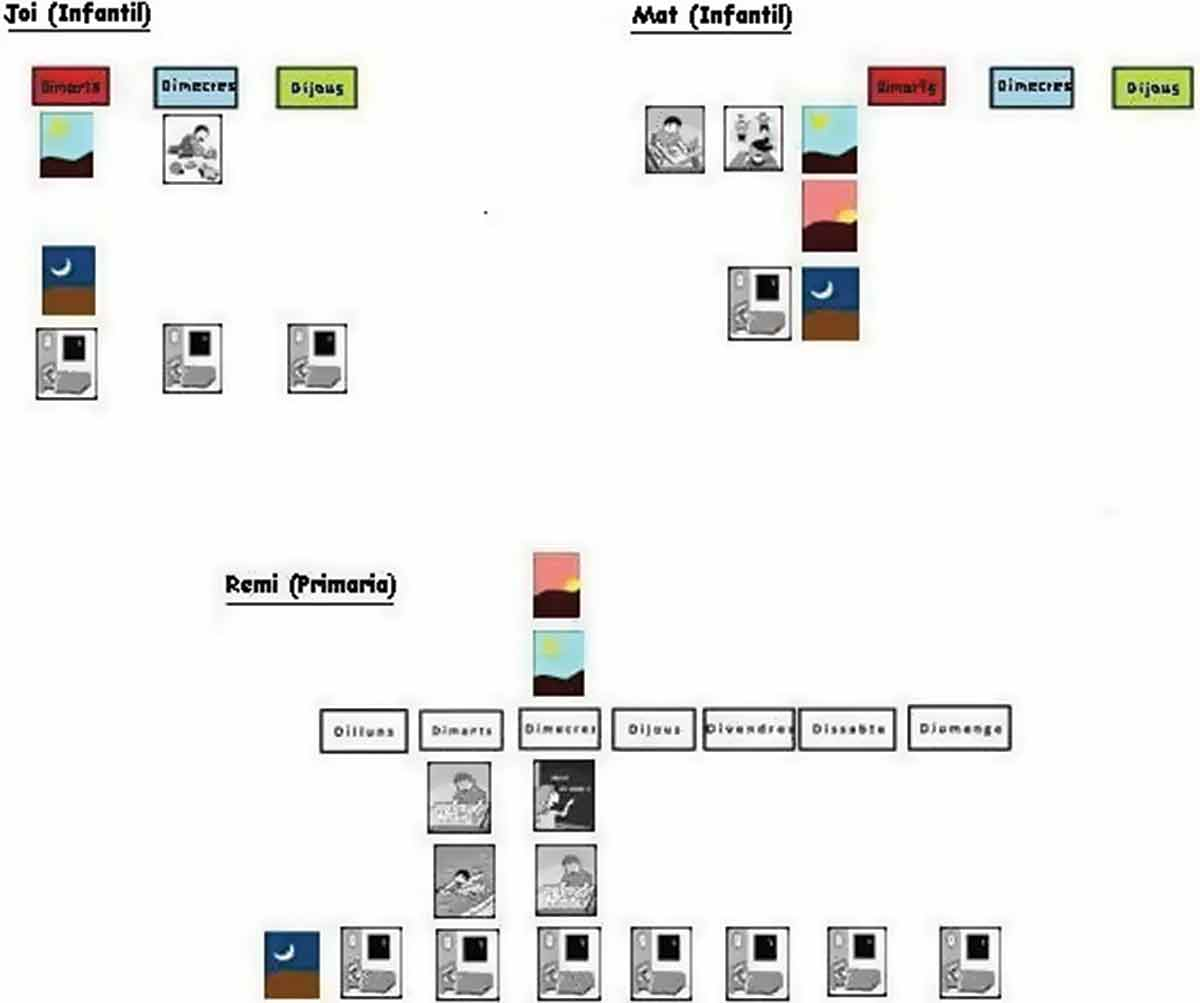
Resultados
Si analizamos la tarea de construcción, los datos muestran que el porcentaje de alumnos que consigue la construcción del calendario con una estructura de doble entrada es muy bajo en infantil, y mejora aunque se mantiene relativamente bajo en primer y segundo ciclo de primaria (respectivamente 2.8, 26.3 y 40%). La diferencia es significativa si se compara el nivel infantil con primer ciclo de primaria (X2(1) = 8.093; p < .01), pero no lo es si se comparan los dos niveles de primaria entre sí (X2(1) = 1.434; p = .231).
Si atendemos el proceso de interpretación, todos los niños de primaria lograron situar una actividad teniendo en cuenta el día y el momento (localización), siendo menor el porcentaje de aciertos en los niños de infantil (63.4%). En la tarea de lectura, el porcentaje de aciertos fue de 77.3% en infantil, de 97.3 % en primer ciclo de primaria y 95.8% en segundo ciclo de primaria (X2 (2) = 7.960; p < .05).
Estos datos indican que la interpretación de una estructura de doble entrada en el contexto de un calendario, resultó menos compleja que su construcción. Para confirmar esta diferencia hemos comparado los rendimientos, para toda la muestra, de la tarea de construcción y de las dos tareas de interpretación. Los análisis indican diferencias significativas en ambos casos: X2 de McNemar = 49.64; p < .01 al comparar construcción y localización, y X2 de McNemar = 52.155; p < .01 cuando se compara la tarea de construcción con la de lectura.
Para ilustrar las dificultades en ambos procesos, mostramos algunos ejemplos (ver Figura 1). Joi (infantil), agrupa las actividades por ser del mismo tipo mezclándolas con el lugar de los momentos; Mat (infantil) sólo considera una de las dimensiones (momentos del día) a pesar de contar con la estructura construida por la entrevistadora cuando sitúa las actividades; y Remi (primaria) tiene dificultades para situar las dos dimensiones conforme una doble entrada cuando construye un calendario. Estas dificultades para considerar de forma adecuada las dos dimensiones se presentan a pesar de algunas ayudas planteadas por el entrevistador, tales como cuestionamientos sobre sus movimientos o incluso sugiriendo donde podría ir mejor tal o cual tarjeta.
Conclusiones
Los resultados muestran una evolución en el manejo de la doble entrada de un calendario semanal, pues en infantil se presentaron más dificultades que en los dos ciclos de primaria tanto en la tarea de construcción como en las de interpretación. Sin embargo, mientras que prácticamente todos los niños de primaria consiguieron interpretar sin dificultad, en la tarea de construcción estas dificultades estuvieron presentes. Por otro lado, encontramos que el proceso de interpretación resultó más sencillo que el proceso de construcción en todos los niveles escolares. Este resultado, a nivel teórico, nos parece interesante pues supone que el manejo de un calendario requiere dos procesos de distinta dificultad y demanda cognitiva: la construcción, en la que la estructura de doble entrada parece ser un claro obstáculo, tal como otros estudios lo señalan (Brizuela & Lara-Roth, 2002; Martí, Garcia-Milà, Gabucio, & Konstantinidou, 2011); y la interpretación, proceso que en el caso del calendario sólo planteó dificultades a los más pequeños (ciclo educativo infantil). Cabe señalar que la interpretación estudiada en el presente trabajo atañe a la lectura y localización de datos, y no a otras competencias más complejas como son relacionar datos o inferir datos nuevos (interpolarlos o extrapolarlos) (Gabucio, Martí, Enfedaque, Gilabert, & Konstantidinou, 2010), en las que los errores que comenten los alumnos son mucho más frecuentes y persistentes.
Las actividades escolares con el calendario suelen ser frecuentes desde la etapa infantil, pero los resultados señalan la necesidad de potenciar tareas que involucren no sólo la lectura de un calendario sino también la comprensión profunda y explícita de su estructura (doble entrada) a través de tareas de construcción.