







Abstract
A single case study for a psychoanalytic psychotherapy process in a girl and her mother is presented from the perspective of the Object Relations Theory framework. Of interest are the empirical findings of therapeutic change and the effectiveness of the tool using a method created by a team of researchers from a university chair. A qualitative and quantitative analysis of textual observational records of sessions was conducted using codes constructed ad hoc from specific manuals for children and adults. The results of the application of the method are contrasted with results from psychological assessment techniques. Therapeutic change indicators are linked to progress in the processes of symbolization; therapeutic efficacy is recorded when the psychotherapist’s interventions favour symbolization and mentalization processes.
This article describes the psychotherapeutic process of a girl and her mother and aimed to assess therapeutic change and the tool’s effectiveness. It was a single case study based on the perspective of the Object Relations Theory framework. The Method of Analysis of the Process of Psychoanalytic Psychotherapy with Children and Parents (MAPPP-C/P) (Luzzi, Bardi, Ramos, & Slapak, 2015), created by the team of researchers from a university chair, was used.
The study of therapeutic change was individual for each patient and indicators were related to the development of processes of symbolization in psychotherapy. With regard to therapeutic change, Joseph (1989/1997) developed the concept of psychic change, understood as what happens at each moment during the transformation, whether they are signs of progress or regress, ‘referring to individual and personal methods that each patient has in order to cope with anxiety and object relations’ (p. 195).
Group psychoanalytic psychotherapy (Bion, 1948) was the tool whose effectiveness was being studied. The purpose of a Group Psychoanalytic Psychotherapy with Children was to increase symbolic capacity and an Orientation Group for Parents or Adults in charge was to increase capacity for emotional containment with regard to children under their care. Therapeutic efficacy was recorded when psychotherapist interventions produced responses in patients that implied a development of the symbolic process and a gradual mentalization (Fonagy, 2006) of the child, in the case of adults.
In the field of clinical psychology use of the single case design is controversial. Roussos (2007) and Weiner (2012) considered calling it a ‘single case study’, as it does not comprise a research design. According to Morley (2007) this study has interesting applications in clinical psychology, specifically with regard to the research task which links research and clinical practice (Roussos (2007). Its name suggests that only a single case is analysed, but as noted by Jones (1993) and Kazdin (2001) these studies may present several cases and its essential characteristic is that this type of analysis does not allow for a direct comparison between subjects.
Other historical cases found that are relevant to this case study in children in classical psychoanalytic literature include ‘Richard’ (Klein, 1961) and ‘The Piggle’ (Winnicott, 1977), among others. Currently some single case studies have been recorded in this evolutionary stage, from different theoretical perspectives (Goldberg, 2009; Grill, Hyden, & Shaw, 2008; Leffler, Fristad, & Klaus, 2010) and there are few empirical studies of group psychoanalytic psychotherapy processes with children.
The study herein corresponds to an observational design of a single case under the conditions of clinical practice, without modification to the context or the exchange between psychotherapist and patient.
Methodology
Participants
A six-year-old girl and her mother, who for the purposes of confidentiality will be called María and Juana respectively. María was included in a group psychoanalytic psychotherapy for children and her mother in an Orientation group for Parents or Adults in charge through a child care service dependent on a university chair. The father was not included because he had left home a year before the consultation following situations of domestic violence (alleged sexual abuse of the girl’s older sister, verbal and physical family violence). Juana was caring for her four children and María was the third in order of birth.
The girl was referred by the school office because she had had panic attacks at school, bedwetting episodes, eating difficulties and psychosomatic manifestations.
Symptoms began after her father left home. The evolutionary stage corresponds to the beginning of latency, having recorded the expected achievements for each age stage.
An informed consent form for the psychotherapy and research was signed by the adult care-giver and the girl’s consent was obtained; information given included the scope of psychotherapeutic and research work and the precautions needed to fully understand and accept the tasks, according to their developmental stage and emotional development. Participation in the research was voluntary and it was explained that the decision not to participate would not condition the psychotherapeutic assistance.
The psychotherapy groups in the institution from where the case was sourced met weekly, had a maximum of eight members and were heterogeneous in terms of psychopathology of the children participating. The grouping was done by age, the psychotherapy had no predetermined term duration and the declaration of the patient cure was done on an individual basis. Play technique is used according to Kleinian specifications (Klein, 1927/1999a; 1932/1999b); each group had a toy box with playful and graphic material.
The Orientation Group for Parents or Adults in charge worked in parallel to the children’s group and consisted of a psychoanalytic psychotherapy focused on the adults’ relationship with their children.
The psychoanalytic psychotherapy group was chosen because it was considered a device that favours the emergence of emotions and an active positioning with peers and the psychotherapist; it generated a regressive process that favours the emergence and processing of conflicts within the therapeutic frame and a connection to intrapsychic and interpersonal aspects (Luzzi & Jaleh, 2010).
Criteria of sample selection
The psychotherapeutic group was made up of six boys and two girls. The study focused on assessing a girl’s psychotherapeutic process because epidemiological studies on the consulting population (Luzzi & Slapak, 2013) indicate that girls are a risk group because of their psychopathological characterization, and consultation is usually done late when the pathology worsens.
Materials and tools
Twelve of María’s group psychoanalytic psychotherapy sessions and six of Juana’s orientation group sessions were analysed. This period corresponds to the period between the test and retest of the validation tests (Child Behaviour Checklist and Rorschach), 12 months in the case of María’s psychotherapy and six months in Juana’s treatment. Sessions 1, 5, 9, 13, 17, 21, 25, 29, 33, 37, 41 and 45 of the children’s group and sessions 1, 5, 9, 13, 17 and 21 for the orientation group were chosen for the sample.
Psychotherapies were in charge of a psychotherapeutic team — external to the research team — consisting of a psychotherapist and a non-participant observer, whose function was to construct a written record as the session unfolded, including the psychotherapist’s interventions, the patients’ responses and both their gestures and actions.
The psychotherapists of both groups had received five years of specific training in group psychoanalytic psychotherapy. The children’s group was coordinated by a clinical psychologist who had ten years’ experience in psychoanalysis with children and the Orientation Group for parents by a clinical psychologist with similar years’ experience in psychoanalytic training.
Observers had received two years training in the capacity of observation, with criteria derived from those used in the Tavistock Clinic for the training of psychotherapists (Bick, 1964). After each session, the observer and psychotherapist met to revise and extend the definitive observational record.
Textual records were analysed with the assistance of the Atlas-ti® software package, which allows segmentation of the session and assigning the selected segments into analytical categories. The researchers used the MAPPP-C/P, which included analytical codes and their definitions grouped into two Code Manuals (children and adults) and the criteria of application and analysis that make up the Procedures Manual. The method reliability test — currently in process — was conducted through agreement between judges; six external evaluators to the research team were trained in the task of assigning codes, and they codified 10 textual records of psychoanalytic psychotherapy sessions with children and orientation groups, different to the study presented in this article.
For methodological validation, international application psychological tests were carried out, ex ante and ex post: the Child Behaviour Checklist (CBCL) (Achenbach & Edelbrock, 1991), validated in Argentina by Samaniego (1998); in this study it was administered to the adult in charge who gave an account of the child’s behaviour.
The CBCL is a standardized form that records the behavioural problems and skills of children aged between four and 18; it consists of a set of predetermined items that describe children’s behaviour and is categorized into 35 scales that are derived empirically. Different types of informants — in this research study the mother — estimate the presence, frequency or severity of the behaviour problems.
Furthermore, the Rorschach Test (1921) was applied to the girl and her mother. This is a global projective technique that studies the subject’s personality, understanding of their inner world and relationships that they have with reality.
Validation tests were administered by members of another university chair, external to the research team.
Procedures
Sessions were coded with the implementation of specific Code Manuals for each psychotherapy. The codes were grouped into two large families:
Once the sessions had been coded, a search and recovery of the analytical categories used and of the chosen session segments was carried out as well as the calculation of frequencies and co-occurrences of those codes, in addition to other tasks.
The results of the qualitative and quantitative analysis obtained were compared with those obtained by the Rorschach and CBCL test and retest. The CBCL test and retest facilitated recording the symptomatic changes in the child from the perspective of the informant, in this case her mother. The aforementioned changes may reflect changes in the child’s behaviour of the adult informant’s perspective. The Rorschach test evaluates the psychological changes that have occurred between the first and second administration, mainly with regard to the basic functions of the ego: test, adaptation and judgement of reality (Passalacqua, Menestrina, Nuñez, Simonotto, Alvarado, & Piccone, 2002). Administering these validation tests — despite belonging to other theoretical frameworks and built for other purposes — facilitates obtaining results that are not comparable with those from the application of the methodology presented, but can detect whether this methodology is able to reflect similar change processes during the period studied.
Results
The following families of codes were considered for María’s analysis process, because they provide information regarding symbolization processes:
From the beginning and throughout the study period, María played
At session 13 (4 in the sample), a change was observed in the subject of
In session 25 (7 in the sample) — where the child was the only girl present — the boys played a
In sessions 41 and 45 (11 and 12 in the sample) she played a
The
María: responses to the therapist’s interventions.
The
The
A change was observed in
Also, a
Regarding María: psychotherapist’s interventions.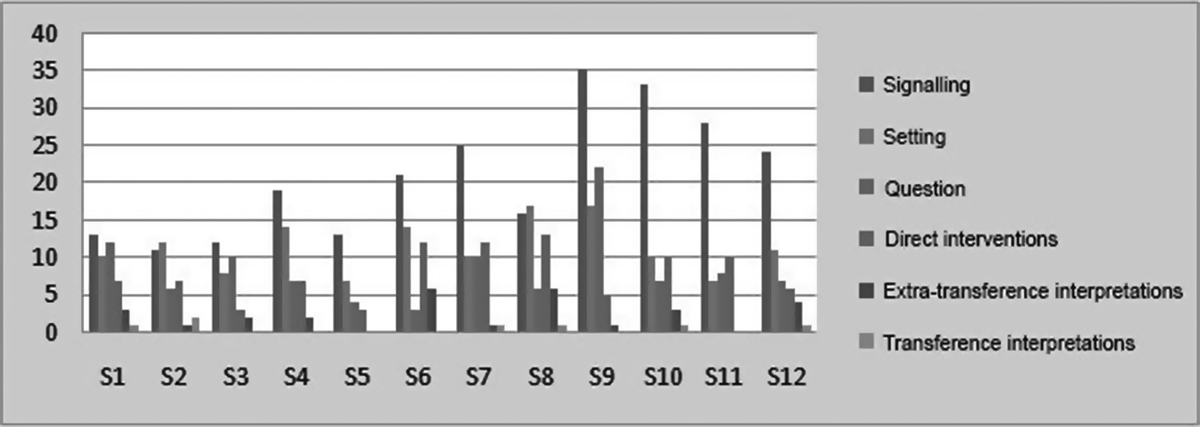
Most were
Second,
Then
The
Interventions exclusively addressed to María were
A
Results of the Rorschach test and retest
Results of María’s first test showed concentration problems, some disorganization in her mental functioning, low tolerance to frustration and opposition when facing tasks. Responses concerning traumatic situations were prevalent. The ego-functions of reality were slightly altered, adjustment difficulties were recorded and judgement of reality showed failures in the logic of thought. Fourteen indicators of suicide risk (Passalacqua et al., 2002) were recorded.
Improvements in the retest were observed in concentration and understanding of the instructions, greater impulse control and tolerance of frustration; changes in defence mechanisms and less opposition. There were no responses concerning traumatic situations. Changes in the ego functions of reality were observed: higher concentration and objectivity, better adaptation to reality and reduced flaws in causal relationship that had been previously recorded. Marked decrease in suicide risk indicators from 14 to 6.
CBCL
María: CBCL results. Tests administered at the beginning of psychotherapy process and at 12 months.
The total score includes 35 scales; only those included in Externalizing and Internalizing syndromes are considered for analysis as they group María’s behavioural problems. In the initial test score, higher scores were observed in the Internalizing syndrome scales (Somatic Complaints, Anxious-depressive and Withdrawal), consistent with the symptoms the child presented in her reason for attending.
Regarding the Externalizing syndrome (Antisocial Behaviour and Aggression), very low scores were recorded in Aggression. The retest showed a marked decrease in the total score and the Internalizing syndrome, and a slight increase in the Externalizing syndrome. High scores regarding depressive and anxious aspects at the beginning decreased significantly at the end of the period.
Below, the study results corresponding to the first semester of Juana’s psychotherapy process are presented. The following families of codes were considered for the process analysis in Juana:
In the first semester Juana’s responses were
The recurring
At the beginning of psychotherapy Juana presented an
Regarding the pairs,
Regarding the psychotherapist interventions, they were mostly
With regard to non-theoretical contents of the
Results of the Rorschach test and retest
In the first test Juana manifested a good intellectual level, although the yields fell sharply against the emergence of unpleasant feelings (anxiety, stress and emotional decontrol). Her thinking was coherent and self-centred, and showed a predominance of idealization and manic denial mechanisms. Her responses registered impulsiveness and a tendency to delegate responsibilities to others. The ego functions — test, adaptation and judgement — fell sharply when faced with specific conflict situations, prone to aggressive unloading.
The retest reported vulnerability in affective expression, schizoid defences and unworked traumatic situations. An incipient ability to accept her need for help and to establish better bonds was detected. Regarding the functions of the ego, an improvement was observed in the adaptation to reality, but the judgement of reality presented alterations in establishing causal relationships, with an attendance to action.
CBCL test and retest results
CBCL results indicate that Juana could notice positive changes in her daughter, showing a greater awareness of reality and emerging possibilities of empathy.
Discussion
Studying the psychotherapeutic process of a child requires considering different perspectives: his/her developmental stage, family and social context and the conditions of psychotherapy. The approach to the psychotherapy treatment of a child involves considering him/her to be a person who is in the process of emotional development (Winnicott, 1960) and contemplating the intra-psychic and environmental difficulties impeding their process.
The single case study presented focuses on the evolution of María’s psychotherapy, and the analysis of environmental conditions focuses on Juana’s psychotherapeutic process, the only responsible adult in the family. The consideration of other variables, such as socioeconomic conditions and the relationship with her siblings, was excluded from this study.
María’s symptoms emerged after traumatic family situations and began to remit after eight months of psychotherapy, according to reports from the child’s teachers.
The analysis of María’s symbolic productions and the type of interaction during psychotherapy allowed us to infer that some changes did occur. Her playings — a privileged indicator of symbolic processes in children according to the referential framework — demonstrated a progression from an iterative and undeveloped initial modelling game to dramatic and complex playings. The theme of these latter games expressed, albeit in different forms, the trauma suffered, and they were accentuated in the second semester when María actively represented these traumatic situations lived passively (Freud, 1920/1975; Klein, 1927/1999a; 1932/1999b). This progression in game playing was accompanied by a greater ability to verbalize fantasies.
During this latter period María began to perform acting-outs within sessions, coinciding with improved symptoms in school. The question arises regarding the possible meaning that these acting-outs gain for María; although these are impulsive discharges of fantasies, their appearance could signal a therapeutic change with regard to manifestations of split aspects within the psychotherapy process. The establishment of the settings as a continent space or ‘toilet-breast’ may have facilitated the emergence of acting-outs in the analytical framework, reducing the risk of disruptive behaviours in other areas (Meltzer, 1967).
Another aspect to consider is the use of space: the move from restriction to expansion was contemporaneous with María’s possibility of manifesting aggressive aspects, consistent with data from the CBCL retest reflecting a decrease in the ‘internalizing’ syndrome and an increase in the ‘externalizing’ one.
Interactions with peers and with the psychotherapist allowed us to visualize the ‘transferences’ within the psychotherapy group (Bion, 1965). Her relationship with boys modified her fear of rivalry and hostility; María began to show aggressive tendencies, possibly as transference expression of conflicts with her father, through the mechanism of identification with the aggressor (Freud, A, 1936).
The relationship with the psychotherapist and the other girl in the group reedited maternal transference, which moved from dependency to opposition and defiance. These changes in the group dynamics, consistent with the evolution of the playings and aggressive manifestations, suggest the possibility of psychic change (Joseph, 1997).
Psychotherapist interventions were mainly aimed at the members of the group and not targeted at group dynamics. The shortage of transference and extra-transference interpretations addressed towards María could be associated with difficulties in handling counter-transference. The questions and signallings directed towards María contributed to ‘making her visible’ in the group context, decreasing anxiety and symbolic expressions in the first semester.
Validation tests denoted changes in interpersonal relationships, defensive modalities, management of impulsiveness and tolerance of frustration. These changes correspond — albeit partially — with those studied through MAPPP-C/P.
The Orientation group for parents aims to foster the connection with childish aspects in adults, necessary for the encouragement of emotional support and the mentalization of the children in their care. This methodology — implemented in parallel with the children’s psychotherapy — contributed to adherence to treatment and weakening resistance, promoting a greater understanding of the child’s condition.
The study of María’s mother’s process reflected little therapeutic change. Juana’s verbalizations, predominantly descriptive, showed emotional distance and little involvement in subjects that arose regarding herself and others. Faced with situations of violence reported by group members, Juana did not show emotional empathy and made no references to her own conflicts; her discourse was focused on superficial issues, and she did not volunteer her own problems or her daughter’s.
The interaction with her psychotherapist changed from opposition to dependence, but this change did not involve a transformation (Bion, 1965) in interpersonal relationships.
Repeated interventions about the setting contributed to ‘transference collection’ (Meltzer, 1967). The signallings and extra-transference interpretations showed Juana’s difficulties with attributing personal meaning to their stories.
Regarding the possibility of emotional control and mentalization (Fonagy, 2006) towards her daughter, Juana’s difficulties are notorious. It is possible that her schizoid defences hinder an emotional connection to avoid pain, given that she has also suffered traumatic domestic situations.
Triangulating the results of the analysis process with Rorschach tests indicated that no therapeutic change was verified. It is possible that the study period was not long enough to assess changes in the patient because of the rigidity of her defence mechanisms.
The group device was relevant when interacting with peers as it favoured the emergence of conflicts; the girl’s transference with peers promoted the treatment of traumatic situations. Juana’s transference with peers and appropriate therapeutic interventions led to an incipient reflective capacity at the end of the period.
Empirical research of a psychotherapy process can reflect patients’ advances and setbacks and demands a reflection on the type of interventions. Progress was made in María’s case but nothing similar happened in her mother’s psychotherapy process. Psychotherapy promotes and unlocks tendencies to develop more rapidly in young children than in adults (Winnicott, 1960), and group psychoanalytic psychotherapy strengthens these results through cross transferences with the psychotherapist and peers (Glasserman & Sirlin, 1979).
Single case studies provide evidence on the operation of a particular psychotherapeutic process. Despite the fact that its results are not generalizable, this method facilitates learning about that case in depth, highlighting facts or processes. These studies did not allow for verification with general hypotheses, but suggest lines of research.
In the study presented, a detailed analysis of symbolic productions and a psychotherapist’s interventions have made it possible to analyse processes of therapeutic change that are specific to this girl and her mother that — while they are not generalizable — lead to possible lines such as the importance of the study of cross transference in group dynamics, the impact of the psychotherapist’s training on the modalities of intervention and the analysis of children’s playing productions for the construction of indicators of therapeutic change, among other variables.
Análisis del proceso de cambio terapéutico en el contexto de una psicoterapia psicoanalítica grupal de niños: un estudio de caso único
En este artículo se describe el proceso psicoterapéutico de una niña y de su madre, con el fin de evaluar cambio terapéutico y eficacia del dispositivo. Se trata de un estudio de caso único desde el marco de la Teoría de las Relaciones Objetales. Para el análisis se emplea el Método de Análisis de Proceso Psicoterapéutico Psicoanalítico en Niños y Padres (MAPPP-N/P, Luzzi, Bardi, Ramos, & Slapak 2015), construido por el equipo de investigadores de una cátedra universitaria.
El estudio de cambio terapéutico es individual para cada paciente y los indicadores están relacionados con el desarrollo de los procesos de simbolización en la psicoterapia. Respecto del cambio terapéutico, Joseph (1989/1997) elabora el concepto de cambio psíquico, entendido como lo que sucede momento a momento en la transferencia, sean signos de progreso o retroceso, ‘referido a los métodos individuales y personales que cada paciente tiene para lidiar con la ansiedad y sus relaciones de objeto’ (p. 195).
La psicoterapia psicoanalítica de grupo (Bion, 1948) es el dispositivo cuya eficacia se estudia. El objetivo de la psicoterapia psicoanalítica grupal de niños es el incremento de la capacidad simbólica y en los grupos de orientación a adultos responsables el incremento de la capacidad de contención emocional respecto de los niños a cargo. Se registra eficacia terapéutica cuando las intervenciones del psicoterapeuta producen respuestas en los pacientes que implican un desarrollo de proceso simbólico y una paulatina mentalización (Fonagy, 2006) del niño, en el caso de los adultos.
En el campo de la psicología clínica la utilización del diseño de caso único genera controversias. Roussos (2007) y Weiner (2012) consideran apropiado denominar ‘estudio de caso único’, en tanto no constituye un tipo de diseño de investigación. Según Morley (2007) este estudio tiene interesantes aplicaciones en psicología clínica, entre las cuales destaca la tarea investigativa; constituye una herramienta que permite vincular la investigación y la práctica clínica (Roussos (2007). Su denominación induce a pensar que se analiza un único sujeto, pero como señalan Jones (1993) y Kazdin (2001) estos estudios pueden presentar varios casos y su característica esencial es la modalidad de análisis que no admite la comparación directa entre sujetos.
Se encuentran antecedentes del estudio de caso en niños en la literatura clásica psicoanalítica: los casos ‘Richard’ (Klein, 1961) y ‘The Piggle’ (Winnicott, 1977), entre otros. En la actualidad se registran algunos estudios de caso único en esta etapa evolutiva, desde distintos marcos teóricos (Gill, Hyden, & Shaw, 2008; Goldberg, 2009; Leffler, Fristad, & Klaus, 2010) y son escasos los estudios empíricos de proceso en psicoterapia psicoanalítica grupal con niños.
El estudio que se presenta corresponde a un diseño observacional de caso único respetando las condiciones de la práctica clínica, sin modificación del contexto ni del intercambio entre psicoterapeuta y paciente.
Método
Participantes
Una niña de seis años y su madre, quienes a los fines del resguardo de la confidencialidad se denominaron María y Juana respectivamente. En un servicio asistencial de niños dependiente de una cátedra universitaria, María se incluyó en un grupo de psicoterapia psicoanalítica de niños y su madre en un grupo de orientación a adultos responsables. El padre no fue incluido debido a que había abandonado el hogar un año antes de la consulta, luego de situaciones de violencia familiar (presunto abuso sexual hacia una hermana mayor de la niña, violencia verbal y física a la familia). Juana había quedado a cargo de sus cuatro hijos y María era la tercera por orden de nacimiento.
La niña fue derivada por el gabinete escolar debido a que presentaba crisis de angustia en la escuela, episodios de enuresis, dificultades de alimentación y manifestaciones psicosomáticas.
Los síntomas comenzaron después del abandono del hogar por parte del padre. La etapa evolutiva corresponde a los inicios de la latencia, habiéndose registrado los logros evolutivos a edades esperables.
Se obtuvo el consentimiento informado para la psicoterapia y la investigación por parte del adulto responsable y el asentimiento de la niña, incluyendo los alcances del trabajo psicoterapéutico e investigativo, con los recaudos necesarios para corroborar la comprensión y aceptación de las tareas, acorde con la etapa evolutiva y el desarrollo emocional. La participación en la investigación fue voluntaria y se explicitó que la decisión de no participar no restringiría la asistencia psicoterapéutica.
Los grupos de psicoterapia realizados en la institución de la cual fue obtenido el caso tienen frecuencia semanal, un máximo de ocho integrantes y son heterogéneos en cuanto a la psicopatología de los niños. El agrupamiento es por franja etaria, la psicoterapia no tiene plazo predeterminado de duración y el alta es individual. Se utiliza la técnica de juego según las especificaciones kleinianas (Klein, 1927/1999a, 1932/1999b); cada grupo tiene una caja con material lúdico y gráfico.
Los grupos de orientación a adultos responsables funcionan en forma paralela al grupo de niños y consisten en una psicoterapia psicoanalítica focalizada en el vínculo con los hijos.
Se indicó psicoterapia psicoanalítica grupal por considerarlo un dispositivo que favorece el surgimiento de emociones y un posicionamiento activo en relación con los pares y el psicoterapeuta; genera un proceso regresivo que favorece la emergencia y tramitación de conflictos dentro del encuadre terapéutico y la conexión con aspectos intrapsíquicos e interpersonales (Luzzi & Jaleh, 2010).
Criterios de selección de la muestra
El grupo psicoterapéutico está conformado por seis varones y dos niñas. Interesa evaluar el proceso psicoterapéutico de una niña porque estudios epidemiológicos realizados sobre la población consultante (Luzzi & Slapak, 2013) indican que las niñas constituyen un grupo de riesgo por su caracterización psicopatológica, y la consulta suele realizarse tardíamente cuando la patología se agrava.
Materiales e instrumentos
Se analizaron 12 sesiones de psicoterapia psicoanalítica grupal de María y seis sesiones del grupo de orientación de Juana. Este período se corresponde con el lapso comprendido entre la administración de test y retest de las pruebas de validación (Child Behaviour Checklist y Rorschach), doce meses en el caso de la psicoterapia de María y seis meses en el tratamiento de Juana. Para la muestra se seleccionaron las sesiones 1, 5, 9, 13, 17, 21, 25, 29, 33, 37, 41 y 45 del grupo de niños y las sesiones 1, 5, 9, 13, 17 y 21 del grupo de orientación.
Las psicoterapias estuvieron a cargo de un equipo psicoterapéutico — externo al equipo de investigación — conformado por un psicoterapeuta y un observador no participante, cuya función fue construir un registro escrito generado en simultáneo con el transcurrir de la sesión, incluyendo las intervenciones del psicoterapeuta, las respuestas de los pacientes y los gestos y acciones de ambos.
Los psicoterapeutas de ambos grupos recibieron cinco años de entrenamiento específico en psicoterapia psicoanalítica grupal. El grupo de niños estuvo coordinado por una psicóloga clínica con diez años de experiencia psicoanalítica con niños y el grupo de orientación a padres por un psicólogo clínico con antigüedad similar en su formación psicoanalítica.
Los observadores fueron entrenados durante dos años en la capacidad de observación, con criterios derivados de aquellos utilizados en la Tavistock Clinic para la capacitación de los psicoterapeutas (Bick, 1964). Luego de cada sesión, observador y psicoterapeuta se reunieron para revisar y ampliar el registro observacional definitivo.
Los registros textuales se analizaron con la asistencia del paquete informático Atlas-ti® que permite la segmentación de la sesión y la asignación de categorías analíticas a los segmentos seleccionados. Se utilizó el MAPPP-N/P, que incluye códigos analíticos y sus definiciones agrupadas en dos Manuales de Códigos (niños y adultos), y los criterios de aplicación y análisis que conforman el Manual de Procedimientos. La prueba de confiabilidad del método — actualmente en proceso — se realiza mediante pruebas de acuerdo entre jueces; se entrenó a seis evaluadores externos al equipo de investigación en la tarea de asignación de códigos, quienes codificaron 10 registros textuales de sesiones de psicoterapias psicoanalíticas de niños y de grupos de orientación, diferentes al estudio presentado en este artículo.
Para la validación metodológica se administraron pruebas psicológicas de aplicación internacional, ex ante y ex post: Child Behaviour Checklist (CBCL) (Achenbach & Edelbrock, 1991), validado en Argentina por Samaniego (1998), y que en este estudio fue administrado al adulto responsable quien dio cuenta de las conductas de la niña.
El CBCL es un formulario estandarizado que registra problemas comportamentales y competencias de niños entre cuatro y 18 años; consiste en un conjunto de ítems predeterminados que describen el comportamiento infantil y se categorizan en términos de 35 escalas derivadas empíricamente. Diferentes tipos de informantes — en esta investigación la madre — estiman la presencia, frecuencia o severidad de problemas de conducta.
Por otra parte se aplicó el Test de Rorschach (1921) a la niña y a su madre. Se trata de una técnica proyectiva global, que permite el estudio de la personalidad, la comprensión del mundo interno y las relaciones que el sujeto mantiene con la realidad.
Las pruebas de validación fueron administradas por integrantes de otra cátedra universitaria, externos al equipo de investigación.
Procedimientos
Se codificaron las sesiones con la aplicación de los Manuales de códigos específicos para cada psicoterapia. Los códigos están agrupados en dos grandes familias: ‘
Una vez codificadas las sesiones, se efectúa la búsqueda y recuperación de las categorías analíticas empleadas y de los segmentos de sesiones seleccionados, el cálculo de frecuencias y co-ocurrencias de códigos, entre otras tareas.
Los resultados obtenidos del análisis cuali-cuantitativo se comparan con los obtenidos mediante test y retest de Rorschach y de CBCL. El test y retest del CBCL permite registrar los cambios sintomáticos en la niña desde la perspectiva del informante, en este caso su madre. Los cambios referidos pueden reflejar modificaciones en las conductas de la niña o en la mirada del adulto informante. El test de Rorschach permite evaluar los cambios psíquicos producidos entre la primera y segunda administración, fundamentalmente respecto de las funciones yoicas básicas: prueba, adaptación y juicio de realidad (Passalacqua et al., 2002). La administración de estas pruebas de validación — aunque pertenecientes a otros marcos teóricos y construidas con otros fines — permite obtener resultados que no son comparables con los resultantes de la aplicación de la metodología presentada, pero permiten detectar si esta metodología logra reflejar procesos de cambio similares, en el período estudiado.
Resultados
Para el análisis de proceso en María se consideran las siguientes familias de códigos:
Desde el inicio y durante todo el período estudiado María realizó
En la sesión 13 (4 de la muestra), se observó un cambio en la temática del juego
En la sesión 25 (7 de la muestra) — siendo la única niña presente — los varones realizaron un
En las sesiones 41 y 45 (11 y 12 de muestra) desarrolló un
Las
Las María: respuestas a las intervenciones del psicoterapeuta.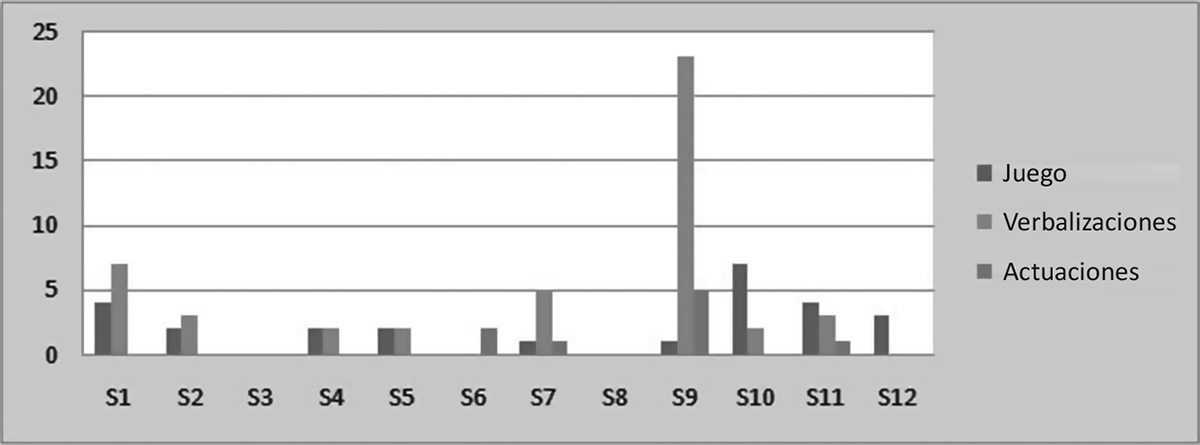
El
El
A partir de la sesión 25 (7 de la muestra), se observó un cambio en las
Asimismo, se observó una relación de
Respecto de las María: intervenciones del psicoterapeuta.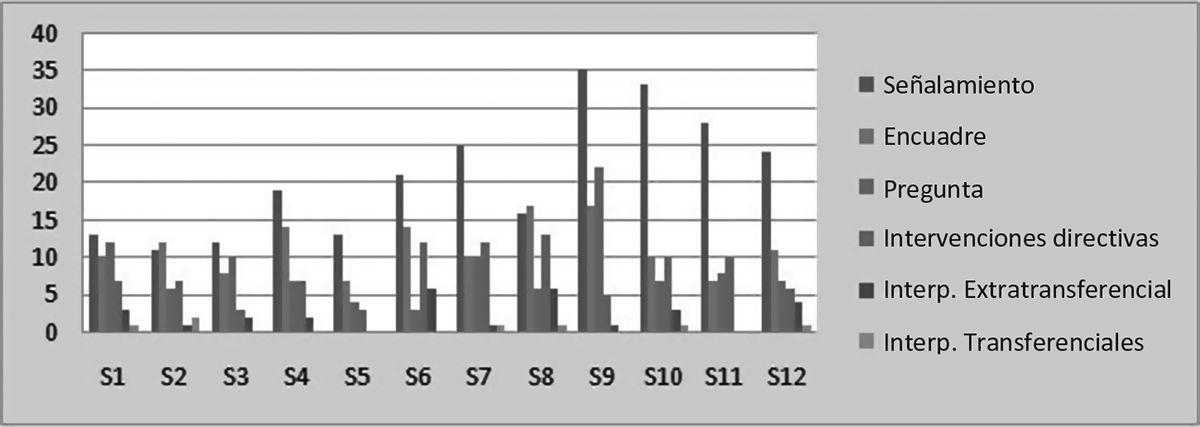
La mayoría fueron
En segundo término, se registraron
Luego las
Las
Las intervenciones exclusivamente dirigidas a María fueron
Se registró una interpretación
Resultados test y retest de Rorschach
En la primera prueba María manifestó desconcentración, cierta desorganización en su funcionamiento mental, poca tolerancia a la frustración y oposicionismo frente a la tarea. Abundaron respuestas referidas a situaciones traumáticas. Las funciones yoicas de realidad se encontraban levemente alteradas, se registraron dificultades de adaptación y el juicio de realidad evidenció fallas en la lógica del pensamiento. Se registraron 14 indicadores de riesgo suicida (Passalacqua et al., 2002).
En el retest se evidenciaron mejorías en la concentración y comprensión de las consignas, mayor control de los impulsos y tolerancia a la frustración; cambios en los mecanismos defensivos y menor oposicionismo. No hubo respuestas referidas a situaciones traumáticas. Se observaron cambios en las funciones yoicas de realidad: mayor concentración y objetividad, mejor adaptación a la realidad y disminución de las fallas en las relaciones causales registradas anteriormente. Marcado descenso de los indicadores de riesgo suicida, de 14 a 6.
CBCL
María: resultados CBCL. Pruebas administradas al inicio de la psicoterapia y a los 12 meses.
El puntaje total incluye las 35 escalas; sólo se consideran para el análisis aquéllas incluidas en los síndromes Externalizante e Internalizante por ser las que agrupan los problemas comportamentales de María. En el test inicial se observó mayor puntaje en las escalas del síndrome Internalizante (Quejas Somáticas, Ansioso-depresivo y Retraimiento), concordantes con los síntomas que presentaba la niña en el motivo de consulta.
Respecto del síndrome Externalizante (Conducta antisocial y Agresividad) se registraron muy bajos puntajes en Agresividad. El retest evidenció un marcado descenso en el puntaje total y en el síndrome Internalizante y un leve aumento en el síndrome Externalizante. Altos puntajes respecto de aspectos depresivos y ansiosos al inicio, disminuyeron sensiblemente al final del período.
A continuación, se presentan resultados del estudio de proceso correspondiente a los primeros seis meses de psicoterapia de Juana. Para el análisis de proceso en Juana se consideraron las siguientes familias de códigos:
En el primer trimestre las respuestas de Juana fueron
Los
En el inicio de la psicoterapia Juana presentó un
En cuanto a los pares, también se observó al comienzo
En cuanto a las intervenciones del psicoterapeuta, fueron mayormente
En relación con los contenidos no teóricos de las
Resultados test y retest de Rorcharch
En la primera prueba Juana manifestó buen nivel intelectual, aunque el rendimiento descendía fuertemente frente a la emergencia de sentimientos displacenteros (angustia, tensión y descontrol afectivo). Su pensamiento era coherente, autocentrado, con predominio de mecanismos de idealización y negación maníaca. Las respuestas registraron impulsividad y tendencia a delegar responsabilidades en otros. Las funciones yoicas — prueba, adaptación y juicio — descendían bruscamente ante situaciones puntuales de conflicto, con tendencia a la descarga agresiva.
El retest registró vulnerabilidad en la expresión afectiva, defensas esquizoides y situaciones traumáticas no elaboradas. Se detectó una incipiente capacidad para aceptar su necesidad de ayuda y establecer mejores vínculos. Respecto de las funciones yoicas, se observó mejoría en la adaptación a la realidad, pero el juicio de realidad presentó alteraciones para establecer relaciones causales, con tendencia a las actuaciones.
Resultados test y retest de CBCL
Los resultados del CBCL indican que Juana pudo advertir cambios favorables en su hija, expresando mayor adecuación a la realidad e incipientes posibilidades de empatía.
Discusión
Estudiar el proceso psicoterapéutico de un niño requiere considerar diferentes perspectivas: la etapa evolutiva, el contexto familiar, social y los avatares de la psicoterapia. El abordaje de la psicoterapia de un niño implica pensar una persona en proceso de desarrollo emocional (Winnicott, 1960) y contemplar las dificultades intra-psíquicas y ambientales que obstaculizan ese proceso.
El estudio de caso único presentado se focaliza en el devenir de la psicoterapia de María y el análisis de las condiciones ambientales se centra en el estudio del proceso psicoterapéutico de Juana, único adulto responsable de su familia. Se excluye en esta presentación la consideración de otras variables, tales como las condiciones socioeconómicas y la relación entre los hermanos.
Los síntomas de María surgieron luego de situaciones traumáticas familiares y comenzaron a remitir a partir del octavo mes del proceso psicoterapéutico, según informes de docentes de la niña.
El análisis de las producciones simbólicas y las modalidades de interacción de María en la psicoterapia, permiten inferir que se han producido algunos cambios. Las producciones lúdicas — indicador privilegiado de procesos simbólicos en niños según el marco referencial — manifestaron una progresión desde un reiterativo y poco desarrollado juego inicial de modelado, hacia juegos dramáticos complejos. La temática de estos últimos juegos expresó, con diferentes modalidades, las situaciones traumáticas padecidas, y se acentuaron en el segundo semestre cuando María representó activamente esas situaciones traumáticas vividas pasivamente (Freud, 1920/1975; Klein, 1927/1999a, 1932/1999b). Esta progresión en las producciones lúdicas fue acompañada por una mayor capacidad para verbalizar fantasías.
En ese último periodo María comenzó a realizar actuaciones en el interior de las sesiones, coincidiendo con una mejoría sintomática en el ámbito escolar. Surge el interrogante acerca del sentido que adquieren las actuaciones para María; si bien éstas constituyen descargas impulsivas de fantasías, su aparición podría señalar un cambio terapéutico en tanto manifestación de aspectos escindidos dentro de la psicoterapia. El establecimiento del encuadre como espacio continente o ‘pecho inodoro’ pudo haber facilitado la emergencia de actuaciones en el marco analítico, disminuyendo el riesgo de conductas disruptivas en otros ámbitos (Meltzer, 1967).
Otro aspecto a considerar es el uso del espacio: el pasaje de la restricción a la expansión fue contemporáneo con la posibilidad de María para manifestar aspectos agresivos, concordante con datos del retest del CBCL que reflejan disminución del síndrome ‘internalizante’ y aumento del ‘externalizante’.
Las interacciones con pares y con la psicoterapeuta permiten visualizar las ‘transferencias’ dentro de la psicoterapia grupal (Bion, 1965). La relación con los varones cambió del temor a la rivalidad y hostilidad; María comenzó a manifestar tendencias agresivas, posiblemente como expresión transferencial de conflictos con su padre, mediante el mecanismo de identificación con el agresor (Freud, A, 1936).
La relación con la psicoterapeuta y la otra niña del grupo reeditaron la transferencia materna, que fue mudando de la dependencia a la oposición y desafío. Estas modificaciones en la dinámica grupal, concordantes con la evolución en el juego y las manifestaciones agresivas, sugieren la posibilidad de cambio psíquico (Joseph, 1997).
Las intervenciones del psicoterapeuta estuvieron mayoritariamente dirigidas a los integrantes del grupo y no apuntaron a la dinámica grupal. La escasez de interpretaciones transferenciales y extra-transferenciales dirigidas a María podría asociarse con dificultades en el manejo de la contratransferencia. Las preguntas y señalamientos a María contribuyeron a ‘hacerla visible’ en el contexto grupal, posibilitando en el primer trimestre la disminución de ansiedad y las expresiones simbólicas.
Las pruebas de validación denotaron cambios en los vínculos interpersonales, modalidades defensivas, manejo de la impulsividad y tolerancia a la frustración. Estos cambios se corresponden — aunque parcialmente — con aquellos estudiados a través de MAPPP-N/P.
Los grupos de orientación a padres apuntan a favorecer la conexión con aspectos infantiles de los adultos, necesarios para propiciar la contención emocional y la mentalización de los niños a su cargo. Este dispositivo — implementado en forma paralela a la psicoterapia de niños — contribuye a la adherencia al tratamiento debilitando resistencias, y favorece una mayor comprensión del padecimiento del niño.
El estudio de proceso de la madre de María refleja escaso cambio terapéutico. Las verbalizaciones de Juana, predominantemente descriptivas, evidenciaban distancia emocional y escaso involucramiento en temas manifiestos propios y de pares. Frente a situaciones de violencia relatadas por integrantes del grupo, Juana no manifestaba emocionalidad ni hacía referencias a sus propios conflictos; su discurso estaba centrado en sí misma en temas superficiales, sin incluir su propia problemática ni la de su hija.
La interacción con el psicoterapeuta fue cambiando de la oposición hacia la dependencia, pero esta modificación no implicó una transformación (Bion, 1965) en los vínculos interpersonales.
Las reiteradas intervenciones acerca del encuadre, contribuyeron a la ‘recolección de la transferencia’ (Meltzer, 1967). Los señalamientos e interpretaciones extra-transferenciales pusieron de manifiesto las dificultades de Juana para atribuir significación personal a sus relatos.
Respecto de la posibilidad de contención emocional y mentalización (Fonagy, 2006) de su hija, son notorias las dificultades de Juana. Es posible que sus defensas esquizoides obstaculizaran la conexión afectiva para evitar el dolor, dado que ella misma había padecido situaciones traumáticas familiares.
La triangulación de los resultados del análisis de proceso con las pruebas de Rorschach indica que no se verificó cambio terapéutico. Es posible que el período estudiado haya resultado insuficiente para evaluar cambios en la paciente debido a la rigidez de sus mecanismos defensivos.
El dispositivo grupal resultó pertinente en tanto la interacción con pares favoreció la emergencia de conflictos; en la niña las transferencias con los pares promovieron el tratamiento de situaciones traumáticas. En Juana las transferencias con los pares y las oportunas intervenciones terapéuticas propiciaron una incipiente capacidad reflexiva al final del período.
La investigación empírica de un proceso de psicoterapia permite reflejar avances y retrocesos de los pacientes y convoca a reflexionar respecto de la modalidad de las intervenciones. En María se registraron avances y no sucedió algo similar en la psicoterapia de su madre. En niños pequeños la psicoterapia promueve y destraba más aceleradamente que en los adultos las tendencias al desarrollo (Winnicott, 1960), y la psicoterapia psicoanalítica grupal potencia esos resultados a través de las transferencias cruzadas con el psicoterapeuta y los pares (Glasserman & Sirlin, 1979).
Los estudios de caso único aportan evidencia acerca del funcionamiento de un proceso psicoterapéutico en particular, si bien sus resultados no son generalizables permiten aprender sobre ese caso en profundidad, poniendo en relieve hechos o procesos. Estos estudios no permiten comprobar hipótesis generales, pero sugieren líneas de investigación.
En el estudio que se presenta, el análisis pormenorizado de las producciones simbólicas y de las intervenciones del psicoterapeuta ha posibilitado analizar procesos de cambio terapéutico particulares en esta niña y su madre que si bien no son generalizables, conducen a posibles líneas de investigación respecto de la importancia de las transferencias cruzadas en la dinámica grupal, la incidencia de la formación del psicoterapeuta en las modalidades de intervención, el análisis de las producciones lúdicas de los niños para la construcción de indicadores de cambio terapéutico, entre otras variables.
Footnotes
This research was conducted under the 20020130100535BA project led by Ana Luzzi and accredited by the University of Buenos Aires, Argentina. / Esta investigación se ha realizado en el marco del proyecto 20020130100535BA dirigido por Ana Luzzi y acreditado por la Universidad de Buenos Aires, Argentina.
Disclosure statement
No potential conflict of interest was reported by the authors. / Los autores no han referido ningún potencial conflicto de interés en relación con este artículo.
1.
The families of codes are indicated in bold, the codes in bold and italics and their definitions in italics.
1.
Las familias de códigos se señalan en negrita, los códigos en negrita e itálica y sus definiciones en itálica.