







Abstract
Despite the fact that the Purpose in Life Test developed by James Crumbaugh and Leonard Maholick in the 1960s is considered to be one of the most commonly used measures in positive psychology, there are no validations of it into the Argentine context. This paper aims to assess the psychometric properties of PIL in a sample of 336 university students residing in Buenos Aires. The results suggest that PIL has adequate psychometric properties for the Argentine context. The confirmatory factor analysis presents a good fit of the data as proposed by the authors. These results favour the assessment of psychological well-being in this local context. Future studies should use different samples in order to provide more robust support to the construct.
Since the emergence of positive psychology at the end of the last century, studies into subjective and psychological well-being have increased both internationally and locally (Castro Solano, 2014, García-Alandete, 2015). Within this context, different studies have been carried out to adapt and validate psychological evaluation techniques developed in this area to local contexts, such as the Life Satisfaction Scale (Dimitrova & Dominguez Espinosa, 2015; Zubieta & Delfino, 2010) and the Affective Balance Scale (Simkin, Olivera, & Azzollini, 2016). However, there are few studies that attempt to explore the psychometric properties of the Purpose in Life Test, one of the most pertinent scales for the study of psychological well-being. As has been seen, the adaptation and validation of psychological evaluation instruments is germane to the development of scientific knowledge in the Ibero-American context (de la Rubia, Ramos-Basurto, & Segovia-Chávez, 2015; Velasco, Pérez, & Rivera, 2014). According to the literature, the adaptation of an existing technique to the local context can be more beneficial than the construction of a new technique, as researchers can compare the results of their work with those reported by other studies using the same scale in different cultural contexts (Borsa, Damásio, & Bandeira, 2012). Thus, the validation and adaptation of the Purpose in Life Test to the local context serves to both make this instrument available for use in Argentina and compare local findings with those reported in other cultures. For this reason, the purpose of this study is to adapt and validate this technique to the Argentine context. To that end, we will analyse evidence of construct validity based on confirmatory factor analysis (CFA) and the reliability or internal consistency of the data using Cronbach’s Alpha. It is hoped that the result of these analyses will contribute to an Argentine version of the instrument, with validated psychometric properties that can be used in the Argentine context (Yela, 1996).
Structural model of the purpose in life test. Modelo estructural del Test de Propósito en la Vida.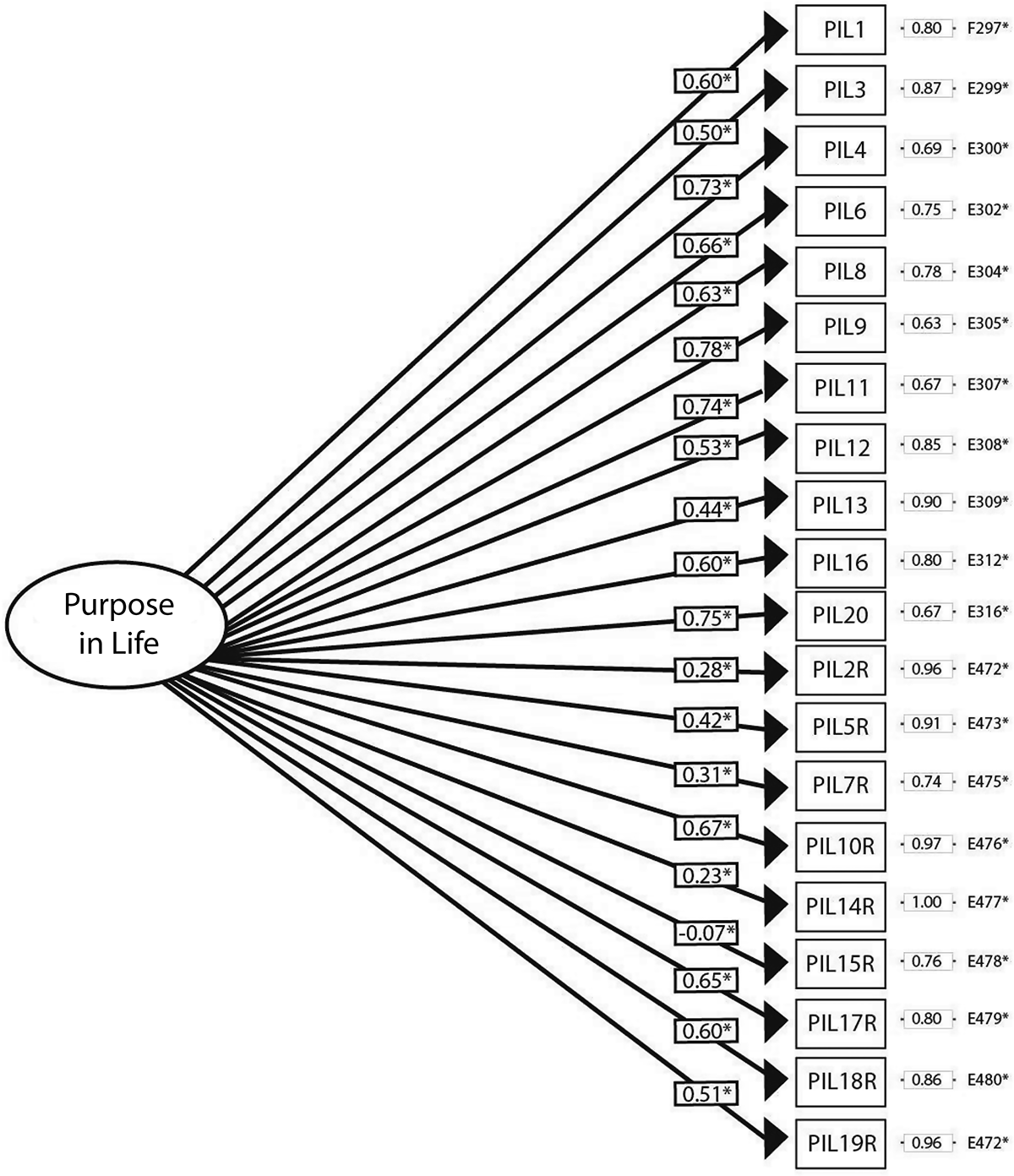
Purpose in life: towards a conceptual definition
At present, the different publications that have studied psychological well-being have focused on different aspects of the construct (Barrera Guzmán & Flores Galaz, 2015; Castro Solano, 2011; Steger, 2009). In this sense, Ryff (1989) proposes a multidimensional model comprising six factors: (1) self-acceptance, defined as the assessment a person has towards themselves; (2) positive relationships with others, the ability a person has to establish contact and intimacy with, and perceive love from, others; (3) autonomy, a person’s ability to think independently and maintain convictions even if they are irreconcilable with dogmas or social mandates; (4) environmental mastery, which combines the skills of creating and maintaining a beneficial environment for the person; (5) personal growth, a person’s ability to realize their own potential and talent and develop new resources; and (6) purpose in life, a person’s ability to find meaning in their experiences as well as set meaningful goals for their lives.
Of the six aspects of the construct, purpose in life is the one that has attracted the greater interest of researchers in the area of positive psychology (Lopez & Snyder, 2003; Snyder & Lopez, 2009). Numerous philosophers, including French existentialists such as Sartre and Camus, consider that life does not have a single predetermined meaning, but is constructed by individuals themselves throughout their life (Fabry, 1988; Yalom, 1980). Thus, a purpose in life has been considered a means of making sense out of chaos (Korotkov, 1998), an individual’s ultimate goal (Damon, 2008; Emmons, 2005) or a stable and generalized intention to achieve something that is both meaningful for oneself and for the world beyond the self (Damon, Menon, & Cotton Bronk, 2003). In particular, Frankl (1984) has defined purpose as an inner force, man’s responsibility for his existence, the very reason for his existence or the specific meaning of a person’s life at any given time. On the other hand, Crumbaugh and Maholick (1964) define it as the ontological meaning of life from the perspective of the individual’s life experience. In other words, purpose refers to a subjective sense of one’s own life as meaningful (Bronk, 2011, 2014; Crumbaugh & Henrion, 2001). According to Cotton Bronk (2014), three central components of the definition of purpose, which underlie various conceptualizations, have been identified: (1) commitment, referring to the ability to develop a stable link to certain beliefs, values and orientations, giving a coherent and unified sense of the self; (2) goal orientation, which refers to the perception that current activities are related to future outcomes; and (3) personal meaning, defined as the extent or degree of ubiquity of purpose in an individual’s life and its impact on their behaviour, thoughts and emotions.
Assessment of purpose in life
Although qualitative approaches have been recorded for the study of purpose in life (McAdams, 2008) in different contexts such as Australia (Browne-Yung, Walker, & Luszcz, 2015), China (Ma & Zi, 2015) and Canada (Alisat & Pratt, 2012; Soucie, Lawford, & Pratt, 2012), the vast majority of papers are inclined to a quantitative evaluation (Cotton Bronk, 2014). The emphasis on this type of approach is characteristic of what has been called ‘mainstream psychology’, because it seems to substantiate and legitimize the scientificity of research (Talak, 2014).
Currently, different instruments for the evaluation of purpose are used, the most popular of which include: the Life Purpose Questionnaire (LPQ; Hutzell, 1989) — mainly used in the United States (Campbell, 2012; Cotton Bronk, 2014; Hutzell, 1989); the Seeking of Noetic Goals Test (SONG, Crumbaugh, 1977) — administered both in the United States (Schulenberg, Baczwaski, & Buchanan, 2014; Yarnell, 1972) and Italy (Brunelli et al., 2012); and the Life Attitude Profile (LAP; Reker & Peacock, 1981), adapted to different contexts such as Germany (Mehnert & Koch, 2008), Canada (Peacock & Reker, 1982; Reker & Peacock, 1981), China (Ho, 1990), Greece (Anagnostopoulos, Slater, Fitzsimmons, & Kolokotroni, 2011) and Turkey (Erci, 2008; Erci & Özdemir, 2013). However, one of the most widely accepted instruments in the literature is the Purpose in Life Test (PIL; Crumbaugh & Maholick, 1964).
The first version of this technique was designed by Viktor Frankl (1966), who developed a questionnaire comprising a set of 13 items, constructed to evaluate the degree of purpose in a clinical population. Although Frankl originally used his tool in the context of clinical assessment and not for research purposes (Cotton Bronk, 2014), Crumbaugh and Maholick (1964) subsequently administered the Frankl questionnaire in a group of psychiatric adult patients and in the general population. However, they found that the reliability and validity of the tool were not entirely satisfactory, so with the collaboration of Frankl, Crumbaugh and Maholick (1964) developed a new version of the technique.
Different versions of the instrument created by Crumbaugh and Maholick (1964) have been used in different contexts such as Australia (Dyck, 1987; Marsh, Smith, Piek, & Saunders, 2003), Colombia (Martínez Ortiz, Trujillo Cano, & Trujillo, 2012), China (Chang & Dodder, 1983; Law, 2012; Shek, 1993), Korea (Kim, Jung, Ko, & Song, 2001), Spain (García Alandete, Martínez, & Nohales, 2013), the United States (Bonebright, Clay, & Ankenmann, 2000; Durant, Getts, Cadenhead, Emans, & Woods, 1995; Jackson & Coursey, 1988; Schulenberg & Melton, 2010), Italy (Brunelli et al., 2012), Hungary (Konkolÿ Thege & Martos, 2006), Japan (Okado, 1998), Norway (Haugan & Moksnes, 2013) and Sweden (Jonsén et al., 2010), both for adolescents (Marsh et al., 2003) and older patients (Gerwood, LeBlanc, & Piazza, 1998; Pinquart, 2002). The results of these studies have reported adequate psychometric properties in regard to internal consistency (α > .70), and according to the literature, in the majority of confirmatory studies the values of the adjustment indexes reached expected figures (Hair, Anderson, Tatham, & Black, 2010; Kline, 2010).
There are two types of considerations that have been published in different studies regarding the psychometric properties of the scale. The first is that certain items should be eliminated because of their irrelevance in certain cultural contexts. For example, Marsh et al. (2003) believe that items 7, 14 and 15 of the original PIL scale should be removed because in their context they seem to not contribute to the total scale. According to their study, items 7 and 15 were excluded when considering the one-dimensional scale, because they did not seem to be relevant to the other items. Item 14 was excluded because it differed from the other items in its wording, since the response it seeks to elicit is what people would do in general, instead of referring to the behaviour of a particular individual, which, according to the authors, can lead to dissimilar responses. Meanwhile, Law (2012) thought that only seven items were relevant for the evaluation of the existential facet of the construct. Thus, this author developed the Existential Scale of the Purpose in Life Questionnaire (EPIL) to evaluate purpose in life during early adolescence.
The second focuses on the dimensionality of the scale. While some studies have recommended evaluating purpose as a one-dimensional concept (Marsh et al., 2003), others have argued that it should be considered multifaceted (Martínez Ortiz et al., 2012; Morgan & Farsides, 2009a; Shek, 1993; Yalom, 1980). And in addition to this, there is some debate about how many and which dimensions to consider. Thus, Shek (1988) argues that purpose consists of five dimensions: beliefs linked to quality of life, goals, death, life choices and retirement. Yet other teams of researchers believe that the scale has only two factors, although they do not agree on how to name them. Different authors have suggested that these factors evaluate an affective dimension and a cognitive dimension (Dufton & Perlman, 1986), an exciting life and purposeful life (Dufton & Perlman, 1986; Morgan & Farsides, 2009b), despair and enthusiasm (Walters & Klein, 1980) or vital purpose and existential coherence (Martínez Ortiz et al., 2012). However, one of the main difficulties of the multidimensional models is the need for theoretical support of these proposed new dimensions (DeVellis, 2012; Martinez-Arias, Hernández-Lloreda, & Hernández-Lloreda, 2006), thus in the case of PIL, the one-dimensional model would still retain greater consensus in the literature (Marsh et al., 2003).
A shortened version of this scale was recently proposed, the Purpose in Life Short-Form (PIL-SF; Schulenberg, Schnetzer, & Buchanan, 2011), which contains only the four items that have given the best results, focused mainly on the identification of objectives.
Method
Participants
The sample was intentional and comprised 336 university students living in Buenos Aires, Argentina, aged between 19 and 55 (M = 25.16; SD = 6.08), and included both males and females (male = 43.1%; female = 56.9%).
Instruments
Purpose in life Test
The Purpose in Life Test (PIL; Crumbaugh & Maholick, 1964) used for this study evaluates the meaning of life by asking a set of 20 questions that are answered on a Likert-type scale with seven response anchors according to the participants’ degree of agreement. In order to accurately adapt the scale to Spanish, the standard international methods recommend by the International Test Commission (ITC) for the validation of psychological assessment techniques in different contexts (Muñiz, Elosua, & Hambleton, 2013; Muñiz & Hambleton, 2000) were strictly adhered to. Following these criteria, the items were not translated literally; they were translated such that the psychological sense of each one was maintained.
Procedure
A back-translation of the original scale developed by Crumbaugh and Maholick (1964) was carried out for the adaptation and validation of the Purpose in Life Test, in which three independent translators collaborated following the recommendations proposed by the literature (Hambleton & Patsula, 1999; Muñiz et al., 2013). After the back-translation process was completed, approval from the University’s Ethics Committee was requested. Subsequently, the questionnaire was administered in a sample of university students from the Autonomous City of Buenos Aires. After requesting their consent, the subjects participated in the study voluntarily in the knowledge that the data derived from this research would only be used for scientific purposes in accordance with National Law 25.326 on the protection of personal data. The researchers were present while participants were administered the PIL test during class time — approximately 40 minutes — authorized by the professors. Once completed, the tests were handed in to the researchers in a sealed envelope, thus respecting the anonymity of the participants.
Data analysis
Statistical analyses of the data was performed using the SPSS 22 and EQS 6.1 programs. The reliability of PIL was analysed from an internal consistency analysis using Cronbach’s Alpha. Following that, the construct validity was evaluated from a confirmatory factorial analysis (CFA), using the AGLS (Arbitrary Generalized Least Squares) method, as recommended by the literature (Schermelleh-Engel, Moosbrugger, & Müller, 2003). The model was subsequently evaluated using the χ2 goodness of fit indexes, IFI (Incremental Fit Index), NNFI (Non-Normed Fit Index), CFI (Comparative Fit Index) and RMSEA (Root Mean Square Error of Approximation), following recommendations in the specialized literature (Freiberg Hoffmann, Stover, de la Iglesia, & Fernández Liporace, 2013; Holgado-Tello, Chacón-Moscoso, Barbero-García, & Vila-Abad, 2009; Schumacker & Lomax, 2004).
Results
Descriptive analysis of each Purpose in Life Test item.
As reported in Table 1, the descriptive statistics of the 20 items were adequate for analysis (Hair et al., 2010). The item-total correlations allowed us to observe that the different items of the PIL test contributed to the total scale (.14 < r < .69).
Confirmatory Factor Analysis of the PIL scale.
Note: *one-dimensional model
The CFA verified that the proposed one-dimensional model fits the data collected in the field (Kline, 2005, 2010). In addition, it was observed that the IFI, NNFI and IFC adjustment indexes reached optimal values above .90, and RMSEA was below .08 points, which are considered cut-off points to identify a good fit (Kline, 2005; Schumacker & Lomax, 2004).
According to the results of the CFA, the model of the Purpose in Life Test is presented in Figure 1.
As shown in the figure, the estimated standardized parameters were significant (p < .05) (Jackson, Gillaspy, & Purc-Stephenson, 2009). However, it should be noted that 16 of the items do not reach optimal values (r > .70) (Kline, 2005).
Discussion
The adaptation of the Purpose in Life Test (PIL; Crumbaugh & Maholick, 1964) showed suitable psychometric properties for administration in the local context. The 20 items of the Argentine version are similar to the original ones. In addition, all the items correlated with the full scale adequately in most cases. There was some inconsistency in some of the items proposed, consistent with the literature (Marsh et al., 2003), mainly in items 7, 14 and 15 (e.g., ‘With regard to death, I am: prepared and unafraid — unprepared and frightened’; ‘Concerning freedom to choose, I believe humans are: totally free to make all life choices — completely bound by limitations of heredity and environment’; ‘After retiring, I would: do some of the exciting things I’ve always wanted to — loaf completely the rest of my life’). As observed, although the standardized parameters of these items were significant (p < .05) (Jackson et al., 2009), their values are far from reaching optimal values (r > .70) (Kline, 2005). It could be hypothesized, based on its history, that items 7 and 14 are considered to be ‘irrelevant’ to the individual’s life, possibly because both samples comprised mostly young adults. Although Marsh et al. (2003) decided to eliminate them, they were maintained in this study because of the theoretical pertinence given to them by the original authors. In addition, the CFA verified that the PIL presented an adequate adjustment to the data obtained in the sample, as occurred in other contexts. In this sense, and as indicated, the IFI, NNFI and IFC indexes reached values above .90, and RMSEA below .08, figures that allowed us to identify a good fit (Schreiber, Nora, Stage, Barlow, & King, 2006).
Regarding the factorial structure of the scale, the one-dimensionality hypothesis is supported as there was no agreement on which dimensions would comprise PIL, since the proposed dimensions still lack theoretical strength. However, the possibility that future studies may consider reviewing the dimensionality of the scale is not ruled out.
Regarding the limitations of the sample, it should be noted that this study has used university students who are studying subjects within a similar field. Because of this, future studies should employ different populations, include students studying different fields, explore psychometric properties in the general population and extend the ages of participants. Similarly, the importance of having a wide range of assessment instruments that can be used locally on a global level must also be emphasized.
Although quantitative approaches are extremely relevant to the investigation of psychological phenomena, designs that include qualitative techniques also contribute significantly to research (Talak, 2014), such that future lines of study could consider complementing findings obtained from the application of this technique with explorations of purpose from a qualitative perspective (Cotton Bronk, 2014; McAdams, 2008).
Finally, we must emphasize that having access to instruments which are validated in a local context to measure purpose in life can contribute to furthering studies into psychological well-being. As we have seen, these studies could favour decision-making in the design of public policies that are aimed at strengthening the well-being of the general population (Diener, 2013; Diener, Oishi, & Lucas, 2015).
Validación argentina del Test de Propósito en la Vida
A partir del surgimiento de la psicología positiva a finales del siglo pasado, los estudios relativos al bienestar subjetivo y psicológico se han incrementado tanto a nivel internacional como en el contexto local (Castro Solano, 2014; García-Alandete, 2015). En este marco, se han registrado diferentes estudios que se proponen adaptar y validar técnicas de evaluación psicológica desarrolladas en el área, como es el caso de la Escala de Satisfacción con la Vida (Dimitrova & Dominguez Espinosa, 2015; Zubieta & Delfino, 2010) o la Escala de Balance Afectivo (Simkin, Olivera, & Azzollini, 2016). Sin embargo, resultan escasos los trabajos que se proponen explorar las propiedades psicométricas del Test de Propósito en la Vida, una de las escalas de mayor relevancia en el área del estudio del bienestar psicológico. Tal como se ha observado, la adaptación y validación de instrumentos de evaluación psicológica resulta de amplia relevancia para el desa-rrollo del conocimiento científico en el contexto iberolatinoamericano (de la Rubia, Ramos-Basurto, & Segovia-Chávez, 2015; Velasco, Pérez, & Rivera, 2014). De acuerdo con la literatura, la adaptación de una técnica puede suponer una ventaja por sobre la construcción de una técnica nueva, debido a que los investigadores pueden comparar los resultados de sus trabajos con los reportados por otros estudios que empleen la misma escala en contextos culturales diversos (Borsa, Damásio, & Bandeira, 2012). De esta manera, la validación y adaptación del Test de Propósito en la Vida al contexto local ofrece la posibilidad de explorar dicho fenómeno en Argentina como así también comparar los hallazgos locales con aquellos reportados en otros contextos. Por este motivo, el presente trabajo tiene por objetivo adaptar y validar dicha técnica al contexto argentino. A tal fin, se analizarán evidencias de validez de constructo a partir del análisis factorial confirmatorio (en adelante, AFC) y la confiabilidad o consistencia interna mediante el estadístico alpha de Cronbach. Como resultado de estos análisis se espera poder contribuir a una versión argentina del instrumento con propiedades psicométricas aceptables para su administración en el contexto argentino (Yela, 1996).
Propósito en la vida: hacia una definición conceptual
En la actualidad, los distintos trabajos que se han ocupado del estudio del bienestar psicológico se han centrado en diferentes aspectos del constructo (Barrera Guzmán & Flores Galaz, 2015; Castro Solano, 2011; Steger, 2009). En este sentido, Ryff (1989) propone un modelo multidimensional compuesto por seis factores: (1) la autoaceptación, definida como la valoración que una persona tiene de sí misma; (2) las relaciones positivas con los demás, que suponen la capacidad de establecer contacto, intimidad y percibir amor de parte de otras personas; (3) la autonomía, que refiere a la capacidad de una persona para pensar de manera independiente y sostener esas convicciones incluso aunque resulten inconciliables con dogmas o mandatos sociales; (4) el dominio del medio ambiente, que reúne las habilidades de crear y mantener un entorno beneficioso para la persona; (5) el crecimiento personal, que se refiere a la capacidad de una persona para realizar su propio potencial y talento y desarrollar nuevos recursos; y (6) el propósito en la vida, que remite a la capacidad de una persona para encontrar un sentido en sus experiencias, así como de establecer metas significativas para su vida.
En particular, de los seis aspectos del constructo, el propósito en la vida es uno de los que ha concentrado un mayor interés en los investigadores en el área de la psicología positiva (Lopez & Snyder, 2003; Snyder & Lopez, 2009). Numerosos filósofos, entre los que se destacan existencialistas franceses como Sartre y Camus, consideran que la vida no tiene un único sentido predeterminado, sino que este es construido por las personas a lo largo del ciclo vital (Fabry, 1988; Yalom, 1980). De esta manera, el propósito en la vida ha sido considerado como un medio de dar sentido a partir del caos (Korotkov, 1998), como el fin último de un individuo (Damon, 2008; Emmons, 2005), o como una intención estable y generalizada de lograr algo que es a la vez significativo para uno mismo y para el mundo más allá del self (Damon, Menon, & Cotton Bronk, 2003). En particular, Frankl (1984) ha definido el propósito como una fuerza interior, la responsabilidad que el hombre tiene de su existencia, el porqué de la propia existencia o el significado específico de la vida de una persona en un momento dado. Por su parte, Crumbaugh y Maholick (1964) lo definen como el significado ontológico de la vida desde el punto de vista de la vivencia individual. En otras palabras, el propósito se refiere a una sensación subjetiva de la propia vida como llena de sentido (Bronk, 2011, 2014; Crumbaugh & Henrion, 2001). De acuerdo con Cotton Bronk (2014), usualmente se han identificado tres componentes centrales de la definición de propósito que subyacen a las diversas conceptualizaciones: (1) el compromiso, que refiere a la capacidad de desarrollar un vínculo estable a ciertas creencias, valores y orientaciones, otorgando un sentido coherente y unificado del self; (2) la orientación a la meta, que remite a la percepción de que las actividades actuales se relacionan con los resultados futuros; y (3) el sentido personal, que se define como el alcance o el grado de ubicuidad del propósito en la vida de una persona y su impacto en su comportamiento, sus pensamientos y sus emociones.
Evaluación del propósito en la vida
Si bien se han registrado enfoques cualitativos para el estudio del propósito en la vida (McAdams, 2008) en diferentes contextos como Australia (Browne-Yung, Walker, & Luszcz, 2015), China (Ma & Zi, 2015) o Canadá (Alisat & Pratt, 2012; Soucie, Lawford, & Pratt, 2012), la amplia mayoría de los trabajos se inclinan por una evaluación de tipo cuantitativa (Cotton Bronk, 2014). El énfasis en este tipo de abordaje resulta característico de lo que se ha llamado la corriente principal o mainstream psychology debido a que parece fundamentar y legitimar la cientificidad de las investigaciones (Talak, 2014).
En la actualidad se han identificado diferentes instrumentos para la evaluación del propósito entre las que se destacan el Cuestionario de Propósito en la Vida o Life Purpose Questionnaire (LPQ; Hutzell, 1989), principalmente empleado en Estados Unidos (Campbell, 2012; Cotton Bronk, 2014; Hutzell, 1989), el Test de Búsqueda de Metas Noéticas o Seeking of Noetic Goals Test (SONG; Crumbaugh, 1977), administrado tanto en Estados Unidos (Schulenberg, Baczwaski, & Buchanan, 2014; Yarnell, 1972) como en Italia (Brunelli et al., 2012) y el Perfil de Actitud hacia la Vida o Life Attitude Profile (LAP; Reker & Peacock, 1981), adaptado a diferentes contextos como Alemania (Mehnert & Koch, 2008), Canadá (Peacock & Reker, 1982; Reker & Peacock, 1981), China (Ho, 1990), Grecia (Anagnostopoulos, Slater, Fitzsimmons, & Kolokotroni, 2011) o Turquía (Erci, 2008; Erci & Özdemir, 2013). Sin embargo, uno de los instrumentos de mayor aceptación en la literatura especializada es el Test de Propósito en la vida o Purpose in Life Test (PIL; Crumbaugh & Maholick, 1964).
La primera versión de la técnica es diseñada por Viktor Frankl (1966), quien desarrolla un cuestionario que consiste en un conjunto de 13 ítems, construido para evaluar el grado de propósito en población clínica. Si bien originalmente Frankl emplea su medida en el contexto de la clínica y no con fines de investigación (Cotton Bronk, 2014), posteriormente Crumbaugh y Maholick (1964) administran el cuestionario de Frankl en un grupo de adultos psiquiátricos y en población general. Sin embargo, dado que la fiabilidad y la validez de la medida no resultan del todo satisfactorias, con la colaboración de Frankl, Crumbaugh y Maholick (1964) desa-rrollan una nueva versión de la técnica.
Diferentes versiones del instrumento conformado por Crumbaugh y Maholick (1964) han sido empleadas en distintos contextos como Australia (Dyck, 1987; Marsh, Smith, Piek, & Saunders, 2003), Colombia (Martínez Ortiz, Trujillo Cano, & Trujillo, 2012), China (Chang & Dodder, 1983; Law, 2012; Shek, 1993), Corea (Kim, Jung, Ko, & Song, 2001), España (García Alandete, Martínez, & Nohales, 2013), Estados Unidos (Bonebright, Clay, & Ankenmann, 2000; Durant, Getts, Cadenhead, Emans, & Woods, 1995; Jackson & Coursey, 1988; Schulenberg & Melton, 2010), Italia (Brunelli et al., 2012), Hungría (Konkolÿ Thege & Martos, 2006), Japón (Okado, 1998), Noruega (Haugan & Moksnes, 2013), o Suecia (Jonsén et al., 2010), tanto en adolescentes (Durant et al., 1995), como adultos (Marsh et al., 2003) y adultos mayores (Gerwood, LeBlanc, & Piazza, 1998; Pinquart, 2002). Los resultados de estos estudios han reportado propiedades psicométricas adecuadas en relación a la consistencia interna (α > . 70) a la vez que en la mayoría de los estudios confirmatorios los valores de los índices de ajuste alcanzaron los guarismos esperados, de acuerdo con la literatura (Hair, Anderson, Tatham, & Black, 2010; Kline, 2010).
Puntualmente se registran dos tipos de consideraciones que los distintos autores han realizado en relación a las propiedades psicométricas de la escala. Por un lado, diferentes estudios concluyeron la necesidad de suprimir ciertos ítems debido a la escasa relevancia que presentan en algunos contextos culturales. Por ejemplo, Marsh et al. (2003) consideran la eliminación de tres de los ítems de la escala PIL original, específicamente el 7, el 14 y 15, debido a que en su contexto parecen no aportar a la escala total. De acuerdo con el estudio los ítems 7 y 15 se excluyeron al considerar la escala unidimensional, debido a que no parecían tener relación a los otros ítems. El Ítem 14 se excluyó por diferir de los demás Ítems en su redacción, ya que dirige a responder en relación a lo que la gente en general haría, en lugar de remitir al comportamiento del individuo en particular, lo que según los autores, puede conducir a respuestas disímiles. Por su parte, Law (2012) decide considerar solo siete ítems para la evaluación de la faceta existencial del constructo. Así desarrolla la Existential Scale of the Purpose in Life Questionnaire (EPIL) orientada a la evaluación del propósito en la vida en la adolescencia temprana.
Por otro lado, se discute acerca de la dimensionalidad de la escala. Mientras que algunos estudios han recomendado evaluar el propósito de manera unidimensional (Marsh et al., 2003) otros han argumentado que debe considerarse de manera multidimensional (Martínez Ortiz et al., 2012; Morgan & Farsides, 2009a; Shek, 1993; Yalom, 1980). Sin embargo, existe cierto debate respecto de cuántas y cuáles son las dimensiones a considerar. Así, Shek (1988) sostiene que el propósito consiste en cinco dimensiones, incluyendo creencias vinculadas a la calidad de vida, las metas, la muerte, las elecciones de vida y la jubilación. Por su parte, diferentes equipos de investigadores concluyen que la escala presenta dos factores, aunque no existe acuerdo en relación a cómo denominarlos. Distintos autores han propuesto que estos factores evalúan una dimensión afectiva y una dimensión cognitiva (Dufton & Perlman, 1986), una vida emocionante y una vida con propósito (Dufton & Perlman, 1986; Morgan & Farsides, 2009b), la deses-peranza y el entusiasmo (Walters & Klein, 1980) o el propósito vital y la coherencia existencial (Martínez Ortiz et al., 2012). Sin embargo, uno de los principales dificultades de los modelos multidimensionales radica en la necesidad de contar con apoyo teórico para las nuevas dimensiones propuestas (DeVellis, 2012; Martinez-Arias, Hernández-Lloreda, & Hernández-Lloreda, 2006), por lo que en el caso de la PIL el modelo unidimensional aún conservaría mayor consenso en la literatura (Marsh et al., 2003).
Recientemente se ha propuesto una versión reducida - el propósito en la vida forma corta o Purpose in Life Test-Short Form (PIL-SF; Schulenberg, Schnetzer, & Buchanan, 2011) - que incluye cuatro de los artículos de la PIL que dieron mejores resultados en la identificación de objetivos
Método
Participantes
La muestra empleada fue de tipo intencional y fue integrada por 336 estudiantes universitarios residentes en Buenos Aires, Argentina, con edades que oscilan entre los 19 y los 55 años (M = 25.16; DE = 6.08), de ambos sexos (hombres = 43.1%; mujeres = 56.9%).
Instrumentos
Test de Propósito en la Vida
Para el presente estudio se emplea el Test de Propósito en la Vida o Purpose in Life Test (PIL; Crumbaugh & Maholick, 1964), el cual evalúa el sentido de la vida a partir de un conjunto de 20 ítems que se responden en una escala tipo Likert con siete anclajes en función del grado de acuerdo de los participantes. Para la adaptación al español se siguieron los estándares metodológicos internacionales sugeridos por la International Test Commission (ITC) para la validación de técnicas de evaluación psicológica en diferentes contextos (Muñiz, Elosua, & Hambleton, 2013; Muñiz & Hambleton, 2000). Siguiendo estos criterios, los ítems no fueron traducidos de manera literal, sino que se procuró respetar el sentido psicológico de cada uno.
Procedimiento
Para la adaptación y validación del Test de Propósito en la Vida se llevó a cabo una retrotraducción de la escala original desarrollada por Crumbaugh y Maholick (1964), en la que colaboraron tres traductores independientes, siguiendo las recomendaciones propuestas por la literatura (Hambleton & Patsula, 1999; Muñiz et al., 2013). Luego de finalizado el proceso de retrotraducción, se solicitó la aprobación del Comité de Ética de la universidad. Posteriormente, se procedió a administrar el cuestionario en una muestra compuesta por estudiantes universitarios de la Ciudad Autónoma de Buenos Aires. Luego de solicitar su consentimiento, los sujetos participaron en el estudio de forma voluntaria en conocimiento de que los datos derivados de esta investigación se utilizarían con fines exclusivamente científicos de acuerdo con la Ley Nacional 25.326 de protección de los datos personales. Los investigadores estuvieron en presencia de los participantes durante la administración del PIL a lo largo del tiempo de clase cedido por los docentes — aproximadamente 40 minutos. Una vez completados, estos fueron entregados a los investigadores en un sobre cerrado, respetando el anonimato de los participantes.
Análisis de datos
Los análisis estadísticos de los datos fueron realizados utilizando los programas SPSS 22 y EQS 6.1. Se analizó la confiabilidad de la técnica a partir del análisis de consistencia interna, empleando el estadístico Alpha de Cronbach. Posteriormente, se evaluó la validez de constructo a partir de un análisis factorial confirmatorio (en adelante, AFC), empleando el método AGLS (Arbitrary Generalized Least Squares), tal como recomienda la literatura (Schermelleh-Engel, Moosbrugger, & Müller, 2003). El modelo fue posteriormente evaluado a partir de los índices de bondad de ajuste χ2, IFI (Incremental Fit Index), NNFI (Non-Normed Fit Index), CFI (Comparative fit index) y RMSEA (Root Mean Square Error of Approximation), siguiendo recomendaciones previas de la literatura especializada (Freiberg Hoffmann, Stover, de la Iglesia, & Fernández Liporace, 2013; Holgado-Tello, Chacón-Moscoso, Barbero-García, & Vila-Abad, 2009; Schumacker & Lomax, 2004).
Resultados
Análisis descriptivo de los ítems del Test de Propósito en la Vida.
Tal como se informa en la Tabla 1, los estadísticos descriptivos de los 20 ítems son adecuados para su análisis (Hair et al., 2010). Las correlaciones ítem-total permiten observar que los diferentes ítems de la PIL aportan a la escala total (.14 < r < .69).
Análisis Factorial Confirmatorio de la escala PIL.
Nota: *modelo unidimensional
El AFC contribuye a comprobar que el modelo unidimensional propuesto se ajusta a los datos recabados en campo (Kline, 2005, 2010). Además, se observa que los índices de ajuste IFI, NNFI y CFI alcanzaron valores óptimos, superiores a .90 y RMSEA inferior a punto 0.08, guarismos que se consideran puntos de corte para identificar un buen ajuste (Kline, 2005; Schumacker & Lomax, 2004).
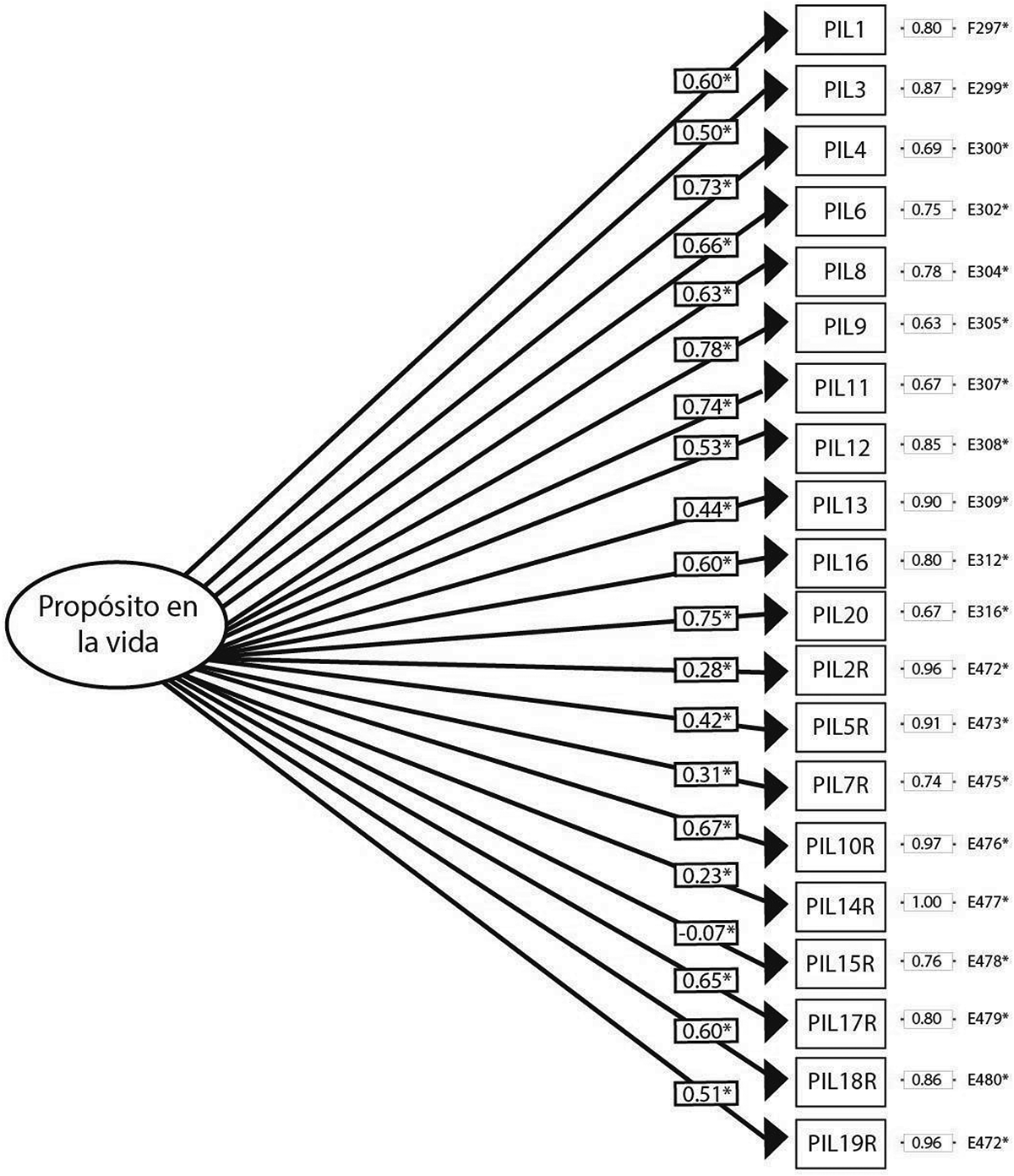
De acuerdo con los resultados del AFC, en la Figura 1 se presenta el modelo del Test de Propósito en la Vida.
Tal como se observa en la figura, los parámetros estimados estandarizados resultaron significativos (p < .05) (Jackson, Gillaspy, & Purc-Stephenson, 2009). Sin embargo, cabe señalar que 16 de los ítems no alcanzan valores óptimos (r > .70) (Kline, 2005).
Discusión
La adaptación del Test de Propósito en la Vida (PIL; Crumbaugh & Maholick, 1964) ha demostrado propiedades psicométricas adecuadas para su administración en el contexto local. Los 20 ítems de la versión argentina resultan similares a los originales. Además, las correlaciones de todos los ítems con la escala total fueron adecuadas en la mayoría de los casos. Se observa en consonancia con la literatura (Marsh et al., 2003) cierta inconsistencia en algunos de los ítems propuestos, fundamentalmente en el 7, el 14 y el 15 (e.g., ‘En cuanto a la muerte: Estoy preparado/a y no tengo miedo — No estoy preparado/a y tengo miedo’; ‘En cuanto a la libertad del ser humano para tomar sus propias decisiones, creo que el ser humano es: Totalmente libre para elegir — Completamente limitado por su herencia y ambiente’; ‘Después de jubilarme, me gustaría: Hacer algunas cosas que me han interesado — Vaguear el resto de mi vida’). Tal como se ha observado, si bien los parámetros estimados estandarizados de estos ítems resultaron significativos (p < 0.05) (Jackson et al., 2009) sus valores se encuentran lejos de alcanzar valores óptimos (r > .70) (Kline, 2005). Podría hipotetizarse, en base a los antecedentes, que los ítems 7 y 14 son considerados como ‘ajenos’ a la vida del sujeto, posiblemente porque ambas muestras se componen, en su mayoría por adultos jóvenes. Aunque Marsh et al. (2003) decidieran eliminarlos, en el presente estudio se ha optado por conservarlos en atención a la pertinencia teórica sugerida por los autores originales. Además, el AFC permite comprobar que la PIL presenta un ajuste adecuado a los datos obtenidos en la muestra, al igual que ocurre con otros contextos. En este sentido, como se ha señalado, los índices IFI, NNFI y CFI han alcanzado valores superiores a .90 y RMSEA por debajo de .08, guarismos que permiten identificar un buen ajuste (Schreiber, Nora, Stage, Barlow, & King, 2006).
En cuanto a la estructura factorial de la escala, se apoya la hipótesis de la unidimensionalidad, debido a que no se ha conseguido aún acuerdo acerca de cuáles serían las dimensiones que componen el constructo, y a que las dimensiones propuestas aún carecen de fortaleza teórica. Sin embargo, no se descarta la posibilidad de que futuros estudios puedan considerar revisar la dimensionalidad de la escala.
En relación a las limitaciones muestrales, debe considerarse que el presente trabajo emplea población de estudiantes universitarios en carreras limitadas. Debido a esto, futuros estudios deberían emplear poblaciones diferentes, incluir estudiantes de otras carreras, explorar las propiedades psicométricas en población general o ampliar las edades de los participantes. A la vez, se destaca la importancia de contar con baremación de instrumentos de amplia utilización a nivel mundial de forma local.
Por otra parte, si bien los abordajes cuantitativos resultan de amplia relevancia para la indagación de los fenómenos psicológicos, los diseños que incluyen técnicas cualitativas también constituyen un aporte central en investigación (Talak, 2014), por lo que próximas líneas podrían considerar complementar los hallazgos obtenidos de la aplicación de la presente técnica a partir de explorar el fenómeno del propósito desde una perspectiva cualitativa (Cotton Bronk, 2014; McAdams, 2008).
Finalmente, cabe destacar que contar con instrumentos validados al contexto local para medir el propósito en la vida podría contribuir a incrementar los estudios relativos al bienestar psicológico. Como se ha observado, estos estudios podrían favorecer la toma de decisiones en cuanto al diseño de políticas públicas orientadas a fortalecer el bienestar de la población general (Diener, 2013; Diener, Oishi, & Lucas, 2015).
Footnotes
Acknowledgements / Agradecimientos
This work is part of the research projects UBACyT 20020150200259AB and 20020150100232BA, and projects PICT-2014-3432 and PICT-2016-4147 accredited by the University of Buenos Aires (UBA) and the National Agency for Scientific and Technological Promotion (ANPCyT). / Este trabajo se enmarca en los proyectos de investigación UBACyT 20020150200259AB, 20020150100232BA y los proyectos PICT-2014-3432 y PICT-2016-4147 acreditados por la Universidad de Buenos Aires (UBA) y la Agencia Nacional de Promoción Científica y Tecnológica (ANPCyT).
Disclosure statement
No potential conflict of interest was reported by the authors./ Los autores no han referido ningún potencial conflicto de interés en relación con este artículo.
