







Abstract
The objective of this study was to examine the mediating effect of emotional intelligence between gender-typed attributes and subjective well-being. The participants were 711 Spaniards (mean age 24). The instruments used were PN-SRI-SP20 for gender-typed attributes, TMMS-24 for emotional intelligence, PANAS for positive and negative affect, and SWLS for satisfaction with life. The findings yielded the direct and indirect effects of the different subscales of emotional intelligence. Emotional clarity and repair were positively associated with subjective well-being, whereas emotional attention was negatively associated with subjective well-being. Positive dimensions of gender-typed attributes improved subjective well-being through emotional intelligence and were more important than the negative dimension. Men scored more than women in satisfaction with life, and women did in emotional intelligence (attention and repair). Programmes for increasing subjective well-being should pay attention to the gender typing and consider the relevance of the dimensions of emotional intelligence on subjective well-being.
Improving the well-being of the population is an objective of Health 2020 (World Health Organization (WHO), 2020). Subjective well-being is positive evaluation of one’s life associated with positive feelings. Previous studies have revealed that men and women differ in well-being (Argyle, 2001). However, evidence of this is controversial. Although women informed higher levels of life satisfaction than men (Batz-Barbarich et al., 2018), women also showed lower positive affect than men (OECD, 2011). Besides, a meta-analysis confirmed that older women reported significantly lower SWB (Pinquart & Sörensen, 2001).
To explain these differences between men and women in SWB, it could be useful to inquire into the gender-typing process (Bem, 1981), which analyses how people think of themselves in terms of masculinity or femininity rather than comparing two social categories. From this perspective, men and women attribute themselves with both masculine and feminine characteristics. In fact, some studies confirmed that gender attributes have a positive relationship with subjective well-being (SWB; Sánchez-Álvarez et al., 2016).
Moreover, Emotional Intelligence (EI) has been identified as a predictor of dimensions of SWB in both adults (Fernández-Abascal & Martín-Díaz, 2015) and adolescents (Salguero et al., 2012; Stange et al., 2013). Similarly, gender is also relevant in understanding EI. Lately, EI researchers have concluded that women score higher than men on measures of emotional intelligence. A meta-analysis of EI (Joseph & Newman, 2010) concluded that women score more in all EI dimensions than men. This difference can also be explained through gender-typing processes. Women are socialized in attending to others, shown to be better at perceiving nonverbal emotion cues (McClure, 2000).
This study investigates the relationship of these three variables by proposing a mediation model. In fact, the mediating effect of EI on unhealthy (Costa et al., 2016) behavioural problems (Gugliandolo et al., 2015), aspects related to depression and mental health problems (Khosravi & Hassani, 2022) and especially on well-being (Schutte & Malouff, 2011) has already been confirmed. So, we hypothesize the meditational role of EI in the explanation of the differences in SWB. Specifically, this study tested the relationships between gender-typing attributes and SWB in adults, considering the role of EI.
Subjective well-being and gender-typed attributes
Although there are different perspectives to conceptualize subjective well-being (SWB), the most relevant considers that it is organized around two dimensions. The cognitive component satisfaction with life (SWLS) refers to the result of the information-processing evaluation that people make about their lives (Pavot & Diener, 2008). The affective component includes the frequency with which people experience positive (positive affect, PA) and negative emotions (negative affect, NA). Usually, SWB has been operationalized as high life satisfaction combined with high levels of positive affect and low levels of negative affect (Lyubomirsky et al., 2005).
Traditionally, three models have been used in order to explain the relation between masculinity/femininity and well-being (Whitley, 1985). The congruence hypothesis is based on the adequation between gender and gender social prescriptions, according to which well-being is a consequence from congruency among a person’s gender-typed attributes and her/his gender. The androgyny hypothesis defends that the optimal well-being will be achieved when people are high on or incorporate both masculinity and femininity. By last, the masculinity hypothesis postulates that higher well-being is related to masculinity.
Historically, the most widely accepted theory about gender typing was formulated by Bem (1981). The bilinear model considers masculinity and femininity as independent dimensions. Gender typing is measured by having research participants describe themselves with gender-typed attributes that are traditionally considered to be related to masculinity and femininity. The scale allows assessment continuously or can be used to classify individuals into masculine-typed or feminine-typed. Also, masculinity and femininity scores are used together to identify androgynous people, i.e., individuals with high scores in both dimensions.
Research is not conclusive about the relationship between gender typing and SWB. The androgyny hypothesis has been confirmed in studies in which both agency and communion were positively related to SWB (Wang, 2016). Also, mental health is related to androgynous individuals, while people who perceive themselves as having characteristics of only masculinity or femininity scored less (Pauletti et al., 2017). However, in other studies, femininity and androgyny were significant predictors of positive affect (Diaz & Bui, 2017).
The congruence hypothesis — that is, when men acted and thought in masculine cultural ways and women in feminine cultural ways (Ashmore, 1990) — has also been partially confirmed because psychological adjustment was positively associated with sex-congruent gender identity and instrumentality but minimally related to expressivity (DiDonato & Berenbaum, 2011). Finally, in male primary school teachers, masculinity positively influenced well-being (Wolfram et al., 2009).
A more multifaceted form to asses gender typing was suggest by Woodhill and Samuels (2003). They evaluated androgyny by means of positive and negative attributes. This approach allowed them to find that positive characteristics linked with androgyny were associated with psychological health and well-being. Moreover, in their study, negative characteristics, both feminine and masculine, showed to be associated with more risks. In conclusion, maintaining the differentiation between positive and negative aspects allows the accurate identification of the effects of masculinity and femininity on well-being, something that has not been considered so far.
Subjective well-being and emotional intelligence
The association between SWB and EI has been studied in the last few years. Different meta-analyses (Martins et al., 2010) and recent studies (Dirzyte & Patapa, 2022) have confirm this relationship. Specifically, investigation showed that higher EI, using self-report measures, is associated with improved SWLS and PA, and with lower NA (Fernández-Berrocal & Extremera, 2008; Schutte et al., 2010). Other studies have found that the cognitive component of SWB was more strongly associated than the affective component with EI. (Sánchez-Álvarez et al., 2016). So, although Zeidner et al. (2012) suggested in their revision that EI is empirically related to SWB, few studies have tested mediation hypotheses directly. That is the aim of this study.
The ability model by Mayer and Salovey (1997) defines EI as the ‘ability to perceive accurately, appraise, and express emotion; the ability to access and/or generate feelings when they facilitate thought; the ability to understand emotion and emotional knowledge; and the ability to regulate the emotions in order to promote emotional and intellectual growth’ (p. 10). From this model, some research tested that Clarity was the best predictor of PA and SWLS, and most closely associated with SWB as well as low levels of NA (Fernández-Berrocal & Extremera, 2008). Nevertheless, in other studies, Repair was the dimension that showed a positive relationship with SWLS (Extremera et al., 2009; Rey et al., 2011). But the most controversial relationship is the one identified between Attention and SWB.
Some studies have found a positive relation between Attention and higher NA, as well as lower levels of SWLS (Extremera et al., 2009), while other research did not find any relationship between SWB and Attention (Rey et al., 2011). Due to the aforementioned findings, it is important to measure separately each EI component in order to evaluate the specific contribution of each dimension to well-being.
This study
Until now, no study has proposed the analysis of the mediating effect of EI between gender typing and SWB in adults. Given that masculinity and femininity imply emotional aspects, to identify their relationship with EI is a serious question. It is known that masculinity is associated with analysis, agency and avoidance of emotions, while femininity is linked to communion and showing affection and concern for others (Gartzia et al., 2012). In fact, some studies have associated emotions with feminine characteristics (Keener et al., 2012) and some of the intrapersonal dimensions of EI with masculine characteristics (Siegling et al., 2012). Besides, we know that two dimensions of EI, Clarity and Attention, are associated with knowledge of one’s own emotions, whereas Repair implies the most analytical aspect of EI (Mayer & Salovey, 1997).
From the above literature and considering the relevance of negative attributes to assess the gender typing, we propose a mediational model. Based on the androgyny hypothesis but differentiating between positive and negative attributes, we hypothesize that EI, as a dispositional factor, will be reduced by self-attribution of negative (masculine and feminine) gender typing, and therefore negative affect will increase but SWLS and PA will reduce. In contrast, EI will be increased by self-attribution of positive (masculine and feminine) gender typing, and consequently SWLS and PA will increase, but negative affect will reduce. Likewise, the evaluation of differences by gender in EI, gender-typed attributes and SWB is considered important to assess the differences between women and men.
Materials and methods
Participants
The participants of the study were 711 members of the University of Murcia. All of them were staff, teachers and students of the university. The age range was between 17 and 65 (M = 23.8, SD = 7.8). 63% of participants were women. 90% were students and 10% teachers and staff.
Measures
Emotional intelligence
The Trait Meta Mood Scale (TMMS-24; Fernández-Berrocal et al., 2004) was used. Each of the three subscales contains eight items: Attention, which conveys the extent to which individuals tend to observe and think about their feelings and moods (e.g., ‘I pay a lot of attention to how I feel’); Clarity, which evaluates the understanding of one’s emotional states (e.g., ‘I am usually very clear about my feelings’); and Repair, which refers to the individuals’ beliefs about their ability to regulate their feelings (e.g., ‘Although I am sometimes sad, I have a mostly optimistic outlook’). The scale range was from 1 (‘totally disagree’) to 5 (‘totally agree’). The ωt in the present study were as follows: Attention (ωt = .91), Clarity (ωt = .92) and Repair (ωt = .91). Also, coefficients of construct validity presented a goodness of fit: RMSEA = .077, GIF = .958, TLI = .932, CFI = .938, AGFI = .949. Coefficients of convergent validity for subscales are: Attention AVE = .54, Clarity AVE = .43, Repair AVE = .55.
Gender-typed attributes
The evaluation of gender-typed attributes was carried out using the Positive-Negative Sex-Role Inventory-Spain (PN-SRI-SP20; Martínez-Marín et al., 2021), the Spanish version of the original Positive-Negative Sex-Role Inventory (PN-SRI; Berger & Krahé, 2013). This comprises four dimensions: (a) positive masculinity (Mas+): analytical, logical, objective, practical, overcautious, rational and solution-focused; (b) negative masculinity (Mas−): arrogant, boastful, ostentatious and power-hungry; (c) positive femininity (Fem+): loving, harsh (inverted item), passionate and tender; and (d) negative femininity (Fem−): emotional, oversensitive, sensitive, naive and self-doubting. Participants used a five-point scale ranging from 1 (‘not characteristic’) to 5 (‘completely characteristic’) to indicate to what extent each attribute was characteristic of them. The ωt in the present study were as follows: Mas+ (ωt = .86), Fem+ (ωt = .79), Mas− (ωt = .68) and Fem+ (ωt = .78).
We carried out a CFA with 20 attributes of PN-SRI-SP20 in order to confirm the model of four factors of the scale. The results presented a good fit statistic: RMSEA = .05, GIF = .997, TLI = .939, CFI = .949, AGFI = .995. Coefficients of convergent validity are adequate on all subscales (Mas+ AVE = .60, Mas− AVE = .50, Fem+ AVE = .67, Fem− AVE = .73).
Satisfaction with life
To measure satisfaction with life, the Diener, Emmons, Larsen and Griffin scale (SWLS; Diener et al., 1985), validated in Spanish by Atienza et al. (2000), was used. This scale consists of five items, using a five-point scale, ranging from ‘very strongly disagree’ to ‘very strongly agree’. The ωt in the present study was .85, and coefficients of construct validity presented a goodness of fit: RMSEA = .00, GIF = .999, TLI = 1.00, CFI = 1.00, AGFI = .998. Coefficient of convergent validity is SWLS AVE = .50
Positive and negative affect
The affective component of subjective well-being was evaluated with the the Positive and Negative Affect Schedule (PANAS; Watson et al., 1988), adapted to Spanish and validated by Sandín et al. (1999). This scale consists of 20 items that evaluate positive affect (PA) (ωt = .85; i.e., ‘I generally feel enthusiastic, determined’) and negative affect (NA) (ωt = .87; i.e., ‘I generally feel distressed, upset’). Response options range from 1 (‘not at all’) to 5 (‘extremely’), where higher scores indicate greater positive or negative affect. The validity of the constructs in the present study presented a good fit statistic: RMSEA = .068, GIF = .958, TLI = .934, CFI = .941, AGFI = .954. Coefficients of convergent validity for both subscales: PA AVE = 1.28, NA AVE = 1.71.
Design and procedure
Given that we do not manipulate the independent variables and our interest is the statistical relationship between variables, our design is correlational non-experimental. This study was carried out in one of the Spanish state universities. The University of Murcia was selected due to the accessibility by the researchers of this study to send the appropriate questionnaires through the university’s online platform. Questionnaires were completed online. Specifically, they were sent to all members of the University of Murcia (staff, teachers, researchers, students, etc.). All the people who answered the questionnaire (regardless of their role at the university: staff, teacher …) were part of the study sample. No classifications were made based on role or any other sociodemographic variable. Participation was voluntary, requesting consent after reporting on the study objectives and methodology. Confidentiality and anonymity were guaranteed. Participants were not financially compensated.
Statistical analysis
A confirmatory factor analysis (CFA) was carried out to ensure the factor structure of the PN-SRI-SP20 in these participants. The methods of WLSMV, oblique rotation and polychoric correlations matrix were used. The goodness of fit of all the instruments in the study was evaluated with RMSEA (< .08), GFI (> .90), TLI (> .90), CFI (> .90) and AGFI (> .90).
To examine the mediation effect, we conducted parallel multiple mediation analysis using the PROCESS macro (Hayes, 2013); see Figure 1.
A parallel multiple mediation model of the relationship between gender-typed attributes and dimensions of subjective well-being as mediated dimensions of emotional intelligence.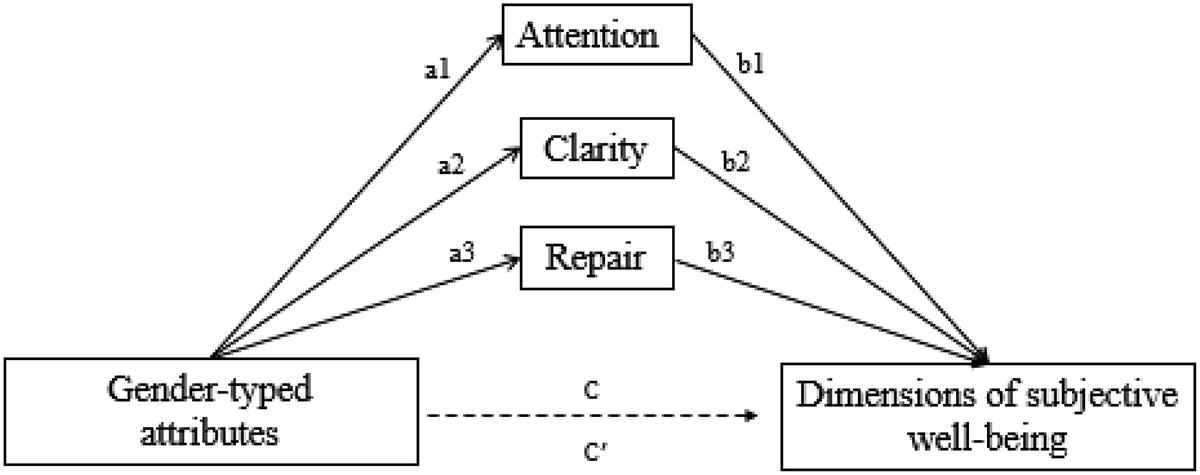
Coefficient omega was utilized to assess internal consistency. This coefficient omega is a more sensitive index of internal consistency, both in relation to alpha and when compared to other alternatives (Zinbarg et al., 2007). Extracted Mean Variance (AVE) was used to assess convergent validity. Fornell and Larcker (1981) recommend a value higher than .50.
Results
Descriptive analyses
Descriptive statistics and gender differences
Note: Mas+ = masculine positive; Fem+ = feminine positive; Mas− = masculine negative; Fem− = feminine negative; SWLS = satisfaction with life; PA = positive affect; NA = negative affect
Correlations of key variables
Note: *p < .05; **p < .001; ***p < .0001
Mediation analyses
Indirect effects of gender-typed attributes on satisfaction with life through dimensions of emotional intelligence and model summary information
Indirect effects of gender-typed attributes on positive affect through dimensions of emotional intelligence and model summary information
Note: significant indirect effects in bold. aBias corrected confidence intervals (CI)
Indirect effects of gender-typed attributes on negative affect through dimensions of emotional intelligence and model summary information
Note: significant indirect effects in bold. aBias corrected confidence intervals (CI)
Direct effects and total effects of gender-typed attributes on dimensions of subjective well-being through dimensions of emotional intelligence
Note: significant indirect effects in bold. SWLS = Satisfaction with life; PA = Positive affect; NA = Negative affect
Mediational effect on the cognitive component of subjective well-being
A statistical diagram of the parallel multiple mediator model for gender-typed attributes in life satisfaction (SWLS) is shown in Figure 2. Specifically, two indirect effects were found for Mas+ and SWLS. Thus, Mas+ was positively related to Clarity, which, in turn, was positively related to SWLS. Similarly, Mas+ was positively related to Repair, which, in turn, was positively related to SWLS.
A parallel multiple mediation model of gender-typed attributes and satisfaction with life (SWLS). Unstandardized regression coefficients for masculine positive without parentheses or brackets, feminine positive inside parentheses and negative attributes in square brackets.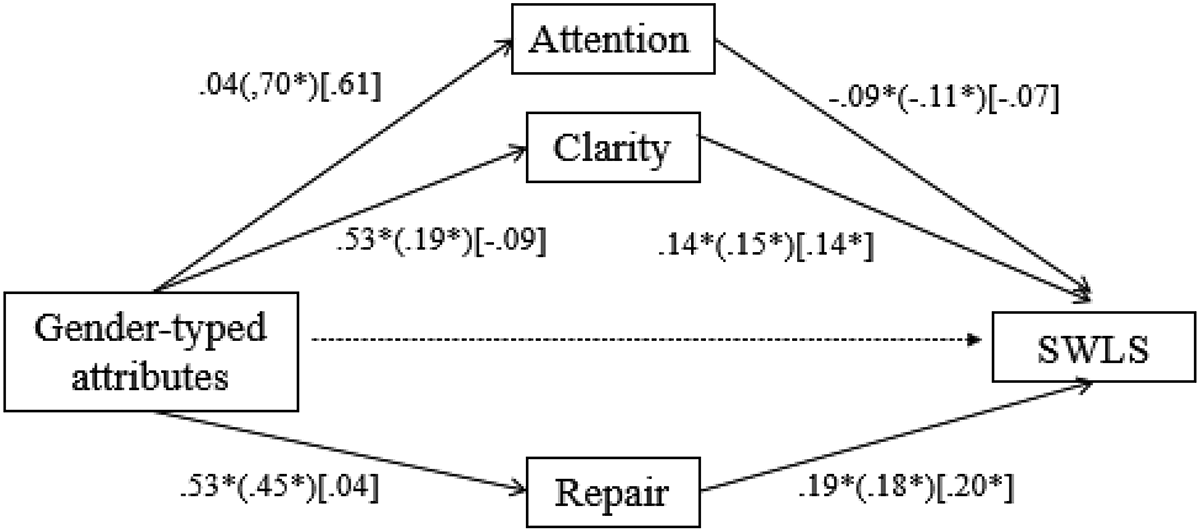
For positive feminine attributes, significant indirect effects were also found. In this case, Attention was positively related to Fem+ but negatively related to SWLS. Regarding Clarity and Repair, both were positively related to Fem+ and SWLS. Indirect effect pairwise contrasts revealed that the indirect effect of Fem+ on SWLS via Repair was stronger than that via Clarity and Attention.
Mediational effect on affective component of subjective well-being
The results of the mediational effect of EI between gender-typing attributes and positive affect are showed in Figure 3. In this case, only Repair was a positive mediator between Mas+ and PA. In contrast, for Fem+, two significant indirect effects were found. Specifically, Attention and Repair were positively related to both Fem+ and PA.
A parallel multiple mediation model of gender-typed attributes and positive affect (PA). Unstandardized regression coefficients for masculine positive without parentheses or brackets, feminine positive inside parentheses and negative attributes in square brackets.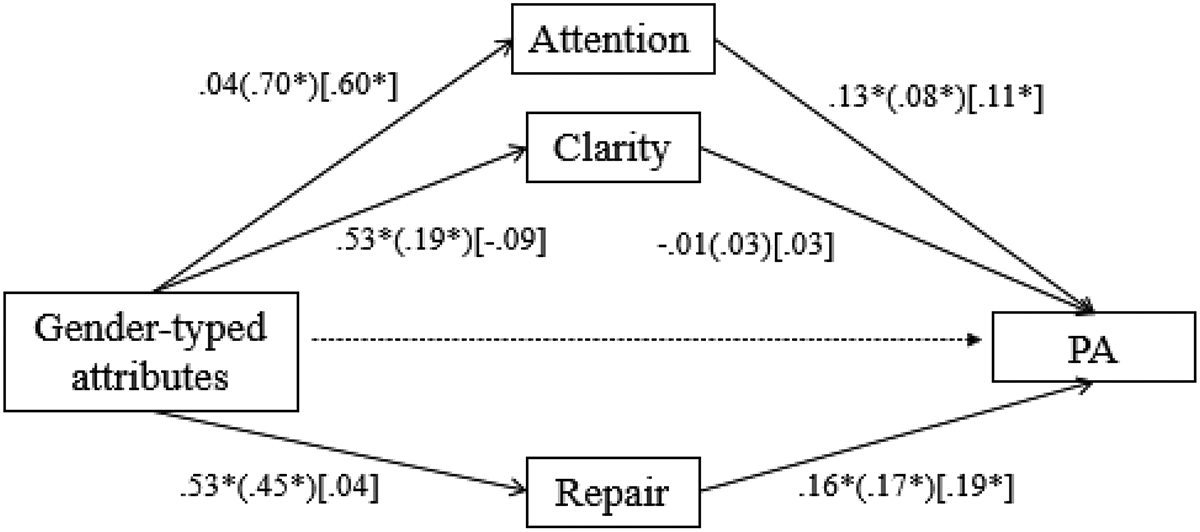
In reference to the negative attributes and their relationships with PA, a significant indirect effect was found, such that Neg attributes were positively related to Attention, which, in turn, was positively related to PA.
Finally, Figure 4 contains the regression coefficients of gender-typed attributes and NA. As is shown, Mas+ attributes were positively related to Clarity, but this dimension of the EI was negatively related to NA. In relation to Fem+, a similar effect was found with both Attention and Clarity. Specifically, Fem+ was positively related to Attention and Clarity, which were negatively related to NA. In contrast, Fem+ was positively related to Repair, which, in turn, was positively related to NA. Regarding Neg attributes, a positive relation to Attention was identified, which, in turn, was positively related to NA. However, Neg attributes were negatively related to Clarity, and this was also negatively related to NA.
A parallel multiple mediation model of gender-typed attributes and negative affect (NA). Unstandardized regression coefficients for masculine positive without parentheses or brackets, feminine positive inside parentheses and negative attributes in square brackets.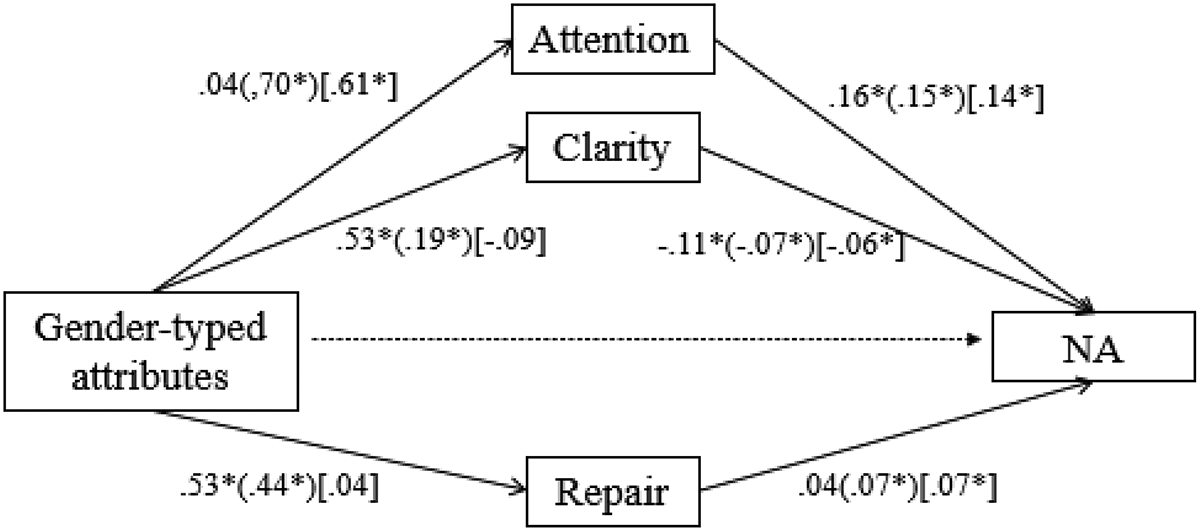
Regarding the ratio of the indirect effect to the total effect, it is observed that 73% of the effect of Fem+ on NA is through Attention; 62% of the effect of Fem+ on SWLS is through Repair; 57% of the effect of Fem+ on SWLS is through Attention; 54% of the effect of Neg on NA is through Attention; and 50% of the effect of Neg on PA is through Attention.
Comparison between mediation models through index of mediation
Note: G-TA = gender-typed attributes; SWB = subjective well-being; EI = emotional intelligence; Fem+ = feminine positive; Mas+ = masculine positive; Neg = negative attributes; PA = positive affect; NA = negative affect; SWLS = satisfaction with life
Discussion
The Member States in the WHO European Region approved a common policy framework (World Health Organization (WHO), 2020), the aim of which was to ‘significantly improve the health and well-being of populations’ (p. 1). The complexity involved in studying well-being means that different perspectives can provide significant data. From a psychological point of view, our study contributes to understanding the role of EI in the SWB.
The current study was designed to examine the mediational role of EI between gender typing and SWB. Our results provide interesting contributions. Firstly, it includes in the study of the SWB the gender-typing attributions and the differentiation between positive and negative dimensions. This approach adds a new explanation about why men report higher levels than women in SWB (Schmitt et al., 2017).
The analysis of gender typing shows that there is a majority of stereotypical gender attribution for the positive aspects. Similar results were found with young adults (Johnson et al., 2006) and with more representative samples (Hentschel et al., 2019). In this sense, our results confirm the hypothesis of stability of gender stereotypes, which affirm that these have remained relatively unchanged in the last 30 years (Haines et al., 2016).
Social Role Theory (Eagly, 1987) of development affirms that differences between men and women result primarily from gender socialization, internalizing gender roles and socio-structural power differentials. Consequently, from the social role theory, gender differences in SWB are expected. If women’s well-being is a consequence of maintaining good relationships with others (communal dimension), it is normal for them to score less than men, who would only have to attend to their own well-being (agentic dimension). Given that we also considered in our study the negative attributes that conform gender typing, we can offer a more precise explanation. In relation to the negative attributes, one aspect should be highlighted. There were only differences in the attribution of negative feminine attributes, being women the ones who most attribute them. This could be related to the lowest score of women on the self-esteem scales in relation to men (Josephs et al., 1992).
Regarding emotional intelligence, some interesting differences were found. In accordance with gender stereotypes, there were differences in Attention; women scored higher than men. This result has appeared in other studies (Rey et al., 2011) and can be considered as a manifestation of the traditional gender norms. Also, women scored higher than men in Repair, a result found in different studies that evaluate gender differences in EI (Extremera et al., 2006; Fernández-Berrocal et al., 2012). This finding could be explained from a sociopsychological point of view. Society still prescribes and values that women attend to the feelings and emotional needs of others. This implies learning communal competencies, such as empathy and concern for others (Menon, 2017). According to the Moral Foundations Theory (Graham et al., 2011), one of the moral concerns is Harm, defined as a concern for someone’s physical and emotional well-being. It seems evident that women are socialized in this aspect more than men, facing more the welfare of others than their own.
The more relevant finding of this investigation is the identification of the mediational role of emotional intelligence. First, our mediational model tests the appropriated differentiation between positive and negative gender-typed attributes. So, we can identify the greater influence that the positive dimension of gender typing had in comparison to the negative one in ameliorating SWB. Besides, this result is a validation of the androgynous hypothesis, because masculine and feminine characteristics are involved in SWB. Because Mas+ and Fem+ attributes increase satisfaction with life and PA while diminishing NA, promoting androgyny and diminishing the attribution of negative attributes in all areas of life, it is a new educational and political task.
The relevance of Mas+ attributes, as an agentic dimension, was evident through more Clarity and Repair, while Fem+ attributes, as a communal dimension, were evident through three dimensions of EI. Similarly, in other studies (Extremera et al., 2009; Fernández-Berrocal & Extremera, 2008; Rey et al., 2011), Clarity and Repair have been found closely linked with SWB. Gohm and Clore (2002) have already pointed out that Clarity promotes active and planned coping and helps to make positive reinterpretations of events.
The role of negative attributes in mediation needs to be commented on in more detail. As expected, the Neg attributes increase NA, obviously through Attention and Clarity. This result supports the relevance of including negative aspects in the evaluation of gender attributions, as several authors have already proposed (Berger & Krahé, 2013; Wajsblat, 2011; Woodhill & Samuels, 2003, 2004). Also, our finding supposes an empirical confirmation of how negative gender attributions increase negative affect and therefore diminish people’s well-being. It is known that desirable content in self-concept is related to better mental health and greater well-being (Locke, 2006). Besides, individuals who describe themselves with negative attributes show less well-being and self-esteem and more stress than those with positive attributes (Bernstein & Chemaly, 2017).
Each dimension of EI showed a specific relation with well-being, which indicates the importance of avoiding the use of a single global measure of IE. When Fem+ was attributed, Attention diminishes SWLS and increases NA. Thus, the mediating effects of Attention were contrary to those expected. Similar results with adults have been found (Vergara et al., 2015). It is probable that paying too much attention to one’s emotions could be maladaptive to the extent that it becomes the so-called rumination: a repetitive self-focus on negative aspects of the emotions. In fact, there is a large deal of research that has shown that rumination maintains negative affect (Vergara et al., 2015).
Clarity and Repair seem to have a similar effect because both ameliorate SWB. It was found that positive attributes increase PA through Repair. In fact, Repair seems to be a very relevant predictor of well-being (Thompson et al., 2007). This also supports the androgyny hypothesis in improving SWB, as Diaz and Bui (2017) indicated.
Regarding gender-typing dimensions, feminine attributes showed more effect size than other masculine dimension in relation to SWB. So, this suggests the relevance that feminine attributes have in different facets of live, such as leadership (Eagly & Johnson, 1990), informal care (Bracke et al., 2008) or in specific jobs (Loughrey, 2008). Nonetheless, society continues to privilege and value the manifestation of the masculine ones. In any case, this evidences that rather than being a natural division, gender is a context-dependent and interactional phenomenon.
It has been proved that it is necessary to consider the different facets or subscales of emotional intelligence in the research of its influence on SWB. Because Clarity and Repair are positively related to SWB, these skills should be the most considered for proper functioning. Further, EI does not improve the SWB outside of gender attributions. To the extent that men and women assume an androgynous model, based on positive dimensions of gender-typed attributes, will increase the SWB. Increasing SWB is a gender question that should be researched throughout life, especially in the most vulnerable groups, such as older women.
Finally, we consider that the influence of negative dimension of gender self-concept on well-being should be investigated further.
A limitation of this study is related to the cross-sectional analysis and non-randomized participant allocation design. More research with groups of other cultures would be necessary in order to corroborate our model. Longitudinal analyses will also contribute to understanding why women are less happy than men throughout life (Senik, 2015). Other measures of gender-typed attributes or gender identity could be used in order to confirm our findings. In fact, one of the subscales of the PN-SRI-SP20, Mas−, does not show adequate reliability and presents low indirect values. Lastly, it is important to evaluate other dimensions as intrapersonal (ability with respect to one’s emotions) and interpersonal (ability to understand and appreciate feelings of others). We know that self-report measures could be biased. So, emotional intelligence execution tests could offer more data about the relationship between these variables.
Explorando el bienestar subjetivo a través del género y la inteligencia emocional. Un modelo mediacional
Mejorar el bienestar de la población es un objetivo de Health 2020 (World Health Organization (WHO), 2020). El bienestar subjetivo es una evaluación positiva de la propia vida asociada con sentimientos positivos. Estudios previos han revelado que existen diferencias entre hombres y mujeres en lo que respecta al bienestar (Argyle, 2001). No obstante, la evidencia de esta afirmación es controvertida. Aunque las mujeres manifestaron niveles superiores de satisfacción con la vida que los hombres (Batz-Barbarich et al., 2018), ellas también mostraron un afecto positivo inferior que los hombres (OECD, 2011). Por otra parte, un meta análisis confirmó que las mujeres mayores comunicaron un bienestar subjetivo significativamente inferior (Pinquart & Sörensen, 2001).
Para explicar estas diferencias entre hombres y mujeres con respecto al SWB, sería útil investigar el proceso de tipificación por género (Bem, 1981), que analiza qué es lo que las personas piensan en sí mismas en términos de masculinidad o feminidad, en vez de comparar dos categorías sociales. Desde esta perspectiva, hombres y mujeres se atribuyen características tanto masculinas como femeninas. De hecho, algunos estudios han confirmado que los atributos de género tienen una relación positiva con el bienestar subjetivo (SWB; Sánchez-Álvarez et al., 2016).
Por otra parte, la inteligencia emocional (IE) ha sido identificada como un predictor de las dimensiones del SWB tanto en adultos (Fernández-Abascal & Martín-Díaz, 2015) como en adolescentes (Salguero et al., 2012; Stange et al., 2013). De modo similar, el género también es importante para comprender la IE. Recientemente, los investigadores de la IE han concluido que las mujeres tienen puntuaciones más altas que los hombres en las medidas de inteligencia emocional. Un meta análisis de la IE (Joseph & Newman, 2010) concluyó que las mujeres tienen puntuaciones más altas que los hombres en todas las dimensiones de la IE. Esta diferencia también puede explicarse a través del proceso de tipificación por género. Las mujeres se socializan atendiendo a los demás, y han mostrado ser más hábiles para percibir señales emocionales no verbales (McClure, 2000).
Este estudio investiga la relación de estas tres variables proponiendo un modelo de mediación. De hecho, el efecto de mediación de la IE sobre los problemas de conducta (Gugliandolo et al., 2015) incapacidad física o dolor (Costa et al., 2016), aspectos relacionados con la depresión y los problemas de salud mental (Khosravi & Hassani, 2022) y, especialmente, con el bienestar (Schutte & Malouff, 2011) ya han sido confirmados. De modo que nuestra hipótesis es que la IE tiene un rol mediador en la explicación de las diferencias relativas al SWB. Específicamente, este estudio investigó las relaciones entre los atributos por tipificación de género y el SWB en los adultos, considerando el rol de la IE.
Bienestar subjetivo y atributos de género
Aunque existen diferentes perspectivas para conceptualizar el SWB, la más relevante considera que se organiza en torno a dos dimensiones. El componente cognitivo satisfacción con la vida (SWLS) se refiere al resultado de la evaluación que procesa la información de lo que las personas hacen con sus vidas (Pavot & Diener, 2008). El componente afectivo incluye la frecuencia con que las personas experimentan emociones positivas (afecto positivo, AP) y negativas (afecto negativo, AN). Generalmente, el SWB se operacionaliza como alta satisfacción con la vida combinada con altos niveles de afecto positivo y bajos niveles de afecto negativo (Lyubomirsky et al., 2005).
Tradicionalmente, se han utilizado tres modelos para explicar la relación entre masculinidad/feminidad y bienestar (Whitley, 1985). La hipótesis de la congruencia se basa en la adecuación entre el género y las prescripciones sociales de género, de acuerdo con las cuales el bienestar es consecuencia de la congruencia entre los atributos de géneros de una persona y su género. La hipótesis de la androginia defiende que el óptimo bienestar se alcanza cuando las personas tienen alta puntuación, o incorporan tanto la masculinidad como la femineidad. Por último, la hipótesis de la masculinidad postula que el bienestar superior está relacionado con la masculinidad.
Históricamente, la teoría más aceptada sobre la tipificación de género fue formulada por Bem (1981). El modelo bilineal considera la masculinidad y la feminidad como dimensiones independientes. La tipificación por género se mide solicitando a los participantes de la investigación que se describan con atributos de género que tradicionalmente se consideran relacionados con la masculinidad y feminidad. La escala permite una evaluación constante, o puede utilizarse para clasificar a los individuos en tipo masculino o tipo femenino. Además, las puntuaciones de masculinidad y feminidad se utilizan juntas para identificar a las personas andróginas, es decir, individuos con puntuaciones altas en ambas dimensiones.
Las investigaciones no son conclusivas en lo que respecta a la relación entre la tipificación de género y el SWB. La hipótesis de la androginia se ha confirmado en estudios en los que la dimensión relacional y la agéntica estaban relacionadas positivamente con el SWB (Wang, 2016). Además, la salud mental está relacionada positivamente con la androginia, mientras que las personas que perciben tener características exclusivamente masculinas o femeninas, obtuvieron puntuaciones más bajas (Pauletti et al., 2017). No obstante, en otros estudios la feminidad y la androginia fueron predictores significativos de afecto positivo (Diaz & Bui, 2017).
La hipótesis de la congruencia, es decir, cuando los hombres actúan y piensan de forma culturalmente masculina y las mujeres de forma culturalmente femenina (Ashmore, 1990), también fue parcialmente confirmada porque el ajuste psicológico se asoció positivamente con la identidad de género y la instrumentalidad congruente con el sexo, pero se asoció mínimamente con la expresividad (DiDonato & Berenbaum, 2011). Finalmente, en los hombres, maestros de enseñanza primaria, la masculinidad tuvo una influencia positiva sobre el bienestar (Wolfram et al., 2009).
Woodhill y Samuels (2003) propusieron una forma más multifacética de evaluar la tipificación de género. Evaluaron la androginia por medio de atributos positivos y negativos. Este enfoque les permitió descubrir que las características positivas asociadas con la androginia se relacionaban con la salud psicológica y el bienestar. Además, en su estudio las características negativas, tanto femeninas como masculinas, mostraron estar asociadas con más riesgos. En conclusión, mantener la diferenciación entre aspectos positivos y negativos permite identificar con precisión los efectos de la masculinidad y la feminidad sobre el bienestar, algo que hasta el momento no se había considerado.
Bienestar subjetivo e inteligencia emocional
La asociación entre el SWB y la IE se ha estudiado durante los últimos años. Diferentes meta-análisis (Martins et al., 2010) y estudios recientes (Dirzyte & Patapa, 2022), han confirmado esta relación. Específicamente, la investigación mostró que, utilizando medidas de auto-informe, una IE superior está asociada con mejor SWLS y AP, y con un AN inferior (Fernández-Berrocal & Extremera, 2008; Schutte et al., 2010). Otros estudios han hallado que el componente cognitivo del SWB estaba más intensamente vinculado con la IE que el componente afectivo (Sánchez-Álvarez et al., 2016). Por tanto, aunque Zeidner et al. (2012) sugirieron en su análisis que la IE está empíricamente relacionada con el bienestar subjetivo, pocos estudios han probado directamente las hipótesis de mediación. Este es el objetivo de este estudio.
El modelo de habilidad de Mayer y Salovey (1997) define la IE como la ‘habilidad para percibir con precisión, valorar y expresar emociones; la habilidad para acceder a y/o generar los sentimientos cuando facilitan el pensamiento; la habilidad para comprender las emociones y para el conocimiento emocional; y la habilidad para regular las emociones con el fin de promover el desarrollo emocional e intelectual’ (p. 10). A partir de este modelo, algunas investigaciones probaron si la Claridad fue el mejor predictor de la AP y la SWLS, y si se asoció más estrechamente con el SWB así como también con bajos niveles de AN (Fernández-Berrocal & Extremera, 2008). De todos modos, en otros estudios la dimensión Reparación fue la que mostró una relación positiva con la SWLS (Extremera et al., 2009; Rey et al., 2011). Pero la relación más controvertida fue la identificada entre la Atención y SWB.
Algunos estudios han hallado una relación positiva entre la Atención y el AN más alto, y también con niveles inferiores de SWLS (Extremera et al., 2009), mientras que otras investigaciones no hallaron ninguna relación entre el SWB y la Atención (Rey et al., 2011). Debido a los hallazgos mencionados, es importante medir por separado cada uno de los componentes de la IE con el fin de evaluar la contribución específica de cada dimensión al bienestar.
Este estudio
Hasta el momento, ningún estudio ha propuesto analizar el efecto mediador de la IE entre la tipificación de género y el SWB en personas adultas. Considerando que la masculinidad y la feminidad implican afectos emocionales, identificar su relación con la IE es un tema delicado. Es sabido que la masculinidad se asocia con el análisis, la mediación y la evitación de las emociones, en tanto la feminidad se vincula con la dimensión relacional, y con las muestras de afecto y preocupación por los demás (Gartzia et al., 2012). De hecho, algunos estudios han asociado las emociones con características femeninas (Keener et al., 2012) y algunas de las dimensiones intrapersonales de la IE con características masculinas (Siegling et al., 2012). Además, sabemos que dos dimensiones de la IE, Claridad y Atención, se asocian con el co-nocimiento de las propias emociones, mientras que la Reparación representa el aspecto más analítico de la IE (Mayer & Salovey, 1997).
A partir de la literatura mencionada, y considerando la importancia de los atributos negativos para evaluar la tipificación de género, proponemos un modelo mediacional. Basándonos en la hipótesis de la androginia, pero diferenciando entre atributos positivos y negativos, nuestra hipótesis de la IE como un factor disposicional, se reducirá por la auto-atribución de la tipificación de género negativo (masculino y femenino) y, por consiguiente, el afecto negativo aumentará, pero la SWLS y el AP se reducirán. En contraste, la IE aumentará por la auto-atribución de la tipificación de género positivo (masculino y femenino), y en consecuencia la SWLS y el AP aumentarán, pero el afecto negativo se reducirá. Del mismo modo, la evaluación de las diferencias según el género en la IE, los atributos de género y el SWB se consideran importantes para evaluar las diferencias entre mujeres y hombres.
Materiales y métodos
Participantes
Los participantes del estudio fueron 711 miembros de la Universidad. Todos ellos pertenecían a la plantilla de la Universidad de Murcia, profesorado y estudiantes de la Universidad de Murcia. El rango de edad abarcó desde los 17 a los 65 años (M = 23.8, SD = 7.8). El 63% de los participantes eran mujeres. El 90% eran estudiantes y el 10% eran profesorado y personal de administración.
Medidas
Inteligencia emocional
Se utilizó la Trait Meta Mood Scale (TMMS-24; Fernández-Berrocal et al., 2004). Cada una de las tres sub-escalas contiene ocho ítems: Atención, que expresa la medida en la cual los individuos tienden a observar y reflexionar sobre su estado de ánimo y sus sentimientos (por ejemplo, ‘Presto mucha atención a cómo me siento’); Claridad, que evalúa la comprensión de los propios estados emocionales (por ejemplo, ‘Por lo general, tengo muy claro cuáles son mis sentimientos’); y Reparación, que se refiere a las creencias de los individuos sobre su capacidad para regular sus sentimientos (por ejemplo, ‘Aunque a veces me siento triste, la mayor parte de las veces soy optimista’). El rango de la escala fue de 1 (‘totalmente en desacuerdo’) a 5 (‘totalmente de acuerdo’). El ωt del presente estudio fue: Atención (ωt = .91), Claridad (ωt = .92) y Reparación (ωt = .91). Además, los coeficientes de validez del constructo presentaron una bondad de ajuste: RMSEA = .077, GIF = .958, TLI = .932, CFI = .938, AGFI = .949. Los coeficientes de validez convergente para las sub-escalas son: (Atención AVE = .54, Claridad AVE = .43, Reparación AVE = .55)
Atributos de género
La evaluación de los atributos de género se realizó utilizando el Inventario español de roles sexuales positivo–negativo, (PN-SRI-SP20; Martínez-Marín et al., 2021), la versión española del original The Positive-Negative Sex-Role Inventory (PN-SRI; Berger & Krahé, 2013). El inventario contiene cuatro dimensiones: (a) masculinidad positiva (Mas+): analítico, lógico, objetivo, práctico, cauteloso, racional, y resolutivo; (b) masculino negativo (Mas−): arrogante, presuntuoso, ostentoso, y ambicioso; (c) femenino positivo (Fem+): cariñoso, seco (ítem invertido), pasional y tierno; y (d) femenino negativo (Fem−): emocional, hipersensible, sensible, ingenuo y dubitativo. Los participantes utilizaron una escala de cinco puntos que abarcó del 1 (‘no característico’) al 5 (‘totalmente característico’) para indicar hasta qué punto cada atributo los/las caracterizaba. El ωt del presente estudio fue: Mas+ (ωt = .86), Fem+ (ωt = .79), Mas− (ωt = .68) y Fem+ (ωt = .78).
Realizamos un CFA con 20 atributos de PN-SRI-SP20 con el fin de confirmar el modelo de cuatro factores de la escala. Los resultados presentaron buen ajuste estadístico: RMSEA = .05, GIF = .997, TLI = .939, CFI = .949, AGFI = .995. Los coeficientes de validez convergente son adecuados en todas las sub-escalas. (Mas+ AVE = .60, Mas− AVE = .50, Fem+ AVE = .67, Fem− AVE = .73)
Satisfacción con la vida
Se utilizó la escala de Diener, Emmons, Larsen y Griffin (SWLS; Diener et al., 1985), validada en español por Atienza et al. (2000), para medir la satisfacción con la vida. Esta escala consiste en cinco ítems, que abarcan desde ‘Totalmente en desacuerdo’ hasta ‘Totalmente de acuerdo’. El ωt del presente estudio fue .85, y los coeficientes de validez del constructo presentan la siguiente bondad de ajuste: RMSEA = .00, GIF = .999, TLI = 1.00, CFI = 1.00, AGFI = .998. El coeficiente de validez convergente es SWLS AVE = .50
Afecto positivo y negativo
El componente afectivo del bienestar subjetivo se evaluó con la medida de afecto positivo negativo y (PANAS; Watson et al., 1988), adaptada al español y validada por Sandín et al. (1999). Esta escala consiste en 20 ítems que evalúan el afecto positivo (AP) (ωt = .85; i.e., ‘Por lo general soy una persona entusiasta y decidida’) y el afecto negativo (AN) (ωt = .87; i.e., ‘Por lo general, estoy disgustado y angustiado’). Las opciones de respuesta abarcaron desde 1 (‘en absoluto’) hasta 5 (‘extremadamente’), y las puntuaciones superiores indicaron mayor afecto positivo o negativo. La validez de los cons-tructos del presente estudio mostraron buenos estadísticos de ajuste: RMSEA = .068, GIF = .958, TLI = .934, CFI = .941, AGFI = .954. Los coeficientes de validez convergente para ambas sub-escalas fueron: PA AVE = 1.28, NA AVE = 1.71
Diseño y procedimiento
Dado que no manipulamos las variables independientes y que nuestro interés es la relación estadística entre variables, utilizamos un diseño no experimental correlacional. Este estudio se realizó en una de las universidades estatales españolas. Se eligió la Universidad de Murcia debido a la accesibilidad de las investigadoras de este estudio para enviar los cuestionarios adecuados a través de la plataforma online de la universidad. Los cuestionarios se completaron online. Específicamente, fueron enviados a todos los miembros de la Universidad de Murcia (plantilla, profesores, investigadores, estudiantes, etc.). Todas las personas que respondieron al cuestionario (independientemente de su rol en la universidad, plantilla, profesor …) fueron parte de la muestra del estudio. No hubo clasificaciones basadas en los roles, ni en ninguna otra variable sociodemográfica. La participación fue voluntaria, y después de comunicar los objetivos y la metodología del estudio se solicitó un consentimiento. La confidencialidad y el anonimato fueron garantizados. Los participantes no recibieron ninguna compensación económica.
Análisis estadístico
Se realizó un análisis factorial confirmatorio (CFA) para asegurar la estructura factorial del PN-SRI-SP20 en estos participantes. Se utilizaron los métodos de WLSMV, rotación oblicua y matrices de correlaciones policóricas. La bondad del ajuste de todos los instrumentos del estudio se evaluó con: RMSEA (< .08), GFI (> .90), TLI (> .90), CFI (> .90) y AGFI (> .90).
Para analizar el efecto de mediación, realizamos un análisis de mediación múltiple paralelo utilizando PROCESS macro (Hayes, 2013); ver la Figura 1.
A Un modelo de mediación múltiple paralelo de la relación entre los atributos de género y las dimensiones del bienestar subjetivo como dimensiones mediadoras de la inteligencia emocional.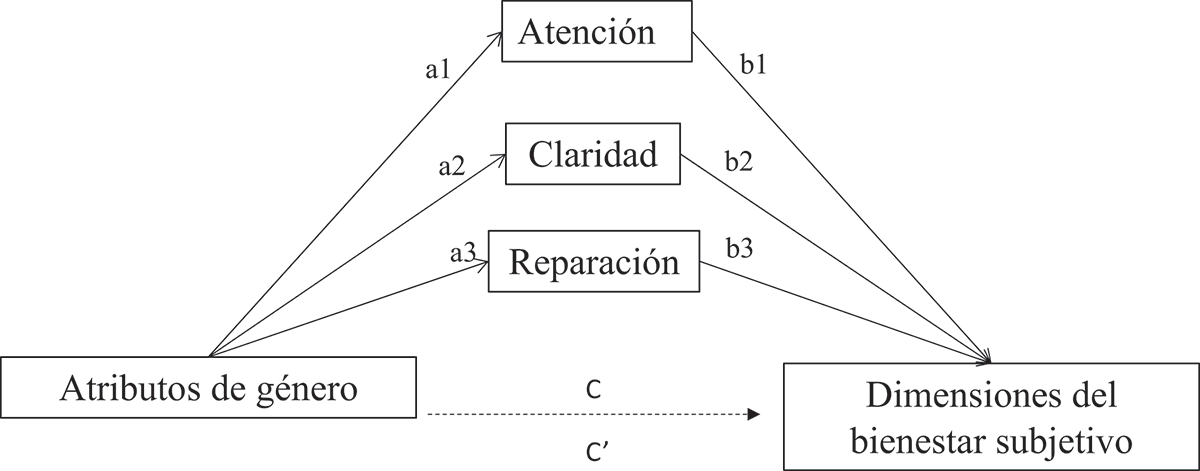
Se utilizó el coeficiente Omega para evaluar la consistencia interna, ya que es un índice más preciso que el índice alfa u otras alternativas (Zinbarg et al., 2007). Se utilizó la varianza media extraída (VME), para evaluar la validez convergente. Fornell y Larcker (1981) recomiendan un valor superior a .50.
Resultados
Análisis descriptivos
Estadísticos descriptivos y diferencias de género
Nota: Mas+ = Masculino positivo; Fem+ = Femenino positivo; Mas− = Masculino negativo; Fem− = Femenino negativo; SWLS = Satisfacción con la vida; AP = Afecto positivo; AN = Afecto negativo
Correlaciones de variables clave
Nota: *p < .05; **p < .001; ***p < .0001
Análisis de mediación
Efectos indirectos de los atributos de género sobre la satisfacción por la vida a través de las dimensiones de la inteligencia emocional e información resumida del modelo
Efectos indirectos de los atributos de género sobre el afecto positivo a través de las dimensiones de la inteligencia emocional e información resumida del modelo
Nota: Efectos indirectos significativos en negrita. aSesgo corregido de los intervalos de confianza (IC)
Efectos indirectos de los atributos de género sobre el afecto negativo a través de las dimensiones de la inteligencia emocional e información resumida del modelo
Nota: Efectos indirectos significativos en negrita. aSesgo corregido de los intervalos de confianza (IC)
Efectos directos y efectos totales de los atributos por tipo de género sobre las dimensiones del bienestar subjetivo a través de las dimensiones de la inteligencia emocional
Nota: Efectos indirectos significativos en negrita. SWLS = Satisfacción con la vida; AP = Afecto Positivo; AN = Afecto Negativo
Efecto mediacional sobre el componente cognitivo del bienestar subjetivo
En la Figura 2 se presenta un diagrama estadístico del modelo mediador múltiple paralelo para los atributos de género en la satisfacción con la vida (SWLS). Específicamente, se hallaron dos efectos indirectos para Mas+ y la SWLS. Por consiguiente, Mas+ se relacionó positivamente con la Claridad, que, a su vez, se relacionó positivamente con la SWLS. De modo similar, Mas+ se relacionó positivamente con la Reparación que, a su vez, se relacionó positivamente con la SWLS.
Un modelo de mediación múltiple paralelo de atributos de género y satisfacción por la vida (SWLS). Coeficientes de regresión no estandarizados para masculino positivo sin paréntesis ni corchetes, femenino positivo entre paréntesis, y atributos negativos entre corchetes.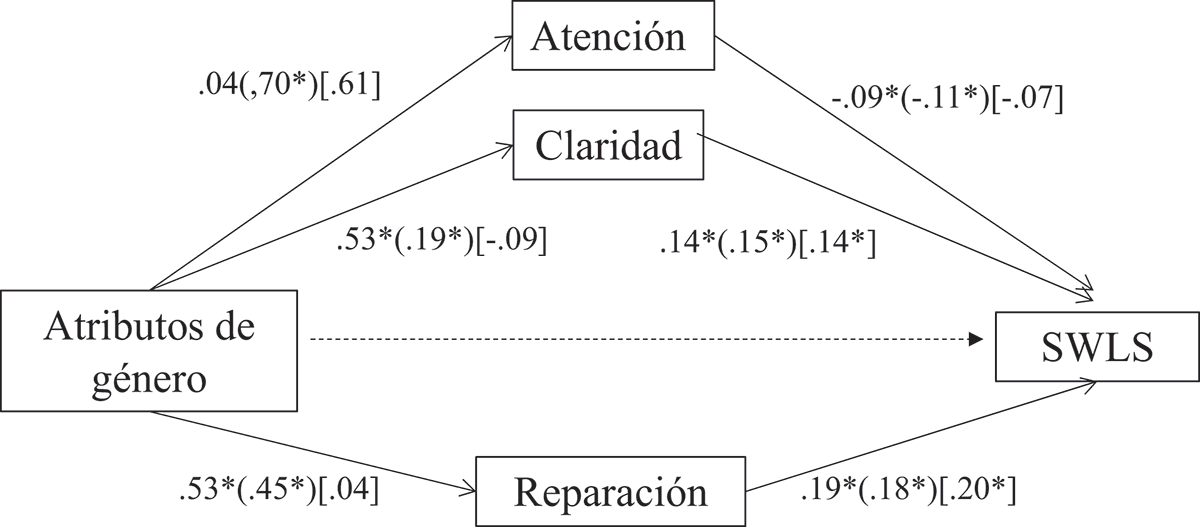
Para los atributos femeninos positivos, también se hallaron efectos indirectos significativos. En este caso, la Atención se relacionó positivamente con Fem+, pero negativamente con la SWLS. En cuanto a la Claridad y la Reparación, ambas se relacionaron positivamente con Fem+ y la SWLS. Los contrastes por pares de los efectos indirectos mostraron que el efecto indirecto de Fem+ sobre la SWLS a través de la Reparación fue mayor que a través de la Claridad y la Atención.
Efecto mediacional sobre el componente afectivo del bienestar subjetivo
Los resultados del efecto mediacional de la IE entre los atributos de tipificación por género y el Afecto Positivo se muestran en la Figura 3. En este caso, únicamente la Reparación fue un mediador positivo entre Mas+ y AP. En contraste, para Fem+ se hallaron dos efectos indirectos significativos. Específicamente, la Atención y la Reparación se relacionaron positivamente con Fem+ y también con el AP.
Un modelo de mediación múltiple paralelo de atributos de género y afecto positivo (AP). Coeficientes de regresión no estandarizados para masculino positivo sin paréntesis ni corchetes, femenino positivo entre paréntesis, y atributos negativos entre corchetes.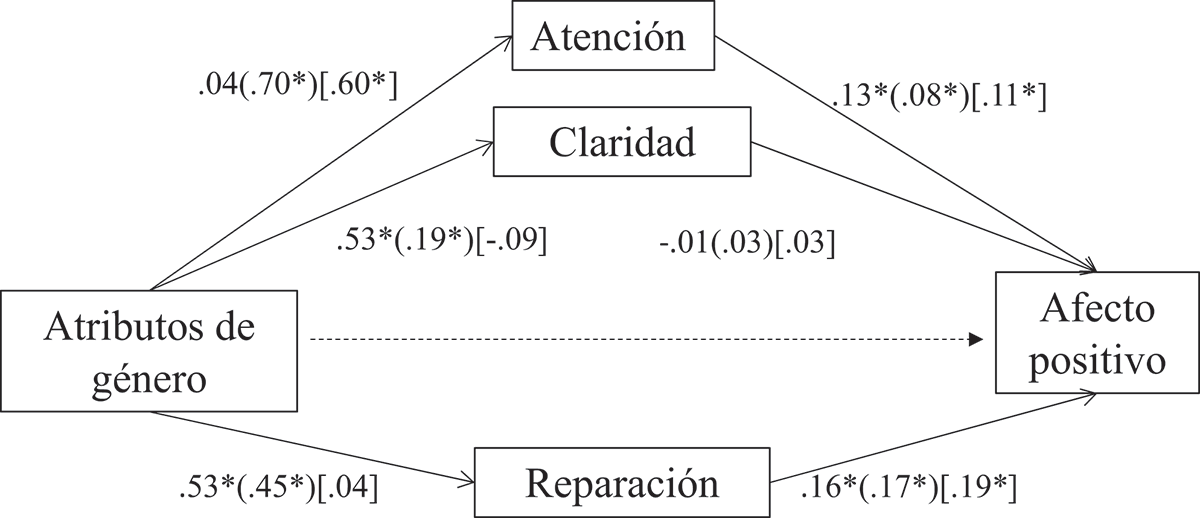
En referencia a los atributos Negativos y sus relaciones con el AP, se halló un efecto indirecto significativo, tal que los atributos Negativos se relacionaron positivamente con la Atención que, a su vez, se relacionó positivamente con el AP.
Finalmente, la Figura 4 contiene los coeficientes de regresión de los atributos por género y el AN. Tal como se puede ver, los atributos Mas+ se relacionaron positivamente con la Claridad, pero esta dimensión de la IE se relacionó negativamente con el AN. En relación con Fem+, se halló un efecto similar tanto para la Atención como para la Claridad. Específicamente, Fem+ se relacionó positivamente con la Atención y la Claridad, que se relacionaron negativamente con el AN. En contraste, Fem+ se relacionó positivamente con la Reparación que, a su vez, se relacionó positivamente con el AN. En cuanto a los atributos Neg, se identificó una relación positiva con la Atención que, a su vez, se relacionó positivamente con el AN. No obstante, los atributos Neg se relacionaron negativamente con la Claridad, y esta también se relacionó negativamente con el AN.
Un modelo de mediación múltiple paralelo de atributos por tipo de género y afecto negativo (AN). Coeficientes de regresión no estandarizados para masculino positivo sin paréntesis ni corchetes, femenino positivo entre paréntesis, y atributos negativos entre corchetes.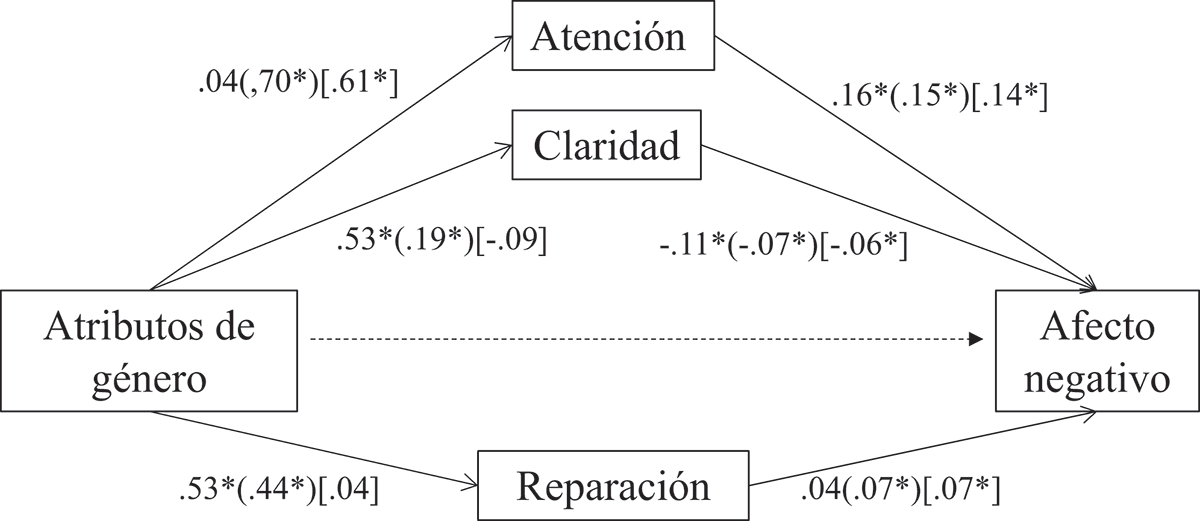
En cuanto a la proporción del efecto indirecto para el efecto total, se observó que el 73% del efecto de Fem+ sobre el AN es a través de la Atención; el 62% del efecto de Fem+ sobre la SWLS es a través de la Reparación; el 57% del efecto de Fem+ sobre la SWLS es a través de la Atención; el 54% del efecto de Neg sobre el AN es a través de la Atención; y el 50% del efecto de Neg sobre el AP es a través de la Atención.
Comparación entre modelos de mediación a través del índice de mediación
Nota: AG = Atributos de género; SWB = Bienestar subjetivo; IE = Inteligencia Emocional; Fem+ = Femenino positivo; Mas+ = Masculino positivo; Neg = Atributos negativos; AP = Afecto Positivo; AN = Afecto Negativo; SWLS = Satisfacción con la vida
Discusión
Los Estados Miembros de la región europea de la OMS aprobaron un marco de políticas comunes, Health 2020, cuyo objetivo fue ‘mejorar significativamente la salud y el bienestar de las poblaciones’ (p. 1). La complejidad que implica el estudio del bienestar significa que perspectivas diferentes pueden ofrecer datos significativos. Desde un punto de vista psicológico, nuestro estudio contribuye a comprender el rol de la IE en el SWB.
Este estudio fue diseñado para analizar el rol mediacional de la IE entre la tipificación de género y el SWB. Nuestros resultados ofrecen contribuciones interesantes. En primer lugar, incluye las atribuciones de tipificación por género en el estudio del SWB, y la diferenciación entre dimensiones positivas y negativas. Este enfoque aporta una nueva explicación de por qué los hombres tienen niveles superiores que las mujeres en el SWB (Schmitt et al., 2017).
El análisis de la tipificación por género muestra que hay una mayoría de atribuciones de género estereotipadas para los aspectos positivos. Se hallaron resultados similares en adultos jóvenes (Johnson et al., 2006), y con muestras más representativas (Hentschel et al., 2019). En este sentido, nuestros resultados confirman la hipótesis de estabilidad de los estereotipos de género, que afirma que éstos han permanecido relativamente iguales en los últimos 30 años (Haines et al., 2016).
La Teoría del Rol Social (Eagly, 1987) del desarrollo sostiene que las diferencias entre hombres y mujeres se deben fundamentalmente a la socialización del género, los roles de género internalizados, y las diferencias de poder socio-estructurales. En consecuencia, según la teoría de rol social se prevé que existan diferencias de género en el SWB. Si el bienestar de las mujeres es una consecuencia de mantener buenas relaciones con los demás (dimensión relacional), es normal que obtengan puntuaciones inferiores que los hombres, que solo deben estar atentos a su propio bienestar (dimensión agéntica). Dado que también hemos tenido en cuenta los atributos negativos que conforman la tipificación de género, podemos ofrecer una explicación más precisa. En relación con los atributos negativos, se debería destacar un aspecto. Solo hubo diferencias en la atribución de atributos femeninos negativos, que estuvieron más presentes en las mujeres. Esto podría relacionarse con las puntuaciones más bajas de las mujeres en las escalas de autoestima, en comparación con los hombres (Josephs et al., 1992).
En lo que se refiere a la inteligencia emocional, se hallaron algunas diferencias interesantes. De acuerdo con los estereotipos de género, hubo diferencias en Atención, donde las mujeres obtuvieron puntuaciones superiores a los hombres. Este resultado ha aparecido también en otros estudios (Rey et al., 2011) y puede considerarse como una manifestación de las normas tradicionales de género. Además, las mujeres tuvieron puntuaciones más altas que los hombres en Reparación, un resultado encontrado en diferentes estudios que evalúan las diferencias de género en la IE (Extremera et al., 2006; Fernández-Berrocal et al., 2012). Este hallazgo podría explicarse desde un punto de vista psicosocial. La sociedad todavía espera y valora que las mujeres se ocupen de los sentimientos y necesidades emocionales de los demás. Esto implica aprender habilidades comunitarias, como pueden ser la empatía y la preocupación por los otros (Menon, 2017). De acuerdo con la Teoría de los Fundamentos Morales (Graham et al., 2011), una de las preocupaciones morales es el Daño, definido como la preocupación por el bienestar físico y emocional de una persona. Parece evidente que las mujeres han socializado este aspecto más que los hombres, lo que las lleva a centrarse más en el bienestar ajeno que en el propio.
El hallazgo más relevante de esta investigación es la identificación del rol mediacional de la inteligencia emocional. En primer lugar, nuestro modelo mediacional somete a prueba la adecuada diferenciación entre atributos de género positivos y negativos. De este modo, podemos identificar la mayor influencia que tiene la dimensión positiva de tipificación del género, en comparación con la dimensión negativa, en la mejora del SWB. Por otra parte, este resultado es una validación de la hipótesis de la androginia, ya que las características masculinas y femeninas están implicadas en el SWB. Dado que los atributos Mas+ y Fem+ aumentan la satisfacción con la vida y el AP, a la vez que disminuyen el AN, promover la androginia y reducir la atribución de atributos negativos en todas las áreas de la vida, es una nueva tarea educativa y política.
La importancia de los atributos Mas+, como dimensión agéntica, fue evidente a través de una mayor Claridad y Reparación, mientras que la de los atributos Fem+, como dimensión comunitaria, fue evidente a través de tres dimensiones de la IE. De forma similar, en otros estudios (Extremera et al., 2009; Fernández-Berrocal & Extremera, 2008; Rey et al., 2011) se observó que la Claridad y la Reparación estaban estrechamente vinculadas con el SWB. Gohm y Clore (2002) ya señalaron que la Claridad promueve una gestión activa y planificada, y ayuda a hacer re-interpretaciones positivas de los eventos.
Es preciso comentar más detalladamente el rol de los atributos negativos en la mediación. Según lo previsto, los atributos Neg aumentan el AN, obviamente a través de la Atención y la Claridad. Este resultado apoya la importancia de incluir aspectos negativos en la evaluación de las atribuciones de género, como ya han propuesto varios autores (Berger & Krahé, 2013; Wajsblat, 2011; Woodhill & Samuels, 2003, 2004). Además, nuestros hallazgos suponen una confirmación empírica de cómo las atribuciones negativas de género incrementan el afecto negativo y, por consiguiente, reducen el bienestar de las personas. Es sabido que el contenido deseable del concepto de sí mismo se relaciona con mejor salud mental y mayor bienestar (Locke, 2006). Por otra parte, los individuos que se definen a sí mismos con atributos negativos evidencian menor bienestar y autoestima, y más estrés que aquellos que se definen con atributos positivos (Bernstein & Chemaly, 2017).
Cada dimensión de la IE mostró una relación específica con el Bienestar, lo que indica la importancia de evitar utilizar una sola medida global de la IE. Cuando se atribuyen Fem+, la Atención reduce la SWLS, y aumenta el AN. Por tanto, los efectos mediadores de la Atención fueron contrarios a los esperados. Se han observado resultados semejantes en adultos (Vergara et al., 2015). Probablemente, poner demasiada atención en las propias emociones podría representar una mala adaptación, hasta el punto de llegar a convertirse en la así llamada rumiación: centrarse reiteradamente en los aspectos negativos de las propias emociones. De hecho, muchas investigaciones han mostrado que la rumiación mantiene el afecto negativo (Vergara et al., 2015).
La Claridad y la Reparación parecen tener un efecto similar porque ambas mejoran el SWB. Se observó que los atributos positivos aumentan el AP a través de la Reparación. De hecho, la Reparación parece ser un predictor muy relevante de bienestar (Thompson et al., 2007). Esto también respalda la hipótesis de la androginia para mejorar el SWB, tal como han indicado Diaz y Bui (2017).
En cuanto a las dimensiones de tipificación de género, los atributos femeninos indicaron mayor tamaño del efecto que otra dimensión masculina, en relación con el SWB. Por tanto, esto sugiere la importancia que tienen los atributos femeninos en diferentes facetas de la vida, como liderazgo (Eagly & Johnson, 1990), cuidados informales (Bracke et al., 2008), o en un trabajo específico (Loughrey, 2008). De todos modos, la sociedad sigue privilegiando y valorando la manifestación de lo masculino. En cualquier caso, esto evidencia que el género es un fenómeno interaccional que depende del contexto, y no una división natural.
Se ha demostrado que es necesario que la investigación considere las diferentes facetas de la inteligencia emocional al analizar su influencia sobre el SWB. Dado que la Claridad y la Reparación se relacionan positivamente con el SWB, estas habilidades deberían ser las más consideradas para un correcto funcionamiento. Pero quizá, la inteligencia emocional no mejora el SWB al margen de las atribuciones de género. El grado en que hombres y mujeres asuman un modelo andrógino basado en las dimensiones positivas de los atributos de género, aumentará el SWB. Aumentar el SWB es una cuestión de género que se debería investigar a lo largo de la vida, especialmente en los grupos más vulnerables, como son las mujeres mayores.
Finalmente, consideramos que la influencia de la dimensión negativa del auto-concepto de género sobre el Bienestar debería ser más investigada.
Una limitación de este estudio está relacionada con el análisis transversal y el diseño no aleatorio de asignación de participantes. Sería necesario hacer más investigaciones con grupos de otras culturas para corroborar nuestro modelo. Los análisis longitudinales también contribuirán a comprender por qué las mujeres son menos felices que los hombres a lo largo de la vida. (Senik, 2015). También deberían utilizarse otras medidas de atributos de género, o de identidad de género, con el fin de confirmar nuestros hallazgos. De hecho, una de las sub-escalas de PN-SRI-SP20, Mas−, no muestra una fiabilidad adecuada, y presenta valores indirectos bajos. Por último, es importante evaluar otras dimensiones, como la intrapersonal (habilidad relacionada con las propias emociones) e interpersonal (habilidad para comprender y apreciar los sentimientos ajenos). Sabemos que las medidas de auto-informe podrían ser sesgadas. Por tanto, los tests de ejecución de inteligencia emocional podrían ofrecer más datos sobre la relación existente entre estas variables.
