







Abstract
In this study, we conceptualize personal initiative as a collective construct and adapt and validate a scale to evaluate it with a sample of 308 Spanish participants belonging to 91 work teams. Personal initiative at group level is a behavioural syndrome in which the team shows an approach to work that is self-initiated, proactive, persistent, capable of modifying the atmosphere and pro organization. As a predictive variable, we analysed the climate for initiative as well as personal initiative at group level. The resulting variables that were analysed referred to organization and team performance, with the team productivity and innovation as the criteria, analysing radical innovation. The scale has suitable psychometric properties. The results show that there is a relationship between the two predictive variables. Furthermore, personal initiative at group level is related to team productivity, while the climate for initiative is related to innovation.
Today’s organizations operate in changing, turbulent environments characterized by increasing levels of complexity, globalization and uncertainty which require constant adaptability and interdependence. In consequence, employees are expected to go above and beyond the technical requirements of their jobs, otherwise organizations will lose competitive advantages in their markets (Frese & Fay, 2001; Frese, Garst, & Fay, 2007; Lisbona & Frese, 2012).
Competitively speaking, limiting oneself to doing what one is asked does not allow for efficient performance in these environments, so individuals must deploy a broader range of behaviours (Griffin, Neal, & Parker, 2007; Hakanen, Perhoniemi, & Toppinen-Tanner, 2008). Personal initiative is one of these new concepts in active work performance and has been defined as a behavioural syndrome targeted at work which is characterized by being self-initiated, proactive, persistent, capable of modifying the environment and pro organization (Frese & Fay, 2001; Frese, Fay, Hilburger, Leng, & Tag, 1997; Frese et al., 2007; Lisbona & Frese, 2012).
Frese and Fay (2001) developed a theoretical model of personal initiative in which they identify its background and consequences. Regarding the background, the model distinguishes between proximal causes, which include orientations, with medium specificity and oriented towards action; and distal causes, which encompass personality, knowledge, skills and abilities (Frese & Fay, 2001). Evaluations of control, self-efficacy, aspirations of control and responsibility, change orientation, dealing with mistakes and active coping are orientations that better predict personal initiative compared to distal causes, which are more general. Environmental support is one of the proximal and distal causes. Finally, the model captures the fact that initiative exerts an influence on performance both individually and organizationally.
Personal initiative as a phenomenon at group level
Research into personal initiative has primarily focused on the individual level, and to a lesser extent on the organizational level through the concept of climate for initiative (Baer & Frese, 2003), so not much attention has been paid to the group level of the construct. However, the literature has noted that work teams play a crucial role in achieving efficiency and competitiveness in organizations, so much so that in recent decades the group, as a basic work unit, has become a core factor in the functioning of organizations (Rico, Alcover, & Tabernero, 2010).
For all of these reasons, in this study we argue for the existence of the construct of initiative at group level, which is produced inside work teams and conceptually acts as a bridge between personal initiative at individual level and personal initiative at organizational level, which has been called climate for personal initiative. This conceptualization of personal initiative as a collective phenomenon within work teams is based on certain contributions from social psychology in recent decades, more specifically on those related to cognitive social theory (Bandura, 2001) and emotional processes in work environments and their influence on performance and wellbeing (Totterdell & Niven, 2014).
In this way, we identify three complementary arguments to uphold our proposal of personal initiative at group level. On the one hand, from a cognitive standpoint, when people work together they can build and share beliefs and affective experiences through a range of social learning mechanisms, so they show similar motivational and behavioural patterns when dealing with shared events (Totterdell & Niven, 2014). Thus, people who work on the same team have more chances to interact with each other and influence each other through social learning mechanisms.
Yet on the other hand, from the standpoint of affective states and emotions, we have the concept of emotional contagion as a means of emotional transfer. Emotional contagion is the mechanism that induces a congruent affective state through observation of the public expression of the other person’s affective state, ‘capturing’ their emotions (Hatfield, Cacioppo, & Rapson, 1993).
Recent studies have shown the effects of emotional contagion on groups and organizations. For example, Sy, Côté, and Saavedra (2005) empirically found that leaders transmit their affective states to other team members through emotional contagion. The leaders’ affects are transferred to other members, which in turn impact the group’s efforts and coordination. Bono and Ilies (2006) show empirical evidence that charismatic leaders express more positive emotions than less charismatic leaders and that their positive emotional expressions have a direct effect on the emotional states of their employees, even when the interactions are brief and casual, increasing the perceived effectiveness of the leader. These findings are congruent with the research on transformational leadership and authentic leadership (Walumbwa, Avolio, Gardner, Wernsing, & Peterson, 2008). Finally, in addition to the influence of the leader-team member, the team members influence each other reciprocally (Ilies, Wagner, & Morgeson, 2007). More recently, emotional contagion has been used in studies on work engagement as a prime mechanism to explain work team engagement, thus speaking of ‘collective emotional states’ in which feelings are shared at the level of work team (Torrente, Salanova, & Llorens, 2013).
The importance of positive emotions is underscored by the broaden-and-build theory (Fredrickson, 2001), which states that positive emotions not only characterize employees’ wellbeing or satisfaction, but that they also produce optimal long-term functioning by expanding the thinking-action repertoires and building lasting personal resources.
Finally, just as Costa, Passos, and Bakker (2014) envision work team engagement as an emerging state within the team, in our study personal initiative at group level is conceptualized as an emerging state. We view processes from a lower level which combine, share and are expressed as a collective phenomenon as bottom-up emerging processes (Kozlowski & Klein, 2000; Rousseau, 1985). The distinction that Marks, Mathieu, and Zaccaro (2001) make between team processes and emerging states of the team may be useful when understanding the conceptualization of personal initiative at group level as a collective phenomenon. Compared to the inventory of actions carried out by group members in team processes, with characteristics such as being interdependent and defined by converting an input into an output through verbal, behavioural and cognitive activities so that the team objectives are achieved through the organization of a series of tasks, emerging states are more dynamic and defined as the cognitive, motivational and affective states of teams, not as the sum of the cognitive, motivational and effective states of the team members (Marks et al., 2001). That is, emerging states refer to qualities of the teams that represent the attitudes, values, cognitions, conducts and motivations that the team members have in common, not the sum of their interactions. The origin of the research into emerging processes originates in chaos theory and seems essential to understanding complexity and effectiveness in organizations (Costa et al., 2014; Kozlowski & Klein, 2000).
Therefore, it is suggested that personal initiative at group level is a collective construct which can occur in the work team and is defined by the conceptualization of personal initiative (Frese & Fay, 2001) as a behavioural syndrome in which the team expresses an approach to work that is self-initiated, proactive, persistent, capable of changing the environment and pro organization.
The study by Brav, Andersson, and Lantz (2009) uses a scale similar to ours, but they do not conceptualize group initiative as a collective phenomenon, nor do they analyse the psychometric properties of a scale conceptualized at group level.
Conceptualizing personal initiative at group level means that it is a construct shared within the team, not the mere sum of individual initiatives. Thus, individual perceptions should converge, and there should be sufficient intra-group homogeneity at the level of work team. This intra-group homogeneity is a sign that this shared perception exists, that it is implicit in the very definition of the concept. The calculation of the different statistical indexes (which shall be outlined throughout this article) which allows us to statistically aggregate the individual data into team data is not merely a statistical analysis but will reinforce the fact that personal initiative at group level is something more than the sum of individual initiatives; in short, it is a shared perception on initiative as a work team.
The purpose of this study is to test our conceptualization of personal initiative as a phenomenon which can take place in the work team by adapting and validating a Personal Initiative at Group Level (PIGL) Scale. From the psychometric standpoint, we hope that just like individual initiative, personal initiative at group level will reflect a single factor to explain its dimension and will show acceptable reliability and validity (convergent, discriminant and concurrent). Likewise, the relationships between this variable and outcome variables related to organizational performance will also be analysed, as explained below.
Given that the climate for initiative refers to a facet of the organizational climate (Baer & Frese, 2003) and is therefore a collective phenomenon, we believe that it will be partly related to personal initiative at group level, although the latter will have greater predictive power over group phenomena. Climate for initiative is positively related to personal initiative at group level (PIGL).
Personal initiative at group level and organizational performance: productivity and innovation
The theoretical model developed by Frese and Fay (2001) spotlights results such as high performance and high organizational effectiveness. In our study, we focus on two important aspects of performance: team productivity and its contribution to innovation in the organization.
Innovation refers to generating and implementing creative ideas, and since it allows organizations to adapt to the changing conditions of the environment, it is a key component in their success. Innovation has the potential to create value for both new and established companies, which increases with organizations that have a structure that is flatter and that are more flexible and lean as opposed to more bureaucratic organizations (Anderson, De Dreu, & Nijstad, 2004). Innovation is also viewed by some authors as an indicator of optimal functioning and active mental health (Binnewies & Gromer, 2012). Even though there are studies that have used objective measures to evaluate innovation — such as the number of suggestions made, the number of new products or the number of patents registered — innovation at team level has often been evaluated by the team members or supervisors (Hülsheger, Anderson, & Salgado, 2009). Furthermore, it is a complex process which is grounded upon individual, group and organizational factors. The literature recognizes the importance of innovation not only for large multinationals but also for small and medium-sized companies and non-profits (Rosenbusch, Brinckmann, & Bausch, 2011).
Recently, several studies have distinguished between radical and incremental innovation (Fischer et al., 2014). Incremental innovation is the ability to generate innovations that finetune and reinforce existing products and services (Subramaniam & Youndt, 2005), while radical innovation gives rise to fundamental changes in an organization’s activities or a sector compared to current practices (Camison-Zornoza, Lapiedra-Alcamí, Segarra-Cipres, & Boronat-Navarro, 2004). Competitors usually respond quickly to incremental innovation; however, radical innovation is much more difficult to respond to successfully in the short term, and consequently it tends to bring increases in companies’ margins and profits.
The relationship between personal initiative and innovation has been examined in numerous previous studies (Binnewies & Gromer, 2012; Binnewies, Ohly, & Sonnentag, 2007; Fischer et al., 2014; Frese, Rooks, & Sserwanga, 2014). Frese et al. (2014) found a relationship between personal initiative and innovation in rural entrepreneurs, but not in urban settings, and they found evidence in favour of the fact that the climate for initiative was related to organizational innovation. Fischer et al. (2014), in turn, further explored this relationship and empirically found that the climate for initiative was related to radical innovation, but not to incremental innovation. The definition of personal initiative leads us to think that its proactive conception means a greater importance of radical over incremental innovation. Likewise, innovation seems to depend more on organizational factors than on group factors, so just like in the study by Fischer et al. (2014), we expect the climate for initiative to be related to radical innovation and personal initiative at group level to productivity. Personal initiative at group level (PIGL) will be positively related to work team productivity. The climate for personal initiative will be positively related to radical innovation in the organization.
Method
Development of the Personal Initiative at Group Level (PIGL) scale
To generate the items on the Personal Initiative at Group Level (PIGL) Scale, we started with Frese et al.’s Self-Reported Initiative Scale (1997) adapted into Spanish by Lisbona and Frese (2012), and we modified the level of definition of the construct, going from the organization to the work team. Just as in the individual version, this new scale is comprised of seven items. The Self-Reported Initiative Scale has been used in numerous studies during the past decade and is regarded as a suitable measure of the conduct of personal initiative since it directly and broadly captures cognitions and other facets of conduct which are not always present in other techniques (Bledow & Frese, 2009).
Participants
The study was conducted with a sample of 399 employees (51.5% female and 48.5% male) organized into 91 work teams belonging to 60 different organizations. Of these 399 employees, 308 are members of the work teams and 91 are supervisors of these teams. Regarding the organizations, they are located in Spain (95.8%, of which: 46.0% Basque Country, 23.0% Madrid, 9.2% Galicia, 6.3% Barcelona, 5.9% Andalusia and 4.6% other) and Chile (4.2%); and they include private companies (71.3%), public administrations (17.5%), non-profit organizations (7.3%) and other kinds of organizations (3.8%). By size, they were classified into organizations with more than 250 employees (39.9%), 50 to 250 employees (22.0%), 10 to 49 employees (28.0%) and fewer than 10 employees (10.1%). The sample was comprised of a heterogeneous number of sectors: teaching and education (18.4%), hiring and temporary work (16.0%), consultancy and advisement (11.0%), training and coaching (9.6%), healthcare (9.2%), insertion and local development (7.9%), industry (7.4%), insurance (6.0%), distribution (3.2%), marketing (3.2%), software (2.8%), industrial maintenance (2.1%) and others (3.2%).
The work teams were mainly comprised of four to eight members (63.6%) or fewer than four members (25.7%), without counting the leader. They are in-person teams (83.2%) in which their members remain in a stable, permanent way (92.0%). The participants have a mean age of 41 (SD = 10.1) and average seniority in the organization of 11.2 years (SD = 8.8). Most of them have a university education (84.2%), or vocational training to a lesser extent (12.1%).
Procedure
Via key people in their structure, organizations were invited to participate in the study. The key individuals, team members and supervisors were unaware of the purpose and hypotheses of the study, and they were simply told that the purpose was to analyse work teams. Following Kozlowski and Bell (2003), the definition of work teams we used was groups that exist to perform organizationally important tasks, that maintain a certain degree of interdependence in terms of both objectives and tasks, that manage and maintain their limits and that are immersed in an organizational context which limits their activity and influences their exchanges with other teams within the organization.
The following inclusion criteria for work teams were established: (a) being active and operating for at least six months; (b) being comprised of at least three members (not counting the leader); (c) getting responses to the questionnaire from at least two members per team; (d) having a single leader per team and getting the leader’s responses to the questionnaire; and (e) limiting the number of different teams per organization to five. Both the definition of the work teams and the inclusion criteria were presented and explained to the key individuals so they could identify the teams in their organizations.
Two different questionnaires were developed, one for the team members and the other for the team supervisors. Both questionnaires were administered voluntarily online. The anonymity and confidentiality of the data were guaranteed. The questionnaire for the leader was administered after checking that the team members had responded.
Instruments
In order to minimize the bias of common method variance, we used two questionnaires: one for members of the team, which measures the predictive variables, and the other for the team supervisors, which measures the criterion variables.
Measures for the team members
Personal Initiative at Group Level (PIGL)
To evaluate the personal initiative at group level, we started with Frese et al.’s (1997) Self-Informed Scale adapted to Spanish by Lisbona and Frese (2012), and the level of definition of the construct was modified from the organization to the work team. This new scale is composed of seven items with Likert-type responses from 1 (‘Totally disagree’) to 5 (‘Totally agree’). One example of the items is ‘The people on our team actively deal with problems’.
Climate for initiative
To evaluate the climate for initiative, we used the Climate for Initiative Scale by Baer and Frese (2003) adapted to Spanish by Lisbona, Palací, and Gómez-Bernabeu (2008). This new scale is composed of seven items with Likert-type responses from 1 (‘Totally disagree’) to 5 (‘Totally agree’). One example of the items is ‘The people in our organization actively deal with problems’.
Measures for supervisors
Productivity
Two items from the scale used by Hannah, Walumbwa, and Fry (2011) were used. One example is ‘On my team, the quality of the work is a top priority for all members’. For the responses, we used Likert-type responses from 1 (‘Totally disagree’) to 5 (‘Totally agree’).
Radical innovation
We used the Radical Innovation Index by Fischer et al. (2014), with a single item which presents the definition of radical innovation: ‘Radical innovation gives rise to fundamental changes in an organization’s activities or a sector compared to current practices. It asks new questions and develops new technical and commercial skills and new ways of solving problems’. The response scale is: 1 (‘No major innovation’), 2 (‘The same or very similar innovation as adopted by the competitors’), 3 (‘Similar innovation as adopted by other organizations in the sector, but our innovation differs in an identifiable way from the innovations of other organizations’), 4 (‘Similar innovation as adopted by other sectors’), 5 (‘Fundamentally new innovation for the organization’) and 6 (‘Fundamentally new innovation for the market’).
Data analysis
First we calculated the descriptive statistics of all the variables both individually and with the aggregate data, given that the predictive variables were measured at the level of work team. To do so, we performed the aggregate analyses of the individual responses with several agreement indexes, using two complementary approaches: the first, based on consistency, was the Intraclass Correlation Coefficient ICC 1 (referring to individual variability explained be belonging to the work team) and the Intraclass Correlation Coefficient ICC 2 (which considers the reliability of the group measures). Values higher than .12 for the ICC 1 and higher than .60 for the ICC 2 are considered a suitable level of intra-unit agreement. The second approach is based more on consensus and used the Average Deviation Index (AD M(J)). This index was chosen over the r wg because of its advantages: there is no need to model the distribution of null or arbitrary responses and it estimates the agreement in the metrics of the original response scale. When the value of the AD M(J) was equal to or under 1, we considered this agreement at team level.
To confirm the structure of a single factor on the Personal Initiative at Group Level (PIGL) Scale, we performed a confirmatory factor analysis using structural equation modelling.
We also used structural equations to analyse the concurrent validity and to contrast the study’s three hypotheses. The estimation method used was maximum likelihood, with three absolute indexes considered as goodness of fit statistics: χ2, Root Mean Square Error of Approximation (RMSEA) and Standardized Root Mean Square Residual (SRMR).
Since the χ2 statistic is sensitive to the sample size, the use of relative indexes is recommended to evaluate the goodness of fit of the models; therefore, we also considered the Comparative Fit Index (CFI) and the TLI. For the RMSEA and the SRMR, values under .08 are considered indicative of acceptable fit, while values under .05 are considered indicative of excellent fit (Hu & Bentler, 1999). For the CFI and the TLI, values equal to or higher than .90 are considered indicative of good fit.
The SPSS Statistics 22 package was used to analyse the data, and AMOS 22 for analyses with structural equations.
Results
Due to the self-reported nature of the data, Harman’s single-factor test was performed through exploratory factor analysis in order to verify whether there was bias in common method variance. The results of the test showed the presence of four discrete factors in the data set which explain 68.91% of the variance. The first explains 38.35% of the variance, the second 14.42% and the third 8.65%. These results are consistent with our propositions and suggest that common method variance has not been a probable contaminant in the study.
Reliability analysis
Descriptive statistics.
Note: The correlations are presented at individual level under the diagonal (N = 289) and at group level over the diagonal (N = 85). Square root of the AVE in parentheses in the diagonal, at work team level first and with unaggregated scores below.
aReported by supervisors.
**p < .01; *p < .05.
Statistics (mean, standard deviation, bias, kurtosis) on the Personal Initiative at Group Level (PIGL) Scale.
Factor loads (λ, t values, reliability coefficients and Average Variance Extracted (AVE).
Table 2 shows the descriptive statistics of the seven items on the Personal Initiative at Group Level Scale, which include central tendency, variability, asymmetry and kurtosis values.
Confirmatory factor analysis
A confirmatory factor analysis was performed with SEM to check that the factor structure of the Personal Initiative at Group Level Scale (PIGL) is the same as the Personal Initiative at Individual Level Scale using the maximum likelihood method.
The single-factor model shows appropriate fit [χ2 (14) = 73.14, p < .000, RMSEA = .117, CFI = .945; TLI = .889; SRMR = .0417], except for the absolute RMSEA index, which is slightly higher at .100.
Descriptive analysis and data aggregation
The measures, standard deviations, Cronbach’s alpha, individual correlations (N = 289) and group correlations (N = 85) and the aggregation indexes are shown in Table 1. The Cronbach’s alphas were satisfactory. The correlations among the variables at individual level only showed significant relationships between personal initiative at group level (PIGL) and climate for initiative (r = .55, p < .01).
Regarding the consistency and agreement indexes for the aggregate data, the scores on the ICC 1 (.56 and .71) and the ICC 2 (.91 and .95) were acceptable. In the calculation of the AD M(J) index, six of the 91 work teams earned scores higher than the criterion established, so they were eliminated from subsequent analyses. For the resulting sample of N = 85, the scores were .47 and .49. These results allow us to empirically justify the aggregation of the perceptions of the members at work team level. The base of the aggregate data thus came from the mean group scores, and based on this aggregate figure the correlations between the variables at team level were calculated. These correlations at aggregate level showed positive, significant relationships between personal initiative at group level and climate for initiative (r = .52, p < .01), between personal initiative at group level and radical innovation (r = .31, p < .01) and between climate for initiative and radical initiative (r = .23, p < .05). As expected, the correlations at work team level showed higher statistical significance than the correlations at individual level.
Convergent validity
To consider convergent validity, the standardized factor loads (λ) of the latent constructs (personal initiative at group level and climate for initiative) must be statistically significant. In all cases, the values of λ were higher than .50 and the values of t were higher than 1.96 (p < .001; see Table 3). Therefore, we can state that the convergent validity is acceptable.
Discriminant validity
The criterion to evaluate the discriminant validity between the two predictive variables evaluated by the team members was that the square root of the AVE had to be higher in the correlation between personal initiative at group level and climate for initiative. Table 3 shows the values of the square root of the AVE. For the personal initiative at group level variable, the values of the square root of the AVE for aggregate and individual scores are .860 and .739, respectively, and for the climate for initiative variable they are .798 and .773 for aggregate and individual scores, respectively. The value of the correlation between both constructs is therefore lower for aggregate scores, .52, than for the individual scores, .55, so we can state that the discriminant validity is acceptable.
Concurrent validity and hypothesis contrasting
By contrasting the proposed hypotheses and analysing the concurrent validity, we tested the structural model in which the climate for personal initiative at group level and the relationship with the criterion variables is as follows: the climate for personal initiative at group level is related to team productivity and the climate for initiative is related to radical innovation, with the aggregate data (N = 85).
Figure 1 shows how the relationships among all the variables were significant. Furthermore, the model’s fit is acceptable [χ2
(109) = 207.65, p < .001, RMSEA = .105, CFI = .913; TLI = .892; SRMR = .0576], with the exception of the absolute RMSEA index, which is slightly higher than .100. Finally, the percentage of explained variance was what we had expected, low in the case of productivity (with 4.4% of total explained variance) and innovation (with 6.8% of total explained variance) due to the complexity of phenomena related to performance. However, the percentage of explained variance of personal initiative at group level is somewhat higher, with 26.2% of the total explained variance. Structural equations model.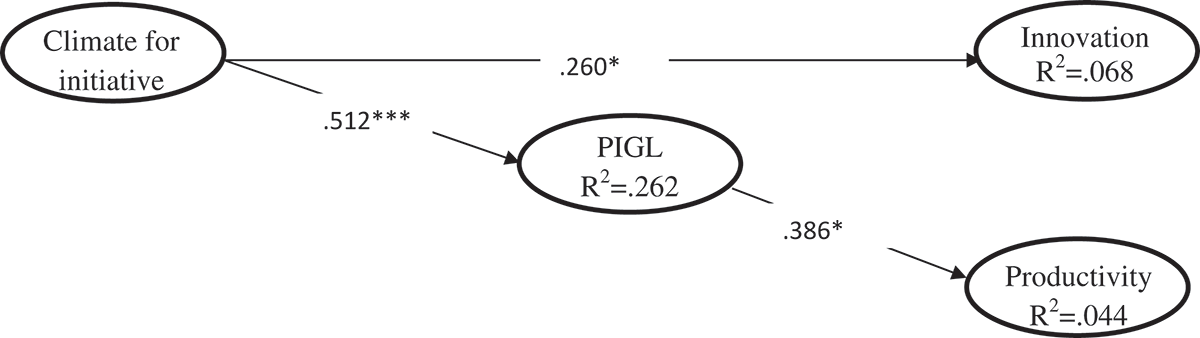
Discussion
This study set out to analyse personal initiative at group level as a collective psychosocial construct which can occur in a work team. The purpose of this study was to analyse the suitability of the personal initiative at group level construct by adapting and validating a scale that measures the construct. The results reveal that the Personal Initiative at Group Level Scale shows high reliability and, as expected, its items reflect a single factor. The results of the analyses performed allow us to corroborate some of the hypotheses posited. Specifically, they show that climate for initiative is positively related to personal initiative at group level (hypothesis 1). The empirical evidence also reveals that personal initiative at group level is positively related to team productivity (hypothesis 2) and that climate for initiative is positively related to radical innovation (hypothesis 3). The productivity and innovation of teams are complex processes in which a wide variety of variables come into play: at group level, the structure of the team or system of transactive memory; at individual level, skills, knowledge and psychological states; and at organizational level, human resources practices, culture and climate or external environment (Anderson et al., 2004). In this context, we believe that despite the fact that the proportion of variance explained by personal initiative is small, it has theoretical and practical interest and opens up future avenues of research.
The results of the aggregation analyses were high, reflecting a high level of shared perceptions, which could itself be considered additional proof of validity of the construct inasmuch as we are conceptualizing personal initiative at group level as a shared property. Even more importantly, our study reveals that the significance of the correlations of personal initiative on productivity and innovation and other statistical data, such as the AVE or the composite reliability coefficient, increases thanks to the data aggregation, which allows us — at least initially — to justify our proposals on personal initiative at group level, as well as its importance.
The conceptualization of personal initiative as a group variable has several implications. First, it serves as a bridge between the individual and the group level of the construct, thus expanding the explanatory power of the personal initiative model. It also contributes to our understanding of the work processes on teams associated with the team’s innovation and productivity.
Implications and practical applications
Our findings have several theoretical and practical implications. Theoretically, this study extends the current conceptualization of personal initiative at team level, expanding the theory of personal initiative and serving as a bridge between the individual and organizational levels of the construct. In this way, personal initiative at group level can play a mediating or moderating role when studying some group phenomena, so including it in the research on work teams may be useful.
Furthermore, our goal is for these findings to be useful in professional interventions following an approach with empirical evidence and for them to be able to translate into practice.
Likewise, as other authors have argued (e.g., Hakanen et al., 2008), personal initiative can be considered a resource according to the model of demands-resources (JD-R; Bakker & Demerouti, 2007). Individuals and teams which have more resources are capable of more easily getting other new resources, generating spirals of gains (Fredrickson, 2001). Envisioning personal initiative and, by extension, personal initiative at group level as a resource means that having this form of active performance and developing it and applying it in work environments will generate new resources for individuals, teams and organizations, making them less vulnerable to potential losses of resources, preventing burnout and promoting occupational health and sustainable performance.
On the applied level, our results suggest that organizations interested in accelerating the effectiveness of their work teams and corporate entrepreneurship should promote the active performance of their members by facilitating personal initiative, not only at individual and organizational levels but also at work team level. Organizations which are concerned with innovation, implementing changes and improving performance should also consider adding the personal initiative of their work teams to their agenda. This study provides a useful tool to evaluate personal initiative at group level, which can be used to measure and intervene in human resources management strategies and especially in the construction and development of high-performance teams. To do so, the previous literature has pointed out how proactiveness and personal initiative can benefit from training (Frese et al., 2007), and that it is possible to redesign some characteristics of the job, such as the control over and complexity of tasks (Frese & Fay, 2001; Frese et al., 2007; Parker, Williams, & Turner, 2006) to increase personal initiative. The leaders of work teams can also develop the personal initiative of individuals and their teams by providing support for the implementation of ideas and emphasizing the value of productivity and quality by example. Nonetheless, organizations must organize the work conditions with enough resources to generate positive spirals.
Limitations and future research
This study has some limitations which should be addressed in future studies. First, it used convenience sampling and its size may be small, although other studies with aggregate data used a similar number of teams (e.g., Le Blanc & González-Romá, 2012). Secondly, we should point out that the composition of the sample is clearly geared towards activity sectors that more intensively employ what are known as knowledge workers, which may be influencing our results. Therefore, it would be wise to continue the validation process of the Personal Initiative at Group Level (PIGL) Scale with other samples, both domestic and international, in which a confirmatory factor analysis is also applied in order to contrast the factor structure identified. Thirdly, the use of only one-item measures, as in radical innovation in our case, prevents us from calculating its reliability. Furthermore, the use of subjective measures in the dependent variables may entail different kinds of biases, despite the fact that some procedural measures were taken, like separating the predictive variables from the criterion statistical variables in the design of the questionnaire, as well as performing Harman’s single-factor test post hoc in the analysis. Therefore, in future studies objective measures of productivity and innovation should be used, even though the previous research has used this kind of measure.
Fifth, instead of a transversal design, in future studies the Personal Initiative at Group Level Scale could be included in longitudinal designs which provide more precise information on how the relationships in this variable take place over time.
Iniciativa en los equipos de trabajo: adaptación y validación de la Escala de Iniciativa Personal a nivel Grupal
Las organizaciones actuales operan en entornos cambiantes y turbulentos, caracterizados por niveles crecientes de complejidad, globalización e incertidumbre, que requieren de una continua adaptabilidad e interdependencia. En consecuencia, se espera que los empleados vayan más allá de los requisitos técnicos de sus puestos de trabajo actuales o, de lo contrario, sus organizaciones irán perdiendo ventajas competitivas en sus mercados (Frese & Fay, 2001; Frese, Garst, & Fay, 2007; Lisbona & Frese, 2012).
Limitarse a hacer lo que se les pide no permite, en términos competitivos, un desempeño eficiente en tales ambientes, por lo que los individuos deben desplegar un rango más amplio de comportamientos, (Griffin, Neal, & Parker, 2007; Hakanen, Perhoniemi, & Toppinen-Tanner., 2008). La iniciativa personal es uno de estos nuevos conceptos de desempeño laboral activo y ha sido definida como un síndrome conductual dirigido hacia el trabajo que se caracteriza por ser autoiniciado, proactivo, persistente, capaz de modificar el ambiente y pro-organización (Frese & Fay, 2001; Frese, Fay, Hilburger, Leng, & Tag, 1997, Frese et al., 2007; Lisbona & Frese, 2012).
Frese y Fay (2001) desarrollan un modelo teórico de la iniciativa personal en el que identifican sus antecedentes y consecuencias. Entre los antecedentes, el modelo distingue entre causas proximales, que incluyen las orientaciones, con una especificidad media y orientadas a la acción; y causas distales, que recogen la personalidad, los conocimientos, destrezas y las habilidades (Frese & Fay, 2001). Las evaluaciones del control, la autoeficacia, las aspiraciones de control y responsabilidad, la orientación al cambio, el manejo de los errores y coping activo son las orientaciones más predictivas de la iniciativa personal frente a las causas distales, que son más generales. Los apoyos ambientales se encuentran entre las causas proximales y las distales. El modelo recoge, por último el hecho de que la iniciativa ejerce una influencia a nivel individual y organizacional en el desempeño.
La iniciativa personal como fenómeno a nivel grupal
La investigación en iniciativa personal se ha centrado fundamentalmente en el nivel individual y, en menor medida, en el nivel organizacional, éste a través del concepto de clima para la iniciativa (Baer & Frese, 2003), por lo que no se ha prestado mucha atención al nivel grupal del constructo. Sin embargo, la literatura viene señalando que los equipos de trabajo juegan un papel crucial en la consecución de la eficiencia y de la competitividad de las organizaciones, hasta el punto que el grupo, como unidad básica de trabajo, se ha convertido en las últimas décadas en un elemento central del funcionamiento de las organizaciones (Rico, Alcover, & Tabernero, 2010).
Por todo ello, en este estudio argumentamos la existencia del constructo de iniciativa a nivel grupal, que se produciría en el seno de los equipos de trabajo y que, conceptualmente, actuaría como puente entre la iniciativa personal a nivel individual y la iniciativa personal a nivel organizacional, lo que se ha denominado clima para la iniciativa personal. Esta conceptualización de la iniciativa personal como un fenómeno colectivo en el seno de los equipos de trabajo se basa en determinadas aportaciones que la psicología social ha realizado desde hace décadas y, más concretamente, en aquellas relativas a la teoría social cognitiva (Bandura, 2001) y a los procesos emocionales en contextos laborales y su influencia en el rendimiento y el bienestar (Totterdell & Niven, 2014).
Identificamos, de este modo, tres argumentos complementarios para sostener nuestra proposición de una iniciativa personal a nivel grupal. Por un lado, desde un punto de vista cognitivo, cuando las personas trabajan juntas, pueden construir y compartir creencias y experiencias afectivas mediante diversos mecanismos de aprendizaje social, de tal forma que muestren patrones motivacionales y comportamentales similares ante eventos compartidos (Totterdell & Niven, 2014). Así, las personas que trabajan en el mismo equipo tienen más oportunidades de interactuar entre sí y de influirse recíprocamente mediante mecanismos de aprendizaje social.
Por otro lado, desde un punto de vista de los estados afectivos y las emociones, está el concepto de contagio emocional como vía de transferencia emocional. El contagio emocional es el mecanismo que induce un estado afectivo congruente mediante la observación de la manifestación pública del estado afectivo de otra persona, ‘capturando’ sus emociones (Hatfield, Cacioppo, & Rapson, 1993).
Estudios recientes han mostrado los efectos del contagio emocional en los grupos y en las organizaciones. Así, Sy, Côté, y Saavedra (2005) encuentran empíricamente que los líderes transmiten sus estados afectivos a otros miembros del equipo a través del contagio emocional. Los afectos de los líderes se transfieren a otros miembros, lo que a su vez impacta en los esfuerzos y en la coordinación del grupo. Bono e Ilies (2006) muestran evidencia empírica de que los líderes más carismáticos expresan más emociones positivas que los líderes menos carismáticos y que sus expresiones emocionales positivas tienen un efecto directo en los estados emocionales de sus colaboradores, incluso cuando las interacciones son breves y casuales, aumentando la efectividad percibida del líder. Esos hallazgos son congruentes con la investigación sobre liderazgo transformacional y sobre liderazgo auténtico (Walumbwa, Avolio, Gardner, Wernsing, & Peterson, 2008). Por último, además de la influencia líder-miembros del equipo, los propios miembros del equipo se influyen recíprocamente (Ilies, Wagner, & Morgeson, 2007). Más recientemente, el contagio emocional ha sido utilizado en los estudios sobre work engagement como principal mecanismo para explicar el team work engagement, hablando por tanto de ‘estados emocionales colectivos’ en los que se comparten sentimientos a nivel del equipo de trabajo (Torrente, Salanova, & Llorens, 2013).
La importancia de las emociones positivas queda subrayada por la teoría abierta y construida (broaden-and-build theory; Fredrickson, 2001), que sostiene que las emociones positivas no sólo caracterizan el bienestar o la satisfacción de los empleados, sino que además producen un funcionamiento óptimo a largo plazo, ampliando los repertorios de pensamiento-acción y construyendo recursos personales duraderos.
Por último, de la misma manera que Costa, Passos, y Bakker (2014) conciben el team work engagment como un estado emergente del equipo, en nuestro trabajo se conceptualiza la iniciativa personal a nivel grupal como un estado emergente del equipo. Entendemos como procesos emergentes de abajo a arriba aquellos procesos de un nivel más bajo que combinan, comparten y se manifiestan como un fenómeno colectivo (Kozlowski & Klein, 2000; Rousseau, 1985). La distinción que realizan Marks, Mathieu, y Zaccaro (2001) entre procesos de equipo y estados emergentes de equipo, puede resultar de utilidad a la hora de comprender la conceptualización de la iniciativa personal a nivel grupal como fenómeno colectivo. Frente al inventario de actuaciones que se llevan a cabo por los miembros del grupo en los procesos de equipo, con características como ser interdependientes y que se definen por el hecho de convertir un input en un output a través de actividades verbales, conductuales y cognitivas para que a través de la organización de una serie de tareas se consigan los objetivos del equipo, los estados emergentes tienen un carácter más dinámico y se definen como estados cognitivos, motivacionales y afectivos de los equipos, y no como la suma de los estados cognitivos, motivacionales y afectivos de los miembros del equipo (Marks et al., 2001). Es decir, los estados emergentes se refieren a cualidades de los equipos que representan las actitudes, valores, cogniciones, conductas y motivaciones que tienen en común los miembros de un equipo, no la suma de sus interacciones. El origen de la investigación en torno a los procesos emergentes tiene su origen en la teoría del caos y parece imprescindible para entender la complejidad y la efectividad en las organizaciones (Costa et al., 2014; Kozlowski & Klein, 2000).
Por tanto, se propone que la iniciativa personal a nivel grupal es un constructo colectivo, que puede producirse en el equipo de trabajo y que se define, de acuerdo con la conceptualización de la iniciativa personal (Frese & Fay, 2001), como un síndrome conductual en el que el equipo manifiesta una aproximación al trabajo autoiniciada, proactiva, persistente, capaz de modificar el ambiente y pro-organización.
El trabajo de Brav, Anderson, y Lantz (2009) utiliza una escala similar a la nuestra, pero no conceptualizan la iniciativa grupal como un fenómeno colectivo ni analizan las propiedades psicométricas de una escala conceptualizada a nivel grupal.
Conceptualizar la iniciativa personal a nivel grupal implica que se trata de un constructo compartido en el equipo, no es la mera suma de las iniciativas individuales. Así, las percepciones individuales deben converger y debe existir una suficiente homogeneidad intra-grupal a nivel de equipo de trabajo. Esa homogeneidad intra-grupal es una muestra de que existe esa percepción compartida, que está implícita en la propia definición del concepto. El cálculo de los diferentes índices estadísticos (que se detallarán a lo largo del trabajo) que permita realizar la agregación estadística de los datos individuales en datos de equipo no constituye solo un mero análisis estadístico, sino que reforzará el hecho de que la iniciativa personal a nivel grupal es algo más que la suma de iniciativas individuales, en definitiva que es una percepción compartida sobre la iniciativa como equipo de trabajo.
El objetivo del presente estudio es someter a prueba nuestra conceptualización de la iniciativa personal como fenómeno que puede producirse en el equipo de trabajo, adaptando y validando una escala de Iniciativa Personal a nivel Grupal (IPG). Desde el punto de vista psicométrico, esperamos que la iniciativa personal a nivel grupal responderá, al igual que en el nivel individual, a un único factor para explicar su dimensión y cuente con una fiabilidad y validez (convergente, discriminante y concurrente) adecuadas. Asimismo, se analizarán las relaciones de ésta variable con variables de resultado relacionadas con el desempeño organizacional, que se detallarán a continuación.
Dado que el clima para la iniciativa se refiere a una faceta del clima organizacional (Baer & Frese, 2003) y es, por tanto, un fenómeno colectivo, entendemos que estará en parte relacionado con la iniciativa personal a nivel grupal, si bien ésta última tendrá un mayor poder predictivo sobre los fenómenos grupales. El Clima para la Iniciativa está positivamente relacionado con la Iniciativa Personal a nivel Grupal (IPG).
Iniciativa personal a nivel grupal y desempeño organizacional: productividad e innovación
El modelo teórico de Frese y Fay (2001) señala como resultados un elevado desempeño y una alta efectividad organizacional. En nuestro caso, vamos a centrarnos en dos aspectos importantes del desempeño: la productividad del equipo, por un lado, y su contribución a la innovación de la organización, por otro.
La innovación se refiere a la generación e implementación de ideas creativas y, gracias a que permite a las organizaciones adaptarse a las cambiantes condiciones del entorno, es un componente clave en el éxito de las mismas. La innovación tiene un potencial de creación de valor, tanto para nuevas empresas como para las ya establecidas, que aumenta en la medida en que nos referimos a organizaciones con estructuras más bien planas, flexibles y ajustadas en lugar de a las organizaciones más burocráticas (Anderson, De Dreu, & Nijstad, 2004). La innovación, además, es vista por algunos autores como un indicador de funcionamiento óptimo y de salud mental activa (Binnewies & Gromer, 2012). Aunque hay estudios que han empleado medidas objetivas para evaluar la innovación — como el número de sugerencias realizadas, el número de nuevos productos o el de patentes registradas — frecuentemente la innovación a nivel de equipo ha sido evaluada por los miembros del equipo o por los supervisores (Hülsheger, Anderson, & Salgado, 2009). Además, es un proceso complejo que necesita considerar como antecedentes aspectos individuales, grupales y organizacionales. La literatura reconoce la importancia de la innovación no sólo para las grandes empresas multinacionales, sino también para las pequeñas y medianas empresas y para organizaciones no lucrativas (Rosenbusch, Brinckmann, & Bausch, 2011).
Recientemente, diversos estudios han distinguido entre innovación radical e innovación incremental (Fischer et al., 2014). La innovación incremental es la capacidad para generar innovaciones que refinen y refuercen los productos y servicios existentes (Subramaniam & Youndt, 2005), mientras que la innovación radical da lugar a cambios fundamentales en las actividades de la organización o del sector con respecto a las prácticas vigentes (Camison-Zornoza, Lapiedra-Alcamí, Segarra-Cipres, & Boronat-Navarro, 2004). Los competidores responden usualmente con rapidez a la innovación incremental. Por el contrario, la innovación radical es mucho más difícil de ser respondida con éxito en el corto plazo y, a consecuencia de ello, suele implicar incrementos de los márgenes y beneficios de las empresas.
La relación entre iniciativa personal e innovación ha sido estudiada en diversos trabajos previos (Binnewies & Gromer, 2012; Binnewies, Ohly, & Sonnentag, 2007; Fischer et al., 2014; Frese, Rooks, & Sserwanga, 2014). Frese et al. (2014) encontraron relación entre iniciativa personal e innovación en emprendedores en el ámbito rural, pero no así en el ámbito urbano, y obtuvieron evidencia favorable de que el clima para la iniciativa estaba relacionado con la innovación organizacional. Por su parte, Fischer et al. (2014) profundizaron en esa relación y encontraron empíricamente que el clima para la iniciativa se relacionaba con la innovación radical, pero no así con la innovación incremental. La definición de iniciativa personal hace pensar que su concepción proactiva implique un mayor peso sobre la innovación radical frente a la innovación incremental. Asimismo, la innovación parece depender más de aspectos organizacionales que de aspectos grupales, por eso, al igual que en el trabajo de Fischer et al. (2014), esperamos que el clima para la iniciativa se relacione con la innovación radical y la iniciativa personal al nivel grupal lo haga con la productividad. La Iniciativa Personal a nivel Grupal (IPG) estará positivamente relacionada con la productividad del equipo de trabajo. El Clima para la Iniciativa Personal estará positivamente relacionada con la innovación radical de la organización.
Método
Desarrollo de la escala iniciativa personal a nivel grupal (IPG)
Para la generación de los ítems de la escala de Iniciativa Personal a nivel Grupal (IPG) se partió de la escala de Iniciativa Autoinformada de Frese et al. (1997) adaptada al español por Lisbona y Frese (2012), y se modificó el nivel de definición del constructo, pasando de la organización al equipo de trabajo. Al igual que en la versión individual, esta nueva escala se compuso de siete ítems. La escala de Iniciativa Autoinformada ha sido utilizada en numerosos estudios durante la última década y es considerada una medida adecuada de la conducta de iniciativa personal al capturar, de forma directa y amplia, cogniciones y otras facetas de la conducta que no siempre están presentes en otras técnicas (Bledow & Frese, 2009).
Participantes
El estudio se ha realizado sobre una muestra de 399 empleados (51.5% mujeres y 48.5% hombres) organizados en 91 equipos de trabajo pertenecientes a 60 organizaciones distintas. De estos 399 empleados, 308 son miembros de los equipos de trabajo y 91 son supervisores de esos mismos equipos. Respecto a las organizaciones, están situadas en España (95.8%, donde: 46.0% País Vasco, 23.0% Madrid, 9.2% Galicia, 6.3% Barcelona, 5.9% Andalucía, y 4.6% otras) y Chile (4.2%); y comprenden empresas privadas (71.3%), administraciones públicas (17.5%), organizaciones no lucrativas (7.3%) y de otro tipo (3.8%). Por tamaño, se clasifican en organizaciones de más de 250 trabajadores (39.9%), de entre 50 y 250 trabajadores (22.0%), de entre 10 y 49 trabajadores (28.0%) y de menos de 10 trabajadores (10.1%). La muestra se compone de un número heterogéneo de sectores: enseñanza y educación (18.4%), selección y trabajo temporal (16.0%), consultoría y asesoría (11.0%), formación y coaching (9.6%), salud (9.2%), inserción y desarrollo local (7.9%), industria (7.4%), seguros (6.0%), distribución (3.2%), marketing (3.2%), software (2.8%), mantenimiento industrial (2.1%), y otros (3.2%).
Los equipos de trabajo están compuestos, sin contar al líder, mayoritariamente por entre cuatro y ocho miembros (63.6%) o por menos de cuatro miembros (25.7%). Son equipos presenciales (83.2%) en los que sus miembros se mantienen de forma estable y permanente (92.0%). Los participantes tienen una edad media de 41 años (DT = 10.1) y una antigüedad media en la organización de 11.2 años (DT = 8.8). Cuentan en gran medida con estudios universitarios (84.2%) y, en menor medida, de formación profesional (12.1%).
Procedimiento
A través de personas clave de su estructura, se invitó a las organizaciones a participar en el estudio. El objetivo e hipótesis del estudio permanecieron ciegos para las personas clave, miembros de los equipos y supervisores, indicándoseles simplemente que el objetivo era analizar los equipos de trabajo. Siguiendo a Kozlowski y Bell (2003), se empleó la definición de equipos de trabajo como aquellos colectivos que existen para realizar tareas organizacionalmente relevantes, que mantienen un cierto grado de interdependencia tanto en términos de objetivos como de tarea, gestionan y mantienen sus límites y están inmersos en un contexto organizacional que limita su actividad e influye sobre sus intercambios con otros equipos dentro de la organización.
Se fijaron los siguientes criterios de inclusión para los equipos de trabajo: (a) estar en activo y contar con una actividad mínima de seis meses; (b) estar compuestos por un mínimo de tres miembros (sin contar al líder); (c) obtener, al menos, respuestas al cuestionario de dos miembros por equipo; (d) contar con un único líder por equipo y obtener su respuestas al cuestionario; y (e) limitar a un máximo de cinco el número de equipos distintos por organización. Tanto la definición de los equipos de trabajo como los criterios de inclusión fueron presentados y explicados a las personas clave con el fin de identificar los equipos en sus organizaciones.
Se elaboraron dos cuestionarios distintos, uno para los miembros de los equipos y otro para los supervisores de los mismos. Ambos cuestionarios se administraron voluntariamente vía web. Se garantizó el anonimato y la confidencialidad de los datos. El cuestionario para el líder se administró después de comprobar que los miembros del equipo habían respondido.
Instrumentos
Con el fin de minimizar el sesgo de la varianza del método común, se han utilizado dos cuestionarios: uno para los miembros del equipo en el que se miden las variables predictoras y otro para los supervisores de los equipos en el que se miden las variables criterio.
Medidas para los miembros del equipo
Iniciativa Personal a nivel Grupal (IPG)
Para evaluar la Iniciativa Personal a nivel Grupal se partió de la escala de Iniciativa Autoinformada de Frese et al. (1997) adaptada al español por Lisbona y Frese (2012) y se modificó el nivel de definición del constructo, pasando de la organización al equipo de trabajo. Esta nueva escala se compone de siete ítems con un formato de respuesta tipo Likert desde 1 (‘Totalmente en desacuerdo’) a 5 (‘Totalmente de acuerdo’). Un ejemplo de los ítems es: ‘La gente en nuestro equipo se enfrenta activamente a los problemas’.
Clima para la iniciativa
Para evaluar el clima para la iniciativa se empleó la escala de Clima para la Iniciativa de Baer and Frese (2003) adaptada al español por Lisbona, Palací y Gómez-Bernabeu (2008). Esta escala se compone de siete ítems tipo Likert desde 1 (‘Totalmente en desacuerdo’) a 5 (‘Totalmente de acuerdo’).Un ejemplo de los ítems es: ‘La gente en nuestra organización se enfrenta activamente a los problemas’.
Medidas para los supervisores
Productividad
Se emplearon dos ítems de la escala utilizada por Hannah, Walumbwa, y Fry (2011) Un ejemplo es: ‘En mi equipo, la calidad del trabajo es una alta prioridad para todos los miembros’. Para las respuestas se utilizó una escala tipo Likert, desde 1 (‘Totalmente desacuerdo’) a 5 (‘Totalmente de acuerdo’).
Innovación radical
Se usó el índice de innovación radical de Fischer et al. (2014), con un único ítem que presenta la definición de innovación radical: ‘La innovación radical da lugar a cambios fundamentales en las actividades de la organización o el sector con respecto a las prácticas vigentes. Plantea nuevas preguntas, desarrolla nuevas habilidades técnicas y comerciales y nuevas formas de resolver problemas’. La escala de respuesta es: 1 (‘Ninguna gran innovación’), 2 (‘La misma o muy similar innovación que la adoptada por los competidores’), 3 (‘Similar innovación que la adoptada por otras organizaciones del sector pero nuestra innovación difiere de forma identificable de las innovaciones de otras organizaciones’), 4 (‘Similar innovación que la adoptada en otros sectores’), 5 (‘Innovación fundamentalmente nueva para la organización’) y 6 (‘Innovación fundamentalmente nueva para el mercado’).
Análisis de datos
En primer lugar, se calcularon los estadísticos descriptivos de todas las variables, tanto a nivel individual como con los datos agregados, dado que las variables predictoras se midieron a nivel de equipo de trabajo. Para ello se realizaron los análisis de agregación de las respuestas individuales empleando varios índices de acuerdo, utilizando dos enfoques complementarios: El primero, basado en la consistencia, empleó el Coeficiente de Correlación Intraclase ICC 1 (referido a la variabilidad individual explicada por la pertenencia al equipo de trabajo) y el Coeficiente de Correlación Intraclase ICC 2 (que considera la fiabilidad de las medidas grupales). Los valores superiores a .12 para ICC 1 y superiores a .60 para ICC 2 son considerados un nivel adecuado de acuerdo intra-unidad. El segundo enfoque se basa más en el consenso y se empleó el Índice de Desviación Promedio (AD M(J)). Se escogió este índice frente a r wg por sus ventajas: no necesita modelar la distribución de respuestas nulas o arbitrarias y estima el acuerdo en la métrica de la escala original de respuesta. Se consideró el acuerdo a nivel de equipo cuando el valor del AD M(J) era igual o inferior a 1.
Para confirmar la estructura de un único factor de la escala de Iniciativa Personal a nivel Grupal (IPG) se llevó a cabo un análisis factorial confirmatorio utilizando un Modelo de Ecuaciones Estructurales.
También se utilizaron ecuaciones estructurales para analizar la validez concurrente y contrastar las tres hipótesis del estudio, el método de estimación utilizado fue el de máxima verosimilitud, considerando como estadísticos de bondad de ajuste tres índices absolutos: χ2, Root Mean Square Error of Approximation (RMSEA) y Standardized Root Mean Square Residual (SRMR).
Como el estadístico χ2 es sensible al tamaño de la muestra, se recomienda el uso de índices relativos para evaluar la bondad del ajuste de los modelos, por eso se consideró también el Comparative Fit Index (CFI) y el TLI. Para el RMSEA y para el SRMR, valores menores a .08 se consideran indicativos de un ajuste aceptable, si los valores son menores a .05 se consideran indicativos de un ajuste excelente (Hu & Bentler, 1999). Para el CFI y el TLI, valores iguales o mayores a .90 se consideran indicativos de un buen ajuste.
Se utilizó el paquete SPSS Statistics 22 para el análisis de datos y AMOS 22 para los análisis con ecuaciones estructurales.
Resultados
Debido a la naturaleza de autoinforme de los datos, se llevó a cabo el test de un único factor de Harman mediante análisis factorial exploratorio con el fin de verificar si se había producido el sesgo de la varianza del método común. Los resultados del test indican la presencia de cuatro factores discretos en el conjunto de datos, que explican el 68.91% de la varianza. El primero de ellos explica el 38.35% de la varianza, el segundo el 14.42% y el tercero el 8.65%. Estos resultados son consistentes con nuestras proposiciones y sugieren que la varianza del método común no ha sido un contaminante probable en el estudio.
Análisis de la fiabilidad
Estadísticos descriptivos.
Nota: Se presentan las correlaciones a nivel individual — bajo la diagonal — (N = 289) y a nivel de equipo de trabajo — sobre la diagonal — (N = 85). Raíz Cuadrada del AVE ente paréntesis en la diagonal, a nivel de equipo de trabajo en primer lugar y con las puntuaciones sin agregar debajo.
aReportado por los supervisores.
**p < .01; *p < .05.
Estadísticos (media, desviación típica, sesgo, curtosis) escala Iniciativa Personal a nivel Grupal (IPG).
Cargas Factoriales (λ, valores de t, coeficientes de fiabilidad y Average Variance Extracted (AVE).
En la Tabla 2 se muestran los estadísticos descriptivos de los siete ítems de la escala de iniciativa personal a nivel grupal, que incluyen valores de tendencia central, variabilidad, asimetría y curtosis.
Análisis factorial confirmatorio
Se ha realizado un análisis factorial confirmatorio mediante SEM para comprobar que la estructura factorial de la escala de Iniciativa Personal a nivel Grupal (IPG) es la misma que la escala de Iniciativa Personal a nivel individual utilizando el método de máxima verosimilitud
El modelo de un único factor cuenta con un ajuste adecuado [χ2 (14) = 73.14, p < .000, RMSEA = .117, CFI = .945; TLI = .889; SRMR = .0417], a excepción del índice absoluto RMSEA, ligeramente superior a .100.
Análisis descriptivo y agregación de datos
Las medias, desviaciones típicas, alpha de Cronbach, correlaciones a nivel individual (N = 289) y a nivel grupal (N = 85) y los índices de agregación se muestran en la Tabla 1. Los alpha de Cronbach fueron satisfactorios. Las correlaciones entre las variables a nivel individual sólo mostraron relaciones significativas entre la Iniciativa Personal a nivel Grupal (IPG) y el Clima para la Iniciativa (r = .55, p < .01).
Respecto a los índices de consistencia y acuerdo para los datos agregados, las puntuaciones de ICC 1 (.56 y .71) y de ICC 2 (.91 y .95) fueron adecuadas. En el cálculo del índice AD M(J), seis de los 91 equipos de trabajo obtuvieron puntuaciones superiores al criterio establecido, por lo que fueron eliminados de los análisis posteriores. Para la muestra resultante de N = 85 las puntuaciones fueron de .47 y .49. Estos resultados permiten justificar empíricamente la agregación de las percepciones de los miembros a nivel del equipo de trabajo. La base de datos agregados se obtuvo, así, con las puntuaciones medias grupales y, a partir de estos datos agregados, se calcularon las correlaciones entre las variables a nivel de equipo. Estas correlaciones a nivel agregado mostraron relaciones positivas y significativas entre la Iniciativa Personal a nivel Grupal y el Clima para la Iniciativa (r = .52, p < .01), entre la Iniciativa Personal a nivel Grupal y la Iniciativa radical (r = .31, p < .01) y entre el Clima para la Iniciativa y la Iniciativa radical (r = .23, p < .05) .Tal y como se esperaba, las correlaciones a nivel del equipo de trabajo mostraron mayor significación estadística que las correlaciones a nivel individual.
Validez convergente
Para considerar la validez convergente, las cargas factoriales estandarizadas (λ) de los constructos latentes (Iniciativa Personal a nivel Grupal y el Clima para la Iniciativa) deben ser estadísticamente significativas. En todos los casos los valores de λ son superiores a .50 y los valores de t superan el valor de 1.96 (p < .001; véase Tabla 3). Por tanto, se puede afirmar que la validez convergente es adecuada.
Validez discriminante
El criterio para evaluar la validez discriminante entre las dos variables predictoras evaluadas por los miembros del equipo ha sido que la raíz cuadrada del AVE fuera superior a la correlación entre la Iniciativa Personal a nivel Grupal y el Clima para la Iniciativa. En la Tabla 3 aparecen los valores de la raíz cuadrada del AVE. Para la variable Iniciativa Personal a nivel Grupal los valores de la raíz cuadrada del AVE para las puntuaciones agregadas e individuales son .860 y .739, respectivamente y para la variable Clima para la Iniciativa .798 y .773 para las puntuaciones agregadas e individuales, respectivamente. El valor de la correlación entre ambos constructos es inferior tanto para las puntuaciones agregadas .52, como para las puntuaciones individuales .55, por lo que podemos afirmar que la validez discriminante es adecuada.
Validez concurrente y contraste de hipótesis
Para contrastar las hipótesis propuestas y analizar la validez concurrente se puso a prueba un modelo estructural en el que el clima aparece relacionado con la iniciativa personal a nivel grupal y la relación con las variables criterio es la siguiente: el clima para la iniciativa personal a nivel grupal se relaciona con la productividad del equipo y el clima para la iniciativa con la innovación radical, con los datos agregados (N = 85).
En la Figura 1 puede verse cómo las relaciones entre todas las variables fueron significativas. Además, el ajuste del modelo es adecuado [χ2
(109) = 207.65, p < .001, RMSEA = .105, CFI = .913; TLI = .892; SRMR = .0576], con la excepción del índice absoluto RMSEA, ligeramente superior a .100. Por último el porcentaje de varianza explicado era el esperado, con un valor bajo debido a la complejidad de fenómenos relacionados con el desempeño, como son la productividad (con un 4.4% de la varianza total explicada) y la innovación (con un 6.8% de la varianza total explicada). Si bien el porcentaje de varianza explicado de la iniciativa personal a nivel grupal es algo superior, con un 26.2% de la varianza total explicada. Modelo de Ecuaciones estructurales.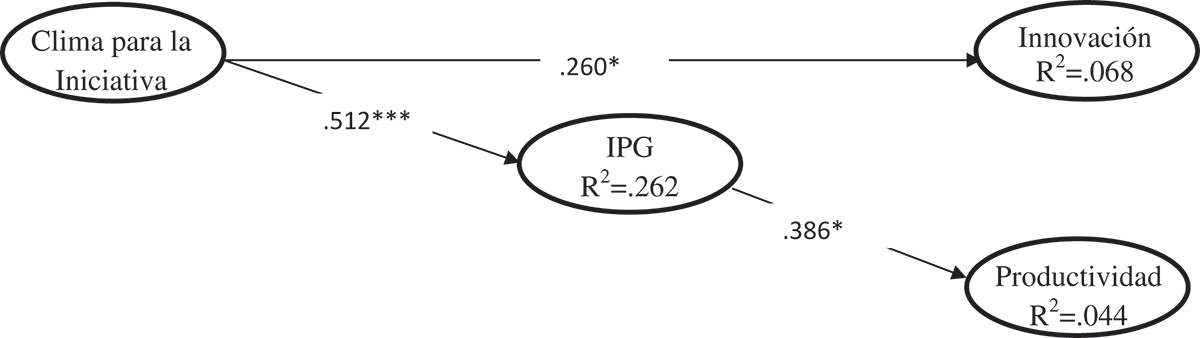
Discusión
En este estudio se propone analizar la iniciativa personal a nivel grupal como un constructo psicosocial colectivo, que puede producirse en el equipo de trabajo. El objetivo de este estudio era analizar la idoneidad del constructo de iniciativa personal a nivel grupal, adaptando y validando una escala que mida el constructo. Los resultados revelan que la escala de Iniciativa Personal a nivel Grupal obtiene una fiabilidad alta y, tal y como se esperaba, que sus ítems responden a un único factor. Los resultados de los análisis efectuados permiten corroborar algunas de las hipótesis planteadas. Concretamente, se muestra que el Clima para la Iniciativa está positivamente relacionado con la Iniciativa Personal a nivel Grupal (hipótesis 1). La evidencia empírica también revela que la Iniciativa Personal a nivel Grupal está positivamente relacionada con la productividad del equipo (hipótesis 2) y que el Clima para la Iniciativa está positivamente relacionado con la innovación radical (hipótesis 3). La productividad y la innovación de los equipos son procesos complejos e intervienen muy diversas variables; así, a nivel grupal, los procesos grupales, la estructura del equipo o el sistema de memoria transactiva; a nivel individual, las habilidades, conocimientos o estados psicológicos; y a nivel organizacional, las prácticas de recursos humanos, la cultura y el clima o el ambiente externo (Anderson et al., 2004). En este contexto consideramos que a pesar de que la proporción de varianza explicada por la iniciativa personal es pequeña tiene interés teórico y práctico, y abre futuras líneas de investigación.
Los resultados de los análisis de agregación fueron altos, reflejando un elevado nivel de percepciones compartidas, lo que podría considerarse en sí mismo un elemento adicional de validez del constructo en la medida en que estamos conceptualizando la Iniciativa Personal a nivel Grupal como una propiedad compartida. Más importante todavía, nuestra investigación pone de manifiesto que la significación de las correlaciones de la iniciativa personal sobre la productividad y la innovación y otros datos estadísticos, como por ejemplo el AVE o el coeficiente de fiabilidad compuesta, aumenta gracias a la agregación de datos, lo que nos permite justificar, al menos inicialmente, nuestras propuestas sobre la iniciativa personal a nivel grupal, así como la importancia de la misma.
La conceptualización de la iniciativa personal como variable grupal tiene varias implicaciones. Por una parte sirve de puente entre el nivel individual y grupal del constructo, ampliando de esta manera el poder explicativo del modelo de iniciativa personal. Asimismo contribuye a la comprensión de los procesos de trabajo en equipo vinculados con la innovación y la productividad de los equipos.
Implicaciones y aplicaciones prácticas
Nuestros hallazgos tienen algunas implicaciones teóricas y prácticas. A nivel teórico, este estudio extiende la conceptualización actual de la iniciativa personal al nivel de equipo de trabajo, ampliando la teoría de la iniciativa personal y sirviendo de puente entre los niveles individual y organizacional del constructo. De este modo, la iniciativa personal a nivel grupal puede jugar un papel mediador o moderador a la hora de estudiar determinados fenómenos grupales, por lo que su inclusión en la investigación sobre equipos de trabajo podría ser de utilidad.
Pretendemos, además, que estos hallazgos puedan ser de utilidad en la intervención profesional siguiendo un enfoque de evidencia empírica y pudiendo traducirse en prácticas.
Además, tal y como han argumentado otros autores (e.g., Hakanen et al., 2008), la iniciativa personal puede ser considerada un recurso, de acuerdo con el modelo de demandas-recursos (JD-R; Bakker & Demerouti, 2007). Aquellos individuos y equipos que disponen de más recursos son capaces de obtener más fácilmente otros nuevos generando espirales de ganancias (Fredrickson, 2001). Concebir la iniciativa personal y, por extensión, la iniciativa personal a nivel grupal como un recurso, supone que disponer de esta forma de desempeño activo, desarrollarla y aplicarla en su entorno de trabajo generará nuevos recursos para los individuos, equipos y organizaciones, haciéndoles menos vulnerables ante la eventual pérdida de recursos, previniendo el burnout y promoviendo la salud ocupacional y el rendimiento sostenible.
A nivel aplicado, nuestros resultados sugieren que las organizaciones interesadas en acelerar la efectividad de sus equipos de trabajo y del emprendimiento corporativo deberían promocionar el desempeño activo de sus miembros facilitando la iniciativa personal, no sólo a nivel individual y organizacional, sino también a nivel del propio equipo de trabajo. También aquellas organizaciones preocupadas por la innovación, la implementación de cambios y la mejora de su rendimiento deberían contemplar en su agenda el impulso de la iniciativa personal de sus equipos de trabajo. El estudio facilita una herramienta útil de evaluación de la iniciativa personal a nivel grupal, que puede ser empleada para la medición e intervención en estrategias de la gestión de recursos humanos y, especialmente, en la construcción y el desarrollo de equipos de alto rendimiento. Para ello, la literatura previa ha venido señalando cómo la proactividad y la iniciativa personal pueden beneficiarse de la formación (Frese et al., 2007), así como es posible rediseñar algunas características del puesto de trabajo, como el control y la complejidad de las tareas (Frese & Fay, 2001; Frese et al., 2007; Parker, Williams, & Turner, 2006), para aumentar la iniciativa personal. Los líderes de los equipos de trabajo, además, pueden desarrollar la iniciativa personal de los individuos y de sus equipos facilitando apoyo a la implementación de ideas y enfatizando con su ejemplo el valor de la productividad y la calidad. Con todo, las organizaciones deberían organizar las condiciones de trabajo con suficientes recursos con el fin de generar espirales positivas.
Limitaciones y futuras investigaciones
Este estudio presenta algunas limitaciones que deberían ser abordadas en futuras investigaciones. En primer lugar, se ha empleado una muestra de conveniencia y su tamaño puede resultar pequeño, si bien otros estudios con datos agregados emplean un número de equipos similar (e.g., Le Blanc & González-Romá, 2012). En segundo lugar, puede señalarse que la composición de la muestra está claramente orientada hacia sectores de actividad que emplean de forma más intensiva a los llamados trabajadores del conocimiento, lo que puede estar influyendo sobre los resultados encontrados. Por ello, es conveniente continuar el proceso de validación de la escala de Iniciativa Personal a nivel Grupal (IPG) con otras muestras tanto nacionales como internacionales en las que, además, se aplique un análisis factorial confirmatorio a fin de contrastar la estructura factorial identificada. En tercer lugar, el uso de medidas de un solo ítem, como en nuestro caso la innovación radical, no permite calcular su fiabilidad. Además, el empleo de medidas subjetivas en las variables dependientes puede implicar distintos tipos de sesgos, a pesar de que se han tomado algunas medidas al respecto bien de tipo procedimental, como separar en el diseño del cuestionario las variables predictoras de las variables criterio, bien de tipo estadístico, como realizar el análisis post-hoc del test de un único factor de Harman. Por ello, sería conveniente emplear en próximos estudios medidas objetivas de productividad e innovación, si bien la investigación previa ha utilizado este tipo de medición.
En quinto lugar, frente a un diseño transversal, en futuras investigaciones podría incluirse la escala de Iniciativa Personal a nivel Grupal en diseños longitudinales que permitan apreciar de forma más precisa cómo se producen las relaciones de esta variable a lo largo del tiempo.
