







Abstract
This study explores the influences of organizational socialization on the intention to stay and innovative behaviours using a two-time design with a sample (N = 308) of volunteers who provide advice and guidance. Furthermore, it analyses the mediating role of perceptions of organizational justice on the relationships between socialization and results. Our findings support the proposed hypotheses; that is, they showed that the higher the organizational socialization, the higher the intention to stay and the more innovative behaviour shown by the volunteers, and that both effects are mediated by the perceived organizational justice. The practical implications are discussed.
Volunteers are extremely important in Western societies today (Jaraíz-Arroyo, 2015). On the one hand, volunteering provides countless benefits to the recipients of the services and to society at large. On the other hand, participation in volunteer jobs has positive implications for the volunteers themselves, such as an increase in their community involvement, the consolidation of their social network and an increase in their life satisfaction, among others (Gow, Avlund, & Mortensen, 2014; Jones, 2016). It also allows volunteer organizations to achieve their institutional objectives. Among volunteer organizations, there is a group devoted to legal, business or professional advice or guidance. Their members include people with high educational levels who guide others with legal problems, setting up new companies or dealing with administrative paperwork. This study is conducted with volunteers belonging to NGOs with these characteristics.
When volunteers join their organizations, they go through a process of organizational socialization (henceforth, OS) in which they learn about the organization to which they belong and develop their perceptions about organizational justice. The intentions to continue providing the volunteer service and innovative behaviour are particularly important attitudinal and behavioural indicators (Vecina & Chacón, 2005), the former due to the fact that the experience and expert knowledge of this kind of volunteer is very valuable for their remining in organizations (Jones, Willness, & Heller, 2016), and the latter because on the consulting side, the volunteer’s innovative behaviour can contribute to better achieving the goals of the service recipients and consequently the objectives of the organization that provides it (Jones, Willness, & Glavas, 2017).
Therefore, this study analyses the influence of OS on volunteers’ intention to stay and innovative behaviours. In turn, it explores the mediating role of organizational justice in the relationship between OS on the one hand and volunteers’ intention to stay and innovative behaviours on the other. This study thus aims to provide explanatory evidence on the correlates of intention to stay and innovative behaviours which will be useful for volunteer organizations when managing their human resources.
Organizational socialization
OS is the process which volunteers go through to become expert members of an organization (Hidalgo & Moreno-Jiménez, 2009). This process is prompting increasing interest due to the influence of OS on attitudes and behaviours in the medium and long terms (Good & Cavanagh, 2017).
There is a considerable body of literature on OS; however, there are very few empirical studies on volunteers. Some authors in Spain have stressed the importance of socialization for volunteers and its influence on their performance, integration and acquisition of operating rules within an NGO (Hidalgo & Moreno-Jiménez, 2009).
In this regard, Haski-Leventhal and Bargal (2008) have stressed that the socialization of volunteers is a critical process because it helps the volunteer deal with their new environment and increases their emotional commitment to the organization and to the role of volunteer which they are beginning to play. OS is regarded as an antecedent of remaining on the job and of the way volunteers perform their work.
The intention to stay and innovative behaviour
Individuals who work as volunteers must be retained not only because this allows NGOs to achieve their objectives but also because an important amount of recruitment and training has been invested in them. However, the high drop-out rate implies that NGOs and their operations experience a degree of uncertainty, and this is therefore a clearly undesirable result in volunteers. The intention to stay is affected by OS, as shown by the findings of Skoglund (2006) in hospital volunteers, for whom the first six months is the key period in determining the future retention of volunteers.
On the other hand, OS determines the way people redefine the tasks they must perform and adjust these demands to their own capacities and resources (Saks & Gruman, 2011). Innovative behaviour, which is one of the components of the broader and more recent concept of performance (Potocnik & Anderson, 2016), includes recognizing problems, generating new ideas and solutions, searching for and strengthening bonds with possible allies and ultimately producing new results. These aspects of performance are applicable to volunteers and beneficial for NGOs. For example, Starbird and Palen (2011) analysed innovative behaviour in the volunteers who spontaneously organized during the earthquake in Haiti. Even though this has been barely researched, some authors underscore the decisive importance of OS in explaining the volunteers’ innovative behaviours (Haski-Leventhal & Bargal, 2008).
Organizational justice as a mediating variable
The perception of organizational justice is the members’ judgement of the way the organization treats them. Justice is also considered to be a personal evaluation of the ethics and morality of the actions performed by those running the organization (Cropanzano, Byrne, Bobocel, & Rupp, 2001). Empirical research has often used overall evaluations of justice, so justice is analysed in a global or aggregate way in many empirical studies (Bauer, Bodner, Erdogan, Truxillo, & Tucker, 2007).
These global perceptions refer to several aspects of the relationship between people and their organizations. Distributive justice can be important in internal processes involving the management of volunteers because people compare the results they receive not only in financial terms but also in the allocation of resources, the distribution of tasks and the workload, and finally the recognition they receive for their performance (Pan, Chen, Hao, & Bi, 2017). Procedural justice is perceived by the organization member as the opportunity to participate in decision-making, which leads them to view their job as meaningful. Therefore, NGOs whose decision-making processes are not based on the possession of capital are constantly recommended to get their volunteers involved in decision-making processes in order to increase the perceived justice (Salamon & Sokolowski, 2016). Furthermore, two-way communication, clear expectations and transparency in the performance evaluation standards are other management features which increase the perception of procedural justice (Vantilborgh et al., 2014).
Finally, interactive justice, which alludes to the way information is transmitted and the sense of feeling like one is treated with dignity and respect by the organization, should be considered a dimension that is clearly relevant to volunteers. Numerous studies concur that even though volunteers receive no monetary compensation, they value their group belonging and the quality of their relations with the NGO and their colleagues and supervisors. Thus, transparent feedback and evaluation geared towards improvement are the necessary conditions for perceived justice (Skoglund, 2006), which is a variable of interest when studying volunteers (Salamon & Sokolowski, 2016).
As mentioned above, during OS, people who are joining the organization gain knowledge of the most common procedures. Recent studies have shown that the OS process enables relationships of trust in the leaders to be established based on affection and helps clarify the demands of the new volunteers (Kim, Kang, Lee, & McLean, 2016; Spagnoli, 2017). These processes lead to perceptions of the justice of the procedures used by the leaders and the organization to reward its members (Bauer et al., 2007). The effects of justice on organizational life are broad and profound, especially its role in explaining the subsequent attitudes and behaviours of the members of the organization (Bauer et al., 2007). Specifically, the theory of dealing with uncertainty has been proposed to explain the relationships between the perceived organizational justice and the attitudes and behaviours of the members of the organization (Van den Bos & Lind, 2002). This socio-cognitive model associates organizational justice with uncertainty at work. Situations of uncertainty encourage people to be more watchful and sensitive to relevant information around them.
On the contrary, perceived justice becomes a source of certainty in the sense that it offers certainty regarding the procedures with which the organization tends to deal with its members or on the behaviour expected by the leaders. Consequently, perceived justice would contribute to lowering anxiety and feelings of threat which usually come with situations involving uncertainty (Rineer, Truxillo, Bodner, Hammer, & Kraner, 2017), such as joining an organization. Despite the existence of recent empirical evidence that supports this hypothesis, this evidence has been obtained not within the sphere of volunteer organizations but among employees of retailers, so it seems relevant to research within this context since different studies attest to differences between workers and volunteers, which should be taken into consideration (Zhou & Feng, 2017). Thus, due to the fact that both the intention to stay and innovative behaviour are positive, desirable results for organizations, it is suggested that organizational justice is a variable that measures the relationship between the antecedents in the environment, such as OS, and the intention to stay and innovative behaviour.
In short, the objective of this study is to analyse the relationships between the OS of volunteers and the results — intention to stay and innovative behaviour — measured by organizational justice in a study with volunteers who offer consulting services. Based on the literature surveyed so far, the following hypotheses are proposed in this study: OS is positively related to the intention to stay (Hypothesis 1a), and this relationship is mediated by organizational justice (Hypothesis 1b). OS is positive related to innovative behaviour (Hypothesis 2a), and this relationship is mediated by organizational justice (Hypothesis 2b).
Method
Participants
This study was carried out with a sample of volunteers (N = 308) in organizations which provide business or legal consulting. Their jobs revolve around information and consulting and include sub-tasks such as providing information on rights, social resources, procedures and obligations; advising on the steps needed to obtain rights and resources; helping to process social benefits; or filing claims of rights. In terms of the specific actions, we can cite complementary tasks in processes like preparing proceedings, gathering documentation, helping to fill out forms, accompanying people to public offices, and others.
The sample was comprised of 54.2% men with an average dedication of 7.9 hours per week (SD = 6.9) and an average of four years working as volunteers (SD = 1.9). The age range of the volunteers was 27 to 83, with a mean age of 50.3 (SD = 16.1).
Instruments
Organizational socialization
The OS scale of the Newcomer Socialization Questionnaire (NSQ) by Haueter, Macan, and Winter (2003) was used, which contains 12 items aimed at evaluating knowledge of the organization and the understanding of the expected behaviours on the job that the new arrival will perform. Examples of the items include the following: ‘I am familiar with the deeply-rooted traditions of this organization’ and ‘I can identify who is the most important in moving the job forward’. The Likert response scale ranges from 1 (‘Totally disagree’) to 5 (‘Totally agree’). Just as in preceding studies (Haueter et al., 2003), in this study the reliability of this scale was acceptable (α = .80).
Organizational justice
The Organizational Justice Scale by Moliner, Martínez-Tur, and Carbonell (2003) was used for this evaluation because it is a brief scale designed specifically for the Spanish context. This instrument has shown suitable psychometric properties in preceding studies (Moliner et al., 2003). The scale consists of 11 items which evaluate the aspects recognized in the research on justice: distributive, procedural and interactive. Example of items include: ‘I am fairly compensated for my volunteer work’, ‘The procedures followed to evaluate my work in this organization are fair’ and ‘My immediate supervisor treats me with dignity and respect’. The Likert response scale ranges from 1 (‘Totally disagree’) to 5 (‘Totally agree’). It achieved acceptable reliability in this study (α = .79).
Intention to stay
The intention to stay was evaluated with the three-item Intention to Remain in Service scale by Vecina and Chacón (2005), which asks volunteers to score their likelihood that they will continue to work as a volunteer within their current organization in six months, 12 months and two years. Examples of items include the following: ‘I will still be working as a volunteer in this organization three months from now’ and ‘I will still be working as a volunteer in this organization six months from now’. The five-point Likert response scale ranges from 1 (‘Not at all likely’) to 5 (‘Totally likely’). The reliability was acceptable in this study, despite the brevity of the scale (α = .65).
Innovative behaviour
To evaluate innovative behaviour in this study, we used the Janssen (2001) scale consisting of nine items that evaluate individual innovative behaviour through the three stages of innovation: generating ideas, promoting new ideas and implementing or carrying out these ideas. The participants had to indicate how often they carried out innovative behaviours such as generating new ideas, getting support for innovative proposals or applying them; to do so, they used a five-point Likert scale ranging between 1 (‘Never’) and 5 (‘Always’). Examples of items include the following: ‘Proposing new ideas for difficult issues’ and ‘Transforming innovative ideas into practical solutions’. For the following calculations, the sum of the scores of the responses on this scale were used, as recommended by Janssen (2001), while in the remaining scales, the mean scores were used. The instrument achieved high reliability indicators (α = .93) in preceding studies (Janssen, 2004), just as it did in this study (α = .83).
The instruments used to evaluate both innovative behaviour and organizational socialization were translated from the originals in English — given that no validated Spanish version was available — following the classic recommendations for this procedure (Beaton, Bombardier, Guillemin, & Ferraz, 2000).
Procedure
The design of the study included two data-collection times, the first one (T1) between January and March of the first year and the second one (T2) between October and December of the same year. This study was carried out with the collaboration of several non-profit organizations which provide consulting on entrepreneurship, legal issues or job searches and career development. To recruit the participants, a research project was suggested to four volunteer organizations, only three of which agreed to participate. The potential participants received an envelope containing the letter introducing the study with information on the objectives, contents, anonymity, voluntary nature of their participation and the possibility of dropping out of the study whenever they wished. Furthermore, the questionnaire was included along with a sealed envelope in which they could place the completed questionnaire, which they could then deposit in a closed urn at the organization’s headquarters. In the first time, the predictive variables were measured, while in the second time, the criterion variables of this study were evaluated.
A total of 980 questionnaires were distributed, 67% of which (N = 656) were filled out and collected in T1. The participants provided an identifying code created for them to merge both phases of the study. The researchers once again distributed the questionnaires in the second phase in the three participating organizations, along with the envelope in which the questionnaire could be placed and the urn where they could be deposited. The organizations sent two reminders to their participants in order to increase the response rate. Finally, 308 completed questionnaires were collected; in this case only 47% of the response rate compared to the previous phase of this study. The participants in T2 were compared with those who did not participate using the information from the sociodemographic variables which were measured in T1. No significant differences were found in the number of years the volunteers had been working, nor in their age or gender.
Data analysis
In this study there were few missing data (0.4%); however, Little’s MCAR test was nonetheless applied with SPSS, which indicated that the missing values were random (p > .05). Consequently, all the participants were included in the subsequent analysis and the listwise deletion procedure was used for cases with missing values. Next, the descriptive and correlational analyses of the variables of the study were performed. Then, in order to test the hypotheses, multiple linear regression analyses were performed with the INDIRECT macro for SPSS (Hayes & Preacher, 2014), which enables the mediating effect of organizational justice to be measured in the relationship between the OS of the volunteers and their results on intention to stay and innovative behaviours on the job.
In both cases, we used the indicators of the regression model, unstandardized coefficients (b), standard deviation, levels like likelihood associated with the contrast statistics and especially the confidence intervals (CI) of the bootstrapping of 5,000 samples (with a confidence level of 95%).
Results
Estadísticos descriptivos y matriz de correlaciones.
Nota: N = 307, M = media, DT = desviación típica, T1 = tiempo 1, T2 = tiempo 2; *p < .05; **p < .01
Descriptive statistics and correlation matrix.
Note: N = 307, M = mean, SD = standard deviation, T1 = time 1, T2 = time 2; *p < .05; **p < .01
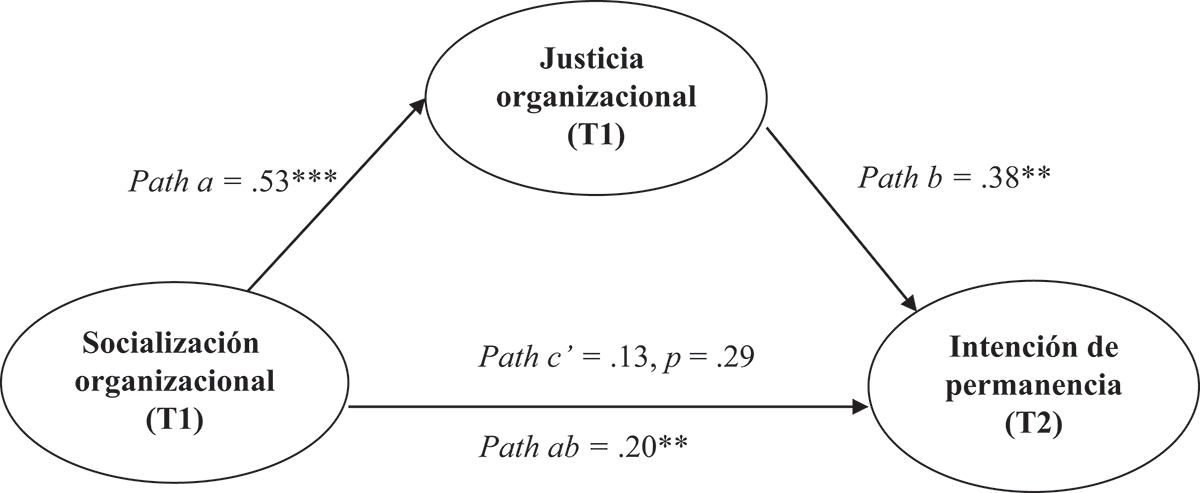
These results corroborate both Hypotheses 1a and 1b. As shown in Figure 1, OS has is a direct effect on intention to stay, which is positive (path c’, b = .13; CI 95% [−.16, .29]), and it has an indirect effect on intention to stay via organizational justice, which is positive and statistically significant (path ab, b = .20; p = .002; CI 95% [.08, .35]), which verifies the support for Hypothesis 1b. The data confirm that the influence of OS on intention to stay is mediated by organizational justice, given that the confidence interval for the effect mediated by organizational justice does not contain zero and the Sobol test confirms that the mediation is significant (z = 3.07; p = .002).
The results on Hypotheses 2a and 2b show that they are supported by the data. As shown in Figure 2, OS has a direct effect on innovative behaviour, which is positive (path c’, b = .99, p = .001; CI 95% [.38, 1.6]; Hypothesis 2a) and an indirect effect on innovative behaviour via organizational justice, which is positive and statistically significant (path ab, b = .34; p = .03; CI 95% [.003, .73]; Hypothesis 2b), which corroborates the hypotheses. Likewise, the data confirm that the influence of OS on innovative behaviour is mediated by organizational justice: the confidence interval for the effect mediated by organizational justice does not contain zero and the Sobel test confirms that the mediation is significant (z = 2.09; p = .03).
Discussion
The main objective of this study was to analyse the relationships between the OS of volunteers and the results — intention to stay and innovative behaviour — mediated by organizational justice. The findings show that OS has an indirect positive effect on intention to stay via organizational justice. Secondly, OS also has a direct, positive effect on innovative behaviour and an indirect, positive effect via organizational justice.
The debate on the differences among the different kinds of volunteers is intense, but the most recent studies suggest sweeping categories which include a dimension of administrative volunteers, who are also called professional volunteers, which would fit this study. The results of recent studies show that certain people are interested in specific kinds of volunteering (Lough & Tiessen, 2017), such as these volunteers, who require specific qualifications and previous academic training, and that the motivation of these volunteers is also quite high.
The findings on the mediating role of the perceptions of justice are quite important, because they could provide support for the theory of multiple needs in organizational justice (Cropanzano et al., 2001), which suggests that justice meets people’s different needs such as control or belonging. In this vein, some authors have explored the role of people’s beliefs in a just world and their possible influence on perceptions of organizational justice (Johnston, Krings, Maggiori, Meier, & Fiori, 2016). Thus, if a volunteer perceives that their organization shows signs of corruption or that its real practices are far from the values they claim to uphold, this could lead to a rupture in the ideological psychological contract, which would end up increasing the intention to leave the organization (Vantilborgh et al., 2014).
The results on the mediating role of organizational justice between OS and attitudes and behaviours match preceding studies, although they studied salaried workers (Bauer et al., 2007). With regard to intention to stay, one of the variables which is frequently explored in empirical research with volunteers, our study found that even though there is a significant relationship among the variables, the percentage of variance explained by OS and justice is not very high. These findings match studies on volunteers in other sectors (Hidalgo & Moreno-Jiménez, 2009).
Innovative behaviour has scarcely been studied in the realm of volunteers, and this study makes an important contribution in this sense. Even though the percentage of variance explained by the model is also modest, OS and justice reveal the volunteers’ intention to innovate. The study seems to point to the fact that people who have a novel idea check with their peers (Urbach, Fay, & Lauche, 2016), suggesting that innovative behaviour is conditioned by peer evaluation and by the effects that this generates in the person being evaluated. These aspects should be further explored in volunteers.
This study provides other novel perspectives which had not been addressed in previous studies. First of all, the administrative or consultative category of volunteers is unlike the majority of volunteers. On the other hand, this study takes a risk when analysing OS, justice and innovative behaviour, variables which have hardly been explored in relation to volunteers. Finally, studies on innovation have primarily been conducted focusing on its positive aspects, but recent studies point to the fact that innovative behaviour has a dark side. It could be threatening to peers (Urbach et al., 2016), generate negative affect or have undesirable consequences for the person who executes it (Devloo, Anseel, De Beuckelaer, & Feys, 2016; González-Romá & Hernández, 2016).
Limitations on this study and suggestions for future research
Viewed from the perspective of generalizing the results, the specificity of the kind of volunteers who participated in this study may seem like a hindrance. Thus, it is possible that the majority of the volunteers, who perform social-assistance tasks, show patterns of relationships among the variables that are different to what we have found here. Likewise, in this study we found that the majority of volunteers are males, unlike other studies and the general population of volunteers (Jaraíz-Arroyo, 2015).
In any event, this study has the strength of being one of the few that have explored the intention of staying of a specific kind of volunteer, since there are preceding studies which compare groups of volunteers but are limited to ecological and social-assistance volunteers (Vecina & Chacón, 2005). However, it is essential to recognize that the design of this study suffers from limitations because the criterion variables were not studied in T1 as well, and therefore it was impossible to control for the self-regressive effect of these variables.
Recommendations for intervention
The research on the OS of volunteers is scarce, but our results provide empirical evidence which upholds the practical recommendations of previous studies (Skoglund, 2006). The implications of this study lead us to once again stress the importance of improving initial OS by creating support groups, training seminars and mentoring programmes for new members. Administrators and managers of programmes should closely monitor new recruits in order to detect any difficulties in an early phase and, to the extent possible, try to adjust the allocation of jobs according to the volunteers’ needs and motivations. For volunteers, this research also provides an interesting result because now, for example, they can request their organization’s training and support in order to improve their performance, and they can expect recognition from their organizations for their contributions.
Relación entre la socialización organizacional y las actitudes y conductas en el voluntariado: la importancia de la justicia organizacional
El voluntariado reviste una enorme importancia en las sociedades occidentales en la actualidad (Jaraíz-Arroyo, 2015). Por una parte, esta actividad brinda innumerables beneficios a los destinatarios de los servicios y a la sociedad en general. Por otra, la participación en estas tareas tiene implicaciones positivas para los mismos voluntarios que las desempeñan, como el aumento de su implicación en la comunidad, la consolidación de una red social, y el aumento de su satisfacción vital, entre otras (Gow, Avlund, & Mortensen, 2014; Jones, 2016). También permite a las organizaciones de voluntariado el logro de sus objetivos institucionales. Entre las organizaciones de voluntarios hay un conjunto dedicadas al asesoramiento u orientación jurídica, empresarial o profesional. Integran a personas con elevada cualificación que guían a otras ante problemas legales, para constituir una nueva empresa o para hacer gestiones y trámites administrativos. El presente estudio se lleva a cabo con voluntarios pertenecientes a ONG’s con estas características.
La incorporación de los voluntarios a sus organizaciones les conduce a través de un proceso de socialización organizacional (en adelante, SO) en el que conocen las organizaciones a las que se integran y desarrollan sus percepciones sobre la justicia organizacional. La intención de permanecer prestando el servicio de voluntario y la conducta innovadora son indicadores actitudinales y conductuales de especial importancia (Vecina & Chacón, 2005). El primero de ellos debido a que la experiencia y el conocimiento experto que poseen este tipo de voluntarios hacen que resulte muy valiosa su permanencia en las organizaciones (Jones, Willness, & Heller, 2016). La segunda porque, en la tarea de asesoramiento, la conducta innovadora del voluntario puede contribuir al mejor logro de los objetivos del destinatario del servicio y, por consiguiente, de la organización que lo presta (Jones, Willness, & Glavas, 2017).
Por lo tanto, la presente investigación analiza la influencia de la SO en la intención de permanencia y las conductas innovadoras de los voluntarios. A la vez, explora el papel mediad or de la justicia organizacional en la relación entre la SO, de una parte, y la intención de permanencia y las conductas innovadoras de los voluntarios, de la otra. El presente estudio pretende así aportar evidencia explicativa sobre los correlatos de la intención de permanecer y las conductas innovadoras que será útil a las organizaciones de voluntariado a la hora de gestionar sus recursos humanos.
La socialización organizacional
La SO es el proceso por el cual los voluntarios pasan a ser miembros expertos de una organización (Hidalgo & Moreno-Jiménez, 2009). Ese proceso despierta cada vez más interés debido a la influencia que la SO ejerce sobre las actitudes y los comportamientos a medio y largo plazo (Good & Cavanagh, 2017).
La literatura sobre SO es muy abundante pero, en relación con el voluntariado, no son frecuentes los trabajos empíricos. Algunos autores en España han insistido en la importancia de la socialización para los voluntarios y su influencia en el desempeño, la integración y la adquisición de las normas de funcionamiento dentro de una ONG (Hidalgo & Moreno-Jiménez, 2009).
En relación con esto, Haski-Leventhal y Bargal (2008) han destacado que la socialización del voluntario es un proceso crítico porque ayuda a la persona a hacer frente a su entorno nuevo y aumenta su compromiso emocional con la organización y con el papel de voluntario que comienza a desempeñar. La SO es considerada un antecedente de la permanencia y de la forma de desempeñar la tarea de voluntariado.
La intención de permanecer y la conducta innovadora
Las personas que ejercen el voluntariado deben ser retenidas no sólo porque permiten a las ONGs alcanzar sus objetivos, sino también porque se ha invertido en ellas una cantidad importante en términos de reclutamiento y formación. Sin embargo, la alta tasa de abandono implica cierto grado de incertidumbre que afecta a las ONGs y a sus operaciones, siendo, por tanto, un resultado claramente indeseable en el voluntariado. La intención de permanecer resulta afectada por la SO, como señalan los hallazgos de Skoglund (2006) en voluntariado hospitalario, para quien los primeros seis meses son el período clave para determinar la futura retención de los voluntarios.
Por otra parte, la SO determina la forma en que las personas redefinen las tareas que deben realizar y ajustan estas demandas a sus propias capacidades y recursos (Saks & Gruman, 2011). La conducta innovadora, que es uno de los componentes del concepto más amplio y actual del desempeño (Potocnik & Anderson, 2016), incluye el reconocimiento de problemas, la generación de nuevas ideas y soluciones, la búsqueda y fortalecimiento de vínculos con posibles aliados, y la producción final de resultados novedosos. Estos aspectos del desempeño son aplicables al voluntario y beneficiosos para las ONGs. Por ejemplo, Starbird y Palen (2011) analizan la conducta innovadora de los voluntarios quienes, durante el terremoto de Haití, se organizaron espontáneamente. Pese a que se ha investigado muy poco, algunos autores subrayan la importancia decisiva de la SO para explicar las conductas innovadoras de los voluntarios (Haski-Leventhal & Bargal, 2008).
La justicia organizacional como variable mediadora
La percepción de justicia organizacional es el juicio de los integrantes acerca del trato que reciben de la organización. También se considera que la justicia es una evaluación personal relativa a la ética y la moral de las acciones ejecutadas por quienes dirigen la organización (Cropanzano, Byrne, Bobocel, & Rupp, 2001). La investigación empírica ha usado con frecuencia evaluaciones globales de la justicia, por lo cual en muchos trabajos empíricos la justicia se analiza de forma global o agregada (Bauer, Bodner, Erdogan, Truxillo, & Tucker, 2007).
Estas percepciones globales se refieren a varios aspectos de la relación entre las personas y sus organizaciones. La justicia distributiva puede ser relevante en los procesos internos de la gestión de los voluntarios porque las personas no solamente comparan los resultados que reciben en términos financieros, sino también la asignación de recursos, la distribución de tareas y de carga de trabajo y, por último, el reconocimiento que reciben por su desempeño (Pan, Chen, Hao, & Bi, 2017). La justicia procedimental es percibida por el miembro de una organización como la oportunidad de participar en la toma de decisiones, viendo así su trabajo como significativo; así pues, las ONGs cuyos procesos decisorios no se basan en la posesión del capital reciben constantemente la recomendación de implicar a sus voluntarios en los procesos de toma de decisión para aumentar la justicia percibida (Salamon & Sokolowski, 2016). Además, la comunicación bidireccional, la claridad de las expectativas y la transparencia de los estándares de evaluación del desempeño, son otros rasgos de la gestión que incrementan la percepción de justicia procedimental (Vantilborgh et al., 2014).
Por último, en cuanto a la justicia interactual, que alude a la forma en que se transmite la información y al hecho de sentirse tratado con dignidad y respeto por la organización, se ha de considerar una dimensión netamente pertinente en el voluntariado. Diversos trabajos coinciden en que, pese a no esperar recompensas monetarias, los voluntarios valoran su pertenencia al grupo y la calidad de sus relaciones con la ONG y los compañeros y supervisores. Así, el feedback transparente y la evaluación orientada a la mejora se vuelven antecedentes de la justicia percibida (Skoglund, 2006), que es una variable de interés en el estudio del voluntariado (Salamon & Sokolowski, 2016).
Como ya se ha señalado, durante la SO las personas que se incorporan alcanzan un conocimiento de los procedimientos más habituales en las organizaciones. Estudios recientes han mostrado que el proceso de SO permite construir relaciones de confianza en los líderes basadas en el afecto y clarificar las demandas que se hacen a los recién llegados (Kim, Kang, Lee, & McLean, 2016; Spagnoli, 2017). Estos procesos permiten alcanzar unas percepciones acerca de la justicia de los procedimientos empleados por los líderes y por la organización para recompensar a sus integrantes (Bauer et al., 2007). Los efectos de la justicia en la vida organizacional son amplios y profundos, en particular su papel en la explicación de las actitudes y conductas subsiguientes de los miembros de la organización (Bauer et al., 2007). En concreto, se ha propuesto la teoría del manejo de la incertidumbre para explicar las relaciones entre la justicia organizacional percibida y las actitudes y conductas de los integrantes de la organización (Van den Bos & Lind, 2002). Este modelo socio-cognitivo vincula la justicia organizacional con la incertidumbre en el trabajo. Las situaciones de incertidumbre favorecen que las personas estén más vigilantes y se vuelvan más sensibles ante las informaciones relevantes del ambiente.
La justicia percibida sería, por el contrario, una fuente de certeza, en el sentido de que ofrecería seguridad acerca de los procedimientos con los que la organización suele tratar a sus integrantes o acerca del comportamiento esperable por parte de los líderes. Por consiguiente, la justicia percibida contribuiría a reducir la ansiedad y los sentimientos de amenaza que generalmente acompañan a las situaciones inciertas (Rineer, Truxillo, Bodner, Hammer, & Kraner, 2017), tales como la incorporación a una organización. A pesar de la existencia de evidencia empírica reciente que apoya la presente hipótesis, dicha evidencia no se ha obtenido en el ámbito de las organizaciones de voluntariado, sino entre empleados de comercios minoristas, por lo cual parece pertinente investigar en este contexto, ya que diversos estudios atestiguan diferencias entre los trabajadores y los voluntarios que no deben dejarse fuera de consideración (Zhou & Feng, 2017). Así, debido a que tanto la intención de permanecer como la conducta de innovación son resultados positivos y deseables para las organizaciones, se propone que la justicia organizacional es una variable que media la relación entre los antecedentes del ambiente, como la SO, y la intención de permanecer y la conducta innovadora.
En resumen, el objetivo de este trabajo es analizar las relaciones entre la SO de los voluntarios y los resultados — intención de permanencia y conducta innovadora — mediada por la justicia organizacional, en un estudio con voluntarios dedicados al asesoramiento. Sobre la base de la literatura revisada hasta aquí, en el presente trabajo se proponen las siguientes hipótesis: La SO se encuentra positivamente relacionada con la intención de permanencia (Hipótesis 1a) y esta relación estará mediada por la justicia organizacional (Hipótesis 1b). La SO se encuentra positivamente relacionada con la conducta innovadora (Hipótesis 2a) y esta relación estará mediada por la justicia organizacional (Hipótesis 2b).
Método
Participantes
El presente estudio se ha llevado a cabo con una muestra de voluntarios (N = 308) en organizaciones de asesoramiento empresarial o jurídico. Sus tareas están centradas en la información y el asesoramiento. Incluyen sub-tareas como dar información sobre derechos, recursos sociales, procedimientos y obligaciones; asesorar sobre los pasos necesarios para obtener derechos y recursos, ayudar a tramitar prestaciones sociales, o efectuar reclamaciones de derechos. En cuanto a las acciones concretas se puede destacar las tareas complementarias en las tramitaciones como preparar expedientes, reunir documentación, colaborar en completar formularios, acompañar a las personas a las oficinas públicas, entre otras.
La muestra estuvo formada por un 54.2% de hombres, con una media de horas de dedicación de 7.9 horas semanales (DT = 6.9) y una mediade cuatro años de dedicación a su labor de voluntarios (DT = 1.9). El rangode edad de los voluntarios osciló entre los 27 y los 83 años, con una media de 50.3 (DT = 16.1).
Instrumentos
Socialización organizacional
Se empleó el Cuestionario de Socialización de los Novatos (Newcomer Socialization Questionnaire, NSQ) Haueter, Macan, y Winter (2003), en su escala de SO, que contiene 12 ítems orientados a evaluar el conocimiento de la organización y la comprensión de las conductas esperadas en el rol que la persona recién llegada va a desempeñar. Son ejemplos de ítems los siguientes: ‘Conozco las tradiciones arraigadas de esta organización’, ‘Puedo identificar quiénes son los más importantes en conseguir que el trabajo salga adelante’. La escala de respuesta tipo Likert oscila entre 1 (‘Totalmente en desacuerdo’) y 5 (‘Totalmente de acuerdo’). Al igual que en los estudios precedentes (Haueter et al., 2003), en el presente estudio su fiabilidad resultó también adecuada (α = .80).
Justicia organizacional
La Escala de Justicia Organizacional (Organizational Justice Scale) Moliner, Martínez-Tur, y Carbonell (2003) fue empleada para esta evaluación debido a que se trataba de una escala breve y diseñada expresamente para el contexto español. El referido instrumento ha mostrado propiedades psicométricas adecuadas en estudios precedentes (Moliner et al., 2003). La escala consta de 11 ítems que evalúan los aspectos reconocidos en la investigación sobre justicia: distributivos, procedimentales y de interacción. Son ejemplos de ítems: ‘Tengo una recompensa justa por mi tarea de voluntario’, ‘Los procedimientos que se siguen en esta organización para evaluar mi trabajo son justos’, ‘Mi jefe inmediato me trata con dignidad y respeto’. La escala de respuesta tipo Likert de cinco puntos oscilaba entre 1 (‘Totalmente en desacuerdo’) y 5 (‘Totalmente de acuerdo’). Alcanzó una fiabilidad adecuada en el presente estudio (α = .79).
Intención de permanencia
La evaluación de la intención de permanecer se efectuó con la escala de tres ítems de intenciones de permanecer en el servicio, Vecina y Chacón (2005), que pide a los voluntarios que puntúen su probabilidad de continuar desempeñando las tareas de voluntario dentro de la organización a la que pertenecían a los seis meses, a los 12 meses y a los dos años. Ejemplos de ítems son los siguientes: ‘Seguiré desempeñándome como voluntario en esta organización dentro de tres meses’, ‘Seguiré desempeñándome como voluntario en esta organización dentro de seis meses’. La escala de respuesta tipo Likert de cinco puntos iba desde 1 (‘Ninguna probabilidad’) a 5 (‘Totalmente probable’). La fiabilidad fue adecuada en el presente estudio, pese a la poca longitud de la escala (α = .65).
Conducta innovadora
Para evaluar la conducta innovadora en este estudio se usó la escala de Janssen (2001) de nueve ítems que evalúa la conducta innovadora individual a través de los tres estadios de la innovación: la generación de ideas, la promoción de ideas nuevas y la implementación o realización de estas ideas. Los participantes debían indicar con qué frecuencia ellos ejecutaban conductas innovadoras tales como generar nuevas ideas, obtener apoyo para las propuestas innovadoras o aplicarlas usando una escala tipo Likert de cinco puntos que oscilaba entre 1 (‘Nunca’) y 5 (‘Siempre’). Ejemplos de ítems son los siguientes: ‘Proponer nuevas ideas para cuestiones difíciles’ o ‘Transformar las ideas innovadoras en soluciones prácticas’. Para los cálculos siguientes se utilizó la suma de las puntuaciones de las respuestas en la presente escala, como se recomienda (Janssen, 2001), mientras que en las restantes escalas se usaron los promedios de las puntuaciones. El instrumento alcanzó indicadores de fiabilidad altos (α = .93) en estudios precedentes (Janssen, 2004), al igual que en el presente estudio (α = .83).
Tanto el instrumento usado para evaluar la conducta innovadora como la socialización organizacional fueron traducidos del original en inglés — dado que no se disponía de versión validada en español — siguiendo las recomendaciones clásicas en relación con este procedimiento (Beaton, Bombardier, Guillemin, & Ferraz, 2000).
Procedimiento
El diseño del estudio ha tenido dos momentos de recolección de datos, el primero (T1) entre enero y marzo del primer año y el segundo (T2) entre octubre y diciembre del mismo año. La presente investigación se desarrolló con la colaboración de diversas organizaciones sin fines de lucro dedicadas al asesoramiento en emprendimiento empresarial, en temas jurídicos o en la búsqueda de empleo y desarrollo de la carrera profesional. Para reclutar a los participantes se propuso un proyecto de investigación a cuatro organizaciones de voluntariado, de las que solo tres accedieron a participar. Los potenciales participantes recibieron un sobre conteniendo la carta de presentación del estudio, con las informaciones relativas a objetivos, contenidos, anonimato, voluntariedad y posibilidad de abandonar el estudio cuando se desease. Además, se incluía el cuestionario y un sobre cerrado para guardar el cuestionario cumplimentado y depositarlo en una urna cerrada en la sede de la organización. En el primer tiempo se midieron las variables predictoras y en el segundo tiempo se evaluaron las variables criterio de la presente investigación.
Se distribuyeron 980 cuestionarios, de los que solo se recogieron cumplimentados en T1 el 67% (N = 656). Los participantes facilitaron un código identificativo para unir ambas fases del estudio, creado a tal efecto por ellos mismos. Los investigadores distribuyeron nuevamente los cuestionarios de la segunda fase en las tres organizaciones participantes, junto con el sobre para guardar el cuestionario y depositarlo en la urna habilidad a tal efecto. Las organizaciones enviaron dos recordatorios a sus participantes con objeto de incrementar la tasa de respuesta. Finalmente, se recogieron 308 cuestionarios completos cumplimentados, encontrando en este caso sólo un 47% de tasa de respuesta en relación con la fase anterior del presente estudio. Se compararon los participantes en el T2 con los que no participaron usando las informaciones de las variables sociodemográficas que se midieron en T1. No se encontraron diferencias significativas en el número de años de permanencia en el voluntariado, ni en la edad o el género.
Análisis de datos
En el presente trabajo había pocos datos perdidos (0.4%) pero igualmente se aplicó el test MCAR de Little con SPSS que indicó que los valores perdidos eran aleatorios (p > .05). Por consiguiente se incluyeron todos los participantes en los análisis subsiguientes y se usó el procedimiento listwise deletion para aquellos casos con valores perdidos. A continuación se han realizado análisis descriptivos y correlacionales de las variables del estudio. Seguidamente, con objeto de poner a prueba las hipótesis, se han efectuado análisis de regresión lineal múltiple con la macro INDIRECT para SPSS (Hayes & Preacher, 2014) que permite valorar el efecto mediador de la justicia organizacional en la relación entre la SO de los voluntarios y sus resultados de intención de permanencia y conductas innovadoras en la tarea.
En ambos casos se recurrió a los indicadores del modelo de regresión, coeficientes no estandarizados (b), errores estándar, niveles de probabilidad asociados a los estadísticos de contraste y, especialmente, a los IC (intervalos de confianza) del bootstraping de 5,000 muestras (con un nivel de confianza del 95%).
Resultados
Los estadísticos descriptivos y la matriz de correlaciones de las variables del estudio se observan en Tabla 1. El examen preliminar de la matriz pone de manifiesto que la edad se relaciona de forma estadísticamente significativa y positiva con la intención de permanencia, y con las percepciones de justicia organizacional. La SO se relaciona de forma positiva y estadísticamente significativa con la justicia organizacional y con la conducta innovadora. Por último, la intención de permanencia se relaciona de forma positiva y estadísticamente significativa con la justicia organizacional y con la conducta innovadora, aunque no se muestra relacionada (r = .04) con la SO.
Los resultados corroboraron tanto la Hipótesis 1a como la 1b. Como se puede apreciar en la Figura 1, hay un efecto directo de la SO en la intención de permanecer, que es positivo (path c’, b = .13; IC 95% [−.16, .29]), y un efecto indirecto de la SO a través de la justicia organizacional en la intención de permanecer, que es positivo y estadísticamente significativo (path ab, b = .20; p = .002; IC 95% [.08, .35]), lo cual verifica el apoyo a la Hipótesis 1b. Los datos confirman que la influencia de la SO en la intención de permanecer resulta mediada por la justicia organizacional, puesto que el intervalo de confianza para el efecto mediado por la justicia organizacional no contiene el cero y el test de Sobel confirma que la mediación es significativa (z = 3.07; p = .002). Estimaciones estandarizadas para el modelo de mediación de la justicia organizacional en la relación entre SO e intención de permanencia. Estimaciones estandarizadas para el modelo de mediación de la justicia organizacional en la relación entre SO y conducta innovadora. Standardized estimates for the mediation model of organizational justice in the relationship between OS and intention to stay.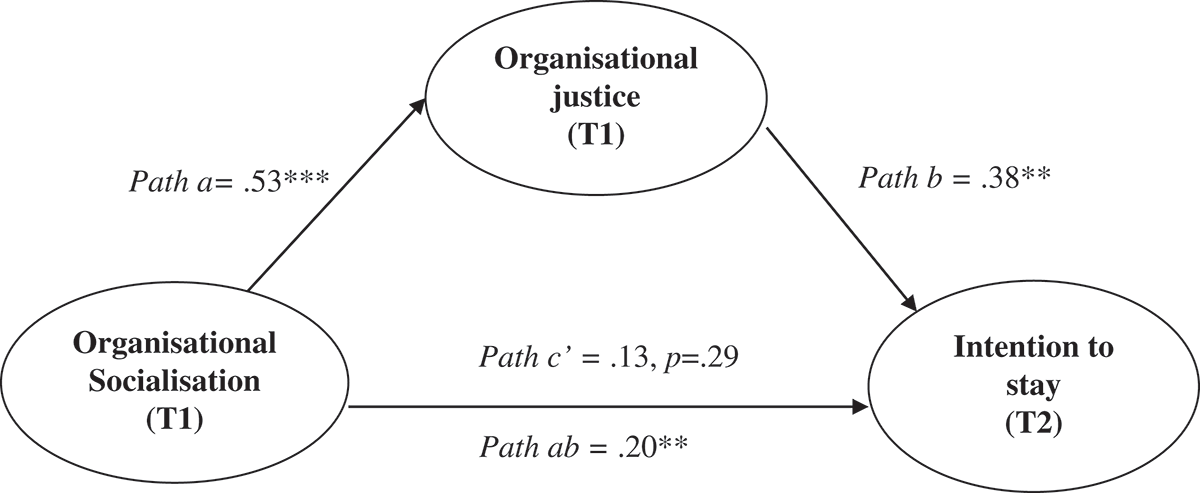

Los resultados relativos a las Hipótesis 2a y 2b muestran que esta resulta apoyada por los datos. Como se puede apreciar en la Figura 2, hay un efecto directo de la SO en la conducta innovadora, que es positivo (path c’, b = .99, p = .001; IC 95% [.38, 1.6]; Hipótesis 2a) y un efecto indirecto de la SO a través de la justicia organizacional en la conducta innovadora, que es positivo y estadísticamente significativo (path ab, b = .34; p = .03; IC 95% [.003, .73]; Hipótesis 2b), lo cual corrobora las hipótesis planteadas. De igual forma, los datos confirman que la influencia de la SO en la conducta innovadora resulta mediada por la justicia organizacional: el intervalo de confianza para el efecto mediado por la justicia organizacional no contiene el cero y el test de Sobel confirma que la mediación es significativa (z = 2.09; p = .03). Standardized estimates for the mediation model of organizational justice in the relationship between OS and innovative behaviour.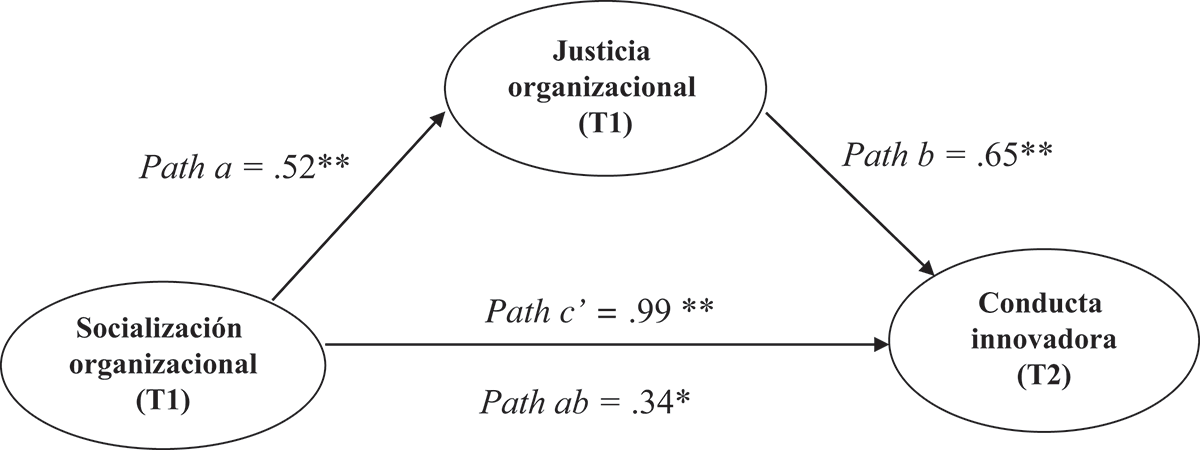
Discusión
En este trabajo, el objetivo principal ha sido analizar las relaciones entre la SO de los voluntarios y los resultados — intención de permanencia y conducta innovadora — mediadas por la justicia organizacional. Los hallazgos muestran que hay un efecto indirecto positivo de la SO en la intención de permanecer a través de la justicia organizacional. En segundo lugar, hay un efecto directo positivo de la SO en la conducta innovadora y un efecto indirecto positivo de la SO a través de la justicia organizacional.
El debate sobre las diferencias entre los diversos tipo de voluntariado es intenso, pero los estudios más recientes proponen tipologías amplias que incluyen una dimensión de voluntariado administrativo, también llamado voluntariado profesional, donde se encuadraría esta investigación. Los resultados de estudios recientes revelan que ciertas personas se hallan interesadas en tipos específicos de voluntariado (Lough & Tiessen, 2017), como este voluntariado profesional que exige alta cualificación y formación académica previa, y que la motivación por parte de estos voluntarios también es muy elevada.
Los hallazgos relativos al papel mediador de las percepciones de justicia son muy relevantes, porque podrían estar proporcionando apoyo a la teoría de las necesidades múltiples en justicia organizacional (Cropanzano et al., 2001), que plantea que la justicia satisface distintas necesidades de las personas, tales como el control o la pertenencia. En esta línea, algunos autores han explorado el papel de las creencias en un mundo justo que las personas detentan y su posible influencia en las percepciones de justicia organizacional (Johnston, Krings, Maggiori, Meier, & Fiori, 2016). Así, si un voluntario percibiera que su organización muestra indicios de corrupción o sus prácticas reales se distancian de los valores que dice defender, se podría llegar a producir una ruptura de contrato psicológico ideológica, que acabaría aumentando la intención de abandono de la organización (Vantilborgh et al., 2014).
Los resultados relativos al papel mediador de la justicia organizacional entre la SO y las actitudes y conductas coinciden con estudios precedentes, aunque con trabajadores asalariados (Bauer et al., 2007). En relación con la intención de permanecer, que es una de las variables frecuentemente exploradas en la investigación empírica con voluntarios, nuestro estudio encuentra que, aunque existe una relación significativa entre las variables, el porcentaje de varianza explicado por la SO y la justicia no es muy alto. Estos hallazgos coinciden con trabajos relativos al voluntariado en otros sectores (Hidalgo & Moreno-Jiménez, 2009).
La conducta innovadora ha sido poco estudiada en el ámbito del voluntariado y este estudio hace un aporte relevante en ese sentido. Aunque el porcentaje de varianza explicado por el modelo es también modesto, la SO y la justicia dan cuenta de la intención de innovar de los voluntarios. La investigación parece apuntar que las personas que tienen una idea novedosa consultan a sus pares (Urbach, Fay, & Lauche, 2016). Esto sugiere que la conducta innovadora está condicionada por la evaluación de los pares y por los afectos que genera en el evaluado, aspectos que convendría explorar en el voluntariado.
Este estudio aporta otras perspectivas novedosas que no se habían abordado en los estudios previos. En primer lugar, el tipo de voluntarios administrativos o de asesoramiento es distinto a la mayoría del voluntariado. Por otra parte, este estudio se arriesga a la hora de analizar la SO, la justicia y la conducta innovadora, variables poco exploradas en relación con el voluntariado. Por último, el estudio de la innovación se ha hecho generalmente destacando sus facetas positivas, pero trabajos recientes apuntan que la conducta innovadora tendría un lado oscuro. Podría resultar amenazante para los pares (Urbach et al., 2016), generar afecto negativo o tener consecuencias poco deseables para quien la ejecuta (Devloo, Anseel, De Beuckelaer, & Feys, 2016; González-Romá & Hernández, 2016).
Limitaciones del presente estudio y sugerencias de investigación futura
Considerado desde la perspectiva de la generalización de los resultados, la especificidad del tipo de voluntarios que participaron en este estudio podría parecer una dificultad. Así, es posible que la mayoría de las personas voluntarias, que se orientan a tareas socio asistenciales, manifiesten patrones de relaciones entre las variables distintos a los que hemos constatado aquí. Asimismo, en el presente estudio se observa que la mayoría de los voluntarios son varones, al contrario de lo que sucede en otras investigaciones o en la población general de voluntarios (Jaraíz-Arroyo, 2015).
En todo caso, este estudio tiene el mérito de ser uno de los pocos que ha explorado las intenciones de permanecer en un tipo específico de voluntariado, ya que hay estudios precedentes que comparan grupos de voluntarios pero se limitan a los ecologistas y a los socio asistenciales (Vecina & Chacón, 2005). No obstante, es necesario reconocer que el diseño de este estudio adolece de limitaciones, debido a que no se evaluaron las variables criterio también en el T1 y por lo tanto no fue posible controlar el efecto autorregresivo de dichas variables.
Recomendaciones para la intervención
La investigación sobre la SO de los voluntarios es escasa, pero nuestros resultados aportan evidencia empírica que sostiene las recomendaciones prácticas de estudios precedentes (Skoglund, 2006). Las implicaciones de este estudio llevan a insistir en la importancia de mejorar la SO inicial, a través de la creación de grupos de apoyo para los nuevos miembros, seminarios de formación y programas de mentoría. Los administradores y gestores de los programas deberían monitorizar de cerca a los nuevos para detectar las dificultades en una fase temprana e intentar ajustar la distribución de las tareas en función de las necesidades y motivaciones de los voluntarios, en la medida de lo posible. Para los voluntarios también brinda un resultado esta investigación porque, por ejemplo, pueden ahora solicitar la formación y el apoyo de su organización con el fin de un mejor rendimiento y también esperar el reconocimiento de sus organizaciones por su contribución.
Footnotes
Disclosure statement
No potential conflict of interest was reported by the authors / Los autores no han referido ningún potencial conflicto de interés en relación con este artículo.