







Abstract
The ability of electrons and phonons to equilibrate is fundamental to the thermodynamic and transport properties of solids. Nonetheless in mesoscopic systems, sufficiently high current densities can lead to situations where the phonon subsystem can no longer reach a steady state. In previous work, this phenomenon was connected with the demonstration that interatomic forces under current are non-conservative, with dramatic dynamical effects. Here we consider these effects in bulk systems. We arrive at a critical current density beyond which current flow results in the uncompensated stimulated emission of a blast of phonons. The result is illustrated with simulations of long atomic wires. It is hoped that the paper will stimulate research into the possible relevance of the effect to electropulsing.
This paper is part of a themed issue on Materials in External Fields.
Keywords
Introduction
We can see and feel – and even hear and smell – the effects of current flow in a lightbulb. Atomic and molecular wires – the systems of interest in the field of molecular electronics [1] – can carry current densities 6–7 orders of magnitude larger than those in a lightbulb filament. As a result, both electromigration forces [2] and local heating [3] in these systems can be dramatic.
We have certain intuitive expectations when considering current-driven atomic motion. One of them was highlighted in a visionary article by Sorbello [4]: the effective force field experienced by scattering centres in an electron flow should be non-conservative even under ideal steady-state conditions. If the current density is spatially non-uniform, then we can design closed paths such that the electron wind force does non-zero net work on scatterers when they travel around these closed paths. This notion later led to the direct construction – through non-equilibrium open-boundary molecular dynamics – of the single-atom analogue of a waterwheel, where current in an atomic wire with a bend drives the corner atom around, pumping energy into the atom during its directional circular motion [5].
A second analogy comes from a natural phenomenon. Suppose we see a picture of a lake with waves running across it. We would know immediately that the picture was taken on a windy day, with the direction of the wind furthermore being evident from the direction of the waves. This is also a form of energy transfer with a directional sense: the flow generates a forward jet of propagating waves.
These ideas have been explored recently in long atomic wires, demonstrating that the action of non-conservative interatomic forces under current can be connected with the preferential directional emission of travelling phonons [6,7], as illustrated schematically in Figure 1.
Schematic of the generation of a forward-travelling phonon shower in a current-carrying atomic wire. The incoming electron current, created by an applied electrochemical potential difference, emits phonons by inelastic electron backscattering. The imbalance in occupancy between electronic states with opposite velocities results in the directional bias of the emitted phonons.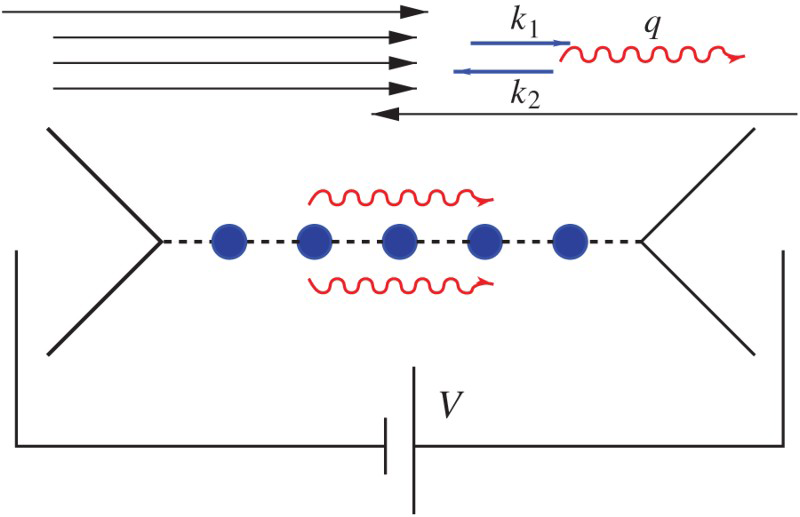
The aim of the present study is to apply these ideas to bulk conductors. The next section shows that there is a critical current density, above which it becomes possible for an electron current to generate explosive directional phonon jets, through uncompensated stimulated emission. Section ‘Non-conservative dynamics in atomic wires’ illustrates the resultant dynamics by model simulations of long one-dimensional conductors. Concluding comments are given in section ‘Concluding remarks’.
Waterwheel effect in bulk conductors
Our starting point is the framework set out in [8]. We consider two degenerate harmonic phonon modes, with generalised displacement operators  and annihilation operators
  , in a steady-state current-carrying system. Ref. [8] envisages localised vibrations in a mesoscopic conductor, but the analysis is generic. Next we form linear combinations of the two modes, by introducing new annihilation operators

The new modes are characterised by opposite generalised angular momenta.
Now we couple the new modes to electrons through a linear coupling  , where
  are electronic operators yielding the atomic forces on the two respective modes. Finally, we compute the rates of change of the populations of the new modes,
  . The result is [8]
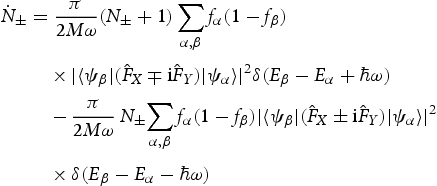
 are the eigenstates of a chosen phonon-free one-electron Hamiltonian, with eigenenergies
  and populations
  , ω is the common frequency of the two degenerate vibrational modes, and M is their effective mass.
From this expression, Todorov et al. [8] then shows how above a critical bias, such as to overcome the electronic friction force, the current in a nanoscale conductor drives one of the two modes, with an exponential growth in energy and angular momentum, and damps the other (depending on the sign of the bias). This is the atomic waterwheel effect, which can further be related to the work done by non-conservative current-induced forces, described by a non-hermitian effective dynamical response matrix [6].
Here we pursue a different route. First, we rearrange Equation (2) as
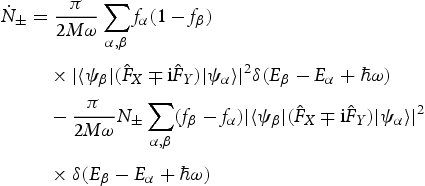
The first term describes spontaneous phonon emission by electrons [8]. We are interested here in the second term, which describes stimulated processes.
Usually the overall prefactor of  in the RHS of Equation (3) is negative. Then the second term describes normal damping of the atomic motion, due to the electronic friction. This enables the phonons to equilibrate with the electrons – to a common temperature at equilibrium, or an elevated temperature under current, due to Joule heating. However, in the atomic waterwheel effect, this prefactor becomes positive for one of the two modes, resulting in uncompensated stimulated emission of directional phonons – an equivalent way of thinking of the action of the non-conservative current-induced forces [6,8].
Our aim now is to consider whether – and under what conditions – this could happen in bulk conduction. We will consider the simplest case of a free-electron conductor (jellium). As our starting phonon modes X and Y, we can always select two frequency-degenerate standing waves, with displacements proportional to  and
and  , respectively, at position
  [7]. Then the new modes ± are waves travelling in opposite directions, with wave-vectors
  . The states
  are plane waves
  with dispersion
  . Selecting mode + for definiteness, the expression for the stimulated contribution to the rate of change of
  takes the form
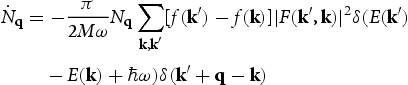
 is a scattering amplitude whose precise form we need not specify.
To describe steady-state current, we adopt the usual solution to the Boltzmann equation in the relaxation-time approximation describing a shifted Fermi sphere:

 is the equilibrium Fermi-Dirac distribution and
  , with
  being the drift velocity of the current-carrying electron gas.
By analogy with the atomic waterwheel effect, we examine the sign of the overall prefactor of  on the right in (4). Specifically, we examine the possibility
  ⇒
⇒ , which would tend to make the prefactor positive, resulting in exponential growth of the phonon population. This requires
  . Together with the energy- and momentum-conservation conditions


The threshold condition for uncompensated stimulated emission by the current therefore is

 is the speed of sound in the jellium metal.
The current density corresponding to the critical drift velocity in (8), for typical physical parameters, is in the region of  . This is huge for a macroscopic metal. We will return to this question later. However for atomic wires, this is a modest current density. We, therefore, set out to illustrate the resultant dynamics in long atomic chains.
Non-conservative dynamics in atomic wires
To study non-conservative dynamics in long atomic wires, we adopt the quasi-classical description of current-driven atomic motion in Ref. [9]. It maps harmonic quantum phonons, weakly coupled to a non-equilibrium electron bath, onto an effective ensemble of classical trajectories generated by a Langevin-type equation of the form

 of mass
  . The effective stochastic force
  holds the quantum mechanics of the problem and describes – in general – coloured noise, with equilibrium and current-induced contributions. Omitting
  corresponds to suppressing spontaneous emission and is equivalent to Ehrenfest dynamics. We will do so here as it does not contribute to our main argument.
  is a non-hermitian effective non-equilibrium dynamical response matrix [6]. Its anti-hermitian part describes the non-conservative current-induced forces.
  is also composed of a hermitian and an anti-hermitian part [9]. The hermitian part describes the electronic friction; the anti-hermitian part comes solely from current flow and is related to the Berry phase [10].
A limitation of Equation (9) is that it employs a perturbative description of the electron–phonon interaction which – at the simplest level adopted here – does not allow the coefficients  and
and  to respond to the changes in current caused by the response of the atomic motion to the current-induced forces. However, it is sufficient for a qualitative illustration of the phenomena we are interested in.
Here we retain the dominant forces, which come from the full  and the equilibrium part of the friction. To solve the model equations of motion, we adopt a single-orbital tight-binding model fitted to the elastic properties of bulk gold. We consider a 200-atom long dynamical atomic chain, sandwiched between perfect 1d electrodes. The geometry and parameters are the same as in [6]. The calculation of
  is described in [6], and that of the friction matrix – in Ref. [9].
The atomic motion starts from the relaxed atomic positions at zero bias, with small random velocities. Figure 2 shows the modulus of the Fourier components of the atomic displacements in time, under a bias large enough to overcome the electronic friction forces. We clearly see the exponentially growing peaks corresponding to travelling phonons in the structure.
Modulus of the Fourier spectrum of the longitudinal atomic displacements in a current-carrying atomic chain as a function of time. (a is the lattice parameter.). Comparison of the Fourier spectra from Figure 2 at two individual times.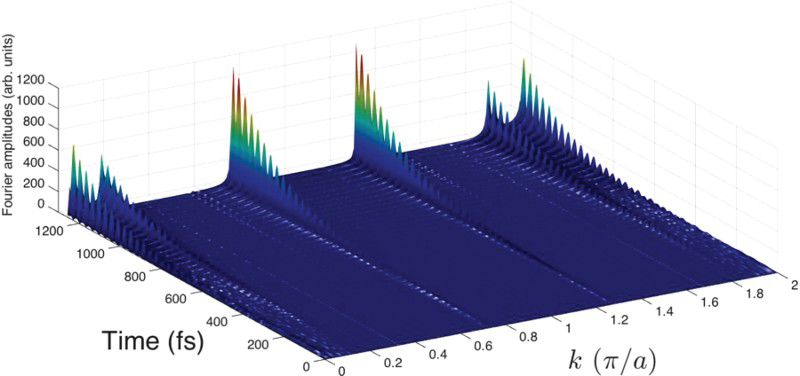
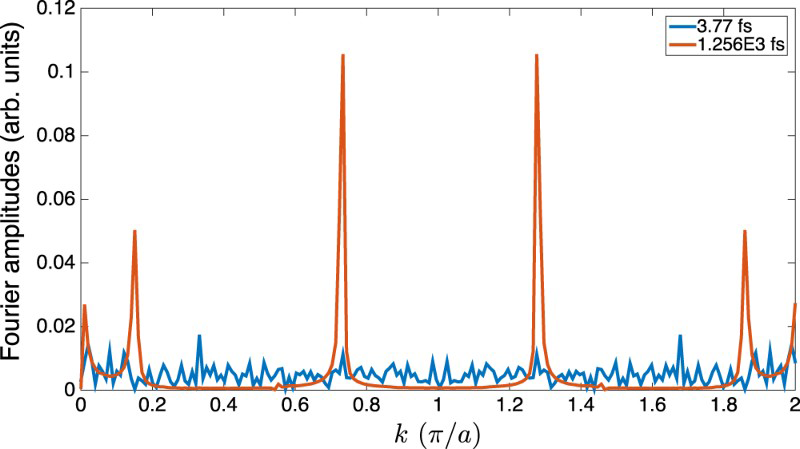
Travelling and standing vibrations are distinguished by the fact that for standing phonons the Fourier components reach down to zero periodically in time. Indeed, the corrugation of the rising crests on the Fourier spectrum indicates a significant standing-wave admixture in the motion. This can be seen more clearly in Figure 4, which shows the data from Figure 2 normalised by the area under the spectrum.
The data from Figure 2, normalised by the area under the spectrum.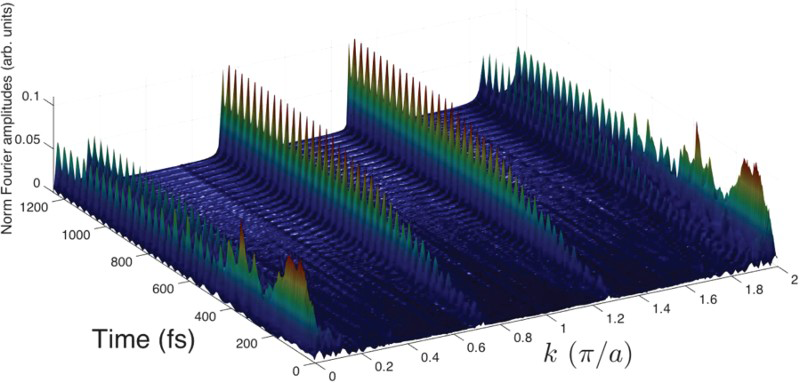
The directionality of the travelling waves, resulting from the uncompensated stimulated emission under the non-conservative current-induced forces, can be seen from a real-space plot of the motion [6]. Figure 5 displays the atomic motion over a window of 200 fs, some times into the simulation. The generated right-travelling waves are clearest near the left end of the wire, where the incoming particle current is entering the dynamical region.
Atomic displacements (in Å) versus atomic position and time, during the time-window from 600 to 800 fs.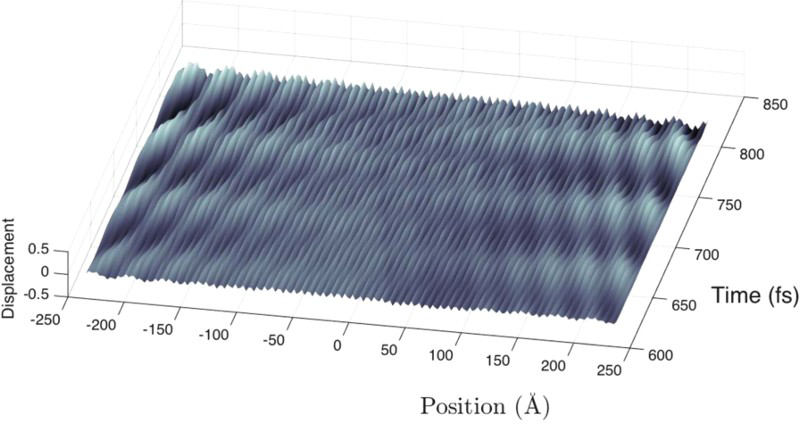
Of course in reality, the exponential growth cannot continue for ever. The limiting factor which eventually enables saturation of the atomic kinetic energy is the increase in resistance – and decrease in current – with increasing atomic amplitude. This requires the full non-adiabatic open-boundary molecular dynamics of Cunningham et al. [11], as opposed to the perturbative description of Equation (9).
Concluding remarks
We have shown that non-conservative current-induced forces can result in uncompensated stimulated phonon emission - with potentially dramatic effects – in extended conductors, and that this effect is associated with a threshold current density. However the threshold condition in (8) corresponds to current densities that are too high to be relevant to normal macroscopic conductors. Can the effect still occur, and could it be a contributing factor to effects such as electroplasticity [12]?
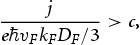
We cannot give a conclusive answer to this question. Indeed, it is hoped that the present paper would stimulate further work on this problem. We conclude, however, by observing that the details of the Fermi surface may play an important role. Retaining a spherical Fermi surface, but allowing a general dispersion,  , generalises (8) to, approximately,
 ,
,  and
and  are the Fermi velocity, wave-vector and density of states per unit volume, respectively. Thus variations in the Fermi properties of the electrons could influence significantly the critical bulk current density for the non-conservative effect.
Footnotes
Acknowledgements
We are grateful to Adrian Sutton for helpful discussions.
Disclosure statement
No potential conflict of interest was reported by the authors.