







Abstract
Optical microscopy, scanning electron microscopy, X-ray diffraction and tensile testing were performed to investigate the microstructure and mechanical properties of as-cast Mg–4Y/Nd–2Zn alloys. The results show that the secondary dendritic arm spacing for the Mg–4Y–2Zn alloy is smaller than that for the Mg–4Nd–2Zn alloy, and that X-Mg12YZn or W-Mg3Zn3Nd2 form in Mg–4Y/Nd–2Zn alloys. The lamellar X phase distributes at the grain boundary, pointing into the grains, whereas the rod-like W phase preferentially segregates at the triangle junction of the grain boundary. The greater grain boundary strengthening effect and the smaller fragmentation effect of the brittle eutectic phases leads to the as-cast Mg–4Y–2Zn alloy having better comprehensive mechanical properties. The fracture mechanism for as-cast Mg–4Y/Nd–2Zn alloys is quasi-cleavage fracture.
Introduction
As the lightest metal structure materials, magnesium alloys have the characteristics of low density, high specific strength, perfect cutting performance, excellent thermal conductivity and good electromagnetic shielding performance. So, it has been widely used as structural material in aviation, aerospace, automobile industry and other industries [1–3]. Unfortunately, relatively low strength, ductility and poor corrosion resistance of magnesium alloys have limited its application in the engineering field [4,5]. To improve the mechanical properties of magnesium alloys, lots of work has been done in the development of new magnesium alloys. It has been demonstrated that rare earth elements are the most effective elements to improve the strength properties of magnesium alloys, and the Mg–RE system is an ideal candidate for developing new magnesium alloys with high performance (RE represents rare earth elements). Most of the rare earth elements have a large solid solubility in magnesium; Mg–RE binary alloys have a significant effect of solid solution strengthening, which can effectively improve the mechanical properties of magnesium alloys at room temperature and elevated temperature. In addition, rare earth elements have significant ageing strengthening effect, which can greatly improve the high-temperature strength and creep resistance of magnesium alloys [6–8].
Y or Nd is one of the light rare earth elements with high solubility in an Mg matrix, and thus offers great potentiality for age-hardening. The precipitation process of prime α-Mg supersaturated solid solution in binary Mg–Y/Nd alloys is as follows: G.P. zones→β′′ (DO19) metastable phase→β′ metastable phase→β equilibrium phase [9–11]. The formation of the age-hardening phases is beneficial to improve the strength of magnesium alloys. The addition of other alloying elements to Mg–RE binary alloys, such as Al, Zn and Zr, results in great improvement in the mechanical properties of magnesium alloys. Zn is one of the most commonly used alloying element in magnesium alloys, and the maximum solid solubility of Zn in an Mg matrix is 6.2% at eutectic temperature (all of the percentages refer to weight percentage if not specific statement), and the solid solubility decreases with the decreasing of temperature, which produces significant solid solution strengthening and ageing strengthening in the Mg matrix. In addition, Zn can also reduce the corrosion of Fe, Cu and other impurity elements in magnesium [12–15].
Up to now, most researches have focused on microstructure and mechanical properties of Mg–Zn–RE alloys. There are three kinds of ternary phases in the Mg–Zn–Y system alloys, such as X phase (Mg12ZnY, long period stacking ordered (LPSO) structure), I phase (Mg3Zn6Y, icosahedral quasicrystal structure, quasi-periodically ordered) and W phase (Mg3Zn3Y2, cubic structure). The formation and quantity of the three phases are related to the Zn/Y atomic ratio [16–23]. T phase (Mg56Nd15Zn29, c-base-centred-orthorhombic structure) and W phase (Mg3Zn3Nd2, face-centred cubic structure) exist in Mg–Zn–Nd system alloys. The lattice constant of W-Mg3Zn3Nd2 is larger than that of the W-Mg3Zn3Y2 phase, because the atomic radius of Nd is larger than that of the Y atom, so the lattice constant of the W phase increases when Y is replaced by Nd [24–27]. Up to now, there are a few researches that focus on Mg–RE–Zn alloys. In this paper, the microstructure, phase composition and mechanical properties of as-cast Mg–4Y/Nd–2Zn alloys have been investigated.
Experimental
Chemical composition of the experiment alloys (wt-%).
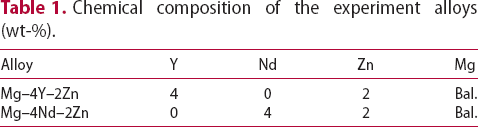
The tensile tests were performed by a CSS-2202 universal testing machine at room temperature, and the gauge dimensions of platy tensile test specimens were 15 mm×4 mm×2 mm. Hardness tests were performed using a 100 N load and loading time of 15 s. Metallographic specimens were finished and polished by a standard metallographic technique and then etched with 3 vol.-% nital. The microstructures of the alloys were observed using a MR5000 optical microscopy, and the average grain size of the alloys was measured quantitatively by the average linear intercept method. Phase identification of the alloys was examined by a Bruker D8 Advance X-ray diffraction (XRD). The phase distribution and fractography of the alloys were characterised by a Hitachi S-4800 scanning electron microscope (SEM) equipped with energy-dispersive spectroscopy (EDS). In addition, the solidification process of as-cast Mg–4Y/Nd–2Zn alloys was analysed by a STA 449 F1 differential scanning calorimeter (DSC).
Results and discussion
Microstructure
The optical micrographs of as-cast Mg–4Y/Nd–2Zn alloys are shown in Figure 1. It can be found that the secondary phases distribute in grain boundaries, and experimental alloys show a microstructure with typical casting dendrites, which is characterised by strong segregation of the alloying elements. The secondary dendritic arm spacings of the Mg–4Y–2Zn and Mg–4Nd–2Zn are 25–28 µm and 36–40 µm, respectively. The XRD analysis results of as-cast Mg–4Y/Nd–2Zn alloys are given in Figure 2. Mg–4Y–2Zn alloy contains α-Mg and an X-Mg12YZn phase with a long period stacking order (LPSO) structure [10,16–18,28,29], while the Mg–4Nd–2Zn alloy contains α-Mg and the W-Mg3Zn3Nd2 phase with a face-centre cubic structure [25,26]. Microstructure of as-cast Mg–4Y/Nd–2Zn alloys: (a) Mg–4Y–2Zn and (b) Mg–4Nd–2Zn. XRD patterns of as-cast Mg–4Y/Nd–2Zn alloys.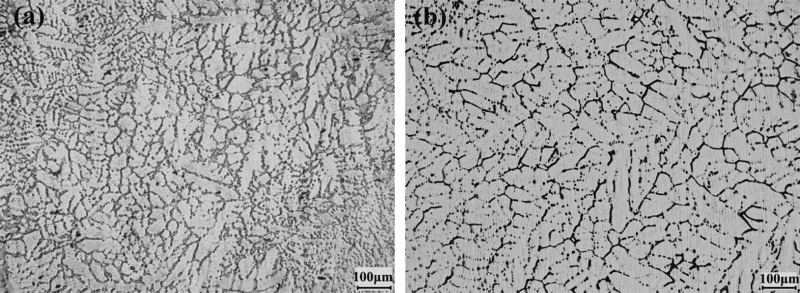

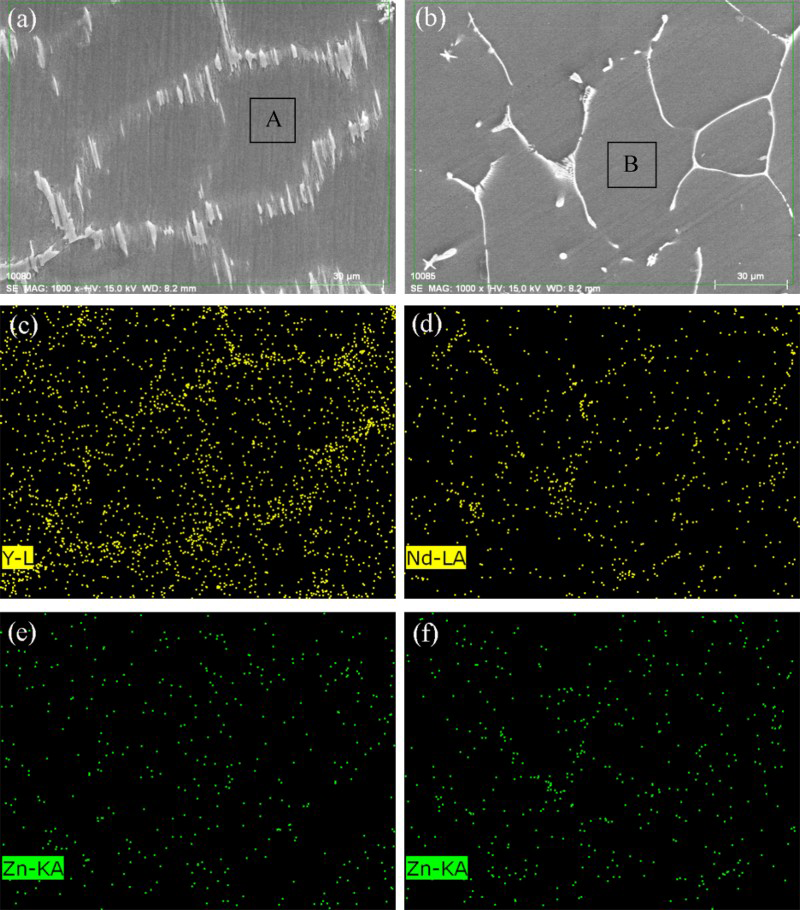
Figure 3 shows the SEM micrographs of as-cast Mg–4Y/Nd–2Zn alloys, and the element distribution of as-cast Mg–4Y/Nd–2Zn alloys is shown in Figure 4. As observed, the lamellar second phase that distributes at the grain boundaries pointed into the grains in the as-cast Mg–4Y–2Zn alloy is X-Mg12YZn phase, whereas the second phase along the grain boundaries for the as-cast Mg–4Nd–2Zn alloy is W-Mg3Zn3Y2phase, most of which is in the form of parallel rod-like at the triple junctions of grain boundaries [30,31]. Although most of the Y, Nd and Zn atoms are concentrated at grain boundaries, there are still some Y, Nd and Zn atoms that dissolve in the matrix, especially Y atoms. SEM images of as-cast Mg–4Y/Nd–2Zn alloys: (a) Mg–4Y–2Zn and (b) Mg–4Nd–2Zn. Elements’ distribution of as-cast Mg–4Y/Nd–2Zn alloys by EDS analysis: (a) SEM image of Mg–4Y–2Zn, (b) SEM image of Mg–4Nd–2Zn, (c) Y distribution of the Mg–4Y–2Zn alloy, (d) Nd distribution of the Mg–4Nd–2Zn alloy, (e) Zn distribution of the Mg–4Y–2Zn alloy and (f) Zn distribution of the Mg–4Nd–2Zn alloy.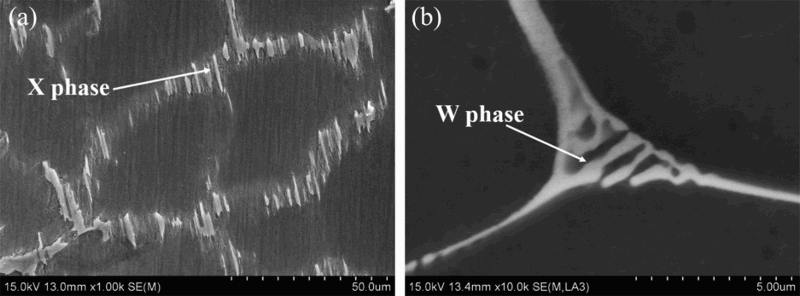
To further verify the formation of the Mg–Y/Nd–Zn ternary phases, the solidification processes of the Mg–Y/Nd–Zn alloys have been discussed based on the results of DSC, and the DSC results of as-cast Mg–4Y/Nd–2Zn alloys are shown in Figure 5. Two experimental alloys have a large endothermic peak at about 633–639°C, which corresponds to the melting temperature of the primary α-Mg phase. The Mg–4Y–2Zn alloy has another endothermic peak at 535°C besides that at 639°C (Figure 5a), the phases in the as-cast Mg–4Y–2Zn alloy are X phase and α-Mg, and the X phase originates from the ternary eutectic reaction of L→α-Mg+X at the temperature of 535°C [31,33,34]. For the Mg–4Nd–2Zn alloy, it has another endothermic peak at 512°C besides that at 633°C (Figure 5b), which correspond to the melting point of the W phase [25,26], and the W phase also originates from the ternary eutectic reaction of L→α-Mg+W. Therefore, the melting point of the ternary eutectic phase of the Mg–4Y–2Zn alloy is 23°C higher than that of the Mg–4Nd–2Zn alloy. DSC curves of as-cast Mg–4Y/Nd–2Zn alloys: (a) Mg–4Y–2Zn and (b) Mg–4Nd–2Zn.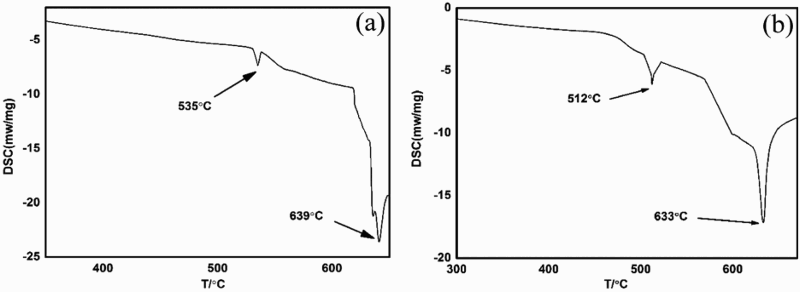
Mechanical properties
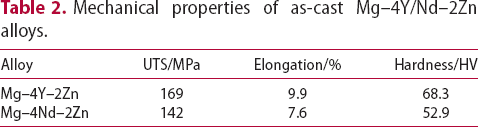
Mechanical properties of as-cast Mg–4Y/Nd–2Zn alloys.
The content of solid solution elements in the α-Mg matrix (at.-%).
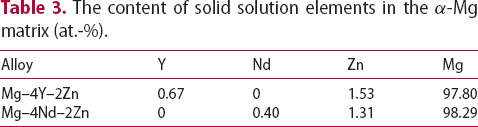
Ternary phases have been formed in Mg–4Y/Nd–2Zn alloys, and their quantity, morphology and distribution have a significant effect on the mechanical properties of the alloys. The eutectic phase distributed along the grain boundary led to a grain boundary strengthening effect [32], there is a good interface matching between the X-Mg12YZn phase with long period stacking structure and the Mg matrix in Mg–4Y–2Zn alloys, the Vickers hardness (137 ± 3.4 HV) of the X-Mg12YZn phase is much higher than that of pure magnesium (31.3 ± 2.2 HV) and the LPSO structure can more effectively prevent the dislocation movement [28,35,36], while the W-Mg3Zn3Nd2 phase with face-centred cubic structure is inconsistent with the hexagonal structure of the α-Mg matrix in Mg–4Nd–2Zn, and has a weak grain boundary strengthening effect; therefore, the room temperature strength and plasticity of the as-cast Mg–4Y–2Zn alloy are better than that of the as-cast Mg–4Nd–2Zn alloy. On the other hand, the greater the amount of solid solution of Zn in the matrix, the lesser the amount of eutectic phase formed from the eutectic melt at the end of the solidification process. The content of Zn in the matrix of the as-cast Mg–4Y–2Zn alloy is much higher than that of the as-cast Mg–4Y–2Zn alloy, the amount of eutectic phase in the as-cast Mg–4Y–2Zn alloy will be smaller. Furthermore, the lamellar X–Mg12YZn phase at the grain boundaries in the as-cast Mg–4Y–2Zn alloy is pointed into the grains, whereas the W-Mg3Zn3Y2 phase in the as-cast Mg–4Nd–2Zn alloy is along the grain boundaries (Figure 4); therefore, the fragmentation effect of the brittle eutectic phases in the as-cast Mg–4Y–2Zn alloy will be greatly reduced, and the as-cast Mg–4Y–2Zn alloy has better mechanical properties.
Rare earths play an important role in the grain refinement. When the alloy is solidified in the way of dendrite, the primary dendrite arm spacing dl can be expressed as follows [37]:


The grain size of the as-cast Mg–4Y–2Zn alloy is smaller than that of the as-cast Mg–4Nd–2Zn alloy (Figure 1); therefore, the as-cast Mg–4Y–2Zn alloy has better mechanical properties.
The typical fracture surface images of as-cast Mg–4Y/Nd–2Zn alloys are shown in Figure 6. The fracture mechanisms of magnesium alloys are mainly cleavage fracture and quasi-cleavage fracture. It can be seen that the fracture surfaces of as-cast Mg–4Y/Nd–2Zn alloys have tearing edges, cleavage faces and small dimples. Therefore, the fracture mechanisms of as-cast Mg–4Y/Nd–2Zn alloys are quasi-cleavage fracture. The fracture tearing edges of the as-cast Mg–4Y–2Zn alloy are more developed, and the dimensions and quantity of the dimples are comparatively large and deep; so its plasticity is comparatively good. Fractographs of as-cast Mg–4Y/Nd–2Zn alloys: (a) Mg–4Y–2Zn and (b) Mg–4Nd–2Zn.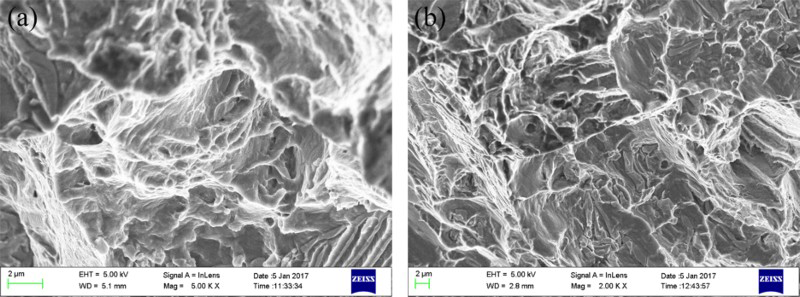
Conclusions
The ternary phases of the as-cast Mg–4Y–2Zn and Mg–4Nd–2Zn alloys are the X-Mg12YZn phase and the W-Mg3Zn3Nd2 phase, respectively. The lamellar X phase distributes at the grain boundary pointed into the grains, whereas the rod-like W phase is preferentially segregated in the triangle junction of the grain boundary. The microstructures of the as-cast alloys show typical casting dendrites, and the secondary dendritic arm spacings of the Mg–4Y–2Zn and Mg–4Nd–2Zn are 25–28 µm and 36–40 µm, respectively. The melting point of the ternary eutectic phase of the Mg–4Y–2Zn alloy is 23°C higher than that of the Mg–4Nd–2Zn alloy. The greater grain boundary strengthening effect and the smaller fragmentation effect of the brittle eutectic phases make the as-cast Mg–4Y–2Zn alloy have better comprehensive mechanical properties. The tensile strength, elongation and hardness of the Mg–4Y–2Zn alloy are 169 MPa, 9.9% and 68.3 HV, respectively. They are increased by 19, 30 and 29%, respectively, compared with those of the Mg–4Nd–2Zn alloy. The fracture mechanism of as-cast Mg–4Y/Nd–2Zn alloys is quasi-cleavage fracture, and the as-cast Mg–4Y–2Zn alloy has good plasticity.
Footnotes
Disclosure statement
No potential conflict of interest was reported by the authors.