







Abstract
The microstructure and mechanical properties of a novel refractory AlNbTiZr high-entropy alloy (HEA) with a low density of ∼5.85 g cm−3 were investigated after arc melting and homogenisation at 1473 K for 5 h. The as-cast HEA exhibits a single-phase ordered body-centred cubic (B2) structure. A hexagonal Zr5Al3-type second phase is introduced into the HEA through homogenisation treatment, resulting in increase of the yield strength, ultimate compressive strength and fracture strain by 70 MPa, 308 MPa and 9.2%, respectively. These results indicate that the introduction of the hexagonal Zr5Al3-type second phase into the B2 matrix can simultaneously improve the HEA strength and ductility, showing a strength–ductility combination superior to those of most reported refractory HEAs.
Introduction
The multi-principal element alloys with equal or near-equal atomic percentage are basically defined as high-entropy alloys (HEAs) [1,2]. Compared to conventional alloys, HEAs form the simple body-centred cubic (bcc) and/or face-centred cubic (fcc) phase more easily, especially at high temperatures, due to the sluggish diffusion effect [3,4]. HEAs have attracted an intense research interest because of their excellent mechanical properties [5,6] such as high strength/high hardness [7,8], exceptional fatigue and toughness [9,10], and excellent wear resistance [11].
In recent years, intense efforts have been devoted to exploring refractory HEAs for various potential applications, but these alloys display high densities of more than ∼10 g cm−3[12–16]. This impedes their practical applications to some extent, and thus materials researchers have gradually focused on studies of low-density refractory HEAs [17–23]. Senkov et al. have reported a Cr–Nb–Ti–V–Zr HEA system with a lower density of ∼6.5 g cm−3 and excellent mechanical properties [24,25]. To further decrease the HEA density, replacement of the heavy constituent elements by lighter atoms (e.g. Al) appears to be a reliable approach [26,27]. Meanwhile, the Al element is beneficial for promoting solid solution formation and for stabilisation of the bcc structure [1]. Stepanov et al. [19] replaced Cr by Al in the Al x NbTiZrV refractory HEA, finding that its density can be reduced to ∼5.55 g cm−3; however, this approach usually deteriorates the HEA mechanical properties. The Al x NbTiZrV refractory HEAs with high compressive strength (1100–1470 MPa) show lower ductility of ∼4.2%. Obviously, it is very urgent to seek an improved balance between the density and mechanical properties of refractory HEAs.
As reported in Refs. [24,25], a CrNbTiZr refractory HEA shows high specific strength but very limited ductility at room temperature. In this work, we investigated a novel AlNbTiZr HEA created by replacing Cr with Al in the CrNbTiZr HEA, which was found to form a mixture of the B2 matrix and the Zr5Al3-type second phase and shows an improved combination of strength and ductility.
Experimental procedures
The AlNbTiZr HEA sample was produced by arc melting in a high-purity argon atmosphere inside a water-cooled copper cavity. To achieve a homogeneous element distribution in the alloys, all ingots were melted five times. All samples used in the experiment were cut from the centre of the as-cast ingot. Then the as-cast ingots were homogenised at 1473 K for 5 h in a vacuum quartz tube and were subsequently furnace cooled to room temperature. The crystal structure was investigated by using a Bruker D8 Advance X-ray diffractometer (XRD) with Cu Kα radiation. The XRD scan angle range was from 20° to 100° at a scanning rate of 4° per minute. A scanning electron microscope (SEM; FEI Sirion-450) with an accessory energy-dispersive spectrometer (EDS) and a transmission electron microscope (200 kV TEM, JEM-2100, Japan) with a selected area electron diffraction (SAED) instrument were used for microstructural analysis. The SEM samples were electrolytically polished in an electrolytic solution of 10% perchloric acid and 90% alcohol at sub-zero temperatures with a direct current of 22 V for 90 s and were slightly corroded for a few seconds with a diluted Kroll reagent. The TEM samples were prepared by ion milling after mechanical grinding down to a thickness of ∼40 μm. The sample density of the homogenised alloy was measured by the hydrostatic weighting method. The sample weight was ∼15 g and was measured on an electronic balance with an accuracy of ±0.0001 g, and the density testing was repeated at least three times to obtain the average value. The Vickers hardness, Hv, was measured on the polished cross-section surfaces by an HXD-1000T microhardness tester. The Hv was measured in 15 randomly sample locations under a load of 500 g for 20 s. Room temperature compression tests were carried out by using an MTS 810 testing machine under a strain rate of 10−4 s−1. Cylindrical specimens used for the compression test had a diameter of ∼2.5 mm and a height of ∼4 mm. To ensure that the obtained compression value was accurate, the measurements were carried out for at least three specimens. The specimens were compressed until complete fracture or partial fracture as indicated by the drop of engineering stress by more than 20%.
Results
Crystal structure
Figure 1 shows the XRD patterns of the AlNbTiZr samples in the as-cast and homogenised states. The Bragg diffraction peaks from the as-cast sample correspond to the BCC phase, with a strong {110}BCC diffraction peak. The superlattice reflection peak of {100}BCC located at ∼27° indicates an ordered BCC (B2: TiAl type, space group Pm3m) phase with the lattice parameter of ∼0.332 nm. The additional diffraction peaks that appear after the homogenisation reflect two phases, i.e. the dominant B2 matrix phase with the lattice parameter of ∼0.334 nm and the hexagonal Zr5Al3-type second phase (Mn5Si3 type, space group P63/mcm), which was observed in the reported AlNbTiVZr
x
(x= 0–1.5) HEAs [28,29]. The lattice parameters of the Zr5Al3-type second phase are a = ∼0.809 nm and c = ∼0.546 nm.
XRD patterns of the AlNbTiZr samples.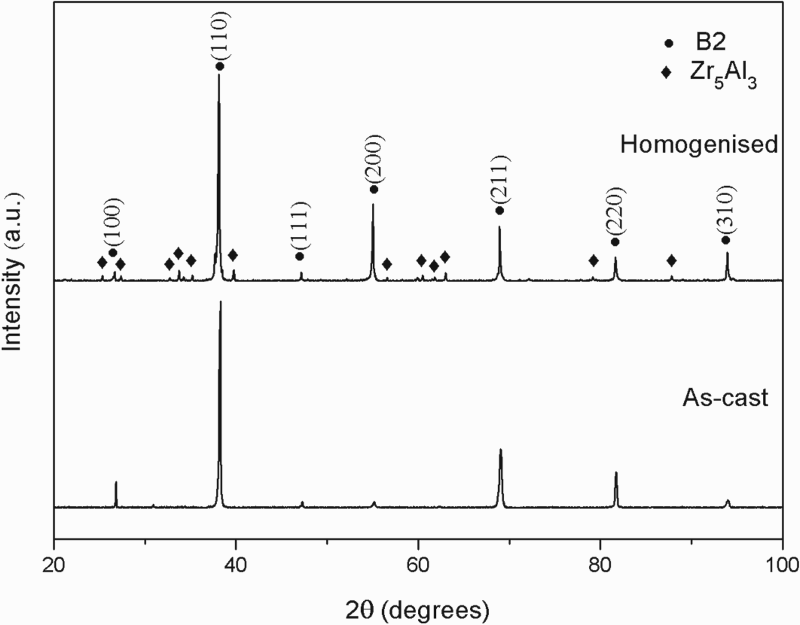
Microstructure and chemical compositions
SEM images of the morphology of the AlNbTiZr samples in the as-cast and homogenised states are presented in Figure 2. The as-cast sample exhibits a typical dendrite structure (Figure 2a,b). According to the EDS analysis (Table 1), the dendrite areas (region A) are enriched in Nb and depleted of Al and Zr, while the interdendrite areas (region B) show the opposite element distribution. This is mainly because the rate of atom diffusion cannot keep up with the crystallisation process caused by the chemical segregation formed during solidification, with the predominant segregation of the refractory elements (mainly Nb) in the dendrites and the lower melting temperature elements (i.e. Al) in the interdendrites. Meanwhile, the light regions (LR) enriched in the Ti element indicate the heterogeneous distribution of the chemical composition. Figure 2(c,d) shows that two phases are present in the homogenised sample, i.e. the equiaxed-grain matrix (region C) and the Zr5Al3 second phase (regions D and E). The second phase, marked as regions D and E, shows a particle shape inside the grains or a continuous network along the matrix grain boundaries, respectively. It is important to note that Ti-rich phenomenon in the interdendrites disappears. The precipitation of these second phases is mainly due to the segregation of the solute atoms in the supersaturated solid solution and precipitation with the decrease of the temperature. The matrix grain size is 200–250 μm, the individual particle size is 2–3 μm, and it was confirmed by metallographic analysis that the volume fraction of the Zr5Al3 phase was 39 ± 3%. Chemical analysis (Table 1) demonstrates that the composition of the equiaxed-grain matrix was close to the nominal composition. Meanwhile, the second phases along the matrix grain boundaries or as individual particles inside grains have similar contents and are enriched with Al and Zr. SEM image of the AlNbTiZr samples at as-cast and homogenised states: (a, b) as-cast state and (c, d) homogenised state. Chemical composition (in at.-%) of the AlNbTiZr samples.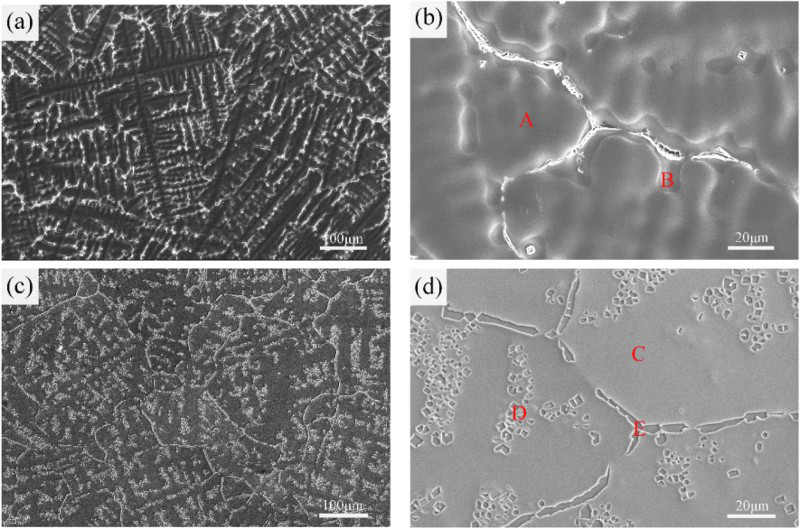
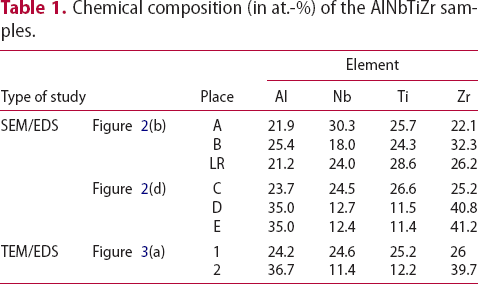
High magnification observations using TEM/EDS allowed the determination of the details of the microstructure and phase composition of the AlNbTiZr HEA after homogenisation at 1473 K for 5 h. Figure 3 shows bright-field TEM images and the corresponding SAED patterns of the AlNbTiZr samples. As seen in Figure 3(a), two large polygonal particles have a diameter of ∼1.5 µm. The corresponding SAED pattern along the [001] zone axis (Figure 3b) confirmed the B2 structure of the matrix grain; the corresponding SAED patterns along the [0001] zone axis (Figure 3c) indicate that the polygonal particle has the hexagonal Zr5Al3-type structure. The phase composition obtained from TEM observation (Table 1) is in good agreement with the XRD results. Bright-field TEM images and the corresponding SAED patterns of the homogenised AlNbTiZr samples: (a) bright-field TEM images; (b) SAED pattern of region 1 (B2) along [001] zone axis; (c) SAED pattern of region 2 (Zr5Al3-type) along [0001] zone axis.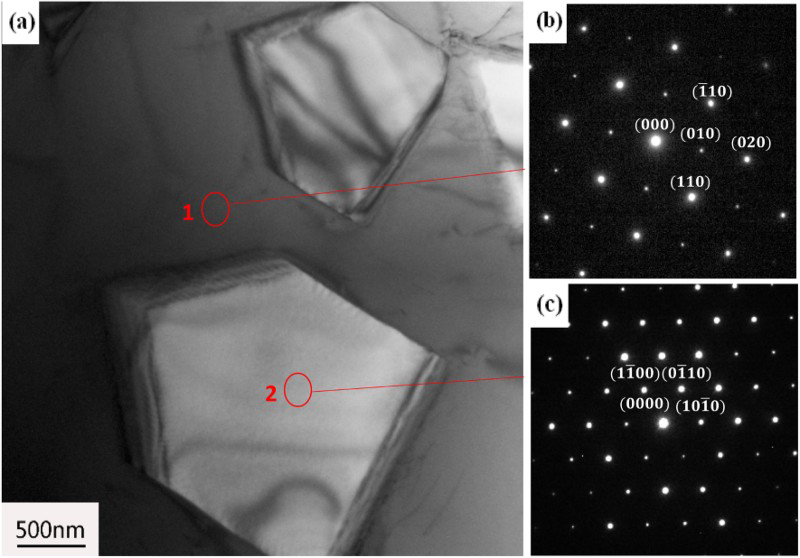
Density
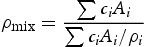
The measured density of the AlNbTiZr HEA was found to be ∼5.85 g cm−3, higher than the theoretical density of 5.69 g cm−3 predicted by the rule of mixtures. Somewhat higher experimentally measured density values in refractory HEAs have already been reported [25,27]. The density of the solid solution in the studied AlNbTiZr HEA can be calculated by
Mechanical properties
The measured Vickers microhardness values are 422 ± 15 HV and 418 ± 15 HV for the as-cast and homogenised states, respectively. The introduction of the Zr5Al3-type particles by the homogenisation treatment did not dramatically harden the alloy.
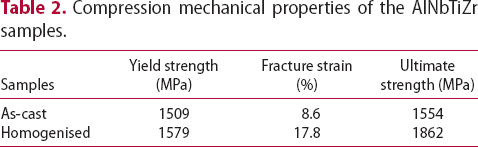
The compression stress–strain curves of the AlNbTiZr samples in the as-cast and homogenised states are shown in Figure 4. The yield strength (σ0.2), ultimate compressive strength (σmax) and fracture strain (δf) are summarised in Table 2. Here, δf is the engineering strain at the occurrence of fracture. The yield strength of the as-cast sample is ∼1509 MPa, which increases slightly by ∼81 MPa after the homogenisation treatment. Meanwhile, the as-cast sample shows a high ultimate compressive strength of ∼1554 MPa at the strain of ∼7.3%, and the fracture occurs when the strain reaches 8.6%. After the homogenisation treatment, the fracture strain and ultimate compressive strength increase by 9.2% and 308 MPa, respectively. This indicates that the as-cast sample is dramatically toughened and strengthened by the homogenisation treatment. Careful macroscopic examination of the sample after the compression test reveals no flat fracture but rather multiple cracks, which are generally aligned with the compression direction or have an angle of 45° with the compression direction. Compression stress–strain curves of the AlNbTiZr HEA samples at room temperature. Compression mechanical properties of the AlNbTiZr samples.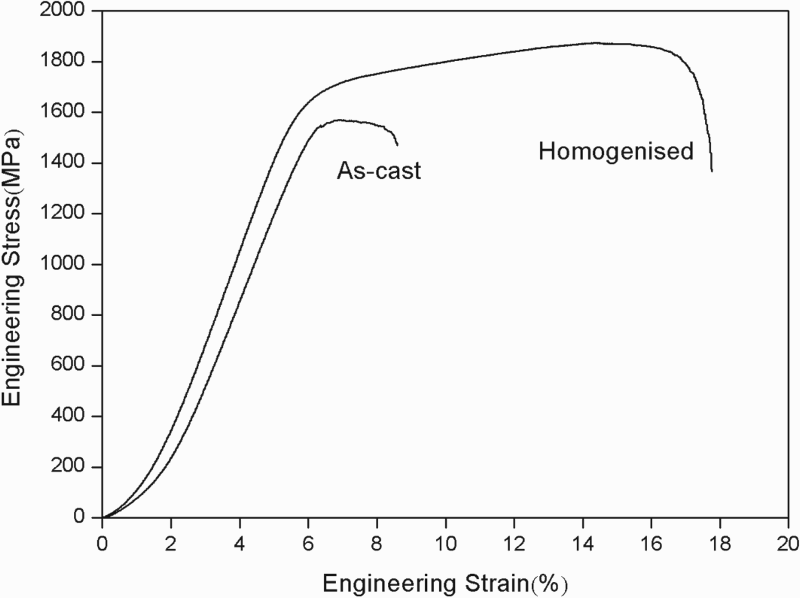
Discussion
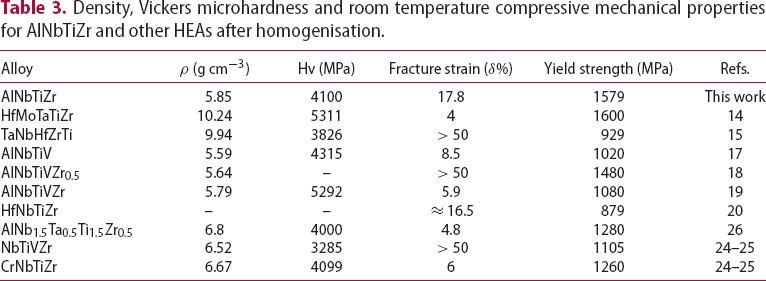
Density, Vickers microhardness and room temperature compressive mechanical properties for AlNbTiZr and other HEAs after homogenisation.
Obviously, the formation of the hexagonal Zr5Al3-type second phase by homogenisation will not provide an explanation for the phenomenon in which the alloy hardness is invariable and the yield strength is not significantly improved. It is well known that a difference in the atomic size is an important cause of lattice distortion. Severe lattice distortion can contribute to a significant solid solution strengthening effect, although it is especially difficult to define the distinction between solute atoms and solvent atoms in HEAs [33]. Zr has a considerably larger atomic radius than the three other elements in the AlNbTiZr HEA and Al–Zr atomic pairs exhibit a strong chemical affinity. Homogenisation treatment can meet the requirement of element diffusion kinetics to form the hexagonal Zr5Al3-type second phase (Table 1). Therefore, an increase in the hardness and yield strength by the Zr5Al3-type phase should be compensated by the weaker solid solution strengthening effect of the B2 matrix phase.
Although the yield strength of the HEA is not dramatically improved, the B2 matrix could undergo large-scale plastic compression deformation, and the Zr5Al3-type second phases could play a crucial role to affect the ultimate compressive strength. The high strength of the AlNbTiZr HEA at room temperature can be attributed to (i) strong bonding between Al and other constituent elements [26,27] and (ii) the presence of the second phase in the grain boundaries and at the grain interior. During the compression deformation, the Zr5Al3-type second phase with different sizes and morphologies can transfer the load from the B2 matrix. Meanwhile, it is necessary to note that the second phase particles at the grain boundary can hinder the movement of the adjacent grains.
The appearance of the interdendritic phase in the as-cast HEA easily leads to a decrease in the plasticity and ductility. After the homogenisation treatment, the fracture strain increases to 17.8%. This may be due to the second phase distribution characteristics and the orientation between the second phase and the matrix, which makes the grains coordinate with each other during the plastic deformation process. Moreover, the appropriate volume fraction and particle morphology of the second phase are also very important. A higher proportion of the second phase will cause associated difficulties in the strain compatibility between the different phases, resulting in rapid failure during compression of the alloy [29]. It is well known that the presence of brittle precipitates on the grain boundaries should lead to a decrease of the plasticity. For instance, the Al0.5CrNbTi2V0.5 HEA [34] was found to consist of the bcc matrix and the C14 Laves phase particle precipitates, which increased its room temperature compression yield strength at the cost of reduced ductility. However, the AlNbTiZr alloy exhibited a high fracture strain of ∼17.8%. In addition to the mechanism of the work hardening effect, another option to consider is the possible transformation-induced plasticity (TRIP) [35,36]. It is possible that during the deformation, the initial B2 matrix will transform into a disordered bcc phase, which effectively suppresses early cracking and eventually gives rise to an outstanding combination of strength and ductility [29].
In view of the above work, the density, microhardness and room temperature compressive properties of AlNbTiZr HEA and other HEAs are given in Table 3. Compared to the previously reported HfMoTaTiZr, TaNbHfZrTi, AlNbTiV, AlNbTiVZr0.5, AlNbTiVZr, HfNbTiZr [14,15,17–20], AlNb1.5Ta0.5Ti1.5Zr0.5[26], NbTiVZr and CrNbTiZr HEAs [24,25], the studied AlNbTiZr HEA with the mixed structure of the B2 phase and Zr5Al3-type second phase shows the highest yield strength, a lower density and a high plasticity of 17.8%. This indicates that the present HEA has better comprehensive mechanical properties than the reported refractory HEAs. Based on the results of the previous studies, we can adjust the amount of Al to control the strength and plasticity. It is very important to provide an effective approach for introducing the second phase in the B2 refractory HEA to simultaneously improve the plasticity and ultimate strength.
Conclusion
In this work, a new refractory HEA, AlNbTiZr, was synthesised and investigated. Combining the experimental results and analysis, the main findings are summarised as follows: AlNbTiZr HEA is composed of a single B2 phase in the as-cast state. After homogenisation, the HEA consists of two phases, i.e. the B2 matrix phase and the Zr5Al3-type second phase. The phase rule in this HEA can be predicted by the law of phase formation. The Vickers hardness values are 422 ± 15 HV and 418 ± 15 HV for the as-cast and homogenised states, respectively. The Vickers hardness decreased slightly after homogenisation, remaining essentially unchanged. The density of the AlNbTiZr HEA is ∼5.85 g cm−3. Compared to the as-cast HEA, the compressive yield strength increased up to 1579 MPa, while the ultimate compressive strength and fracture strain increased by 308 MPa and 9.2% after homogenisation. The Zr5Al3-type second phase has a significant strengthening effect on the B2 AlNbTiZr HEA, showing a strength–ductility combination superior to those of other HEAs.
