






Abstract
The effect of cobalt addition instead of nickel on the crystal structure, martensitic transformation behaviour and shape memory effect were investigated. Within the analysed range of chemical composition, a single non-modulated martensite was detected at ambient temperature. Cobalt addition modified the lattice parameters and, thus, affected the tetragonality of the martensite unit cell. The hysteresis of martensitic transformation was differently affected by the type of heat treatment applied. For furnace cooled samples, the hysteresis decreased from 50°C to 30°C; in the case of water quenched samples, the hysteresis sharply increased up to 60°C. The shape memory effect, measured as the recoverable strain upon annealing after compression tests, reached a fully recoverable deformation at 10 at.-% of cobalt.
This paper is part of a Thematic Issue on The Crystallographic Aspects of Metallic Alloys.
Introduction
The ternary Ni–Mn–Ga Heusler alloys attracted considerable attention due to their functional properties such as magnetic-field-induced strain (MFIS) effect [1-5]. Materials which exhibit this effect could find practical use in actuators and sensor devices [6-10]. The MFIS may be observed in the ferromagnetic state at temperatures below the martensitic transformation (MT). The mechanism of MFIS is based on the rearrangement of crystallographic domains (twin variants) under an external magnetic field of about 1 T which varies depending on the twinning stress and the magneto-crystalline anisotropy of different crystal structures [11-15].
The stoichiometric Ni2MnGa alloy at room temperature possesses cubic L21 crystal structure and upon cooling undergoes reversible martensitic transformation from a parent phase to a low-temperature martensite phase. Three main types of martensite phases have been discovered in Ni–Mn–Ga alloys, i.e. 5-layer modulated (10M) and 7-layer modulated (14M) monoclinic structures and a non-modulated (2M) tetragonal structure. The ‘a’ and ‘c’ lattice parameters of the martensitic structure define the maximal theoretical MFIS described as 1−c/a. These maximum values of longitudinal strain induced by the external magnetic field were already reported in 10M and 14M martensite single crystals which equal about 7% and 11%, respectively [16,17]. However, for the 2M martensite of ternary Ni–Mn–Ga alloy, the MFIS effect has not been reported so far which is a consequence of a relatively large twinning stress (about 8–10 MPa) and insufficient magneto-crystalline anisotropy [18-23]. The twinning stress may be reduced by modifying the unit cell in order to decrease its tetragonality (c/a) [24]. This effect was achieved by replacing Ni by Co [25]. Apart from the change of the unit cell parameters, the addition of other elements affects the martensitic transformation temperature which is very sensitive to the chemical composition of the parent phase [26-29]. In contrast, the Curie temperature is not so much composition dependent [30]. Thus, by composition adjustment one may control the main functional properties and other factors important for industrial applications of Ni–Mn–Ga-based Heusler alloys. Ageing of Ni–Co–Mn–Ga alloys, as potential high temperature shape memory materials, has increased the Curie temperature. On the other hand, only a modest increase of the martensitic transformation temperature takes place after longer ageing times of ∼104 min which was attributed to defect annihilation or to an early stage of precipitation [31].
In this paper, the effect of Co addition on the temperature of martensite transformation, structure and shape memory effect of Ni55−x Mn25Ga20Co x (x = 0, 5, 10 at.-%) alloys was examined. Also, the influence of water quenching (WQ) and thus atomic ordering of the structure was investigated upon Co addition.
Materials and methods
The chemical composition, e/a ratio and lattice parameters of Ni55− x Mn25Ga20Co x alloys.

Results and discussion
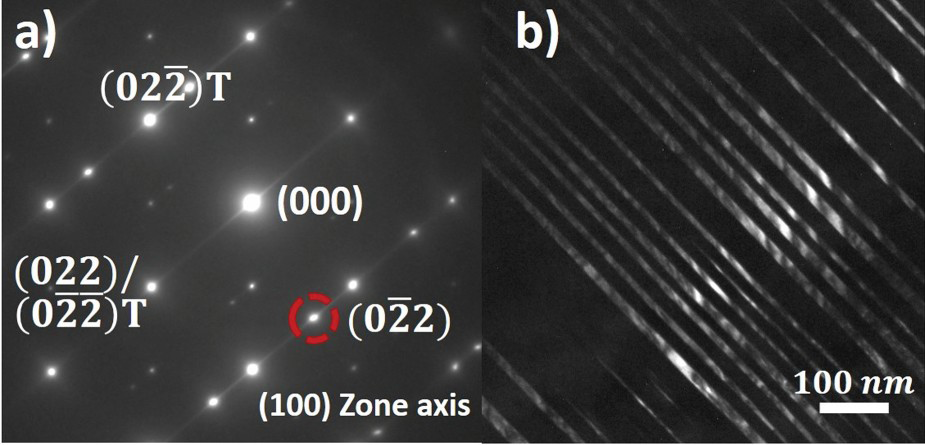
The SEM microstructural observations revealed a typical martensitic morphology of self-accommodated lamellar microstructure in all the investigated samples (Figure 1). The martensitic plates were of few micrometers in thickness with visible branching that occurs due to necessary shape accommodation taking place during martensitic transformation. The TEM investigations showed that individual martensitic plates were internally twinned and thus, a so-called twin within twin microstructure was created which is typically observed in Heusler alloys [32] (Figure 2(a)). The dark field TEM image revealed that the mean twin thickness spread throughout each plate was about 10 nm (Figure 2(b)).
SEM micrographs revealing platelike microstructure of FC Ni55−
x
Mn25Ga20Co
x
alloys: (a) x = 0, (b) x = 5, (c) x = 10. Selected area diffraction pattern (a) with a corresponding dark field image and (b) of Ni50Mn25Ga20Co5 FC sample.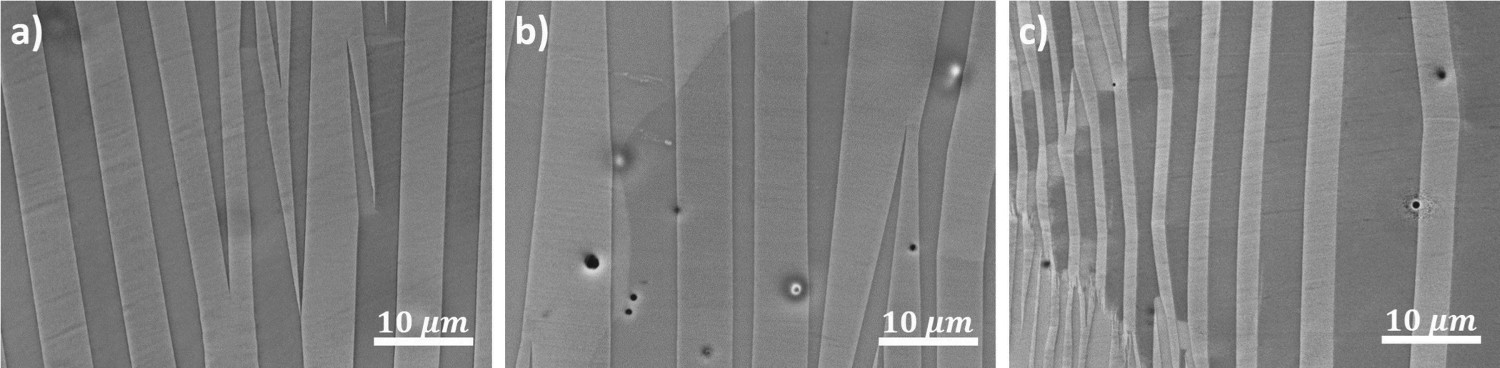
The EDS data of the chemical composition of the alloys are collected in Table 1 together with the calculated e/a ratio. To calculate the e/a ratio the number of valence electrons of Ni, Mn, Ga and Co were taken as 10, 7, 3 and 9, respectively. Thus, the substitution of Ni by Co in the Ni55− x Mn25Ga20Co x alloy decreases the e/a ratio from 7.83 down to 7.72 for Co0 and Co10 alloys, respectively.
The XRD profiles recorded at ambient temperature revealed that the investigated alloys were single phase of 2M martensite structure (Figure 3). The appearance of this type of martensite phase is independent of the amount of Co addition and the type of heat treatment applied (i.e. FC and WQ samples). Although the type of martensite was the same in each case, one can observe changes in the lattice parameters. The addition of Co modifies the lattice parameters of both the FC and WQ samples. The ‘a’ and ‘c’ lattice parameters change from 5.40 to 5.43 Å and from 6.69 to 6.58 Å, respectively. The tetragonality of the martensite unit cell then changes accordingly from 1.24 to 1.21.
XRD patterns of polycrystalline arc melted Ni55−
x
Mn25Ga20Co
x
(x = 0, 5, 10 at.-%) alloys. All of the reflection were indexed according to the 2M martensite structure.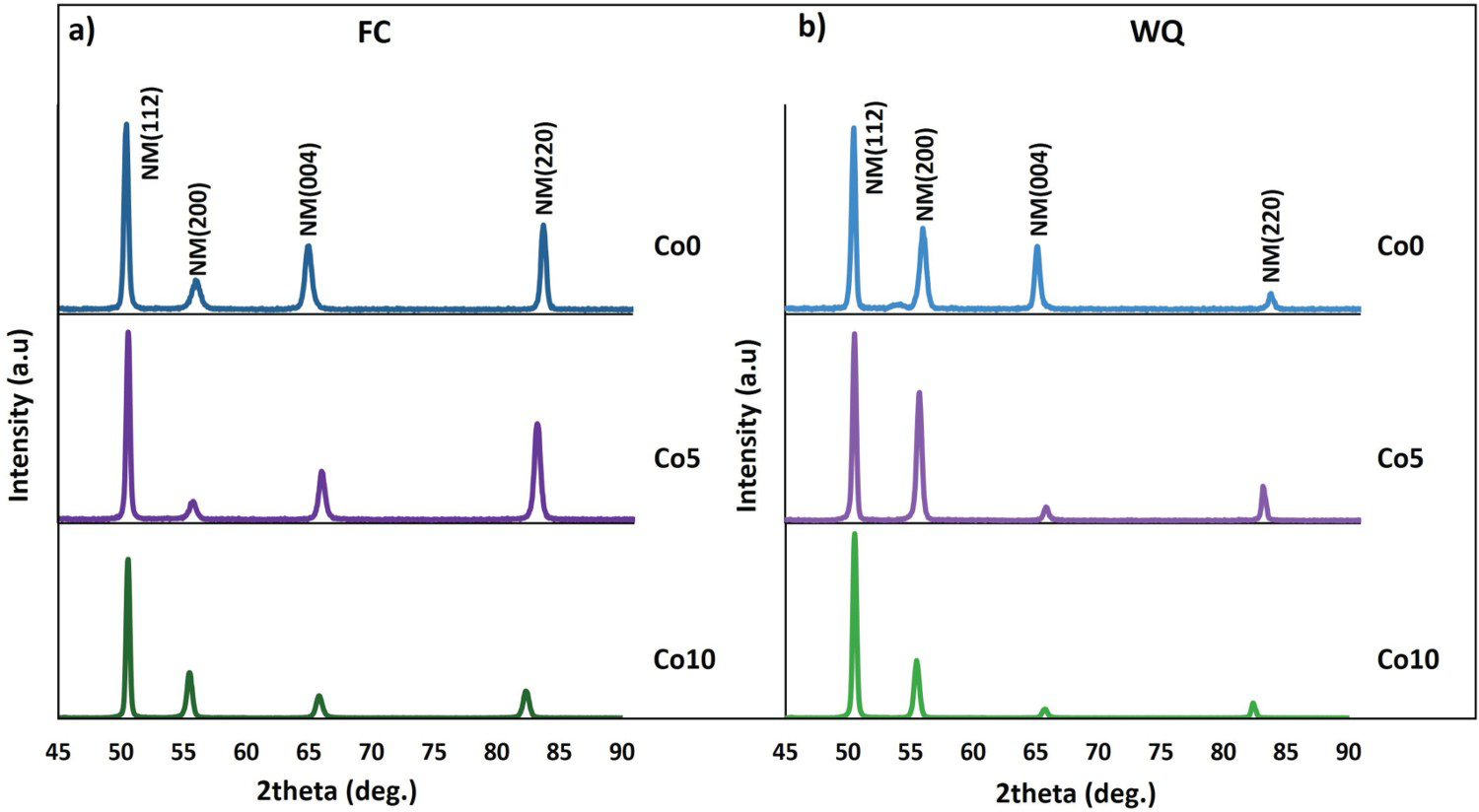
The DSC curves of the Ni55−
x
Mn25Ga20Co
x
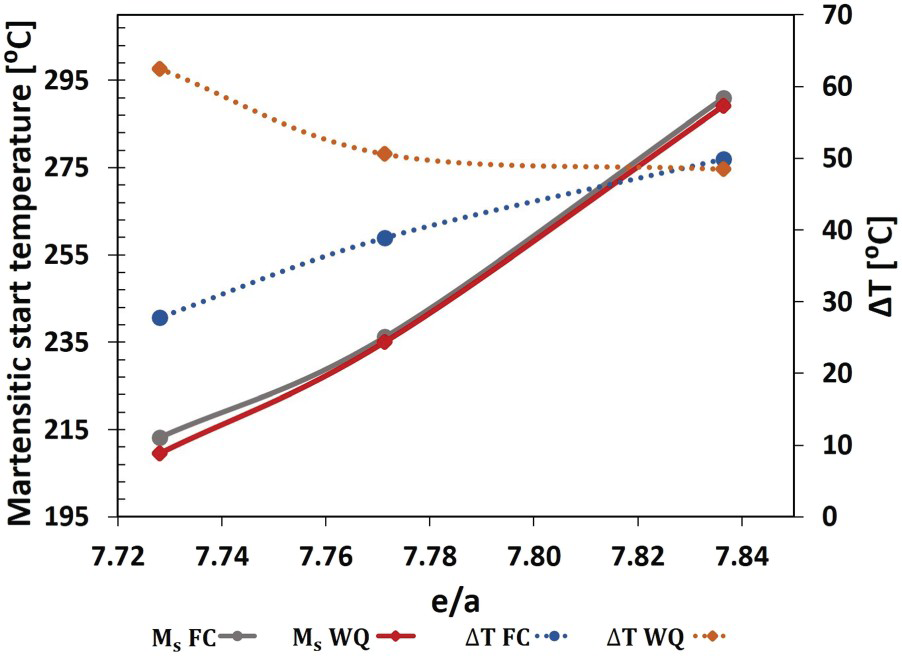
(x = 0, 5, 10 at.-%) alloys are shown in Figure 4. All of the samples possess a reversible martensitic transformation. The exothermic and endothermic peaks during full cycle of heating and subsequent cooling correspond to the reverse and forward martensitic transformation, respectively. The characteristic transformation temperatures (i.e. the start (Ms) and finish (Mf) temperatures of the forward transformation of the parent phase to the martensite phase during cooling and the start (As) and finish (Af) temperatures of the reverse transformation of martensite to the parent phase during heating) were estimated by the two-tangent method (see the DSC curve of sample Co0 WQ in Figure 4). One can notice that generally the Ms is proportional to the e/a ratio (see Figure 5 and Table 1). For the FC samples, the Ms drops from 291°C to 213°C that corresponds to a decrease of e/a from 7.83 to 7.72, respectively. The applied WQ procedure affects the As increasing the reverse transformation temperature. Also, the hysteresis of martensitic transformation (ΔT) was significantly affected by the heat treatments. The hysteresis was defined as the temperature difference between the peak maximum of the forward and reverse martensitic transformations observed during DSC cooling/heating cycles. For the FC samples, the hysteresis narrows upon Co addition from 50°C to 28°C. Interestingly, the ΔT of WQ samples, turned out to be inversely proportional to the e/a ratio which has increased from 49°C to 63°C for Co0 WQ and Co10 WQ samples, respectively. This effect is a consequence of the strong influence of WQ on the As and Af temperatures increasing them sharply in each case (Figure 4).
DSC curves of Ni55−
x
Mn25Ga20Co
x
(x = 0, 5, 10 at.-%) that show the forward (on cooling) and reverse (heating) martensitic transformation. Dependence of the martensitic start temperature Ms and thermal hysteresis ΔT on valence electron concentration per atom e/a in Ni55−
x
Mn25Ga20Co
x
(x = 0, 5, 10 at.-%) alloys.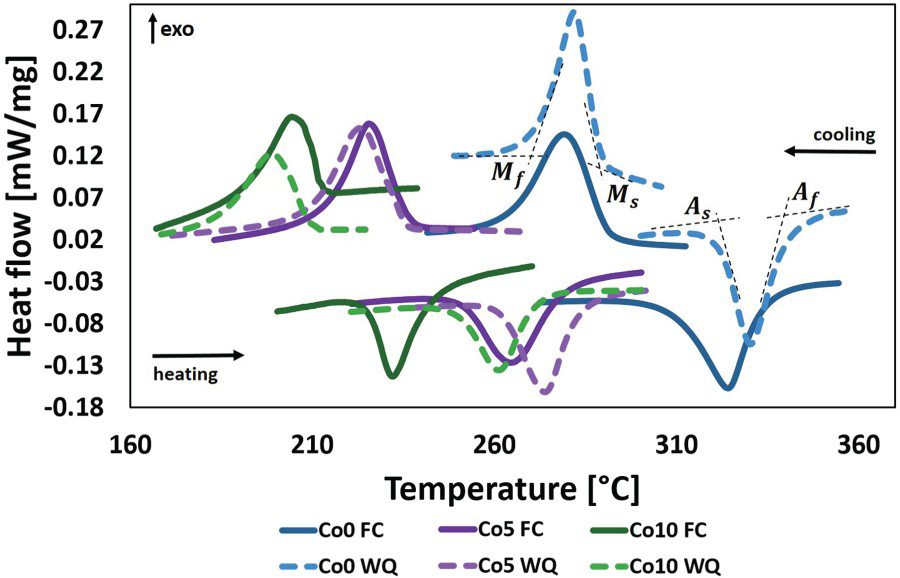
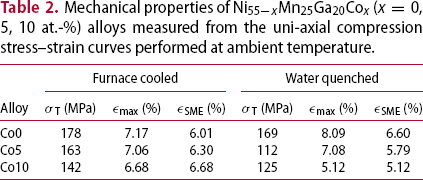
From the uni-axial stress–strain compression characteristics, one can see that the maximum strain (εmax), which was measured after unloading, decreases upon the Co addition from 7.17% to 6.68% and from 8.09% to 5.12% for FC and WQ samples, respectively (Table 2 and Figure 6). Although the εmax has somewhat decreased, the recoverable strain (εSME) measured after annealing at 500°C (i.e. the shape memory effect) increases from 6.01% to 6.68% for Co0 and Co10, respectively. Interestingly, a fully recoverable shape memory effect was obtained for the FC and WQ samples that contained 10 at.-% of Co only. One can also see that the twinning stress (σT), measured at the half of εmax, also decreases upon Co addition (Table 2).
Compressive stress vs. strain curves of samples Co0 and Co10 after both types of heat treatment. Note the difference of recoverable strain εSME upon Co addition. Mechanical properties of Ni55−
x
Mn25Ga20Co
x
(x = 0, 5, 10 at.-%) alloys measured from the uni-axial compression stress–strain curves performed at ambient temperature.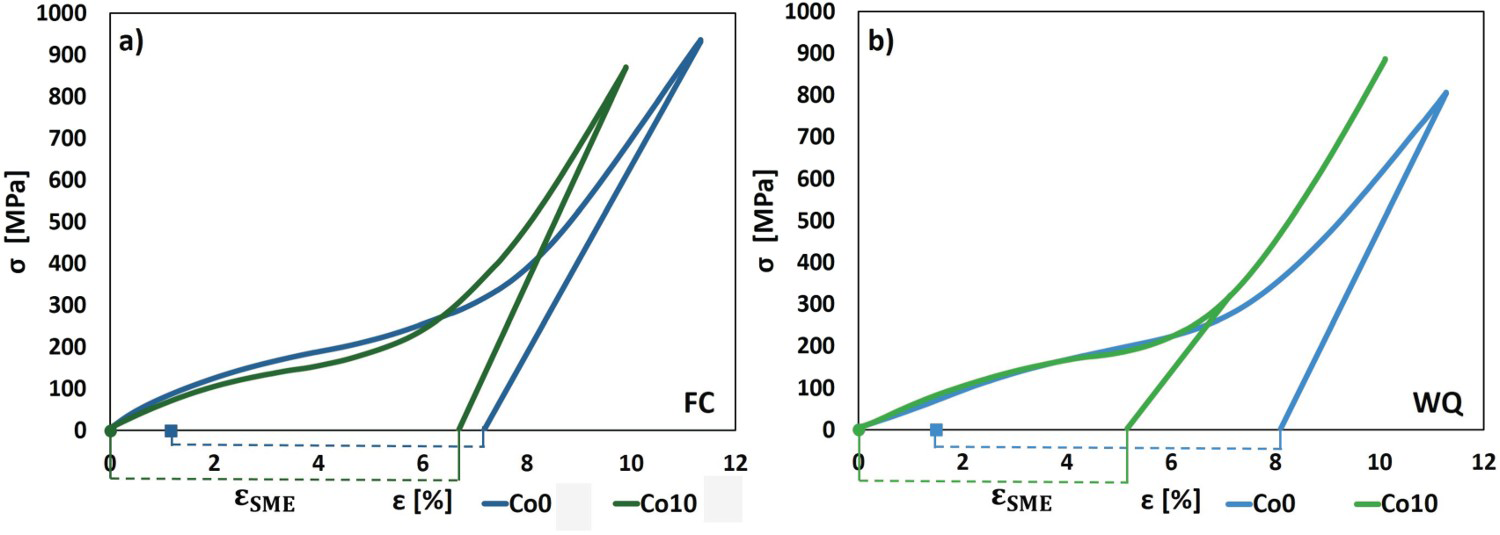
Conclusions
In this work, the type of crystal structure, martensitic transformation behaviour and compressive properties of polycrystalline Ni55−
x
Mn25Ga20Co
x
(x = 0, 5, 10 at.-%) alloys after two types of heat treatments were studied. Based on the experimental results, the following conclusion can be drawn:
The substitution of Ni for Co does not change the type of martensite structure which turned out to be the 2M non-modulated phase. The Co addition, however, modifies the lattice parameters that led to a change of the tetragonality of the unit cell from 1.24 to 1.21 for Co0 and Co10 alloys, respectively. The martensitic transformation temperature decreased when Ni was replaced by Co which was proportional to the change of the e/a ratio. The hysteresis of martensitic transformation ΔT has a different composition dependence with respect to the type of the heat treatment. For FC samples, the ΔT narrows considerably from 50°C to 28°C upon Co addition. On the other hand, in the case of WQ samples, an increase of ΔT occurs that reached ∼63°°C for the Co10 sample. The recoverable strain of FC samples induced by annealing at 500°C increased with Co addition and eventually reached a full recoverable shape memory effect at the highest amount of 10 at.-% of Co.
Footnotes
Acknowledgements
The experimental tests were performed in the Accredited Testing Laboratories at the Institute of Metallurgy and Materials Science of the Polish Academy of Sciences.
Disclosure statement
No potential conflict of interest was reported by the authors.