







Abstract
Low-cycle fatigue tests on [001], [011] and  Ni-based single crystal superalloys were conducted at 900°C under a constant plastic strain control. Cracks will more readily propagate between the {111} planes than migrate between the {111} and {001} planes, as shown by the longer crack propagation period and fatigue life for each [001] specimen (all crystal orientations). The oxidation could proceed via two different diffusion paths: short-range diffusion and long-range diffusion. Fatigue cracks prefer to nucleate at one oxide and then propagate along the oxidised slip bands until they link to the next oxide, which could be predicted from fatigue crack growth data, including the fractographic slip band density and oxide depth.
Introduction
Ni-based superalloys are an important class of engineering materials that are widely used in fabricating critical components in gas turbine engines because of their excellent physical and mechanical properties, including good fatigue and fracture resistances and outstanding oxidation, corrosion and creep resistances at elevated temperatures [1,2]. The typical microstructure of single crystal (SX) superalloys usually contains L12-ordered γ’ (Ni3(Al, Ti)) precipitates that are coherently embedded in the γ matrix and have a face-centred cubic crystal structure [3]. The mechanical properties of these materials depend on the volume fraction, distribution, size and morphology of the γ’ precipitates. This morphology indicates that the properties of SX superalloys are orientation dependent, and the orientation effect on the mechanical behaviour of SX superalloys is closely related to the activated slip systems. SX superalloys usually undergo deformation on their octahedral slip systems {111}<110>, but deformation on their cubic slip systems {001}<011> is also observed at elevated temperatures [4,5]. The activation of the cubic slip system is derived from the cross slip, which is also responsible for the non-Schmid effect, abnormal temperature–strength relationship and tension/compression asymmetry [6–10].
Fundamental fatigue behaviour studies have primarily been conducted using SX copper that was oriented for single slip, with considerable attention placed on the development of persistent slip bands [11–14] and the effect of the slip mode [15]. Studies have recently been conducted to investigate the deformation mechanisms of fatigued Re-bearing and non-Re-bearing [001] SX superalloys [16,17]. The slip mode gradually changed from wavy to planar slip with increasing temperature, and the addition of Re further reinforced this trend. Deformation homogenisation became dominant at high temperatures, thus resulting in a cracking mode transition from shear fracture to normal fracture.
Although the in-situ tensile deformation and fracture behaviour of nickel-based SX superalloys with different crystal orientations have been systematically studied [18], research is lacking on how the crystal orientation improves the high-temperature performance of Ni-based superalloys, particularly their low-cycle fatigue (LCF) behaviour [19–21]. Therefore, it is necessary to further analyse the orientation effect on the LCF properties of Ni-based SX superalloys, particularly the cracking mode. Research on ductile alloys has mostly focussed on strain localisation in slip bands and its relationship to stress–strain cyclic behaviour, with little attention given to fatigue life–strain curves. It should be noted that the conventional fatigue test for SX superalloys was controlled by the total strain amplitude, and LCF tests that were controlled using a constant plastic strain amplitude provided better constraints on the plastic deformation behaviour of SX superalloys. In this study, a set of constant plastic strain-controlled LCF tests was conducted at 900°C on Ni-based SX superalloys with different crystal orientations to elucidate the key role of crystal orientation in crack initiation and propagation.
Experimental procedures
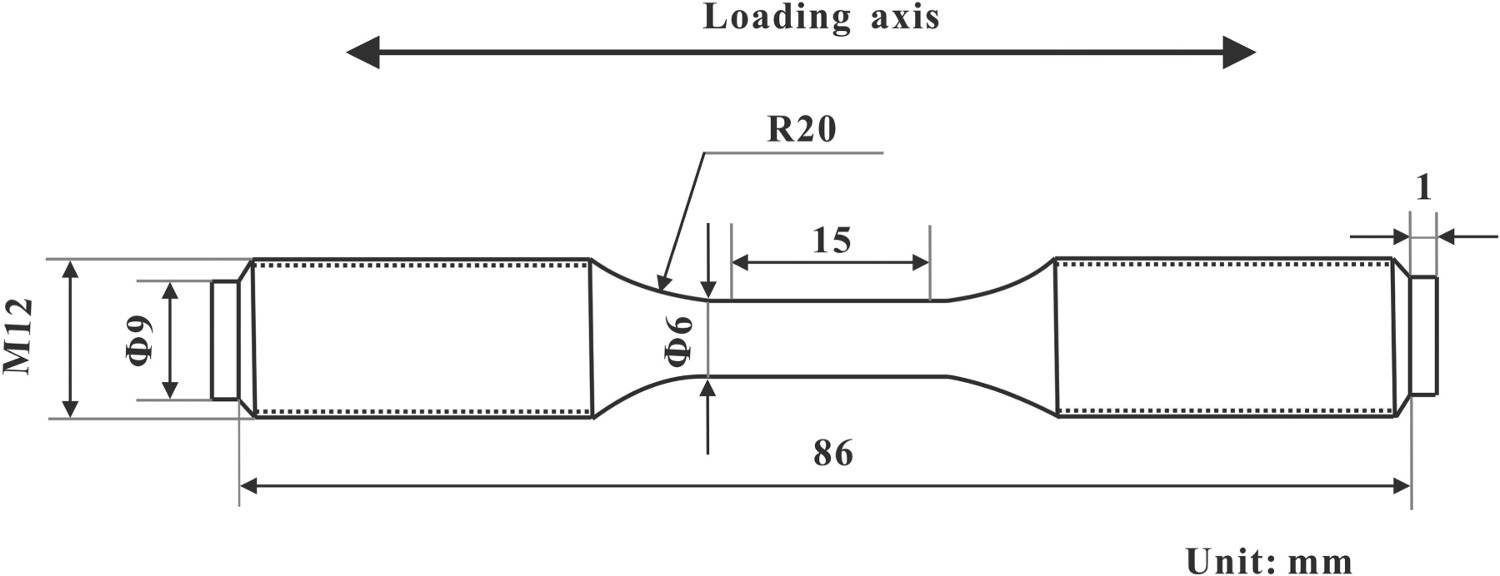
A set of Ni-based SX superalloys with various crystal orientations was produced using the crystal selection method in a directional solidification vacuum furnace. Their reference chemical compositions consist of the following (in wt-%): 10 Co, 8.0 Ta, 6.0 W, 6.0 Cr, 4.0 Al, 2.0 Ti, 2.0 Mo and the balance in Ni. The longitudinal crystal orientation of all specimens was within ±10° of their longitudinal axes parallel to the [001], [011] and Schematic diagram of low-cycle fatigue specimens. , respectively. The as-cast rods were cut into ∼90-mm-long bars, treated with a solution and subjected to a two-step aging treatment (1080°C/6 h, AC + 870°C/24 h, AC) [17]. LCF specimens with 6 mm diameter and 15 mm gauge length were then machined parallel to the longitudinal direction of the heat-treated bars by using an electrospark cutting machine. Figure 1 shows the geometry and dimensions of the specimens for the fatigue tests. All specimens were polished in the longitudinal direction by using emery paper (#400, #800, #1200, #1500 and #2000 in this order), followed by electropolishing at 13 V for 35 s in an electrolyte solution containing 10% perchloric acid and 90% ethanol.
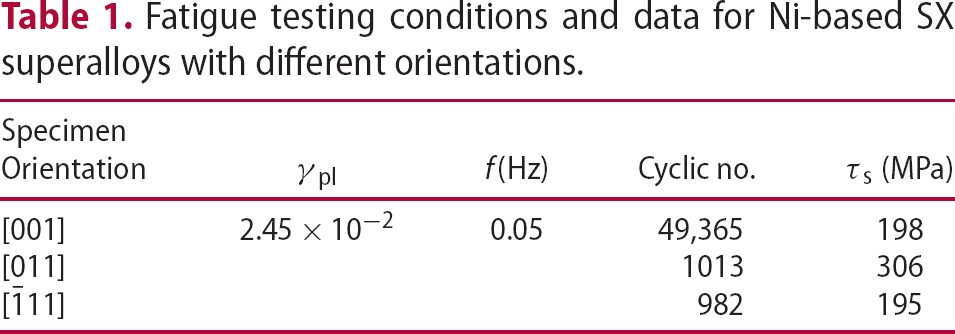
Fatigue testing conditions and data for Ni-based SX superalloys with different orientations.
Experimental results
Cyclic hardening and LCF behaviour
Figure 2 shows the cyclic stress response curves of the Ni-based SX superalloys with different crystal orientations under a constant plastic strain of 2.45%. Three fatigue tests were conducted for each crystal orientation to accurately refine the statistical significance of the results. One cyclic stress response curve for each crystal orientation is shown in Figure 2 to illustrate the differences in LCF behaviour. The [011] specimen exhibits a slow softening phenomenon from the onset, and the softening trend became more obvious after 100 cycles. The crack then spreads rapidly, and the effective section area decreases, thus resulting in a rapid decrease in stress until the final fracture. Conversely, no slow softening process exists in the [001] and Cyclic stress response curves of Ni-based SX superalloys with different orientations at the constant plastic strain amplitude of  specimens, and the saturation stress always maintains a stable value. The stress begins to decrease rapidly as the cracks initiate. The shear stress amplitude of the [011] specimen is generally the highest among the three oriented specimens, whereas the shear stress amplitudes of the [001] and
  specimens are almost the same [2,20]. The [011] and
  specimens have a similar fatigue life, whereas the [001] specimen has a distinctly longer fatigue life.
 .
.
A constant plastic strain control can more effectively reflect the LCF behaviour of single crystals with different crystal orientations, particularly their microstructural evolution [22]. Previous studies have recognised that cyclic deformation with alternating tension and compression at a constant plastic strain amplitude provides the most suitable basis to form a physically meaningful interpretation of the observed features [23]. The resolved shear strain amplitudes of the [001] and [011] specimens with an axial strain amplitude of 1% are the same as those at 2.45%. The axial strain was measured using a linear variable differential transducer, with the load determined using a load cell [22]. The same plastic shear strain 2.45% was used for the fatigue tests on the  specimen to compare the stress response behaviour of different-oriented superalloys. Figure 2 summarises a typical
  cyclic stress response curve. The resolved stress of the [011] specimen is more than 300 MPa under the same plastic strain amplitude, but the stresses of the [001] and
  specimens are approximately 200 MPa. Figure 2 highlights another important observation – the fatigue life of the [001] specimen is more than an order of magnitude higher than those of the other oriented specimens under the same high-strain amplitude.
Li et al. [16] and Liu et al. [24] investigated the LCF behaviour of Ni-based SX superalloys at different total strain amplitudes and found that the cyclic softening became more obvious and the fatigue life gradually decreased with increasing strain amplitude; however, large differences still existed between different oriented specimens. It is believed that the fatigue life exhibits a strong orientation dependence that is closely related to the elastic modulus. The [001] specimen with the smallest elastic modulus exhibited the longest fatigue life. It has been demonstrated that increasing the elastic modulus gradually reduces the fatigue life of SX superalloys [18,25], but the elastic modulus may not be the only factor that influences fatigue life. Therefore, it is necessary to incorporate the slip mode and oxidation effects when investigating fatigue crack initiation and propagation.
Surface slip features and fracture morphologies
Slip is the most important deformation mode in SX superalloys and is the basic origin of fatigue damage. However, oxidation plays an equally important role, i.e. the degree of oxidation becomes increasingly important with increasing cycle time; an extended cycle time causes oxides to be the other crack source in fatigued specimens [26].
Figure 3 shows the slip morphologies and fatigue cracks of [001], [011] and Surface morphologies and fatigue cracks in [001], [011] and  Ni-based SX superalloys at 900°C. Many slip bands are evenly distributed, with slight intrusion and extrusion. The fracture surface is perpendicular to the loading axis, and this finding is consistent with the propagation direction of the oxidation cracks (Figure 3a). Oxidation cracks are also present on the surface, and the cracking direction is perpendicular to the loading axis (Figure 3b). Apparent oxidation traces on the fracture surface suggest that the fracture of the [001] specimen at 900°C is caused by oxidation. Figure 3(c and d) illustrates the slip morphologies and cracking mode of a [011] specimen at 900°C, and two sets of mutually perpendicular slip bands are observed on the fatigued surface. These slip bands possess a very uniform distribution, and the intrusion/extrusion phenomenon is more intense than that of the [001] specimen. The specimen ruptured along the slip bands even though the surface crack is perpendicular to the loading axis. A comparison of Figure 3(c and d) shows that some cracks propagated parallel to the slip bands, whereas others are parallel to the oxidation crack. Therefore, crack propagation in the [011] specimen is the result of both slip and oxidation.
 Ni-based SX superalloys at 900°C at the plastic strain amplitude of
  .
.
Figure 3(e and f) reveals the LCF features of a  specimen at 900°C, namely, fatigue crack initiation and propagation due to oxidation and slip, respectively. The oxidation crack initiates and propagates along the direction perpendicular to the loading axis (Figure 3f). Microcracks form inside the surface defects under cyclic loading and is perpendicular to the loading axis [27]. Cruchley et al. [28] found that the crack only propagates inside the oxidised film. Xu et al. [29] demonstrated that the interaction of an oxide crack with the slip bands would contribute to crack propagation [29], with the crack propagating along the primary and secondary slip bands [30]. The crack initiates at an oxide in the
  specimen, but its propagation is fully dependent on the slip bands; this phenomenon may primarily be attributed to the oxide crack and slip crack [31].
The fracture of SX superalloys is also closely associated with oxidation. Chieragatti and Remy [32] compared the crack mode of the same oriented specimens at 650°C and different strain amplitudes. They confirmed that fatigue cracks initiate at subsurface micropores under low plastic strain, whereas slip bands form and fatigue cracks nucleate on the surface of MC precipitates early in their fatigue life under high plastic strain. Li et al. [17] found that the cracking mode of a [001] specimen transitions from shear fracture to normal fracture with increasing temperature. Therefore, the transition to fatigue cracking mode in the [011] and  specimens lags behind that in the [001] specimen at high temperatures, thus further influencing the LCF life of SX superalloys.
Figure 4 illustrates the fracture morphologies of a [001] specimen at 900°C and a plastic strain amplitude of 2.45%. The observed cracking is caused by a single crack source. The fatigue crack originates from the oxidation defect on the crystal periphery and propagates to the interior parallel to either the (100) or (001) plane. Kunz et al. [33] observed both long stage I crack growth via crystallographic crack initiation and non-crystallographic stage II propagation. The scatter in the fatigue life data could be explained by variations in both the microstructural conditions and casting defect size distribution. Although there are significant shrinkage defects inside the specimen (Figure 4d), these internal porosities cannot be the origin of the observed cracking. The transient zone of the [001] specimen consists of {111} crystal planes, with slip bands I and II clearly observed. Slip band II is associated with the crack propagation (Figure 4b).
Fracture morphologies in fatigued [001] Ni-based SX superalloy at 900°C at the plastic strain amplitude of  .
.
Figure 5 illustrates the fracture morphologies of the fatigued [011] and Fracture morphologies in fatigued [011] and  SX superalloys. The [011] specimen cracking is caused by a multicrack source (Figure 5a). All crack sources appear on the specimen surface, and the propagation plane of every source is limited to a narrow zone. A number of river patterns are also present on the fracture surface. He et al. [34] found that these river patterns are composed of mutually intersecting {111} crystal planes. Slip traces are also observed inside the crystal planes, thus indicating that the slip systems have been widely activated. The appearance of a secondary crack in the centre of the fracture demonstrates the requirement for a high shear stress amplitude.
 Ni-based SX superalloys at 900°C at the plastic strain amplitude of
  .
.
Figure 5(c and d) shows the fracture morphologies of the  specimens that were cyclically saturated at a plastic strain amplitude of 2.45%. Specimen cracking is caused by a single crack source, as observed in the [001] specimen. Figure 5(d) indicates that loosen can be regarded as the first crack source. The fatigue cracks propagating on the (111) planes belong to the primary and secondary slip systems. The spacing between the fatigue striations is wide, with the transient zone consisting of {111} crystal planes. Liu et al. [24] found that the crack sources of the
  specimen increase in number and that the fatigue crack simultaneously propagates along all crystal planes with increasing strain amplitude, thus confirming the use of the same plastic strain control as the basis for comparing the LCF behaviour of SX superalloys with different crystal orientations.
Discussion
The high-temperature LCF life of superalloys can be described via the Coffin–Manson formula:

 is the fatigue ductility coefficient, c is the fatigue ductility index and
  is the reverse loading number until fatigue failure. The fatigue life is primarily controlled by the plastic strain at the same loading condition, and a longer fatigue life is obtained as the plastic strain amplitude is reduced.
The fraction of the fatigue life spent in crack propagation is inferred from the fatigue life curves. The absence of any crack length dependence on the crack growth rate for more than half the fatigue life suggests that a conventional analysis of fracture mechanics cannot be used to predict the fatigue life of these specimens. A damage equation was proposed to describe the damage rate accumulation in a microstructural element of size  [33]. Chieragatti and Remy [32] considered that the damage rate dD was related to the cycle number
  required to break the microstructural element:

The determination of  is not complicated because the crack growth rate in the LCF specimen is simply obtained by da/dN = λ/Nλ, where da is the crack extension length per cycle. The fatigue life of smooth LCF specimens can easily be deduced from the crack growth data. An average Young's modulus was used in the qualitative analysis of the crystal orientation effect on the fatigue life of SX superalloys via Equation (1). The quantitative prediction of fracture at different temperatures and strain amplitudes was computed as follows:

The oxidation depth is a function of oxidation temperature, exposure time and crystallographic orientation. The oxide scale becomes too thick to retain its epitaxial growth after a long oxidation time, and this oxidation anisotropy is primarily due to the effect of short-circuit diffusion paths on both surfaces. Therefore, the specimen surfaces with different crystallographic orientations exhibit various oxidation rates [35]. When the oxidation scales grow on the SX superalloy surface, they contain a large number of short-circuit diffusion paths, and these short-circuit diffusion paths are frequently generated because the oxidation scale is subjected to an epitaxial growth force as it grows on the SX superalloy surface during cyclic loading [36]. The deepest oxidation crack will control the degree of fatigue life reduction.
The most common oxides observed in superalloys are Ni, Cr, Nb, Ti, Co and Al oxides [37]. These oxide complexes usually possess a layered structure that consists of a thermodynamically unstable central NiO/CoO layer, a thermodynamically stable intermediate Cr2O3 layer and a marginal Al2O3/TiO2 layer. Cyclic oxidation yields similar oxide layers that consist of an external Cr2O3 layer and an internal Al2O3 layer [38]. Ghonem et al. [39] suggested that the oxidation could proceed via two different diffusion paths: (1) short-range diffusion, where only the crack tip is oxidised, thus resulting in the formation of a wedge-like oxidation crack with a fracture that accelerates fatigue crack growth and (2) long-range diffusion through the slip planes. It was also noted that the depth of oxygen penetration was controlled by the formation of Cr2O3. Molins et al. [40] confirmed that anionic diffusion was the controlling factor at low partial pressures, whereas cationic diffusion was the controlling factor at high partial pressures. They also suggested that the formation of epitaxial NiO prevented the annihilation of vacancies at the crack tip, thus leading to material damage.
Reed [2] demonstrated that failure typically occurs within 105 cycles, with a majority of the fatigue life being spent in the crack propagation stage, which links the activated slip systems. The fatigue cracks in SX superalloys propagate along the slip plane in most cases. The main cracks in the [011] and  specimens propagate along the (111) planes, whereas the main crack in the [001] specimen propagates along the {001} plane (Figure 3). Crack propagation along the {001} plane should obviously be more difficult than that along the {111} plane because the octahedral slip systems {111}<110> are more easily activated than the cubic slip systems {001}<011>. However, the angle between the slip plane and loading axis is different, thus leading to a change in the stress field at the crack tip. According to the cross slip model for crack propagation proposed by Neumann [41], the crack tip continuously hardens when the crack propagates along the primary slip planes, whereas non-coplanar secondary slip does not synchronously harden the crack tip, thus causing the crack to migrate from the primary slip plane to the secondary slip plane. In this study, a large number of octahedral slip systems {111}<110> are initiated, and the dislocations will more readily migrate via cross slip between the {111} planes than between the {111} and {001} planes. Furthermore, crack tip hardening along the {111} plane becomes lower than that along the {001} plane. Therefore, the crack propagates exclusively by slip, with no monotonic increase in work hardening. The crack will more readily propagate between the {111} planes than migrate between the {111} and {001} planes because the production of a new surface by two slip systems is highly irreversible. Therefore, the [001] specimens experience longer crack propagation periods and exhibit longer fatigue lives than the [011] and
  specimens.
Both microcrack initiation and crack propagation have large effects on fatigue life, with the former being inseparable from oxidation. Oxide formation is also related to the strain accumulated during cyclic deformation, which may influence the local slip system activity [42]. A higher accumulated strain is usually associated with a greater number of dislocations and vacancies produced during the deformation process, which can facilitate the diffusion of oxide-forming elements and accelerate oxide formation. Fatigue cracks prefer to nucleate at one oxide and then propagate along the oxidised slip bands until they link to the next oxide. Therefore, the fatigue life can be predicted from the fatigue crack growth data, including the fractographic slip band density and oxidation depth.
Conclusion
The orientation effect on the LCF behaviour of Ni-based SX superalloys at 900°C is summarised as follows:
The LCF life of the [001] specimen is more than an order of magnitude longer than those for other crystal orientations at the same constant plastic strain amplitude. The fracture of the [001] specimen is solely due to oxidation, whereas the crack propagation in the [011] and The oxidation depth is a function of oxidation temperature and exposure time. Oxidation could proceed via two different diffusion paths: (1) short-range diffusion, where only the crack tip is oxidised, thus resulting in the formation of a wedge-like oxidation crack with a fracture that accelerates fatigue crack growth and (2) long-range diffusion through the slip planes. The fatigue life is almost entirely spent on crack propagation, which is linked to the activated slip systems. Crack propagation is favoured between the (111) planes compared with migration between the (111) and (001) planes. Therefore, the [001] specimens experience longer crack propagation periods and exhibit longer fatigue lives than the [011] and
 specimens results from the interaction between slip and oxidation. The fatigue cracks prefer to nucleate at one oxide and then propagate along the oxidised slip bands until they link to the next oxide, and this behaviour could be predicted from the fatigue crack growth data, including the fractographic slip band density and oxide depth.
 specimens.
Footnotes
Acknowledgements
The authors are grateful to H.H. Su, L.X. Zhang, J.L. Wen and Q.Q. Duan for their assistance in the fatigue experiments and morphological observation.
Disclosure statement
No potential conflict of interest was reported by the authors.