







Abstract
Diversified technological applications necessitate the tailoring of morphology of materials at nanoscale. This paper reports morphological modifications of boron carbide (BC) at nanoscale through alkali (NaOH) treatment. The multilayered hollow microspheres of BC, obtained by the refluxion of castor oil with boric acid, are subjected to exfoliation by sonicating it in the ethanol–water mixture. The attractive morphologies evolved in the sonication process as a result of changing the BC concentration, auxiliary agent and sonication time are analysed. The multilayered hollow structure on sonication with NaOH yields flower-like morphology that seems to evolve from the basic spindle structure. The morphological tuning makes the study relevant in the areas like bleaching, where the surface area is crucial.
Introduction
In the development of the hardest materials, the third hardest material, boron carbide (BC), has a leading role in a variety of applications. Boron carbide is an essential refractory semiconductor with unique physical, mechanical and chemical properties such as low density, high modulus, high melting point, chemical durability, and excellent neutron absorption [1-3]. These properties together make it a strong material for high energy and technology applications in the automobile industry, nuclear, microelectronics, military, space and medical industries [4-6].
The quality and also the quantity of boron carbide depend upon the boron and carbon sources and techniques used for synthesis [7-9]. The commercial production of boron carbide includes carbothermic reduction of boric anhydride at higher temperature, i.e. above 2000°C. The disadvantage of this method is the presence of a large amount of free carbon in the final product [10,11]. An alternative synthesis method uses a solution-based approach which yields powdered boron carbide at a lower temperature. The condensation reaction is one such most crucial method for the synthesis of boron carbide at low temperature [10,12-14]. In spite of the difficulties in getting the morphology with unusual shapes like spheres, fibres, spindle, and flower-like, the emulsion-based synthesis overcomes these limitations. We have already reported the synthesis of multilayered hollow microspheres of boron carbide at low temperature by the emulsion-based synthesis method using castor oil and boric acid [15].
In the long term, the synthesis of tailored microstructures has significant interest due to their potential applications in electronic, optical, drug and gene delivery, and catalysis [16,17]. The fabrication of particles as individual units with the same form and function has research attention due to their enhanced properties such as narrow size distribution, porosity, high surface area and shell thickness as compared to larger one [18]. There are several techniques for the production of individual units with different sizes and shapes. The commonly used methods of exfoliation are chemical method, chemical vapour deposition, epitaxial growth, and liquid-phase exfoliation. It is reported that the nanoplates generated in the chemical exfoliation method contain defects which dramatically modify the electrical and physical properties [19]. The substrate-based methods such as chemical vapour deposition (CVD) and epitaxial growth suffer from the control on dimension and higher cost [20]. Liquid phase exfoliation, a top-down method, involves a stable dispersion of particles in organic/ionic solvents exfoliates via sonication or shear mixing. The method is proven to give good results in the exfoliation of boron carbide [21] and boron based nanosheets [22,23].
The solvents used for exfoliation plays a significant role in separating the layers or particles depending on their nature. For example, water can act as an ideal dispersion medium for exfoliating hydrophobic materials. The non-volatile organic solvents with high boiling points used for exfoliation include N,N-Dimethyl formamide, dimethyl sulfoxide, and ortho-dichlorobenzene. The use of such solvents necessitates drying by heating to recover the material. This process leads to the formation of composites due to the possible reaction between the material and the solvent. The use of solvents like ethanol [24,25], acetone, isopropanol and chloroform [26-28] with a low boiling point for the exfoliation process as it enables the recovery of material by simple air drying overcomes the formation of composites. The efficiency of liquid exfoliation can be further be enhanced by the addition of secondary agents, like organic and inorganic salts or by increasing the sonication time. Liu et al. [29] have reported the use of sodium hydroxide for improving the level of exfoliation efficiency. The paper betells methods of tuning the morphology of material through alkali (sodium hydroxide-NaOH) treatment on boron carbide (BC) sample as an example for enhancing the effective surface area through liquid-phase exfoliation for potential surface area dependent applications [30-34]. For this, the previously reported multilayered hollow microspheres of boron carbide are systematically subjected to exfoliation. The role of effective surface area on the physical property is exemplified through bleaching studies as an example.
Materials and methods
Among various processing methods available for the synthesis of boron carbide, condensation reaction helps to reduce the synthesis temperature. In the present work, boric acid is refluxed with castor oil in the ratio 1:5. The constant temperature maintained during refluxion also facilitates the removal of water from the mixture. The process results in a thermodynamically unstable emulsion which attains spherical shape. The detailed synthesis procedure is given in our earlier paper [15]. The process results in a transparent product which on cooling appears like a white solid. This sample is heated to 300°C for 1 h and subjected to structural and morphological characterisations. The ultrasonication of the sample in ethanol–water mixture yields boron carbide nanostructures of different morphology. The ultrasonication is carried out by varying the concentration (S1 – 0.8 mg ml−1, S2 – 0.5 mg ml−1 and S3 – 0.2 mg ml−1) and sonication time (1 and 2 h). The addition of sodium hydroxide (NaOH) as the secondary agent in the ratio 1:2 (Si:NaOH) improve the dispersion of sample in ethanol–water solution. For understanding the influence of NaOH on tailoring the morphology, samples are prepared by varying the amount of NaOH in the ratio 1:1, 1:2, and 1:3. The effect of sonication time along with NaOH is also studied for 1 and 2 h. The morphologies of samples are analysed by field emission scanning electron microscope (FESEM – Nova Nano FESEM).
The morphological modification greatly influences the properties of the material depending on surface area. The surface area modifications can easily be brought out through the bleaching action of the sample on the dye methylene blue (MB). For carrying out MB dye degradation by the BC samples (S1, S2, and S3 exfoliated in the presence of NaOH), dye solutions are prepared by dissolving 0.02 mg MB in 5 ml distilled water at room temperature. To study the dye degradation efficiency of BC, MB is added to the samples and the absorption spectrum is recorded (using UV–VIS – Perkin Elmer scan lambda 950) at three different intervals of time as 0, 41, and 65 h.
Results and discussions
In the present work, we report how the morphology can be tailored for various applications depending on surface morphology. For this boron carbide synthesised are subjected to exfoliation through sonication for tailoring its morphology. The sample synthesised is sonicated and investigated the effect of (i) concentration, (ii) the auxiliary agent NaOH, and (iii) sonication time on morphology. The morphology and X-ray diffraction (XRD) pattern of the multilayered hollow microspheres of boron carbide, synthesised by the refluxion of castor oil with boric acid, is reproduced in Figure 1 [15] for better understanding and clarity. The analysis of the XRD pattern shown in Figure 1, detailed in our earlier publication [15], reveals the peaks at 20.1°, 28.4°, and 40.1° corresponding to the planes (021), (901), and (271), respectively of orthorhombic boron carbide.
(a) FESEM image and (b) XRD pattern of the boron carbide sample(Reproduced with permission from Ref. [15].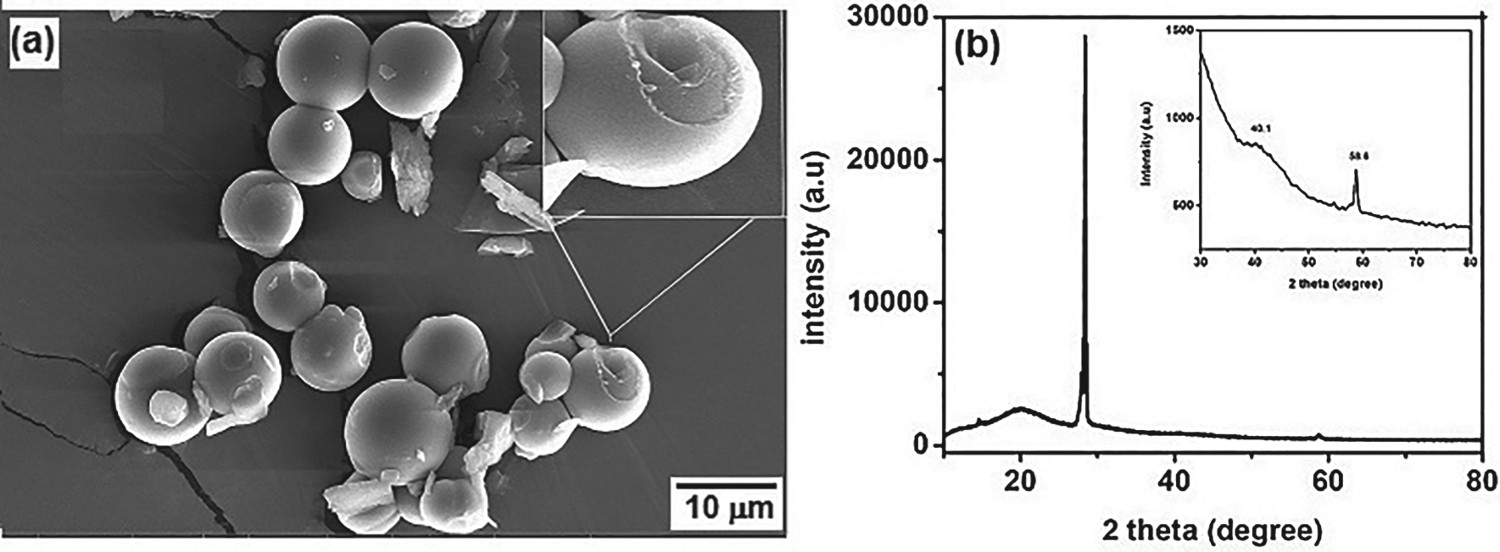
Effect of concentration
To study the role of concentration in exfoliation by sonication three samples are prepared by varying the boron carbide concentration as 0.2, 0.5, and 0.8 mg ml−1. From the FESEM images of the samples shown in Figure 2, it can be seen that the multilayered hollow spheres are broken down on sonication for 1 h. The FESEM images also reveal that for the higher concentration (0.8 mg ml−1) though exfoliation does not happen upon sonication, the hollow microspheres get break down. The thick multilayered broken piece of the boron carbide (Figure 1) hollow sphere can be seen in Figure 2(a). When the concentration is reduced to 0.5 mg ml−1 and 0.2 mg ml−1 and sonicated, the thick layered piece of broken hollow sphere starts separating into flakes (evident from Figure 2(b,c)). This study suggests that the sample concentration influences the exfoliation by sonication for a given sonication time.
FESEM images of exfoliated boron carbide with varying concentration (a) 0.8 mg ml−1, (b) 0.5 mg ml−1, and (c) 0.2 mg ml−1.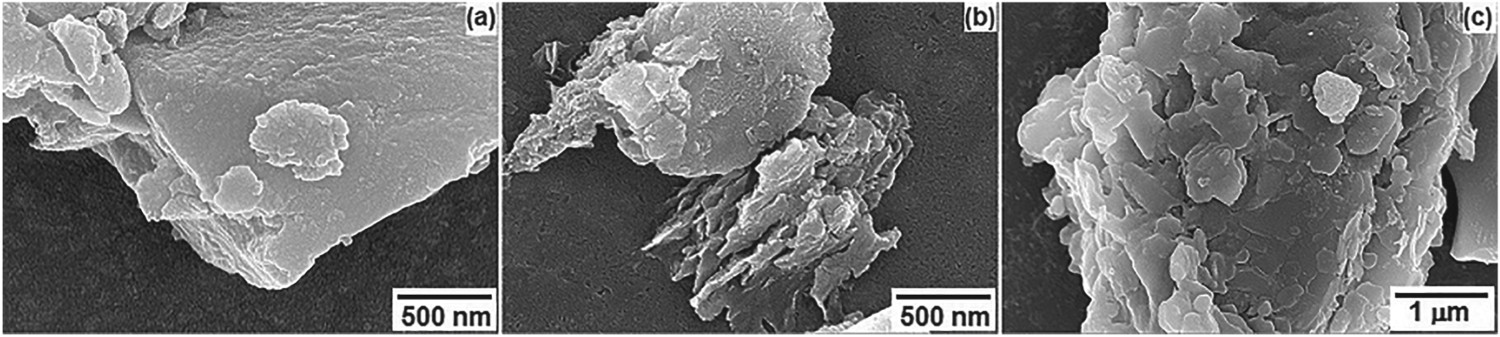
Effect of auxiliary agent, NaOH
From literature, it can be seen that the pH of the dispersing solution places a significant role in the exfoliation process [35]. In the present work, NaOH is used as an auxiliary agent to enhance the dispersion ability [36-38] and to assist the exfoliation process. The samples (S1–S3) sonicated for 1 h in the presence of the auxiliary agent (taken in the ratio 1:2) shows attractive evolution of flower-like morphology as shown in Figure 3. This study also reveals that lowering of concentration significantly influences the exfoliation process. Figure 3(a) shows a flower-like structure with the petals as an aggregation of some basic structure and is given in the inset. For the sample S2, the exfoliation results in a structure with a morphology resembling a garden of flowers and buds. When the concentration of the sample is further reduced, the agglomerated structures of the petals, as seen in Figure 3(a) get separated to form a beautiful flower-like morphology (Figure 3(c)). The dynamics of evolution of morphology is depicted in Figure 4, which shows a spindle structure as the base unit which combines to form a flower-like morphology. The aggregation of the spindle structure may also be due to Ostwald ripening.
FESEM images of samples (a) S1, (b) S2, and (c) S3 exfoliated in the presence of NaOH. Dynamics of formation of flower-like morphology.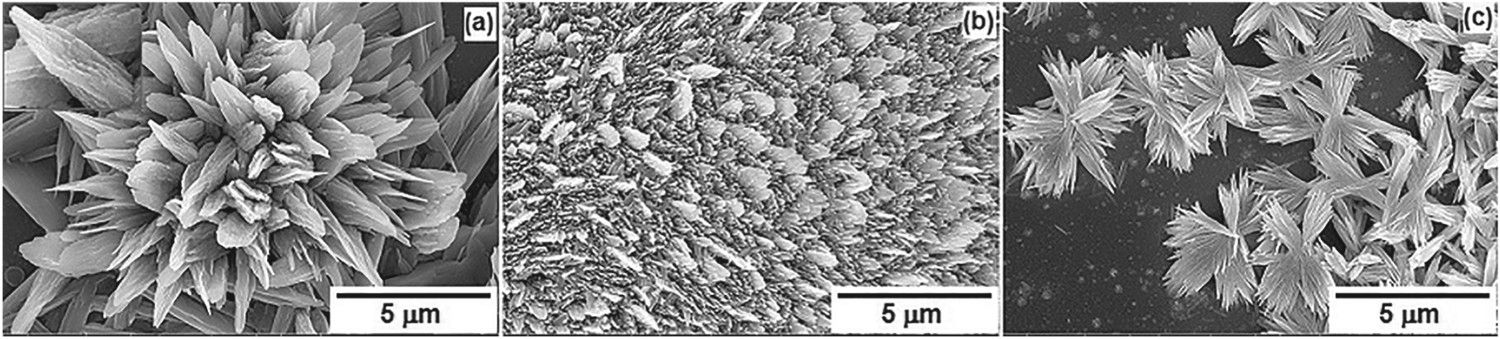

The above studies revealed better result for exfoliation resulting flower-like morphology for the sample concentration of 0.2 mg ml−1. Investigations are further carried out to find the effect of varying the amount of auxiliary agent, NaOH. Accordingly, the sample-NaOH ratios are taken as 1:1, 1:2 and 1:3 and sonicated for 1 h. Surprisingly the attractive morphologies get destroyed for the ratios except 1:2. The resultant morphologies are shown in Figure 5. Thus it can be concluded that for tailoring beautiful morphologies, it is advisable to fix the auxiliary agent to vary the amount of sample as evidenced by Figure 3.
FESEM images of sample S3 exfoliated with different NaOH concentrations (a) 1:1, (b) 1:2, and (c) 1:3.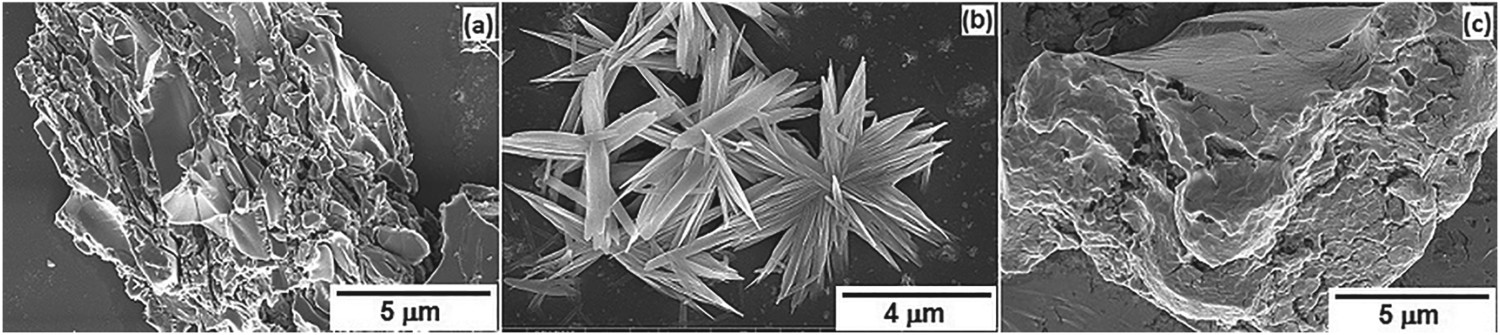
The sample shown in Figure 3(c) is dropped on a quartz glass plate, dried and washed repeatedly with water. The FESEM image shown in Figure 3(c) is found to get modified, as shown in Figure 6. The morphology undergoes a transformation from flower-like to pineapple-like structure. This may be due to the rejoining of the petals shown in Figure 3(c) initiated by the surface tension of water.
FESEM image of sample S3 sonicated for 1 h along with NaOH after washing.
Effect of sonication time
Sonication time is another critical parameter in the process of exfoliation. The lower concentration sample, S3 with NaOH in the ratio 1:2 is sonicated initially for 1 h and then for 2 h. The FESEM image revealing flower-like morphology is obtained for sonication time of 1 h and is shown in Figure 3(c). Dwindling effect is observed on the morphology on increasing the sonication time. The petals found in Figure 3(c) get separated, as shown in Figure 7 and the beauty of morphology is lost. For other concentrations of the sample, no significant effect could be observed in the morphology on sonication.
FESEM images of sample S3 exfoliated for 2 h in the presence of NaOH with concentrations (a) 1:1, (b) 1:2, and (c) 1:3.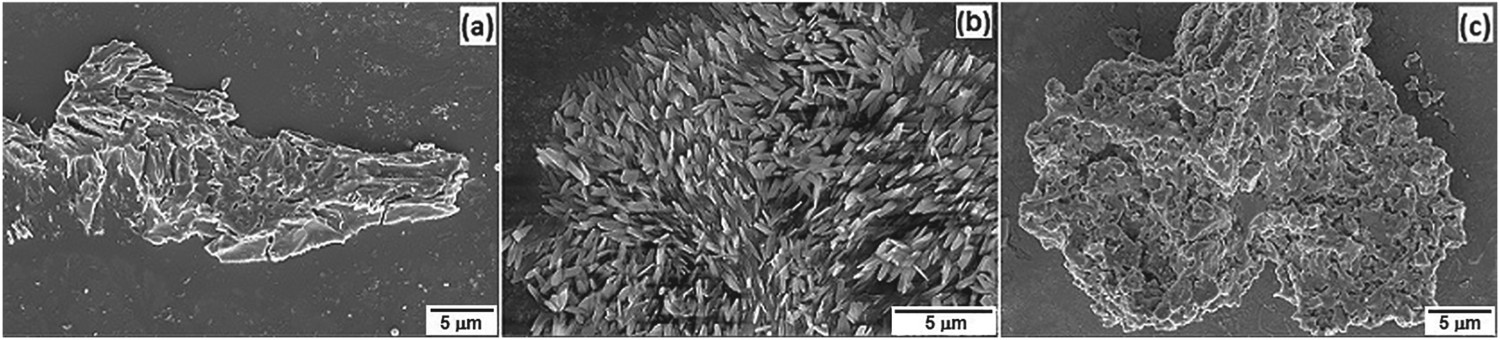
Degradation of methylene blue
The dye degradation studies are highly significant in waste water treatment. In this work, the degradation of one of the widely used neurotoxic dye MB by the exfoliated BC samples is studied. The study reveals the effect of morphology of the sample in the bleaching action. The UV–VIS absorption spectrum of MB and sample incorporated MB at different time (0, 41, and 65 h) are shown in Figure 8.
UV–VIS absorption spectrum of – (a) methylene blue; BC-MB sample (b) at t = 0 h, (c) at t = 41 h, and (d) at t = 65 h.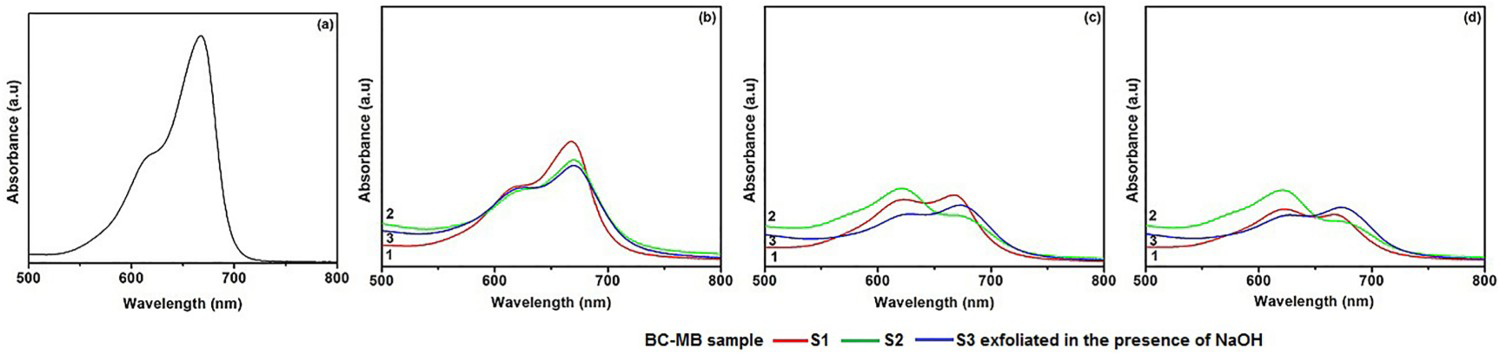
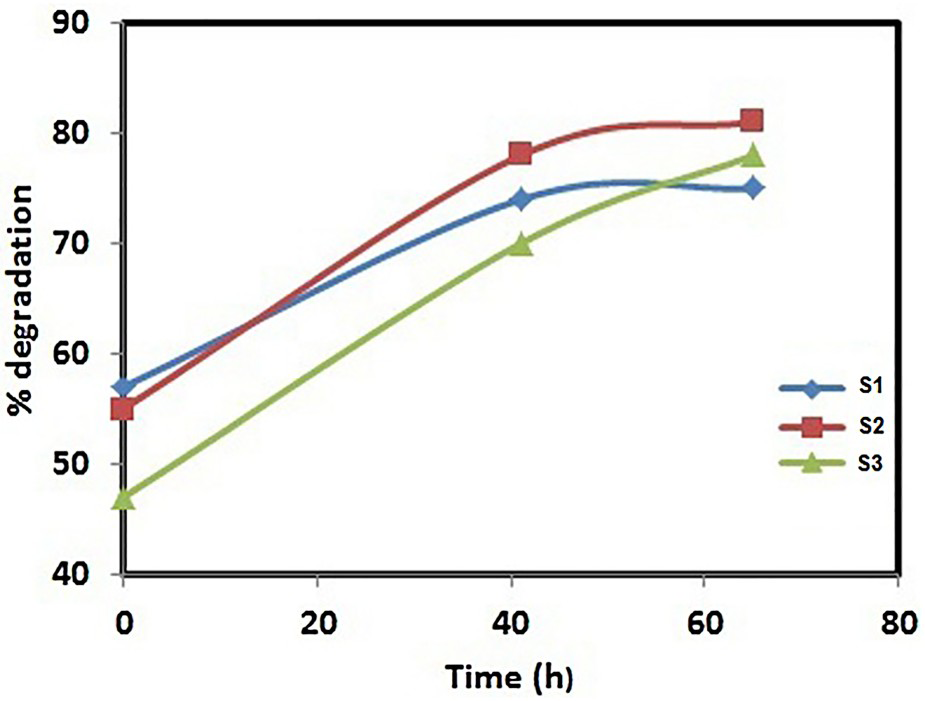
The intensity of the absorption peak around 665 nm, seen in Figure 8(a), gets reduced by the BC samples. This is due to the decomposition of chromo-phoric group of dye into the intermediate molecules [32], here the BC sample. From Figure 8, the percentage degradation of dye can be calculated using the relation
Percentage degradation vs. time for the samples S1, S2, and S3 exfoliated in the presence of NaOH.
Conclusions
Wide range of industrial applications demands morphological modifications of material to suit a particular application. (i) In this work, we have reported simple, cost-effective methods of tailoring the morphology through alkali (NaOH) treatment. (ii) The multilayered hollow microspheres of BC, synthesised by refluxing castor oil with boric acid, are subjected to ultrasonication by varying (a) concentration, (b) auxiliary agent, and (c) time. (iii) The process is found to evolve attractive flower-like morphologies from the broken layered flakes of multilayered hollow microspheres of BC, with a spindle-like structure as the basic unit. (iv) The degradation of the dye MB by the exfoliated BC samples clearly reveals the morphology dependent surface area in bleaching. (v) Thus, the study suggests the possible methods of varying the surface area by tailoring its morphology for surface area dependent potential applications.
Footnotes
Disclosure statement
No potential conflict of interest was reported by the author(s).