






Abstract
18Ni maraging steel is normally used to make key components by machining processes. It is necessary to understand the fracture mechanism and behaviour of 18Ni maraging steel for the study and further optimisation of machining processes. In this paper, the Split Hopkinson Tensile Bar tests accompanied by quasi-static mechanical tests are carried out to relate the stress triaxiality, deformation temperature and strain rate with the fracture strain. During the building up of the fracture model, it is noticed that the change of fracture mechanism from 600°C to 900°C brings about a non-linear relationship of fracture strain with the deformation temperature. This results in a large error in fitting the Johnson–Cook (J-C) fracture model, so a modified fracture model is put forward.
Introduction
18Ni maraging steel is used in a wide variety of applications in aerospace, military, transportation industries, etc. and characterised by its high strength and low thermal conductivity [1-3]. Therefore, the machining of 18Ni maraging steel parts is very difficult and often accompanied by high cutting force, high temperature, serious tool wear and chip breakage problems. It is highly important to study the fracture behaviour of 18Ni maraging steel under high temperature at high strain rate for understanding and further control of the chip separation, chip breakage and chip type.
Since the 1950s, the damage and fracture of materials have attracted extensive attention. Based on the continuous fracture model proposed by Kachanov [4], Gurson [5] and Tvergaard [6], various forms of fracture criteria applicable to different deformation and fracture processes are proposed. These fracture criteria can be divided into two types, including integral-type developed by Freudenthal [7], Cockcroft and Latham [8], McClintock [9], Rice and Tracey [10], Brozzo et al. [11], and nonintegral-type by Johnson and Cook [12], and Bao and Wierzbicki [13]. Among these models, the J-C fracture model is the most widely used failure criterion, as shown in Equation (1) [12], because it relates the fracture strain with stress triaxiality, strain rate and deformation temperature and its parameters can be easily obtained through tests.
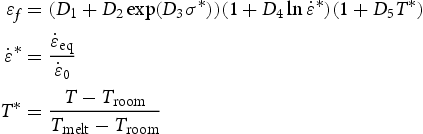
 is the fracture strain,
  the stress triaxiality,
  the equivalent strain rate,
  the reference strain rate,
  the deformation temperature,
  the melting temperature,
  the room temperature, and
  ,
,  ,
,  ,
,  and
and  the material-related coefficients.
In this paper, the J-C fracture model of 18Ni martensitic steel is first built up by integrating split Hopkinson tensile bar (SHTB) tests [14,15] with quasi-static mechanical tests under different deformation conditions.
Material and tests
The 18Ni maraging steel is first smelted by vacuum induction melting combined with vacuum consumable arc remelting, then by four-step spinning. After ageing treatment, its tensile strength can reach upto 1800 MPa and Rockwell hardness HRC 50–54. The microstructure is shown in Figure 1.
Microstructure of 18Ni maraging steel.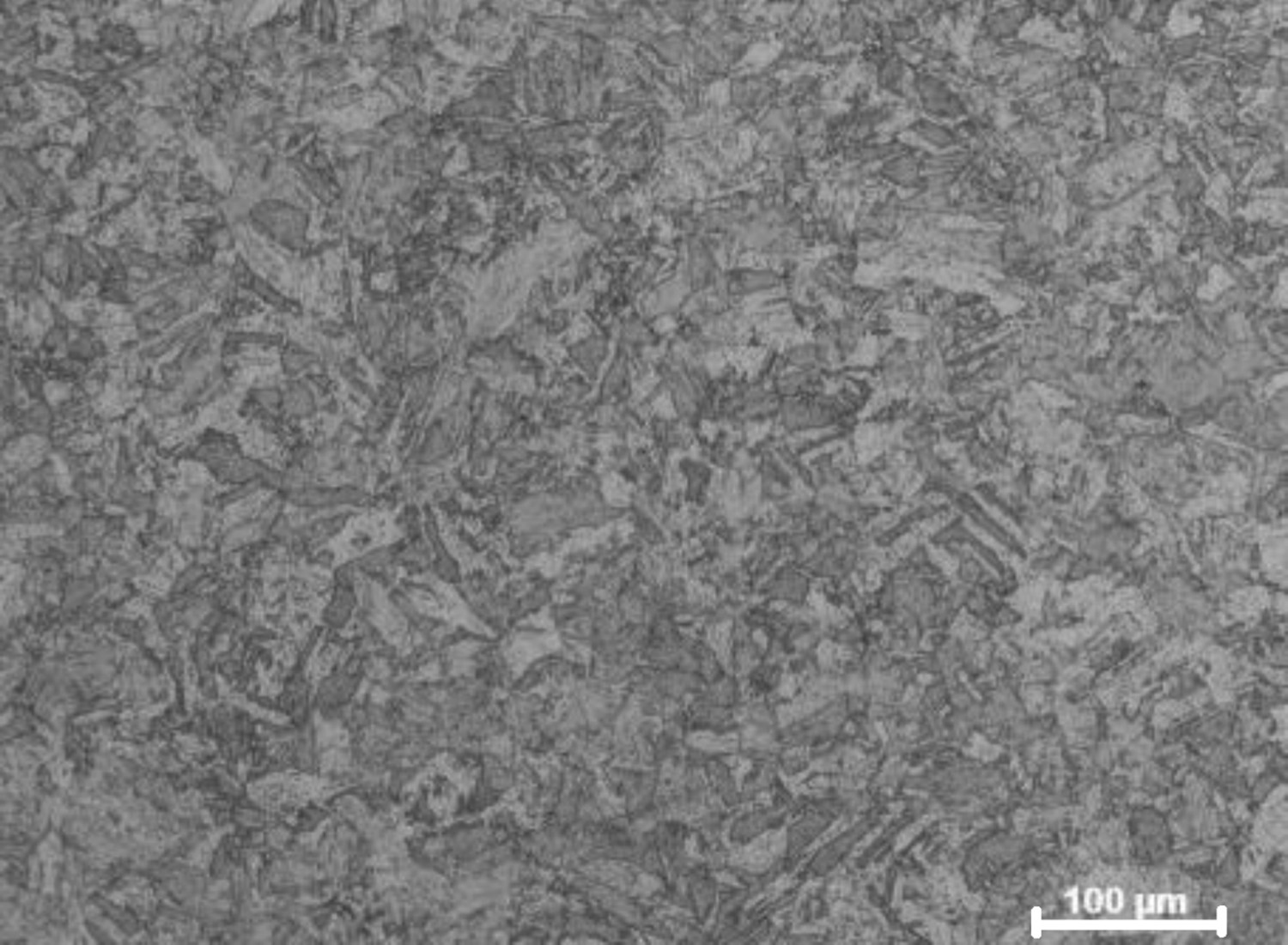
To discover the fracture under such extreme conditions as in machining, fracture behaviour in a wide deformation temperature range of 25–900°C and strain rate of 10−4 1000 s−1 is studied by five groups of SHTB tests [14,15] with samples C, three groups of quasi-static tension tests with notched sample A and two groups of quasi-static tension tests with sample B.
SHTB tests were carried out at deformation temperatures of 25–900 °C and strain rates of 500–1000 s−1 on the SHTB device in Figure 2(b), which is equipped with a dual synchronisation system [16]. During the test preparation, the sample in Figure 2(a) is placed on the guide rail and heated with a furnace. Then, synchronous device 1 pushes the sample to the reserved clamping position between the incident bar and the transmission bar, and synchronisation device 2 pulls the transmission bar to make the sample contact closely with the two bars. In the test, the flange impacts the incident bar to make the sample break. Tests at the same condition are repeated three times.
The schematic diagram of the SHTB test device and the samples.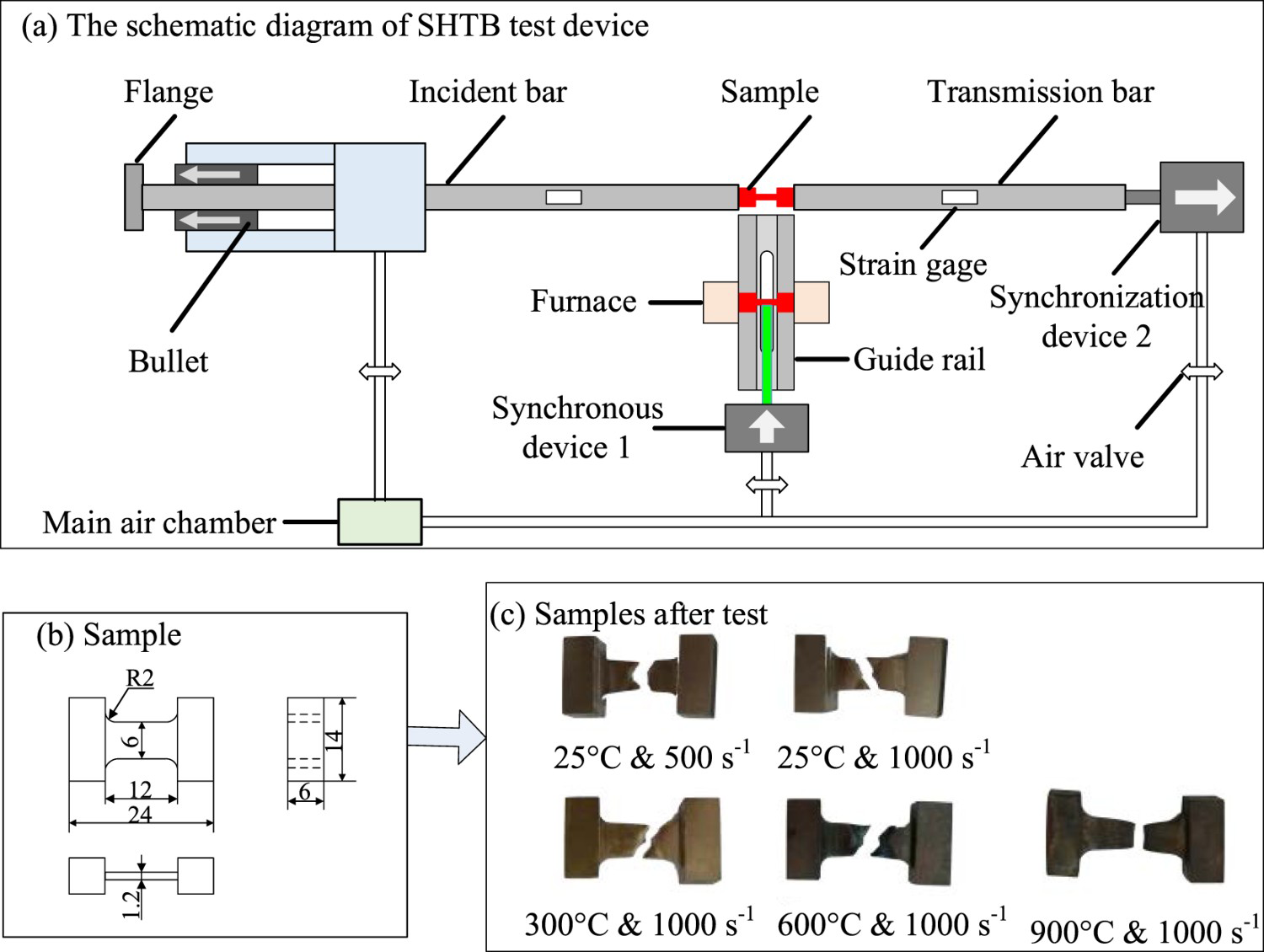
Results and discussion
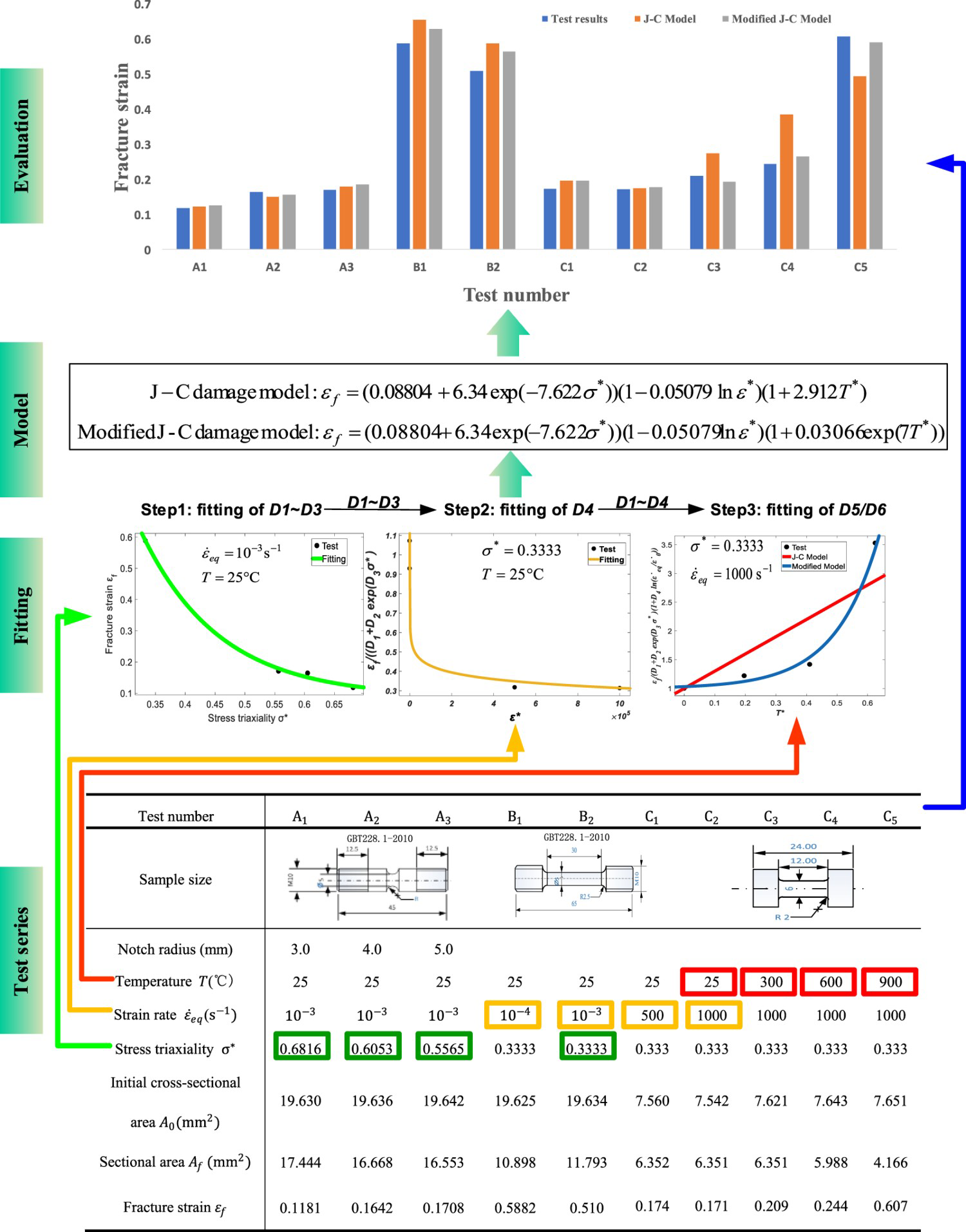
The procedure for fitting J-C fracture model parameters [17] is shown in Figure 3. First, by changing the stress triaxiality only but keeping the room temperature and reference strain rate, quasi-static tensile tests A1–A3 and B2 are combined for fitting the parameters D1, D2 and D3. Then, because quasi-static tensile tests B1–B2 and SHTB tests C1∼C2 have the same stress triaxiality and the room temperature, they are used to fit parameter D4. Finally, the SHTB tests C2–C5 with the same stress triaxiality and strain rate, but different deformation temperatures, are used to fit parameter D5. The J-C fracture model is established for 18Ni maraging steel as given in Equation (2)
The flow chart of establishing the fracture model.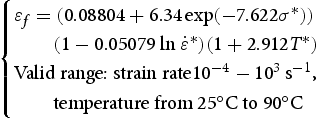
It is found that below 900°C fracture takes place along a 45° or v-shaped shear zone in the middle without obvious necking phenomena, while at 900°C fracture appears approximately perpendicular to the axial direction of the samples with obvious necking phenomena (Figure 2(c)). The examination on the sample fracture by the scanning electron microscope (SEM) with HITACHI S-3400N shows different fracture mechanisms. The fracture below 900°C is characterised by a typical dimple fracture of the characteristic of the microporous polymeric fracture [18,19]. While at 900°C, the material has been austenitised [20], which helps to reduce the size of the tearing dimples, so very small dimples covered by oxide can be seen in Figure 4(d).
SEM images of the fracture appearance: (a) 25°C, 1000 s−1; (b) 300°C, 1000 s−1; (c) 600°C, 1000 s−1; and (d) 900°C, 1000 s−1.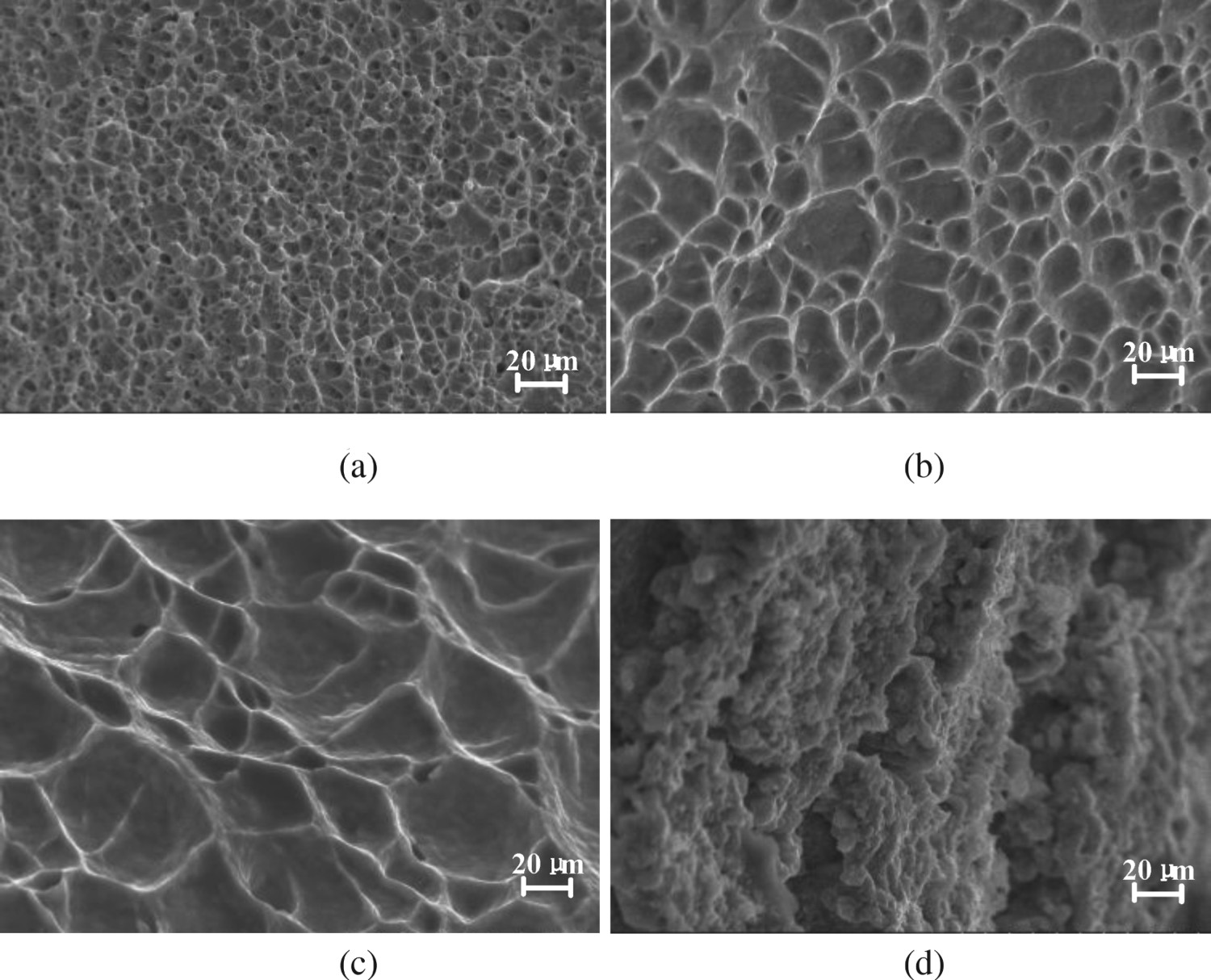
The change of fracture mechanism may be caused by phase transformation from martensitic to austenite [20] and the induced jump in plasticity. So it is better to express this non-linear characteristic of temperature effect caused by phase transformation by modifying the temperature item of the J-C fracture model with the exponential form. After data fitting, the fracture model can be expressed as follows:

Conclusions
The paper studies the fracture mechanism and behaviour of 18Ni maraging steel. Based on the systematic test design of SHTB tests and quasi-static mechanical tests with different shape samples, the fracture strain is found to be related with stress triaxiality, deformation temperature and strain rate. In the establishment of the J-C fracture model for 18Ni maraging steel, it is found that there exists a non-linear relationship between the fracture strain and deformation temperature in the range from 600°C to 900°C. It is assumed to be caused by the phase transformation and the induced change of fracture mechanism. By modifying the deformation temperature item of the J-C fracture model, a new fracture model is proposed with a satisfactory fitting accuracy. Meanwhile, the discovery of non-linear characteristic is of meaningful for machining. When deformation temperature increases up to about 900°C, the material will become much more difficult to fracture. This brings the chip breakage problems in machining of this material. Effective cooling in machining will be helpful for chip breakage.
Footnotes
Disclosure statement
No potential conflict of interest was reported by the author(s).
Correction Statement
This article has been republished with minor changes. These changes do not impact the academic content of the article.