







Abstract
The nickel-based superalloys Hastelloy X and Haynes 214 are widely used for honeycomb liners; however, thermo-physical properties at temperatures close to the melting range are poorly described in the literature. Based on the thermo-physical properties, endothermic effects between 550°C and 650°C have been observed that develop due to the formation of the short-range order in both alloys and in Haynes 214, in addition to the short-range order, an increase in the specific heat capacity due to the γ′-precipitation up to 950° was detected. At low and intermediate temperatures, the Hastelloy X is significantly better suited than the Haynes 214. At high temperatures the Haynes 214 is superior to the Hastelloy X due to the dissolution of the γ′-phase.
Keywords
Introduction
Honeycomb liners are the oldest type of abradable sealing systems that are used between the rotor and stator of gas turbines [1]. They drastically reduce the leakage between rotating and static components of a turbine due to the small gap between the rotor and stator and rub-induced wear [2]. The characteristics of the honeycomb liners arise from their small rubbing surface.
Rub-in events of fast-moving rotor blades into the surfaces of the honeycomb liners generate considerable amounts of heat which may result in temperature spikes close to the melting range of the alloys [3]. Ghasripoor et al. [4] showed through correlation between the material properties and rub-in experiments that the rub-in behaviour is strongly dependent on heat transfer coefficient of the alloy but not so much on the mechanical strength. Emery et al. [5] suggested to assure a good thermal contact between rotor and stator and to allow the abradable seal material to conduct the heat spikes away from the rotor. Marscher [6] suggested as result of the phenomenological model of the rub-induced wear in aircraft turbines to choose abradable materials with low conductivity, high thermal expansion, low specific heat capacity and low softening temperature. Sporer and Shiembob [7] proposed for honeycomb liner materials low conductivity and low elasticity. Therefore, the application of nickel-based alloys for honeycomb liners and the understanding of the rub-induced wear require an extended data on the thermo-physical properties of these alloys. In the existing literature, thermo-physical properties of honeycomb alloys, such as Hastelloy X and Haynes 214, at the temperatures close to the melting range are poorly covered.
The nickel-based superalloys Hastelloy X and Haynes 214 are commonly used honeycomb alloys [8]. The most comprehensive thermo-physical properties of these alloys are presented in the datasheets of Haynes International, Inc. [9,10], the trademark holder for alloys Hastelloy X and Haynes 214. Sporer and Shiembob [7] provide the properties of thermal conductivity, thermal expansion coefficient and Young's modulus for both alloys, but these data cover only two temperature points. Nickel Development Institute [11] provides data for Hastelloy X on specific heat capacity, thermal conductivity and thermal expansion up to 1093°C. Mills [12] considers the thermo-physical properties of Hastelloy X and recommends values for fully molten metal using a mathematical estimation model from the chemical composition of the alloy. Maglic et al. [13] consider Hastelloy X for high-temperature applications and aim to approach properties up to the melting range. Besides the data of Haynes International, Inc., no data on thermo-physical properties of Haynes 214 are found in the literature. The available studies are related to the oxidation resistance [14,15] and mechanical properties [16]. The purpose of this study was to determine the thermo-physical properties of these two alloys up to the onsets of their melting.
Materials and methods
Description of the honeycomb liners’ material sheets used in this study.

Nominal composition of honeycomb liner materials in wt-%.

The Hastelloy X sheets were solution annealed at 1177°C for 1 h and rapid air-cooled. The 0.5 mm strip had an ASTM grain size of 9 and was produced by Elgiloy Specialty Metals. The 4.6 mm strip with an ASTM grain size of 6.5 was produced by Special Metals. The Haynes 214 strips were solution annealed at 1095°C for 2 h and rapid air-cooled. The 0.6 mm sheet was produced by Elgiloy Specialty Metals into ASTM grain size 4. The sheet with a thickness of 3.2 mm was produced by Haynes International with the same ASTM grain size of 4. The specimens with suitable geometries for various measurements were handled with the electron discharge machining and then flat grinded.
Currently available methods allow measurements of the specific heat capacity [17] and thermal diffusivity [18] up to the melting range of the investigated material. In this study, thermal diffusivity and specific heat capacity of Hastelloy X and Haynes 214 alloys were measured up to the melting temperature, mean thermal expansion coefficient up to 1250°C and elastic constants up to 900°.
The thermal diffusivity,  , was determined using the laser flash method described by Parker et al. [19] on a NETZSCH LFA 427 apparatus. The measurements were carried out under an argon gas flow of 70 ml/min. In order to improve the energy absorption of the laser flash all samples were sand blasted and graphite coated before the measurements. For measurements up to solidus temperatures 10 mm squared sheet samples were mounted in graphite sample holders (GH). Thermal diffusivities, where the alloy was expected to melt, were measured on 1.46 mm thick discs with 10.7 mm diameter mounted in sapphire sample holders (SH).
The specific heat capacity,  , was measured by dynamic differential scanning calorimetry (DSC) using a NETZSCH DSC 404 F1 Pegasus apparatus. The purge gas was argon 70 ml/min. The heating rate was 20°C/min. The measuring range for a specific heat was from 20°C to 1400°C. The
  was measured on squared 5×5 mm samples.
The thermal expansion coefficient was measured from 200°C up to 1250°C using a push-rod dilatometer NETZSCH DIL 402C device. The measurements were performed using argon as purge gas. The heating rate was 10 K/min. The Hastelloy X sample length was 16.55 mm and that of the Haynes 214 sample length was 12.33 mm. Mean thermal expansion coefficient,  , as a function of temperature was calculated using the following equation:
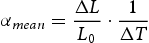
 is the original specimen length at reference temperature
  ,
,  is the specimen length change at the
  temperature change. The thermal conductivity was calculated from the following equation:

 is the thermal conductivity,
  is the thermal diffusivity,
  is the specific heat capacity,
  is the density.
Young's modulus E, shear modulus G and Poisson's ratio v were measured by resonant ultrasound spectroscopy (RUS) described in Migliori and Maynard [20] from room temperature up to 900°C. Measurements were undertaken in air with a heating rate of 10°C/min. 900°C turned out to be the upper limit on these alloys due to pronounced damping effects resulting in the disappearance of the transverse wave [21]. Small cubic samples with dimensions 4.5×6×8.9 mm and 3×4.1×8.9 mm were used for Hastelloy X and Haynes 214, respectively.
The uncertainties of the measurements are calculated according to the ISO/IEC 98-3:2008 [22].
The combined standard uncertainty for the thermal conductivity  was calculated from the fractional uncertainties of the thermal diffusivity a, specific heat capacity
  and density
  :
:

Results and discussion
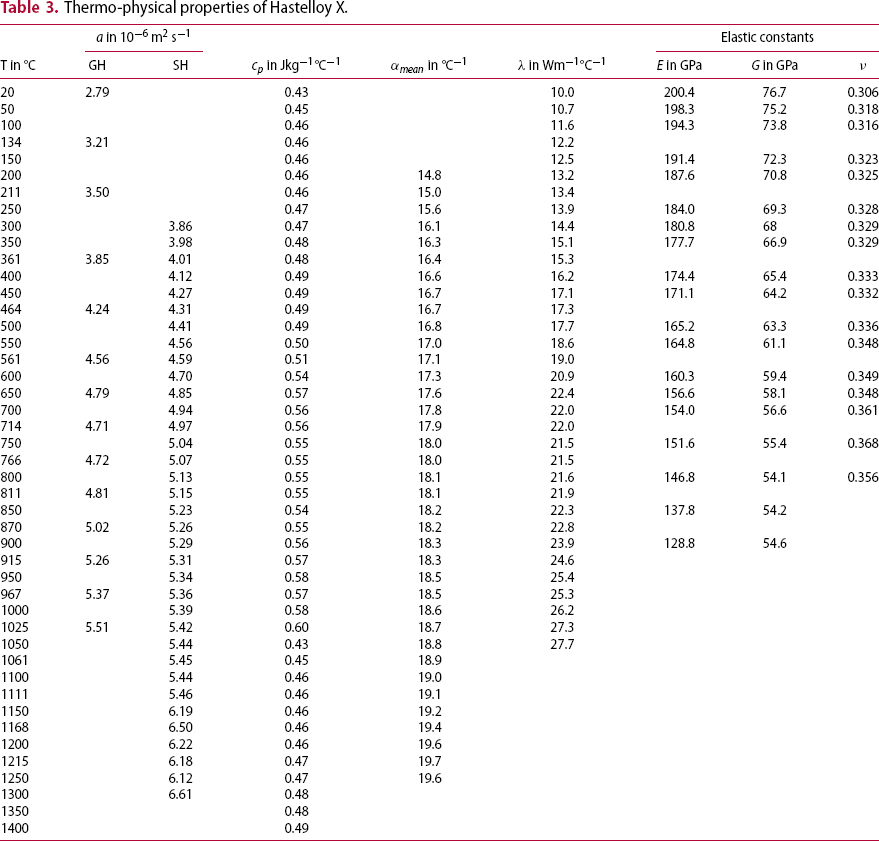
Thermo-physical properties of Hastelloy X.
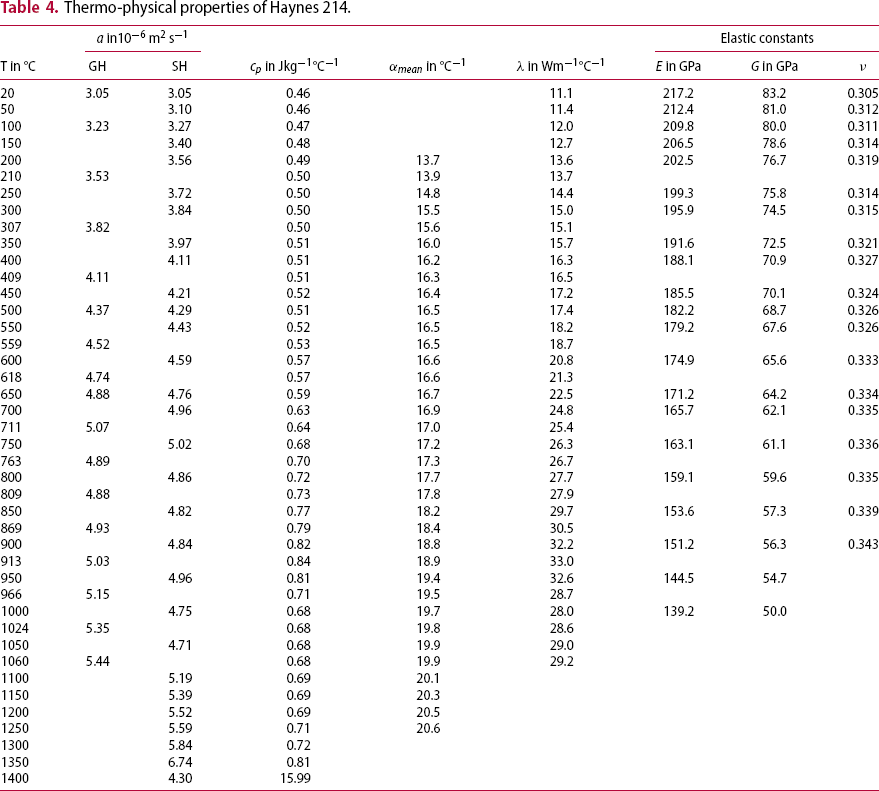
Thermo-physical properties of Haynes 214.
The thermal diffusivity a of Hastelloy X increases almost linearly from 2.9·10−6 m2/s at 20°C to 6.2·10−6 m2/s at 1250°C (Figure 1(a)). A deviation from the linear evolution is observed between 650°C and 750°C. Measurements with the graphite holder GH and the sapphire holder SH agree with each other up to 1000°C well. The measurements up to 1000°C are in good agreement with the results on Hastelloy X of Maglic et al. [13]. Around the onset of melting at ∼1260°C measurements of the thermal diffusivity scatter considerably.
Thermal diffusivity of a. Hastelloy X and b. Haynes 214.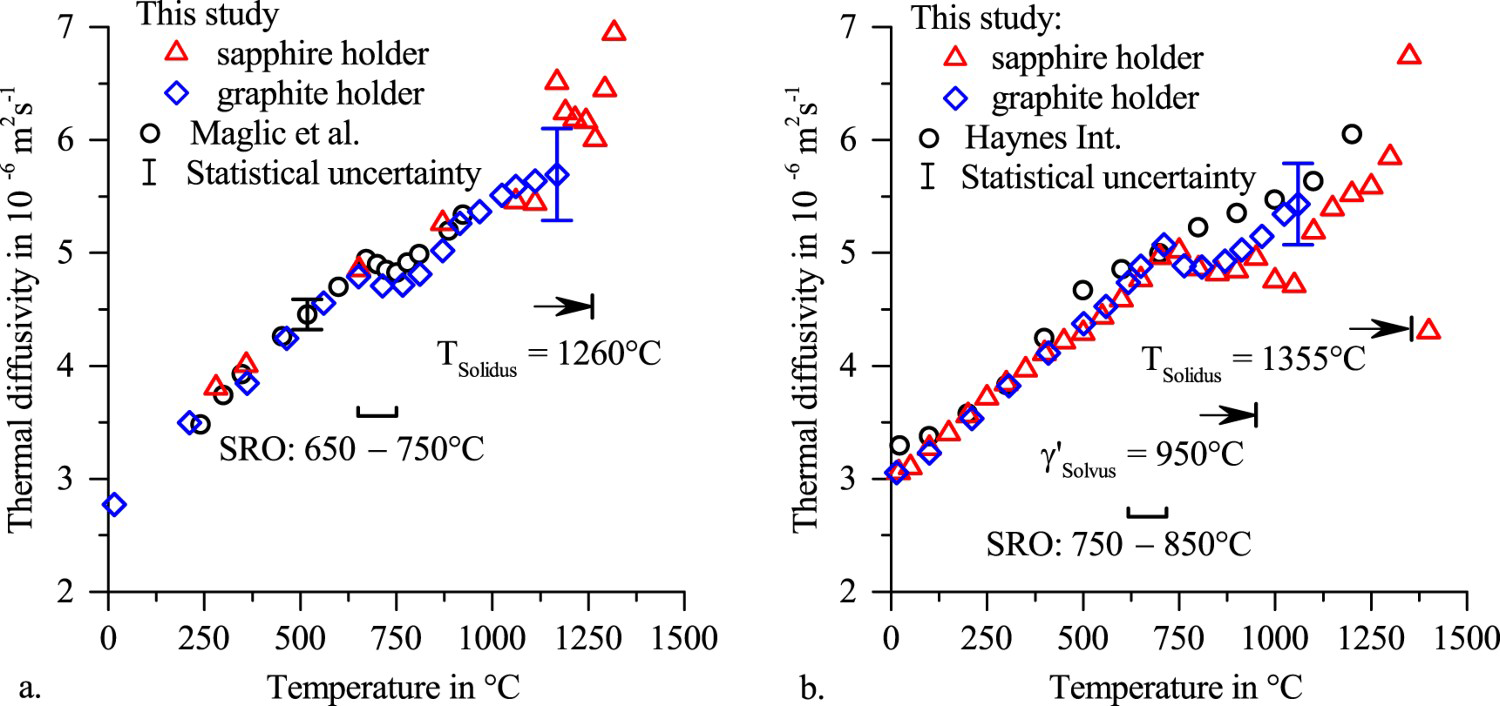
Thermal diffusivities of Haynes 214 are plotted in Figure 1(b). The thermal diffusivity increases almost linearly from 3.1·10−6 m2/s at 20°C to 5·10−6 m2/s at around 750°C. The values in this temperature range determined with the graphite holder GH and the sapphire holder SH match well with the values provided by Haynes International, Inc. [10]. Above about 750°C both test series GH and SH show lower values than those of the Haynes International, Inc. [10]. This ‘downswing’ may be attributed to a short range ordering (SRO) effect and/or precipitation of the γ′-phase which occurs between 595°C and 925°C, according to Haynes International, Inc. [10]. With dissolving γ′-phase and approaching the solidus temperature of Haynes 214 of 1355°C, the diffusivity is growing sharply. Above 1355°C the thermal diffusivity falls rapidly and it is likely the result of the onset of melting of Haynes 214. Similar thermal diffusivity variations were obtained for other γ′-precipitation-hardened alloys by Quested et al. [23].
The statistical uncertainty (Type A) for the thermal diffusivity was calculated from two repeated measurements under the same conditions. The mean value of thermal diffusivity and its statistical uncertainties (error bar) are given in Figure 1. The maximum statistical uncertainty in the measured temperature range is around ±7%. The systematic uncertainty (Type B) of the thermal diffusivity measured using graphite holder and sapphire holder are lower than ±3% and ±5%, respectively, according to the specification of the manufacturer NETZSCH. The combined standard uncertainty for the thermal diffusivity, calculated from the statistical und systematic uncertainties, does not exceed ±9%. Maglic et al. [13] gives for the thermal diffusivity an uncertainty of ±3% (error bar on Figure 1).
The specific heat capacity Specific heat capacity of a. Hastelloy X and b. Haynes 214. of Hastelloy X grows from 0.43 Jg−1°C−1 at 20°C to 0.67 Jg−1°C−1 at 1260°C (Figure 2(a)). The graph shows an endothermic effect in the temperature range from 550 to 850°C. The onset of melting is visible in a steep increase of
  at around 1260°C. Up about 700°C the values of
  published by Haynes International, Inc. [9], Nickel Development Institute [11] and Maglic et al. [13] and measured in this study show similar evolutions with an increasing temperature, even though the step increase between 550°C and 650°C is most pronounced in this study. Above 700°C both Nickel Development Institute [11] and Haynes International, Inc. [9] state a gradual upswing of
  , which is not confirmed by Maglic et al. [13] and this study. Instead, above about 650°C the heat capacity
  is observed to increase with more or less the same grade than below about 550°C. The endothermic peak between 550°C and 650°C coincides well with short-range order–disorder phenomena reported for Ni-Cr-systems [24,25] and some nickel-based superalloys [13,26].
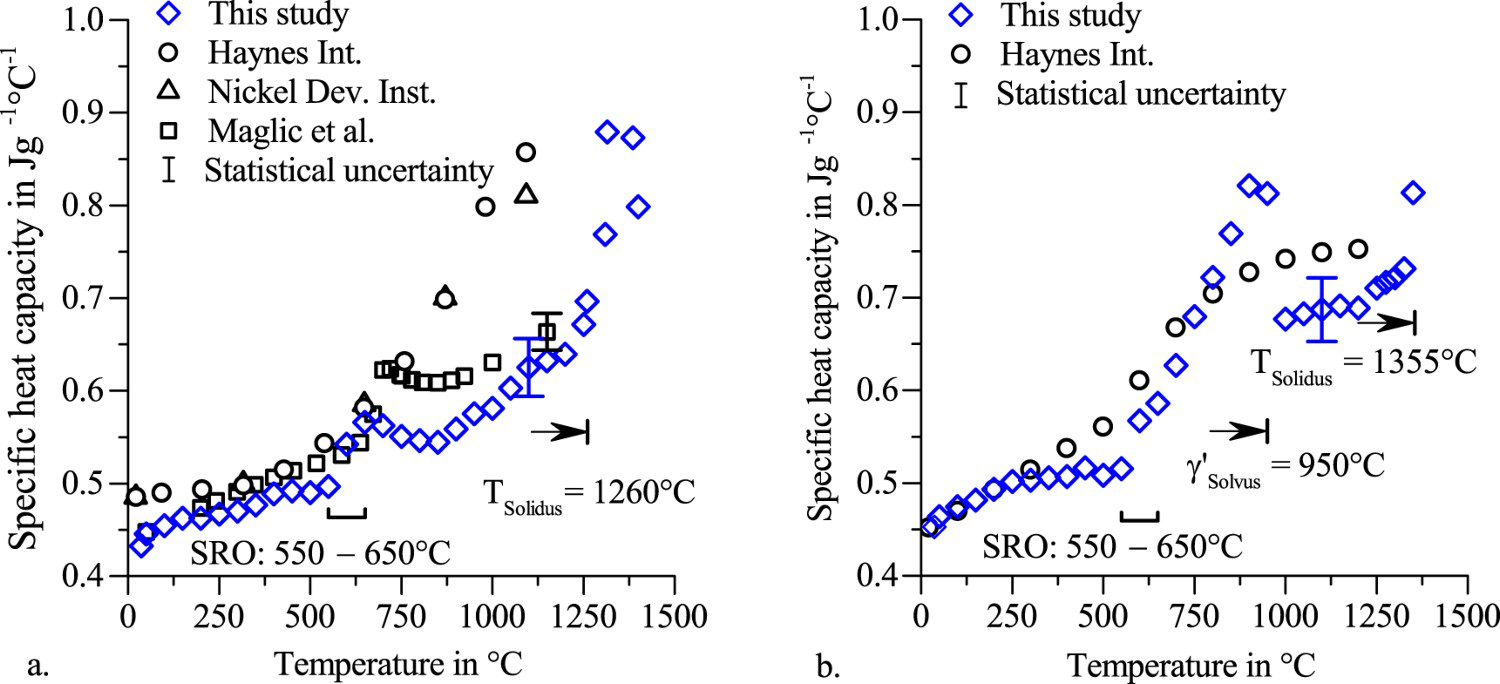
The specific heat capacity of Haynes 214 rises from 0.46 Jg−1°C−1 at 20°C to 0.73 Jg−1°C−1 at 1350°C (Figure 2(b)). For Haynes 214 endothermic effects at temperatures 550–650°C and 650–950°C were revealed. The step-like rise in  at around 550°C again coincides well with reported short-range order–disorder phenomena [24,25]. The pronounced increase of
  upon heating starting at around 650°C is most likely due to the precipitation of γ′ phase from the supersaturated alloy up to about 950°C when dissolution of γ′ occurs in Haynes 214 [10]. Melting started at 1355°C is equal to the solidus temperature of Haynes 214 reported by Haynes International, Inc. [10].
The statistical uncertainty (Type A) of the reference standard (sapphire vs. sapphire)-based specific heat capacity is less than ±5%. The maximum systematic uncertainty for the specific heat capacity is around ±2% according to the specification of the manufacturer NETZSCH. The combined standard uncertainty for the specific heat capacity is not higher than ±5%. Maglic et al. [13] estimates for the specific heat capacity measurement uncertainty of ±3% (given as error bar on Figure 2).
The mean thermal expansion coefficient, αmean, of Hastelloy X increases linearly with temperature from 14.8·10−6°C−1 at 200°C to 19.6·10−6°C−1 at 1250°C (Figure 3(a)). The measured values are little higher than reported in other studies [7,9,27].
Mean thermal expansion coefficient of a. Hastelloy X and b. Haynes 214.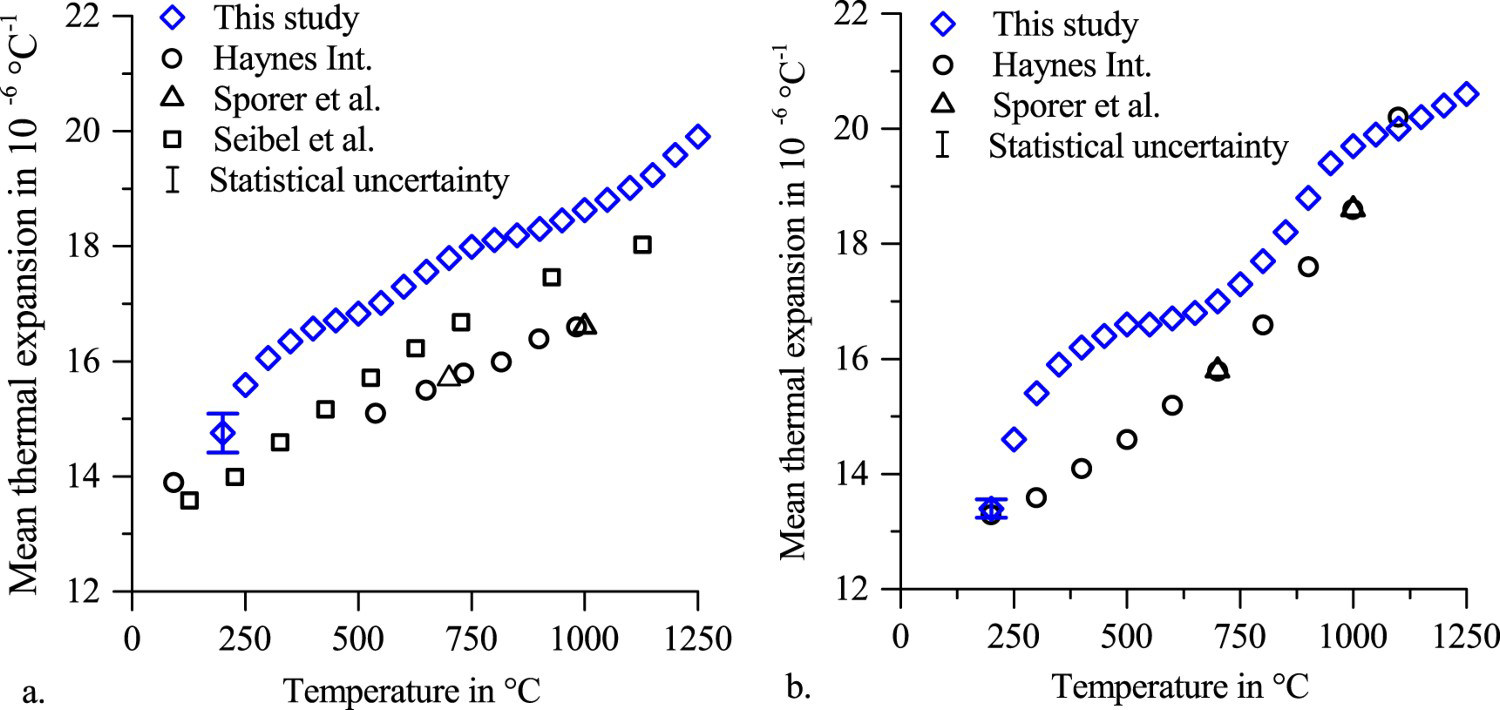
The mean thermal expansion coefficient of Haynes 214 (Figure 3(b)) is growing from 13.7·10−6 °C−1 at 200°C to 20.6·10−6 °C−1 at 1250°C. The measured values are slightly higher than those reported in other studies [7,10].
The statistical uncertainty (Type A) for the mean thermal expansion is calculated from three repeated measurements under the same conditions: the estimated value is less than ±3% (error bar on Figure 3). The maximum systematic uncertainty (Type B) for the mean thermal expansion is ±1.5% according to the manufacturer's specification. The combined standard uncertainty is not higher than ±3%.
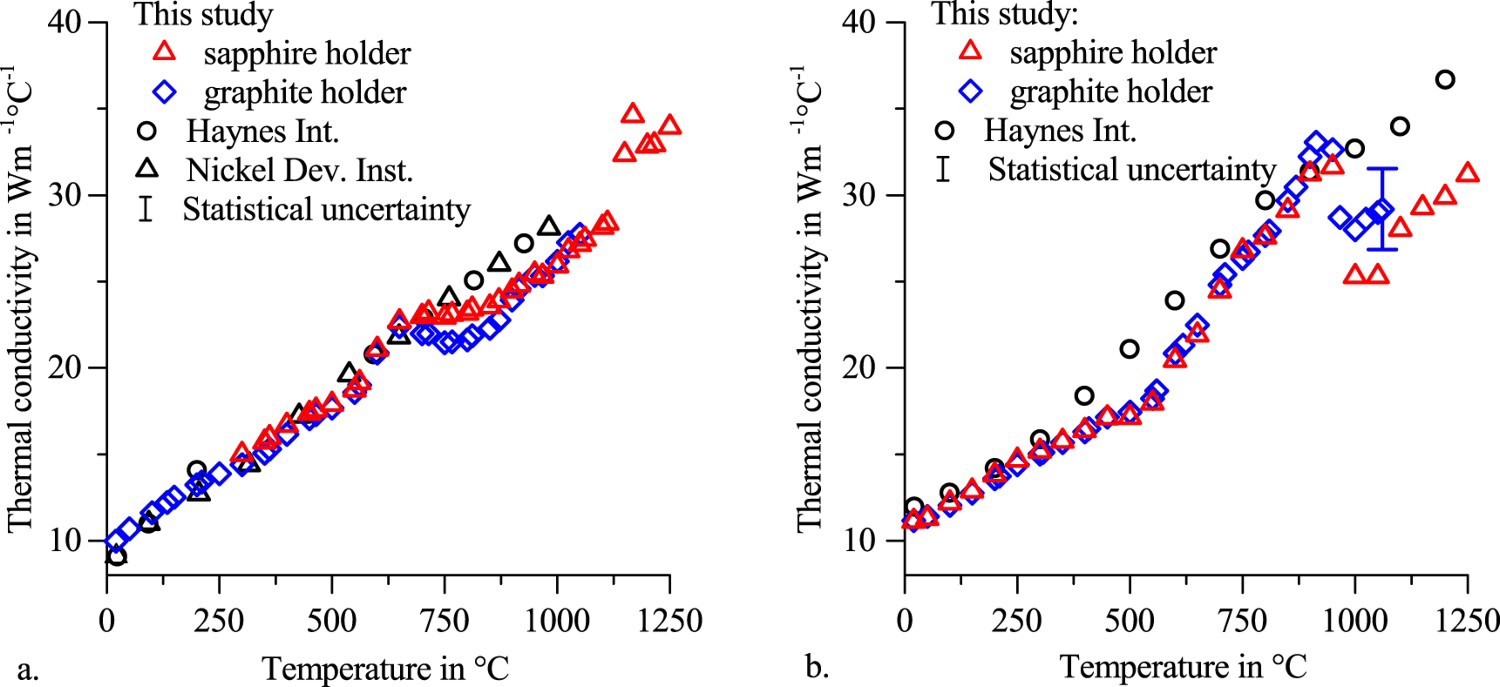
The thermal conductivities Thermal conductivity of a. Hastelloy X and b. Haynes 214. of Hastelloy X and Haynes 214 obtained with GH and SH are given in a and Figure 4(b), respectively. The thermal conductivity of Hastelloy X is increasing from 10 Wm−1°C−1 at 20°C to 33.9 Wm−1°C−1 at 1250°C. A step-like decrease occurs between 650°C and 850°C. The differences between other studies [9,11] and this study are marginal. The thermal conductivity of Haynes 214 is continuously growing up to 30 Wm−1°C−1 at 950°C. From 950°C the conductivity is sharply decreasing to 20 Wm−1°C−1 at 1000°C and from that temperature increasing to 30 Wm−1°C−1 at 1250°C. The combined standard uncertainty for the thermal conductivity, estimated using Equation (3), is around ±10%.
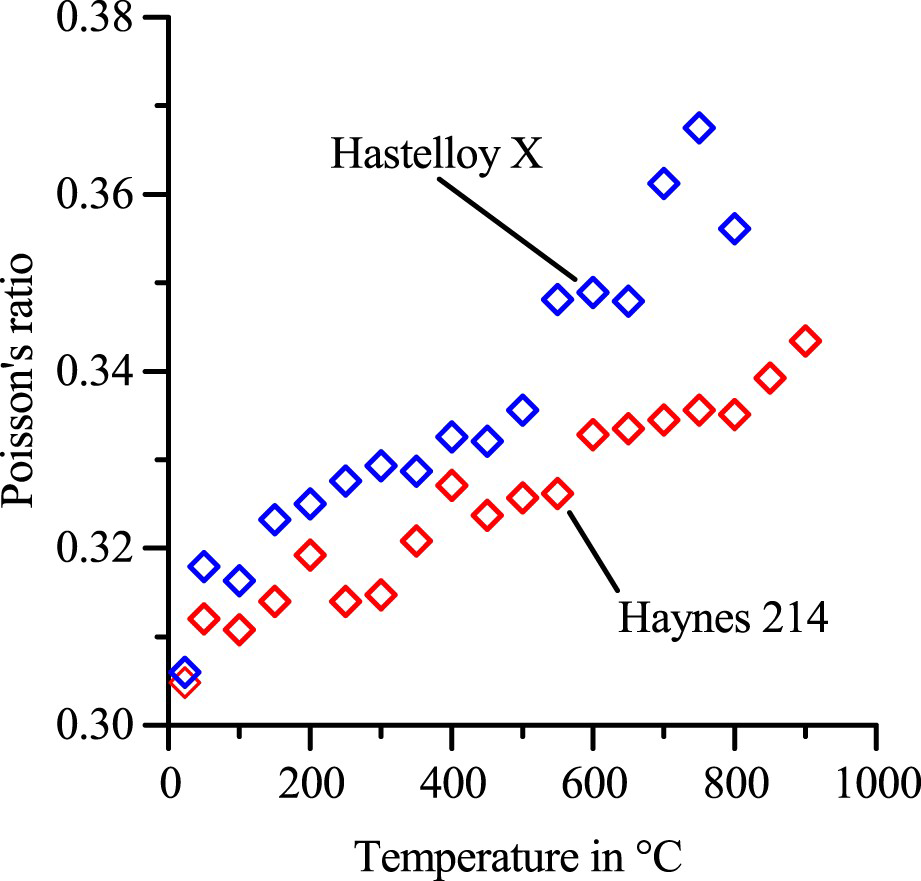
Young's modulus E for Hastelloy X decreases from 200 GPa at room temperature to 129 GPa at 900°C (Figure 5(a)). The results of the study are somewhat lower than elastic modulus given in the datasheets of Haynes International, Inc. [9]. The Young's modulus for Haynes 214 decreases from 217 GPa at room temperature to 139 GPa at 1000°C (Figure 5(b)). The acquired data points are fairly consistent with the elastic modulus given from Haynes International, Inc. [10]. The Poisson's ratio for both honeycomb alloys is presented in Figure 6. For both materials, the Poisson's ratio increases with temperature. The Poisson's ratio v for Hastelloy X at room temperature (0.31) is lower than that given by Haynes International, Inc. (0.32) [9]. For both alloys the temperature-dependent shear moduli and Poisson's ratios were measured for the first time within this study. The combined standard uncertainty for the elastic constants is less than ±2%, according to the RUS developer [28].
Young's and shear moduli as a function of temperature for a. Hastelloy X and b. Haynes 214. Poisson's ratio for Hastelloy X and Haynes 214.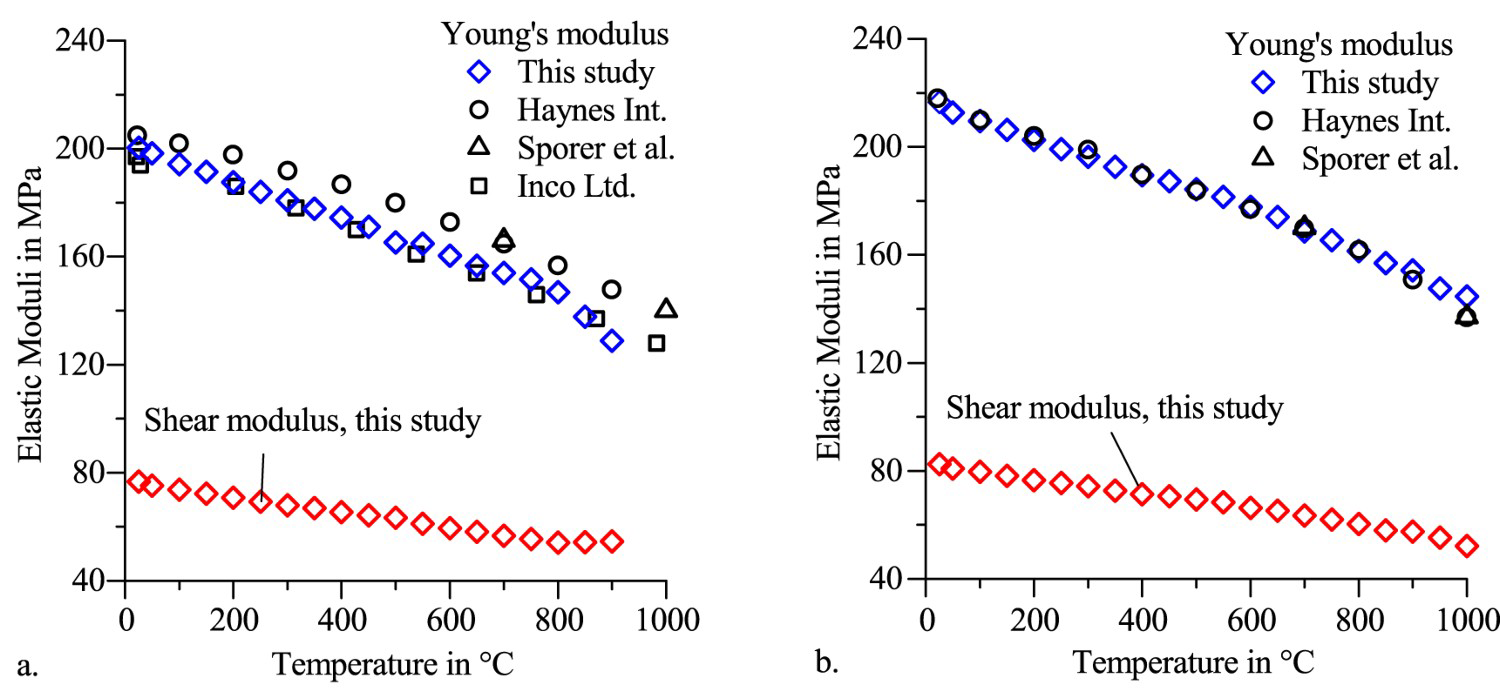
This study reviewed the existing literature and extended data on the thermo-physical properties of two honeycomb liner alloys. The material properties have been determined in several series of experiments using laser flash method, differential scanning calorimetry, resonant ultrasound spectroscopy and dilatometry.
In general, with the rising of the temperature, the specific heat capacity and the thermal diffusivityof the alloys increase, consequently the thermal conductivity increases, the thermal expansion increases and elastic moduli decrease. The results indicate that according to the existing requirements to honeycomb materials [6,7] the thermal response of the specific heat capacity, the thermal expansion and the thermal conductivity are ineffective for the rub-induced wear. In contrast, the thermal response of the thermal expansion and the elastic moduli show the desirable behaviour for the rub-in.
We also identified endothermic effects between 550°C and 650°C that develop due to the formation of the short-range order in both alloys. In Haynes 214, in addition to the short-range order transformation, an increase in the specific heat capacity due to the γ′–precipitation up to the γ′–solvus temperature 950° was detected. It appears, therefore, that the influence of physical properties on the rub-in performance of the alloys depends on the temperature. At low and intermediate temperatures, the Hastelloy X shows higher suitability than Haynes 214. The Haynes 214 alloy is superior to Hastelloy X alloy at high temperatures due to dissolving of the γ′-phase.
The study of Fischer et al. [29], based on numerical rub-in model, confirms that at intermediate temperatures Hastelloy X has a better rub-in performance than Haynes 214. The abradability rig testings on honeycomb liners, carried out by Sporer and Shiembob [7], confirmed the superior rub-in behaviour of the Hastelloy Xalloy than that of the Haynes 214 alloy.
Conclusions
In this study new thermo-physical properties data for honeycomb liner alloys Hastelloy X and Haynes 214 are presented. For Hastelloy X the thermal diffusivity is given up to 1317°C, specific heat capacity up to 1400°C, thermal expansion coefficient up to 1250°C and elastic constants up to 900°C. In addition, new data on Haynes 214 up to high temperatures, especially thermal diffusivity up to 1450°C, specific heat capacity up to 1400°C, thermal expansion coefficient up to 1250°C and elastic constants up to 900°C are presented in this study.
Based on thermo-physical properties, endothermic effects between 550°C and 650°C have been observed that develop due to the formation of the short-range order in both alloys. In Haynes 214, in addition to the short-range order transformation, an increase in the specific heat capacity due to the γ′-precipitation up to the γ′-solvus temperature 950° was detected.
Based only on the physical properties of the actual alloys and the anticipated properties of an alloy to be applied in honeycomb liners, it may be assumed that the Hastelloy Xis superior to the alloy Haynes 214 at low and intermediate temperatures and is less favourable at high temperatures.
Footnotes
Disclosure statement
No potential conflict of interest was reported by the author(s).