






Abstract
In metastable high-entropy alloys (HEAs), the decrease of phase stability enables the development of dual-phase microstructure (interface hardening) and occurrence of strain-induced martensitic transformation (transformation-induced hardening), which overcomes the strength–ductility trade-off. The stacking-fault energy (SFE) is closely related to the phase stability and plays a key role in controlling the underlying deformation mechanism and hence the mechanical performance of HEAs. Here, we review some approaches of SFE calculation, including theoretical and experimental methods as well as the factors affecting SFE. Several compositional systems related to metastable HEAs are also briefly reviewed. Furthermore, we show the unique microstructure and the structure–property relationship of the metastable HEAs. Furthermore, some potential research topics in the future are also proposed.
Keywords
Introduction
The development of metallic materials keeps pace with the progress of human civilisation and plays an indispensable role in it. Materials with superior performance have always been people's tireless pursuit. The design of traditional alloys is based on one or two principal elements and a small amount of other elements are added to further change or optimise the specific properties. However, this traditional alloying method may be meeting with the bottleneck, due to the limitation of base elements. High-entropy alloys (HEAs) or complex, concentrated alloys, as a breakthrough of this limitation, have drawn extensive attention since the concept was first proposed in 2004 [1,2]. In the initial design concept, HEAs consist of multiple principal elements with equiatomic or near-equiatomic ratios and with concentrations between 35 and 5 at.-% for each element [2]. HEAs owe their name to the assumption that the solid solutions are stabilised by maximising configurational entropy of mixing [3]. Based on this, several HEAs with simple solid solution structures were produced, such as face-centred cubic (FCC) [4-6], body-centred cubic (BCC) [7-9], and the hexagonal close-packed (HCP) [10,11] structures. Particularly, the CoCrFeMnNi, termed the ‘Cantor’ alloy, has excellent tensile properties and fracture toughness especially at cryogenic temperatures [12-14].
However, numerous recent studies have shown that the equiatomic atomic ratio of the alloy, namely the pursuit of maximum configurational entropy, does not necessarily lead to a stable single phase and a highly stable single-phase HEA may not be necessarily associated with superior properties [15,16]. Motivated by these findings, the restrictions on the single-phase structure of the alloy have been relaxed and the composition space of high-entropy alloy has been further expanded. In this context, some attention has been shifted to the study of multicomponent alloys with non-equiatomic compositions, including eutectic HEAs [17-20], precipitation-hardened HEAs [21-24], interstitial alloyed HEAs [25-28], transformation-induced plasticity (TRIP) HEAs [29-32], twinning-induced plasticity (TWIP) HEAs [33-35], dual-phase (DP) HEAs [36-39], and mix of them. For example, increasing the cobalt content on the basis of equiatomic HEA yields a series of Co-rich HEAs (e.g. Co35Cr25Fe20Ni20 [40] and Co35Cr25Mn15Fe10Ni15 [41]), which exhibit TWIP or TRIP effects. Among these, non-equiatomic TRIP-DP HEAs, inspired by the TRIP steel and metastable austenitic steel [42-44], combines the interface hardening with transformation-induced hardening, improving strength, and ductility, simultaneously. This metastable engineering strategy enables the transition of dislocation activity from wavy slip to planar slip, providing a prerequisite for the TRIP process, due to the low-phase stability and stacking-fault energy (SFE) [38]. Unless explicitly pointed out, the SFE in this article refers to intrinsic stacking-fault energy (ISFE).
Moreover, metastable HEAs with TRIP effect not only overcome the strength–ductility trade-off but also present a valuable design direction to explore superior properties for HEA. In this focused review, we aim herein to provide a brief overview of the strong and ductile non-equiatomic HEAs, placing specific attention on SFE calculation including experimental and theoretical methods, compositional systems, microstructure and mechanical properties, and summary and outlook for future efforts.
SFE calculation
Stacking faults (SFs) are one of the most important microstructural components of FCC metallic materials, which are commonly generated through the dissociations of dislocations [45]. SFE, the quantity for the SFs, is critical in controlling the plastic deformation, dislocation glide, and deformation twinning as well as occurrence of phase transformations in many alloys, including high-entropy alloy [46,47]. It is commonly assumed that deformation twinning (15–45 mJ m−2) and phase transformation (<15 mJ m−2) are favoured in low SFE materials and dislocation slip dominates (>45 mJ m−2) in high SFE materials [48]. Certainly, metastable HEAs with the TRIP effect appear to be associated with their low SFE. As such, more and more academic interests were recently focused on systematic and in-depth research on the SFE of HEAs, particularly FCC HEAs [49-56]. In the following section, the theoretical and experimental methods of SFE calculation are discussed as well as the factors affecting SFE.
Theoretical methods
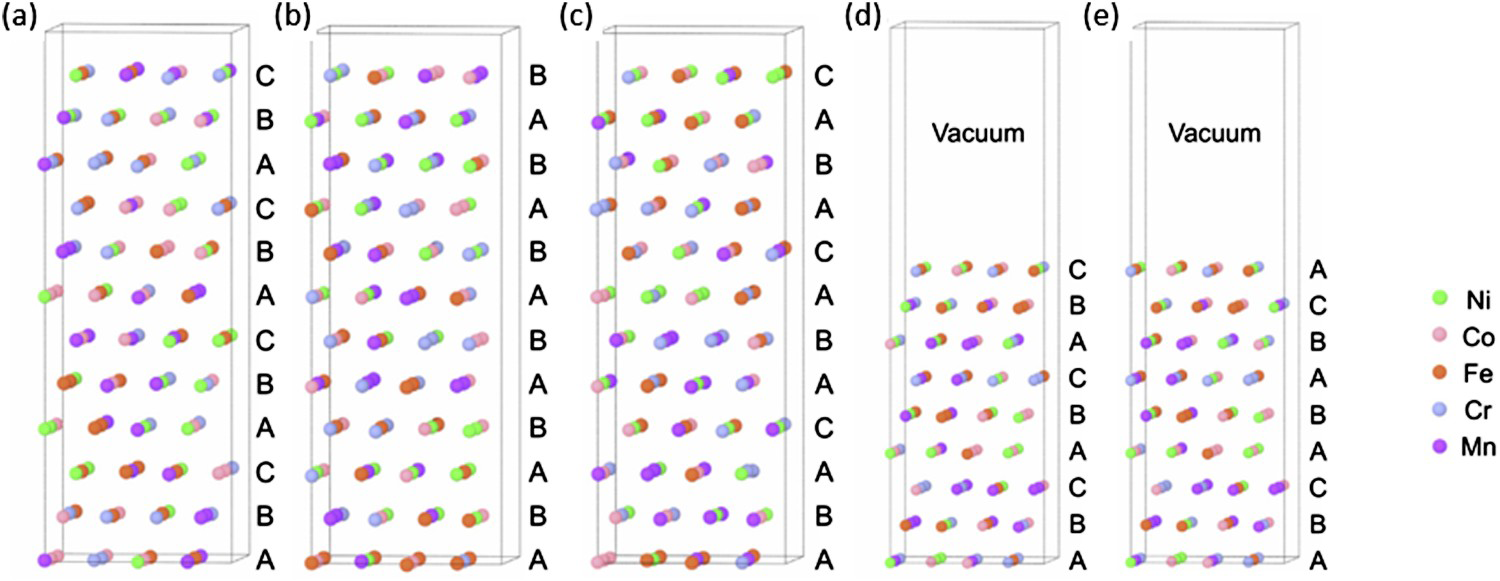
Theoretically, SFE can be determined by using first principle or atomistic methods, such as density-functional theory (DFT) and molecular dynamics simulations. Here we review two approaches based on first principles calculations using both supercell methods and the axial interaction model (AIM, Ising-like model) [45,57,58]. AIM method constructs a parameterised model obtained by mapping the stacking sequence onto a one-dimensional axial next-nearest neighbour Ising (ANNNI) model [59]. In this model, the SFE can be determined from the energies of structures having different stacking sequences, namely FCC, hexagonal close pack (HCP) and double hexagonal close packed (dHCP) (Figure 1(a–c)). SFE can be expressed in terms of the energy of these three structures
Illustration of the simulation setup used to calculate stacking-fault energies in CoCrFeMnNi: (a) FCC, (b) HCP, (c) dHCP, (d) the perfect structure, and (e) and stacking-fault structure. The stacking sequence in each structure is provided right next to the configuration. Adapted from [58], with permission from publisher: Elsevier, 2017.
 ,
,  ,
,  , and A are the total energy per atom of the HCP, dHCP, and FCC phase, stacking areas, respectively. However, the AIM model cannot explore the influence of local chemical environment close to SFs on SFE because its structure is perfect-FCC and HCP crystal structure. In the supercell approach, a supercell is used to represent the disordered state and an SF is then introduced by sliding the upper half of the supercell with respect to the lower half with an appropriate glide vector. In the FCC structure HEAs for {111}
  slip system, the ISF was introduced by shifting the upper half of the supercell along the
  direction by the Burgers vector of the Shockley partial
  , where
  is the lattice constant. The SFE was computed with

 and
and  are the energies of the simulation supercells with and without ISF, respectively (Figure 1(d–e)), and A denotes the area of the ISF [60]. In addition to the above methods, SFE can also be estimated based on the difference in Gibbs free energy between HCP and FCC phase. A detailed description will be discussed in the following sections. In recent studies on metastable TRIP HEAs, Wei et al. proposed a series of cobalt-rich HEAs and used the supercell method to calculate the SFE of the alloys. Among them, the SFE of the Co45Cr25Fe15Ni15 [40], Co35Cr25Mn15Ni15Fe10 [41], and Co50Cr25Fe10Ni10Mo5 [61] alloys at 0 K is −50 , −87, and −75 mJ m−2, respectively, exhibiting FCC → HCP martensitic transformation (TRIP effect). Compared to stable single-phase CoCrNi alloy (SFE: −24 [62], −26 [63], and −41 [64] mJ m−2), the metastable TRIP HEAs have a lower SFE.
Although the supercell approach for calculation of SFE is the most widely adopted, there are still some details to discuss. For example, the number of layers of simulated supercells is uncertain (e.g. 6, 9, and 12 layers) or the results of how many layers of supercells are constructed are more appropriate. Based on simulated experimental data, the SFE difference between 6 and 12 layers supercells is less than 1% [59]. Similar results were also reported previously [58,65]. In addition, there are two common ways to construct the supercell for simulating the ISF in FCC structures, i.e. tilted supercell and single-shift supercell [60]. The tilted supercell contains only one bulk slab and its stacking-fault structure was created by tilting the <111> axis of the perfect-FCC cell by prescribed displacement vectors; the single-shift supercell contains two bulk slabs, which slide with respect to each other, and the vacuum layer was added to minimise the interactions of the cells. The former exhibits the smallest cell, which greatly reduces the computational cost, while the latter requires an additional vacuum layer introducing unexpected surface effects, which may be particularly problematic for HEAs. Last but not least, different ab initio methods (two ab initio methods: exact muffin-tin orbitals method combined with coherent potential approximation (EMTO-CPA) and Vienna ab initio simulation package in combination with special quasi-random structure (VASP-SQS)) could also cause small differences in SFE of the same alloy, mainly due to the different emphases of the two methods [50]. In particular, the EMTO-CPA method which captures perfect chemical disorder does not include atomic relaxation and local atomic environment, while the VASP-SQS method takes full atomic relaxation into consideration but the chemical disorder is limited by the randomness captured by the SQS.
Experimental methods
In addition to the above theoretical methods based on first principles, the SFE can also be obtained experimentally, mainly by means of transmission electron microscopy (TEM) [55,66-69] and diffraction techniques [50,70]. The latter is often used in conjunction with first principles calculations, so we will only cover the former here. The former approach using the weak-beam dark-field (WBDF) imaging technique in TEM is conducted to measure the width of partial dislocations and then determine the SFE. The SFE can be calculated from the width of partial dislocations using

Impact factors on SFE
In the process of research, it is found that there are a number of factors that can affect SFE. Among them, the chemical composition is the most significant factor, and small changes in the constituent elements and their concentrations can cause huge changes in SFE [74]. Interestingly, SFE is found to have a weak dependence on the number of elements in the alloy system. Meanwhile, influence of deformation temperature [45,75,76], local chemical fluctuations [30,53], and magnetic state (ferromagnetic and paramagnetic) [64,77] can also affect SFE to a certain extent. For example, with decreasing deformation temperature, deformation twinning, and martensitic phase transformation occur successively, which means that there is a positive dependence between the temperature and SFE of alloys.
Moreover, local chemical order, ordering in the first few neighbour atomic shells to enhance the number of energetically preferred bond types, is one of the characteristics that distinguish HEAs from metallic glasses and traditional alloys. For instance, experimental studies showed chemical short-range order (SRO) in CoCrNi HEA, which Cr atoms tend to combine with Co and Ni rather than themselves. From DFT-based lattice Monte Carlo (MC) simulations, stacking-fault energies can be tuned by tailoring local chemical order, which SFE increases with increasing degree of chemical SRO [56]. Furthermore, the state of the local chemical order of the material can be adjusted by changing the chemical composition of the alloy and the processing routes.
Compositional systems
In the field of HEA, a large number of compositions have been designed so far, but there is still a huge unexplored compositional space due to the concern of non-equiatomic compositions. The main aim of this work is to design metastable HEAs with TRIP effect, which is closely related to the phase stability and SFE of the alloys. The SFE, which is closely related to the thermal HCP-FCC phase stability, can be expressed as

 is the molar free energy difference between the FCC and HCP phase that be used to express HCP–FCC phase stability and can be calculated by Thermo-Calc software,
  is the planar packing density (moles/area) of a close-packed plane, and
  is the coherent FCC–HCP interfacial energy [78]. In this regard, the key point behind this design concept is to determine the effects of alloy composition on the phase stability and SFE, and then to obtain the target alloys exhibiting the TRIP effect.
Recent work by Li et al. [38] first applied the ‘metastability-engineering’ strategy in the quaternary Fe80-x Mn x Co10Cr10 (at.-%) system and the underlying idea is to reduce the thermal and mechanical stability of FCC phase by optimising the Fe/Mn ratio, which promotes the DP structure and TRIP effect. More details are provided in the following sections. Based on this approach, Huang et al. [79] successfully fabricated a DP structure consisting of HCP phase and metastable BCC phase via reducing the Ta content and transformation-induced ductility and work-hardening capability were realised in brittle TaHfZrTi HEAs. Nevertheless, the design of the above metastable alloys is mainly based on an experimental verification approach, which is usually costly and time consuming, especially for HEAs. With aid of computer simulations, immense compositional space can be effectively reduced to determine the promising metastable alloys with TRIP effect. Accordingly, computational techniques such as thermodynamic and first principles calculations provide useful guidelines for the alloy design. The following are several common compositional systems of metastable HEAs.
Fe-rich TRIP-assisted HEA (FCC → HCP)
As mentioned above, Li et al. [38] designed a series of Fe-rich non-equiatomic HEAs, which exhibits a DP microstructure and FCC → HCP martensitic transformation with a decrease of Mn content (e.g. Fe50Mn30Co10Cr10 and Fe45Mn35Co10Cr10). In the quaternary CoCrFeMn system, the reduced content of Mn decreases the phase stability of the FCC matrix, which enables the development of thermally-induced martensite transformation upon cooling and strain-induced martensite transformation at room temperature. Assisted with ab initio simulations of thermodynamic phase stabilities, Li et al. [80] found that the decrease of Ni concentration enhances the HCP phase stability, which is beneficial to the occurrence of TRIP phenomena in quinary Fe40-x Mn20Co20Cr20Ni x (at.-%) HEAs system. Fe34Mn20Co20Cr20Ni6 HEA shows the TRIP-DP effect and hence higher ultimate tensile strength and strain-hardening ability compared to equiatomic CoCrFeMnNi alloy. Through the real-time observations of DP TRIP-assisted Fe34Mn6Co34Cr20Ni6 HEA, Chen et al. [30] found that strain-hardening results from the formation of stable three-dimensional stacking-fault networks that impede dislocation motion and the network further provide nucleation sites for the HCP phase transformation. Furthermore, Li et al. [27,81] reported an interstitial Fe49.5Mn30Co10Cr10C0.5 (at.-%) HEA, derived from tuning the SFE and FCC phase stability of the previous metastable Fe50Mn30Co10Cr10. The addition of interstitial carbon enables a joint activation of TWIP and TRIP effects, owing to an increase in SFE and FCC phase stability. From the above, it can be seen that controlling the content of Ni and Mn is very important for the design of metastable Fe-based HEAs.
Co-rich TRIP-assisted HEA (FCC → HCP)
Inspired by the developments of Fe-rich TRIP-DP HEAs and wide application in the manufacturing field of Co-based alloy with exceptional mechanical properties, a large number of Co-rich HEAs were proposed. With aid of ab initio and thermodynamics calculations, Wei et al. reported a series of metastable Co-rich high-performance HEAs, such as Co
x
Cr25(FeNi)75-x
[40] and Co35Cr
x
(MnNi)15Fe35-x
[41] (at.-%), and presented the principles for the regulation of SFE and phase stability via composition modification, i.e. the increase of Co concentration at the expense of decreasing Fe and Ni concentrations yields a lower SFE and reduced FCC phase stability in Figure 2. In addition, Liu et al. [67] also found that the deformation mode of the Co
x
Cr20Fe20Mn20Ni40-x
HEAs changes from dislocation slip of Co23Cr20Fe20Mn20Ni17 to TWIP of Co27Cr20Fe20Mn20Ni13, then to TRIP of Co30Cr20Fe20Mn20Ni10 with the increase of Co content. Furthermore, Wei et al. [61] also reported that the minor addition of Mo reduced the FCC phase stability and SFE, whereas it increases the lattice parameters and decreases the Young's moduli and shear moduli of non-equiatomic HEA. In addition, Co-based biomedical Co–Cr–Mo (CCM) alloys have been developed using electron beam melting (EBM), a layer-by-layer additive manufacturing technique. For the required higher fatigue properties of biomedical alloys and the inhomogeneity in microstructures and mechanical properties brought about by the EBM fabrication process, Wei et al. [82,83] proposed a post-production heat treatment to manipulate the phase constituent and grain size and then deal with them. The strain-induced martensitic transformation in CCM alloys is also critical for excellent fatigue properties and strength. These metastable Co-rich HEAs designed above exhibit an excellent combination of strength and ductility, due to the massive solid solution strengthening of a HEA and TRIP effect of a metastable FCC phase. Therefore, it is feasible to develop novel Co-rich HEAs exhibiting TRIP effect by tuning the compositions.
(a) The  of Co
x
Cr25(FeNi)75−x
(x: 25∼65) HEAs calculated by Thermo-Calc; (b) the ISFE of the HEAs at 0 K calculated by DFT method. Adapted from [40], with permission from publisher: Taylor & Francis Group, 2018.
of Co
x
Cr25(FeNi)75−x
(x: 25∼65) HEAs calculated by Thermo-Calc; (b) the ISFE of the HEAs at 0 K calculated by DFT method. Adapted from [40], with permission from publisher: Taylor & Francis Group, 2018.
Fe-rich TRIP-assisted HEA (FCC → BCC)
Phase transition caused by phase metastability is not only limited to FCC to HCP phase transition but also includes FCC to BCC phase transition. Based on the computational results that reduction of (CoNi) contents destabilises the FCC phase at 298 K and BCC phase becomes more stable than FCC and HCP phases as the temperature decreases in Fe x (CoNi)90-x Cr10(at.-%), Bae et al. [84,85] reported a ferrous Fe60Co15Ni15Cr10 (at.-%) MEA exhibiting exceptional phase-transformation strengthening at cryogenic temperatures. Meanwhile, the increase of Fe concentration at the expense of decreasing Co and Ni concentrations will reduce the production cost of HEAs. Zhang et al. [86] systematically investigated the microstructure and tensile properties of Fe x CoCrNiMn within a wide composition range of 20–60 (at.-%) Fe. The increase of Fe content will decrease the mixing entropy of FeCoCrNiMn, leading to the decrease of the stability of the FCC phase and promoting the formation of the BCC phase. In addition, Yang et al. [87] presented a new metastable Fe45Co30Cr10V10Ni5-x Mn x and revealed that increased Mn content reduces a critical strain required to trigger the martensitic transformation, thus increasing the phase transition rate.
Additionally, Zaddach et al. [50] found by means of X-ray diffraction measurements and first principle that the increase of Cr content could also reduce evidently SFE of CoCrFeMnNi HEAs in addition to Ni. Fang et al. [88] also obtained metastable HEAs with TRIP effect by increasing the content of Cr and adjusting the valence electron concentration of the alloy. For 3d transition-metal HEAs, it can be inferred from the above that the decrease of Ni element content and the increase of other elements content reduce the stability of FCC phase and SFE of the alloy, which is conducive to the occurrence of the TRIP effect.
Microstructure and mechanical properties
As with traditional alloys, there is also a close relationship between composition, microstructure, and mechanical properties in HEAs. Mechanical response of materials, including strength, hardness, ductility, and toughness, are highly sensitive to microstructure, i.e. grain size, recrystallisation state, and dislocation substructure. But different from other DP alloy, two high-entropy phases (i.e. FCC γ matrix and HCP ϵ phase) in metastable HEAs are compositionally equivalent and the FCC phase can also be easily transformed to the HCP phase through the glide of partial dislocations upon deformation. The complex structure of metastable HEAs greatly influences the deformation behaviour and mechanical properties of alloys. Therefore, it is effective and necessary to utilise microstructure control for tuning their mechanical properties.
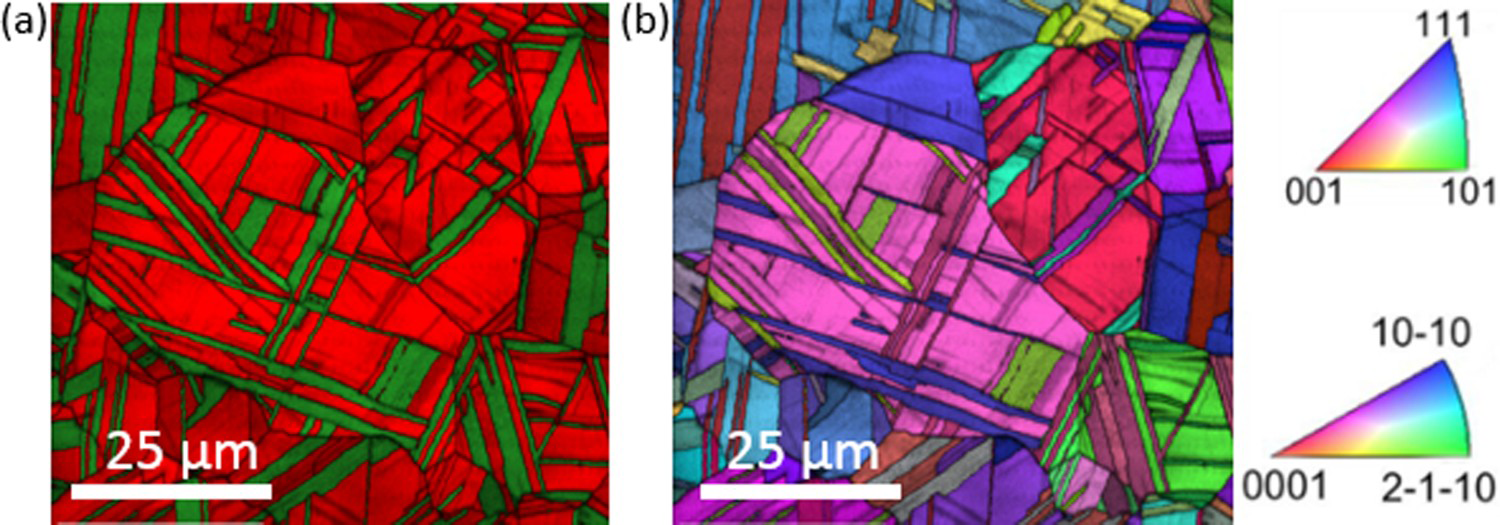
Among these structural characteristics, grain size and phase fraction play an important role in tuning the mechanical properties of metastable HEAs. A great deal of efforts was invested in optimising the mechanical properties of alloys by adjusting the grain size and phase fraction. Li et al. [29] investigated the effects of annealing time on FCC grain size and HCP phase fraction prior to loading in TRIP-DP HEA (Fe50Mn30Co10Cr10). As shown in Figure 3(a), FCC grain size and HCP phase fraction increase with increasing annealing time on the whole. Figure 3(b) shows the tensile stress–strain curves of the DP HEAs with various FCC grain sizes and initial HCP phase fractions at room temperature. The finer FCC grain size (4.5 μm) or higher HCP phase fraction (32%) results in superior mechanical properties (ultimate tensile strength 870 MPa, elongation to fracture 75%). This phenomenon is attributed to the enhanced work-hardening ability caused by the increase of phase stability of the FCC matrix and excellent grain boundary strengthening. Meanwhile, a recent study by Yu et al. [89] on a novel DP HEA (Co35Cr25Fe37.5Ni2.5) has shown a similar effect, which investigates the effects of annealing temperature and cooling medium on the grain size and HCP phase fraction. Interestingly, the HCP phase fraction is doubled and HCP laminates of different orientations intersect within the grains as the cooling medium of water is replaced by liquid nitrogen (Figure 4). Furthermore, Nene et al. [90] reported a friction stir processing (FSP) engineered Fe50Mn30Co10Cr10 HEA, exhibiting a smaller grain size and optimised fractions of FCC and HCP. Inspired by this, a series of metastable HEAs by FSP that demonstrated an unexpected strength–ductility response were developed, such as Fe42Mn28Cr15Co10Si5 [91], Fe39Mn20Co20Cr15Si5Al1 [92,93], Fe40Mn20Co20Cr15Si5 [26,93,94], and Fe38.5Mn20Co20Cr15Si5Cu1.5 [95,96]. The other thing to note is compositional inhomogeneity [28,97] can significantly deteriorate the mechanical properties of metastable HEA and compositional homogeneity is essential for the development of advanced HEAs.
(a) Variations of FCC grain size and HCP phase fraction in the Fe50Mn30Co10Cr10 HEAs with increasing the annealing time; (b) tensile stress–strain curves of the DP HEAs with various FCC grain sizes and initially available HCP phase fractions. Adapted from [29], with permission from publisher: Elsevier, 2017. The EBSD maps of the Co35Cr25Fe37.5Ni2.5 annealed at 900°C for 60 min and quenched in liquid nitrogen: (a) phase map and (b) IPF map. Adapted from [89], with permission from publisher: Elsevier, 2020.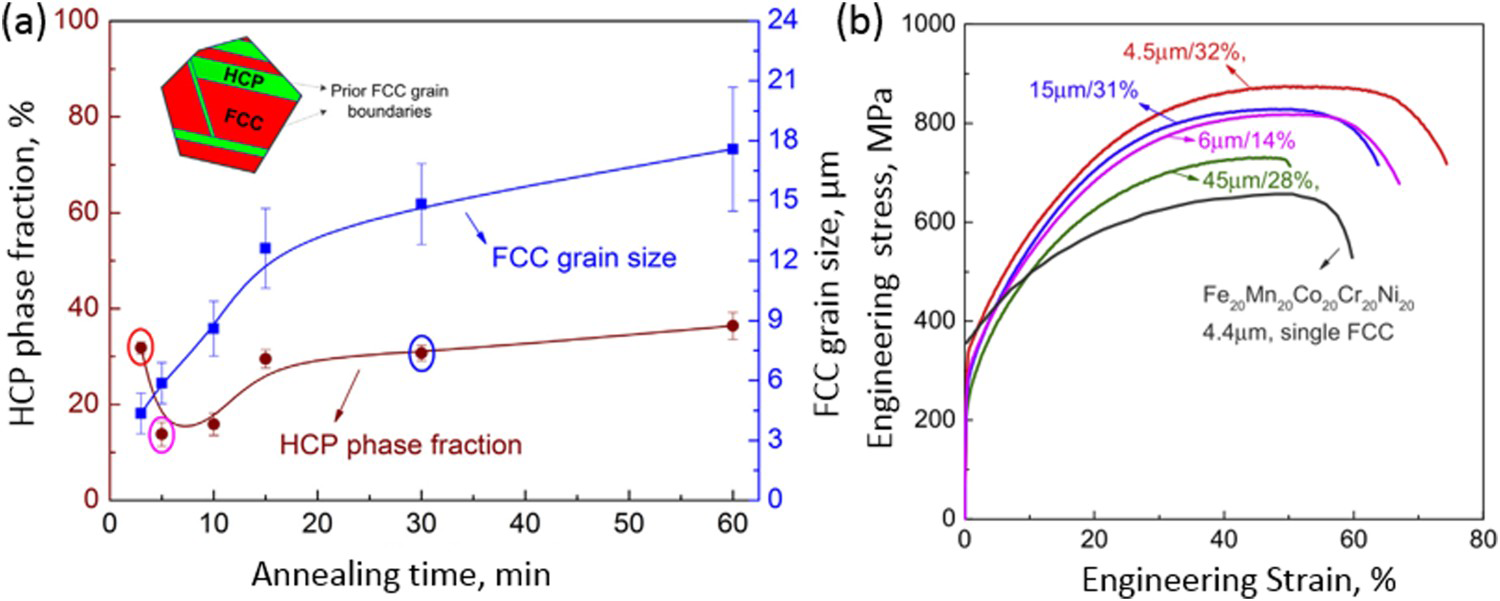
In addition, intensive studies have demonstrated that alloys with nanostructure and heterogeneous microstructure generally have high strength without sacrificing the ductility [36,98-101]. Lu et al. [102] presented a new dynamic deformation and transformation mechanism referred to as the bidirectional transformation-induced plasticity (B-TRIP) effect. By triggering the B-TRIP effect characterised by dynamic forward (FCC γ → HCP ϵ) and reverse (HCP ϵ → FCC γ) deformation-driven transformation, a hierarchical nano-laminate structure was developed. The nano-laminate structure is continuously refined under mechanical loading. When the length scale of the laminate structure reaches 50 nm, the strength and ductility of the alloy are increased simultaneously, and the elongation is up to 77%. Analogously, Su et al. [103] designed a bulk nanostructure of metastable HEA via B-TRIP effect, exhibiting excellent strength–ductility synergy (ultimate tensile strength 1.05 GPa at 35% total elongation). The heterogeneous microstructure includes nano-twins, gradient nano-grains, or recrystallised and non-recrystallised grains and can be obtained by cold rolling and subsequent tempering and annealing [99]. A heterogeneous or hierarchical microstructure was produced by Su et al. [104] and the trimodal microstructure comprising small recrystallised grains (<1 μm), medium-sized grains (1–6 μm), and retained large un-recrystallised grains shows a good combination of yield strength (824 MPa), ultimate tensile strength (1.05 GPa), and ductility (33%). Thus, engineering the nanostructure and hierarchical microstructure could be an efficient strategy in improving the mechanical properties of metastable HEA.
Summary and outlook
Metastable HEAs with TRIP effect as a novel design concept have engaged much attention. In this work, we briefly reviewed SFE calculation, compositional systems, microstructure, and mechanical properties of the non-equiatomic TRIP-DP HEAs. Since the occurrence of TRIP effect is strongly related to the SFE, which is mainly determined by the chemical composition. To design such a metastable HEA, the composition design is the first problem we have to face. Assisted with ab initio simulations, a preliminary and suitable composition can be determined. Then, on the premise of meeting the basic requirements of this alloy (TRIP effect), how to further improve the properties of the alloy is the focus of our consideration. From a composition perspective, adding minor interstitial atoms and large size atoms can also effectively improve the properties of the alloy. From a microstructure perspective, the construction of nanostructure or heterogeneous microstructure is also an effective strategy to enhance the properties of alloys. Although metastable HEAs have been developed rapidly, there are still many unknowns to be explored.
The SFE is a main factor affecting the plastic deformation mechanism and a low SFE is associated with FCC → HCP strain-induced martensitic transformation, showing the TRIP effect in traditional alloys. However, there are no clear criteria to determine the occurrence of the TRIP effect either from the perspective of experimental measurement or theoretical calculation in the field of HEA. Moreover, the damage mechanisms of a mechanically metastable Fe45Mn35Co10Cr10 HEAs was investigated, which ascribes to highly localised incompatible strain caused by the asynchronously martensitic transformation [105]. Still, studies on the damage behaviour of metastable TRIP-assisted HEAs are limited. In addition, except for the excellent combination of strength and toughness, high-temperature shape memory effect was introduced into metastable HEAs and shows great potential recently [106]. B-TRIP effect, as a new mechanism in metastable HEAs, is also worth further study to explore its potential.
Footnotes
Acknowledgements
This research was supported by the National Natural Science Foundation of China (No. 51701061), the Natural Science Foundation of Hebei Province (No. E2019202059), and the foundation strengthening program (No. 2019-JCJQ-142).
Disclosure statement
No potential conflict of interest was reported by the authors.