






Abstract
Novel Cu–24Pb–xAl alloys with dispersed and rodlike Pb-rich secondary phases (PSPs) were designed and prepared with the guidance of CALPHAD. Through primary binary-phase diagram analysis and thermodynamic calculation, Al was proven to be a suitable alloying element in Cu–Pb system to promote the formation of dispersed and rodlike PSPs during solidification by introducing a (L1 + L2 + α-Cu) phase region in Cu–Pb–xAl systems. The Cu–24Pb–xAl (wt-%, x = 0, 2, 4) alloys were then prepared in order to verify the reliability of the alloy design strategy. Cu–24Pb–2Al alloy with rodlike PSPs was successfully designed and prepared. A novel strategy to design Cu–Pb–(X) immiscible alloy with optimised microstructure is thus proposed in this work which can help establish a design criterion for other immiscible alloys.
Keywords
Introduction
Owing to the relatively high strength and outstanding self-lubricating property, Cu–Pb alloy has become an extremely important bearing alloy widely used in engine with a high speed and heavy load [1,2]. However, the formation of Pb-rich secondary phases (PSPs) with a network morphology frequently occurs. It has been acknowledged that network PSPs will seriously decrease the mechanical property of Cu–Pb alloy by splitting the Cu-rich matrix and will easily lead to the scraption of bearing. On the contrary, Cu–Pb alloy with rodlike PSPs usually presents eligible mechanical property [3]. It is thus essential to search an efficient method to stably produce Cu–Pb alloy with rodlike PSPs.
According to the previous work, homogenously distributed and rodlike PSPs can be obtained by adding the suitable third element X. A novel Cu–Pb–(X) will be thus designed and produced [4]. However, Cu–Pb alloy belongs to immiscible alloy in which the solid solubility of solute (Pb) in solvent (Cu) rapidly decreases during solidification and almost declines to zero at room temperature [2]. That makes it difficult to observe the microstructure of Cu–Pb immiscible alloy at specific temperature by traditional quenching method, and will certainly hinder the design of Cu–Pb–(X) alloy with rodlike PSPs.
In order to address the above problem, a novel strategy to optimise PSPs’ morphology is proposed in this work with the guidance of calculation of phase diagram (CALPHAD). A new Cu–Pb–(X) alloy with rodlike PSPs is designed and produced. Simultaneously, the function mechanism of the additional element X is revealed. This work will contribute to the establishment of a CALPHAD-guided alloy design method.
Experimental
Thermodynamic and phase diagram calculation
Cu–24Pb (wt-%) alloy frequently used in industry is selected to be the research object. Through primary analysis of binary phase diagram and molar mixed Gibbs free energy of liquid phase ( ) in Cu–X, Cu–Pb and Pb–X systems, the suitable additional element X can be determined.
  can be calculated by Equation 1 [5]:

 mol−1); T is the absolute temperature (K); xi and
  are molar fraction of components i and j;
  is a parameter representing the interaction between components i and j in liquid phase.
In order to determine the specific composition of Cu–24Pb–(X) alloy, Cu–Pb–(X) pseudo-binary phase diagrams are calculated by Pandat 2020 with Precious metal thermodynamics and kinetics database (PanNoble_TH + MB) developed in cooperation with CompuTherm.
Materials preparation and characterisation
Element pieces (Cu, Pb and X) with purity above 99.9wt-% are melted by using an induction heating furnace. After homogenised at a temperature about 50K higher than liquidus calculated through CALPHAD for 2 min, the alloy melt is cast into a water-cooling copper mould with a diameter of 40 mm.
The longitudinal section of ingots will be examined by using an optical microscope (MEF-4A) and an SEM (Zeiss Supra55) equipped with an EDS (Oxford INCA X-ACT).
Results and discussion
Analysis of binary phase diagrams to determine the additional element X
Figure 1(a) presents Cu–Pb binary phase diagram, a monotectic reaction (L1→α-Cu + L2) horizontal line can be observed. Cu–24Pb is on the left of monotectic point (MP). Primary α-Cu first nucleates and grows in Cu–24Pb alloy when temperature declines below liquidus during solidification. With temperature declining to monotectic temperature, the primary α-Cu existing before monotectic reaction can promote the nucleation of monotectic α-Cu by offering nucleation pivot point and decreasing the nucleation energy. Therefore, a relatively high fraction of primary α-Cu will accelerate the monotectic reaction (L1→α-Cu + L2) by promoting the formation of α-Cu. Simultaneously, Pb will be rejected away from α-Cu/L1 interface (solidification front), which will lead to the formation of Pb-rich L2 among the clearance of α-Cu. L2 will thus exist as the filling among grain boundary clearance and finally result in the formation of continuously network PSPs. The above opinion has been proven in the previous work [3].
(a)–(c) Binary-phase diagram and (d)–(f)  three-dimensional cloud map respectively of Cu–Pb, Al–Pb and Cu–Al systems.
Therefore, a suitable additional element X should be able to make the monotectic point move left, and decrease the fraction of primary α-Cu. The moving left of MP means that the separation between Cu and Pb can occur with a relatively low value of Pb wt-%. Element X promoting the separation between Cu and Pb can be taken into consideration.
Generally, for a ternary A–B–(C) system, the separation between A and B can be promoted if atoms A–C present heterocoordination preference and atoms B–C present homocoordination preference [6]. Through primary analysis of binary Pb–X and Cu–X phase diagrams, it's found that Pb–Al system (see Figure 1(b)) mainly consists of α-Al and Pb-rich phase, indicating that Pb–Al system present strong homocoordination preference. On the contrary, many ordered Cu–Al intermetallics exist in Cu–Al system (see Figure 1(c)). Therefore, atoms Cu and Al tend to treat each other as neighbour atom. Cu–Al system thus present heterocoordination preference, and element Al can be determined to be the suitable additional element to promote the moving left of MP.
Figure 1(d–f) shows  three-dimensional cloud map of the Cu–Pb, Al–Pb and Cu–Al systems. Cu–Pb system respectively show concave and convex
  curves at relatively high and low temperature, as shown in Figure 1(e). Generally, concave and convex
  curves respectively correspond to a tendency of heterocoordination (ordering) and homocoordination (separation). Simultaneously, Al–Pb and Cu–Al systems respectively present completely concave and convex
  curves in the whole temperature range. It's thus further proven that, for reaching the minimum of free energy, Al–Pb system will show strong homocoordination preference and Cu–Al system will show heterocoordination preference.
In conclusion, element Al is proven to be a suitable additional element in this case because Al can potentially promote the separation between Cu and Pb by respectively presenting heterocoordination and homocoordination tendency with Cu and Pb.
CALPHAD-guided design of the Cu–24Pb–xAl alloys
Since Cu–Pb–(Al) system has been qualitatively designed through thermodynamic analysis of binary systems, the concrete composition of Cu–24Pb–xAl alloy can be then quantitatively designed with the guidance of CALPHAD. Figure 2(a,b) shows pseudo-binary phase diagrams of Cu–Pb–2Al and Cu–Pb–4Al (wt-%) systems. It's found that MP moves from about 42wt-% in Cu–Pb system to 24wt-% in Cu–Pb–2Al and 16wt-% in Cu–Pb–4Al. It's proven that MP in Cu–Pb system will move left with increasing Al content. The calculated liquidus of Cu–24Pb, Cu–24Pb–2Al and Cu–24Pb–4Al alloys are respectively 1277, 1302 and 1598 K. According to the molar fraction of phases in Cu–24Pb–2Al and Cu–24Pb–4Al systems in Figure 2(c,d), primary α-Cu will be eliminated with Al wt-% above 2wt-%. However, liquid–liquid phase separation (LLPS) corresponding to (L1 + L2) phase region will occur in Cu–24Pb–(Al) system if Al wt-% surpasses 2wt-%. LLPS always occurs in immiscible alloys. Two immiscible liquids with different densities will exist in a system, which may lead to the formation of macro-segregation similar to water/oil separation.
Pseudo-binary phase diagram of (a) Cu–Pb–2Al; (b) Cu–Pb–4Al; (c)–(d) Molar fraction of phases in Cu–24Pb–2Al and Cu–24Pb–4Al systems.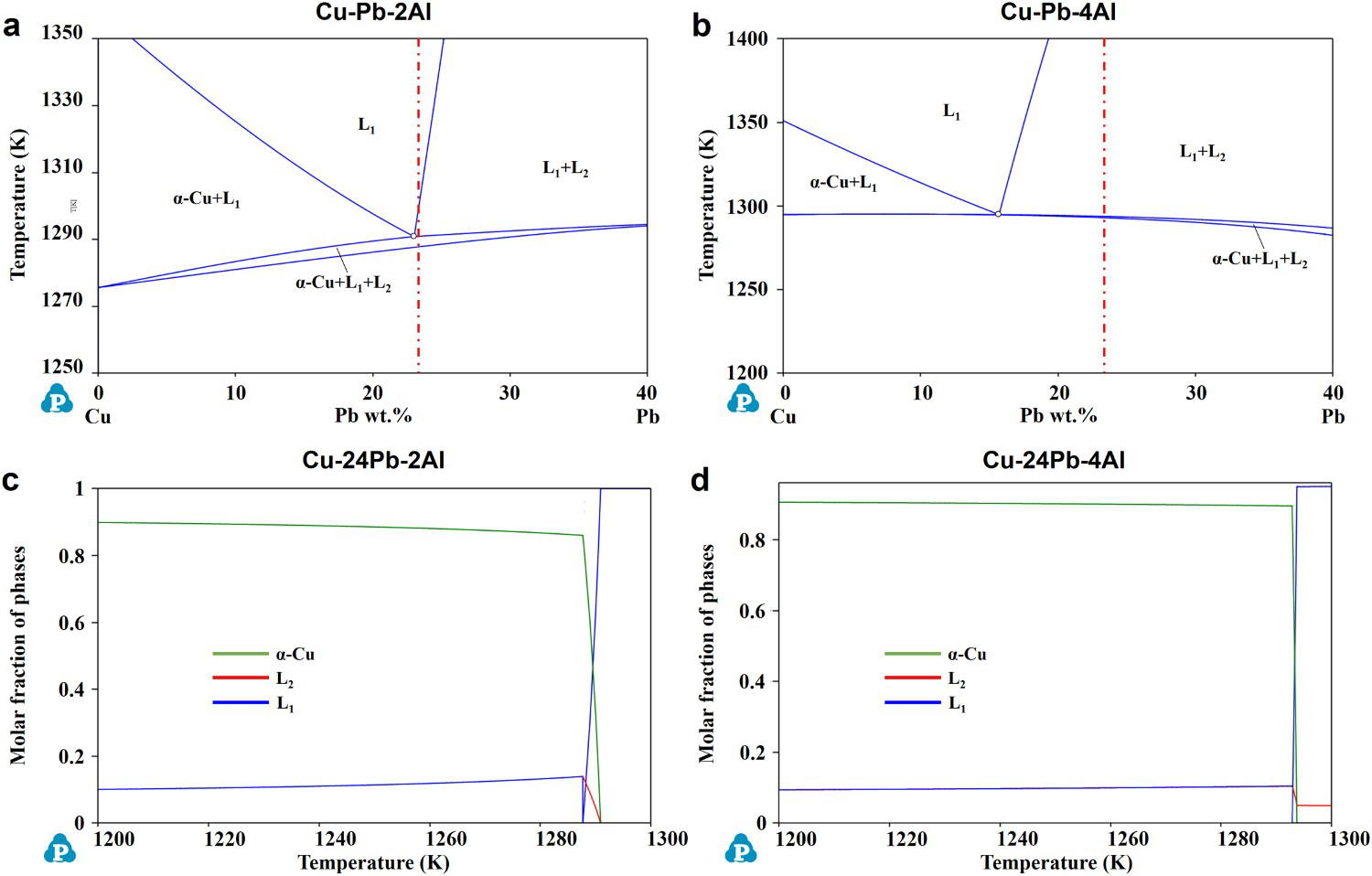
Therefore, on the one hand, Al additional element can promote the moving left of MP and decrease the molar fraction of primary α-Cu. On the other hand, LLPS accompanied with gravity segregation may occur one the content of Al surpasses a critical value.
Influence of al content on microstructure evolution of the Cu–24Pb–xAl alloys
In order to verify the accuracy of phase diagram and explore the influence of Al content on microstructure evolution of the designed Cu–24Pb–xAl alloy, solidification experiments were designed. Cu–24Pb, Cu–24Pb–2Al and Cu–24Pb–4Al alloys were prepared. Figure 3(a) presents the sampling position for microstructure characterisation. Figure 3(b–j) presents the microstructure of Cu–24Pb (Figure 3(b–d)), Cu–24Pb–2Al (Figure 3(e–g)) and Cu–24Pb–4Al (Figure 3(h–j)) alloys. PSPs in Cu–24Pb alloy show completely network morphology. However, vast quantities of fine and rodlike PSPs with a size lower than 10μm exist in Cu–24Pb–2Al alloy, as shown in Figure 3(f,g). It can be further proven that the moving left of MP and the existence of (L1+L2+α-Cu) phase region can suppress the formation of network PSPs. Especially, the function mechanism of (L1+L2+α-Cu) phase region has been revealed in the previous work [3,4]. Simultaneously, it's also found the formation of abnormally coarsened PSPs and gravity segregation occurred in Cu–24Pb–4Al alloy, and PSPs with a size higher than 1mm can be observed at the bottom. Referring to the phase diagram, LLPS occurred in Cu–24Pb–4Al alloy, and resulted in the macro-segregation.
(a) Schematic diagram of ingot; Microstructure of (b)–(d) Cu–24Pb, (e)–(g) Cu–24Pb–2Al and (h)–(j) Cu–24Pb–4Al alloys.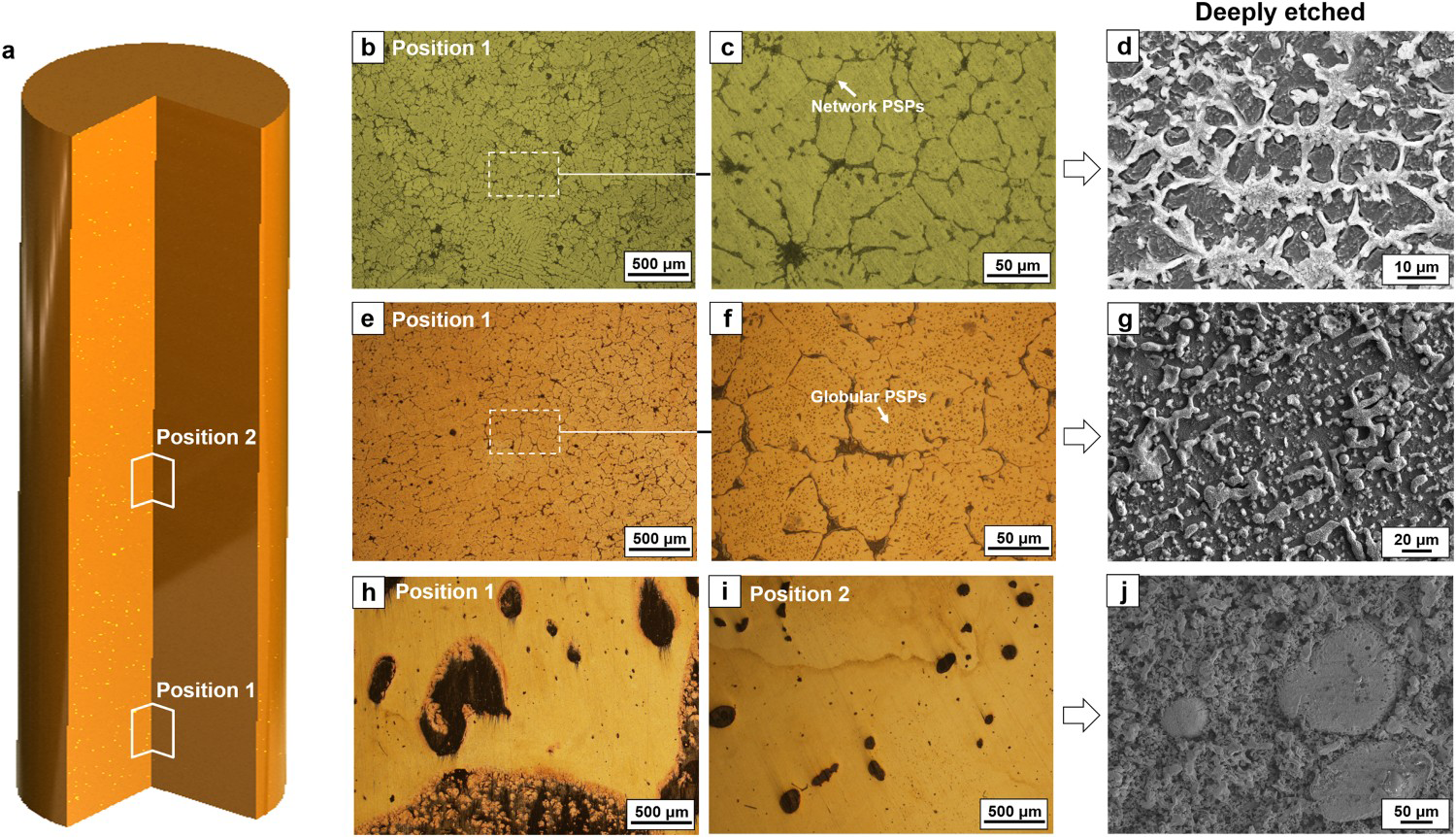
Through comparation between experiments and calculations, the microstructures of Cu–24Pb–xAl alloys designed match well the phase diagrams calculated through CALPHAD.
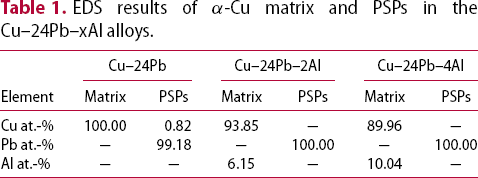
Figure 4(a,b) and Figure 4(c,d) respectively present the composition variation in Pb-rich secondary phase droplets (L2) and α-Cu. Both Al wt-% in L2 and Pb wt-% in α-Cu are almost zero. As shown in Figure 4(a,b), a certain amount of Cu will dissolve in L2 at relatively high temperature due to the low value of. With temperature decreasing from 1373 to 773 K, Cu wt-% (Pb wt-%) in L2 of both Cu–24Pb–2Al and Cu–24Pb–4Al will monotonously decline (increase) close to 0 (100wt-%). On the contrary, for both Cu–24Pb–2Al and Cu–24Pb–4Al systems, element Al almost completely dissolves in α-Cu during solidification, as shown in Figure 4(c,d). Figure 4(e) presents the EDS results of Cu–24Pb–4Al alloy at point 1 and 2. It's observed that element Al almost dissolves in Cu, and PSPs are nearly pure Pb. Therefore, it can be further proven that Al can promote the separation between Cu and Pb due to the heterocoordination and homocoordination tendency respectively with Cu and Pb. The EDS results of the Cu–24Pb–xAl alloys have been listed in Table 1.
(a) Cu wt-% and (b) Pb wt-% of L2 in Cu–24Pb–2Al and Cu–24Pb–4Al alloys; (c) Al wt-% and (d) of α-Cu in Cu–24Pb–2Al and Cu–24Pb–4Al alloys; (e) SEM image and EDS results of Cu–24Pb–4Al alloy; (f)–(g) Schematic diagram of function mechanism of Al. EDS results of α-Cu matrix and PSPs in the Cu–24Pb–xAl alloys.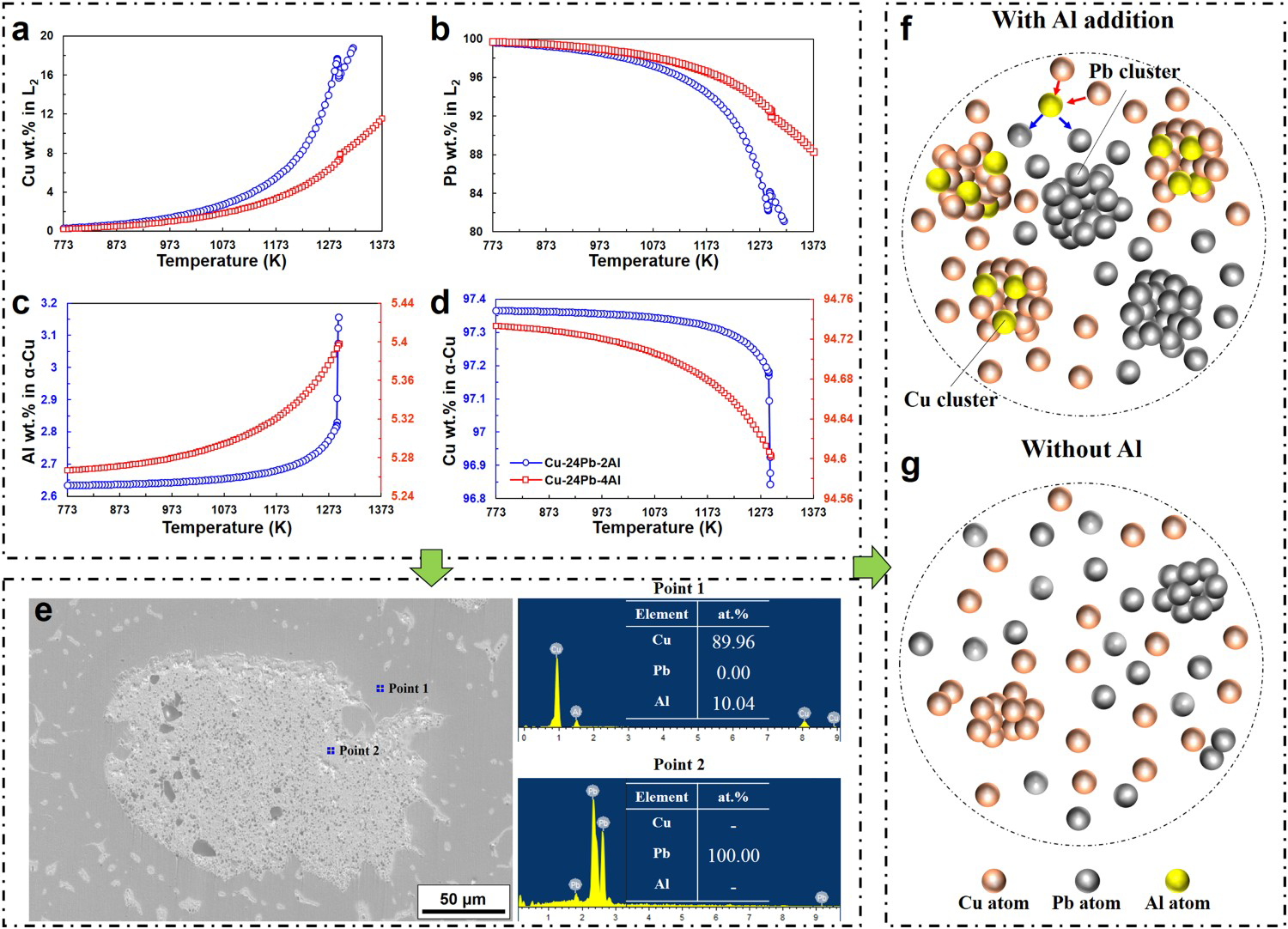
According to the above analysis, it's further proven that Al atoms prefer to take Cu atoms as neighbour atom, and will promote the separation between Cu and Pb by attracting the former and rejecting the latter, as shown in Figure 4(f,g). That means the separation between Cu and Pb during monotectic reaction can occur more easily and with relatively low Pb wt-%. It will simultaneously make MP move left, and promote the occurrence of liquid–liquid phase separation and macro segregation.
Therefore, Cu–24Pb–2Al with rodlike PSPs can be proven to be the best composition. Additional element Al promoting the separation between Cu and Pb will help promote the morphology transformation of PSPs from network to rodlike. However, LLPS will be triggered if the content of Al surpasses 2wt-%.
Conclusion
In this work, a novel strategy is proposed to design Cu–Pb–(X) alloy with dispersed and rodlike Pb-rich secondary phases. The main design step can be concluded as follow:
Through primary binary-phase diagram analysis and thermodynamic calculation, the additional element X can be determined. For binary system, Cu–X system should present heterocoordination preference, and Pb–X should present homocoordination preference. Element Al meeting the above requirements can promote the monotectic point moving left, which will also promote the formation of rodlike PSPs by reducing the fraction of primay α-Cu. Cu–24Pb–xAl (wt-%) systems are thus designed through CALPHAD. With the guidance of CALPHAD, Cu–24Pb–2Al alloy with dispersed and rodlike PSPs was designed and identified to be the ideal composition.
Footnotes
Disclosure statement
No potential conflict of interest was reported by the author(s).