







Abstract
The present work reports the effect of increasing concentration of antiferromagnetic element Cr in FeCoCrxNi2Al (x = 0.5, 1.5) high entropy alloy (HEA) on their magnetic properties. We find that the structure and composition of different phases present in HEA significantly affects its magnetic properties. Interestingly, the sample with Cr concentration x = 1.5 showed two times larger saturation magnetisation as compared to x = 0.5. Furthermore, the magnetisation versus temperature response shows multi-phase character and exhibits distinct behaviour in low temperature and high temperature regime in both the samples. The obtained soft ferromagnetic behaviour of these HEA is crucial for the development of a new class of HEA for various applications.
Introduction
Conventional alloys consist of one primary element with the addition of a few minor alloying elements to achieve desired properties. High entropy alloy (HEA) comprises five or more significant elements in equiatomic or nearly equiatomic proportions [1]. In HEA, fundamentally, the interplay among configurational entropy, free energy, and phase selection leads to optimised stability and required properties with a concentration of each element ranging in between 5 and 35 at.-%. In general, HEA is known to form body-centred cubic (BCC), face-centred cubic (FCC) or FCC + BCC solid solution phases, because of its high configurational entropy due to the presence of a large number of elements. A delicate balance between the size of the constituting atoms, enthalpy of mixing and entropy of mixing is critical to obtain the preferred solid solution phase. Otherwise, the formation of an undesired intermetallic phase or amorphous phase may take place [1-3]. HEA has enormous application potential in high-temperature corrosion resistant coating, diffusion barrier layers, fatigue resistance, soft ferromagnet etc. [4,5]. In terms of preparation techniques of HEA, mechanical alloying is advantageous as it results in ultrafine nanocrystalline HEA with homogeneous composition [6]. In contrast, phase segregation can be produced by melting and casting [7]. Element selection plays a crucial role in developing a HEA with desired properties. In recent times Fe, Co, Ni, Cr and Al constituent elements based HEA have drawn significant attention as the magnetic properties can be suitably tuned for fitting in the precise application of electric and electronic device, where a constant thermally stable magnetisation in larger temperature range needs to be maintained. Non-equiatomic eutectic FeCoCrNi2.1Al HEA shows a good balance between ductility and strength as reported in earlier studies [8-10]. In an earlier study by Kao et al. [11], the magnetic properties of FeCoCrNiAlx HEA were found to be associated with the crystal structure and concentration of Al or Al–Ni rich phase. It essentially showed that a high concentration of Al significantly affects the ferromagnetic nature of the alloy with some of the particular combinations exhibiting spin-glass behaviour. As Vaidya et al. [12] reported, change in the sequence of alloying element substantially modifies the fraction of BCC and FCC phase in FeCoCrNiAl HEA. For FeCoCrNiAl HEAs, using magnetisation versus field or temperature response it is found that the magnetisation enhances at low temperature [13,14]. Saturation Magnetisation (Ms) of FeCoCrNiAlCu [15] was found to be 38.10 emu g–1. Wang et al. [16] studied magnetisation curves for as-cast FeCoCrNiCu and FeCoCrNiCuAl at room temperature. It was found that AlCrFeCoNiCu shows ferromagnetic behaviour and approaches saturation at 40 emu g–1. Lucas et al. [17] showed that the presence of Pd increases the ordering or Curie temperature (Tc) of FeNiCoCr from 293 to 440 and 503 K for FeNiCoCrPd and FeNiCoCrPd2, respectively. Kulkarni et al. [18] observed that the increase in Fe content enhances the ferromagnetic exchange interaction, resulting in the development of a soft magnetic nature in AlNiCo(CuFe). It was also reported that Fe, Co, Ni enhances the FCC phases while Cr and Al promote the BCC phase [19]. In a recent work by Na et al. [14] tailoring of magnetic properties by Ni or Al substitution for Cr in equiatomic FeCoNiCrAl has been reported. Interestingly, drastic change in magnetic properties was observed by increasing the phase percentage of the FCC phase, which in turn were strongly related to both elemental substitution and the annealing condition of HEA. Following the synthesis route of sintering and arc-melting it has been found that in FeCoNiCrAl HEA three phases with different stoichiometries can be stabilised and the composition intricately depends on the Al or Cr content in the HEA [20,21]. Furthermore, in a recent study Shivam et al. [22] reported soft ferromagnetic property and reasonably high Tc in AlCoCrFeNi HEA synthesised using mechanical alloying. Based on the existing literature, it is evident that though few studies have attempted to understand the structural and magnetic properties correlation in HEA composed of AlCoCrFeNi, however, in-depth understanding of such correlation with varying Cr concentration in HEAs prepared using mechanical activated synthesis requires further exploration. It would also be interesting to note the stability of the system obtained using mechanical activated synthesis method for the HEA.
We have investigated the effect of varying Cr concentration in FeCoCrxNi2Al (x = 0.5, 1.5) HEA on structural and magnetic properties in the present work. In particular, we have studied the magnetisation (M) versus field (H) as well as temperature (T) response to obtain insight into the evolution of different magnetic phases. Furthermore, we attempt to correlate the magnetic properties with the results of structural characterisation.
Experimental methods
The powders of Aluminium (Al), Cobalt (Co), Iron (Fe) and Nickel (Ni) of 99.9% purity from Alfa Aesar were weighed in non-equiatomic ratio with varying content of Chromium (Cr) to synthesise FeCoCrxNi2Al (x = 0.5, 1.5) HEA by mechanical activated synthesis. The powder mixture in desired stoichiometry was milled for 2 h in a Planetary Ball Mill (Fritsch P-5) at 300 rev min–1 with a ball to powder weight ratio of 10:1. Tungsten carbide vials and balls were used as milling media and toluene as a process control agent. The 2 h milled powders were compacted at 50 MPa pressure in a 15 mm cylindrical stainless-steel die and were annealed at 1100 °C in an Argon atmosphere for 1 h holding period in a tubular furnace (Ants Ceramics, India) followed by furnace cooling to room temperature. Hereafter, we refer to the sample with x = 1.5 as sample A and with x = 0.5 as sample B. The synthesised samples (A and B) were carefully analyzed for the corresponding phases using an X-ray diffractometer (Xpert Pro Pananalytical instrument with Cu kα radiation (λ = 1.54 Å)) and standard slit size was kept during the measurement (Source slit (anti Scattering = 1°, Divergence = 1/2°) and Detector slit (anti Scattering = 1/32°)). The phase segregation and composition were analyzed using backscattered mode in Field Emission Scanning Electron Microscopy (FE-SEM, make Carl Zeiss microscopy ltd, UK & SIGMA) and spot Energy Dispersive X-ray Spectroscopy (EDS) were obtained at an operating voltage of 10 kV. The magnetic characterisation was done using Lakeshore Vibrating Sample Magnetometer (VSM 7400-S) for two different temperature range (i.e.) 15–300 K and 300–900 K.
Results and discussion
X-ray diffraction
X-ray diffraction patterns of sample A (FeCoCr1.5Ni2Al) and sample B (FeCoCr0.5Ni2Al) produced by mechanical activated synthesis are shown in Figure 1(a–d). From the XRD pattern of sample A, a dual phase comprising of FCC + BCC (BCC1, BCC2) structure has formed, whereas with a decrease in the concentration of Cr (sample B) a single FCC phase is obtained (Figure 1(a)). The formation of two BCC1, BCC2 phases in sample A is shown in Figure 1(b–d). The lattice parameter of FCC, BCC1 and BCC2 phases in sample A is observed to be 3.585 ± 0.002, 2.879 ± 0.002 and 2.862 ± 0.002 Å (c.f. Figure 1(b–d)) respectively. The lattice parameter of the FCC phase in sample B is 3.572 ± 0.002 Å. Furthermore, the formation of a solid solution phase by 2 h of mechanical alloying and annealing at high temperature in the present work may be likely due to the high entropy effect along with stronger bonding among constituent elements. In similar alloys, as reported in other studies prepared using mechanical alloying alone, need a longer duration of milling to obtain the solid solution phase [6]. Joy et al. [23] intensively discussed the role of enthalpy of mixing of a constituent element in determining the formation of solid solution phase in multicomponent HEA. It has been summarised that in HEA with atomic size difference (δ) between 5.6 and 7.6% and enthalpy of mixing (ΔHmix) between −20 and −5 kJ mol−1 accelerates the formation of the solid solution during mechanical alloying [3,24]. The enthalpy of mixing of samples A and B investigated in the current study were found to be −16.19 and −12.36 kJ mol−1 respectively. Comparing the results of sample A with that of B the change in the phase composition from the dual FCC + BCC (BCC1, BCC2) phases to single phase FCC is attributed to the decrease in the concentration of Cr [25]. From the calculation, the entropy of mixing (ΔSmix) were found to be 13.01 J.(mol K)−1 and 12.59 J.(mol K)−1 for samples A and B respectively. ΔSmix facilitates the elements to distribute randomly in the crystal lattice and enables the formation of simple solid solution phases with FCC and BCC structure [24]. Additional details of the calculation for both ΔHmix and ΔSmix can be found in supplementary information.
(a–d) X-ray diffraction patterns of samples A = FeCoCr1.5Ni2Al and B = FeCoCr0.5Ni2Al HEA respectively. (a) Peaks corresponding to FCC and BCC structures are identified in the plots. (b–d) show the presence of FCC, BCC1 and BCC2 peaks in sample A at 2θ angle 44°, 65°, 83° respectively.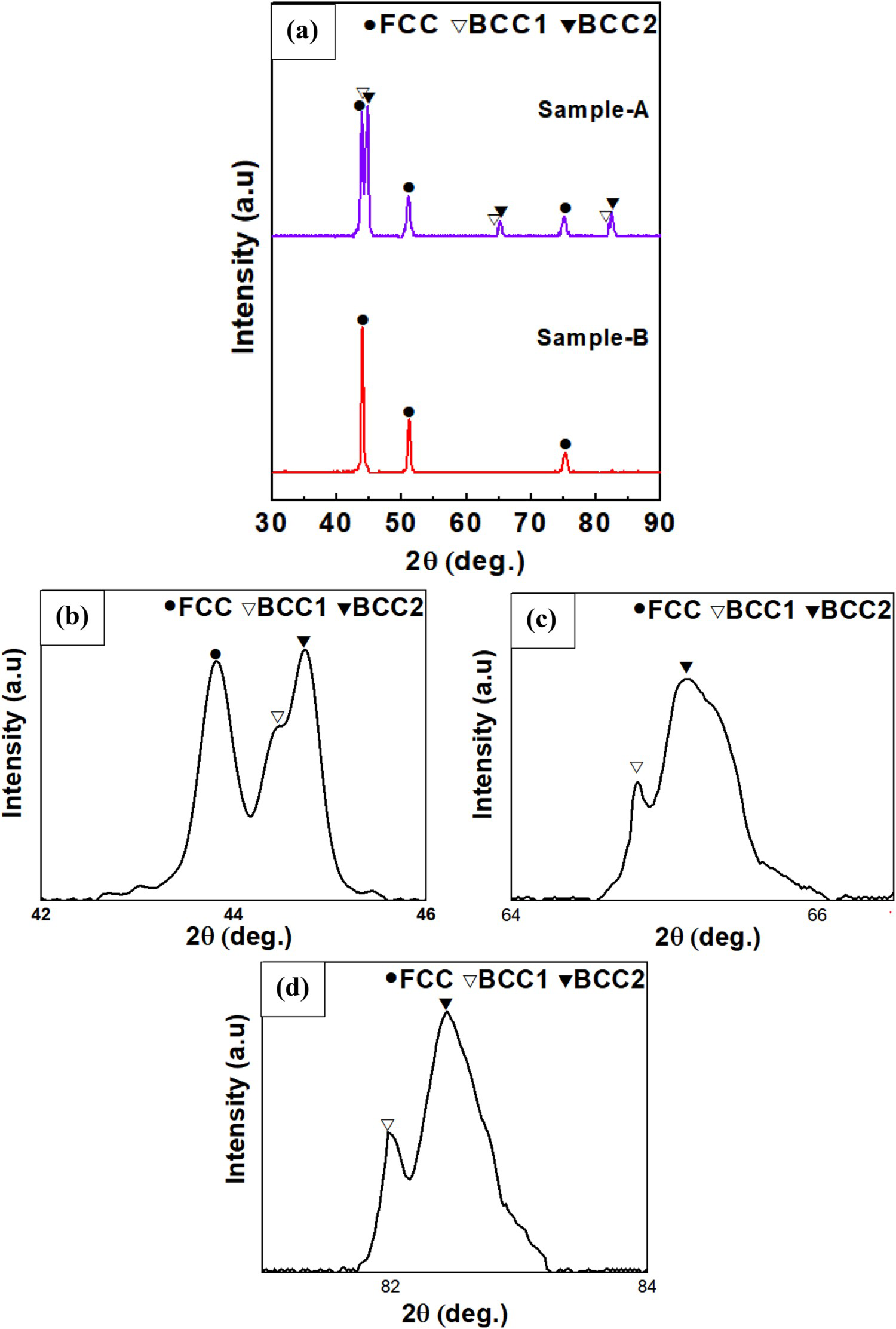
For HEAs, the phases can be predicted by the phenomenological model of valence electron concentration (VEC), which essentially refers to the number of total electrons in the valence band [14,26,27]. Following the calculation for the VEC, for samples A and B we get 7.53 and 7.82, respectively. Though based on the VEC model both samples A and B should have a mixture of FCC and BCC phase (VEC > 8.0 for only FCC, 6.87 < VEC < 8.0 for BCC + FCC, and VEC < 6.87 for BCC), however, sample B shows exception. We do not rule out the possibility that a negligibly small fraction of the BCC phase in sample B may exist, which is challenging to be detected using the limited sensitivity of XRD. Additionally, using HT-XRD, we have also found the presence of FCC + BCC peaks in sample A in which the phases are stable up to 900 °C (c.f. Supplementary information Fig. S1).
It is shown that mechanical activated synthesis method shows a good thermal stability of FeCoCrNi2Al HEA up to 1000°C. The dual phases observed were prominent from the HT-XRD results [28]. The reported results were found to be in conjunction with that of dilatometry and differential scanning calorimetry (DSC) results. Therefore, we believe that a good thermodynamic balance between the phases can be found in our samples also, since the same synthesis procedure has been followed in our case. The phase transition from the FCC + BCC (BCC1, BCC2) phase (sample A) to the dominant FCC phase (sample B) with a decrease in the concentration of antiferromagnetic Cr leads to markedly different magnetic properties. It is worth mentioning here though using XRD, we get the confirmation of the solid solution phase, however further in-depth morphology and microstructure information is expected to provide more insight into these HEAs.
Field emission scanning electron microscopy (FE-SEM)
The Backscattered Secondary Electron (BSE) image for samples A and B are shown in Figure 2(a,b). The surface morphology obtained in these images reveals the presence of multiple phases in both samples with a contrast difference. Clearly, from either of these images, it is difficult to comment on porosity, any particular phase grain size or grain boundaries. These observations suggest that during mechanical alloying and subsequent annealing, continuous deformation and enhanced diffusivity lead to somewhat non-uniform distribution of phases all across the sample with crystalline nature well preserved. Furthermore, these phases are identified using spot EDS and the composition of each phase are tabulated for samples A and B in Table 1. The region where spot EDS is performed in sample A is denoted as a, b and c, whereas in sample B the same is indicated as d, e and f. These regions are carefully identified so that the spot EDS can be performed over the uniform contrast, which is possibly related to a particular phase.
(a) and (b) Surface morphology of samples A and B using backscattered Scanning Electron Microscope. Images reveal the major phases in the samples as different grey contrast. Encircled regions (a)–(f) refer to the location where energy-dispersive X-ray spectroscopy has been performed (cf. text for details). Composition of different phases obtained by spot EDS scan for samples A and B in regions indicated in Figure 2.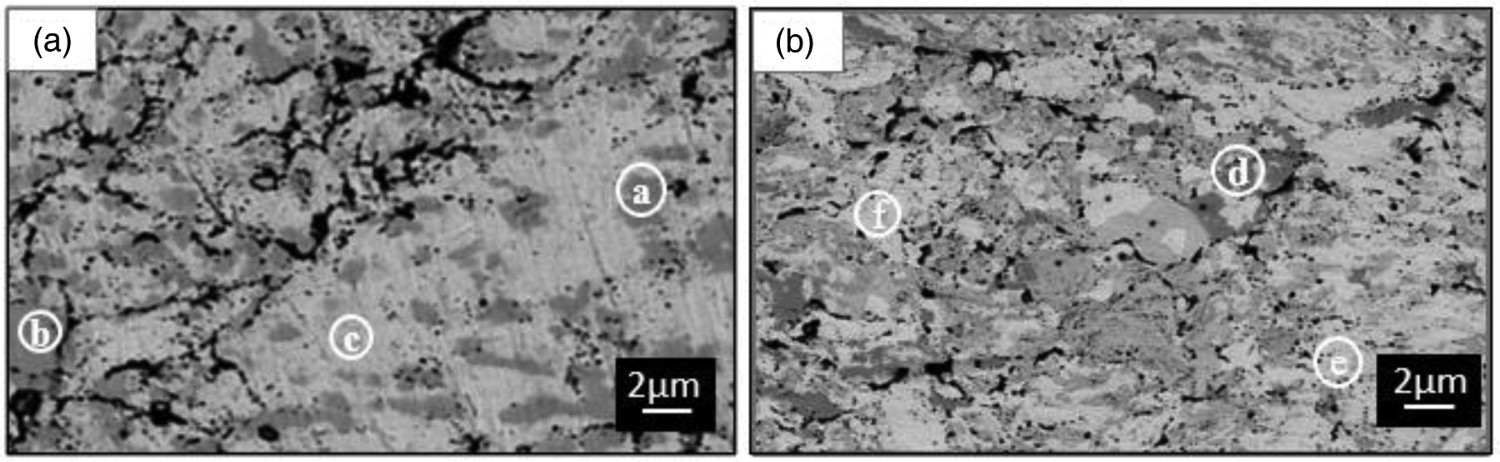
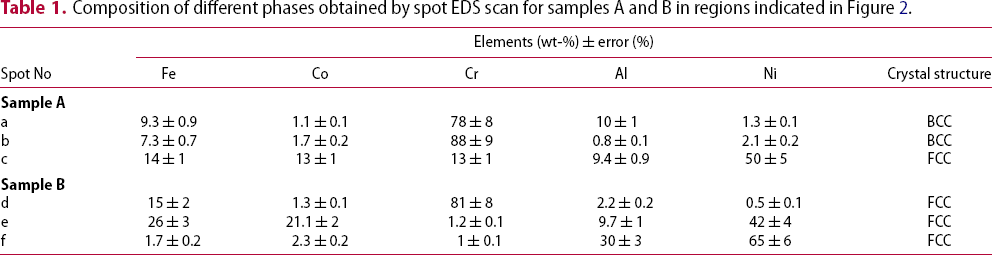
In the case of Sample A, FeCoCr1.5Ni2Al HEA, the EDS analysis of the microstructure indicates the presence of Cr–Fe–Al (a), Cr-rich (b), and Fe–Co–Ni (c) phases. It is interesting to note that in sample B, FeCoCr0.5Ni2Al HEA, the EDS analysis of the microstructure reveals the formation of phases which are enriched in Cr–Fe (d), Fe–Co–Ni–Al (e), and Ni–Al (f). The local inhomogeneity of phases in various HEAs has been previously reported. In an earlier study, Manzoni et al. [29] observed in as-cast AlCoCrFeNi HEA separation of Al–Ni-rich matrix and Cr–Fe-rich precipitates. Fluctuations of single elements within the Cr–Fe-rich phase were also reported by them using sophisticated three-dimensional atom probe measurements. In another report by Singh et al. [30] investigated the effect of the decomposition of Cr–Fe–Co in AlCoCrCuFeNi and concluded that the decomposition of Fe and Cr in Cr–Fe-rich regions of HEA is spinodal. Based on the experimental data from the existing literature [30], we speculate that in both samples A and B, spinodal decomposition of Cr-rich phases in Fe–Co–Ni-rich phases may occur. It is thus interesting to investigate the magnetic properties of both samples A and B with a particular emphasis to understand the role of these phases in influencing the temperature-dependent magnetisation response.
Magnetic studies
In order to understand the effect of phase decomposition by changing the concentration of antiferromagnetic Cr element in sample A and sample B, we discuss the M versus H and M versus T response. Figure 3(a,b) shows the M versus H response for samples A and B at 15 and 300 K respectively. Both the samples show a clear ferromagnetic response with a small coercive field and remanence. Interestingly, sample A shows large Ms ∼ 85 emu g–1 and the sample B exhibits Ms ∼ 43 emu g–1 at 300 K. Interestingly, we find that the extent of increase in the Ms at 15 K in sample A is larger in comparison to that in sample B. It is worth to note that the coercive field does not show any appreciable change at low temperature for both these samples. It is interesting to note that the higher concentration of antiferromagnetic element Cr in sample A leads to stabilisation of suitable Fe–Co–Ni rich phases thereby resulting in nearly two times enhanced Ms as compared to sample B. From the analysis of SEM images using ImageJ software the volume fraction of the Fe–Co–Ni (c) phases present in the alloy is nearly 50% when comparing with that of the other phases such as Cr–Fe–Al (a) and Cr-rich (b) in the alloy. In sample B, we find Cr–Fe (d) phase as the dominant one with its percentage close to 45%. Other phases e.g. Fe–Co–Ni–Al (e) and Ni–Al (f) correspond to 24 and 26%, respectively. Following the Slater-Pauling (SP) rule, which essentially relates the average magnetic moment of 3d alloys and compounds to valence electron concentration, suitable ferromagnetic phase segregation that is facilitated by enhanced Cr content results in the observation of an increase in Ms. According to the SP rule, if Fe or any other alloy, having VEC = 8 may be stabilised in the FCC structure in the high spin state at room temperature, then its Ms will be comparable to iron (∼220 emu gm–1). It is worth mentioning here that the Ms value obtained in the present study in sample B, which shows FCC structure and has VEC = 7.82 is still nearly 6 times smaller than that predicted by SP rule. These M vs H results indicate that the Ms value in AlCoCrFeNi based HEA can be suitably controlled by just varying the Cr concentration in the alloy. Additionally, the reduced magnetisation value also indicates the presence of other magnetic phases in the HEA that need further investigation.
(a) and (b) Magnetisation (M) versus Field (H) hysteresis loop for samples A and B at 300 and 15 K. Inset shows the zoomed in MH hysteresis loop to indicate the coercive field. For sample A, the magnetisation versus temperature response measured in the temperature range 15–300 K (c) and in the temperature range 300–900 K (d). Similarly, for sample B the magnetisation versus temperature response for 15 to 300 K is shown in (e) and for 300 to 900 K is shown in (f). The M vs T measurements are performed at an applied field H = 100 Oe. The transition temperatures are indicated using arrow in the plot.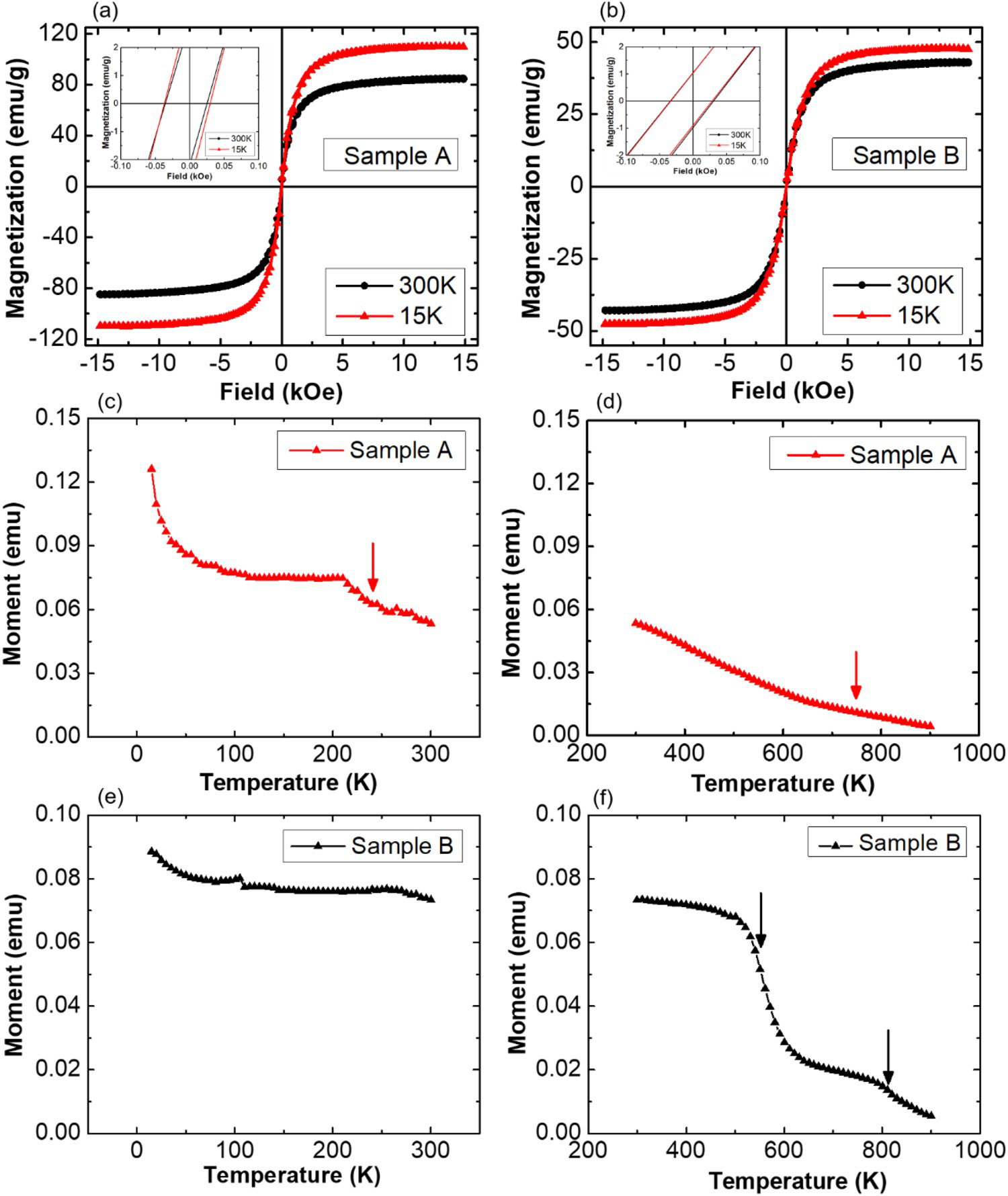
In order to get insight into Tc due to the presence of multi-phase character, we investigated the M versus T response from low temperature 15 K to high temperature 900 K (Figure 3(c,d) for sample A and Figure 3(e,f) for sample B). In case of low temperature measurement, the sample is cooled down to 15 K in zero field, then H = 100 Oe is applied during the warm-up cycle and the magnetic moment values are measured. Similarly, for the high temperature measurements magnetic moment values are recorded as the sample temperature is increased from 300 to 900 K in the presence of H = 100 Oe. The Tc between the paramagnetic and ferromagnetic phase was determined from the minima of the plot of dM/dT versus T or by extrapolating the linear part of the M vs T where it intersects M = 0 (cf. Supplementary Figs. S1 (a–d), and S2 (a–d)). The estimated Tc values are indicated using arrow in M vs T plot [13,31]. From both these curves, a distinct M as a function of T response compared to that of conventional ferromagnetic material is observed. Interestingly, in Figure 3(f), in the temperature range 490–620 K the magnetisation undergoes a sharp drop by nearly three times. In other measured temperature ranges, variation in M as a function of T is relatively slow. Such wide rate variation in the magnetisation across the transition temperatures indicates that multiple magnetic phases govern the magnetic properties of these samples. The transition originating due to the multiphase nature present can be understood from the existing literatures. The dominant phase present in sample A has Fe–Co–Ni rich presence and it can be attributed to the ordering temperature (Tc ∼ 750 K) [32]. It is likely that Cr-rich and Fe–Cr–Al phases are antiferromagnetic in nature and their ordering temperature may be below room temperature [13]. Mostly it is understood that increasing the Cr concentration will lead to the formation of Cr-rich phase in the alloy and it is responsible for the decreased magnetic moment and reduced ordering temperature [13,17,31]. Interestingly, due to the complex nature of the alloy, it is somewhat non-trivial to exactly estimate ordering temperature that correspond to other phases. For Sample B, we speculate the 810 K ordering temperature with the FeCoAlNi phase based on the existing literature [13]. However, it is difficult to attribute ordering temperature 550 K with any of the determined phase in this sample. Importantly, the XRD results of sample A exhibits FCC + BCC and sample B exhibits only FCC structure. However, to understand the exact influence of each structure on the magnetic properties is somewhat challenging and it requires further experimental and theoretical investigations [31,33]. Therefore, the above observations also give an impression that both these samples are magnetically inhomogeneous with the possible existence of any residual non-ferromagnetic phase present in the alloy. Overall, the interactions in both these samples A and B are dominated by the ferromagnetic phases, which result in ferromagnetic response at room temperature.
Conclusion
HEA composed of FeCoCrxNi2Al (x = 0.5 and 1.5) containing various phases have been prepared by ball milling and subsequent annealing at 1100 °C. The XRD analysis of a sample with a high Cr concentration (x = 1.5) shows a mixed FCC and BCC phase and with decreasing Cr concentration single FCC phase is stabilised. These HEA exhibit interesting magnetic properties which are correlated with microstructural and morphological analysis performed by SEM and EDS. We believe, the phases observed are likely due to the multiphase nature of the sample resulting in magnetically inhomogeneous phases stabilisation. Specifically, the sample with Cr concentration x = 0.5 shows nearly half saturation magnetisation compared to x = 1.5 with no appreciable change in coercivity and remanence. Interesting magnetisation versus temperature response found in 15–900 K makes this HEA system intriguing to in-depth understand the structure and magnetic property correlation.
Footnotes
Acknowledgements
We acknowledge Nanotechnology Research Centre (NRC), SRM Institute of Science and Technology, for providing research facilities.
Disclosure statement
No potential conflict of interest was reported by the author(s).