







Abstract
Aligning the hard phase has always been a great challenge in fabricating bulk nanocomposite magnets due to the high soft-phase fractions. In this work, anisotropic bulk Pr2Fe14B/α-Fe nanocomposite magnets have been fabricated from amorphous precursors by high-pressure thermal compression deformation. The synthesised magnet exhibits an ultrastrong magnetic anisotropy with a high soft-phase fraction of ∼29 wt.% and a dual-morphology grain structure that consists of equiaxed and lath-shaped grains. The anisotropy is originated from the strong (00l) crystallographic texture for Pr2Fe14B nanocrystals on account of its preferential nucleation and growth during the deformation with high stress and large strain. This study is favourable for the development of bulk nanocomposite magnets with superior energy products on the premise of high soft-phase fractions.
Keywords
Introduction
Energy product, which is a key figure of merit for evaluating the performance of nanocomposite magnets, is strongly dependent on the structural characteristics of individual components including the size, morphology, crystallographic orientation, and distribution [1-3]. However, precise control over these desired characteristics for the soft and hard phases is extremely difficult as certain characteristics required for individual components often conflict [2-4]. In the past decades, the characteristics of soft phase, e.g., size and distribution, have been efficiently controlled via self-assembling [5,6], bottom-up approaches [7,8], melt spinning [9], and severe plastic deformation [10,11] in FePt/Fe3Pt, SmCo/Fe(Co), and NdFeB/Fe(Co) systems. Nevertheless, the resulting nanoscale hard-phase grains typically exhibit a random crystallographic orientation, giving rise to magnetic isotropy and inferior energy products [2,12,13]. For example, by engineering the nanoscale dimension and spatial distribution of the hard and soft phases, an enhanced energy product has been achieved using a self-assembled approach [5,6]. The energy product is still smaller than the theoretical prediction due to the isotropic hard phase. Hence, inducing the strong texture of hard-phase grains along their easy magnetisation axis (i.e., magnetic anisotropy) remains a critical issue in fabricating bulk nanocomposite magnets with high energy products on the premise of high soft-phase fractions [1,14,15].
Recently, a great progress has been made in aligning hard phase (SmCo7 and Nd2Fe14B) nanocrystals from amorphous precursors by employing a novel strategy of high-pressure thermal compression (HPTC) in bulk SmCo/FeCo and NdFeB/Fe systems with soft-phase fractions above 20 wt.% [15-19]. Using this deformation approach, the alignments of hard phase in anisotropic bulk nanocomposite magnets with large energy products (28 and 24.3 MGOe) and high soft-phase fractions (28 and 31 wt.%) have been realised in SmCo/FeCo [15] and NdFeB/Fe [18], respectively. To facilitate comparison, the ratio of the remanent magnetisation values, i.e.,  , where
  and
and  are the remanence measured parallel and perpendicular to the pressure direction, was employed to quantify the degree of magnetic anisotropy [20,21]. And the value of the ratio is generally in the range from 0 (i.e., the isotropic magnets) to 1 (i.e., the perfect anisotropic magnets). Although record-high energy products have been obtained, the degree of magnetic anisotropy with the value of 0.29 in SmCo/FeCo and 0.33 in NdFeB/Fe is still very poor as compared with that (>0.5) of conventional single-phase anisotropic rare-earth magnets [8,20]. Therefore, to further improve the energy products of bulk nanocomposite magnets, it is of great significance to strengthen the hard-phase texture [15,18,22].
Here, bulk Pr2Fe14B/α-Fe nanocomposite magnet with an ultra-strong magnetic anisotropy has been fabricated from amorphous precursors by HPTC. The resulting anisotropic structure was mainly due to the strong (00l) texture for Pr2Fe14B nanocrystals, which originated from the preferential growth in an amorphous matrix under high stress and large strain.
Experimental procedure
Amorphous Pr10Fe83.5Cu1.5B5 ribbons were produced using the melt-spinning technique at a wheel speed of 28 m/s. These ribbons were pulverised and then consolidated at an isostatic pressure of 0.9 GPa at a low temperature of 380oC for 5 minutes to produce bulk amorphous precursors. Finally, a steel tube filled with the as-compacted samples was placed in the center of two cemented carbide punches and subjected to HPTC deformation in a vacuum chamber at uniaxial stress (σ increasing from 350 to 700 MPa) and large strain (ϵ ≈ 81%) under continuously increasing temperature (T increasing from 525 to 725°C within 4.5 s) using a commercial Gleeble 3800 machine. The deformed specimen with a dimension of ∼15 mm in diameter and 1.5 mm in thickness was acquired.
Microstructure characterisation of the deformed magnet was conducted using transmission electron microscope (TEM) and X-ray diffractometer (XRD). To avoid the strong fluorescence effect generated by the interaction between X-ray and Fe atoms, a Co Kα target was used for XRD measurements in this study. The weight fraction and grain size were calculated using the Rietveld refinement procedure with the HighScore Plus software. The magnetic properties of the deformed magnets with cylinder-shaped specimens were measured using a vibrating sample magnetometer with a maximum field of 30 kOe at ambient temperature and the demagnetisation effect was corrected [3].
Results and discussion
Microstructure characterisation and analysis
XRD patterns were firstly conducted on sample surface perpendicular (⊥) and parallel (//) to the pressure direction (Figure 1). The results exhibit that the synthesised magnet is composed of α-Fe and Pr2Fe14B crystalline phases with grain sizes of ∼35 nm and ∼29 nm, respectively, using the Rietveld refinement procedure (Figure 1(a)). The weight fraction of α-Fe phase is determined to be ∼29 wt.% and most Pr2Fe14B grains are aligned along its easy magnetisation axis (00 l) parallel to the pressure direction, which is indicated by the remarkably strengthened (004), (105), and (008) reflection peaks (Figure 1(a)), where the intensity ratio of I(004)/I(220) = 2053% (Figure 1(d)) is much larger than that (73%) of isotropic Pr2Fe14B crystals (see the Inorganic Crystal Structure Database (ICSD): 614150) (Figure 1(c)). Moreover, the I(004)/I(220) value of the produced sample is also much larger than that (∼631%) in our previous work [18]. This can be further confirmed by the significantly weakened (004), (105), and (008) reflection peaks (Figure 1(b)) on the surface parallel to the pressure direction, where the intensity ratio of I(004)/I(220) = 1.6% (Figure 1(e)) is much lower than that (73%) of isotropic Pr2Fe14B crystals. The above-mentioned results demonstrate an ultrastrong (00 l) crystallographic texture of Pr2Fe14B phase together with a high fraction (∼29 wt.%) of α-Fe phase in bulk Pr2Fe14B/α-Fe nanocomposite magnet.
XRD patterns of the synthesised magnet measured on the surface perpendicular (a) and parallel (b) to the pressure direction. (c) Peak positions for the standard PDF cards of isotropic Pr2Fe14B (see the Inorganic Crystal Structure Database ICSD: 614150) and α-Fe (ICSD: 159352) crystals. (d,e) Zoomed-in views of the XRD patterns (marked with dot rectangle in panels a and b) and the corresponding separated XRD peaks from the patterns.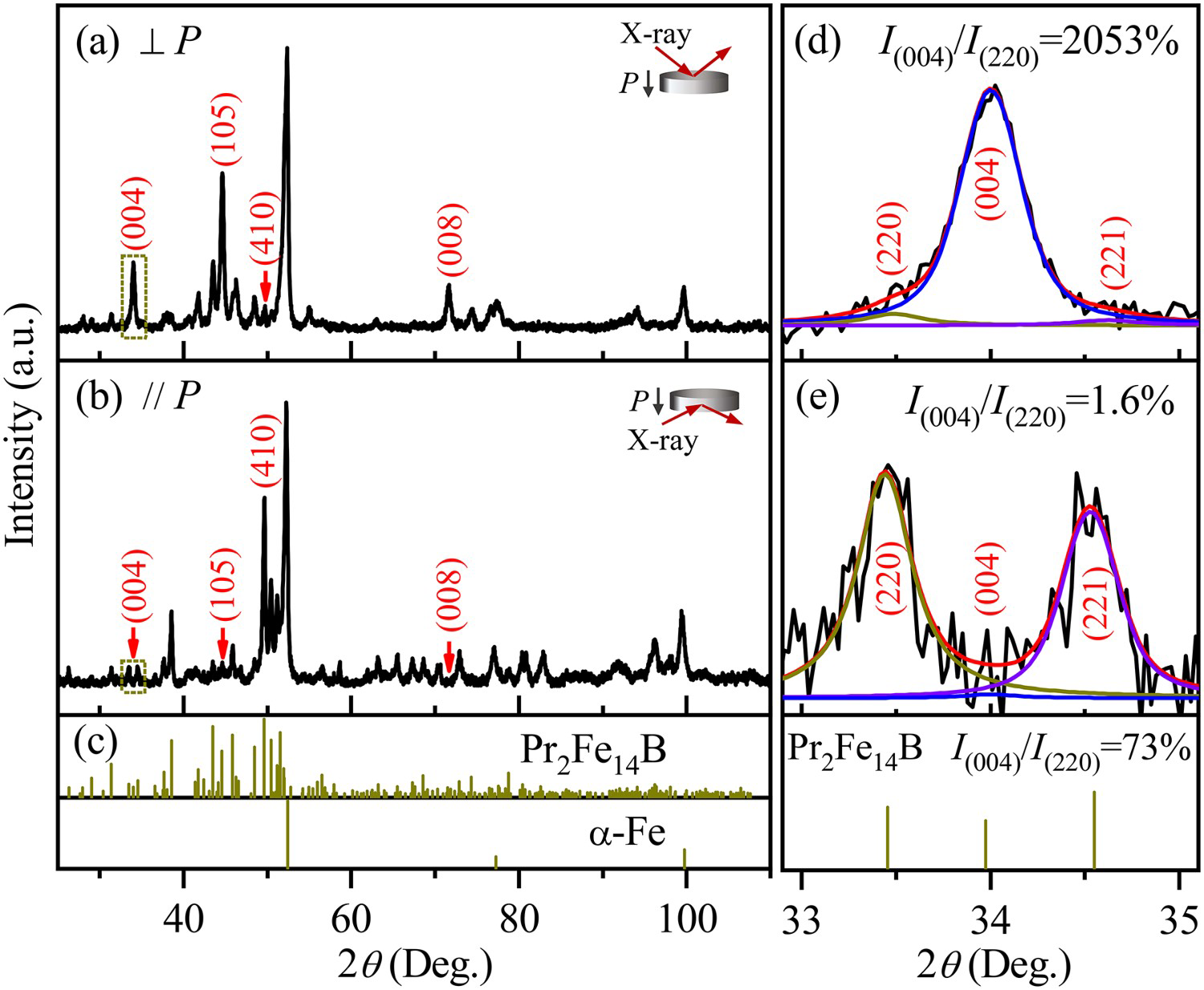
To further characterise the morphology of the synthesised magnet, TEM observations were performed on the surfaces perpendicular (cross section) and parallel (longitude section) to the pressing direction (Figure 2). The cross-sectional TEM image shows approximately equiaxed grains with sizes ranging from ∼20 nm to 100 nm (Figure 2(a)). The selected area electron diffraction (SAED) displayed two phases of α-Fe and Pr2Fe14B (the inset in Figure 2), which is consistent with the XRD results. The longitude-sectional TEM images exhibit a dual-morphology grain structure that consists of equiaxed (15-35 nm in diameter) and lath-shaped (50-100 nm in length and 12-35 nm in thickness) grains (Figure 2(b and c)). The strong diffraction spots in the SAED pattern (the inset in Figure 2(b and c)) indicate the (006) crystallographic texture of the Pr2Fe14B nanocrystals, as confirmed by XRD studies. These results demonstrate that Pr2Fe14B nanograins with c-axis alignment approximately along the pressure direction and equiaxed α-Fe nanograins have been produced in the synthesised magnet. The mechanism of the oriented Pr2Fe14B nanocrystals may result from its preferential nucleation and growth in amorphous matrix under high uniaxial stress and large strain [15,19].
Structure characterisation of the synthesised magnet. (a) Cross-sectional bright-field TEM image, the corresponding SAED pattern (the inset). Longitude-sectional bright-field (b), dark-field (c) TEM images, the corresponding SAED pattern (the inset).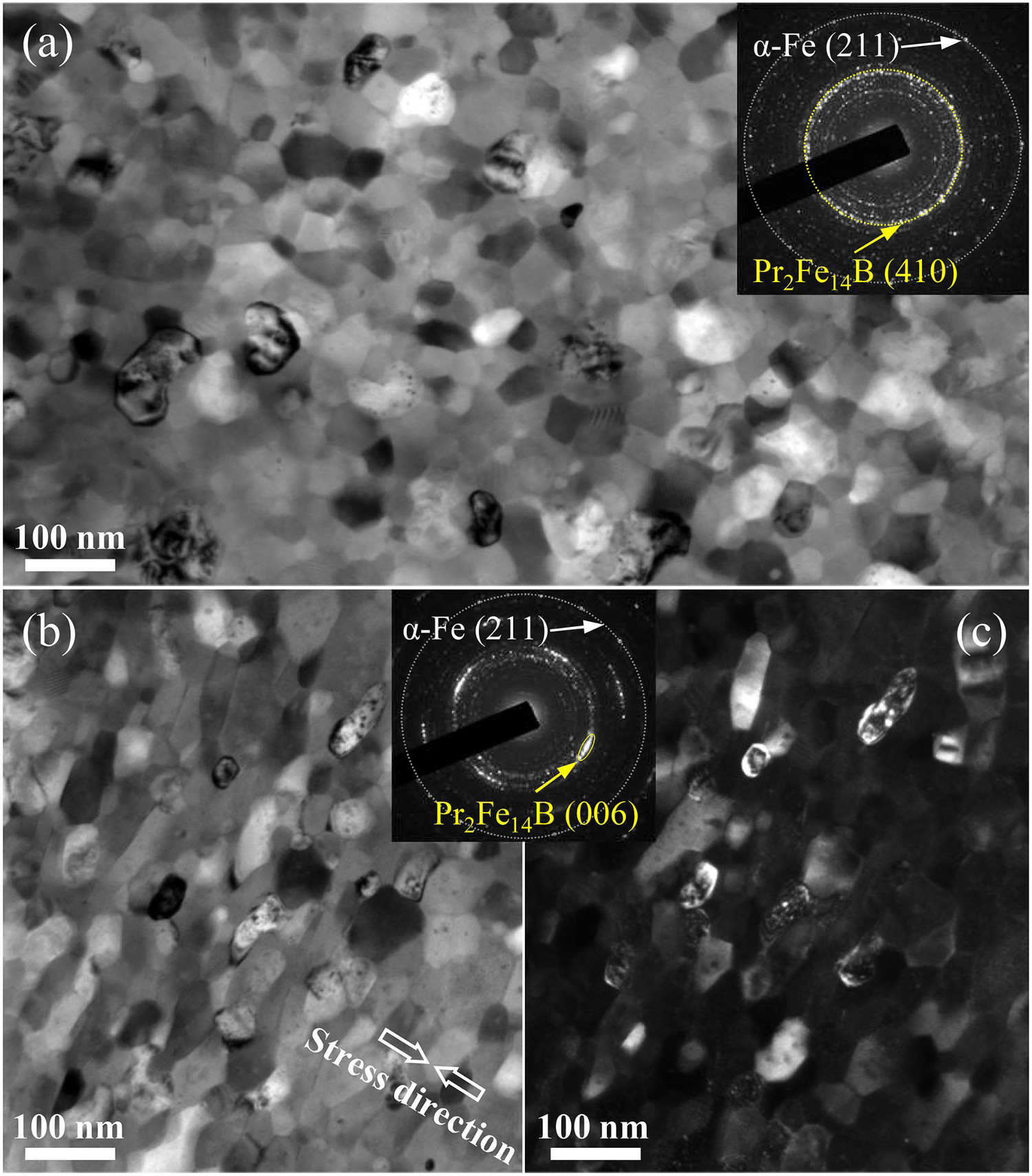
Magnetic properties
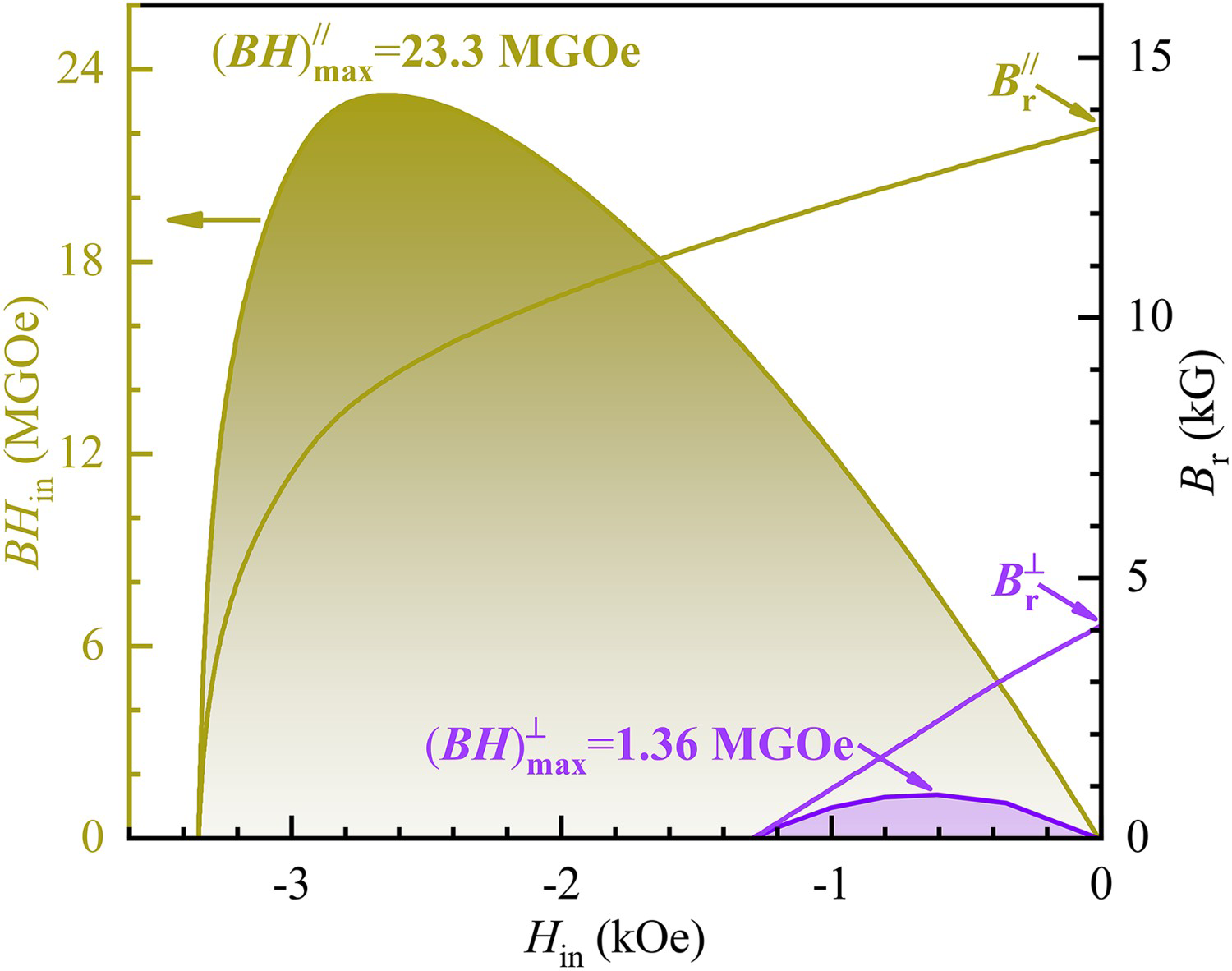
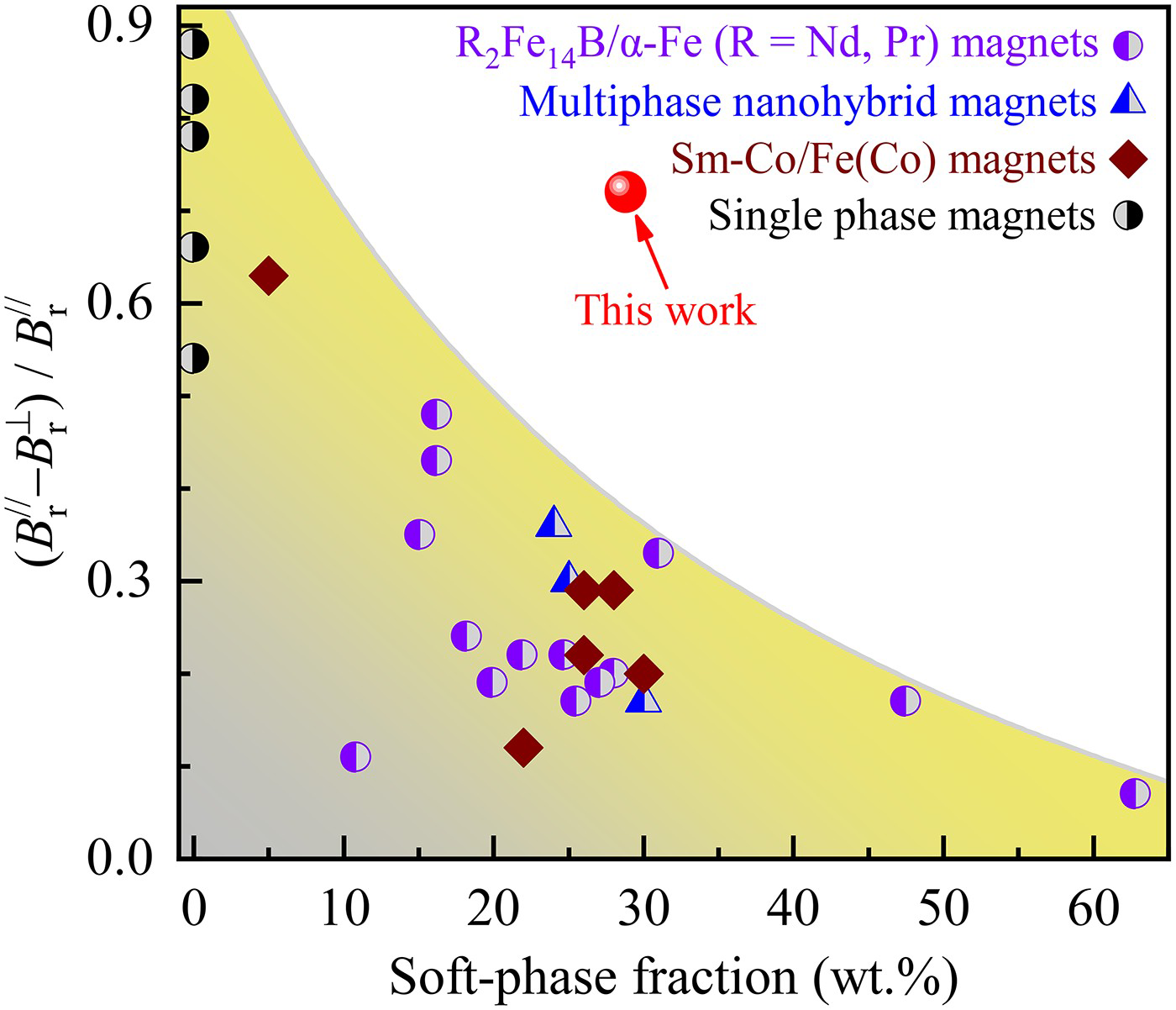
Having characterised the microstructure of the synthesised magnet, we examined the magnetic properties. The demagnetisation curves and energy products (BHin curves) of the synthesised magnet were presented in Figure 3. A maximum energy product (BH)max ∼ 23.3 MGOe together with the remanent magnetisation Br ∼ 13.6 kG was obtained along the pressure direction, while the corresponding values are merely 1.36 MGOe and 3.85 kG in the perpendicular direction. The remarkable difference in (BH)max and Br between the two directions (parallel and perpendicular to the pressure direction) indicates an obvious magnetic anisotropy, which is originated from the strong (00 l) texture of Pr2Fe14B nanocrystals, as confirmed by XRD and TEM results. To quantify the degree of magnetic anisotropy, the remanence ratio of Demagnetisation curves and the energy products (BHin curves) parallel (//) and perpendicular (⊥) to pressure direction for the synthesised magnet. Representative magnetic anisotropy of bulk nanocomposite magnets with various soft-phase fractions. For comparison, the magnetic anisotropy of single-phase R-Fe-B and SmCo5 magnets[8,20,21,25,26], SmCo/α-Fe(Co) magnets[3,8,15,28], multiphase hybrid magnets[16,17,29] and R2Fe14B/α-Fe magnets[18,19,23,27] reported in previous literatures together with the data in this work are presented. is generally employed. Numerous studies over the recent decades indicated that with increasing soft-phase fraction, the magnetic anisotropy and energy density of bulk nanocomposite magnets are greatly deteriorated [7,18,23]. The trade-off between the magnetic anisotropy and soft-phase fraction has always been a formidable challenge for the fabrication of high-energy-product bulk nanocomposite magnets [14,24]. Strikingly, the remanence ratio of
  with a value of ∼0.72 in this study is far away from the shaded region [3,8,15-23,25-29] (as shown in Figure 4), indicating that a record-high magnetic anisotropy together with high soft-phase fraction has been obtained in bulk Pr2Fe14B/α-Fe nanocomposite magnet.
Although a strong magnetic anisotropy of the bulk nanocomposite with a high soft-phase fraction and an enhanced energy product has been achieved in this study, the energy product of the synthesised magnet is still significantly below the theoretical value because of that it is extremely difficult to concurrently control the structural characteristics: small grain size of about 10 nm, homogeneous distribution to ensure effective exchange coupling, sufficient alignment of hard phase, and high soft-phase fractions up to 50%. To tackle this problem, extensive studies have been taken into our group via composition design and structural construction [3,15,17,22]. Moreover, the coercivity of the synthesised Pr2Fe14B/α-Fe magnet in this work is only ∼3.4 kOe, which is lower than that of 4.1 kOe in Nd2Fe14B/α-Fe nanocomposite magnet [18]. The reason for the low coercivity can mainly be attributed to the high degree of texture and the large grain size compared to those in Nd2Fe14B/α-Fe nanocomposite magnets. In addition, the coercivities of these two systems are quite low relative to their anisotropy fields. And the low coercivity (Hci < 5 kOe) has become a crucial drawback to further improving the magnetic properties of the (Nd/Pr)2Fe14B/α-Fe bulk nanocomposite magnets [16,18,19,27]. Hence, the coercivity enhancement, which can be obtained by microstructure manipulation (e.g., grain refinement [30], microalloying [31], interfacial modification [32,33] and ordered gradient structures [9,34], etc.), will be the major issue in our future work and the related study is in progress. We firmly believe that the magnetic properties of the bulk nanocomposite magnets can be enhanced by further optimising the composition and the deformation parameters on the premise of strong magnetic anisotropy and high soft-phase fraction.
Conclusions
Bulk Pr2Fe14B/α-Fe nanocomposite magnet with ultrastrong magnetic anisotropy ( ) and high soft-phase fraction (∼29 wt.%) has been fabricated from amorphous precursors by the HPTC technique. The anisotropic microstructure is mainly originated from the strong (00l) crystallographic texture for Pr2Fe14B nanocrystals on account of its preferential nucleation and growth during the deformation process with high stress and large strain. The current research brings great hope for the fabrication of bulk nanocomposite magnets with superior energy products on the premise of high soft-phase fractions.
Footnotes
Disclosure statement
No potential conflict of interest was reported by the authors.