







Abstract
The grain size is a key characteristic to strongly affect the mechanical properties and performance, and the presence of additional phases plays an important role in affecting the microstructure evolution. In this work, a phase field model was adopted for immobile second-phase particles distributed at grain boundaries and analysed its pinning effect on polycrystalline grain growth. According to the size and distribution characteristics of second-phase particles in extruded AZ80 magnesium alloy, the effects of the particle morphology, particle size and volume fraction on the grain growth were investigated. The results showed that small-sized rod high-dispersion particles exhibit a stronger pinning effect on grain boundary migration. In addition, the generalised Zener relation of R lim = 2.49r sp/f sp−0.322 was obtained for the particles located at grain boundaries.
Keywords
Introduction
The mechanical properties of metallic materials are highly dependent on their microstructure, and the grain size and its distribution in polycrystalline materials is a key characteristic. Therefore, it is important to accurately describe grain growth behaviour, and mesoscale numerical simulations were necessary to understand the complex structure-properties relationships as well as to guide the design of materials with outstanding properties [1]. The simplest model of curvature-driven ideal grain growth with isotropic grain boundary properties could be used to better understand the various factors affecting grain growth in industrial metal materials. These factors could include abnormal anisotropic [2-4], nonuniformity in grain boundary energy [5] and the presence of additional phases [6-8].
It has been acknowledged that grain refinement could significantly strengthen material without sacrificing too much elongation [9-11]. For example, Lee et al. [12] discussed the grain refinement induced by the NiAl-rich second-phase particles pinning the grain boundary and hindering the grain growth during aging. In general, there are two ways to adjust the grain growth during the thermal processing that solute drag and Zener pinning. As for solute drag, the solute drag located at grain boundaries will retard the grain boundary migration. And for Zener pinning, almost all particles tend to hinder grain boundary migration, and the effects depend critically on the type of the particle features. For instance, the grain growth of the matrix in the NiCoCr medium-entropy alloy was affected by the Cr2N precipitates around the grain boundary, inducing a grain size of less than 1 µm, much smaller than CoCrNi medium-entropy alloy with similar heat treatment [13]. It is difficult to experimentally prepare a series of second-phase particles with various particle sizes, volume fractions and shapes. Thus, mesoscale numerical simulation is the effective method to investigate the effects of particles on grain growth. There are several numerical models using phase field (PF) [14-16], Monte Carlo (MC) [17-20] and cellular automaton (CA) [21-23] methods have proposed to simulate ideal grain growth. Among these methods, the PF method for the study of grain growth has been gaining more attention due to several advantages and plays an important role in material structure simulations. In this method, based on diffusion interface, each grain orientation is represented by a set of field variables. The total free energy of the system is composed of a sum of the free energy of individual grains, and then grain boundary energy is described as gradients of the field variables [5,24,25]. Phase fields have been established to study the influence of second-phase particles on grain structure evolution. To investigate the effect of inert second-phase particles on grain growth, Moelans et al. [26,27] established free energy by adding an additional variable. The same form was used by Suwa et al. [28] for 3D polycrystalline grain growth in the presence of inert particles. Zhou et al. [29] studied the influence of particle shape, volume fraction and particle size on the grain growth of two various phases by the phase field model.
The inhibition of grain growth by second-phase particles has been studied by a number of authors through both theoretical models and computer simulations. The presence of second-phase particles inhibits grain growth in such a way that grain growth stops when a limiting grain radius is obtained. In the classical Zener-Smith analysis [30], it is assumed that: (1) all particles are of equal size; (2) particles are randomly distributed; (3) particles interact with only one-grain boundary. In addition, particles in most research may be located at grain interior for high volume fractions. However, in some special cases, most particles are distributed on the grain boundaries [31,32], and the Zener assumptions are not applicable anymore [33,34], so the pinning relationship needs to be revised.
From the above, an additional orientation variable was introduced into the two-dimensional phase field model to investigate the polycrystalline grain growth contained immobile second-phase particles, which mostly distributed on the grain boundaries. The quantitative analysis of interface properties was discussed to determine the coupling term coefficient. To validate the reliability of the modified model, the evolution laws of grain boundary topology obtained from the phase field simulation were discussed. In addition, the effects of particle shape, volume fraction and particle size on grain growth were also analysed. In addition, the generalised Zener relation was obtained to predict the relation between limiting grain size and the size and volume fraction of the particles. The main purpose of this work is to (i) investigate the effects of second-phase particles on the grain growth and (ii) explore the grain growth behaviour under different initial structure, so as to provide an optimisation method for second-phase particles in a uniform grain structure.
Phase field model for grain growth with inert second-phase particle
In the diffuse-interface phase field method, an arbitrary polycrystalline microstructure can be described by a set of non-conserved field variables:

 describes the grain orientation, and the
 describes the second-phase orientation. These field variables are continuous in time and space. Only one phase field variable was added to represent all the particles, and these particles were immobile and do not evolve with time (inert particles). These variables can be defined as follows: (1) There is only a unique variable value inside any grain at any time; (2) Inside the grain marked
 , the variable value is
 ,
,
 ,
,

 ; And inside the second-phase particles
 , the variable value is
 ,
,

 ; (3) All the interfaces are diffusion interface, that is the value of the field variable varies smoothly from 0 to 1.
For the inhomogeneous system, including second-phase particles, the total free energy is composed of the free energy of these variables (including grains and inert particles) and interfacial energy. So the same form as to Fan and Chen [35] of the total free energy is chosen to describe the function of these field variables and their gradients:
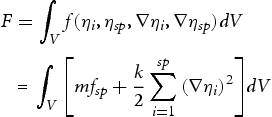

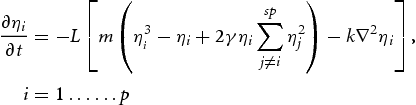
The evolution of these field variables can be described by the time-dependent Ginzburg-Landau kinetic equation given by the following [1]:

Parameter determination and model implementation
To ensure each field variable is spatially equivalent, the local free energy has one minimum equal to zero for all ηi
, and the gradient term is non-zero only at interfaces. Thus, the main requirement for the local free energy density is that it has p+1 minimum with an equal potential well depth at:

The spatial distribution law of local free energy as a function of grain and second-phase field variables with different coupling term coefficients is shown in Figure 1. As shown in Figure 1(a,b), the local free energy
The spatial distribution of local free energy
 cannot get the minimum value at
 when γ = 0.1 and γ = 0.2. That is, the free energy of the system cannot take values to equal-depth potential wells. When γ = 0.5 (as shown in Figure 1(c)), although the local free energy
 can take a minimum value at
 , the value is not unique. And when γ = 1.0, 1.5 and 2.0 (as shown in Figure 1(d–f)),
 can take only minimum value at
 . Thus, fsp
can meet the main requirement only when γ≥1.0.
. Thus, fsp
can meet the main requirement only when γ≥1.0.
 with different γ: (a) 0.1, (b) 0.2, (c) 0.5, (d) 1.0, (e) 1.5, (f) 2.0.
For simplicity, we assume that the grain boundary has the same interfacial properties as the interface between grains and the second-phase particles. In order to quantitatively discuss the interface properties, a simplified system which just contains one grain and one second-phase particle is constructed. We employed periodic boundary conditions and 128 × 128 square lattice points to spatially discretise, and the coupling term coefficient γ is set as 1.0, 1.5 and 2.0, respectively.
In Figure 2(a), the horizontal coordinate represents the distance between grain and second-phase particle, and the vertical coordinate depicts the value of the order parameter which varies between 0 and 1 at the interface. Although the two field variables value with three different coupling term coefficient distributions are symmetric about the centre line of the interface, the value of the field variable at the intersection point decreases from 0.46 to 0.57 as the coupling term coefficient increasing from 1.0–2.0, while the intersection point value is exactly 0.50 when γ = 1.5. As shown in Figure 2(b,c), the horizontal coordinate represents the value of the grain order parameter, while the vertical coordinate depicts the value of the second phase-order parameter. The value of the contour line is the local free energy density under the influence of η
1 and η
sp, and the local free energy density can reflect properties to a certain extent. All three sets of ridge line of the free energy density are coincident with η
1 = η
sp, which illustrates that the interface between the second phase and the grains is symmetrical. In addition, the slot line of the free energy density is coincident with η
1+η
sp = 1 when γ = 1.5, so it indicates that the sum of the order parameters at the interface is always equal to 1, which facilitates visualisation of the value of order parameters. And the interface is a completely symmetrical diffusion interface this time. Thus, the coupling term coefficient γ is always set as 1.5 in the next section.
Field variables and local free energy distribution at the interface: (a) the two field variables, (b) the
 , (c) the local free energy.
To solve Equation (5), it must also be discretised in time and space, in which the Laplacian is discretised by Equation (7):

 is the grid size, ξ denotes the nearest neighbour grid point of site i, and ζ represents the next-nearest neighbour grid point of site i. In addition, the explicit Euler equation is applied for discretisation in time, shown as Equation (8):

 is the time step for integration.
In this paper, the 256 × 256 square lattice points are employed to spatially discretise, and the periodic boundary conditions are applied in Cartesian coordinate axes. The unit grid size
 is 1 µm, and the time step
 is 0.1; The number of field variables p is assumed to be 36; The parameter of m in the local free energy is assumed to be 0.2. k and L are chosen to be 0.2 and 2.0, and all parameters are dimensionless. The initial value of all field variables and all grid points are assigned to be small random values, i.e. between −0.001 and 0.001, and it represents that the simulation started from a liquid phase then allowing grain growth.
Results and discussion
Validation for grain boundary topology evolution
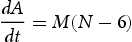
Grain growth is a diffusion process of interfacial migration, which manifests as a topological evolution of grain edge number. The rate at which the area decreases or increases during the evolution of grain growth is determined only by the grain variation and follows the Mullins-von Neumann law, i.e. the grains with the number of sides less than 6 gradually shrink and become smaller during the growth process, while the grains with the number of sides greater than 6 gradually grow up [36]:
In order to verify the reliability of the grain growth simulation results of this model, the initial grain topology without second-phase particle is employed to simulate its shrinkage topology evolution during the grain growth process. After the initial grain topology is formed (about 1000 time steps), and the grain structure evolution in the local area is saved for every 200 time steps. The topological evolution simulation during two-dimensional grain growth for grains which edge of less than 6 is shown in Figure 3. As shown in Figure 3(a–c), the 3-sided grain A gradually shrinking and finally disappear, and then form a grain boundary trijunction. And the experimental results are shown in Figure 3(d–f) of Ref. [37] are consistent with the simulated results.
Topological evolution during grain growth for 3-sided grain: (a)–(c) simulated results; (d)–(f) experimental results.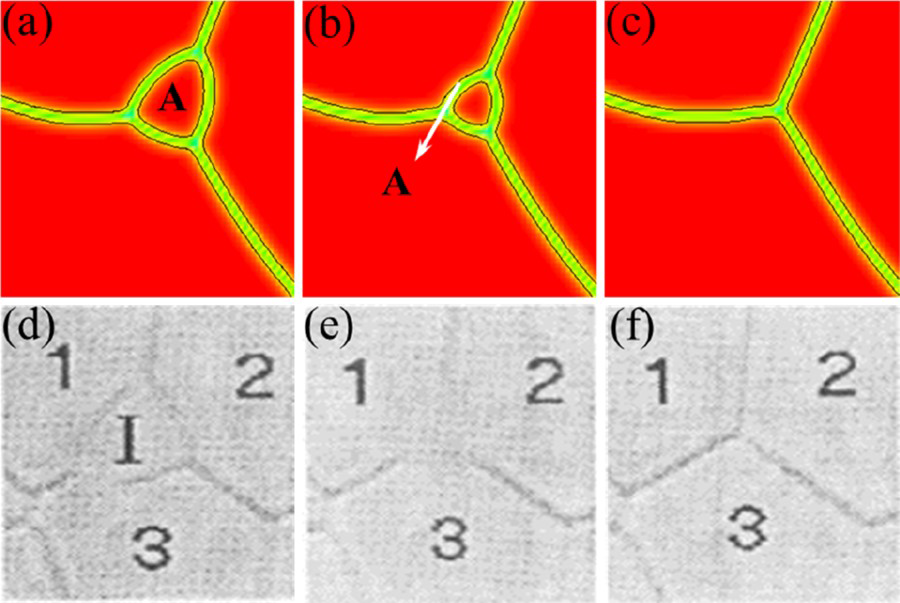
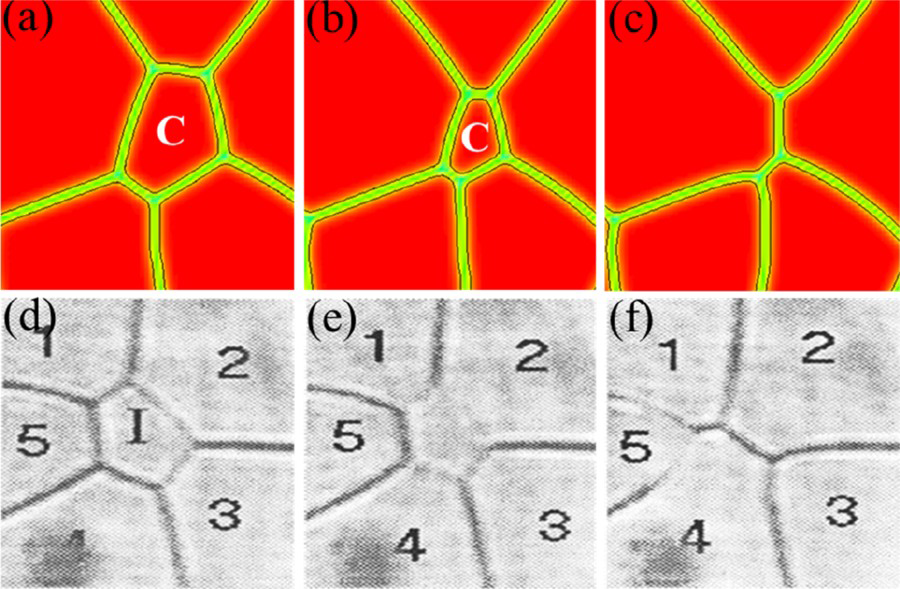
The 4-sided grain B and 5-sided grain C shown in Figures 4 and 5 will also directly disappear during the evolution process, rather than transforming to be 3-sided grain or 4-sided grain. Moreover, the two pairs trijunction in Regions I and II merge during the grain B gradually shrinking and move to the inverse direction immediately. It can well simulate the behaviour of forming two pairs of new trijunction due to high curvature grain boundaries during the 4-sided grains shrinking and disappearing [38].
Topological evolution during grain growth for 4-sided grain: (a)–(c) simulated results; (d)–(f) experimental results. Topological evolution during grain growth for 5-sided grain: (a)–(c) simulated results; (d)–(f) experimental results.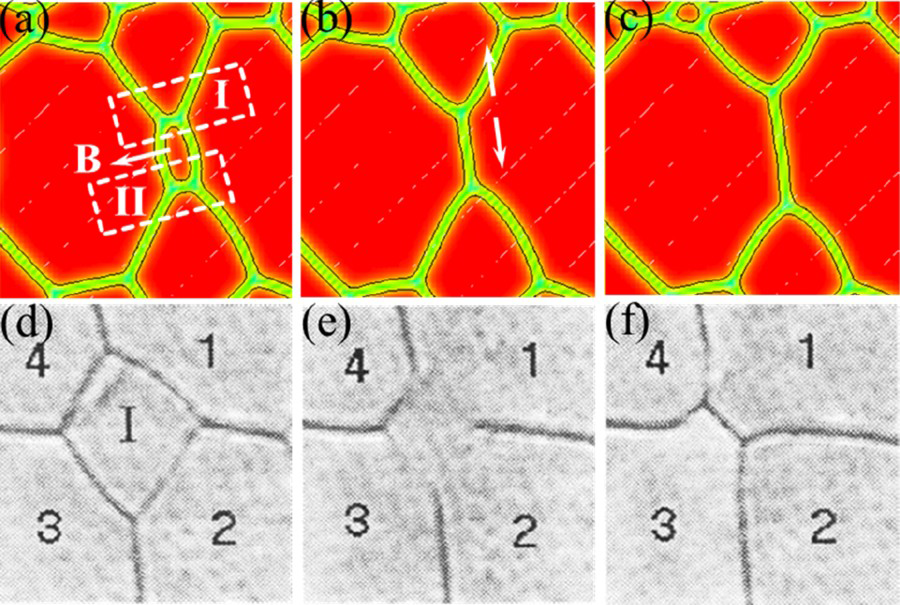
The evolution of four-grain junctions during grain growth is shown in Figure 6. According to its forming history, there are two categories: (1) Neighbour switching: As shown in Figure 6(a–d), grain boundary between Grain D and Grain E gradually disappears to be a four-grain junction, and then it splits into a new grain boundary and a pair of trijunction which move to inverse direction; (2) The four-grain junction shown in Figure 6(e–h) result from the shrinking and disappearing of 4-sided grain, and then also splits into a new grain boundary and a pair of trijunction which move to inverse direction; The simulation results above are in full compliance with the Mullins-von Neumann law, and are also in complete agreement with the experimental observation of succinonitrile (SCN) thin films [37].
The simulation of four-grain junction instability during grain growth: (a)–(d) neighbour switching, (e)–(h) four-grain junction split.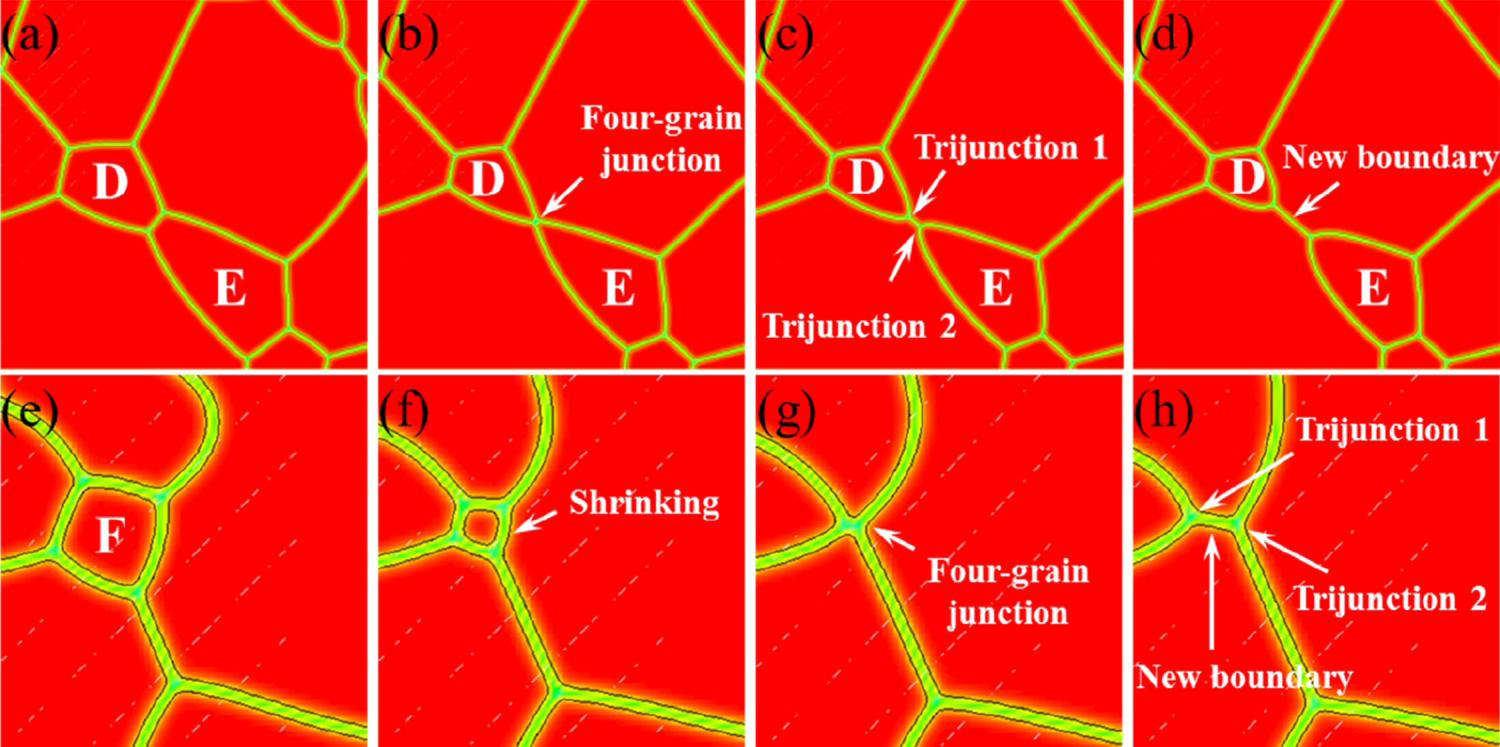
Effects of second-phase particle on grain growth
The morphology, size and distribution of second-phase particles in extruded AZ80 magnesium alloy are shown in Figure 7. The second-phase particles are mainly Mg17Al12 and their shape is irregular. The average equivalent radius of the second-phase particles r
sp = 1.46 µm and the volume fraction is the area percentage f
sp = 10.63%, in addition, more than 94.97% have a size distribution between 0 and 1.5 µm. From Figure 7(a), the distribution position of the second-phase particles has significant characteristics that almost all second-phase particles are distributed on grain boundaries. Thus, the effects of particle morphology, particle size and volume fraction on the grain growth are detailed in the next simulation, and the volume fractions are range from 0 to 12% while the equivalent radius range from 0 to 1.5 µm.
Microstructure of extruded AZ80 magnesium alloy: (a) SEM image, (b) size distribution of second-phase particles (solid line is the fitted Gaussian distribution).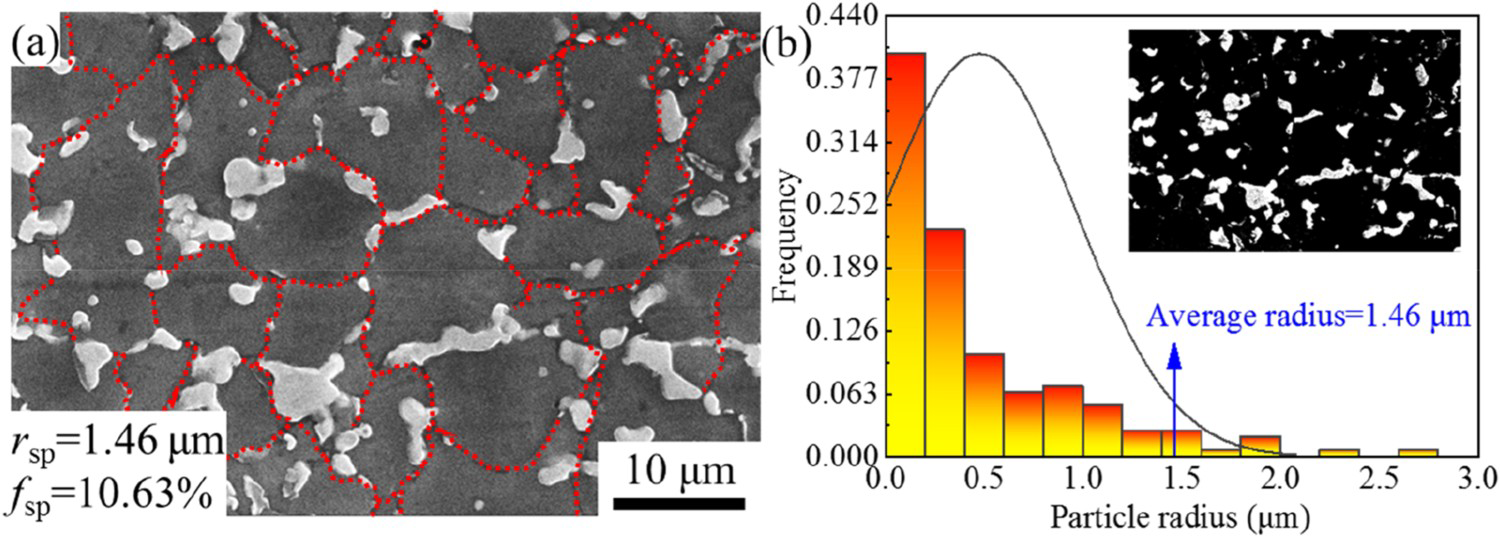
Effect of particle morphology
In order to investigate the effect of particle morphology on grain growth, the round particle and rectangular particle are placed in the same initial grain structure as shown in Figure 8, in which the initial average grain diameter is 21 µm (as shown in Figure 8(a)). As shown in Figure 8(b,c), the radium of round particle is 1.00 µm while the equivalent radium of a rectangular particle is 0.99 µm (length = 3.10 µm, width = 1.00 µm), so we approximate that the equivalent radium of round particle and rectangular particle are equal. The volume fraction of second-phase particle in Figure 8(b,c) are all equal to 0.2%, where the volume fraction is the ratio of the total area of the second-phase particles to that of simulated region.
Initial grain structure topology: (a) without second-phase, (b) with round particles, (c) with rectangular particles.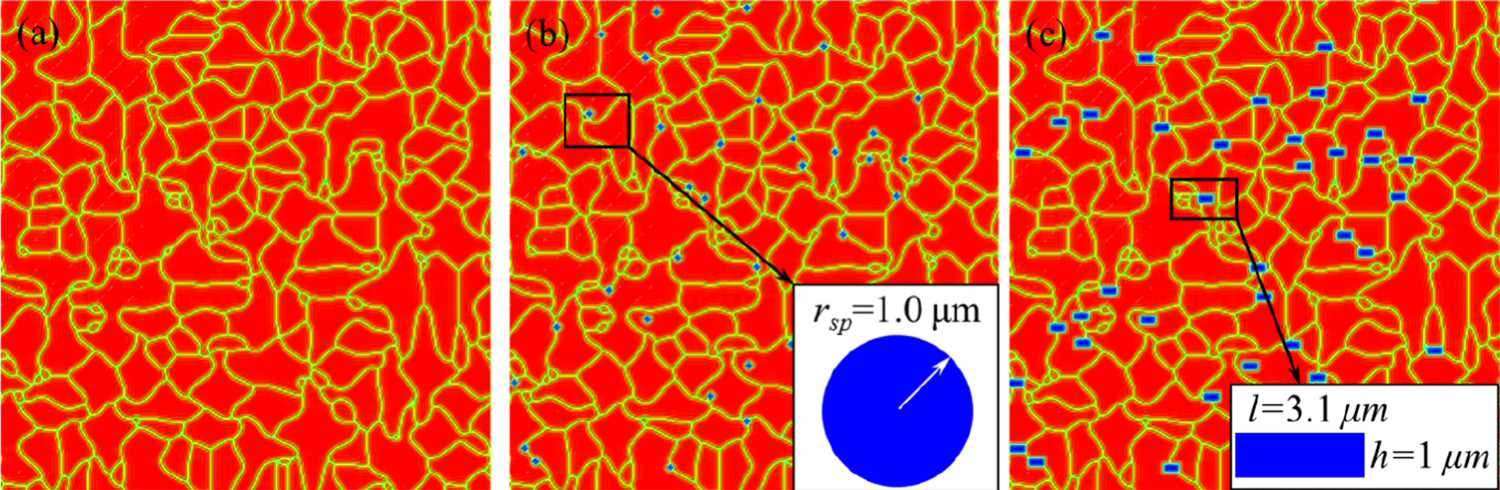
The average grain size evolution of initial topology with different particle morphology is shown in Figure 9(a), and the results show that the three sets of curves have the same overall trend in which the average grain size gradually grows to a certain size and remains stable, no matter whether containing second-phase particles and no matter what morphology. And then, the stable average grain size without the second-phase particles is 26.7 µm which is coarser than that with particles. It can be attributed to the pinning effect of second-phase particles on grain boundaries. As shown in Figure 9(b,c), the second-phase particles could drag the grain boundaries, resulting in reduced grain boundary migration. In addition, the stable average grain size with rod particles is 24.8 µm which is finer than that with round particles of 26.3 µm. It demonstrates that rod particles have stronger pinning effect on grain boundaries, and it is consistent with the experimental results of Ringer on the pinning effect of TiN rod-like second-phase particles on grain boundaries [39].
Topology evolution with different particle morphology: (a) average grain size evolution, (b) round particles pinning grain boundaries, (c) rectangular particles pinning grain boundaries.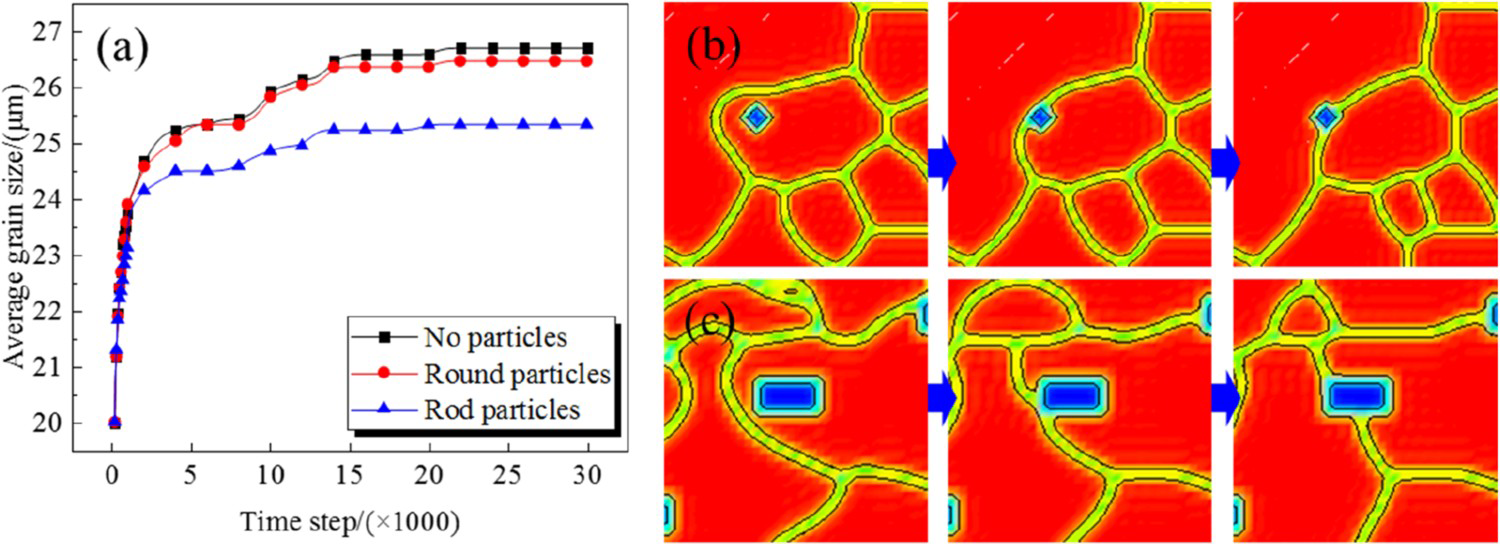
Effect of particle size
Considering that most of the second-phase morphology in the alloy is dominated by round particles, the round particles are mainly studied in the next section. The round particles with the same volume fraction of 0.2% and different equivalent radii of 0, 0.5, 1.0 and 1.5 µm are placed in the same initial structure as shown in Figure 10(a–d), and the corresponding stable microstructure after grain growth are shown in Figure 10(e–h). Almost all particles are located at grain boundaries when particle radium is 1.0 and 1.5 µm, while many particles are located inside grain when particle radium is 0.5 µm. That is, the grain boundaries surrounding the small radius particles are prone to de-pinning.
Topological structure evolution with different radius round particles: (a)–(d) initial topological structure, (e)–(h) stable structure after the evolution of time step 30,000.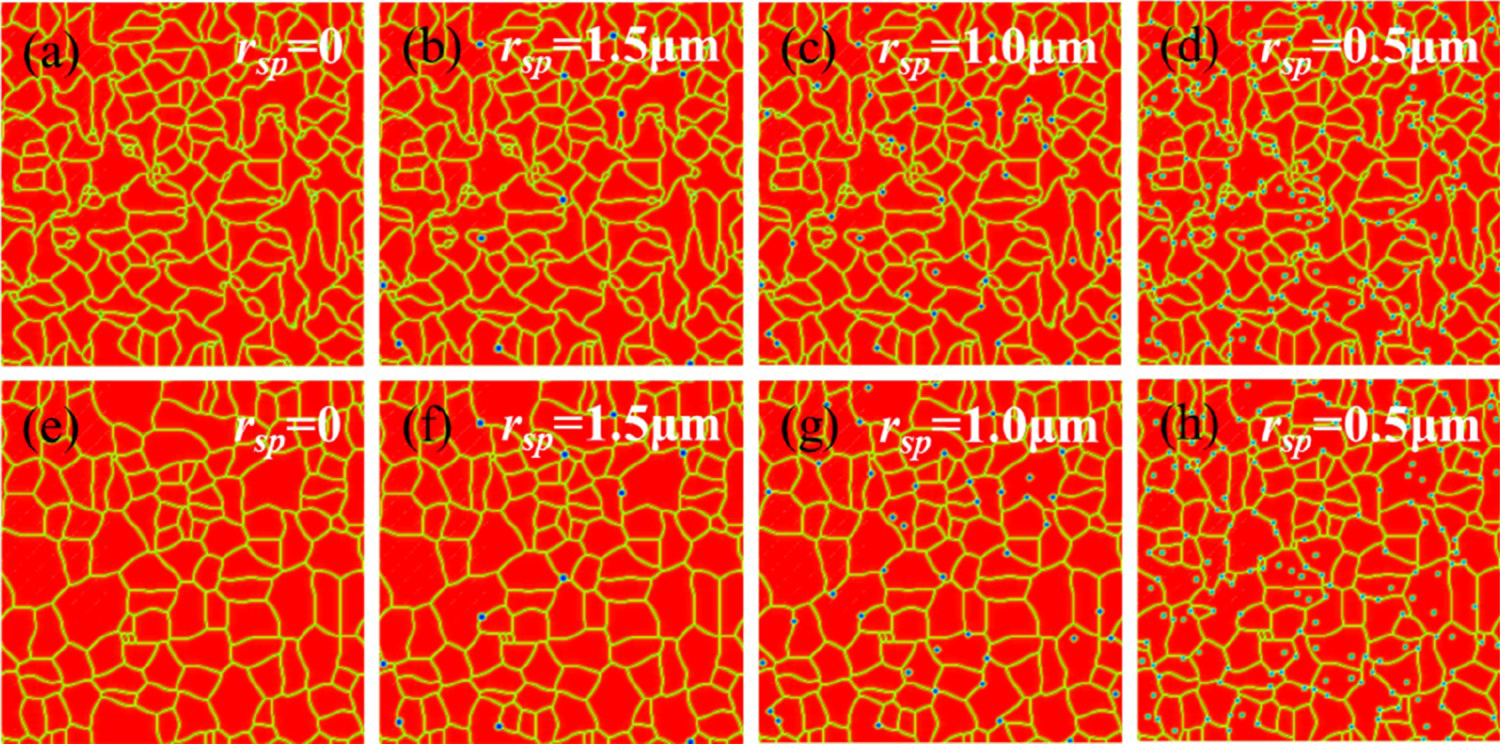
This is because when the second-phase particles pin the grain boundaries, the grain boundaries may be replaced by the particle interface, resulting in smaller grain boundary energy. The grain boundary energy does not decrease significantly for the grain boundaries replaced by small-sized particle interface, while it has a greater reduction for that replaced by coarser particles. However, the internal evolution motivation comes from the reduction of the system free energy. Thus, when the free energy is reduced to exceed the energy required for the grain boundary to de-pin particles, it is possible for the grain boundary to break away from the pinning effect of particles, i.e. the pinning effect of the coarser particles is more pronounced. In addition, the stable structure after evolution with an initial microstructure containing more dispersed particles is more uniform. It can be attributed to that the number of pinned grain boundaries is limited when the equivalent particle radius is coarser, and the pinning effect on the grain boundaries is also limited.
It can be seen from Figure 10(a–d) that the grain structures in the four initial topologies are the same, and the initial average grain size is 20 µm. Since the volume fraction is the same, the second-phase particles are more dispersed for a smaller equivalent radius. As shown in Figure 11(a), the average grain size of the initial topology with particle radius of 0, 1.5, 1.0 and 0.5 µm gradually increases with time step increasing, and they are 26.7, 26.4, 26.2 and 24.8 µm after evolution to stability (as shown in Figure 11(b)), respectively. It demonstrates that the more dispersed second-phase particles placed in initial structure, the smaller the average grain size after grain growth. In addition, the average grain size quickly tends to a stable value when rsp
= 0.5 µm (about 10,000 steps) while a longer time were taken when rsp
= 1.5 and 1.0 µm (about 15,000 steps). It can be attributed to the high dispersion of particles promotes the pinning effect, resulting in restricted movement of grain boundaries, and the microstructure evolution quickly reaches a steady state. Therefore, the pinning effect of the dispersed particles on the grain boundary is more obvious, and the grain growth and merger in the topological structure are slower.
The average grain size evolution of topological structure with different particle radius: (a) grain size evolution, (b) average grain size after evolution.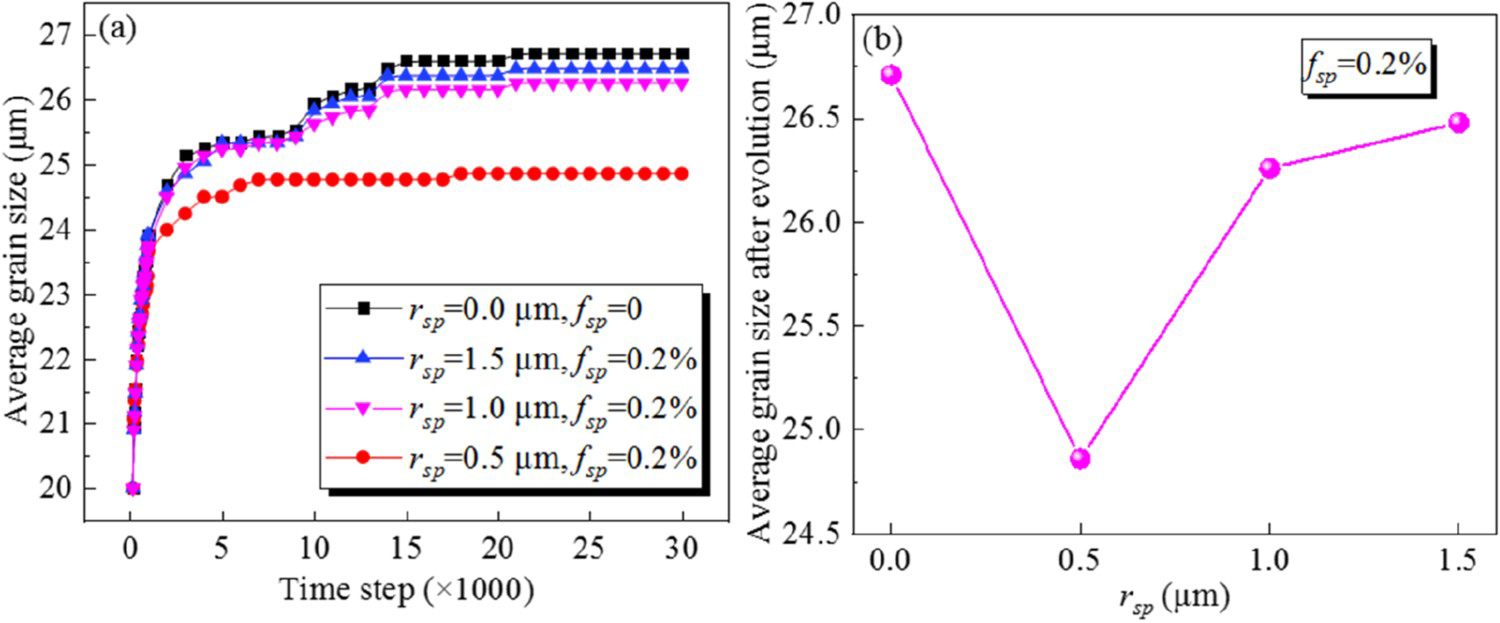
Effect of particle volume fraction
Actually, besides the equivalent particle radius, the volume fraction also plays important role in the topological structure evolution. The round particles with volume fraction of 1.5%, 3.0%, 6.0% and 12.0% and a radius of 3.0 µm are placed in the same initial grain structure, and the stable structure after grain growth are shown in Figure 12(a–d), respectively. It can be seen that a more uniform and finer structure can be obtained for the initial structure placed particles with a volume fraction of 12.0%. Because more grain boundaries can be pinned when more particles are placed in the structure, the pinning effect is also stronger.
Topological structure evolution with particles of different volume fraction: (a) 1.5%, (b) 3.0%, (c) 6.0%, (d) 12.0%, and the (e) grain size evolution.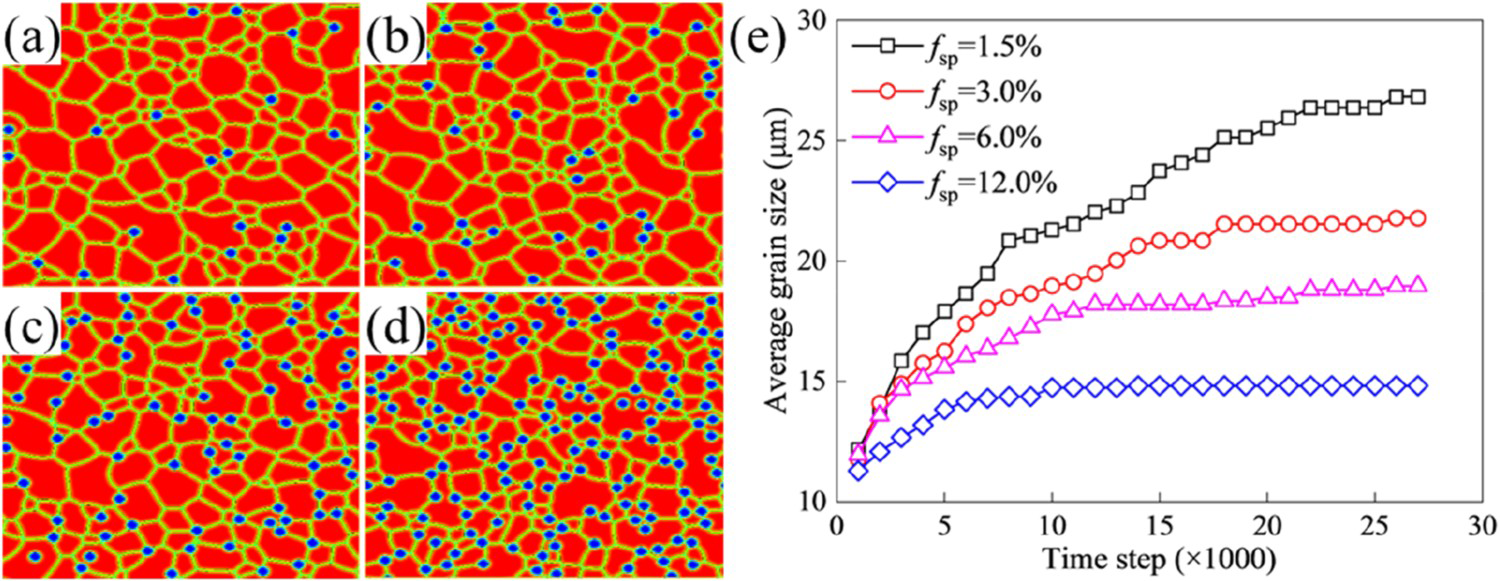
The average grain size evolution of the initial topology containing particles with different volume fractions is shown in Figure 12(e). It can be seen that the average grain size gradually becomes coarser with time step and that four groups with particles are finer than that without particles. After the evolution of grain growth, the average grain size is 29.5, 21.8, 19.3 and 14.8 µm (as shown in Figure 12(e)) for the four groups with volume fractions of 1.5%, 3.0%, 6.0% and 12.0%, respectively. That is, the higher the volume fraction of the second-phase particles, the smaller the average grain size after grain growth. In addition, the average grain size tends to stable more quickly when fsp = 12.0%, because the grain boundaries in the system are rapidly pinned by a large number of second-phase particles.
Generalised Zener relation
Normal grain growth would be completely inhibited when the grain size reached a critical maximum grain radius R
lim given by:
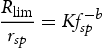
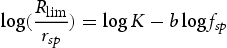
The simulated data obtained in Section 4.2.3 was substituted into Equation (11), and perform a linear fit to the data points. The fitted slope and intercept are b and log K, and then obtained the b = 0.322 and K = 2.49, respectively. The generalised Zener relations in this paper were plotted in Figure 13. Smith and Zener proposed an equation for grain growth in a system containing a random dispersion of rigid, immobile particles of radius. Under the Smith-Zener assumptions, K = 4/3, and b = 1 [30]. Thus, the simulation results here show that the b is far different from 1 (classical Zener relations). The discrepancy between these results and classical value can attribute to the grain boundaries and the distribution of the second phase. However, the results are in good agreement with some experimental and theoretical simulation results. For example, the Monte Carlo simulations on the two-dimensional polycrystalline systems containing second-phase particles show that the K = 1.7 and the b = 0.5 [40]. In addition, the K = 1.7 and the b = 0.56 were obtained on the grain growth in aluminium alloy thin films [41]. The discrepancy of K and b between these studies and our investigation could attributed the different particle distribution locations. That is, in our investigation, particles mainly distributed on grain boundaries rather than distributed interior grains or randomly distributed in whole simulated area. Therefore, the phase field model predicts the inhibition of second-phase particles distributed at the grain boundaries on the grain growth with certain accuracy.
Zener relations in Section 4.2.3, classical Zener relation, Al alloy thin films and Monte Carlo simulation.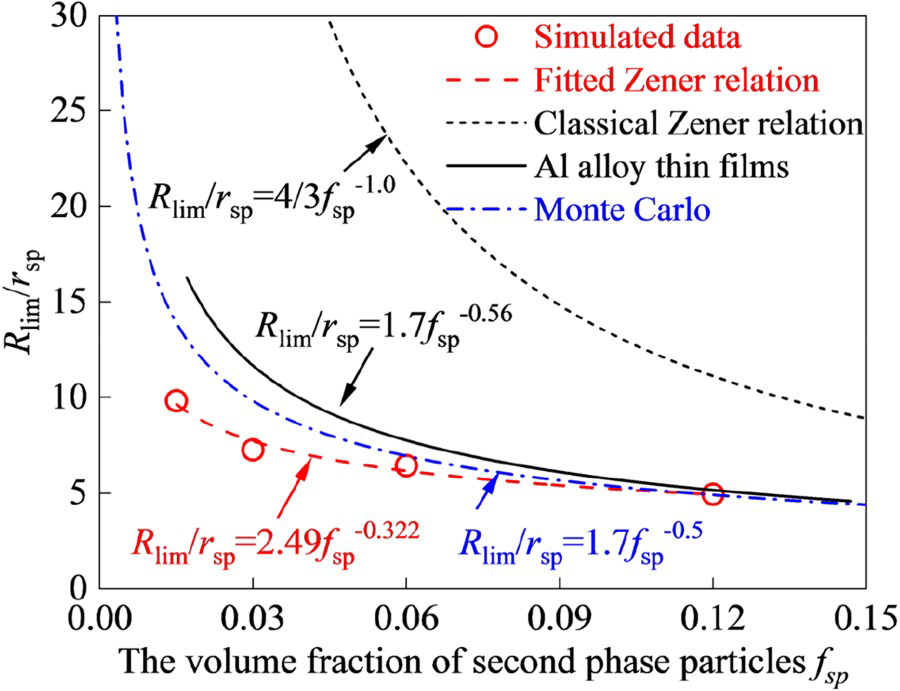
Conclusions
For accurately depicting the immobile second-phase particles distribute at grain boundaries, a modified phase field model was adopted to analysed its pinning effect on polycrystalline grain growth. And for providing a series of potential wells with equal depth of the local free energy density and obtaining symmetrical interfaces, the coupling term coefficient was determined to be 1.5 during the construction of the free energy density function. According to the size and distribution characteristics of second-phase particles in extruded AZ80 magnesium alloy, the effects of the particle morphology, particle size and volume fraction on the grain growth were investigated, and the results show that small-sized rod high-dispersion particle exhibit a stronger pinning effect on grain boundary migration. When most particles are located on grain boundaries, the classical Zener relation no longer applies anymore, and the generalised Zener relation of R
lim = 2.49r
sp/f
sp−0.322 was obtained. The discrepancy between the generalised one and classical value can attribute to the grain boundaries and the distribution of the second phase, and the phase field model predicts the inhibition of second-phase particles distributed at the grain boundaries on the grain growth with certain accuracy.
Footnotes
Disclosure statement
No potential conflict of interest was reported by the author(s).