







Abstract
The effective plastic strain is a commonly used damage variable within continuum damage framework. The value of effective plastic strain at fracture, however, depends on strain rate, temperature and strain path. An alternate state variable is proposed in this work that can provide a unique path-independent2 fracture locus. The average dislocation density is a microstructure-based state variable and has been established in the past to describe the constitutive behaviour of plastic deformation. It is demonstrated that when the average dislocation density is used to model fracture initiation, the fracture locus is unique over a range of strain rates, unlike the conventionally used fracture strain.
Ductile fracture in metallic materials beyond large plastic deformation is due to the growth and coalescence of voids that are either present and/or nucleated during deformation [1,2]. Following the classical work of McClintock [3] and Rice and Tracey [4], Gurson [5] modelled void growth during plastic deformation (through yield criterion) and related a critical volume fraction of void to ductile fracture. The Gurson yield criterion was subsequently modified by many, e.g. [6-10], notably by Tvergaard and Needleman [10] and is referred to as porous plasticity models. An alternate approach to model damage phenomenologically follows the early work of Kachanov [11] and Rabotnov [12], where a damage variable evolves with plastic deformation and failure occurs when the variable reaches a critical value. In the approach known as continuum damage mechanics (CDM), the variable is a scalar for isotropic damage when the void distribution and growth can be assumed to be uniform in the entire material or a tensor if the damage evolution is anisotropic 1 [13]. Both the approaches couple the damage evolution with the constitutive behaviour of the material. In the latter approach, when elastic strain is used to homogenise the effective load-bearing area, the damage evolution is accompanied by the loss of elastic modulus. Lemaitre [14] succinctly showed that ignoring elastic deformation, ductile plastic damage under proportional loading can be expressed as a function of deformation state (stress and strain). Such damage models are uniquely related to the deformation state without affecting the constitutive description 2 and are referred to as uncoupled damage models. The rest of the manuscript focuses only on uncoupled fracture criterion and hence ‘uncoupled’ shall be omitted in the description.
Many early models [15,16] that describe effective fracture strain (for damage) as a continuous function of stress triaxiality were found to be ineffective when applied to a wider range of stress triaxiality [17]. Based on systematic experimental studies, Bao and Wierzbicki developed a fracture locus [18] which had discontinuities depending upon the mode of fracture. They proposed a stepped function for fracture strain as a function of triaxiality. However, as the stress triaxiality cannot uniquely refer to the stress state, this led to discrepancies especially in fracture under shear [19,20]. Most of the subsequent development [21-24] accommodated this by including the third invariant of stress tensor through Lode angle parameter.
In general, the fracture models attempt to express the damage as a function of effective plastic strain
 , which is associated with the total deformation. The effective plastic strain at fracture is, however, not unique
3
and it has been demonstrated recently that the fracture locus is path dependent [25]. The variation of fracture locus with strain rate and temperature is well known and has been accommodated in the early work such as Johnson–Cook model [16]. If the fracture locus can be represented in terms of an alternate path-independent state variable, it is possible to obtain a unique fracture locus. It is envisaged to explore such a possibility in the current work, using the microstructural parameter, namely, the dislocation density, through the framework of the classical Kocks–Mecking–Estrin (KME) model.
, which is associated with the total deformation. The effective plastic strain at fracture is, however, not unique
3
and it has been demonstrated recently that the fracture locus is path dependent [25]. The variation of fracture locus with strain rate and temperature is well known and has been accommodated in the early work such as Johnson–Cook model [16]. If the fracture locus can be represented in terms of an alternate path-independent state variable, it is possible to obtain a unique fracture locus. It is envisaged to explore such a possibility in the current work, using the microstructural parameter, namely, the dislocation density, through the framework of the classical Kocks–Mecking–Estrin (KME) model.
The dislocation density-based model of KME is a mechanical state-based constitutive model which is used widely to characterise the thermally activated plastic deformation behaviour of metals. The average dislocation density is used as a state variable to describe the deformation state uniquely. The expression for strain rate-dependent flow stress is given as
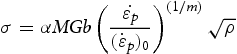
The evolution of dislocation density ρ with plastic strain
 which dictates the hardening behaviour of a material is described by
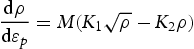
 and
and
 are material constants associated with the storage and annihilation of dislocations, respectively. The dislocation annihilation reflects the stage III hardening due to thermal activation. As a result,
 is influenced by both temperature and strain rate.
Equation (2) can be integrated within appropriate limits to obtain a closed-form expression for dislocation density as a function of plastic strain as

 is the initial dislocation density at the onset of yielding (
 ) and can be related to the yield stress
 through Equation (1) as
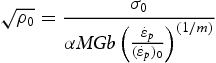
 can be considered a constant (say r) for a particular plastic strain rate, assuming the constancy of the strain rate sensitivity parameter m over the entire range of plastic strain.
Efforts to incorporate dislocation density as a parameter in ductile damage models, especially coupled ones have been reported in the literature [26-30]. In most of the cases, however, the role of dislocation density was limited to describing the strain hardening behaviour.
The dislocation density in the KME model is an average value of the in-homogeneously distributed dislocations. A pertinent question is whether this average measure could be used to model the local phenomenon such as fracture. Few attempts [29,30] have been made to correlate the void nucleation to dislocation density evolution. In the above cited work, the void nucleation was also related to other variables such as temperature and strain rate. Therefore, the localisation was not uniquely related to the dislocation density.
The closest attempt in this direction can be attributed to that of Yasnikov et al. [31], where the onset of plastic instability was related to dislocation density. They showed that the onset of geometric instability during a uniaxial tensile test following Considère criterion is a natural consequence of the evolution of dislocation density during plastic deformation. In a subsequent work [32], they observed excellent agreement between the predictions of plastic strain at the onset of instability by the KME model with that of the experimental data in nickel polycrystal specimen over a range of grain sizes.
 ) can therefore be related to a corresponding value of dislocation density through the KME model using Equation (3). This value of dislocation density at plastic instability is referred to as critical dislocation density
 and can be derived as shown below.
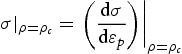

 on the right-hand side can be obtained by differentiating Equation (1) with respect to ρ. The second term
 can be substituted from Equation (2).
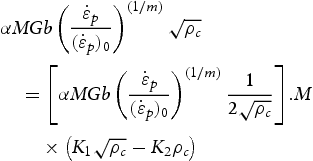
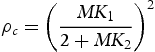
 . The intersection point of the plots of true stress versus plastic strain (
 ) and that of the hardening rate versus plastic strain
 gives us the value of the critical plastic strain at onset of instability
 . The value of
 can then be substituted into Equation (3) to arrive at the value of
 as follows:
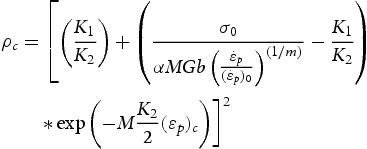
 ,
,
 ,
,
 and the ratio
 for each case. These constants are listed in Table 1. The values of material constants α, M, G and b are taken from the literature [34].
Dislocation density parameters obtained for the material DP800 corresponding to the different strain rates ( , M = 3, G = 80, 000 MPa, ).
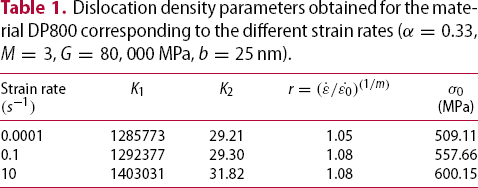


Figure 1(a) shows the comparative plots of true stress versus true plastic strain up to the onset of plastic instability. The evolution of dislocation density with true stress is plotted in Figure 1(b). It is interesting to observe that while the values of the plastic strain at onset of instability vary with strain rate, the corresponding values of critical dislocation density converge to a single unique value. It is logical to expect that a material-specific critical dislocation density can be obtained independent of deformation temperature too.
Plots of (a) true stress versus true plastic strain and (b) true stress versus dislocation density, up to the point of onset of plastic instability for different strain rates.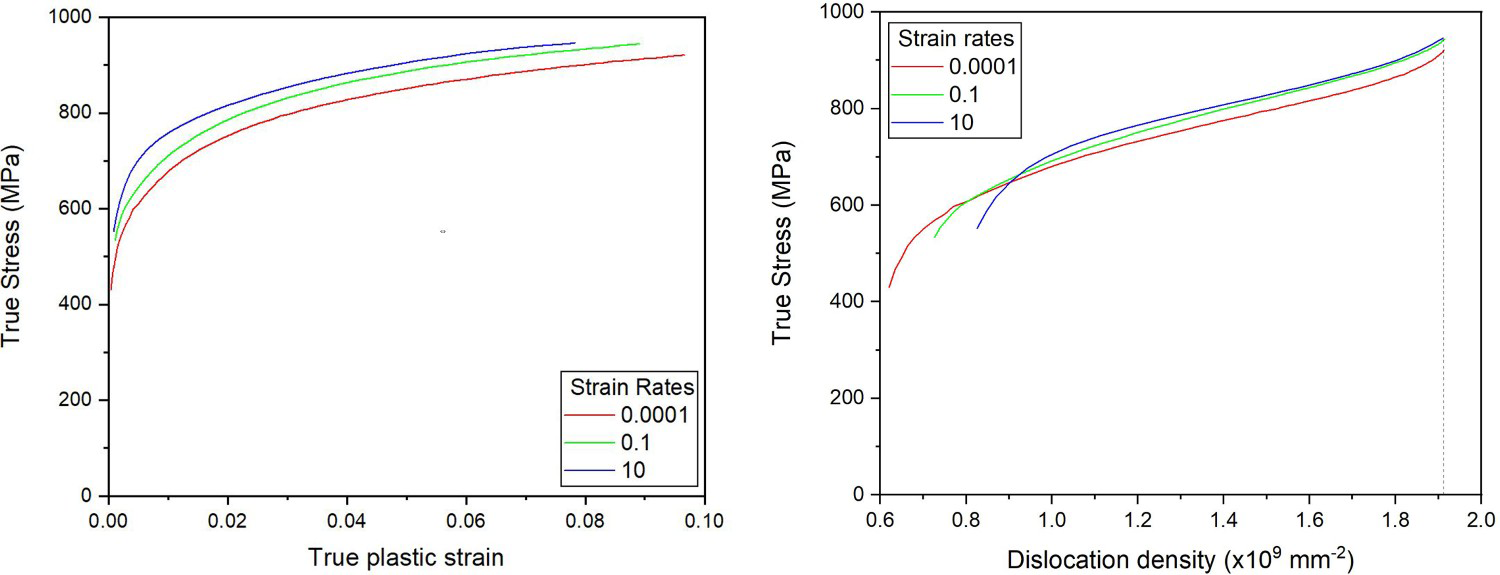
In a recent work [35], the authors have demonstrated that the dislocation density can be related to formability characterised by local necking. The objective of this study is to look at the possibility of obtaining a unique fracture locus using dislocation density as a variable. In other words, the possibility of extending the hypothesis illustrated previously for the onset of uniaxial plastic instability to ductile fracture initiation is explored. To demonstrate this, it is planned to adapt the existing Bao–Wierzbicki (BW) ductile damage model [17,18] to the space of dislocation density, i.e. the fracture loci at different strain rates are plotted in the dislocation density versus stress triaxiality space. A relatively simple BW model where fracture strain is a function of a single stress-state variable is chosen for the purpose. It has been well established through advanced models that the fracture strain is also a function of a second stress-state variable, Lode angle. It will be of interest to investigate the correlation between dislocation density and Lode angle. Extending the present work, it is planned to study the evolution of 3D fracture locus between dislocation density, stress triaxiality and Lode angle in the future. Similarly, if the rate-dependent fracture loci can be shown to converge into a unique locus, it is assumed that similar uniqueness can be obtained for temperature and change in strain path, at least within a certain range.
BW model [18,36] characterises the fracture behaviour of materials through a fracture locus in the space of effective plastic strain to fracture and stress triaxiality. The fracture envelope consists of three regions corresponding to different modes of fracture, and can be represented by the following functional expression [36,37]:
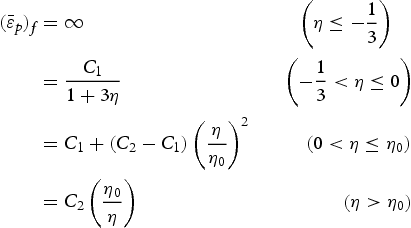
 is the effective plastic strain to fracture,
 is equal to
 in pure shear and
 is equal to
 in uniaxial tension.
 is the average value of triaxiality in an uniaxial tensile test and is taken to be equal to 0.4 [18]. In the absence of pure shear data, the constant
 can be determined from the constant
 corresponding to uniaxial data through the relation,
 , n is the strain hardening coefficient obtained by fitting the Hollomon relation
 to the true stress versus true plastic strain curve obtained from uniaxial tensile test. A family of fracture loci for multiple strain rates can therefore be generated based on the values of effective plastic strain to fracture at tensile and/or pure shear conditions, at different strain rates.
The BW fracture loci are plotted in the space of plastic strain versus stress triaxiality for the three strain rates, using the data of uniaxial plastic strain to fracture [33]. The plot is shown in Figure 2(a). It is observed that the fracture loci are distinct for each strain rate. Using Equation (3), the dislocation density corresponding to the fracture strain over the entire locus is calculated. The adaptation of the BW plots in terms of dislocation density is shown in Figure 2(b). It can be observed that the three loci corresponding to the three different strain rates converge into a single plot. This demonstrates the potential of dislocation density as a path-independent damage variable for use in uncoupled damage models. Since the state variable is also used to describe the strain hardening behaviour, the present approach acts as a bridge between coupled and uncoupled fracture models. The coupling here is weak, as the fracture loci are still estimated from fracture strain and converted to equivalent dislocation density. Nevertheless, the approach provides an opportunity for a unified phenomenological model to characterise continuum damage.
BW plot in (a) plastic strain space and (b) dislocation density space.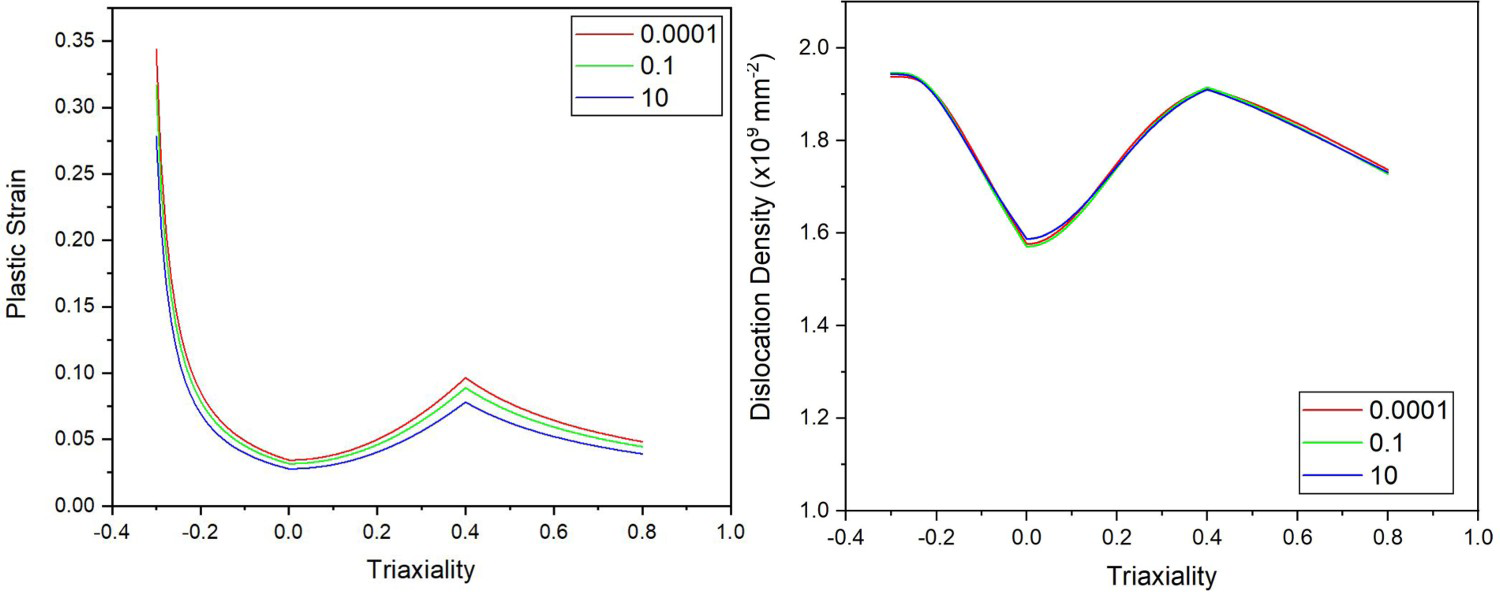
It has been shown for the first time the possibility of obtaining a unique fracture locus using dislocation density as a damage variable. This was achieved by suitably adapting the existing ductile damage model of BW in terms of dislocation density. It points to the possible existence of a critical value of dislocation density that is characteristic of a material condition, which can indicate damage for multiple strain rates. Future work is planned to evaluate the uniqueness of the fracture locus over varying loading conditions (stress triaxiality and Lode angle), strain paths, strain rates and temperatures. The conclusions drawn would also be verified over a range of metallic materials.
Footnotes
Disclosure statement
No potential conflict of interest was reported by the author(s).
1
By equating similar traction forces on a fictitious undamaged material, the damage variable assumes a second-order tensor, whereas equating the elastic limit strain (Young's modulus) would result in fourth-order or eighth-order tensor.
2
The constitutive description here represents the stress and strain tensors computed based on net area of cross section ignoring any reduction in area due to damage.
3
Even when the stress state is uniquely represented using stress triaxiality and Lode angle parameter, is not unique.
