







Abstract
The present paper focuses on the underlying principles of the effect of S-phase on reducing hydrogen embrittlement susceptibility. Hydrogen permeation test indicates that S-phase formed by low-temperature carburising has minor effect on hydrogen diffusion. Moreover, hydrogen-induced phase transformation caused by hydrogen charging is suppressed in the presence of S-phase. The kernel average misorientation result indicates that lattice distortion introduced by hydrogen charging is suppressed in the presence of S-phase. Cross-sectional EBSD investigations on the surface layer of fractured samples show that S-phase remains extremely stable during tensile deformation after hydrogen charging.
Introduction
The most commonly used materials for hydrogen storage and transportation are austenitic stainless steels (ASS) due to their low susceptibility to hydrogen embrittlement (HE). The high cost of nickel and molybdenum in stable AISI 316L makes metastable AISI 304 much more favoured in hydrogen application. However, the fcc γ-austenite to bcc α′-martensite transformation of metastable ASS during service in hydrogen existing environments can greatly increase its susceptibility to HE [1].
Although the atomistic processes of HE are not fully understood yet, it is common sense that hydrogen enters the metallic structure via surface or near surface processes such as adsorption, dissociation, absorption and diffusion. Therefore, it is appropriate to introduce surface treatment on metastable ASS to prevent the underlying metallic structure from HE [2]. One of the most promising candidates for the hydrogen permeation barrier in iron-based alloys are nitrided or carburised layers introduced via low-temperature plasma treatment [3-5]. Through low-temperature plasma nitriding or carburising treatments, interstitially super-saturated austenite called ‘S-phase’ are formed on the outer surface of metallic structure. S-phase is a metastable, precipitate free, interstitial super-saturated, super-hard ‘expanded austenite’, which can be formed at low temperatures by introducing interstitials (such as N and C, or both) into an FCC structured substrate. S-phase can enhance the mechanical properties of ASS, such as hardness, wear resistance and fatigue properties [6,7], and even better corrosion resistance in some cases due to the absence of carbides or nitrides [8,9].
Some results on the improved HE resistance owing to nitriding and nitro-carburising are reported and most of these works emphasise the effect of the S-phase layers on the hydrogen entry and transport [10-12] and the mechanical properties of the S-phase layers [13] on the effect of hydrogen. In our previous study [14], slow strain-rate tensile tests and fractographic investigations shows that S-phase has promising effects on reducing the tensile properties degradation caused by hydrogen. However, there is a lack of evidence on the related principles of the S-phase effect on HE susceptibility in metastable ASS such as compressive stress, austenite stability and hydrogen diffusivity, which is of crucial importance to provide a basic guideline for the practical application of low-temperature plasma carburised 304 stainless steel in hydrogen industrial.
In the present paper, the underlying principles of the effect of S-phase on HE are further studied by series of experiments including hydrogen permeation test and electron backscattered diffraction (EBSD) microstructural analysis.
Materials and methods
The materials studied in this paper were commercial cold-rolled AISI 304 ASS plate with a thickness of 1.4 mm. All test samples were first annealed at 950°C for 0.5 h followed by water quenching then polished and washed in soapy water. EBSD measurements were used to characterise the phase and lattice misorientation information.
The plasma carburising treatment was conducted using a 60 kW Klöckner DC plasma vacuum unit at 500°C for 10 h in a 400 Pa gas mixture of 1.5% CH4 + 98.5% H2. Hydrogen electrochemically charging was conducted on both the as-receive samples and plasma carburised (PC) samples in an aqueous solution of 0.1 M NaOH containing 4 g L−1 thiourea at a current density of 50 mA cm−2 for 24 h at 80°C.
Transient and steady-state fluxes of hydrogen were measured for as-received and carburised membranes with a thickness of 0.5 mm using a gas phase permeation instrument. The upstream side of the tested membrane was filled with pure hydrogen at constant pressure of 4 bar and temperature of 300°C. H2 permeation data were measured as a function of downstream H2 gas flow across the membrane versus time by a quadrupole mass spectrometer.
Results and discussion
Some results about the improved HE resistance attributed to nitriding and nitro-carburising are reported [10-13] and most of these works state that S-phase strongly decreased the hydrogen diffusion rate by one to three orders by impeding both hydrogen entry (surface effect) and transport (barrier effect). Contradictory to these results, our previous fractographic investigations [14] show that after electrochemically hydrogen charging, the near-surface fracture morphology of both as-received and PC samples changed from ductile microvoid coalescence to quasi-cleavage. The thickness of the ‘hydrogen-affected’ regions is the same for as-received and PC samples indicating that the hydrogen diffusing distance do not change after carburising treatment. Therefore, hydrogen permeation test are performed to further explore the effect of carburised layer on the hydrogen diffusion. The plots of H2 partial pressure versus time and the calculated hydrogen diffusion coefficient for as-received and PC samples are as shown in Figure 1. The earlier rapid increase and higher steady-state permeation rate of as-received membrane compared to PC membrane indicate that it takes more time for the hydrogen to diffuse across the membrane on the existence of the S-phase layer. However, there are little distinction between the calculated hydrogen diffusion coefficients for as-received and PC samples compared to those mentioned in studies [10-13]. This is consistent with our previous fractographic investigations [14] that the hydrogen diffusivity is not affected much by the S-phase. It is rational that the interstitial dilution of N and/or C atoms reduce the diffusion rate of hydrogen considering that interstitial sites are blocked and hydrogen can be trapped in the nitride and carbon precipitates [8,9], However, in our work, by low-temperature carburising, the formation of carbon precipitates is suppressed and no carbon precipitates are detected by XRD which accounts for the minor effect of S-phase on reducing hydrogen diffusion. Therefore, the promising effect of S-phase on HE can only be partially attributed to its effect on reducing hydrogen diffusion.
Plots of H2 partial pressure versus time for as-received and PC samples.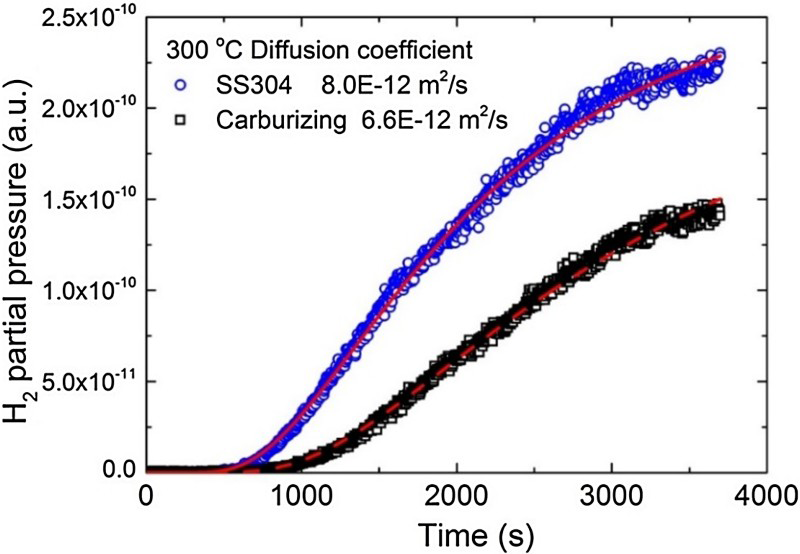
Another important factor that contributes to the improved HE resistance is that the addition of C atoms stabilises the austenitic structure. Figure 2 shows the ‘in situ’ phase distribution on the surface of the as-received and PC samples before and after hydrogen charging and the corresponding kernel average misorientation (KAM) results. After hydrogen charging, evident martensite transformation occurs in the as-received sample (Figure 2(b)). In contrast, no martensite is observed in the PC sample after hydrogen charging comparing Figure 2(c) and (d). It is thus concluded that carbon interstitials suppress the hydrogen-induced phase transformation.
EBSD characterisation of the phase distribution on the surface of (a) as-received, (b) charged as-received, (c) plasma carburised, (d) charged PC samples with α′-martensite marked as green, austenite marked as white and ε-martensite marked as blue. KAM of (e) as-received, (f) hydrogenated, (g) carburised, (h) hydrogenated PC samples.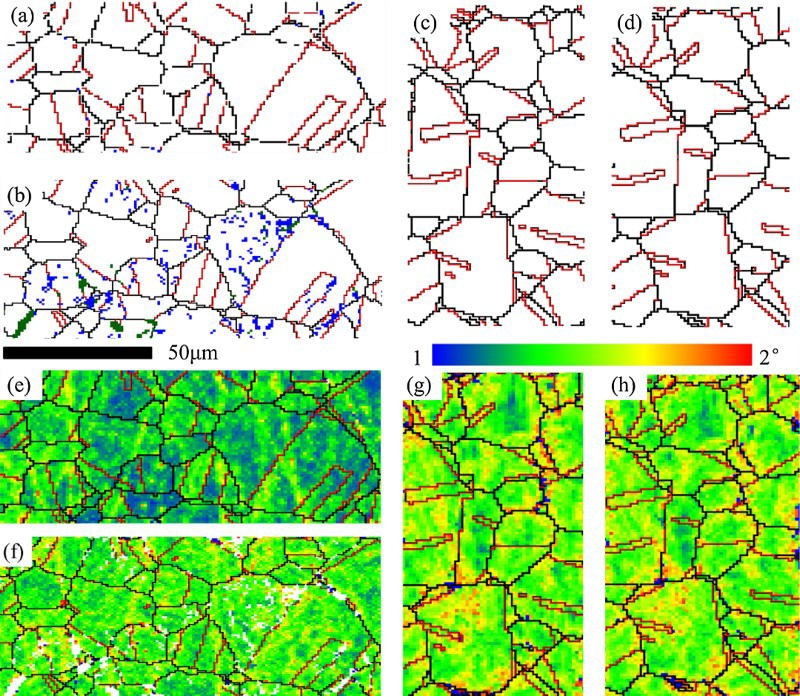
The introduction of H or C atoms can result in the expansion of lattice causing local lattice distortion in the austenite substrate. These local lattice distortions are usually very small and corresponding to small misorientation value between two measurement points in EBSD. The KAM quantifies the average misorientation around a measurement point with respect to a defined set of nearest or nearest plus second-nearest neighbour points. To characterise the local lattice distortion in the austenite grains caused only by the hydrogen charging and plasma carburising, misorientation values above a predefined threshold (here it is 2°) are excluded from the calculation of KAM because these points are assumed to belong to adjacent grains or subgrains [15]. That is only small misorientation caused by local lattice distortion is considered while high misorientation related to grain boundaries is excluded. Comparing Figure 2(e) with (f), it is recognised that after hydrogen charging, there is obvious increase in the KAM value for the as-received sample while the level of lattice distortion remains the same for the PC sample after hydrogen charging (Figure 2(g) and (h)). The increase of lattice distortion is not caused by martensite transformation as equivalent increase of lattice distortion is observed in regions without phase transformation. On the contrary, this indicates that hydrogen charging can cause local lattice distortion by introducing local plastic deformation on ASS [16] and then promoting the martensite transformation which reduces the ductility of materials. On the existence of the carbon interstitials, the lattice distortion introduced by hydrogen charging is suppressed in the S-phase. Lattice rotations can be induced by plasma carburising [17] resulting a higher KAM distribution comparing Figure 2(e) and (g). After lattice rotations, the lattice arrangement tends to transit into a more stable state suppressing the subsequent lattice distortion introduced by hydrogen.
After tensile fracture, the fracture surface was polished and EBSD measurements were applied on the tested samples. Figure 3 shows the phase distribution on the polished fracture surface of the as-received, hydrogenated, PC and hydrogenated PC samples. For the as-received and hydrogenated samples, most austenite transforms into martensite (Figure 3(a) and (b)). However, the martensite transformation is suppressed in the surface S-phase layer (Figure 3(c) and (d)). The introduction of nitrogen or carbon into the interstitial sites of an ASS grain can be considered equivalent to a tensile load in the direction normal to its surface [18]. Martensite transformation is accompanied by volume expansion and the internal stress introduced by carburising will counteract the applied tensile stress and stabilise the austenite during tensile deformation. Moreover, hydrogen tends to segregate upon straining with concentrated stress, reducing the boundary cohesive strength, promoting the initiation of micro cracks from the phase transitional boundaries causing HE [19]. The stable lattice arrangement after carburising can suppress these hydrogen-induced processes.
EBSD characterisation of the phase distribution on the fracture surface of (a) as-received, (b) hydrogenated, (c) carburised, (d) hydrogenated PC samples with α′-martensite marked as green, austenite marked as blue and ε-martensite marked as yellow.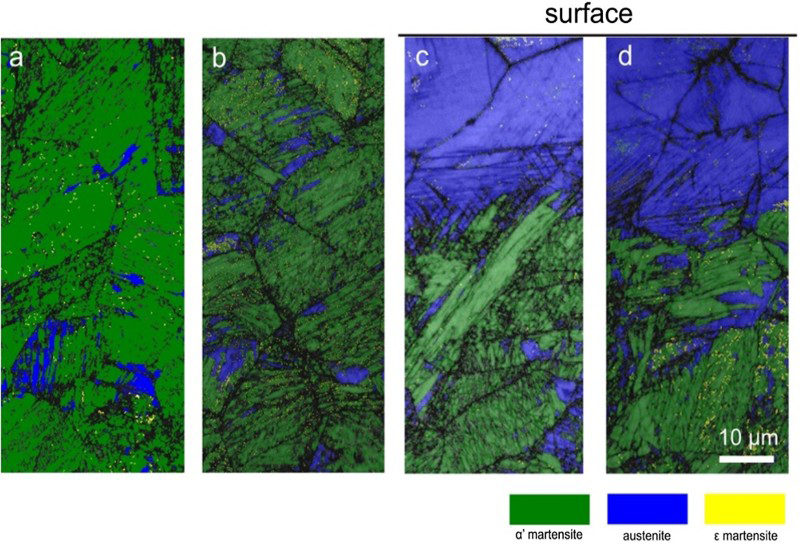
Conclusion
In this work, we demonstrate that on the absence of carbon precipitates the S-phase has minor effect on reducing hydrogen diffusion. The improved HE resistance is mainly attributed to the carbon interstitials on stabilising the austenite structure. After low-temperature carburising treatment, hydrogen-induced phase transformation and local lattice distortion caused by hydrogen charging are suppressed. S-phase remains extremely stable during tensile deformation after hydrogen charging.
Footnotes
Acknowledgements
This research was supported by the National Natural Science Foundation of China (No. 51201105 and No. 51571141). The authors are grateful for the EBSD measurements in TESCAN (China) and sincerely appreciate for the help from Prof Dong and Dr Li in the University of Birmingham (UK) on the investigations of S-phase.