







Abstract
Stannous sulphide (SnS) thin films have been synthesised using two different solutions. The solutions were prepared by the dilution of SnCl2 and thiourea in distilled water and methanol separately. The effects of solvents and deposition time on the properties of the prepared thin films are investigated. X-ray diffraction analysis revealed that the variation of the solvent and the deposition durations alters the structure of the prepared films. The films analysis by scanning electron microscope showed that the SnS films prepared with methanol are more dense and smooth than the SnS films prepared with distilled water. The resistivity depends on the used solvent and their growth duration. The elemental composition of the films deposited during 30 min with methanol indicate that SnS is quasi-stoichiometric, while those prepared with distilled water are slightly Sn rich. We have also found that the films deposited with distilled water are n-type, whereas those prepared with methanol are p-type.
Introduction
Metal chalcogenides semiconductors are very useful in different technological fields, such as polarisers, sensor and thermoelectric cooling materials. 1 Among these materials, tin sulphides have attracted considerable interest in recent years,1,2 particularly in photovoltaic energy conversions.3,4 These materials have the ability to form several binary sulphides, such as SnS, SnS2, Sn2S3 and Sn3S4. This is due to the coordination features of polyvalent tin and sulphur. Tin monosulphide, SnS, seems to be one of the most important and the most studied compounds. 5 Indeed, it can be used in many technological devices. 6 It is specifically used as absorber in the fabrication of solar cells based on low-cost materials.6-8 It is also used in holographique recording medium, light-emitting diodes, electrical switching, lithium ion battery, gas-sensor and optical material. 9 Stannous sulphide (SnS) is a binary semiconductor with an orthorhombic structure,10,6 and a very useful direct band gap for the photovoltaic conversion, with an almost optimum value varying in the range 1.3–1.7 eV. 11 In addition, it has a very high absorption coefficient (≈105 cm−1). 12 This compound was found to exhibit both n- and p-types conductivities.7,13 Several deposition techniques have been used to prepare absorbers thin films, including metal organic chemical vapour deposition, 14 precipitation method, 15 one-pot synthesis method, 16 aerosol-assisted chemical vapour deposition, 17 spray pyrolysis, 18 CSVT technique 19 and plasma-enhanced chemical vapour deposition. 5 In this paper, SnS thin films have been synthesised on glass substrates using the ultrasonic spray pyrolysis method. This technique was used owing to its numerous advantages, such as better stoichiometry control, ability of deposition of large uniform homogeneous layers area and low processing temperature. Our approach consists on the study of the effect of the solvents and the deposition time herein, the structural, morphological, optical and electrical properties of SnS thin films have been investigated.
Experimental details
Films preparation
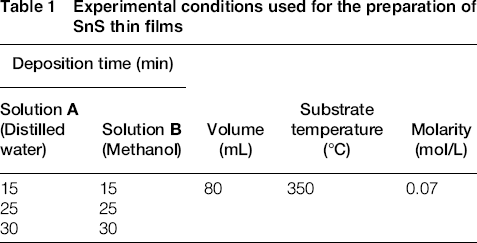
The samples used in this study were grown by ultrasonic spray pyrolysis technique. This method is mainly composed of an ultrasonic spraying system and a substrate holder with heater. The ultrasonic vibrator frequency was 40 kHz. During the deposition, the nozzle–substrate distance was kept constant to 4.5 cm. The substrate temperature was fixed at 350°C, as it was found to be the optimum temperature value to obtain uniform and well adherent SnS thin films. 20
Experimental conditions used for the preparation of SnS thin films
Characterisation
The crystalline structure of the deposited SnS thin films were investigated by X-ray diffraction (XRD) using a BRUKER-AXS type D8 diffractometer with CuKα radiation (λ = 1.541838 Å). The morphology and the chemical composition of the prepared thin films were carried out using a scanning electron microscope (SEM), (JEOL JSM 6400 model), equipped with an energy dispersive X-rays (EDXs) microanalysis system. The optical absorption of the films was studied using a Cary 5000 UV–Vis–NIR spectrophotometer. The electrical characteristics were measured using a Hall Effect Measurement system (HMS-3000).
Results and discussion
Structural and morphological properties
XRD patterns of deposited SnS thin films using distilled water at different deposition time are shown in Fig. 1. The films were found to be polycrystalline and have an orthorhombic structure. The broad hump situated in the small diffraction angles (20–35°) is due to the amorphous glass substrates network as was observed by other researchers.21,22 On the other hand, we note that when the deposition time increases, a peak located at ∼29.89° and assigned to the (101) plane of the SnS orthorhombic structure emerges.
XRD patterns of SnS thin films prepared with varied deposition times using distilled water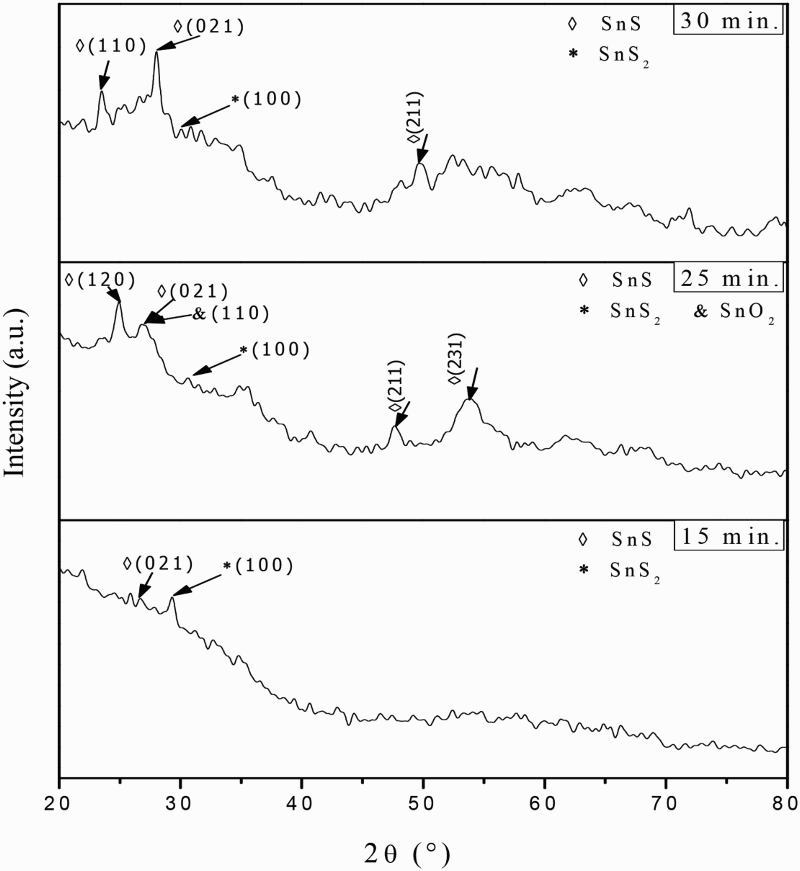
When the deposition time was further increased (from 25 to 30 min), the strong peak located at ∼26.93° and related to (021) plane of the SnS film deposited at 30 min became narrower and more intense. The small peaks situated at ∼22.03° and ∼50.35° were indexed with (110) and (221) planes, respectively. The spectrum of the film deposited during 25 min shows diffraction peaks related the SnS orthorhombic phase, and also some small diffraction peaks corresponding to the SnO2 phases. The peaks of the XRD patterns were indexed using the standard card of orthorhombic SnS (PDF card no: 33-1375).
Fig. 2 shows the XRD diffraction patterns of deposited SnS thin films using methanol at different deposition time. The films were found to be polycrystalline with a relatively strong (120) peak. In addition, the diffraction pattern contained peaks that correspond to (110), (021), (111), (140), (210), (221), (151), (122) and (231) planes. The presence of these peaks indicates that the prepared SnS films XRD patterns of SnS thin films deposited at different deposition times with methanol. Variation of the intensities of most intense peak of different present phases of thin films Grain sizes and internal strain of films 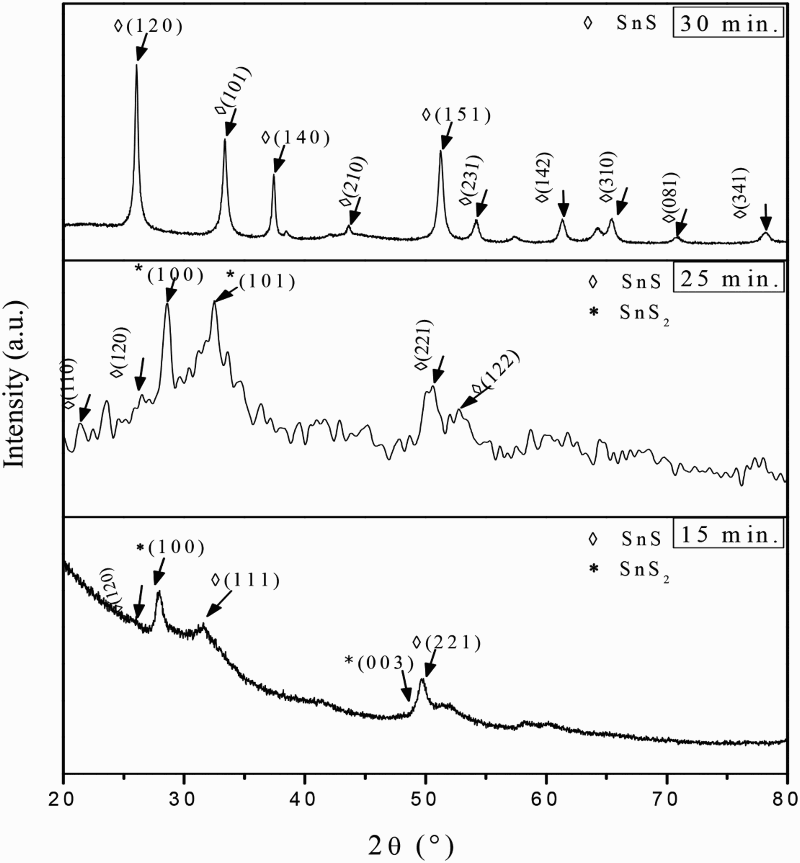
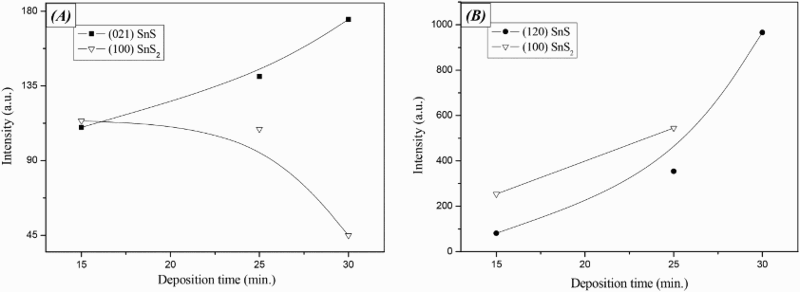
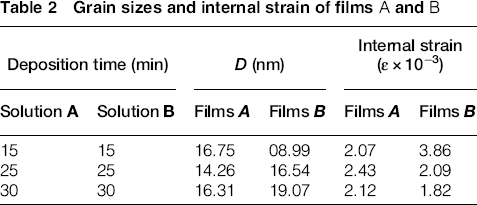
The grain size calculated from the XRD diffraction spectrum varied from 16.75 to 16.31 nm when the deposition time increased from 15 to 30 min for the films prepared with distilled water. These sizes values indicate the nanocrystalline nature of films
Films morphology and chemical composition was carried out using SEM and EDX technique. The typical SEM images of SnS thin films SEM images of SnS films prepared at 30 min with distilled water a and methanol b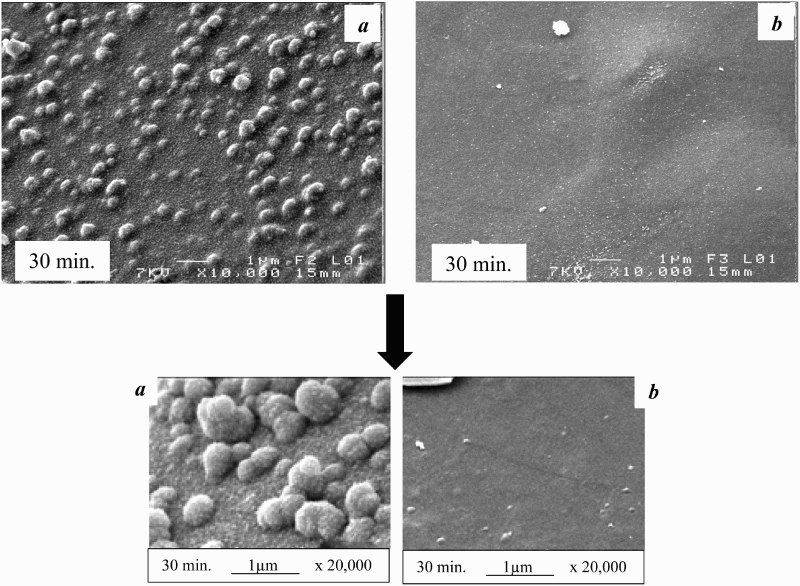
Optical properties
Figure 5 shows the absorption spectra of SnS films prepared with distilled water and methanol at various deposition times.
Variation of the absorption coefficient α as a function of the wavelength: a distilled water; b methanol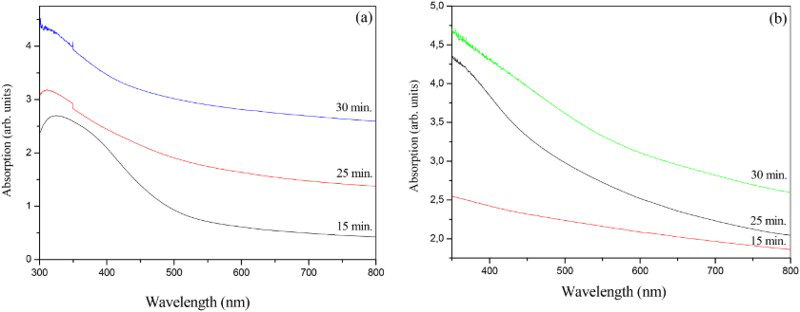
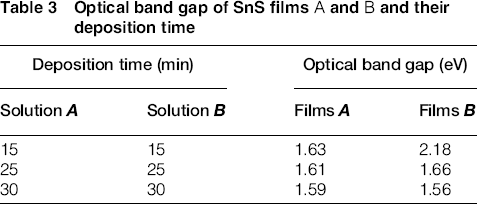
The optical band gap is obtained from the plot of the following relation:
Plot of (αhv)2 versus hν of SnS films 
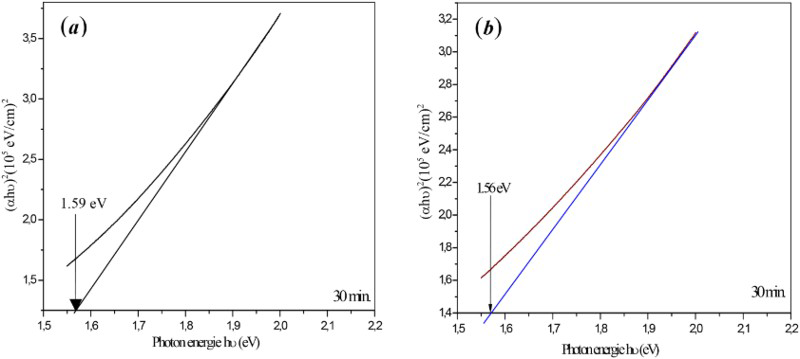
Optical band gap of SnS films
Electrical properties
Resistivity variation
The resistivity variation of films Variation of the resistivity of SnS films 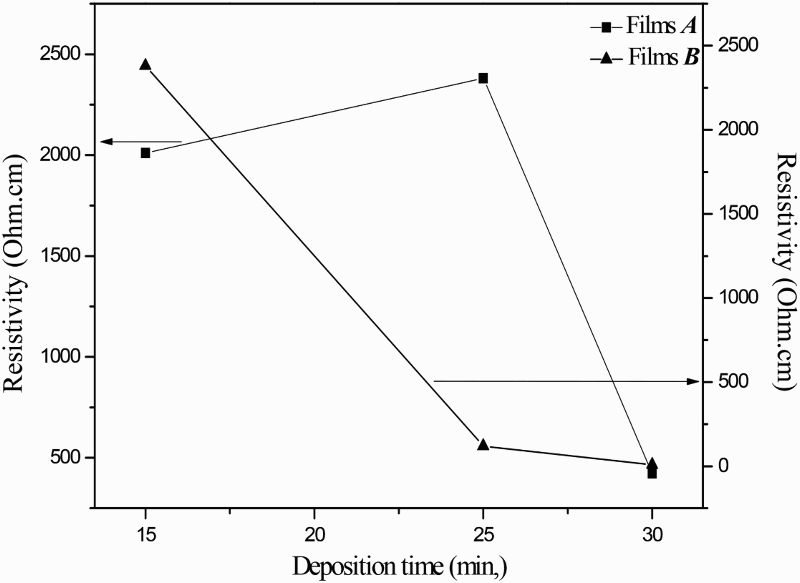
Conduction type variation
The conduction type is one of the most important parameters of the studied films and its determination is carried out using Hall Effect measurement.
Electrical conductivity of SnS films

Conclusion
The effect of distilled water and methanol solvents and deposition time on SnS thin films was investigated. XRD analysis revealed that both films are polycrystalline and have an orthorhombic structure. In addition, the films deposited using methanol have a better crystallinity than the films deposited with distilled water. Analysis by SEM showed that SnS film deposited during 30 min with methanol is more dense and smooth than the film deposited in 30 min using distilled water. The elemental composition shows that the film deposited during 30 min with methanol is quasi-stoichiometric, whereas the film prepared with distilled water is slightly Sn rich. The electrical study indicate that the resistivity of films
Footnotes
Disclosure statement
No potential conflict of interest was reported by the authors.