







Abstract
Aluminium-doped zinc oxide (AZO)/fluorine-doped tin dioxide (FTO) double-layered transparent conducting films were manufactured on quartz glass substrates by spray pyrolysis. Like top films, AZO has marvellous reduction-resistant properties during a-Si:H deposition. However, as thin films with features of self-textured surfaces, SnO2:F (FTO) provides high light scattering for front electrode in photovoltaic devices. The distribution of elements in surface and interface has been analysed by glow discharge spectrometer. The anti-reductive behaviour in ambient hydrogen plasma condition was studied and the results showed that hydrogen ions are dispersed in the AZO layer but not diffused to the FTO layer, thus avoiding the reduction of SnO2 to SnO or Sn during hydrogen plasma bombardment. Besides, this phenomenon also indicated that the coating of the AZO layer on FTO electrode can increase the resistance of FTO to hydrogen. AZO film protects FTO from reduction, and the resistivity to hydrogen plasma of AZO/FTO bilayer films has been improved.
Keywords
Introduction
For a front electrode with thin film solar cells, light trapping structure plays a decisive role in scattering the incoming light into the silicon absorber layer [1-4]. But it does not work for good transparent conducting oxides (TCOs). Another issue which mattered is that TCO is inert to hydrogen-rich plasmas because of the a-Si:H layers deposited onto it [5,6]. Light scattering is normally achieved by a textured surface which can be obtained either by chemical etching or direct growth [7-10]. Direct growth is highly efficient to form a high haze surface and to make the grains present pyramidal or mountain-like morphology at the film surface by controlling the growth process. The latest commercial high haze TCOs were made of fluorine-doped tin dioxide (SnO2:F, FTO) through atmospheric pressure chemical vapour deposition (e.g. Asahi U-type) or spray pyrolysis [11-13]. While FTO thin films are chemically and thermally stable under ambient air, they are sensitive to hydrogen. Reasons may lie in that during the a-Si:H depositing process, electric conductive is reduced and optical properties are deteriorated. Compared with FTO, aluminium-doped zinc oxide (AZO) is relatively stable in the hydrogen plasma environment. Nevertheless, it is hard for AZO to form self-textured surface and it has to use acids etching to acquire rough crater-like morphological characteristics. On the other hand, AZO loses its excellent electrical conductivity when placed in an air atmosphere of over 350°C [8,14].
The focus of present work is the development of a transparent conductive double-layered AZO/FTO electrode which is deposited by spray pyrolysis methods. Combining the merits of FTO with AZO, AZO/FTO bilayered films are promising to realise high stability, haze, conductivity and optical transmittance. Though the monolayer film of FTO or AZO has been studied thoroughly in recent years, bilayered films have been paid little attention. Montero et al. [15] have already performed thermal stability studies on AZO/ATO double-layered transparent conducting electrode. In this study, we will investigate the way of coating a thin AZO film (10–100 nm) over an FTO layer (540 nm thick) and the anti-reductive properties of AZO/ATO double-layered films in a hydrogen-rich plasmas environment.
Experiment
Butyltin trichloride (C4H9Cl3Sn, MBTC) and ammonium fluoride solution (NH4F) were used as precursors of FTO films. A mixture of MBTC (0.09 mol) and 12 mol L−1 HCl (0.65 mol) was dissolved in solution A of 144 mL methyl alcohol, while NH4F (0.03 mol) was dissolved in solution B of 24 mL deionised water. Solution A and B were mixed and stirred magnetically for 6 h, and then there was a 48 hours’ aging. The precursor solution was then placed in an ultrasonic nebuliser reactor which produced aerosol with a droplet size. The cleaned glass substrates (30 mm × 25 mm × 1 mm in size) were preheated to 360°C and the distance between the spray nozzle and the substrate was 20 cm. Natural cooling was performed in air atmosphere finally.. The average thickness of FTO film was strictly controlled at around 540 nm. Then, zinc acetate and aluminium nitrate were used as a precursor to coat a thin AZO film with the thickness of 10–100 nm over an FTO layer. Different AZO/FTO bilayered films were gathered with the changing concentration of precursor solution, temperature of substrate and deposition time. FTO and AZO/FTO double-layered films were treated, respectively, in hydrogen plasma environment with radio frequency (RF) deposition device (DHDP-1) and RF power of 300 W and H2 pressure of 200 Pa for 3 min. The phase and crystalline structure of AZO/FTO films were characterised by XRD (D/max–2500/PC) and the morphology and thickness were studied by FESEM (S4800). Film thickness was estimated by SEM cross-section. Besides, the haze value, transmittance and sheet resistance were studied by haze meter (SGH-2), UV–Vis Spectrophotometer (UV1900) and four-point probe method (DMR-1C), respectively. Glow discharge spectrometer (GD-Profiler 2) was adopted to analyse the element distribution.
Results and discussion
Bare FTO film and AZO/FTO bilayered thin films present distinctly different behaviours when exposed to a hydrogen plasma atmosphere (Figure 1). The sheet resistance of FTO film increases from 8.3 to 55.7 Ω/square and its average transmittance decreases sharply from 72.2 to 11.9%, which indicates that anti-reduction of bare FTO film is indeed poor. It is due to the treatment of FTO films by hydrogen plasma which promotes the conversion of some SnO2 into SnO or Sn. The conductivity of FTO film is inhibited in that the film during its hydrogen plasma bombardment is in a reductive atmosphere and it loses oxygen. The surface sheet resistance of AZO/FTO film decreases [16,17]. Bilayered films present better in the resistance of bombardment of hydrogen plasma. Deferent spray time (2–14 min) of AZO governs its thickness (0–100 nm). Figure 1(a) shows the deposition of a thin AZO film over an FTO layer increases reductive resistant properties of FTO films, minimising its electrical conductivity losses under relatively severe hydrogen plasma bombardment. Average transmittance declines slightly in the same condition (Figure 1(b)). This protective effect enhances a little with the increase of ATO thickness. During hydrogen plasma bombardment, H ions are adsorbed on the AZO surface, and some hydrogen ions which enters the AZO film will attract the surrounding O atoms, making H-O as a shallow donor of ZnO and reducing the surface sheet resistance [18]. The AZO film FTO sample is attenuated by hydrogen ion passing through the AZO layer and the misfit dislocation is present, and the concentration of H ions decreases to near zero at the FTO/AZO interface. A few hydrogen ions are dispersed into the crystals of the FTO surface, which are less severe compared with the absence of the AZO layer in the photoelectric properties of the FTO films [16]. After hydrogen treatment, the SnO2 crystal becomes disordered, and electron traps (electron scattering) appear in the interior due to the formation of Sn and SnO. The optical band structure and the valence band of the sample moves up, while the conduction band moves down, showing a decrease in the optical transmittance [19].
Sheet resistance (a) and average optical transmittance of AZO/FTO (b) vs. spray time of AZO. For monolayered FTO, spray time of AZO = 0.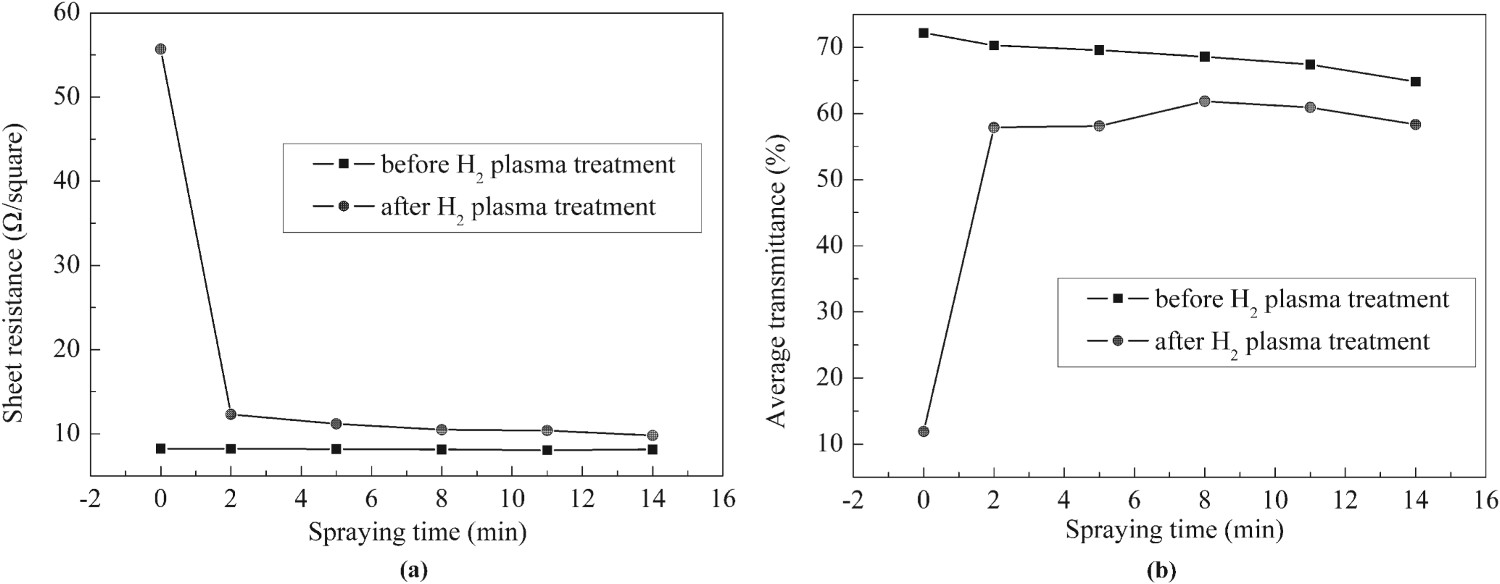
Figure 2 shows FESEM surface morphology of FTO (a, b) and AZO/FTO bilayered films (c, d) before (a, c) and after (b, d) hydrogen plasma treatment. It is found that the crystal boundary is clear in the as-deposited FTO film before hydrogen plasma bombardment (a), but it becomes misty after that (b). After hydrogen plasma bombardment, the surface grains in FTO film begin to decompose and large particles (particles with diameters are larger than particles without hydrogen ions) which are apparently stacked are initiated. These large particles are assembled by Sn or SnO, and the instability of SnO2 matters a lot. As contrast, AZO/FTO bilayered films (c, d) change little in the same condition. Therefore, it accounts for the coating AZO on FTO enhances anti-reduction of FTO.
FESEM morphology of FTO (a,b) and AZO/FTO double-layered film (c, d) (AZO prepared at 360°C, 8 min) before (a, c) and after (b, d) hydrogen plasma treatment.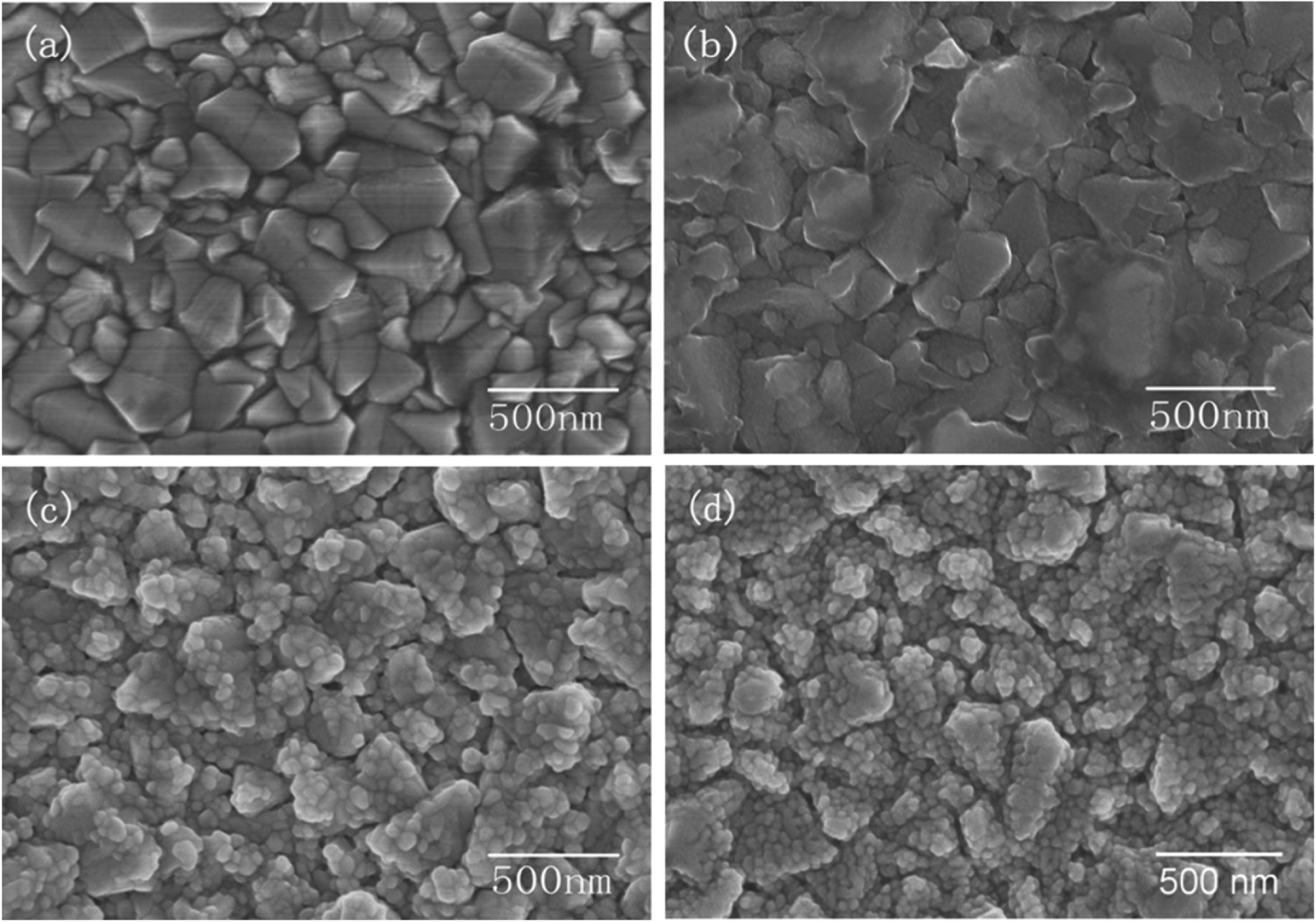
X-ray diffractions and glow discharge spectrometer could assist the understanding of the effect of the AZO protective layer. AZO and FTO possess hexagonal structures and tetragonal rutile, respectively. XRD patterns of FTO film before and after H2 plasma treatment are shown in Figure 3(a). It can be observed that SnO2 phase (with polycrystalline tetragonal cassiterite structure (P42/mnm (136), JCPDS No. 41-1445)) exclusively exists in the as-deposited FTO film, and SnO, Sn also occurs after hydrogen plasma bombardment, which is in consist with the previous conjecture. Stannous oxide and metallic tin turn out to make the carrier concentration and mobility decline, the factors of which control the conductivity of SnO2 semiconductor. The black blue SnO strongly absorbs visual light, and thus the transmittance decreases under the circumstances. The XRD diffraction pattern of AZO/FTO bilayered film (Figure 3) shows that most diffractions belong to tetragonal SnO2 because FTO layers are more crystalline and thicker. Besides, the diffraction peaks of ZnO with hexagonal structure can also be detected. They barely change before and after hydrogen bombardments, which reveals that double layers possess more anti-reductivity. The ratio of half-width and height of FTO and FTO/AZO films before and after hydrogen treatment is 1:1 calculated by XRD diffraction spectrum which shows that the grain size has not changed in the same period.
(a) XRD pattern of FTO film before and after hydrogen plasma treatment, (b) XRD pattern of AZO/FTO bilayered films before and after hydrogen plasma treatment.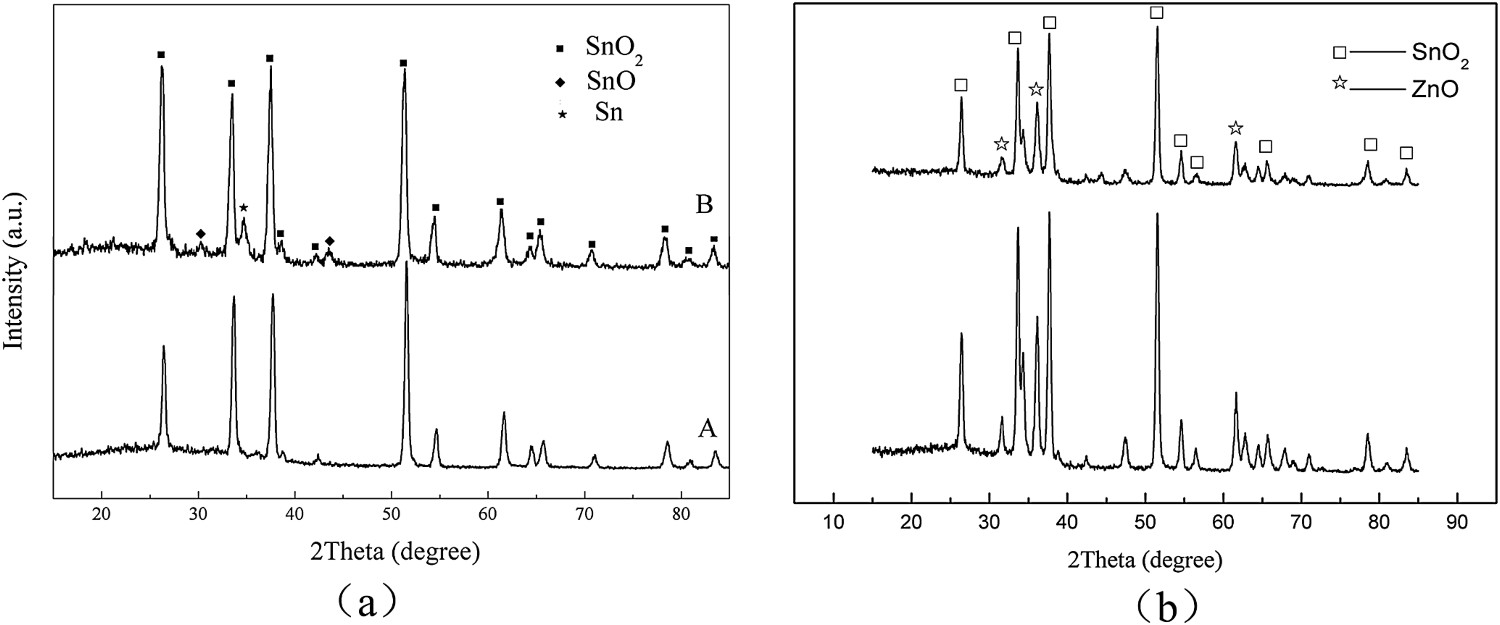
Film stacked structure of AZO/FTO bilayered films after hydrogen plasma bombardment was analysed by glow discharge spectrometer (Figure 4). Elements distribution concerning the thickness could be displayed clearly. ZnO and SnO2 appear from the top surface to substrate with the etching time in turn. Zn element is dominant in the initial 5 s, and its concentration reaches the highest at 2.5 s, but then declines sharply, which is because that the thickness of AZO is around 57 nm based on SEM cross-section morphology. From then on, Sn elements rise suddenly and keep high content until 25 s. At the same time, the oxygen content is invariably at an upper level. It should be noted that there is a transition region from 2.5 to 5.5 s. In this district, ZnO and SnO exist in the meanwhile, which means the happening of interlayer diffusion. Although hydrogen elements can be seen in the whole region, its peak appears at the top surface and later falls quickly. Similar to the single FTO film in Figure 4, H+ ions are shown to accumulate at the surface and in the interfacial region, where it is assumed to have a lower surface energy compared with the mid-layer regions [20]. Hydrogen atom radius is so tiny that it can penetrate into the deeper layers. The diffusion depth of hydrogen atom is nearly the same with the thickness of AZO. As a result, it is essential for the AZO layer to keep adequate thickness. Thus, we can draw the conclusion that coating AZO film on FTO film plays an important role in protecting FTO from hydrogen plasma reduction.
Elements distribution along depth of AZO/FTO bilayered film analysed by glow discharge spectrometer.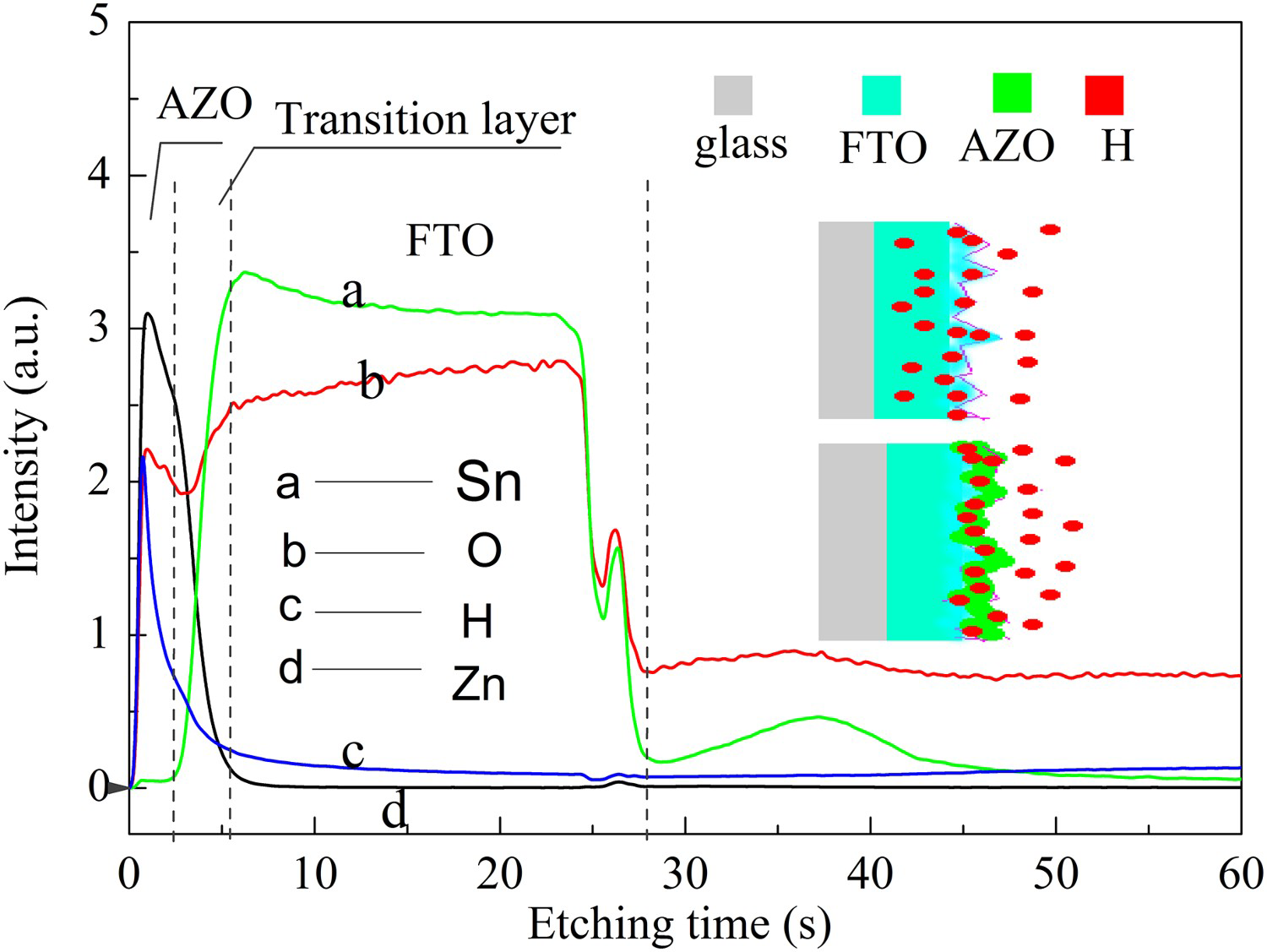
Conclusions
In summary, two types of films (FTO films and bilayers AZO/FTO films) were considered as solar cell front electrodes. Compared with AZO thin films, FTO films reveal uneven surface morphology, which is conducive to absorb light energy in the solar spectrum and improve the efficiency of photoelectric conversion. Bare FTO film and AZO/FTO bilayered films are successfully placed on silica glass substrates by spray pyrolysis in the ambient air. Its ability of reduction-resistant is tested in hydrogen plasma environment. FTO films deteriorate badly, and AZO/FTO bilayered films change a little in conductive and optical properties when exposed to hydrogen in a plasma environment. The reason is that SnO2 in the FTO film is reduced into SnO or Sn during hydrogen plasma bombardment, thus decrease the electrical properties. In contrast, it can be figured out from the glow discharge spectrometer that hydrogen ion in the AZO/FTO bilayer film is dispersed in the AZO layer but not the FTO layer. An AZO layer with high ability of reduction resistivity is found to successfully act as a barrier against hydrogen diffusion avoiding. Adequate thickness of AZO film is crucial to avert hydrogen diffusion into FTO layer.
Footnotes
Disclosure statement
No potential conflict of interest was reported by the authors.