







Abstract
We report on the effect of metallic nanoparticles on the liquid-state dewetting behaviour of bismuth films. The nanoparticles and the films were grown by thermal evaporation and subjected to annealing under ambient conditions. Dewetting was analysed by morphological studies of TEM images and by calculating the surface exposure of the films. Our results show that the addition of Ag and Au destabilizes the film, while Cu has the opposite effect. This is explained by the formation of solid solutions for Bi–Au and Bi–Ag, which lower the melting point. Cu nanoparticles stabilize the film by pinning the dewetting front. This mechanism is different from solid-state dewetting where stabilization is due to the reduction in pinhole formation at the grain and triple boundaries. This study provides insight into the role of nanoparticles on the stability of metallic films and can be extended to other low melting metallic systems.
Introduction
Thin films are widely used for functional applications due to their electrical, optical, and magnetic properties. The integrity of thin film-based devices is of prime importance, especially when they are used for high-temperature applications. When thin metallic films are heated, they tend to disintegrate and form islands. This transformation is known as dewetting and is driven by minimization of the interfacial energy between the substrate and the film. Dewetting occurs in two forms, namely solid-state and liquid-state dewetting [1,2]. Solid-state dewetting in metals is more common and occurs when the films are annealed well below the melting point of the material. Examples of liquid-state dewetting in metals are less common, since the film needs to be heated rapidly above the melting point, while suppressing solid-state dewetting.
Solid-state dewetting in metals primarily starts with nucleation of holes, hole growth, formation of interconnected structures (when the holes meet), and finally, the film breaks up into isolated islands. Hole nucleation typically starts at defect sites and triple-point boundaries, especially in polycrystalline films. Liquid-state dewetting, on the other hand, is mainly governed by the hydrodynamic flow of the liquid [2,3]. The process also occurs via hole nucleation, hole growth, coalescence, but finally, the formation of droplets is due to Rayleigh instability of the liquid. Dewetting of ultra-thin liquid films is mainly governed by spinodal instability, in which local height perturbances in the melted film are amplified until it breaks down [4]. Dewetting is normally considered detrimental as it limits the thermal stability of films [5]. There are also applications, primarily to synthesize nanoparticle arrays by dewetting, with or without patterning [6-15]. Recently, we had reported on the synthesis of Cu–Ag bimetallic nanoparticles, by solid-state dewetting, which were used as etch masks to fabricate dual-diameter silica nanopillars for antireflection coating applications. The nanopillars grown from these bimetallic nanoparticles showed lower reflectivity when compared with pillars obtained from monometallic particles [13].
There have been reports on controlling solid-state dewetting by using bilayer films; an example is the deposition of an Fe layer on the top of an Au film, which improves thermal stability when compared with a pure Au film [16]. This is due to the low density of defects, which prevents the formation of holes. Similarly, the thermal degradation of Au was delayed by incorporating Pt [17]. Compositionally modulated coatings also provide enhanced thermal and environmental stability, with the composition gradient modulating the residual stress in the film and reducing pore density [18,19]. Liquid-state dewetting has generally been studied for polymer thin films, where the films were annealed above the glass transition temperature. There have been reports on inhibiting liquid-state dewetting in polymer films, by the addition of nanoparticles or nanofillers. Barnes et al. [20] reported that the addition of a small amount of fullerene (C60) to polystyrene (PS) and polybutadiene (PB) film delayed the development of instability. Amarandei et al. [21] have also reported that the addition of Au nanoparticles to the PS films improves the stability. Liquid-state dewetting in pure metallic thin films has been induced by ion-beam, electron, and laser annealing the films above the melting temperature [2-6,22-26]. For example, in laser annealing, the beam interacts with the film, which raises the surface temperature and causes localized melting [24,27].
While studies on the effect of a second phase material on the thermal stability of metallic films (in the solid-state) are available, there is limited information on the effect of a second phase on liquid-state dewetting process in metallic films. Earlier, we had reported on the effect of Ag nanoparticles on the solid-state dewetting of metallic Cu thin films and found that the Ag suppresses the dewetting of Cu film by pinning the triple-point boundaries and reducing the formation of pin holes [11]. In liquid-state dewetting, the mechanism is expected to be different since dewetting proceeds due to the Rayleigh instability in the molten film. To perform liquid-state dewetting studies for metallic thin films, we need to identify a suitable low melting point metal. There have been reports that Bi thin films do not dewet on annealing close to melting temperature [28]. Also, the melting point of Bi (Tm = 271°C) is still high, compared to room temperature, that it will not affect the film stability during thermal evaporation. Therefore, we selected Bi as a model system to study liquid-state dewetting of metallic thin films. We chose three second phase materials, Cu, Ag, and Au, and compared the stability of this two-phase system with pure Bi. Our results show that nanoparticles can either destabilize (Au and Ag) or stabilize (Cu) the film, depending on their interaction with Bi. The learnings from this model system can also be extended to studying dewetting in other low melting metals, such as In and Ga and their alloys.
Materials and methods
Amorphous carbon (a-C)-coated copper transmission electron microscopy (TEM) grids purchased from Electron Microscopy Sciences were used as substrates for thin film deposition. Bi, Au, Ag, and Cu were evaporated from their respective pure metal sources (99.99% purity) in a thermal evaporation chamber, HPVT 303, supplied by Hydro Pneo Vac Technologies. All depositions were carried out at a base pressure of 3 × 10⁻⁶ mbar. The TEM grid was placed in a custom-built substrate holder and loaded in the vacuum chamber. The Bi film was deposited from Bi pieces, procured from Sigma Aldrich, and the thickness was fixed at 10 nm using the quartz crystal microbalance. After the deposition of Bi, Ag was thermally evaporated from a source, procured from Alfa Aesar, without breaking chamber vacuum. Similarly, Au and Cu (procured from Alfa Aesar) were also deposited on top of Bi, in separate experiments. Three deposition times were used – 5, 10, and 20 s, to vary the amount of the second phase material on Bi. Thus, there were four sets of thermally evaporated films, namely pure Bi, Bi–Ag, Bi–Au, and Bi–Cu. Post-deposition, the samples were annealed ex situ in ambient atmosphere at 400°C for 5 h, at a heating rate of 5°C/min. The as-deposited and annealed samples were characterized using TEM, a Philips CM12 microscope operating at 120 kV. The nanoparticle size, grain size, and surface exposure were calculated using Image J software package.
Results and discussion
Figure 1 shows a representative TEM image of the as-deposited 10 nm thick Bi film. The film is polycrystalline in nature, with well-defined grain boundaries and an average grain size of 83.1 ± 39.4 nm. There have been several reports on the formation of Bi films by thermal evaporation, molecular beam epitaxy, pulsed laser deposition, electrodeposition, and sputtering [29-34]. The nature of the film depends on parameters such as substrate type and temperature, and the film properties can be further modified by post-deposition annealing [28]. Vapour-deposited films (thermal evaporation or sputtering) on inert substrates grow via Volmer –Weber or island growth mode. Initially, the evaporated material forms islands on the substrate and with an increase in deposition time, these islands coalesce to form a continuous polycrystalline film. For the experiments with the second phase, this polycrystalline Bi film acts as the substrate.
Bright-field TEM micrograph of as deposited 10 nm Bi film showing polyhedral grains. The film has well-defined grains and grain boundaries with an average size of 83.1 ± 39.4 nm. The bright and dark regions in the grains are due to diffraction contrast.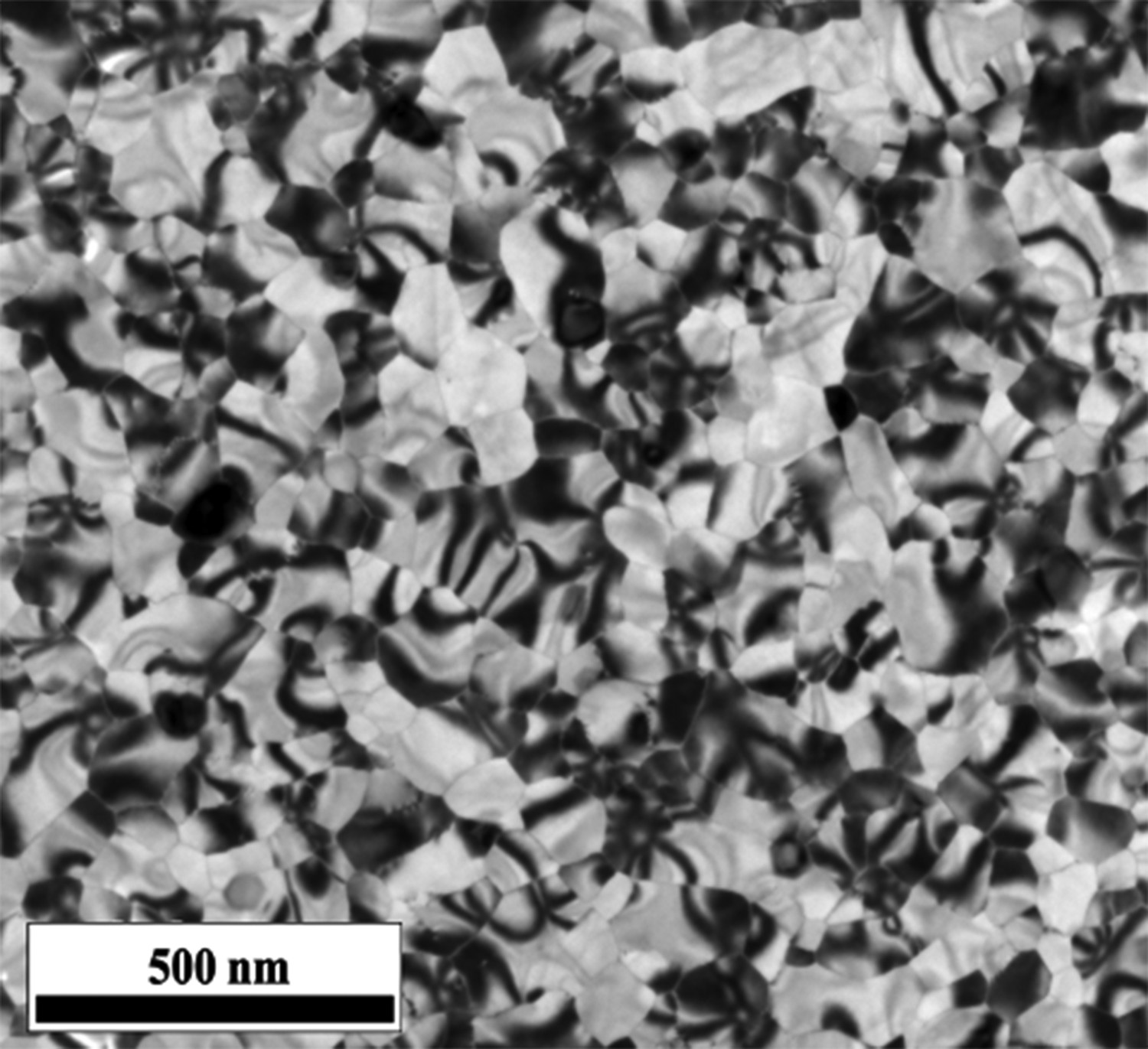
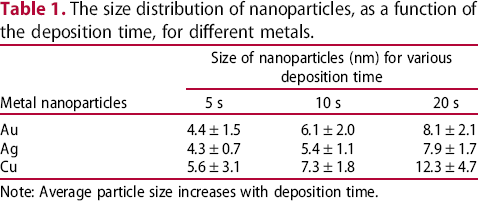
TEM images in Figure 2 correspond to the Bi films with the second phase deposited on top. Figure 2 (a–c) corresponds to Au–Bi, with increasing Au deposition time from Figure 2(a) to (c). Au forms nanoparticles, which are uniformly distributed on the top of the film. Au nanoparticles obtained by deposition for 5 and 10 s are mostly spherical, but their shape changes to elongated for 20 s deposition time. The average nanoparticle size increased from 4.5 ± 1.5 to 8.1 ± 2.2 nm, going from 5 to 20 s deposition time. Similarly, Ag and Cu also form nanoparticles on Bi, which increase in size with deposition time, as shown in Figure 2(d–f) and (g–i), respectively. The formation of nanoparticles, during deposition, can be explained in terms of the surface energies of the various elements. The surface energy of Bi (0.53 J m−2) is lower than that of Au (1.28 J m−2), Ag (1.18 J m−2), and Cu (1.95 J m−2) [35]. Thus, Au (or Ag or Cu) tend to form particles during deposition, to minimize the overall energy of the system. The slightly elongated particles observed at the highest deposition time (20 s) can be attributed to frustrated surface diffusion at room temperature, which prevents the formation of fully spherical nanoparticles. The average nanoparticle sizes, for different materials and deposition times, are summarized in Table 1.
Bright-field TEM micrographs of as deposited 10 nm Bi, with Au, Ag, and Cu nanoparticles. Nanoparticle size increases with deposition time, t = 5 s (a, d, and g), t = 10 s (b, e, and h), and t = 20 s (c, f, and i). The particles are mostly spherical for 5 and 10 s, but are slightly elongated for 20 s due to frustrated surface diffusion at room temperature. Scale bar corresponds to 50 nm for all images. The size distribution of nanoparticles, as a function of the deposition time, for different metals. Note: Average particle size increases with deposition time.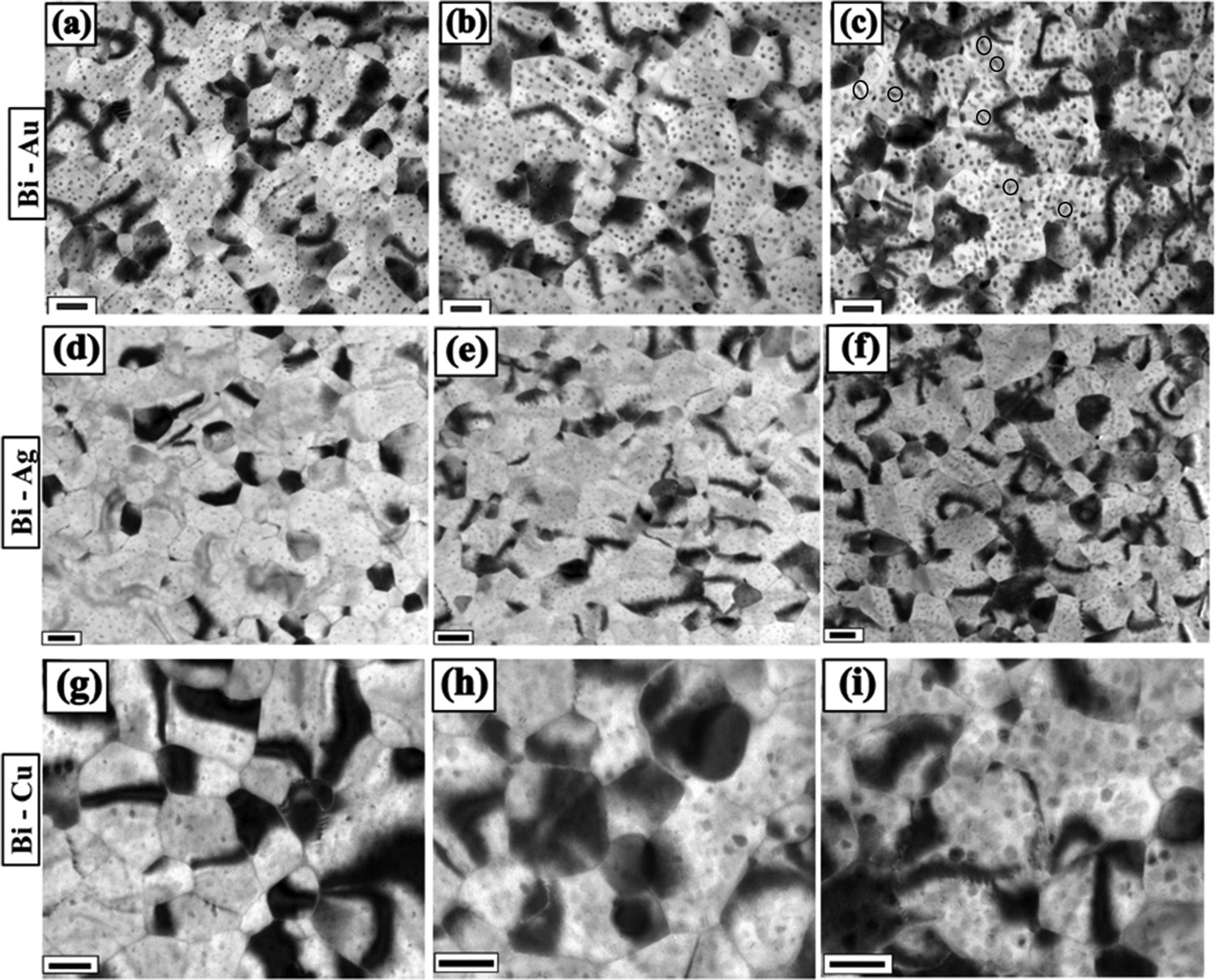
These films were subjected to annealing, in an ambient atmosphere, at 400°C for 5 h, well above the melting point of Bi. The annealed samples were then imaged using TEM. Thin films on annealing tend to rupture because the supplied thermal energy allows the film to agglomerate exposing the substrate. It can be observed from the TEM image in Figure 3 that post-annealing, the Bi film is no longer continuous. The morphology of annealed film reveals that it has melted exposing the underlying a-C substrate. The process is not complete, which can be attributed to the formation of an oxide layer at the surface due to annealing under ambient conditions. Similar results were observed in the case of Cu films annealed in air, where the formation of the oxide layer delayed solid-state dewetting [11]. There have been reports that, in liquid films, the influence from heterogeneous sites, such as grain and triple boundaries (associated with the dewetting in the solid-state), is suppressed. Capillary waves due to surface perturbances play a major role in instability [36,37]. The perturbance length scales as the square of the initial film thickness [4]. Bi films behave differently than other metallic films, in that solid-state dewetting is suppressed and grain boundaries disappear when annealed closer to the melting point [28]. This suppression of solid-state dewetting in Bi means that it is a model system to study the effect of a second phase on liquid-state dewetting. To check the effect of nanoparticles on dewetting behaviour of Bi, films with nanoparticles were also subjected to annealing under the same conditions and examined using TEM.
Bright-field TEM micrograph of annealed 10 nm Bi film. Annealing at 400°C, for 5 h, results in dewetting of the Bi film. The bright portions are dewetted areas and dark areas show the Bi film post-melting. The exposed surface area is 10.1 ± 1.4%.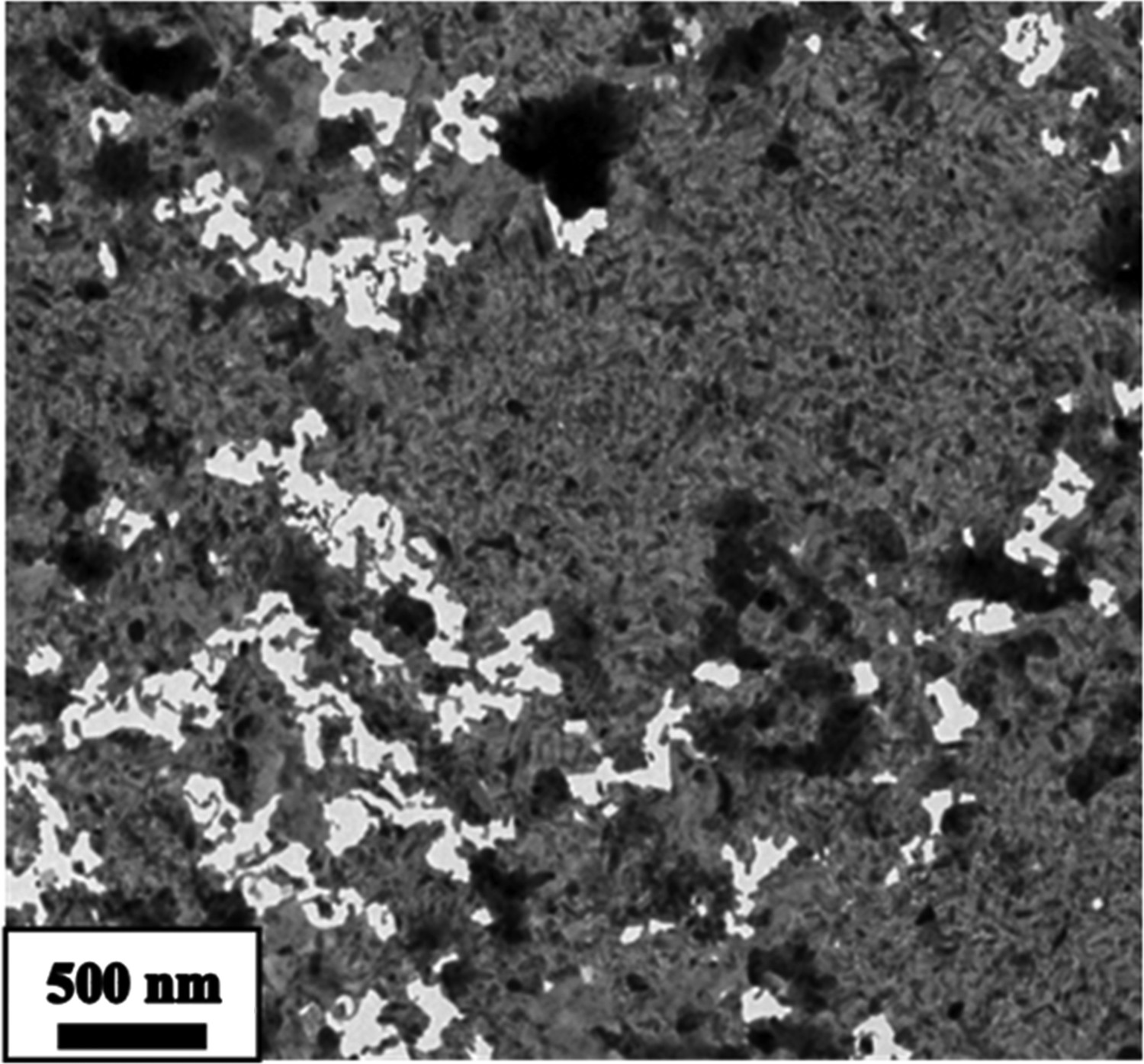
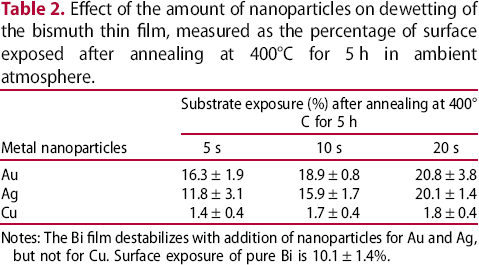
Figure 4 shows TEM images of annealed Bi–Au, Bi–Ag, and Bi–Cu films. It is observed that the morphology is different when compared with the annealed pure Bi film (Figure 3). Annealing of Bi – Au film also leads to the formation of interconnected structures, but the exposed substrate area is greater compared to pure Bi. Also, increasing the amount of Au (by increasing deposition time) leads to an increase in the substrate exposure post-annealing. The substrate area exposed, for annealed samples, increases by nearly 100%, from 10.1 ± 1.4% for pure Bi to 20.8 ± 3.8% for the Bi film with Au deposited for 20 s (maximum amount of Au). The percentage of the substrate exposed, for different amounts of Au, are listed in Table 2. Thus, with increasing Au, the destabilization of the Bi film increases. While liquid-state destabilization by a second phase has not been observed for metallic systems, similar work has been carried out in the case of polymer films. The addition of silicon and carbon particles in PS leads to stabilization and destabilization of the film, respectively. When there is a strong interaction between the polymer and Si particles at the edge of a hole, interfacial pinning leads to the suppression of dewetting, whereas the repulsive interaction due to phase separation between the carbon black and polymer leads to the acceleration of dewetting [38].
Bright-field TEM micrographs of annealed 10 nm Bi film with nanoparticles, showing non-continuous film with exposure of the substrate. The bright regions are the dewetted areas and their fraction increases with increasing amount of Au (a–c) and Ag (d–f). Cu nanoparticles (g–i), on the other hand, help in stabilizing the Bi film and there is less substrate exposure. Scale bar corresponds to 500 nm. The amount of surface area exposed is tabulated in Table 2. Effect of the amount of nanoparticles on dewetting of the bismuth thin film, measured as the percentage of surface exposed after annealing at 400°C for 5 h in ambient atmosphere. Notes: The Bi film destabilizes with addition of nanoparticles for Au and Ag, but not for Cu. Surface exposure of pure Bi is 10.1 ± 1.4%.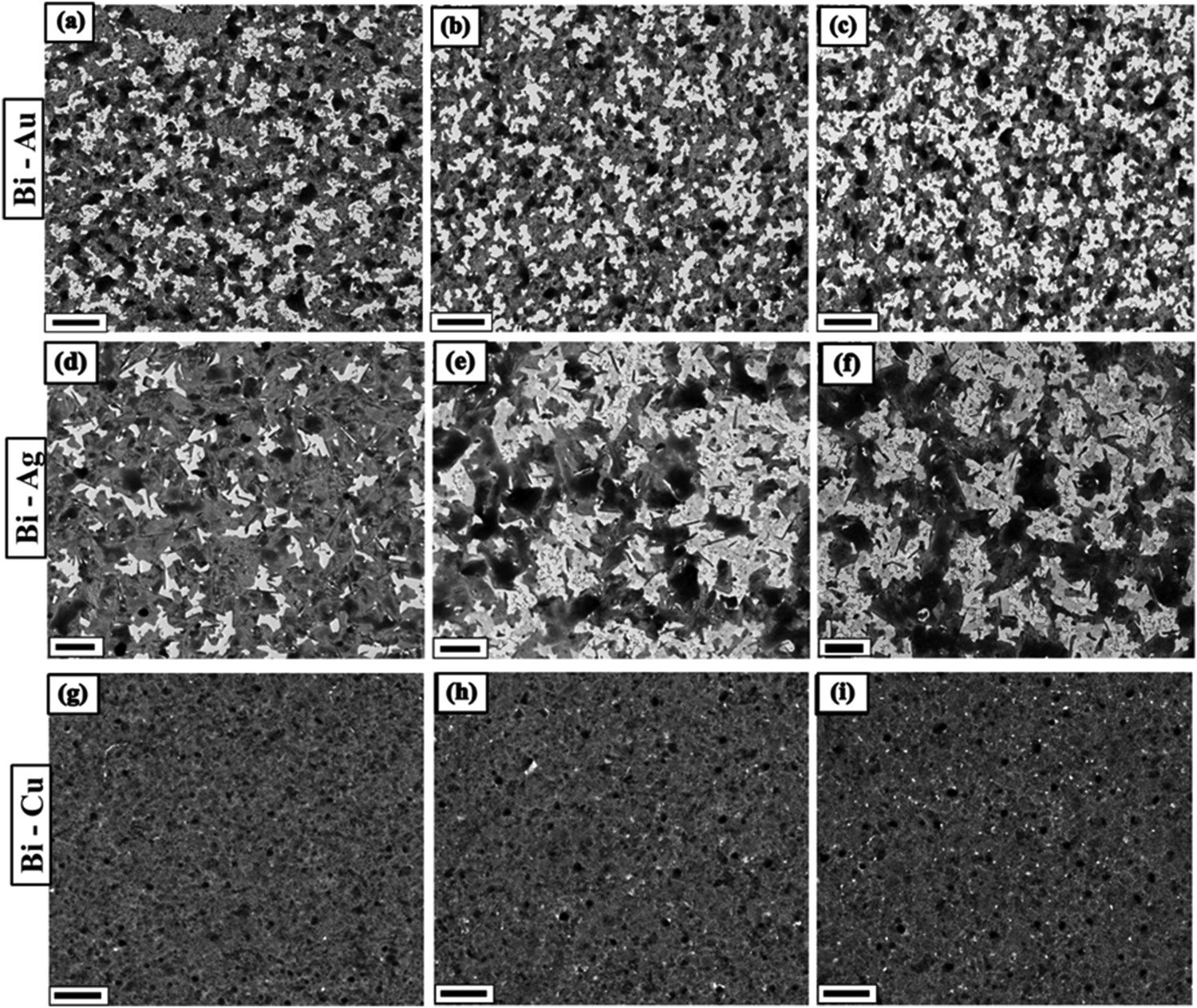
The Bi–Au system has a eutectic temperature of 241.5°C at 14.1 wt-% (13.2 at.-%) of Au [39]. Previous studies on this system showed that Au nanoparticles tend to dissolve in the Bi matrix on heating and the rate of dissolution increases with decrease in particle size [40]. This dissolution is accompanied by the formation of an Au2Bi intermetallic, which can be seen in the phase diagram [41]. It is clear from the TEM images in Figure 4 that Au nanoparticles alter the dewetting mechanism of the Bi film. Figure 3 shows that the pure Bi exhibits localized melting and random formation of large voids. Annealed Bi–Au film, on the other hand, exhibits branched structures and with the increasing amount of Au, there is a corresponding increase in exposed substrate area. The increase in substrate exposure after annealing indicates that the destabilization of the film increases with the amount of Au deposited. There have been reports on the size dependence of melting for bismuth nanoparticles, where the depression in melting point is inversely proportional to the particle size [42]. Minenkov et al. [43] have reported the effect of size on the phase transformation temperatures of layered structures of Ge/Bi/Ge films and observed that Bi thin films confined between Ge layers melt much lower than the bulk. In this study, we have a system which consists of Au nanoparticles deposited on Bi. Dissolution of Au in Bi will lower the melting point, and this will cause the film to dewet differently when compared with pure Bi. This can be seen from the Bi–Au phase diagram, where the melting point reduces, till the eutectic, with an increase in Au composition.
 ) and the Au nanoparticles (
 ) were calculated using the formulas shown in the below equation
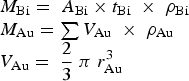
 is the area of a region on the bismuth film (chosen using Image J),
 is the Bi film thickness (fixed at 10 nm). The radius of the individual gold nanoparticles in the chosen area is
 and
and
 is their volume, considering the particles as hemispheres. The radius is obtained by thresholding the image to identify the particle boundaries and the volumes of the selected particles are summed to obtain the total gold mass. The process was repeated for multiple TEM images for each sample so that reliable statistics can be obtained.
 and
and
 correspond to the theoretical densities of Bi and Au, respectively. Similarly, compositional analysis for Bi–Ag and Bi–Cu was also performed and the data are summarized in Table 3 (expressed as at.-%) as a function of the deposition time. In the case of Bi–Au, the amount of Au for all deposition times lies well within the solubility limit of 13.2 at.-% [39]. This means, the melting point for the Bi–Au system is below the melting point of pure Bi and this lowered melting point is responsible for increased dewetting. Thus, we can conclude that Au nanoparticles destabilize the Bi film by lowering the melting point.
The composition (at.-%) for the different metal-bismuth systems.
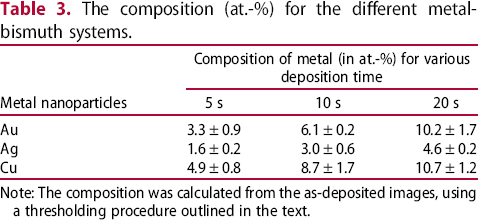
Note: The composition was calculated from the as-deposited images, using a thresholding procedure outlined in the text.
Similarly, annealed films of Bi–Ag and Bi–Cu were also analysed using TEM. Figure 4(d–f,g–i) shows images of dewetted films of Bi–Ag and Bi–Cu, respectively. Bi with Ag nanoparticles behaves similar to the Bi–Au system and surface exposure increases with added Ag. This can be attributed again to the lowering of the melting point of Bi–Ag with increasing amounts of Ag. There have been reports on Ag forming Ag2Bi, in a manner similar to Au [44]. Bi also forms a eutectic with Ag (eutectic temperature of 262.5°C) with 2.62 wt-% (4.95 at.-%) of Ag. When the amount of Ag is increased, the composition decreases towards the eutectic, thereby lowering the melting point. The calculated amount of deposited Ag also lies within the maximum solubility limit of 4.95 at.-% as shown in Table 3. From Table 2, the extent of dewetting is nearly similar for both Bi–Au and Bi–Ag, for the same deposition time. Contrastingly, the Bi–Cu system behaves differently, as seen from Figure 4 (g–i), where the annealed Bi–Cu films are more stable than pure Bi. Pinhole formation is observed in the film and the exposed substrate area has decreased from 10.1 ± 1.4% for pure Bi to 1.8 ± 0.4% for Bi–Cu (20 s deposition). Also, the percentage dewetting seems to be mostly independent of the amount of Cu added (within experimental error). This stabilization of Bi in the presence of Cu can be explained by the lack of eutectic and a very low solubility of Cu in Bi [39], which allows phase separation of Cu in Bi films. Thus, in an effect similar to the stabilization of PS by Si, the segregation of Cu nanoparticles at the interfaces of the molten Bi film helps to slow down the agglomeration process and increases the stability of the Bi film. This effect is different than the stabilization of thin films in solid-state dewetting by nanoparticles [11]. There, the nanoparticles at the grain and triple boundaries help in pinning these boundaries and delay the formation of holes. Thus, as the areal density of nanoparticles increases, the pinhole size decreases [11]. In the case of stabilization of Bi by Cu, the effect is more or less independent of Cu concentration since the nanoparticles locally pin the liquid front and reduce the extent of dewetting. There have been similar reports on other polymer films, where nanofillers in the form of nanoparticles and dendrimers suppressed the dewetting of the film because of phase separation. The particles helped in pinning down the contact lines of the growing holes [20,45,46].
Conclusion
Second phase metallic nanoparticles affect the liquid-state dewetting process of Bi thin films, in a manner similar to that observed in polymer films. Structural characterization reveals that increasing amounts of Au and Ag lead to increased destabilization of the film, due to the solid solubility of the two metals in Bi. This results in a lowering of the melting point of the film and enhances dewetting. Cu nanoparticles, on the other hand, interact differently with Bi film and help in suppressing the liquid-state dewetting of Bi film. These results suggest that this model can be extended to study the liquid-state dewetting of low melting materials such as In and Ga, which are mostly used in thin films for optoelectronic applications. The stability of these systems can be controlled by introducing second phase materials in the form of nanoparticles. This will be especially useful in developing low melting solders and electrodes for electronics applications.
Footnotes
Acknowledgements
This research is supported by the Naval Research Board, Government of India, under the project number NRB/4003/PG/354. TEM was performed in the Department of Metallurgical and Materials Engineering, IIT Madras.
Disclosure statement
No potential conflict of interest was reported by the author(s).