







Abstract
The present paper evaluates the contribution of feature type and feature distinctiveness to naming of living and nonliving things using a naming from definition task. Normal subjects read verbal descriptions containing features varying in type (i.e., sensory vs. functional) and distinctiveness (i.e., distinct vs. shared) and were asked to name the concept described and to select the three features that most contributed to their answer. Main results showed that sensory features were selected more often than functional features to support naming living things and that, independent of feature type, more distinct features were selected to support naming more often than shared features. Results are discussed considering the implications for understanding naming and for neuropsychological evaluation.
From our daily experience in naming different kinds of things we readily recognize that all we know about a concept does not have an equal importance for naming it. At a more general level this assumption is supported by a large literature reporting diverse cases of neurological patients who exhibit either impaired object naming without a commensurate comprehension impairment (e.g., Farah & Wallace, 1992; Graham, Patterson, & Hodges, 1995; Kay & Ellis, 1987) or a preserved naming ability with severe problems of comprehension (e.g., Brennen, David, Fluchaire, & Pellat, 1996; Heilman, Tucker, & Valenstein, 1976; Kremin, 1986). The fact that there is a greater prevalence of cases where object naming is impaired (Brennen et al., 1996; Humphreys, Riddoch, & Forde, 2002) seems to show that naming requires a previous activation of an object's conceptual/semantic representation, although, as it was mentioned, not all of the features of that representation may be equally important in this process.
Having established that some semantic features are more important to naming than others, we can then ask, which characteristics make a feature more important to this task?
Chertkow, Bub, and Caplan (1992), analysing the performance of patients with dementia of the Alzheimer's type (D.A.T.) in questions about pictures and word concepts, concluded that the features more important to naming would be perceptual features. Hodges, Patterson, Graham, and Dawson (1996) evaluated D.A.T. patients in picture naming and verbal definition tasks and proposed that object naming depends upon accessing a subset of semantic knowledge that is especially composed of physical (i.e., perceptual) features that are specific to the concept being named.
More recently, Sloman and Ahn (1999) have proposed that a single feature can be evaluated in terms of its “name centrality” or importance to naming and validated measures to assess this dimension (and also to assess conceptual centrality). Marques (2002) evaluated Sloman and Ahn's (1999) measure of name centrality as a function of feature type (functional vs. sensorial) and item's domain (living vs. nonliving) and showed that functional features were judged to be more important to naming than were sensorial features for both living and nonliving concepts.
It thus seems that the present evidence is inconclusive to answer the question about which characteristics make a feature more important to naming, with Marques's (2002) emphasis on functional features being at odds with the relevance found for perceptual features in both Chertkow et al. (1992) and Hodges et al. (1996). The present paper tries to reconcile these seemingly disparate results and to provide an empirical answer to this question.
A first aspect to consider in the integration of these results is the different nature of the three studies: Chertkow et al.'s (1992) study involved probe questions about features for pictures or words representing animals; Hodges et al.'s (1996) study involved picture naming and the generation of verbal definitions to named and unnamed concepts that were classified by independent raters; Marques's (2002) study was done on verbal materials and with a feature judgement task. So part of the explanation may lie in the fact that input modality was different and that this has a differential effect on the features that subjects consider for naming. Marques admits this possibility, and Chertkow et al. also interpreted better performance on pictures than on words as evidence of closer links of pictorial material to perceptual features related to naming.
Another important difference in these results regards feature definition. In fact, Chertkow et al. (1992) and Hodges et al. (1996) used a rather loose definition of associative/functional features (i.e., nonperceptual) that was contrasted with either perceptual features (Chertkow et al., 1992) or only visual features (Hodges et al., 1996). Marques (2002) contrasted several classifications that are more restricted in what concerns functional features (i.e., what the concept does and/or is used for) and that include either a small set of visual features (i.e., Farah & McClelland, 1991) or a larger set of perceptual/sensory features containing visual and nonvisual features (i.e., Tyler & Moss, 1997; Warrington & Shallice, 1984). Moreover, when only visual features were considered there were no feature type differences in terms of name centrality (Marques, 2002).
A final difference between these results regards the control of other feature dimensions. Both in Chertkow et al. (1992) and in Hodges et al. (1996) no other feature dimensions were controlled for, while in Marques (2002) judged features were all dominant features (i.e., features with high category validity), and feature distinctiveness (i.e., the extent to which a feature is specific of a certain object) was controlled for across feature type. Hodges et al. did distinguish between general and specific features in analogous terms of distinctiveness and found that the physical advantage was limited to the latter. It thus seems that feature distinctiveness is an important variable to consider as the effect of feature type might be confounded with distinctiveness. Moss, Tyler, and colleagues (Moss, Tyler, & Devlin, 2002; Tyler, Moss, Durrant-Peatfield, & Levy, 2000) have also emphasized the importance of this dimension, considering the opposition between shared and distinctive features, the latter being more informative in distinguishing one category member from others. Moreover, they proposed that this dimension differently affects domains and feature types. Particularly relevant to the present case, functional features of nonliving things seem to be more distinctive, whereas functional features of living things (and namely biological functional features) seem to be more shared (Moss et al., 2002; Tyler et al., 2000).
In summary, it seems that other factors can also determine the influence of feature type in naming: Input modality may emphasize some feature types instead of others, with perhaps visual input giving more salience to visual features; visual features may play a more important role than other sensorial features and functional features a more important role than other associative features; and, finally, feature distinctiveness also plays a role in naming, and this effect may have been sometimes confounded with feature type effect.
The present study tries to empirically disentangle this last possible confound and at the same time to evaluate the importance of feature type and feature distinctiveness to naming living and nonliving things using a naming from definition task. This evaluation considers the general principle of “target–competitor differentiation” as proposed by Humphreys et al. (2002). Humphreys et al. argue that within each processing level involved in naming, information will be recruited from different sources (e.g., sensory, functional) to the extent that this information contributes to the differentiation between a target and its competitors (Humphreys et al., 2002). 1 Within this framework, the influence of feature type would be related to the fact that sensory and functional knowledge would vary across domains in terms of their constancy and specificity, with sensory features more important for naming living things and functional features more important for naming nonliving things (Humphreys et al., 2002). With regard to feature distinctiveness, distinctive features would be overall more important to naming than would shared features, as they are more informative in distinguishing one category member from others (Moss et al., 2002; Tyler et al., 2000).
This general principle is further developed and specified by the authors (see Humphreys et al., 2002), but as the present study uses a naming from definition task it does not allow the evaluation of this information. As such, it was decided not to include the specifications that were not tested.
To evaluate these general hypotheses the present study used verbal descriptions containing features varying in type and distinctiveness (from Garrard, Lambon Ralph, Hodges, & Patterson, 2001, feature norms) and asked participants to name the concept described and to select the three features that most contributed to their answer.
For correctly named concepts, a first prediction is that sensory features (i.e., features appreciated in some sensory modality) will be selected more often for living things and that functional features (i.e., what the concept does or what it is used for) will be selected more often for nonliving things. Independently of feature type and domain, a second prediction is that distinctive features will be selected more often than shared features.
Method
Participants
A total of 25 undergraduate students participated for partial fulfilment of an introductory psychology course requirement.
Materials
A total of 30 items (half living and half nonliving) were selected from Garrard et al. (2001) norms, the living items composed of 12 animals and 3 fruits and the nonliving items composed of 6 vehicles, 2 tools and 7 small objects (list of items is in Appendix). 2 A verbal description for each item was composed by selecting two features from the same norms for each possible combination of feature type (sensory vs. functional) and distinctiveness (distinct vs. shared). For this selection, we considered Garrard et al.'s (2001) classification of sensory (i.e., features appreciated in some sensory modality) and functional features (i.e., what the concept does or what it is used for) and chose for each item and feature type two features with high distinctiveness and two features with low distinctiveness (i.e., shared features). 3 In each verbal description a random order of the eight features was considered. Concept familiarity was controlled for across domains (mean concept familiarity of 1.52 for living things and 1.44 for nonliving things; Portuguese norms from Marques, 1997 4 ), and feature distinctiveness was controlled for (Feature Type × Domain). In this last case, although no significant differences were found for distinctiveness considering the four sets of features, there were significant differences considering domain and feature type alone. In the first case, features for nonliving things were relatively more distinctive, F(1, 236) = 8.09, p < .05, and in the second case functional features were relatively more distinctive than sensory features, F(1, 236) = 5.43, p < .05. Garrard et al.'s (2001) feature norms also provide feature dominance and degree of feature intercorrelation measures for which no significant differences were found considering the sets of features under evaluation. However, there were some significant differences considering domain and feature type alone. In the case of feature dominance, sensory features were relatively more dominant than functional features, F(1, 236) = 4.81, p < .05. In the case of feature intercorrelation, features regarding living things were more intercorrelated than features regarding nonliving things, F(1, 236) = 28.73, p < .05.
A complete list of the definitions is available from the author at http://www.fpce.ul.pt/pessoal/ulfpfred/aprende/materials/definitions.htm
The total number of concepts of Garrard et al. (2001) norms is 64 (half living and half nonliving), but we had to limit our selection to the concepts where it was possible to simultaneously manipulate feature type and distinctiveness (especially in the case of nonliving things, where there were many concepts where it was not possible to selected low distinctiveness features).
Five-point familiarity scale (the higher the number the lower the familiarity).
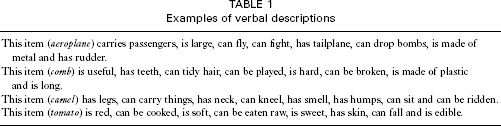
Verbal descriptions were printed on cards, and below the description a space was included for writing the concept's name and for indicating the three features that were judged more important for the name choice. Some examples of the verbal descriptions used are presented in Table 1.
Examples of verbal descriptions
Procedure
Participants were tested in small groups, and each participant answered the items in a different random order. Participants were instructed to read each description completely and to write down the name of the concept they thought best corresponded to the description presented. After naming they were also instructed to write down the three features that determined their answer, considering their order of importance. Two definitions (rhinoceros and garbage can) were presented as training examples.
Results
A mean percentage of 70.26% of correct naming responses was obtained with no significant differences observed between living and nonliving domains (respectively, 73.6% for living vs. 66.93% for nonliving). To evaluate predictions the features selected to support correct naming were analysed by domain, feature type, and feature distinctiveness both by participants and by concepts (i.e., item analysis). In the first case the features selected for the total of living and for the total of nonliving concepts named correctly were analysed considering first, second, and third choices. In the second case, analysis was done considering the features selected for each concept (also first, second, and third choices) by the participants who correctly named it. In each case an analysis of variance (ANOVA) was performed considering domain, feature type, and feature distinctiveness as independent variables, and an alpha level of .05 was considered for all statistical tests. As all variables were manipulated at a within-subject level, the by-participants analysis was performed with a repeated measures design, while a mixed design was used for the by-items analysis, with domain as between-participants variable and feature type and feature distinctiveness as within-participants variables. Results for first feature selected (i.e., first choice) are presented by participants in Figure 1, considering domain, feature type, and feature distinctiveness.
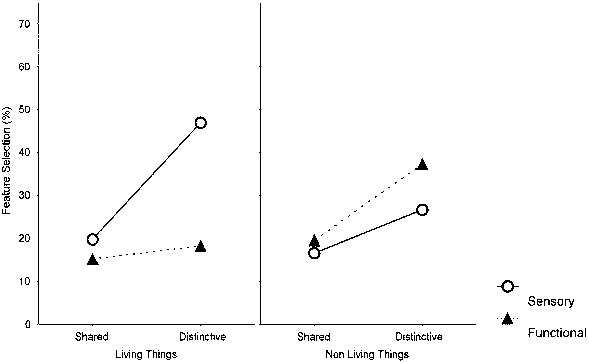
First feature selection (in percentage) by domain, feature type, and feature distinctiveness.
In the case of the by-participants analysis main effects were found for feature type, F(1, 24) = 5.13, MSE = 235.41, p < .05, and feature distinctiveness, F(1, 24) = 45.56, MSE = 231.61, p < .05, showing that sensory features were more often selected than functional features and that more distinctive features were selected more often than more shared features. Significant interactions were also observed for Domain × Feature Type, F(1, 24) = 47.73, MSE = 146.78, p < .05, Feature Type × Feature Distinctiveness, F(1, 24) = 5.33, MSE = 159.14, p < .05, and for the Domain × Feature Type × Feature Distinctiveness interaction, F(1, 24) = 15.27, MSE = 207.05, p < .05. Post hoc analysis (Scheffé test) showed in the first case that sensory features were selected more often than functional features for living things and the reverse for nonliving things (although the difference failed to reach significance level in this case, p = .07). In the second case, post hoc analysis (Scheffé test) showed that sensory distinctive features were more selected than functional distinctive features, with no significant difference found for shared features, and also that distinctive features were more selected than shared features for both feature types. Finally, post hoc analysis (Scheffé test) of the triple interaction showed that the distinctive over shared advantage in feature selection was more pronounced in the case of sensory features for living things and in the case of functional features for nonliving things. The by-item analysis confirmed the main effect found for feature distinctiveness, F(1, 28) = 6.84, MSE = 764.86, p < .05, and the Domain × Type interaction, F(1, 28) = 4.24, MSE = 826.29, p < .05; same post hoc analysis results. Other effects were not significant.
When the analysis was extended to second and third features selected these effects were greatly reduced, with no significant effects observed in the case of the by-item analysis, and with significant effects observed in the case of the by-participants analysis only when it was performed considering simultaneously the three features selected. Trying to understand why this might have happened, we interviewed some of the participants about how they completed the feature selection task. Some stated that the demand to justify their response with three features did not make sense for many concepts, where just one or two features supported naming. Thus it is possible that many features were selected second and third just to fulfil the task and had no contribution to the response, which would explain these results.
A complementary error analysis of the misnamed concepts showed that about 13.88% of the errors were living things and 15.75% nonliving things (nonresponses were only to 0.4% of the total errors). All errors were concepts of the same domain and category (e.g., monkey instead of dog, apple instead of tomato, wheelchair instead of bicycle). Moreover, considering the three features chosen to support the naming, the name was correct, which makes the errors attributable to a failure in distinguishing the real target name from a competitor. Taking into account that the first feature selected had probably more weight for naming, this selection was analysed in the same manner as that for correctly named concepts. In the case of the by-participants analysis a main effect was found for feature type, F(1, 24) = 11.24, MSE = 703.23, p < .05, with sensory features more selected overall than functional features. A significant interaction was also observed for Domain × Feature Type, F(1, 24) = 17.01, MSE = 681.32, p < .05, post hoc analysis (Scheffé test) showing that sensory features were selected more often than functional features for living things with no feature type advantage for nonliving things. Finally, a significant triple interaction was also observed, F(1, 24) = 8.88, MSE = 835.5, p < .05, but no significant differences emerged from the post hoc analysis. The by-item analysis confirmed these three effects, F(1, 24) = 4.47, MSE = 100.9, p < .05, for the feature type; F(1, 24) = 5.36, MSE = 1,000.9, p < .05, for the Domain × Feature Type interaction; and F(1, 24) = 8.88, MSE = 835.5, p < .05, for the triple interaction. Overall, error analysis seems to show that failing to select the more distinctive features that were associated to the targets may have been one of the factors underlying the errors. Another factor may be name familiarity. In fact, a significant correlation of −.43 (n = 30; p < .05) was observed between naming and concept familiarity, showing that higher familiarity was related to higher naming (familiarity scale is reversed), although all materials were very familiar.
Discussion
Overall results considering the first feature selected support the hypotheses stated in the Introduction. In the first place results showed that for correctly named concepts, sensory features were selected more often than functional features for living things and that functional features were selected more often than sensory features for nonliving things. The fact that this tendency was not significant in the latter case may, however, show that feature type is more important to living things than to nonliving things, a result that is in accordance with Farah and McClelland's (1991) “single feature-domain connection hypothesis”. If this is the case, this result may show that functional features do not vary across domains in a manner that is relevant to naming. In the second place, results also showed that, independent of feature type, distinct features were more often selected than shared features to support naming. Moreover, the role of feature distinctiveness was also confirmed by error analysis, as failure to notice more distinctive features associated to the targets may have been one of the factors for the naming errors.
In summary, the present results seem to show that at least feature type and feature distinctiveness, as well as concept's domain, play a significant role in naming from definition.
Further confirmation of these results and explanations is obviously needed with larger sets of features and concepts and should include more detailed concept domain and feature type classifications (e.g., Cree & McRae, 2003). Other variables that have been demonstrated to influence naming, such as age-of-acquisition or word familiarity, can and should also be explored within this framework. The present study showed that, although concept familiarity was controlled for across domains, it nevertheless was correlated to correct naming. Other feature dimensions such as feature dominance (e.g., Sloman & Ahn, 1999) and degree of feature intercorrelation (e.g., Moss et al., 2002; Tyler et al., 2000) have also been associated with semantic memory organization and should be considered. The present study controlled these variables among sets, which does not make it suitable for this evaluation. Another candidate is semantic relevance, an index proposed by Sartori and Lombardi (2004) that combines feature dominance and feature distinctiveness as an aggregate dimension, which also has been shown to be associated with naming from description.
The methodological approach presented in the present paper also has practical implications. Although not as common as the picture-naming task, naming from definition has been extensively used in the more general context of neuropsychological evaluation and for studying category-specific impairments. However, to our knowledge, with the recent exception of Sartori and Lombardi (2004), the manipulation of features comprising the definitions has not been systematically done. This approach has two advantages. First, at a theoretically oriented level, it allows for a closer look at which concept characteristics and especially at which feature dimensions are relevant to naming. The more used picture-naming task has already provided much information on the influence of both visual and verbal characteristics to naming (see, e.g., Lambon Ralph, Graham, Ellis, & Hodges, 1998, for a review) but pictures, unlike verbal definitions, are difficult to manipulate in terms of theoretical important variables such as feature type, distinctiveness, and so on. Second, at a clinically oriented level, more controlled verbal definitions may allow a more fine-graded diagnostic of the patients’ difficulties in naming and allow for a more precise intervention in terms of neuropsychological rehabilitation.
Footnotes
Appendix
List of items