







Abstract
Inhibition of return (IOR) refers to slowed responding to a target that appears in the same rather than in a different location as a preceding peripheral onset cue. This study examined IOR as a function of whether the peripheral onset cue was a word that participants were directed to remember or forget. Using a modified item-method directed forgetting paradigm, words appeared one at a time to the left or right, followed by a remember or forget instruction. A target dot was then presented either in the same peripheral location as the preceding word or in a different location; participants made a speeded response to localize this target. Confirming compliance with the memory instructions, recall tests that alternated with blocks of IOR trials (Experiment 1) revealed few intrusions of to-be-forgotten words, and a final recognition test (Experiments 1 and 3) revealed more hits for to-be-remembered words than for to-be-forgotten words. Reaction times to the target dot revealed greater magnitude IOR following to-be-forgotten words than following to-be-remembered words (Experiments 1 and 3). Moreover, when compared to baseline IOR values (Experiment 2), it appeared that this difference resulted from a magnification of IOR following forget instructions and a reduction in IOR following remember instructions. These results demonstrate the usefulness of IOR as an index of memorial processes and suggest that attentional orienting may play a role in the remembering and forgetting of words presented in peripheral visual locations.
Adaptive behaviour depends on adaptive thought. One of the key aspects of adaptive thought is the ability to retain information that is of immediate or future relevance but to forget information that is of no further use (e.g., Bjork, 1972; Bjork & Bjork, 1996). One way in which intentional forgetting has been studied in the laboratory is with directed forgetting tasks, of which there are two common paradigms (see Basden, Basden, & Gargano, 1993; MacLeod, 1999). In the list-method directed forgetting paradigm, participants are given a list of words that is interrupted at its midpoint by the instruction to forget the words that have been presented. When later tested for recall of the words on the first half of the list (the to-be-forgotten, TBF, words), performance is worse relative to recall of the words on the second half of the list (the to-be-remembered, TBR, words). In the typical item-method paradigm, which is of particular interest for the present study, the word list is presented one word at a time. Each word is followed by a memory instruction in the final seconds of word presentation or following a short delay. On a random half of trials, this instruction is to remember the word; on the other half of trials, it is to forget the word. Following the presentation of the entire list of words, memory performance is assessed by recall and/or recognition. Typical results reveal better recall and recognition of TBR words relative to TBF words (see Basden & Basden, 1998, for a review). In a modified item-method paradigm, Zacks, Radvansky, and Hasher (1996) also revealed few intrusions of TBF words into the recall of TBR words. Regardless of the paradigm used, the difference in memory performance for TBR relative to TBF words is referred to as a directed forgetting effect. Importantly, directed forgetting effects do not seem to be due to experimenter demand characteristics; such effects persist even when financial incentive is offered for the report of TBF words (e.g., MacLeod, 1999).
The influence of the memory instruction on recall and recognition performance in an item-method paradigm has been explained with reference to selective encoding (e.g., Basden et al., 1993; MacLeod, 1999). The suggestion is that participants engage in maintenance rehearsal until the presentation of the memory instruction. If the instruction is to remember the word, then more elaborate encoding is engaged; if the instruction is to forget the word, rehearsal is aborted. As such, fewer TBF words are reported in recall and endorsed in recognition precisely because they have not been encoded as fully as TBR words. Such differential encoding of TBR and TBF items is consistent with patterns of evoked-response potentials (ERPs) that have been measured during an item-method directed forgetting task (Paller, 1990).
Even though a selective encoding account can accommodate the memory performance that is obtained in an item-method directed forgetting paradigm, it only explains the fate of information after it has been selected; it does not indicate how this selection occurs. How are the TBR items selected for elaborative rehearsal; how are the TBF items dropped from the rehearsal set? One possibility is that attentional mechanisms subserve both functions by restricting access of TBF items to limited processing resources. This would prevent the continued rehearsal of TBF items while also freeing precious processing resources for the rehearsal of TBR items. Just such a possibility is implied by Zacks et al. (1996). In the context of accounting for age-related changes in memory performance, Zacks et al. proposed that, “analogous to the mechanism of inhibition of return in visual search… attentional inhibition may…have the function of preventing the return of attention to a previously rejected item, whether that item is an external stimulus event or a thought” (pp. 143–144). Even though Zacks et al. refer to an inhibitory effect that prevents the return of attention to a rejected item, the logical extension of this reasoning is that the instruction to reject an item in the first place (e.g., via a forget instruction) must generate some kind of inhibitory tag or invoke a mechanism that can influence subsequent processing. The goal of the present investigation is to explore this possibility by examining the relative effects of remember and forget instructions on inhibition of return (IOR; Posner, Rafal, Choate, & Vaughan, 1985) to a peripheral target.
IOR refers to slowed reaction times (RTs) to a target that appears in the same rather than a different location as a peripheral onset cue (Posner & Cohen, 1984). Although there is debate over whether the effects of IOR have an attentional locus (e.g., Handy, Jha, & Mangun, 1999; Reuter-Lorenz, Jha, & Rosenquist, 1996), a motor locus (e.g., Klein & Taylor, 1994; see Taylor & Klein, 1998, for a review), or some combination of the two (e.g., Abrams & Dobkin, 1995; Kingstone & Pratt, 1999; Rafal, Egly, & Rhodes, 1994; Taylor & Klein, 2000), the source of the effect is less contentious: IOR is the result of a saccadic programme to fixate a peripheral location and occurs whether or not the programme is executed (Rafal, Calabresi, Brennan, & Sciolto, 1989). Thus, in the case of a peripheral onset cue, IOR is generally conceived of as an aftereffect of the automatic capture of overt or covert attention to the location of the cue. Importantly, this aftereffect is revealed only when attention is withdrawn from that location prior to the onset of the target (e.g., Posner & Cohen, 1984); if attention does not leave the cued location, IOR may be masked or eliminated by attentional facilitation (cf. Danziger & Kingstone, 1999).
To the extent that IOR provides an index of the aftereffects of (covert or overt) attentional allocation and withdrawal, it should be possible to use IOR to reveal differential attentional allocation to the spatial representation of TBR and TBF items. Why examine allocation to the spatial representation of TBR and TBF items, rather than their semantic representations? Consider that with space being the fundamental percept of vision (cf. Kubovy, 1988), it is difficult to perform a nonspatial discrimination of a visual stimulus without also attending to its location (e.g., Tsal & Lavie, 1993). Indeed, concurrent what and where discriminations about a visual object may be made without mutual interference (e.g., Duncan, 1993). This suggests that differential encoding of TBR and TBF words might be accomplished, in part, by differential attention to their spatial representations. If this is true, then Zacks et al.'s (1996) claims for an inhibitory effect “analogous to inhibition of return” might actually be IOR in the case of “previously rejected” peripherally presented words. If so, then the instruction to forget a peripherally presented word should result in greater IOR than the instruction to remember a peripherally presented word. This prediction follows from the notion that attention is paid to both words until the presentation of the memory instruction. If the cue is to forget, then attention is withdrawn from the spatial representation of the peripherally presented word, thereby revealing IOR. Although Zacks et al. make no explicit claims about the fate of relevant information, the logical extension would be that if the cue is to remember, then attention is maintained on the spatial representation of the peripherally presented word. Given that IOR is not observed when attention is maintained at the cued location (e.g., Posner & Cohen, 1984), this maintenance of attention on the spatial representation of a remember cued word would serve to reduce or eliminate IOR. Hence, when compared directly to one another, the magnitude of IOR should be overall greater following forget instructions than following remember instructions.
The prediction of greater IOR effects following forget instructions than following remember instructions was tested in the context of a modified item-method directed forgetting paradigm. Participants were presented with an onset word in the visual periphery. Because the memory instruction was not known a priori, participants were likely to attend voluntarily to this onset as well as to have their (covert and/or overt) attention captured automatically by virtue of its abrupt onset. Following the presentation of this peripheral word, a memory instruction was presented. This instruction was a high- or low-frequency tone. The memory instruction was followed by the presentation of the target with equal probability to the left or right. Thus, on half of the trials, the target appeared in the same location as the TBR or TBF word; on the other half of the trials, the target appeared in a different location. Participants made a speeded button-press to indicate the location of the target. IOR was measured as the RT difference when the target appeared in the same rather than in a different location relative to the word and as a function of whether the word was TBR or TBF.
In Experiment 1, IOR trials were presented in five blocks that alternated with recall tests. These recall tests were intended primarily to reinforce the instruction to commit the TBR words to memory but were also examined for the intrusion of TBF words into free recall (cf. Zacks et al., 1996). Following the last recall test, participants were given a recognition test that explicitly required the endorsement of all presented words-whether they were TBR or TBF. Note that performance on the recall and recognition tests was intended as a manipulation check to confirm that participants were complying with the memory instruction. The dependent measure of greatest interest was the magnitude of IOR following these instructions. Again, the prediction was for IOR to be greater following TBF words than following TBR words.
Despite the fact that the prediction for performance in Experiment 1 is stated in terms of the relative magnitude of IOR on TBF versus TBR trials, it nevertheless seemed useful to also obtain a baseline measure of IOR in the absence of a concurrent memory task. As such, Experiment 2 examined IOR under identical stimulus conditions as Experiment 1 but in the absence of any memory instruction or measurement. Finally, Experiment 3 replicated the methods of Experiment 1 except that the interposed recall tests were eliminated from the blocks of IOR trials. This was done to serve both as an independent replication of key findings in Experiment 1 and to ensure that the alternation of recall tests with IOR trials did not influence the pattern of IOR results.
Experiment 1
In Experiment 1, a tone instructed participants to remember or forget a word that had been presented to the left or right of centre. This was followed by an onset target to the left or right of centre. Participants made a speeded button-press to indicate the location of this target, and IOR was measured as the RT difference when the target appeared in the same versus a different location relative to the word. The prediction was that the magnitude of this IOR effect would be greater following TBF words than following TBR words.
Method
Participants
A total of 16 undergraduate students volunteered in exchange for psychology class credit. Participants were tested individually in a session that lasted less than 1 hr. All participants were naïve to the purpose of the experiment.
Stimuli and apparatus
A 17′ ViewSonic PT775 colour display monitor presented stimuli on a uniform white field. Three 2-point outline black boxes were aligned along the horizontal axis, with the middle box placed in the centre of the computer screen. The left and right boxes were centred at 30% and 70% of the horizontal extent of the monitor, respectively. At a viewing distance of approximately 57 cm, the boxes were 3 degrees of visual angle on a side. Peripheral boxes were separated from the central box by 3 degrees of visual angle, measured between adjacent sides. Stimulus presentation and data collection were controlled by a Macintosh G4-400 running PsyScope 1.5.2 (Cohen, MacWhinney, Flatt, & Provost, 1993). Participants responded by pressing keys or typing responses onto a standard Macintosh Universal Serial Bus keyboard.
The Kucera and Francis (1967) word norms were used to construct two lists of 120 words each that had approximately equal overall word frequency. The words on both lists were nouns, three to eight letters long. Each list served as a word list for half of the participants and as a foil list for the other half. The word list served as peripheral cue stimuli that could be presented individually in the centre of the left and right stimulus boxes. The foil list was reserved for use on the recognition test. All words were presented in lower case and fitted within the frame of the stimulus box.
The fixation stimulus was a solid black circle, 0.5 degrees of visual angle in diameter, which was placed in the centre of the middle stimulus box. The memory instruction was a high- (1170-Hz) or low-frequency (260-Hz) tone. The target stimulus was a solid black circle—identical to the fixation stimulus—which occurred in the left or right stimulus box.
Procedure
Five blocks of 24 IOR trials alternated with five recall tests. Prior to beginning the experiment, participants were given verbal instructions from the experimenter. These were reinforced by written instructions that appeared on the computer screen prior to the first block of IOR trials. Both sets of instructions described the trial events, the meaning of the tones that were used as memory instructions, and the recall tests that would be administered throughout the block; the target response was described, and speed and accuracy of this response were both emphasized. For half of the participants, a high tone instructed them to remember, and a low tone instructed them to forget; this designation was reversed for the other half of the participants. The designation of word lists as word or foil was counterbalanced within each tone designation.
To acquaint participants with the sound of the tones and to reiterate their meaning, 10 tone familiarization trials followed the initial instructions. On each of these trials, participants were given a 3-s presentation of the relevant tone-instruction pairing via words in the centre of the computer screen (e.g., “High Tone-Remember”). At 2 s into this presentation, the indicated tone was sounded. After these trials, participants received instructions to begin the experiment.
The following describes the IOR trials, recall tests, and the recognition memory test in turn.
IOR trials. Each IOR trial began with the presentation of the three stimulus boxes. After 500 ms, the fixation stimulus appeared in the middle box and remained visible throughout the trial. At an 800-ms delay following the appearance of the fixation stimulus, a word was presented for 400 ms with equal probability to the left or right; the word was drawn randomly without replacement from the 120-item word list. No overt response was required to the word. After a 200-ms delay, there was a 400-ms presentation of a memory instruction tone. The pairing of words and memory instructions was done randomly by the computer, with the constraint that half of the memory instructions were remember, and the other half were forget. Following a 200-ms delay, a target dot was presented with equal probability to the left or right.
Participants made a speeded spatially compatible response to localize the target by pressing the “f” key for left and the “j” key for right. These keys were selected so that participants could keep their fingers aligned on the home row during both the IOR trials and the recall tests. If participants made a correct response within 1,000 ms of target presentation, they heard a computer-generated “correct beep”; if they hit an incorrect key, they heard an “incorrect beep”. If participants struck any key between the presentation of the word and the target, they heard a “boing” to alert them of the need to withhold a response until target presentation. To maximize ecological validity, eye movements were neither monitored nor discouraged. In fact, eye movements were probably necessary in order to foveate and read the peripheral word. Of importance for present purposes is that IOR for manual target localization responses is caused (cf. Taylor & Klein, 1998) by peripheral onsets, whether or not the eyes move to them (e.g., Taylor & Klein, 2000).
The IOR trials were presented as a 2 (word location: left, right)×2 (memory instruction: remember, forget)×2 (target location: left, right) within-subjects mixed-blocks factorial design. For the purpose of analysis, however, the design was reconceptualized by collapsing over the same word-target location (left-left, right-right) and different word-target location (left-right, right-left). Within this framework, the IOR trials constituted a 2 (location: same, different)×2 (memory instruction: remember, forget) design.
Recall test. Following the presentation of each block of 24 IOR trials, a recall test was presented. At the beginning of each recall test, participants viewed a computer display that instructed them to use the keyboard to type in words that they had been asked to remember during the preceding block of IOR trials; there was no mention of words they had been asked to forget. Participants were encouraged to be attentive to spelling but were told that the case of the words did not matter.
The instructions remained in the top half of the computer screen. The prompt, “Enter a word then press the space bar” was centred horizontally on the computer screen, slightly above the horizontal midline. Across the horizontal midline was a 6-point outline black box in which keystrokes were made visible to the participant. Each keystroke was printed in 18-point Arial Black font. The contents of this box were recorded and cleared when the space bar was depressed.
Participants had unlimited time to input the words that they remembered from the preceding IOR trials. The words entered were evaluated for: (a) their match to TBR words from the immediately preceding block of IOR trials; (b) their match to TBF words from the immediately preceding block of IOR trials; (c) their match to words from previous blocks of IOR trials (on-list intrusions); and (d) their match with no other presented words (off-list intrusions). Words could be entered in upper, lower, or mixed case. However, due to the subjectivity involved in determining the word intended by a misspelling, words had to be spelled correctly in order to count as a match to a presented item; misspelled words were counted as off-list intrusions. As is seen in the results, there were very few such intrusions/misspellings. The first instance of duplicated words was accepted; remaining duplicates were ignored and counted neither as correct productions nor as errors.
When participants had finished entering all the words they could recall, they pressed an escape sequence (shift-4, $) to exit the recall test. The study then progressed to the next block of 24 IOR trials or, following the last recall test, to the recognition test.
Recognition test. Following the fifth alternation of IOR trials with memory recall, participants were presented with a recognition test. They had not received any prior instruction to indicate that such a test would follow. Participants were instructed that words would appear one at a time on the computer screen and that they were to indicate whether each word had been presented on any of the preceding trials. They were told to press “y” to indicate that the word had been presented and “n” to indicate that it had not. Participants were explicitly told that it did not matter whether the word had received a remember or a forget instruction and that all presented words, regardless of instruction, should be endorsed with a “y” response.
The instructions remained in the top half of the computer screen, while the word being queried was presented in blue 18-point Arial font in a position located just above a 6-point black outline box that was centred in the middle of the computer screen and used to display the character entered from the keyboard. After the press of the space bar, the entry was recorded and the box cleared of its contents. Responses other than “y” or “n” (e.g., yn) were excluded as errors.
The words presented on the recognition test were drawn randomly without replacement from the 120-item word list used in the IOR trials (five blocks of 24 words each) and from the 120-item foil list. Participants were given unlimited time to make their responses. Response times were recorded but, because speed was not emphasized, they will not be considered further.
Results
Unless otherwise stated, significance for all statistical tests reported in this study was evaluated at α = .05. The results for the recall and recognition tests are used as a manipulation check on compliance with the memory instructions and precede consideration of the results from the IOR trials. The data from one participant were eliminated due to an apparent misunderstanding of the tone designation: This individual recalled 0 words that had been TBR and 27 words that had been TBF; the hit rate on the recognition test was 32% for TBR words and 74% for TBF words. No other participant showed effects in this direction- across all remaining participants, recall and recognition were better for TBR than for TBF words.
Recall performance. Across five blocks of IOR trials, 60 words were TBR, and 60 were TBF. Totalled over these blocks, participants correctly reported an average of 31.93 (SE = 1.64) of the 60 TBR words (53.22%) and intruded 0.93 (SE = 0.25) of the 60 TBF words (1.55%). When analysed in a one-way repeated measures analysis of variance (ANOVA), the difference in the report of words from these two memory conditions was significant, F(1, 14) = 326.55, MSE = 22.07.
Averaged over participants, the total number of on-list intrusions (i.e., intrusions from previous blocks of IOR trials) was 0.27 (SE = 0.12) TBR words and 0.07 (SE = 0.07) TBF words. This difference was not significant, F(1, 15) = 3.50, MSE = 0.09. Totalled over five blocks of trials, there was an average of 4.00 off-list intrusions (i.e., true off-list intrusions and/or misspellings).
Recognition performance. Only trials on which a single “yes” or “no” response was made on the computer keyboard were used in this analysis; trials on which keys other than “y” or “n” were used and trials on which multiple keys were struck prior to entering the response with the space bar were excluded. This resulted in an average loss of 3.80 of the 60 remember trials, 1.80 of the 60 forget trials, and 2.13 of the 120 foil trials. To account for the consequent alteration in the base number of eligible responses, the following represents recognition performance as a percentage of the total number of included trials for each condition.
The percentage of endorsements (i.e., “yes” responses) was analysed in an ANOVA as a function of recognition condition (remember, forget, foil). In the case of remember and forget words, this represents the hit rate; in the case of foils, this represents the false alarm rate. This analysis revealed a significant effect of condition, F(2, 28) = 158.78, MSE = 83.05, with 71.72% (SE = 3.31) “yes” responses to remember words, 31.59% (SE = 4.63) to forget words, and 13.85% (SE = 3.28) to foils. All of the pairwise differences between these conditions were significant. The greater percentage of hits for remember than for forget words is consistent with the typical findings from item-method directed forgetting tasks. The difference in the percentage of “yes” responses to forget words and foils indicates that there was some memory for the forget words, albeit not as much as for the remember words.
IOR trials. Overall, performance on the recall and recognition tests suggests that participants complied with the memory instructions. As such, the interest was in determining whether memory instructions affected the magnitude of IOR to the subsequent target. This would be revealed as a significant interaction between word-target location and memory instruction. The RTs for correct responses that were made within 80–1,000 ms of target onset are shown in Figure 1. These data were analysed in an ANOVA, with word-target location (same, different) and memory instruction (remember, forget) as factors. This analysis revealed no significant main effect for word-target location and no significant main effect for memory instruction. Critically, however, there was a significant interaction between these factors, F(1, 14) = 8.06, MSE = 934.67. There was a significant 39-ms IOR effect following forget cues, F(1, 14) = 11.89, MSE = 934.67, and a nonsignificant −6-ms IOR effect following remember cues, F < 1.
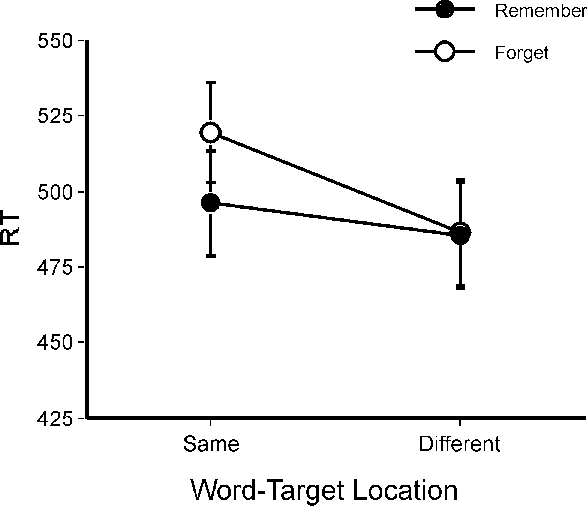
Experiment 1. Reaction times (RTs) in milliseconds (ms) to respond to the target on IOR trials, as a function of word-target location (same, different) and memory instruction (remember, forget). Error bars show the standard error of the mean.
The associated accuracies on IOR trials were also analysed. None of the effects was significant. When they followed remember cues, targets were localized correctly on 88.76% (SE = 2.99%) of trials on which they occurred in the same location as the word and on 88.75% (SE = 2.70%) of trials on which they occurred in a different location. When they followed forget cues, targets were localized correctly on 88.50% (SE = 2.41%) of trials on which they occurred in the same location and on 92.70% (SE = 1.83%) of trials on which they occurred in the different location.
Discussion
The results of Experiment 1 reveal a clear difference in the magnitude of IOR as a function of memory instruction. The recall and recognition performance is consistent with the use of the tones to instruct memory. The impact of having done so is obvious: When a target followed a forget instruction there was a significant 39-ms IOR effect; when a target followed a remember instruction there was a nonsignificant −6-ms IOR effect.
These results are exactly those predicted by the view that differential attentional allocation plays a role in item-method directed forgetting of peripherally presented words. The relatively larger magnitude IOR effect following forget instructions is consistent with the notion that attention is paid to the peripheral word but then withdrawn from the spatial representation of that word upon presentation of the instruction to forget. In contrast, the lack of an IOR effect following remember cues is consistent with the notion that attention may dwell on the spatial representation of the peripheral word despite the fact that the impending target is equally likely at either location. This continued dwell time may create a facilitatory effect that operates in conjunction with IOR laid down by the onset event to produce a null effect; alternatively, attention could simply operate on a different time course, such that there is a delay in returning attention to centre in preparation for the target. This possibility is currently being investigated. Regardless of the exact mechanism, the fact is that the predicted difference in the magnitude of IOR following remember and forget cues was observed.
Based on the results of Experiment 1, it appears that memory instructions influence attentional allocation to the spatial representation of peripheral words. Nevertheless, because there is no baseline measure of IOR, it is impossible to determine whether the difference in magnitude following TBF and TBR words results from attentional effects operating in both memory conditions or in only one. This is clearly an important consideration in determining the attentional mechanism(s) that may underlie the effective use of memory instructions in an item-method task. Is better memory performance for TBR items than for TBF items subserved by the withdrawal of attention from TBF items and an attendant increase in the availability of processing resources for TBR items? Alternatively, is better memory performance for TBR items due to the maintenance of attentional resources on these items and poorer memory performance for TBF items due to the withdrawal of attention from these items?
Experiment 2
Experiment 2 provided a baseline IOR measurement for the paradigm used in Experiment 1. To determine the effectiveness of the stimuli in establishing and measuring IOR independently of memory instruction, the methods of Experiment 1 were repeated except that all memory demands were eliminated.
Method
Participants
A total of 16 undergraduate students who had not participated in Experiment 1 volunteered in exchange for psychology class credit. Participants were run individually in an experimental session that lasted less than 1 hr. All were naïve to the experimental purpose.
Stimuli and apparatus
Stimuli and apparatus were identical to those in Experiment 1 except that there was no need to counterbalance the tone designation (i.e., because the tone did not have any symbolic meaning). The word and foil lists from Experiment 1 were each used for half of the participants.
Procedure
Unlike in Experiment 1, there was no memory instruction or test in Experiment 2. The IOR trials were presented in a single block of 120 trials that had rest breaks after each set of approximately 24 trials. The instructions were modified accordingly.
Results
The RTs for correct responses made within 80–1,000 ms of target onset were analysed in a two-way ANOVA with tone stimulus (high, low), and word-target location (same, different) as factors. Following a high tone, RTs were 345 ms (SE = 10.34) to targets that occurred in the same location as the word and 327 ms (SE = 9.81) to targets that occurred in a different location. Following a low tone, RTs were 353 ms (SE = 9.80) to targets that occurred in the same location and 329 ms (SE = 6.65) to targets that appeared in a different location. The only significant effect was that of word-target location, F(1, 15) = 21.09, MSE = 351.07, revealing an overall 22-ms IOR effect.
The overall accuracies for the IOR trials were analysed in a similar two-way ANOVA. When they followed high tones, responses were made correctly on 97.93% (SE = 0.90%) of trials when the target occurred in the same location as the word and on 98.76% (SE = 0.59%) of trials when the target occurred in a different location. When they followed low tones, responses were made correctly on 98.13% (SE = 0.79%) of trials when the target occurred in the same location as the word and on 95.58% (SE = 1.44%) of trials when the target occurred in a different location. None of the effects in the analysis of accuracies was significant.
Discussion
The results of Experiment 2 are instructive. There was a significant 22-ms IOR effect obtained in the absence of a concurrent memory task. 1 Interestingly, the magnitude of this effect is numerically in between the significant 39-ms effect observed following forget cues in Experiment 1 and the nonsignificant −6-ms effect observed following remember cues. Although caution is required when drawing comparisons between two experiments that differ so markedly in their cognitive demands, an exploratory between-subjects ANOVA was used to compare the target RTs of Experiments 1 and 2. Tone in Experiment 2 was used as a dummy code for the remember/forget instruction. This allowed for an analysis of target RTs using memory instruction (remember, forget) and word-target location (same, different) as within-subjects variables and experiment (1, 2) as a between-subjects variable. In addition to a significant main effect of experiment, F(1, 29) = 24.70, MSE = 14,432.76, and an interaction of this factor with memory instruction, F(1, 29) = 4.92, MSE = 557.48, there was a critical three-way interaction between word-target location, memory instruction, and experiment, F(1, 29) = 5.60, MSE = 540.94. This three-way interaction is consistent with the suggestion that the magnitude of IOR was magnified on the TBF trials and reduced on the TBR trials of Experiment 1 relative to the baseline control condition of Experiment 2. In other words, this exploratory analysis suggests that the attentional influences operating in directed forgetting affect both the remember and the forget conditions.
This value is similar in magnitude to IOR effects that are obtained in typical cue–target paradigms that require localization (cf. Taylor & Klein, 2000, no response manual IOR = 21 ms) and is consistent with a 29 -ms effect obtained with another group of 21 participants who were run in a pilot version of the present paradigm.
Even disregarding this exploratory comparison of the magnitude of IOR effects between Experiments 1 and 2, even the simple fact that there was a significant IOR effect in Experiment 2 is important. It suggests that attentional effects operating to generate compliance with the memory instructions were not isolated to the forget condition of Experiment 1. Given only the results of Experiment 1, it would be unclear whether an IOR effect emerged in the forget condition where none would otherwise have occurred and/or whether an IOR effect was obscured or eliminated in the remember condition where one would otherwise have occurred. The finding of a significant IOR effect in Experiment 2 clearly indicates that, given the stimulus conditions and timing parameters of Experiment 1, an IOR effect would have been expected in the absence of a concurrent memory task. As such, the lack of such an effect in the remember condition of Experiment 1 strongly suggests a role for attention in that condition, whether alone or-given the results of the exploratory between-experiments comparison—in conjunction with a complementary attentional effect in the forget condition. Thus, it would appear that the difference in memory performance between the TBR and TBF conditions was likely subserved not only by attentional withdrawal from the TBF items but also by attentional dwell on the TBR items.
Although differential allocation of attention to TBR and TBF words is an exciting possibility, before drawing too heavily on the results of Experiments 1 and 2, it is prudent to independently replicate the critical interaction between target location and memory instruction that was observed in Experiment 1. Moreover, it is important to do this in the absence of interposed recall tests. Experiments 1 and 2 differed from one another not only in terms of whether the target task was performed concurrently with a memory task, but also in the alternation of recall trials with IOR trials in Experiment 1 but not in Experiment 2. Although intended to reinforce the memory instruction, it is possible—albeit, not likely—that the interposed recall trials were responsible for the larger magnitude IOR effects following TBF than TBR words. Elimination of the alternating recall trials prohibits any such effect on IOR.
The elimination of recall trials also allows for an uncontaminated measure of directed forgetting. Consider that on the recall tests of Experiment 1, participants were asked to input all the words they had been instructed to remember, with no mention of the words they had been instructed to forget. As such, any recall of TBF words was not due to an active attempt to retrieve these from memory but due to unintentional intrusion of these words into the recall of TBR words. This differs from the typical directed forgetting task in which participants are explicitly told also to recall the TBF words. The recall of TBR words in the absence of explicit recall of TBF words may have inflated the difference observed between these items on the recognition test. That is, greater recognition of TBR words at the end of the experiment may have been due, in whole or in part, to their prior recall during the experiment. Experiment 3 addresses these possibilities by eliminating the recall trials from the methods of Experiment 1.
Experiment 3
To ensure that the key findings of Experiment 1 were not due to the interposition of recall trials within the blocks of IOR trials, Experiment 3 eliminated recall. Although it would have theoretically been possible to include a recall test at the end of the experiment, the large number of TBR words (60) made this seem too difficult for the participants. As such, the final recognition test served as the measure of directed forgetting and as a manipulation check for the memory instruction. In all other respects, Experiment 3 was identical to Experiment 1.
Method
Participants
A total of 33 undergraduate students volunteered in exchange for psychology class credit. Participants were tested individually in a session that lasted less than 1 hr. None had participated in Experiments 1 or 2.
Stimuli and apparatus
The stimuli and apparatus were identical to those of Experiment 1.
Procedure
The procedure was identical to that of Experiment 1 except that the recall trials and all references to them were eliminated.
Results
The data from three participants were eliminated. Two participants failed to produce responses to targets on forget trials: One did not produce any responses at all; the other did not produce any responses when the target appeared in a different location relative to the TBF word. The third participant appeared to have confused the meaning of the tones used as memory instructions, as revealed by a hit rate of 65% for TBF words and 21% for TBR words. No other participant showed effects in this direction—all of the remaining participants showed overall greater recognition of TBR than TBF words.
Recognition performance. As in Experiment 1, only trials on which a single “yes” or “no” response was made on the computer keyboard were used in the analysis. This resulted in an average loss of 3.57 of the 60 remember trials, 2.10 of the 60 forget trials, and 2.57 of the 120 foil trials. In the following, recognition performance is calculated as the percentage of total number of unspoiled trials in each condition.
The percentage of trials on which a “yes” response was made was calculated as a function of recognition condition (remember, forget, foil). This analysis revealed a significant effect of recognition condition, F(2, 58) = 196.91, MSE = 110.49, with 66.71% hits to remember words, 38.71% hits to forget words, and 12.86% false alarms to foil words. All of the pairwise comparisons were significant. The greater percentage of hits for remember than forget words reflects a directed forgetting effect; the greater percentage of hits for forget words relative to false alarms to foil words indicates that there was some memory for forget words, even if less than for remember words.
IOR trials. The directed forgetting effect obtained on the recognition test indicates compliance with the memory instructions. As such, the interest was in determining whether the target RTs continued to reveal greater IOR effects following forget than following remember words, even when the recall tests were eliminated. To this end, target RTs were examined for those trials on which a correct response was executed within 80–1,000 ms of target onset. These RTs are shown in Figure 2. An analysis of these data revealed a significant main effect for location, F(1, 29) = 11.88, MSE = 1,231.36, but no significant main effect for memory instruction, F(1, 29) = 2.78, MSE = 2,072.69. Critically, the two-way interaction between word-target location and memory instruction was significant, F(1, 29) = 4.97, MSE = 773.00, confirming the greater magnitude IOR effect following forget instructions than following remember instructions. Planned contrasts revealed that the 11-ms IOR effect in the remember condition was not significant, F(1, 29) = 2.25, whereas the larger 33-ms IOR effect in the forget condition was significant, F(1, 29) = 21.66.
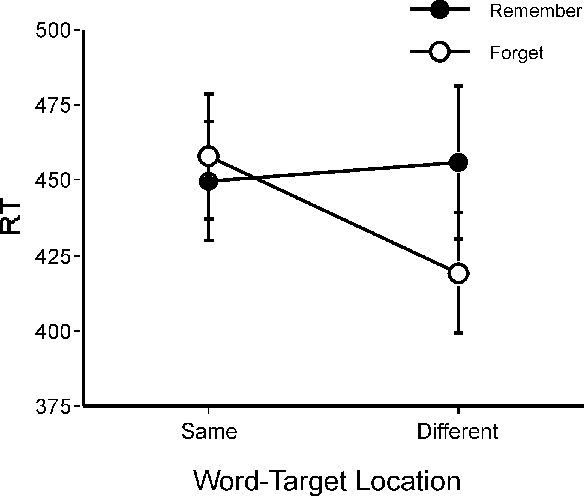
Experiment 3. Reaction times (RTs) in milliseconds (ms) to respond to the target on IOR trials, as a function of word-target location (same, different) and memory instruction (remember, forget). Error bars show the standard error of the mean.
An analysis of associated accuracies revealed no significant effects. When they followed remember instructions, targets were localized correctly on 90.34% (SE = 2.15%) of same location trials and on 86.57% (SE = 2.18%) of different location trials. When they followed forget instructions, targets were localized correctly on 88.67% (SE = 1.82%) of same location trials and on 87.54% (SE = 1.84%) of different location trials.
Discussion
The results of Experiment 3 replicate and extend the critical finding of Experiment 1: The magnitude of IOR is greater following forget instructions than following remember instructions. As in Experiment 1, the results of Experiment 3 reveal greater recognition memory for TBR than for TBF words, confirming compliance with the memory instruction. In the case of Experiment 3, the difference between the 66.71% hit rate for TBR words and the 38.71% hit rate for TBF words provides an uncontaminated measure of directed forgetting. Likewise, replication of the critical interaction between word-target location and memory instruction confirms that the significant IOR effect following forget instructions but not following remember instructions is found even in the absence of interposed recall tests. Of course, a visual comparison of Figures 1 and 2 reveals that the pattern of individual data points is slightly different between Experiments 1 and 3. As well, the scale on Figure 2 covers the same range as that on Figure 1 but reveals overall slower RTs. It thus seems likely that participants in Experiment 3 may not have been as alert to the task as those in Experiment 1 who were required to reproduce the remembered words on the interposed recall tasks. Despite this apparent difference, the magnitude of IOR continued to be larger following forget instructions than following remember instructions.
To get a better sense of how Experiments 1 and 3 compare, a mixed ANOVA was performed on the data, with experiment as a between-subjects factor. Because no recall test was given in Experiment 3, only recognition performance and target RTs were evaluated. The analysis of recognition performance revealed an interaction of recognition condition (remember, forget, foil) with experiment. This interaction suggests that the interposition of recall trials in Experiment 1 may, in fact, have inflated recognition of TBR words and interfered with recognition of TBF words. This is because relative to Experiment 1, the hit rate for Experiment 3 was 5% higher for the remember condition (71.72% vs. 66.71%), 7% lower for the forget condition (31.59% vs. 38.71%), and essentially unchanged for the foil condition (13.85% vs. 12.86%). In contrast, the analysis of target RTs revealed no obvious effects of the interposed recall test on the measurement of IOR. There was a near-significant main effect of experiment (p = .0658) and a near-significant interaction of memory instruction with experiment (p = .0501). However, there was no interaction of experiment with word-target location (p = .5937) or, most importantly, with the combination of word-target location and memory instruction (p = .12291). Given the unequal n in the two experiments, this analysis must be interpreted cautiously. Nevertheless, it does suggest that the apparent surface differences in target RTs were not meaningful between the two experiments and that the greater magnitude of IOR effects following forget than following remember instructions is reliable.
General discussion
The results of this study are clear. The generation of IOR by the visual onset of a peripheral word (Experiment 2) can be modified by the instruction to remember or forget that word (Experiments 1, 3). The present results confirm compliance with the memory instruction and—at least when there is no contamination by interposed recall tests—reveal a typical directed forgetting effect in recognition. The fact that the magnitude of IOR is reliably greater following TBF than following TBR words argues that compliance with the memory instruction involves attentional mechanisms.
Zacks et al. (1996) proposed an IOR-like mechanism that could prevent attention being reallocated to a word that was no longer goal relevant. The present study did not examine whether attention is, in fact, slowed from revisiting a no-longer-relevant forget word. This would require an exploration of the effects of attentional allocation/withdrawal to a memory-cued word (see Taylor & Klein, 1998, for a distinction between causes and effects of IOR). Instead, the present study examined the plausibility of such a mechanism by determining whether a memory instruction could affect responding to a subsequent peripheral visual target. Indeed, at least when words are presented peripherally, there is evidence that memory instructions do affect orienting to their spatial representations (Experiments 1, 3). Based on the comparison of Experiments 1 and 2, it appears that the instruction to remember a word may encourage attentional dwell on its spatial representation. To the extent that IOR occurs automatically and immediately upon the capture of attention to a peripheral onset (Danziger & Kingstone, 1999), it follows that the attentional dwell probably does not eliminate IOR but, rather, generates a facilitatory effect that combines additively with IOR. The net result is either the elimination (e.g., Experiment 1) or reduction in magnitude (e.g., Experiment 3) of measured IOR effects. In contrast, the comparison between Experiments 1 and 2 suggests that the instruction to forget a peripherally presented word serves to encourage the withdrawal of attention from a peripheral location. It is difficult to speculate whether this withdrawal increases the ceiling for the magnitude of obtainable IOR effects or, more likely, speeds the reorienting of attention to centre and thereby shifts the time course of the IOR function.
In a typical item-method directed forgetting task, the words are presented at centre, as are the memory instructions. As such, there is probably no role for a spatial attentional mechanism of the kind observed in the present study. Nevertheless, the fact that a forget cue appears to withdraw attention from the location of a peripheral word and that a remember cue appears to cause attention to dwell at that location suggests a potential role for the tagging of a location representation when words are presented peripherally. When words are, in fact, presented in noncentral locations, location information appears to form part of the stored representation upon which the memory instruction operates. That is, remembering and forgetting are aimed not only at the semantic content of the affected word but also at nonsemantic information that may distinguish the learning episode, such as the location of the presented word. Even though this kind of tagging may not operate in standard laboratory tasks for which all stimuli are presented centrally, it probably plays a role in the item-by-item tagging of learning episodes that are marked as no longer goal relevant in the real world.
This study reflects a first step in the exploration of spatial attentional contributions to item-method directed forgetting. Although these findings shed light on the potential role that visuo-spatial attention may play in complying with instructions to remember and forget, they also leave open many questions regarding the extent and operation of spatial attentional mechanisms in memorial function. A key question that remains is whether the effects observed in the present study reflect an inhibitory mechanism of the type possibly envisioned by Zacks et al. (1996) or whether the interaction of target location and memory instruction may be explained more parsimoniously with reference to interference effects (cf. MacLeod, Dodd, Sheard, Wilson, & Bibi, 2003). There are also questions raised about whether the effects of memory instruction on the magnitude of IOR depend on the initial automatic orienting of attention to the location of a peripheral word or whether similar effects might also be generated following initial strategic orienting to the word. Likewise, it will be important to determine whether similar attentional effects might also extend to the semantic representation of the affected word. That is, once the location of the presented word has been subject to attentional dwell (remember) or withdrawal (forget), is there an impact on access of the semantic representation of the affected words to working memory (perhaps similar to the effects envisioned by Zacks et al., 1996)? Although there seems to be no such effect when the words are presented centrally (e.g., Marks & Dulaney, 2001), it is possible the allocation of attention to spatial and semantic representations interact when words are presented peripherally. Additionally, the notion of dwell and withdrawal require further specification to determine whether these states of attentional allocation are absolute or whether they represent shifted time course functions for forget and remember conditions. Indeed, further investigation into the attentional parameters surrounding the IOR effects that were observed in the present study will help determine and define attentional mechanisms operating in the control of memorial processes. Clearly, the use of IOR as a tool for measuring the consequences of memorial processes is a fruitful means for exploring links between attention and memory.