







Abstract
Previous studies indicate that non-tau sources of depth information, such as pictorial depth cues, can influence judgements of time to contact (TTC). The effect of relative size on such judgements, the size-arrival effect, is particularly robust. However, earlier studies of the size-arrival effect did not include binocular disparity or familiar size information. The effects of these cues on relative TTC judgements were measured. Results suggested that disparity can eliminate the size-arrival effect but that the amount of disparity needed to do so is greater than typical stereoacuity thresholds. In contrast, familiar size eliminated the size-arrival effect even when disparity information was not available. Furthermore, disparity contributed more to performance when familiar size was present than when it was absent. Consistent with previous studies, TTC judgements were influenced by multiple sources of information. The present results suggested further that familiar size is one such source of information and that familiar size moderates the influence of binocular disparity information.
The time remaining until an approaching object contacts the eye is specified by the inverse of the object's relative rate of optical expansion, and this variable is known as tau (Lee, 1976). Studies suggest that observers can use this optical time-to-contact (TTC) information to perform a variety of tasks (e.g., Schiff & Detwiler, 1979; Schiff & Oldak, 1990; Todd, 1981). However, the conditions under which tau provides accurate TTC information are limited (Tresilian, 1991). For example, tau is restricted to events in which an object approaches the eye on a direct path and at a constant velocity, the law of small angles is observed, and the object is rigid and, if rotating, symmetrical. When such conditions are violated, tau can lead to inaccurate TTC estimation (Tresilian, 1991). In these situations, observers may base their judgements on other information (DeLucia, Kaiser, Bush, Meyer, & Sweet, 2003).
The longer duration was used to maximize the effectiveness of binocular disparity when it was added in Experiment 3. The time necessary to perceive depth in a stereoscopic display is greater for complex displays (such as those used here) than for simple displays (Julesz, 1971).
Indeed, it has been shown that TTC judgements are influenced by non-tau sources of information. In particular, such judgements were influenced by the pictorial depth cue of relative size (DeLucia, 1991a; DeLucia & Novak, 1997). Recently, it was shown that TTC judgements also are influenced by height in field, occlusion, and motion parallax (DeLucia et al., 2003). These findings are important because tau specifies TTC directly; it is not necessary to perceive distance or speed to perceive TTC (Lee & Young, 1985). Therefore, pictorial depth cues are not necessary in TTC judgements.
Why would the visual system use pictorial depth cues, especially when tau is available? Several reasons were considered by DeLucia et al. (2003), summarized next. First, the quality or effectiveness of visual information varies with distance (Cutting & Vishton, 1995; Tresilian & Mon-Williams, 2000). For example, binocular disparity is effective at relatively near distances whereas pictorial relative size is effective at both near and far distances. Second, the spatial and temporal resolution of the visual system is limited. It may not extract TTC information effectively when relevant information is subthreshold. Third, as noted earlier, certain conditions must be met for tau to provide veridical TTC information. When these conditions are not met, it is adaptive for the visual system to rely on other information such as depth cues. The visual system is opportunistic and relies on whatever information is available to perform a task (Tresilian, 1995). Finally, the visual system may not distinguish between events in which conditions required by tau are met and those in which they are not. Therefore, it seems advantageous to use heuristics as an ongoing general strategy even when tau is available.
In light of the limits in the visual system and the limits in the adequacy of visual information, it has been proposed that the information sources that influence TTC judgements vary throughout a task or event (DeLucia, 2004a; DeLucia & Warren, 1994; see also Rushton & Wann, 1999). According to this proposal, particular sources of information are below threshold at certain distances. Such information exceeds threshold and reaches maximal effectiveness as distance decreases. Consider a scenario in which a small near object and a large far object approach the observer. They begin at relatively far distances. Optical expansion, and thereby tau, may be subthreshold. During this part of the event, observers may perceive the smaller object as farther due to pictorial relative size. As the objects get closer, and TTC decreases, the influence of tau may increase. More generally, the relative contribution of different information sources to TTC judgements changes over time (DeLucia, 2004a; DeLucia & Warren, 1994; see also Rushton & Wann, 1999). Therefore, it is not unreasonable to expect a variety of information sources to influence TTC judgements. One of these information sources, pictorial relative size, has received particular attention because it provides only heuristic information about depth and has robust effects on TTC judgements even when the invariant tau is available. Relevant studies are summarized in the next section. Subsequently, the potential roles of binocular disparity and familiar size in TTC judgements are considered.
Size-Arrival Effect
The effect of pictorial relative size on TTC judgements initially was reported by DeLucia (1989, 1991a). Observers viewed computer simulations of two approaching objects and reported which object would “hit” them first (or a location next to them), had the objects continued travelling beyond the screen. In the three-dimensional space represented by the simulation (virtual space), the difference in the objects’ sizes was chosen so that the smaller object projected the smaller image throughout the approach even though it was closer to the viewpoint. In other words, tau specified that the smaller object would arrive first, but the depth cue of relative size indicated that the larger object was closer (assuming equal sizes in virtual space). Typically, observers reported that the larger object would hit them first. Judgements were consistent with relative size rather than with tau. This effect of relative size on arrival-time judgements is referred to as the size-arrival effect (Caird & Hancock, 1994; DeLucia, 1999; DeLucia & Warren, 1994; van der Kamp, Savelsbergh, & Smeets, 1997).
Subsequent studies demonstrated that the size-arrival effect is robust and occurs under a variety of task and display conditions. These included active collision-avoidance tasks (DeLucia & Warren, 1994), judgements about whether two objects would collide with each other (DeLucia, 1995), high-resolution photographic animations of real approaching objects (DeLucia, 1989, 1991a), simulations of self motion and object motion during self-motion (DeLucia, 1991b; DeLucia, Meyer, & Bush, 2002), and high-fidelity computer simulations of traffic scenes (Caird & Hancock, 1994).
Other studies identified several factors that constrain the size-arrival effect. For example, the size-arrival effect was reduced when the ratio of the object's sizes (small: large) was .60 or greater (DeLucia, 1989, 1991a), when motion perspective information was provided by translating the virtual scene laterally (DeLucia, 1989, 1991a, 1991b), and when both objects started (and finished) closer to the virtual eye and provided faster rates of optical expansion (DeLucia, 1989, 1991a, 1991b). The size-arrival effect also was reduced when the objects were located on the ground plane (DeLucia, 1991b), and when ground-intercept information was provided by adding markers on the road directly below each object (DeLucia, 1989, 1991a, 1991b). Generally, results of these earlier studies indicate that TTC judgements are influenced by multiple sources of information, including pictorial and motion-based information (DeLucia, 1991a; DeLucia & Novak, 1997; DeLucia & Warren, 1994; Kaiser & Mowafy, 1993).
Earlier demonstrations of the size-arrival effect (e.g., DeLucia, 1991a, 1995; DeLucia & Novak, 1997; DeLucia & Warren, 1994) are limited because the potential role of binocular disparity or familiar size was not examined. Further, one could argue that the size-arrival effect may not occur in natural contexts that have many depth cues (Wann, 1996). Binocular disparity and familiar size are considered in turn.
Binocular Disparity
Binocular disparity is an important depth cue because it can provide a binocular correlate of TTC (Gray & Regan, 1998). That is, binocular information can specify TTC, as can monocular TTC information (tau). However, several studies have indicated that the relative effectiveness of monocular and binocular information in TTC judgements and related tasks depends on object size.
For example, when only binocular TTC information was available, observers judged the TTC of an approaching object accurately for either small (.03 deg) or large (.70 deg) objects (Gray & Regan, 1998). However, when only monocular TTC information was available, observers judged TTC accurately for large objects, but not for small objects. Furthermore, judgements of large objects were more accurate when monocular and binocular TTC information was available than when either was available alone. The authors proposed that observers use binocular information almost exclusively to accurately judge the TTC of small near objects (assuming that disparity is above threshold). Furthermore, observers opened and closed their grasp later to catch small approaching balls than to catch larger balls (van der Kamp et al., 1997). However, this effect of size was observed only in monocular viewing conditions. When binocular disparity information was present, effects of ball size were not significant. Finally, Rushton and Wann (1999) proposed a dipole model to account for the changes in relative effectiveness of disparity and looming information as a function of object size. Performance in a virtual ball-catching task was consistent with the cue that resulted in the most immediate (shortest) TTC. This finding is indicative of cue switching, which is predicted by their model.
These studies provide compelling evidence that both monocular and binocular information influence TTC judgements and that the relative contribution of these cues varies with stimulus parameters including object size. This is consistent with a visual system that is opportunistic and relies on whatever information is available to perform a task (Tresilian, 1995) and with the notion that the information sources used in TTC judgements vary throughout a task or event (DeLucia, 2004a; DeLucia & Warren, 1994; see also Rushton & Wann, 1999). A visual system with such characteristics is particularly appropriate for judgements of approaching objects because the effectiveness of information sources changes with distance (Cutting & Vishton, 1995; Tresilian & Mon-Williams, 2000). For example, the effectiveness of binocular disparity declines below its useful limit at about 10 m (Nagata, 1993) to 30 m (Cutting & Vishton, 1995), and is particularly effective within 5 m (Sherman & Craig, 2003). In contrast, relative size is above its useful limit at both near and far distances (Cutting & Vishton, 1995). Therefore, it is adaptive for the visual system to rely on different sources of information as an object approaches the eye. For example, when the object is far, and binocular disparity is not effective, observers may rely on relative size information. When the object is near, observers may rely on binocular information.
However, the effectiveness of binocular disparity information is constrained by factors other than distance. For example, stereoacuity is affected by spatial frequency or object size (Bruce, Green, & Georgeson, 1996; Schor, Wood, & Ogawa, 1984), temporal frequency (Morgan & Castet, 1995), and velocity and retinal eccentricity (Sachsenweger & Sachsenweger, 1988/1991). Similarly, depth perception in stereoscopic displays is influenced by the type of disparity (crossed vs. uncrossed) and exposure duration (Patterson, Moe, & Hewitt, 1992). Furthermore, in many ordinary situations, observers must plan and begin to execute actions before disparity information becomes available or reaches threshold. For example, it may take a driver several seconds to begin braking to avoid collision with another vehicle; thus, the driver's recognition of potential collision may occur when the vehicle is beyond the effective range of disparity (Stewart, Cudworth, & Lishman, 1993). Similarly, an outfielder may lose the reference point needed to detect disparity when attempting to catch a fly ball (Rushton & Wann, 1999). It is important to measure the conditions under which binocular disparity influences TTC judgements, particularly when other information sources, such as relative size, are available (DeLucia, 2004a).
Familiar Size
Familiar size is another important depth cue because it (along with retinal size) can provide absolute distance information about an object if the observer's assumption about the object's size is accurate (Coren, Ward, & Enns, 1999; Hochberg, 1978). Although familiar size can be a weak or ineffective cue, it also can determine apparent distance when realism is high or when it is the only cue available (Hochberg, 1978). Indeed, familiar size has been proposed as a contributor to the overrepresentation of small cars in accidents (Eberts & MacMillan, 1985), which can be considered evidence for the size-arrival effect in natural contexts. It is important to determine whether familiar size influences TTC judgements particularly when other information sources, such as relative size, are available (DeLucia, 2004a).
Objectives
Although DeLucia (e.g., 1989, 1991a, 1995, 2004a) demonstrated robust effects of relative size on various TTC judgements, displays did not contain binocular disparity or familiar size information. More generally, prior investigations of binocular disparity in TTC judgements did not include familiar size information (e.g., Gray & Regan, 1998). The primary objective of the present study was to investigate the role of these information sources in relative TTC judgements, particularly within the context of the size-arrival effect. The present study focuses on three questions. First, does the size-arrival effect occur when binocular disparity or familiar size information is available? Second, how much disparity is needed to eliminate the size-arrival effect? Third, does disparity and familiar size information affect thresholds for the elimination of the size-arrival effect? Four experiments were conducted to answer these questions. In Experiment 1, the size-arrival effect was measured when monocular information was provided, and disparity information was not available. In Experiment 2, a staircase procedure was used to determine the amount of disparity needed to eliminate the size-arrival effect. In Experiment 3, above-threshold disparity information was added to the scenes used in Experiment 1, and results of the two experiments were compared. Finally, in Experiment 4, a staircase procedure was used to determine how fast the objects had to move to eliminate the size-arrival effect.
Experiment 1
The purpose of Experiment 1 was two-fold. The first aim was to replicate the size-arrival effect described by DeLucia (1991a). The second aim was to determine whether familiar size information would affect the size-arrival effect. After replicating the size-arrival effect in Experiment 1, the amount of binocular disparity needed to eliminate it was determined.
Method
Participants
A total of 6 male and 6 female participants received credit toward a psychology course at Texas Tech University. All participants had normal or corrected visual acuity and were naive as to the hypotheses of the experiment. All participants in Experiments 1–4 completed the Stereo Optical Circles Test (Turner, Braunstein, & Andersen, 1997). They achieved stereoacuity of 40 s/arc of visual angle or less, with the exception of two observers who scored 50 s/arc. Stereoacuity has been characterized as typically 3–40 s/arc (Gillam, 1995; Sachsenweger & Sachsenweger, 1988/1991; Turner et al., 1997) but better acuity can be achieved (e.g., Hochberg, 1971). Stereoacuity of 59 s/arc typically is required for an unrestricted driver's licence in the United States (Coren et al., 1999). Finally, the interpupillary distance of all participants was measured. The mean and standard deviation were 66.4 mm and 3.2 mm, respectively.
Apparatus and Displays
Computer simulations were generated by a Pentium III 550-MHz computer with an Evans & Sutherland Tornado-3000 graphics card, and they were presented in 800 × 600-pixel resolution on a 43.18-cm monitor with a 100-Hz refresh rate. The frame rate was updated every fourth refresh (25 frames/s). Generally, displays consisted of perspective drawings of a three-dimensional scene in which a small and a large object approached the observer at constant and identical speeds. Without a known referent, size and distance are ambiguous in a virtual environment, which is specified to a scale factor. For convenience, object parameters are described in virtual units (vu) instead of metres. Small and large objects were 1,280 vu and 1,820 vu from the virtual eye, respectively. Respective sizes were 16 vu and 120 vu. Both objects moved at either 7.64 vu/frame (0.31 vu/s; long-duration display) or 24.26 vu/frame (0.97 vu/s; short-duration display). Table 1 describes the objects in visual angle, and Figure 1 provides a visual representation.
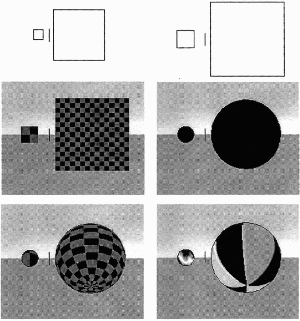
Schematic representations of the scenes (actual scenes were in colour). Top, left: Line-drawn squares (first frame). Top, right: Line-drawn squares (last frame). Middle, left: Textured squares. Middle, right: Nontextured spheres. Bottom, left: Textured spheres. Bottom, right: Familiar size (marble and beach ball).
The visual angle a subtended by the approaching objects’ heights (or diameters) on the first and last frames in Experiments 1–4
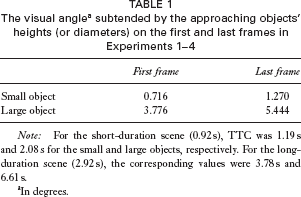
For the short-duration scene (0.92 s), TTC was 1.19 s and 2.08 s for the small and large objects, respectively. For the long-duration scene (2.92 s), the corresponding values were 3.78 s and 6.61 s.
In degrees.
The small object was closer to the viewpoint than the larger object, but subtended a smaller optical size throughout the approach. Thus, the depth cue of relative size contradicted TTC information. There were six different scenes. The first two scenes were similar to those used by DeLucia to demonstrate the size-arrival effect (DeLucia, 1991a, Exp. 1). Displays consisted of black line-drawn squares against a white background. The first short-duration scene was 0.92 s in duration. The second long-duration scene was 2.92 s in duration. The remaining scenes were 2.92 s in duration and contained a textured ground plane and sky. 1 The third scene contained two squares that were textured with a purple checkerboard. The fourth scene contained purple spheres without texture. The fifth scene contained spheres that were textured with a purple checkerboard. The final scene contained spheres with textures that simulated a marble and a beach ball. A real marble and beach ball, which approximated the size ratios and textures of the computer displays, were shown to observers before they viewed these simulations. Finally, the spheres in the last three scenes rotated about the horizontal axis so that the texture patterns were more noticeable.
Objects that were textured with a checkerboard and objects that were not textured were included because the marble and beach-ball patterns contained both familiar size information and texture elements. It was important to determine whether effects of familiar size on the size-arrival effect were due to the presence of texture per se, or to the familiar size information provided by the texture. There were other advantages to including textured objects. For example, texture improves depth perception in stereoscopic displays as measured with a depth-matching task; large untextured surfaces typically result in ineffective stereoscopic depth cues (Thomas, Goldberg, Cannon, & Hillis, 2002). Thus, in order to compare results of scenes in Experiment 1 to results of scenes in Experiment 3 (in which disparity information was provided), texture was included to enhance the effectiveness of disparity information. Prior studies of binocular disparity in TTC judgements typically did not include textured objects (Bennett, van der Kamp, Savelsburgh, & Davids, 2000; Gray & Regan, 1998; van der Kamp et al., 1997). Finally, textured objects provide a greater number of locations to compute tau than do nontextured objects and may weaken the effect of relative size on TTC judgements (see also DeLucia, 2004b; Smith, Flach, Dittman, & Stanard, 2001).
Procedure
It was necessary to present the six scenes in order of increasing complexity (e.g., line-drawn objects, textured objects, familiar size) so that potential effects of response bias could be minimized. For example, when observers see familiar-size scenes first, it may bias their judgements of more simple scenes. Thus, observers provided a judgement for a given scene before proceeding to the next scene. To allow observers to examine the scenes adequately, each scene was shown seven times in succession. This is considered one trial. This method replicates that of DeLucia (1991a).
The observers viewed the displays through a reduction tube from 45.72 cm. Head movements were minimized with a chin rest. After each trial, observers were asked four questions about the scene:
Which one of the objects would reach or pass you first, if the motion continued at the same speed after the scene disappeared? (Responses to this question represent a measure of the size-arrival effect.) Which object begins farther away from you? Which object moves faster? Does the initially farther object ever pass the other object?
Immediately before presenting the familiar-size scenes, observers were shown a real marble and beach ball in the laboratory. They were told that the computer simulations represented these objects. The small object was located to the left of the large object on half of the trials, alternating positions on each trial. For half of the observers, the small object started on the right side. Feedback on performance was not provided (DeLucia & Novak, 1997, Footnote 14).
Finally, it was important to design Experiment 1 so that results could be compared to those of Experiment 3 without experimental confounds. Ideally, the only difference between the experiments would be that binocular disparity information was available in Experiment 3, but was not available in Experiment 1. To achieve this aim, observers in both experiments wore shutter glasses (see Experiment 2 for details) so that potential artefacts associated with “glass wearing” were eliminated as confounds. Similar confounds would occur if observers in Experiment 3 view the displays with two eyes while observers in Experiment 1 view the displays with one eye (e.g., resulting in a smaller total field of view). To manipulate only the availability of disparity information, observers in both experiments viewed the same displays with two eyes through activated shutter glasses. However, the horizontal separation between the two images was set to zero in Experiment 1; the images were nondisparate. Hereafter, this is referred to as the condition without binocular disparity information. This method is similar to that used previously to compare the contribution of monocular and binocular information in TTC judgements (Gray & Regan, 1998).
Results and Discussion
Results are summarized in Tables 2–5. Binomial probabilities (Hays, 1981) were used to determine whether the size-arrival effect occurred for each scene. This measure allowed comparisons with results of earlier studies (DeLucia, 1991a). Binomial probability values are based on the null hypothesis that 50% of the observers would choose the small object, and 50% would choose the large object. This represents chance probability. Thus, the obtained binomial probabilities indicated whether the number of observers who reported that the larger object would reach them first (i.e., the size-arrival effect occurred) was significantly above chance probability.
The number of observers who reported that the large square would reach them first (the size-arrival effect) in Experiments 1 and 3
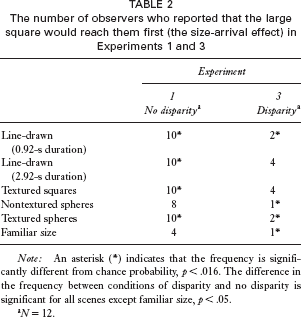
An asterisk indicates that the frequency is significantly different from chance probability, p < .016. The difference in the frequency between conditions of disparity and no disparity is significant for all scenes except familiar size, p < .05.
N = 12.
The number of observers who reported that the small object started farther from them in Experiments 1 and 3
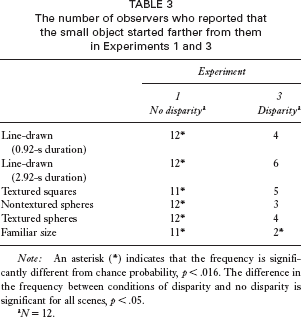
An asterisk indicates that the frequency is significantly different from chance probability, p < .016. The difference in the frequency between conditions of disparity and no disparity is significant for all scenes, p < .05.
N = 12.
The number of observers who reported that the small object moved faster in Experiments 1 and 3
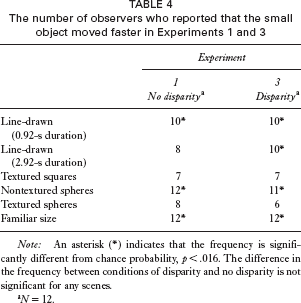
An asterisk indicates that the frequency is significantly different from chance probability, p < .016. The difference in the frequency between conditions of disparity and no disparity is not significant for any scenes.
N 12.
The number of observers who reported that the initially farther object passed the other object in Experiments 1 and 3
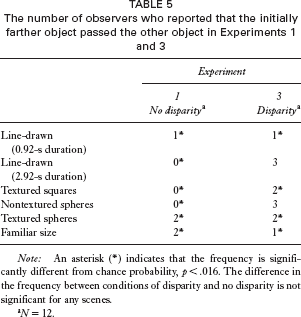
An asterisk indicates that the frequency is significantly different from chance probability, p < .016. The difference in the frequency between conditions of disparity and no disparity is not significant for any scenes.
N = 12.
Results indicated that the size-arrival effect occurred for all scenes except two, p < .016. The frequency of the size-arrival effect was not significantly different from chance for the scenes with nontextured spheres or the scenes with familiar size information. The finding that the size-arrival effect occurred when texture was present is consistent with earlier reports that texture did not improve performance, and size effects persisted, in collision-control tasks (DeLucia, 2004b; Smith et al., 2001).
For all scenes, a significant number of observers reported that the smaller (closer) object began farther away, p < .003. In addition, the number of observers who reported that the smaller object moved faster was significant in only three of the scenes: line-drawn squares with 0.92-s duration, nontextured spheres, and familiar size, p < .016. Finally, the number of observers who reported that one object passed the other object was significantly below chance in all scenes, p < .016.
The occurrence of the size-arrival effect with line-drawn objects replicates the original findings of DeLucia (1991a), who also used simple displays. New here is the demonstration that the size-arrival effect did not occur when familiar size information was available. 2 In addition, the size-arrival effect occurred with textured scenes.
Unexpectedly, the size-arrival effect also did not occur for scenes with nontextured spheres, yet it occurred for scenes with textured spheres. One possible explanation for these findings is that, in the absence of explicit familiar-size information, some observers nevertheless may have assumed that the nontextured spheres represented objects familiar to them. If these assumed objects approximated the ratios represented by the marble and beach ball in the familiar-size scenes, the occurrence of the size-arrival effect would not be expected. In contrast, when both objects contained the same checkerboard texture, observers may have assumed that the objects were equal in virtual size, resulting in the size-arrival effect. According to this explanation, one might argue that the scenes with line-drawn squares should not have resulted in the size-arrival effect because observers assumed that the squares represented familiar objects (as they putatively did for the nontextured spheres). However, this seems less likely. Whereas spheres comprise a large number of moving objects encountered in the real world (balls), squares do not. In any case, twice as many observers reported the size-arrival effect for the nontextured spheres as for the familiar-size scenes (8 observers vs. 4 observers).
Experiment 2
The results of Experiment 1 provide a baseline measure of the frequency with which the size-arrival effect occurs for each scene. These frequencies are compared to those obtained when disparity information is added in Experiment 3. However, it is necessary first to approximate how much disparity is needed to eliminate the size-arrival effect. The first aim of Experiment 2 was to determine the amount of disparity required for observers to report that the small object would reach them first (i.e., elimination of the size-arrival effect). The second aim was to determine whether this amount of disparity differed among the scenes.
Method
Participants
A total of 6 male and 6 female participants had the characteristics described in Experiment 1. Their mean interpupillary distance and standard deviation were 62.7 mm and 4.7 mm, respectively.
Apparatus and Displays
The apparatus and displays were as described in Experiment 1. However, to minimize problems associated with fatigue, only three displays were included: the line-drawn squares, the textured squares, and the familiar-size scene. All scenes were 2.92 s in duration. Stereographics’ CrystalEyes shutter glasses were used to provide binocular disparity information. Custom software permitted the manipulation of the magnitude of disparity or the horizontal separation between two images of the scene. This was achieved by varying the interpupillary distance between the two eyes in virtual space. The plane of zero disparity was set to 1,850 vu from the virtual eyes, causing both approaching objects to result in crossed disparity. This plane served as the reference for all calculations of the objects’ disparities. 3 A vertical line in the centre of the screen was located at the plane of zero disparity and was shown for one second before the objects appeared. It helped observers to prepare for the onset of motion and remained present until the scene ended. Observers were instructed to focus on the vertical line at all times so that the objects would remain in crossed disparity (Patterson et al., 1992).
Relative binocular disparities were computed from the parameters of the virtual scenes with formulas published previously (Cormack & Fox, 1985; Kaufman, 1974). Participants viewed the displays from the canonical distance (DeLucia, 1991a; Hochberg, 1986) so that the optical properties subtended at the participant's eyes approximated those subtended at the virtual eyes.
Procedure
The observers viewed the displays through a reduction tube from 45.72 cm. Head movements were minimized with a chin rest. The observers were instructed to use mouse buttons to report which of the objects would reach or pass them first, had they kept moving in the same manner after they disappeared. The magnitude of binocular disparity was varied with Levitt's (1970) transformed up–down staircase method. The staircase method converged on the 70.7% and 29.3% thresholds, and the staircases were interleaved randomly. The initial magnitude of disparity was determined in pilot studies. For the smaller object, disparity was 99.4 s/arc and 348.1 s/arc on the first and last frames, respectively. Corresponding values for the larger object were 3.2 s/arc and 101.5 s/arc. The initial staircase delta value (i.e., step size) was 1 vu and was determined in pilot observations; it decreased on each even-numbered reversal (the magnitude of delta decreased each time: initial delta/2, initial delta/3, initial delta/4, etc.). The session proceeded until six reversals occurred for both staircases. The stimulus value on the last four reversals was averaged to compute threshold. It is important to note that the staircase manipulation of disparity created a cue-conflict situation. That is, binocular disparity varied independently of other depth information such as relative size.
Observers completed the staircases for one scene before proceeding to the next scene. The presentation order of the scenes differed for each observer in a counterbalanced design. Observers completed a second repetition of each scene in the reverse order. One practice trial was provided before the first repetition of each scene. Finally, a display consisting of a moving wire-frame cube was shown to observers before the experiment started. This display was used to show observers how to position their head so that the shutter glasses were within the range of the emitter (so that the glasses were activated).
Results and Discussion
The magnitude of disparity at the 70.7% threshold was averaged across replications. This measure indicated how much disparity was needed for observers to report that the small object would reach them first on 70.7% of the trials. Therefore, this measure defines the disparity threshold for the elimination of the size-arrival effect. As shown in Table 6, this threshold was greater than typical thresholds for stereoacuity.
Disparity thresholds a for each scene in Experiment 2
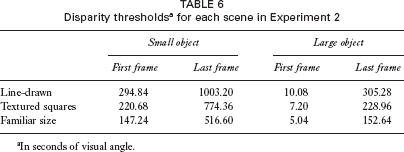
In seconds of visual angle.
Disparity thresholds were analysed with a one-way repeated measures analysis of variance (ANOVA). Results indicated a main effect of scene, F(2, 22) = 6.54, p < .015, w2 = 10.77%. Tukey's HSD tests indicated that the mean threshold for the scene with familiar size information was smaller than that with line-drawn squares, p < .05.
Although binocular disparity information ultimately eliminated the size-arrival effect, the disparity had to exceed a minimal magnitude, and this magnitude was greater than stereoacuity thresholds. In other words, the amount of disparity needed to overcome the effect of relative size (i.e., such that observers judged the small object as closer), was greater than the amount of disparity ordinarily needed to detect a difference in depth between two objects. The implication is that TTC judgements were influenced by relative size information until disparity information exceeded a minimal value. As noted earlier, disparity decreases as distance increases whereas relative size is effective for near and far distances. Therefore, it would not be surprising to find that TTC judgements of approaching objects are influenced by relative size information when objects are relatively far and are influenced by disparity information when objects are near (DeLucia, 2004a). The relatively smaller disparity thresholds for the familiar-size scenes suggest further that familiar size information enhanced the effectiveness of disparity information.
There are other important issues to consider when evaluating the results of Experiment 2. First, people with 100% stereopsis can accurately interpret a difference in depth between two objects with a binocular disparity of 20 s/arc (Coren et al., 1999). People with 25% stereopsis require a disparity of 286 s/arc to detect differences in depth, and such large differences have been characterized as encountered seldomly in ordinary situations (Coren et al., 1999). Relatedly, the disparity that results from a specific depth between two objects depends on the objects’ distances from the observer (Hochberg, 1971). For example, when an object's distance is decreased from 20 m to 2 m, binocular disparity increases by a factor of 100 (Bruce et al., 1996). The effective range of disparity has been characterized as less than 30 m (100 ft; Palmer, 2002). Thus, the present results suggest that the amount of disparity needed to overcome the effect of relative size not only is greater than typical stereoacuity thresholds but may be greater than disparity values that observers ordinarily encounter.
Second, retinal disparity is ambiguous. The same disparity can result from a large distance between two objects viewed from a far distance as can result from a small distance between two objects viewed from a near distance (Davis & Hodges, 1995). Convergence may provide information to scale the disparity and recover absolute depth (e.g., in metres; Bruce et al., 1996). In short, to derive absolute depth from disparity information, viewing distance must be considered, and extraretinal information may be needed. The implication is that the amount of disparity needed to overcome the effect of relative size may be available for near objects. But for far objects, the amount of disparity needed may be greater than that typically encountered.
Another way of conceptualizing this point is that the disparity needed to eliminate the size-arrival effect would require an interpupillary distance much larger than the typical 6.5 cm. To illustrate this point, consider the largest value of relative disparity at threshold obtained in Experiment 2, which was 1003.2 s/arc (0.2787 deg). Assuming a typical interpupillary distance of 6.5 cm, this corresponds to an object located at 6.37 m in front of an observer who is fixating a target 12.19 m away. This same disparity threshold is equivalent to an object that is located 15.24 m in front of an observer who is fixating a target 30.48 m away. However, this would require a 14.83-cm interpupillary distance. Thus, with far objects, the disparity threshold for the elimination of the size-arrival effect may require an interpupillary distance larger than normal. Moreover, disparity must be less than 0.1 deg (360 s) to achieve fusion rather than diplopia (Bruce et al., 1996). Therefore, the threshold disparity obtained in the present study may result in diplopia rather than fusion. In any case, the amount of disparity needed to eliminate the size-arrival effect appears to depend on the characteristics of the scenes and the distance of the object. This is consistent with Gray and Regan (1998) who reported that observers can estimate TTC accurately on the basis of binocular information when an object is small and relatively close (a few metres). When the object is large, observers can estimate TTC accurately on the basis of monocular information or binocular information.
Experiment 3
The results of Experiment 2 provide an estimate of how much disparity observers need to report that the smaller object would reach them first on 70.7% of the trials. The first aim of Experiment 3 was to determine whether the size-arrival effect would be eliminated when “above-threshold” disparity was added to the scenes in Experiment 1. The second aim was to compare the frequencies of the size-arrival effect for scenes with disparity in Experiment 3 with the frequencies for the same scenes without disparity in Experiment 1.
Method
Participants, Apparatus, Displays, and Procedure
A total of 12 students participated. Their mean interpupillary distance and standard deviation were 68.0 mm and 2.1 mm, respectively. The apparatus, displays and procedure were identical to those in Experiment 1, except that disparity information was provided. The magnitude of disparity was determined by the results of Experiment 2 and pilot observations. A value was selected such that disparity was above threshold but would not result in diplopia. For the smaller object, the disparity was 200.2 s/arc and 697.7 s/arc on the first and last frames, respectively. Corresponding values for the larger object were 8.6 s/arc and 207.4 s/arc. The only difference between Experiments 1 and 3 was that the horizontal distance between the two images was set to zero in Experiment 1.
Results and Discussion
Results are summarized in Tables 2–5. Binomial probabilities indicated that the number of observers who reported the size-arrival effect was significantly below chance probability for four of the six scenes, p < .016. These included the line-drawn squares with a 0.92-s scene duration, the nontextured spheres, the textured spheres, and the familiar-size scenes. The frequency of the size-arrival effect was not different from chance probability for the line-drawn squares with a 2.92-s duration and the textured squares.
The number of observers who reported that the smaller object began farther away than the larger object was not significantly different from chance. This was true for all scenes except one. When familiar size was present, the number of observers who reported the smaller object as farther was significantly below chance probability, p < .016. That is, familiar size information improved performance; it is the only scene for which a significant number of observers reported correctly that the larger object was farther. Yet, this also was the only scene in which all observers reported that the small object approached faster than the larger object, p < .0002 (this frequency was significantly above chance for line-drawn squares and nontextured spheres). The number of observers who reported that one object passed the other was not significantly above chance probability in any scenes.
Fisher's exact tests (Wike, 1971) were used to determine whether the number of observers who reported the size-arrival effect when disparity information was present differed from that when disparity information was absent (in Experiment 1). For the line-drawn squares (short and long scene durations), a greater number of observers reported the size-arrival effect when disparity information was absent than when it was present, p < .05. This result also occurred for textured squares (p < .05), nontextured spheres (p < .01), and textured spheres, (p < .01). The difference in the frequency of the size-arrival effect between the conditions with and without disparity was not significant for the familiar-size scene. This appears to be due to a decrease in the number of observers who reported the size-arrival effect in the familiar-size scenes compared with the other scenes, when disparity was absent (refer to Table 2).
Experiment 4
The purpose of Experiment 4 was similar to that of Experiment 2. However, rather than manipulating disparity to measure the threshold for the elimination of the size-arrival effect, the speed of the smaller object was manipulated to measure threshold. The first aim was to determine how fast the smaller object had to move to eliminate the size-arrival effect and to measure the corresponding optical expansion rate. The second aim was to determine whether this result differed among the scenes.
Method
Participants
A total of 16 participants had the same characteristics as those in Experiment 1. Their mean interpupillary distance and standard deviation were 63.8 mm and 3.2 mm, respectively.
Apparatus and Displays
The apparatus and displays were the same as those in Experiment 2. However, rather than varying disparity with the staircase procedure, the smaller object's virtual speed was varied. The staircase procedure was used to determine how fast the smaller object had to move for observers to report that it would reach them first on 70.7% of the trials. This measure defines the speed threshold for the elimination of the size-arrival effect. The initial speeds of the objects corresponded to those in Experiment 1. Step size was 0.5 vu/frame (0.02 vu/sec) and was determined from pilot studies. The session proceeded until six reversals occurred for both staircases. The stimulus value on the last four reversals was averaged to compute threshold. To minimize problems associated with fatigue, each observer viewed only two of the three scenes from Experiment 2. Half of the observers viewed the line-drawn squares and the textured squares. The other observers viewed the textured squares and the familiar-size scenes. Thresholds were measured twice for each scene, in either an ABBA or a BAAB order. One practice trial was completed before the first replication of each scene. Finally, when disparity information was provided, the magnitude was based on the results of Experiments 2 and 3. For the smaller object, the disparity at the beginning of the staircase was 200.2 s/arc and 697.7 s/arc on the first and last frames, respectively. Corresponding values for the larger object were 8.6 s/arc and 207.4 s/arc. These values changed when speed varied.
Procedure
The procedure approximated that of Experiment 2 except that all observers participated in two binocular disparity conditions. In one condition, binocular disparity information was not available. In the other case, disparity information was provided. Observers were instructed to report which of the objects would reach or pass them first. Half of the observers viewed scenes with disparity first. The remaining observers viewed scenes without disparity first.
Results and Discussion
The magnitude of the smaller object's speed at the 70.7% threshold was averaged across replications. These mean speed thresholds were analysed with a 2 × 2 (disparity × scene) repeated measures ANOVA. Results of observers who viewed the line-drawn squares and textured squares were analysed with a separate ANOVA from those who viewed the textured squares and familiar-size scenes. Results indicated that the mean threshold was smaller for scenes with familiar size than for scenes with textured squares, F(1, 7) = 12.98, p < .009, w2 = 2.27%. Differences between line-drawn squares and textured squares were not significant. Moreover, the effect of disparity on threshold was not significant for any scenes. However, further analyses indicated that the effect of disparity accounted for less than 1% of the variance for the line-drawn squares and for the textured squares when viewed by participants who also viewed line-drawn scenes. In contrast, disparity accounted for over 10% of the variance for the familiar-size scene (15.23%) and for the textured squares when viewed by participants who also viewed the familiar-size scenes (11.14%). Thus, although disparity did not have a significant effect on speed thresholds for the elimination of the size-arrival effect, it contributed more to performance when familiar size was present.
The mean thresholds were used to compute the optical expansion rate for each scene (refer to Table 7). The expansion rate at threshold was lowest for the familiar-size scene even when disparity was not present. The lowest expansion rate occurred when both familiar size and disparity information were present. Further analyses of these optical expansion rates follow in the General Discussion.
Small object's optical size at threshold a in Experiment 4
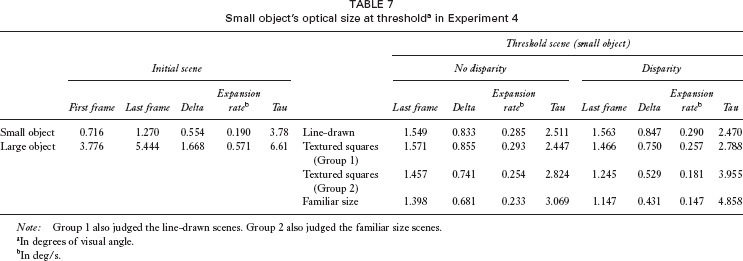
Group 1 also judged the line-drawn scenes. Group 2 also judged the familiar size scenes.
In degrees of visual angle.
In deg/s.
General Discussion
Summary of Findings
The present study focused on three questions. Does the size-arrival effect occur when binocular disparity or familiar size information is available? How much disparity is needed to eliminate the size-arrival effect? Do disparity and familiar size information affect thresholds for the elimination of the size-arrival effect? Each question is considered in turn.
When binocular disparity information was not available, results indicated that the number of observers who reported the size-arrival effect was significantly above chance probability for four of the six scenes. DeLucia's (1991a) results were replicated. The size-arrival effect occurred with not only the simple line-drawn squares similar to those used by DeLucia. It also occurred when scenes contained objects textured with a checkerboard pattern. However, it did not occur when the objects’ textures provided familiar-size information. In this case, the number of observers who reported the size-arrival effect was not significantly different from chance. When disparity information was provided, the frequency of the size-arrival effect for the four scenes that resulted in the size-arrival effect either fell significantly below chance or was not significantly different from chance. For all scenes except one, the frequency of the size-arrival effect was significantly smaller when disparity was present than when it was absent. The exception was the familiar-size scene. In this case, the frequency of the size-arrival effect did not differ between the disparity conditions. Thus, the answer to the first question is that the size-arrival effect does not occur when binocular disparity or familiar size information is present. However, this will be qualified when answering the second question.
When a staircase procedure was used to measure the magnitude of disparity needed to eliminate the size-arrival effect (i.e., the small object was reported as arriving first on 70.7% of the trials), the results indicated that the disparity for the small object (at threshold) was between 147.2 s/arc and 294.8 s/arc on the first frame. On the last frame, the disparities were between 516.6 s/arc and 1,003.2 s/arc (the disparity at threshold was smaller for the larger object, 5.0–305.3 s/arc, because it was much farther). The answer to the second question is that the disparity threshold to eliminate the size-arrival effect typically is greater than that which characterizes typical stereoacuity of 3–40 s/arc.
However, the disparity threshold was smaller when scenes contained familiar size information than when they contained line-drawn squares. Familiar size information affected the threshold. Similarly, when the staircase procedure was used to measure the magnitude of the smaller object's speed needed to eliminate the size-arrival effect, the mean threshold was smaller for scenes with familiar size information than for scenes with textured squares. Familiar size again affected the threshold. In contrast, disparity did not. The mean threshold did not differ significantly between conditions with and without disparity information. The answer to the third question is that familiar size, but not disparity, affects the threshold for the elimination of the size-arrival effect.
Theoretical Implications
The results of the present study have several important theoretical implications. First, consistent with earlier studies (e.g., DeLucia, 1991a; DeLucia et al., 2003), information other than monocular tau information can influence TTC judgements. New here is the demonstration that familiar size is one such influential source of information. Convergent evidence for the effects of familiar size on TTC judgements was recently demonstrated in a prediction-motion task (Hosking & Crassini, 2003).
Second, the presence of surface texture did not eliminate the size-arrival effect. Consistent with earlier studies, relative TTC judgements did not improve even when texture elements provided a greater number of locations to compute tau (see also DeLucia, 2004b; Smith et al., 2001). The implication is that observers may have used information other than monocular tau.
Third, the effect of familiar size was not due to texture per se, but rather to the familiar size information provided by the texture. When the two spheres were textured with a checkerboard, the size-arrival effect occurred. It did not occur when the spheres were textured to represent a marble and a beach ball. Familiar size appears to be more influential than texture in relative TTC judgements.
Fourth, the size-arrival effect did not occur when familiar-size information was present. This is important because it suggests that depth information putatively based on the assumed size of an object may influence TTC judgements even when veridical tau information is available. 4
According to constructivist theories, familiar size is the only depth cue that, by definition, requires past experience (Hochberg, 1971), and an effect of familiar size implicates cognitive mechanisms associated with traditional empirical theories of depth perception (Hochberg, 1978). Results of earlier studies also implicated cognitive processes in TTC judgements (DeLucia, 2004a; DeLucia & Liddell, 1998; DeLucia & Novak, 1997). However, known size has been characterized as a powerful cue to distance perception without reference to such traditional theories (Wann, Mon-Williams, McIntosh, Smyth, & Milner, 2001).
Fifth, in the present displays, familiar size information indicated that the smaller object was closer, consistent with relative TTC information. Therefore, whereas tau alone could not prevent the size-arrival effect, the presence of both tau and familiar size information appeared to do so. Moreover, the absence of the size-arrival effect in the familiar-size scenes occurred even when disparity information was not available. The implication is that although a minimal magnitude of disparity is sufficient to eliminate the size-arrival effect, it is not necessary to do so. In addition, disparity did not have a significant effect on speed thresholds for the elimination of the size-arrival effect, but it contributed more to performance when familiar size was present. Familiar size moderated the influence of disparity information.
Sixth, familiar size information appears to reduce the amount of optical expansion needed to eliminate the size-arrival effect. In Experiment 4, the optical properties of the smaller object were computed from the speed thresholds. In the original line-drawn scene that resulted in the size-arrival effect, the object's expansion rate was 0.190 deg/s. At threshold, the expansion rate increased to 0.285 deg/s when disparity information was not present. The addition of disparity information resulted in about the same expansion rate (0.290 deg/s). In contrast, the expansion rate for the familiar-size scene was only 0.233 deg/s when disparity information was not present. It dropped to 0.147 deg/s when both familiar size and disparity information were present. The implication is that familiar size may enhance the effectiveness of disparity information (and vice versa). It also is clear from Table 7 that although the familiar-size scene resulted in a smaller threshold than did the other scenes, it did not correspond to the lowest value of tau; rather, it corresponded to the highest value. Indeed, on the last frame of the scene, tau was nearly 5 s in the familiar-size scene and 2.47 s in the line-drawn scene when disparity was present.
In conclusion, the present results are consistent with the proposal that TTC judgements are influenced by multiple sources of information, including heuristics such as pictorial depth cues and motion-based invariant information such as tau (e.g., DeLucia, 1991a, 2004a; DeLucia et al., 2003; DeLucia & Warren, 1994) and that this allows for flexible and adaptive performance (DeLucia, 2004a; DeLucia et al., 2003). The present study shows further that binocular disparity and familiar size influence relative TTC judgements even when pictorial relative size contradicts tau. Moreover, familiar size moderates the influence of disparity information. Future research should measure the relative weights and combining rules of multiple information sources including familiar size and binocular disparity (e.g., see DeLucia et al., 2003; Rushton & Wann, 1999). Results would contribute to the understanding of how observers use different sources of information in different settings.
The visual system's reliance on multiple information sources may arise from limits in the spatial and temporal resolution of the visual system, the changes in the quality of information sources that occur as a function of changes in distance, and the restricted conditions under which tau provides accurate TTC information (DeLucia, 2004a; DeLucia et al., 2003). Therefore, it is important that observers can adjust to the situation and rely on different sources of information depending on the setting and task. Consequently, it is likely that information sources that influence TTC judgements vary throughout an event or task (DeLucia, 2004a; DeLucia & Warren, 1994) as the visual system shifts weightings from one information source to another to perform the task at hand (Rushton & Wann, 1999). In short, multiple sources of information, including heuristics and invariants, must be considered in models of perceived collision (DeLucia, 2004a). The present study demonstrates that familiar size is one such source of information.