







Abstract
Two experiments investigated the impact of the relationship between processing and storage stimuli on the working memory span task performance of children aged 7 and 9 years of age. In Experiment 1, two types of span task were administered (sentence span and operation span), and participants were required to recall either the products of the processing task (sentence-final word, arithmetic total) or a word or digit unrelated to the processing task. Experiment 2 contrasted sentence span and operation span combined with storage of either words or digits, in tasks in which the item to be remembered was not a direct product of the processing task in either condition. In both experiments, memory span was significantly greater when the items to be recalled belonged to a different stimulus category from the material that was processed, so that in sentence span tasks, number recall was superior to word recall, and in operation span tasks, word recall was superior to number recall. Explanations of these findings in terms of similarity-based interference and response competition in working memory are discussed.
Working memory is widely believed to be responsible for the ability to store and manipulate information for brief periods of time. Its capacity is commonly measured by complex span tasks, in which participants are required to combine processing activities with the short-term retention of information. One such task is reading span, which involves processing a series of sentences for meaning while retaining the sentence-final words for subsequent recall (Daneman & Carpenter, 1980). Variations of the reading span task, such as counting span (Case, Kurland, & Goldberg, 1982), operation span (Turner & Engle, 1989), and spatial span (Shah & Miyake, 1996) are also widely used. Performance on such tasks is strongly related to higher level cognitive activities such as reasoning and reading comprehension (e.g., Engle, Cantor, & Carullo, 1992; Kyllonen & Christal, 1990) and also academic achievement (e.g., Gathercole, Pickering, Knight, & Stegmann, 2004; Hitch, Towse, & Hutton, 2001; Swanson, 1999).
The nature of the cognitive processes underpinning working memory span has been the focus of substantial research activity in recent years. An initial account was that the processing and storage demands of the tasks compete for a limited resource. By this account, increases in processing efficiency result in the availability of additional resources to support storage (e.g., Daneman & Carpenter, 1980). This concept of working memory was used by Case and colleagues as the basis for an account of the developmental increases in working memory span performance across the childhood years (Case, 1985; Case et al., 1982). It was suggested that age-related increases in memory span arise from improvements in processing efficiency that release additional resources to support storage. An alternative view advanced by Towse and colleagues (e.g., Towse & Hitch, 1995; Towse, Hitch, & Hutton, 1998) is that storage items are vulnerable to time-based forgetting while the participant is engaged in the processing requirements of the task. Accordingly, the longer the processing phase of the span task, the longer the participant is switched out of remembering, and hence the more difficult it is to accurately recall memory items. More recent evidence suggests that both retention duration and the demands of the processing task influence working memory span. Under conditions in which processing duration is held constant, tasks that impose significant processing demands lead to working memory decrements compared with articulatory suppression, an activity that demands few processing resources (Barrouillet & Camos, 2001; Conlin, Gathercole, & Adams, in press).
The purpose of the present experiments is to investigate a further aspect of working memory span performance in children: the extent to which interference occurs as a result of similarity between the stimuli that are processed and stored in working memory span tasks. Recent evidence indicates that, in adults at least, high degrees of relatedness between material to be processed and stored in complex span tasks impairs complex memory span. Several studies (e.g., Bayliss, Jarrold, Gunn, & Baddeley, 2003; Shah & Miyake, 1996) have reported poorer complex memory performance when the storage items were from the same domain as the processing task (e.g., verifying arithmetic calculations and recalling digits) than when processing and storage elements differed in terms of modality (e.g., performing mental rotation and recalling words). Further evidence for a similarity decrement was provided by Duff and Logie (2001), who found that complex memory span performance was greatest under conditions in which the recall items (e.g., words) were unrelated to the processing material (e.g., arithmetic problems). Duff and Logie argued that the distinctiveness of the processing and storage materials allows for them to be handled more readily by separate subsystems of working memory, such as the central executive and the phonological loop (e.g., Baddeley & Hitch, 1974), reducing competition for limited resources. Turner and Engle (1989) also report data that appear to show a similarity decrement across a series of conditions that combined digit- and word-based processing tasks with recall of digits and words, although no statistical comparisons of the conditions were reported.
The present experiments provided a systematic investigation of the effects of the similarity of processing and storage stimuli on complex memory span performance in children. The experiments contrasted two types of span task (sentence span and operation span) and two different categories of the recall stimuli (words and digits). In Experiment 1, children were required to perform either a sentence completion task or a mental arithmetic task. For each span task, the children were assigned to either a word recall or a number recall condition. In the sentence span/word recall condition, the task was to recall the final words from a series of the sentences, and in the sentence span/number recall condition it was to recall a digit presented after each sentence has been processed. In the operation span/number recall condition, the task was to recall the series of arithmetic totals that had been calculated, whereas in the operation span/word recall condition, the children attempted to recall individual words presented after each arithmetic operation.
On the basis of previous evidence from studies of adult participants (e.g., Duff & Logie, 2001; Shah & Miyake, 1996), it is predicted that memory span performance will be poorer under conditions in which the processing and recall stimuli belong to the same information categories than when they belong to different categories. That is, the sentence span task should yield higher memory spans when the recall items are numbers than when they are words, and the operation span task should yield higher memory spans when the recall items are words than when they are numbers. The two age groups were included in order to investigate whether any similarity effects in this study were generalizable across age groups.
Experiment 1
Method
Participants
A total of 96 children were drawn from Year 3 (N = 48, mean age 8 years 3 months, range 7;9 to 8;9) and Year 5 (N = 48, mean age 10 years 3 months, range 9;9 to 10;8) from a state primary school in Stockton on Tees, UK. In each age group, 28 children were randomly allocated to either the sentence span/word recall or the sentence span/number recall group, and 20 children were randomly allocated to the operation span/word recall or operation span/number recall group.
Design and materials
A three-way between-subjects design was employed with type of processing task, recall category, and age as independent variables and span as the dependent variable. The materials for the sentence span task consisted of nine sets of sentences with the final word missing (for example, A dog wags its ______), each set comprising two, three, or four short sentences. The interpolated memory item for the sentence span/number recall group was a single digit number (see Appendix). The materials for the operation span task consisted of nine sets of arithmetic operations (for example, 14 + 5 = ?), each set comprising two, three, or four equations. The interpolated memory items for the operation span/ word recall group were nouns, matched in syllable with the corresponding total in the operation span/number recall group (e.g., motorbike-twenty two; garden-sixteen).
Procedure
Each participant was tested individually on a laptop computer in a quiet area of the school. All the tasks had a similar structure. In the sentence span task, participants were presented with an incomplete sentence on the computer screen and were requested to read the sentence aloud and complete it with a semantically appropriate word. No child had any problem supplying the missing word. As soon as a response had been given, the experimenter pressed a key, and the sentence was replaced on the screen by a number, which was also read aloud by each child. Following another key press by the experimenter, another incomplete sentence appeared, and then another number. The children in the word recall group were then requested to recall, in order, the words they had generated; the children assigned to the number recall group were requested to recall the numbers they had read aloud. Children were presented with an increasingly long series of tasks until they failed to recall the memory items of all three trials at a particular level. Testing was discontinued at this point.
In the operation span task, the sequence of events was similar. The span task began with an arithmetic operation (e.g., 12 + 4 = ?) displayed in black letters on a white computer screen. The children were instructed to calculate the answer as quickly and accurately as possible and to report the answer out loud. All children reached over 90% accuracy in this task. As soon as the answer had been reported, the experimenter pressed a key, and a word appeared on the screen that was to be read aloud. Following this, a further arithmetic operation appeared, followed by another word. The children in the word recall group were then requested to recall, in order, the words they had read aloud; the children assigned to the number recall group were requested to recall the totals they had calculated. As with the sentence span task, the children were presented with increasing long series of tasks until they failed to recall the memory items of all three trials at a particular level, at which point testing was terminated. A practice session preceded the task for each child. For both the operation span task and the sentence span task, each correctly recalled memory item counted as one third; the total number of thirds was then added up to provide a span score. For example, the correct recall on all the trials of one and two items, of two series of three items and two series of four items yielded a span score of (3 + 3 + 2 + 2) × 1/3 = 3.33.
Results
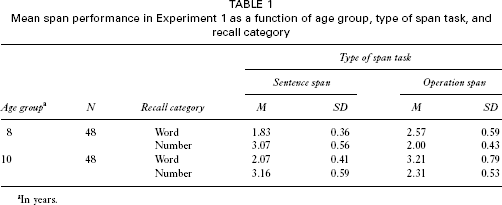
Table 1 shows mean span performance for Experiment 1. Memory span was higher for numbers (2.55, SD = 0.71) than for words (2.50, SD = 0.78). The older children had a higher mean span (2.69, SD = 0.78) than the younger children (2.35, SD = 0.67). Spans were equivalent for the sentence completion (2.53, SD = 0.76) and operation span task (2.52, SD = 0.72).
Mean span performance in Experiment 1 as a function of age group, type of span task, and recall category
In years.
A three-way between-subjects analysis of variance was conducted on the span scores as a function of recall category (word, number), type of span task (sentence, operation), and age (8 years, 10 years). There was no significant main effect of recall category, F(1, 88) = 3.42, MSE = 1.07, p > .05, partial η2 = .04, and no significant main effect of span task, F(1, 88) = 0.01, MSE = 0.002, p > .05, partial η2 = .001. There was a significant main effect of age, F(1, 88) = 7.76, MSE = 2.42, p < .05, partial η2 = .08. The Span Task × Age interaction was nonsignificant, F(1, 88) = 1.81, MSE = 0.56, p > .05, partial η2 = .02, as were the Recall Category × Age interaction, F(1, 88) = 1.02, MSE = 0.32, p > .05, partial η2 = .01, and the Span Task × Age × Recall category interaction, F < 1. However, the Span Task × Recall Category interaction was highly significant, F(1, 88) = 67.84, MSE = 21.14, p < .001, partial η2 = .44. The simple effects of recall category were explored for each of the span tasks using one-way between-subjects analyses of variance. In the sentence span task, number recall was significantly higher than word recall, F(1, 38) = 57.15, MSE = 13.58, p < .001, η2 = .60. In the operation span task, word recall was significantly higher than number recall, F(1, 54) = 18.49, MSE = 7.63, p < .001, η2 = .26.
Discussion
In both experiments, children's memory spans were superior when the stimuli encountered in the processing task and recall items were drawn from different rather than common semantic categories. In the sentence completion task, recall of unrelated numbers was greater than that of the sentence-final words generated by the participant. Similarly, in the arithmetic operation task, recall of unrelated words was superior to that of the calculated totals. The findings were consistent across both 7/8- and 9/10-year-old age groups. The reversal in the operation span task of the number recall superiority established in the sentence span task rules out an account in terms simply of an intrinsic memory advantage of one stimulus category (words or numbers) over another. The findings are instead consistent with previous reports from studies using adult participants of poorer memory span performance under conditions in which the processing and recall stimuli are drawn from similar rather than distinct categories (e.g., Duff & Logie, 2001; Turner & Engle, 1989).
However, there was in the present experiment a procedural difference between the similar and dissimilar conditions that may have contributed to the results. The stimulus-similar recall items (words in the sentence span task, digits in the operation span task) were generated directly by the processing activity. In contrast, the stimulus-dissimilar recall items (digits in the sentence span task and words in the operation span task) were unrelated to the processing and were presented subsequent to the completion of each processing activity. It is possible that the greater memory spans in the stimulus-dissimilar conditions reflect the better recall of stimuli that were unrelated to rather than directly generated by the processing activity, rather than an advantage to memory items drawn from a different domain from that of the processing stimuli. However, it should be noted that as there is a considerable body of evidence pointing to beneficial rather than disruptive effects of self-generation on memory performance (e.g., Slamecka & Graf, 1978), this confound seems unlikely to underpin the present findings. More plausibly, the independent presentation of the memory item in the stimulus-dissimilar recall conditions may enhance temporal distinctiveness, a factor that is known to facilitate immediate memory (e.g., Neath & Crowder, 1990).
A further experiment was conducted with the aim of eliminating the procedural confound between the similar and dissimilar conditions in Experiment 1. In Experiment 2, the items presented for recall in both the stimulus-similar and stimulus-dissimilar conditions were unrelated to processing activities. The two tasks involved either sentence-based processing or arithmetic processing, with memory items consisting of either unrelated words or digits. In the sentence span/word recall condition, the task was to process a series of sentences for meaning and then to recall the sequence of unrelated individual words presented after each processing activity. In the sentence span/number recall condition, single digits rather than words were presented after each sentence, for later recall. In the operation span/word recall condition, the processing task involved a series of simple arithmetic calculations, each of which was followed by the presentation of an individual word to be recalled later. In the operation span/number recall condition, single digits rather than words were presented after each calculation, for later recall. If the recall advantage of the dissimilar over similar conditions in Experiment 1 arose from differences in the manner by which the recall items were provided (generated either by the processing activity or independently by the experimenter), then differences in memory span performance across stimulus-similar and stimulus-dissimilar conditions should be eliminated in Experiment 2 as the storage items presented independently of the processing activity in both conditions. Alternatively, if recall is genuinely impaired as a result of processing and storage stimulus similarity, memory span should be greater for numbers than for words in the sentence span task, and greater for words than for numbers in the operation span task.
Experiment 2
Method
Participants
A total of 80 children were drawn from Year 3 (N = 40, mean age 7 years 7 months, range 7;0 to 8;0) and Year 5 (N = 40, mean age 9 years 6 months, range 9;1 to 10;0) from a state primary school in Stockton-on-Tees, UK. In each age group, the children were randomly allocated to one of four groups: the sentence span/word recall group, the sentence span/number recall group, the operation span/word recall group, or the operation span/number recall group. None of the children had participated in Experiment 1.
Design and materials
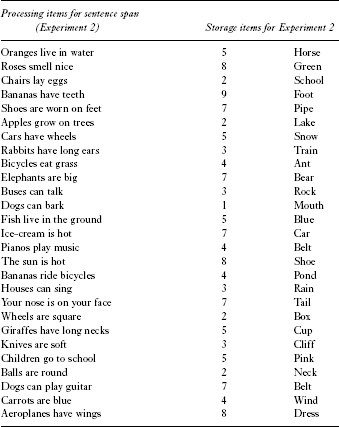
A three-way between-subjects design was employed with age, recall category, and type of span task as independent variables, with span as the dependent variable. The materials for the sentence span task consisted of nine sets of sentences, each set comprising two, three, or four simple sentences. A total of 13 sentences contained true information (e.g., Apples grow on trees), and 14 sentences contained false information (e.g., Bananas ride bicycles). The materials for the operation span task consisted of nine sets of arithmetic operations, each set comprising two, three, or four equations (same as in Experiment 1; see Appendix). Items presented for retention and subsequent recall consisted of either monosyllabic nouns (e.g., box) or single digit numbers that ranged between 1 and 9. The numbers were generated at random, with the exception that they were never identical to the calculated total of the arithmetic task.
Procedure
Each participant was tested individually on a laptop computer in a quiet area of the school. In the reading span task, each child read a series of short sentences and judged the veracity of each sentence in turn by responding “true” or “false”. As soon as a response had been given, the experimenter pressed a key, and either an unrelated word (for the children in the word recall group) or a number (for the children in the number recall group) appeared on the screen, which remained visible until it had been read aloud by the child. This was the item that the child was instructed to retain for subsequent recall. Following a further key press by the experimenter, the next sentence appeared.
In the operation span task, the task began with an arithmetic operation (e.g., 12 + 4 = ?) displayed in black letters on a white computer screen. The children were instructed to calculate the answer as quickly and accurately as possible and to report the answer out loud. All children reached over 90% accuracy in this task. As soon as the answer had been reported, the experimenter pressed a key, and either a word (for the word recall group) or an unrelated digit (for the number recall group) appeared on the screen, which was to be read aloud. Following this, a further arithmetic operation appeared, followed by another word. At the end of each trial for both types of span task, the children in the word recall group were asked to recall the words, and the children in the number recall group were asked to recall the numbers in the order that they had been presented. This structure began with two successive tasks (i.e., processing task-memory item, processing task-memory item) and was discontinued if recall was unsuccessful on all three trials at a particular level, at which point testing was terminated. A practice session preceded the task for each child. Span was scored as in Experiment 1.
Results
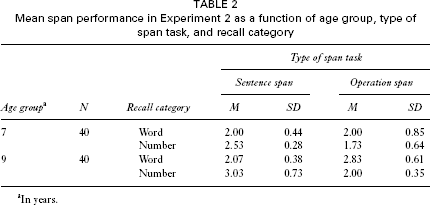
Table 2 shows mean span performance for Experiment 2. Memory span was higher for numbers (2.32, SD = 0.72) than for words (2.22, SD = 0.68). The older children had a higher mean span (2.48, SD = 0.70) than the younger children (2.06, SD = 0.64), and the sentence span task produced higher spans (2.41, SD = 0.63) than the operation span task (2.13, SD = 0.74).
Mean span performance in Experiment 2 as a function of age group, type of span task, and recall category
In years.
A three-way between-subjects analysis of variance was conducted on the span scores as a function of recall category (word, number), type of span task (sentence, operation), and age (7 years, 9 years). There was no significant main effect of recall category, F(1, 72) = 0.61, MSE = 0.20, p > .05, partial η2 = .008. There was a significant main effect of span task, F(1, 72) = 4.41, MSE = 1.42, p < .05, partial η2 = .06. There was also a significant main effect of age, F(1, 72) = 10.79, MSE = 3.48, p < .05, partial η2 = .13. The Span Task × Age interaction was nonsignificant, as was the Recall Category × Age interaction (Fs < 1). However, the Span Task × Recall Category interaction was highly significant, F(1, 72) = 26.09, MSE = 8.41, p < .001, partial η2 = .27. The Span Task × Age × Recall Category interaction was marginally significant, F(1, 72) = 3.88, MSE = 1.25, p = .053, partial η2 = .05.
The simple effects of recall category were explored for each of the span tasks using one-way between-subjects analyses of variance. In the sentence span task, number recall was significantly higher than word recall, F(1, 38) = 21.60, MSE = 5.60, p < .001, η2 = .36. In the operation span task, word recall was significantly higher than number recall, F(1, 38) = 6.20, MSE = 3.01, p < .05, η2 = .14.
The simple effects of age were also explored for each of the span tasks. A one-way analysis of variance showed that there was no significant difference in memory performance between the older and younger children on the sentence span task, F(1, 38) = 2.10, MSE = 0.81, p > .05, η2 = .05, but older children significantly outperformed younger children on the operation span task, F(1, 38) = 6.23, MSE = 3.03, p < .05, η2 = .14. In the sentence span task, younger children recalled significantly more numbers than words, F(1, 18) = 10.17, MSE = 1.41, p < .01, η2 = .36, and older children also recalled significantly more numbers than words, F(1, 18) = 13.80, MSE = 4.66, p < .01, η2 = .53. In the operation span task, older children recalled significantly more words than numbers, F(1, 18) = 13.84, MSE = 3.46, p < .01, η2 = .43, but there was no significant difference in memory span for the younger children, F(1, 18) = 0.63, MSE = 0.35, p > .05, η2 = .03.
Discussion
Using a procedure in which the recall items were independent of the processing task in all conditions, memory span was found to be greater for numbers than words in the sentence completion task and conversely greater for words than numbers in the operation span task. These findings indicate that the corresponding pattern of findings obtained in Experiment 1 was not an artefact of the procedural differences in the manner of generation of the memory items (self-generation vs. experimenter presentation) in the same-category and different-category conditions. The results suggest instead that children's performance in complex memory span tasks is genuinely impaired when the processing and recall stimuli are drawn from the same rather than different semantic categories.
Although the general pattern of similarity decrements across processing and storage domains emerged for both age groups in both experiments, some age-related differences were found in Experiment 2 on the operation span task. The similarity decrement in operation span was found only in the older age group. This asymmetry of findings was unexpected and was not reflected in the data from Experiment 1. It should, however, be noted that span scores were extremely low in the operation span/number recall condition in the younger age group (mean span 1.73). It is therefore possible that the absence of a similarity effect in operation span simply results from a floor effect in performance.
General discussion
Two experiments demonstrated that complex memory span performance in children is poorer when the type of stimuli encountered in the processing activity matches that of the items to be remembered than when the processing and storage items are drawn from different stimulus categories. This stimulus-similarity effect was extremely robust, generalizing across both word- and number-based tasks, across paradigms in which the same-category items were either independent of or generated by the processing activity, and across age groups.
These findings are consistent with previous studies of adult participants showing span decrements with high degrees of similarity between processing and recall items in complex memory span paradigms (Duff & Logie, 2001; Shah & Miyake, 1996; Turner & Engle, 1989). This result is particularly noteworthy in Experiment 1, in which the stimulus-similar items were generated directly by the processing activity but resulted in reduced span scores. On a priori grounds, one might have expected a recall advantage for stimuli that have been generated directly by the processing activity over those that are unrelated to the processing activity. In episodic memory, self-generation of memory items confers a substantial benefit (Slamecka & Graf, 1978). In the specific context of this working memory task, an advantage might have been expected because memory for the processing activity provides a relevant context that could support reconstruction of degraded memory representations (e.g., Cowan et al., 2003). On these grounds, the present finding that self-generated items were recalled more poorly than the unrelated stimuli is counterintuitive. The present findings indicate either that contextual and lexical reconstruction does not occur in complex memory span tasks or that if it does, the benefit for recall is more than offset by a disruptive effect of processing and recall items sharing the same stimulus category.
The crucial theoretical issue raised by the present results is why complex memory span performance is lower when items to be stored belong to the same stimulus category as items that are processed. One account advanced by Duff and Logie (2001) is that the greater the separation of processing and storage demands, the more easily the information is handled by the separate subsystems of working memory such as the central executive and the phonological loop. This account cannot readily accommodate the present findings, in which the contrasting stimulus categories (words and digits) are both verbal in nature and are therefore both likely to depend on the phonological loop (e.g., Baddeley, 1986).
A second possibility is that the detrimental effect of stimulus-similarity in complex span tasks arises from interference within working memory. According to a recent account by Saito and Miyake (2004), similarity-based interference is explained in terms of the differential degrees of representational overlap between the processing and storage stimuli. When processing and storage domains are similar, the representations generated by the processing and item maintenance activities are likely to overlap, causing interference and therefore poorer recall, than when domains are dissimilar. Furthermore, as the amount of information that must be processed increases, so does the number of representations, which increases the potential for interference and performance decrements. This account fits well with adult studies investigating the effects of susceptibility to proactive interference in span tasks (e.g., Lustig, May, & Hasher, 2001; May, Hasher, & Kane, 1999). According to May et al. (1999), proactive interference is likely to build up across trials within a span task, because as the set sizes become progressively larger, the competition among candidate responses also increases. Drawing the stimuli to be processed and remembered from different domains (words and numbers, in the present experiments) would therefore indeed be expected to decrease pro-active interference within the span task.
A final, and related, possibility is that the stimulus-similarity effect arises solely from the later response competition process. By using knowledge of the domain of the target recall items, activated representations of stimuli encountered in the processing task may be more readily rejected as potential response items under conditions in which processing and recall stimuli belong to different rather than common categories. One prediction of this account is that errors in tasks in which the recall and processing items belong to the same category should feature intrusions from the processing activity. Although insufficient errors were generated in the span procedure employed in the present experiments to test this prediction, such intrusion errors in complex span have been observed in other studies (De Beni & Palladino, 2000; Passolunghi & Siegel, 2001).
In summary, the experiments reported here extend previous evidence (Bayliss et al., 2003) that in children, complex span performance is influenced by the similarity of informational domain between processing and storage stimuli. Contrary to reconstructive views of short-term memory, no beneficial effect of the processing context on item recall was observed: The similarity decrement occurred irrespective of whether the stimulus-similar items were the product of the processing activity or unrelated. These findings indicate that complete accounts of working memory span will need to include mechanisms that mediate the similarity decrements, in addition to attentional constraints (Barrouillet, Bernadin, & Camos, 2004; Conlin et al., 2004) and time-based forgetting (Towse et al., 1998). Further investigations of the potential role of response competition and representation-based interference are likely to provide useful insights into the underpinnings of this robust working memory phenomenon.
Footnotes
Appendix
| Processing items for sentence span (Experiment 2) | Storage items for Experiment 2 | |
|---|---|---|
| Oranges live in water | 5 | Horse |
| Roses smell nice | 8 | Green |
| Chairs lay eggs | 2 | School |
| Bananas have teeth | 9 | Foot |
| Shoes are worn on feet | 7 | Pipe |
| Apples grow on trees | 2 | Lake |
| Cars have wheels | 5 | Snow |
| Rabbits have long ears | 3 | Train |
| Bicycles eat grass | 4 | Ant |
| Elephants are big | 7 | Bear |
| Buses can talk | 3 | Rock |
| Dogs can bark | 1 | Mouth |
| Fish live in the ground | 5 | Blue |
| Ice-cream is hot | 7 | Car |
| Pianos play music | 4 | Belt |
| The sun is hot | 8 | Shoe |
| Bananas ride bicycles | 4 | Pond |
| Houses can sing | 3 | Rain |
| Your nose is on your face | 7 | Tail |
| Wheels are square | 2 | Box |
| Giraffes have long necks | 5 | Cup |
| Knives are soft | 3 | Cliff |
| Children go to school | 5 | Pink |
| Balls are round | 2 | Neck |
| Dogs can play guitar | 7 | Belt |
| Carrots are blue | 4 | Wind |
| Aeroplanes have wings | 8 | Dress |