






Abstract
Solid wastes derived from metallurgical industries have created threats to the environment and their disposal is a major concern for the World. Semi-coke generated in the coal-based direct reduction process of iron ore is a solid waste and its effective utilisation has not been developed so far. In order to develop it properly, the characteristics of this semi-coke have been comprehensively studied and an investigation was carried out into the use of semi-coke as an alternative fuel in iron ore sintering. It is shown that the semi-coke could be substituted for coke breeze without affecting the sintering and metallurgical performances by adjusting its size distribution to offset the adverse effect of its superior combustion properties. In addition, the application of semi-coke in sintering could decrease SO x and NO x pollutants by 66 and 25%, respectively, in waste gas compared with coke breeze as solid fuel.
Introduction
Nowadays, the coal-based direct reduction process has aroused extensive concern in China owing to the shortage of coking coal and the rise in coke price, as well as the environmental pressure. 1 In general, the coal-based direct reduction of iron ore in rotary kiln proceeds in two type reactions simultaneously. One is the reduction of iron oxides to metallic iron by carbon monoxide, and the other is coal coking process and partial gasification of coalchar according to Boudouard reaction. 2,3 The final products of the process are direct reduction iron (DRI) and residual char or semi-coke. However, up to now, there is no effective utilisation of this residual char due to the relatively less quantity. The majority of the residual char are only disposed or dumped in near wasteyard, leading to waste of carbon values and causing environmental pollution. 4
Based on the abundant refractory iron ores and inferior coal resources in China, a new concept was proposed to coproduce DRI concentrate and high carbon semi-coke in one process from low grade siderite ore and low rank coal in rotary kiln. 5–7 In the process, the superfluous dosage of reductant was intentionally applied for the direct reduction of iron ore. In traditional coal-based direct reduction of iron oxides, the dosage of reductant is required as less as possible to reduce the energy consumption and material cost (C/Fe is generally around 0.6). The majority carbon involves in the gasification after pyrolysis to provide CO for iron oxides reduction, so the ash dominates the non-magnetic products with less value. While in this process, 5 the C/Fe mass ratio is intentionally superfluous to recover the iron and carbon simultaneously. The excessive coal dosage could provide strong reduction atmosphere for iron ore reduction and avoid the local oxidative exothermic reaction that causing the ring formation in rotary kiln. In addition, excessive C/Fe of certain range could enhance coal coking to form high value semi-coke by-product to offset the cost of excess lump coal for reduction. The final goal is to realise the clean and effective utilisation of the refractory iron ores and low rank coal resources. The characterisation analysis of this semi-coke indicated that when the C/Fe mass ratio of reduction is 2.50, as high as 76.11% fixed carbon content can be achieved, which is similar to traditional coke breeze for sintering. Coke breeze and anthracitic coal are mainly applied as solid fuels in the sintering process currently. However, coke breeze is limited and costly, while anthracitic coal is with higher emission of SO x and NO x pollutants. In consideration of the environmental pressure, several researches have been conducted to seek other clean and renewable alternative fuel, such as biomass or biomass carbonised char, to replace coke breeze. 8–13 Semi-coke derived from the excessive coal-based direct reduction process of iron ore is a kind of new and relatively cleaner energy, which could reduce the cost of production, as well as SO x and NO x emission in iron ore sintering process. Therefore, this paper aims to investigate the feasibility of the semi-coke as an alternative substitution for coke breeze in the iron ore sintering. The small-scale sinter pot tests were conducted to study the effect of semi-coke as solid fuel on the granulating, sintering and emission characteristics.
Experimental
Preparation of semi-coke by coal-based direct reduction in rotary kiln
The procedure of the coal-based direct reduction test as well as the preparation of semi-coke as by-product is presented in Fig. 1.
5
Siderite lump was charged into a pilot scale rotary kiln of φ1000 × 500 mm for reduction, and the amount of coal required for reduction was determined by the designed C/Fe ratio. The reduction was kept at a certain temperature for some time. Then the reduced ore and the residual char were discharged and cooled in nitrogen atmosphere till room temperature, followed by dry magnetic separation. The magnetic reduced ore was crushed and wet milled, then followed by wet magnetic separation to obtain final DRI concentrate. The non-magnetic product was screened to remove the coal gangue of +10 mm size to obtain the semi-coke by-product. Procedure of generating semi-coke as by-product by coal-based direct reduction process in rotary kiln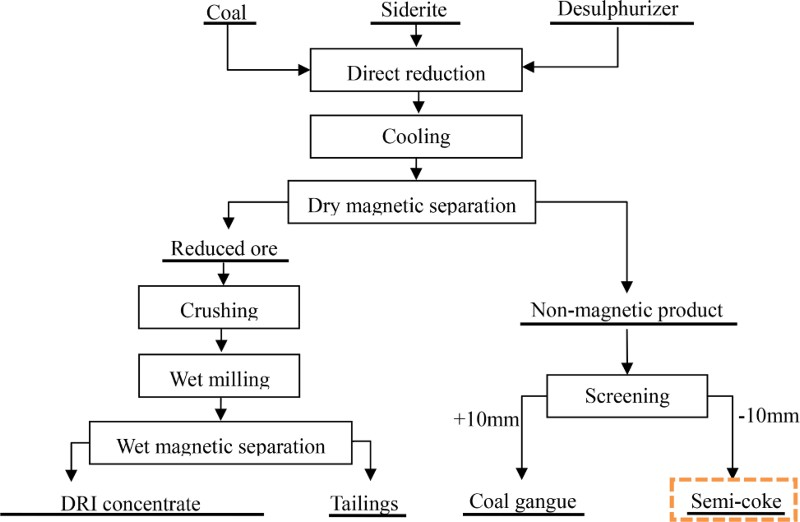
The optimised conditions of the process were obtained as follows: reducing the siderite lump of 5–25 mm at 1050°C for 120 minutes, with 2.50 C/Fe mass ratio and 6% desulfuriser, then dry magnetic separating at 0.15 T magnetic field intensity, and followed by two stages of wet separating, the first stage separating at 0.08 T magnetic field intensity after wet grinding the reduced siderite sample with up to 50% passing 0.074 mm, and the second one separating at 0.043 T with up to 90% passing 0.074 mm. The final DRI concentrate assaying 91.04% Fe was obtained at a total iron recovery of 81.33%, whilst the semi-coke with 76.11% fixed carbon content was coproduced. Once 1 kg DRI powder was produced, 1.34 kg semi-coke with high carbon was generated at the same time.
Raw materials of iron ore sintering
Chemical compositions and proportion of sinter raw materials
Note: The ratio is calculated on the conditions of fuel being 4.3%.
Proximate analysis of coke breeze and semi-coke
Note: Q gr,v,d – Gross calorific value in isovolumetric dried basis
Chemical compositions of semi-coke and coke breeze ash (mass %)
Size distributions of semi-coke and coke breeze using in the sintering (mass %)
Procedure of laboratory sintering test
A small-scale sinter pot with the size of Φ100 × 500 mm was employed in the laboratory tests. The procedure involved ore proportioning, blending, granulation, loading hearth layer onto grate, charging of granulated mixture into pot, ignition, sintering, cooling and sinter plug treatment. The specific operation parameters were listed as follows: granulating for 5 minutes in a drum of Φ600 × 300 mm, igniting at 1150 ± 50°C for 1.5 minutes, the negative pressure of ignition and cooling process was 5 kPa, and that of sintering process was 10 kPa. Before unloading, 5 minutes for cooling was needed. In the sintering process, a flue gas analyzer (KM9106, UK) was used to continually detect the contents of CO, CO2, O2, NO x and SO x in exhaust gas. After sintering, the fired sinter cake was removed from the pot, cooled and weighed. Then the dropping test (2 m × 3times), screening and tumble index (TI) were carried out to value the yield and quality of sinter, including the sintering productivity, sinter yield, tumble strength and solid fuel consumption. A 1500 g sinter product of 10–12.5 mm was used to determine the metallurgical performance, including reduction index (RI) and reduction degradation index (RDI) measured by GB13241-91 and GB13242-91, respectively. A sample of 500 g taken from sinter product was pulverised for chemical analysis.
The addition of semi-coke substitution was based on the heat equivalent basis.
Results and discussion
Effect of semi-coke substitution for coke breeze on granulation
It is commonly acknowledged that the permeability and granule strength of sinter mix have important impacts on the sintering process. The higher drop strength means the less fractures of green granulates occur during transportation, and the better the permeability of sinter bed. The permeability of sinter bed depends not only on the size distributions of granules but also the granule strength against pressure and impact stress during transporting and loading.
As can be seen from Fig. 2, the granulation performance is slightly improved with an increase of semi-coke ratio within 40%, and the permeability drops dramatically while the ratio is beyond 40%. The fundamental physical properties of the semi-coke.
14
and coke breeze (Table 5) indicate that the semi-coke has flourishing porous structure and superior water adsorptive capability compared to coke breeze. The loose well-developed porous structure of semi-coke may lead to the poorer strength of the green granules. In addition, in the course of granulation, a certain amount of moisture must be present on the surface of the particles to function as a bridge. When a certain amount of moisture has been added to ore particles, the moisture on the surface of the ore is thought to be affected by the moisture-absorbing capability of the ore. Since the semi-coke possesses well-developed pores, most of the added water is absorbed into the pores, reducing the quantity of water needed to act as a bridge. This is considered to adversely affect granulation.
15
Therefore, higher moisture should be used for granulation of sinter mixture containing semi-coke. Effect of semi-coke substitution on granulation and permeability of sinter mix (7.5% moisture, granulating for 5 min)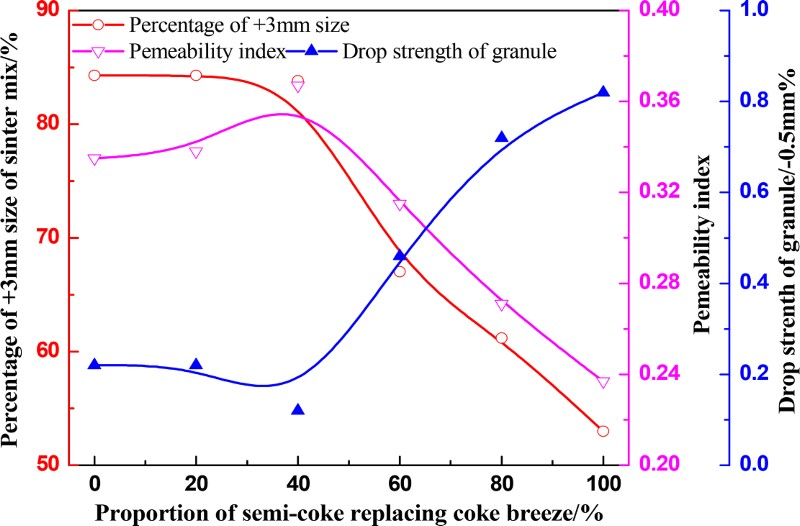
Physical properties of semi-coke and coke breeze
Effect of semi-coke substitution for coke breeze on sintering process
Figure 3 illustrates the changes of sintering performances when using various ratio of semi-coke to replace coke breeze. It can be seen that the flame speed increases with an increase ratio of semi-coke, and reaches to the peak value of 28.74 mm min−1 at 60% of semi-coke in the solid fuels (i.e. 2.58% semi-coke in the sinter mixture), then declines when ratio of semi-coke is over 60%. Owing to the higher reactivity of semi-coke compared to coke breeze, the use of semi-coke as solid fuel may reduce the sintering time, causing mismatching of flame front speed and heat front speed probably. It can be found that the sinter yield gradually drops as semi-coke ratio increases, and the return fine balance cannot be achieved when the semi-coke ratio is over 40%. In addition, the fuel consumption increases obviously with more semi-coke used as alternative fuel. Accordingly, from the results of sintering performances, maximum proportion of semi-coke in the fuel was proposed at 40% for iron ore sintering. Effects of semi-coke to replace coke breeze on sintering indexes (7.5% moisture for 0% and 20% ratio, 8.0% moisture for 40% and 60% ratio, 8.5% moisture for 80% and 100% ratio, granulating for 5 min, 4.3% solid fuel)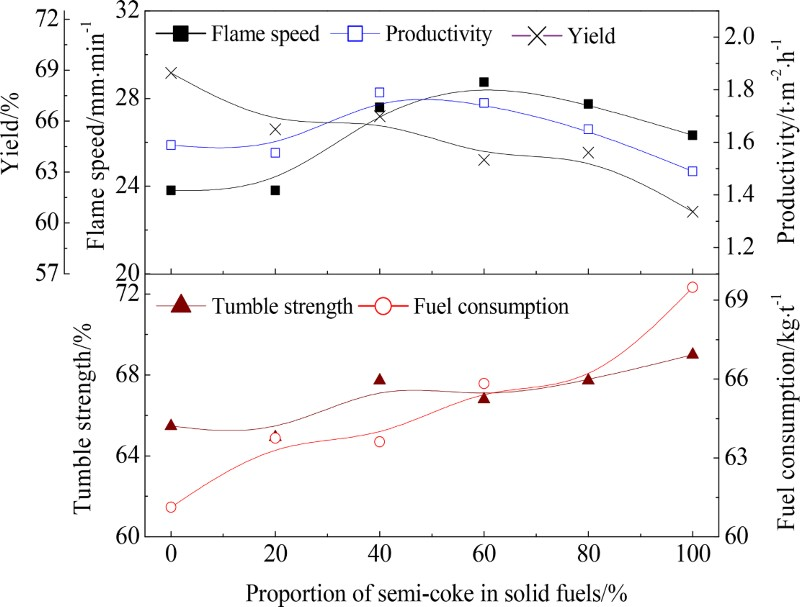
In order to reveal the different sintering performances when using semi-coke to replace coke breeze, the combustion efficiency of solid fuels was investigated (equation (1)).
The evolution of CO, CO2 and O2 in flue gas of the sintering pot is delineated in Fig. 4. Normally, flue gas compositions from the sinter bed are about 8–15%O2, 2–16%CO2 and 1–3%CO.
16
As seen in Fig. 4, both the CO and CO2 concentrations in flue gas elevated with the increasing substitution of semi-coke for coke breeze, however the concentration of O2 in flue gas decreased. It means more oxygen was consumed during combustion at higher semi-coke substitutions, resulting in lower O2 concentration in flue gas. Effect of semi-coke substitution for coke breeze on O2, CO2 and CO concentration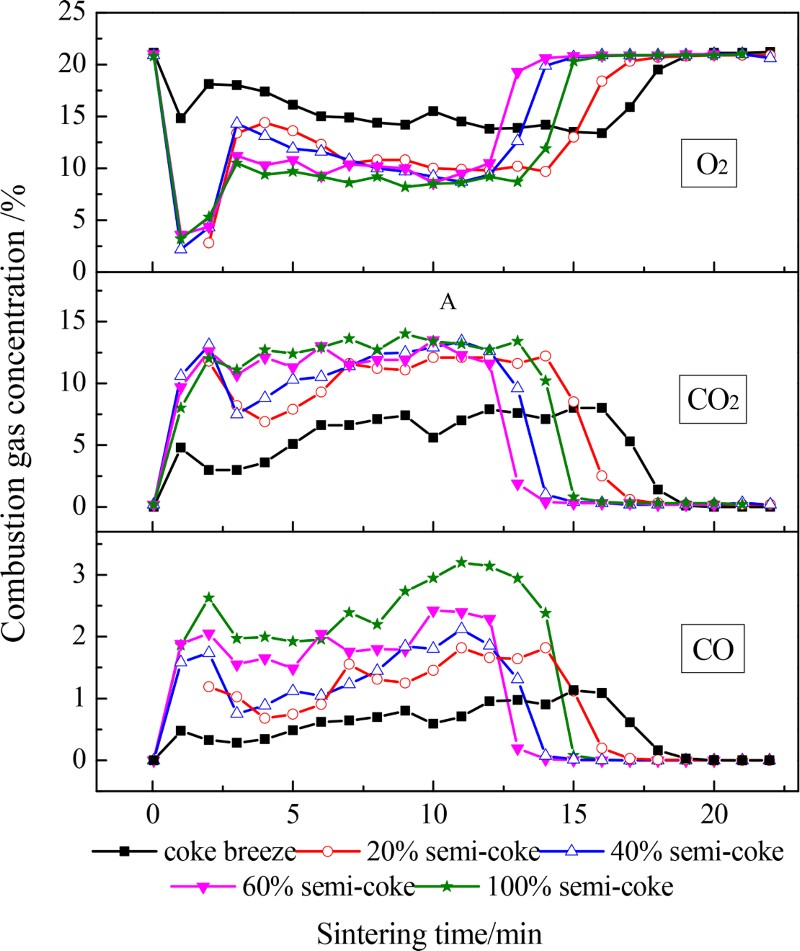
It can be clearly compared that the carbon combustion efficiency of sintering drops from 0.91 to 0.85 with the proportion of semi-coke in the solid fuels increasing from 0 to 100% (Fig. 5). The ratio of CO2/(CO + CO2) is regarded to evaluate the utilisation degree of carbon energy in the sintering. The decrease of combustion efficiency means the probability of incomplete combustion reaction increase and the sintering system are more prone to reduction atmosphere. The use of semi-coke causes the heat utilisation efficiency decrease. Effect of semi-coke substitution for coke breeze on carbon combustion efficiency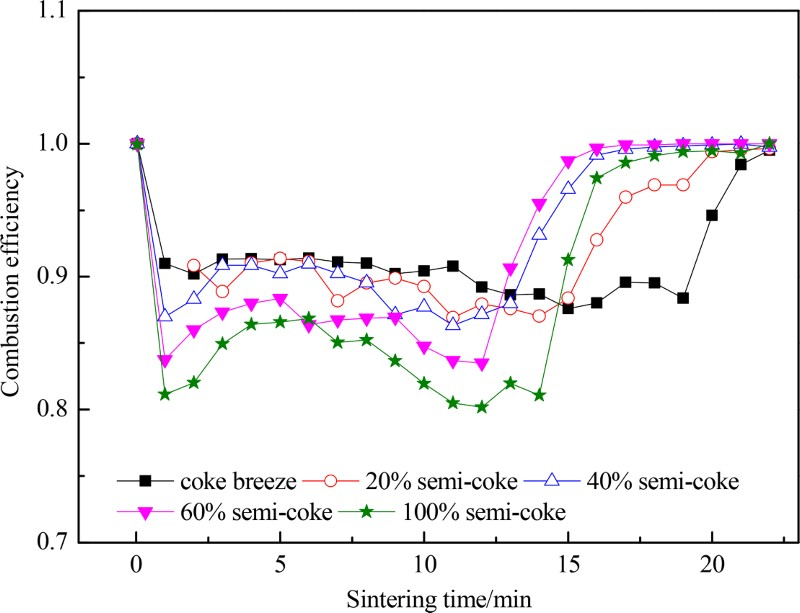
In order to clarify the effect, the combustion and gasification characteristics of fuels were studied by non-isothermal TG analysis in the air and CO2 atmosphere, respectively. Based on the data of TG and DTG curves of samples, we can get starting temperature T
s, ignition temperature T
i, burnout temperature T
e, maximum combustion rate V
max and comprehensive combustion characteristic index P. Index P value reflects combustion reactivity of the whole combustion process and the fuel with higher value of P has better combustion performance.
17
Index P is determined by equation (2):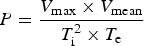
Combustion and reactivity properties of semi-coke and coke breeze
From the perspective of sintering performances, only 40% of coke breeze can be substituted by semi-coke in the iron ore sintering process. Since the semi-coke possesses superior combustion properties, the asynchronisation between flame front speed and heat front speed may occur, leading to reduction of heat utilisation and deterioration of sinter indexes.
Adjusting size distribution of semi-coke
Size distributions of semi-coke and coke breeze (mass %)
It is exhibited in Fig. 6 that the productivity and yield gradually increase and reach to the peak value of 1.74 t m−2 h−1 and 68.43%, respectively, at 60% of −3 mm size fraction, then decline with fuel particle size further coarsening. In addition, the solid fuel consumption reaches minimum at 60% of −3 mm size fraction and the tumble strength remains unaffected. On the whole, the sintering performance was optimal when the percentage of −3 mm size of semi-coke occupies 60%. Effect of semi-coke size distribution on sintering performances (8.5% moisture, 100% semi-coke substitution, granulating for 5 min, 4.3% solid fuel)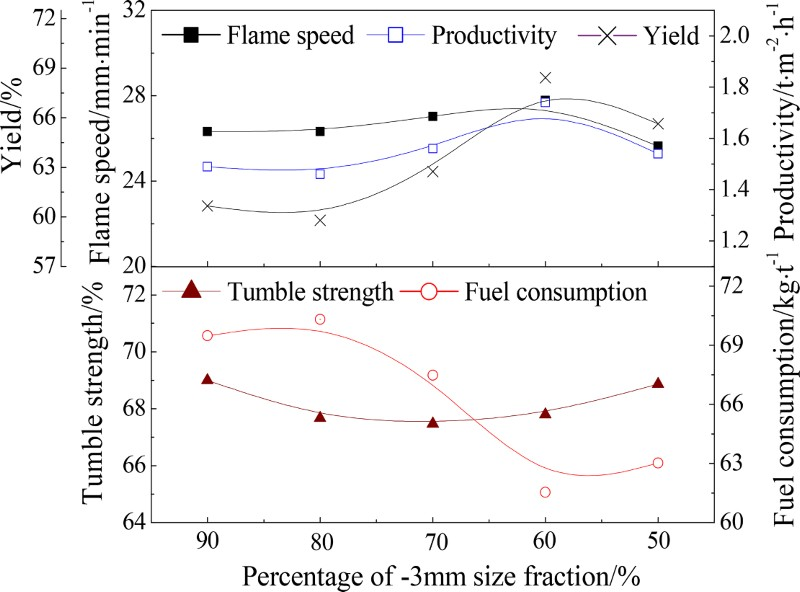
Effect of semi-coke size on average combustion efficiency
Comparison results of different solid fuels on sintering performances
Effect of semi-coke substitution for coke breeze on the metallurgical performance of sinter product
Chemical compositions of sinter between using coke breeze and semi-coke as fuel (mass %)
Metallurgical performance of sinter between using coke breeze and semi-coke as fuel
Effect of substitution of semi-coke for coke breeze on SO x and NO x emissions
SO
x
and NO
x
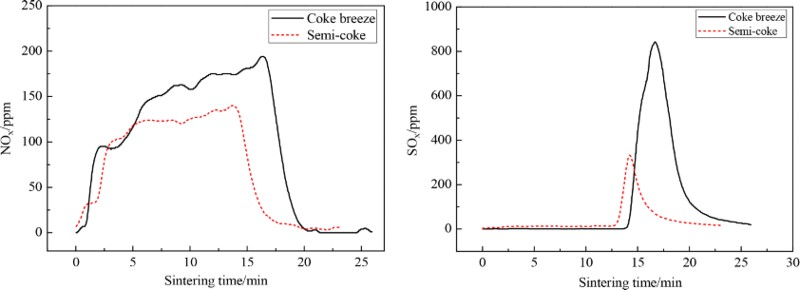
emissions in the waste gas were analysed continually during the sintering process and the emission profiles are shown in Fig. 7. Obviously, the emission mechanisms of SO
x
and NO
x
during sintering are quite different. NO
x
was observed over the whole sintering process, however the SO2 emission was observed only towards the completion of the sintering process. The volume concentrations of SO
x
and NO
x
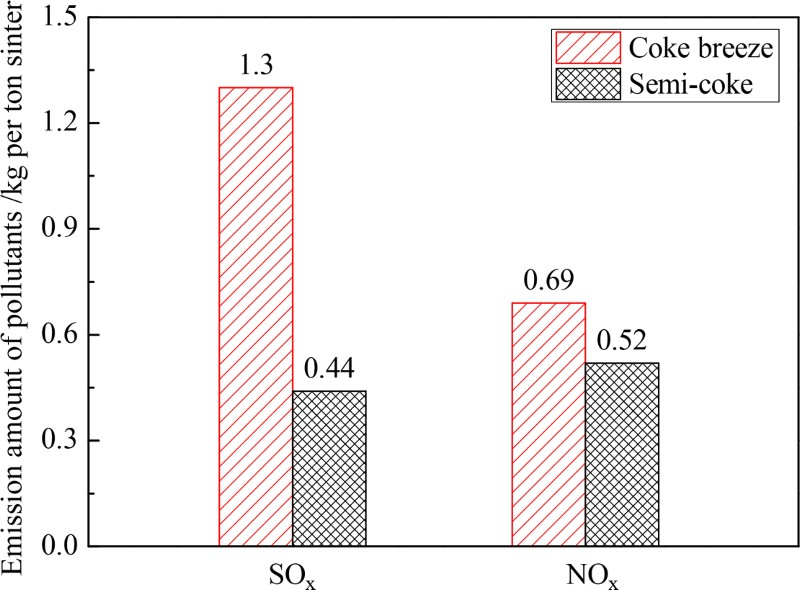
using semi-coke are obviously lower than that of using coke breeze. Based on equation (3), the mass of pollutant per unit mass sinter can be calculated, and plotted in Fig. 8. It can be clearly observed that the total emissions of SO
x
and NO
x
during sintering using semi-coke were 0.44 and 0.52 kg ton−1 sinter, respectively, reduced by 66 and 25% compared with that using coke breeze, reflecting the lower sulphur and nitrogen content of semi-coke as a relatively cleaner energy. Therefore, the use of semi-coke as solid fuel for iron ore sintering could reduce the SO
x
and NO
x
emissions in the exhaust gas to some degree. NO
x
and SO
x
emission profiles in the waste gas between using coke breeze and semi-coke as solid fuel for iron ore sintering Emission amount of pollutants in the sintering between using coke breeze and semi-coke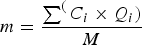
Conclusions
An investigation was conducted on the application of semi-coke derived from the coal-based direct reduction as an alternative fuel in the iron ore sintering process. It can be concluded: The characterisation analysis reveals that semi-coke possesses similar gross calorific value with coke breeze and higher basicity in coal ash. Semi-coke features well-developed porous structure and superior reaction activity that inevitably affects the sintering process; sinter pot experiments indicate the proper substitution of semi-coke for coke breeze is proposed less than 40% on condition that −3 mm size occupies about 90%. When replacement ratio exceeds 40%, the carbon combustion efficiency declines leading to the degradation of sintering performance; as the ratio of −3 mm size particles of semi-coke decreases to 60%, the fuel combustion efficiency increases and semi-coke could totally replace coke breeze without significantly affecting sintering and metallurgical performances; the use of semi-coke in the sintering could decrease SO
x
and NO
x
pollutants by 66 and 25%, respectively, in waste gas compared with coke breeze as solid fuel.
Footnotes
Acknowledgments
The authors are grateful for the financial support provided by the National Natural Science Foundation of China (No. 51574281) and Co-Innovation Center for Clean and Efficient Utilization of Strategic Metal Mineral Resources of China.